In the corridors of the hotel, I met him walking around with a little lock-eating animal.
He would put the little animal on his elbow, and then the animal was happy and would eat the lock.
Then he would walk further down the hall, and the animal was happy and another lock would be eaten. And so on for several, and so on for many. The man was walking around like someone whose home had expanded. As soon as he opened a door, a new life would begin for him.
But the little animal was so hungry for locks that its master soon had to go out again and look for other break-ins, so that he got very little rest.
I did not want to ally myself with this man. I told him that what I liked best in life was going out. He looked blank. We weren’t on the same side, that’s all, or else I would have allied myself with him; I liked him but he did not suit me.
When you come home on your wedding day, if you stick your wife in a well to soak all night she is flabbergasted. Even if she had always been vaguely worried about it . . .
“Well, well,” she says to herself, “so that’s what marriage is like. No wonder they kept it all so secret. I’ve been taken in by the whole business.”
But since her feelings are hurt, she doesn’t say a thing. That’s why you can plunge her into it for a long time, over and over, without making any trouble in the neighborhood.
If she didn’t understand the first time, it’s not very likely that she’ll catch on after that, and you have a good chance of being able to continue with no problems at all (except for bronchitis) if you really want to.
As for me, since I suffer even more in other people’s bodies than in my own, I had to give it up right away.
I get hold of a field marshal and grind him up so fine that he loses half his senses, he loses his nose that he thought really had flair and even his hand that he can’t raise to his cap any more even if a whole army saluted him.
Yes, through a series of grindings, I reduce him, I reduce him—a sausage unable to do anything from now on.
And I don’t limit myself to field marshals. In my cellar I have lots of sausages that were once important people supposedly out of my reach.
But my infallible instinct for jubilation triumphed over these obstacles.
If they act up after that, it’s really no fault of mine. They could not have been mixed and ground any more than they were. I’ve been told that some of them are still moving about. It’s printed in the papers. Is this real? How could it be? They’re rolled up. The rest is the tail end of a phenomenon, the kind that one might encounter in nature, a sort of mystery comparable to reflections and exhalations whose importance should not be exaggerated. No, absolutely not.
The Darelette is found in dry and sandy terrain. It is not a plant but an agile beast, corseted and boned unlike any insect, fat as a rat and long as one, if the tail is included.
If a man jumps on her last segment (there are three), it may well break if the animal has not arrived at adult age.
Since the inside, under walls as thick as a little finger, does not contain any essential organs, the wounded beast continues her walk with her abdomen pounded to jelly and her walls breached. She is a beast who fears no one, eats snakes, and goes to suck the udders of cows which do not dare move.
The ditch spider makes war on her successfully; it winds around her, overwhelms her with threads; as soon as she is paralyzed, it pumps her out completely through the ears.
Her rosy ears and her eyes and her internal organs are the only tender parts of her body.
For twenty years now Berryman’s lineI conclude now I have no inner resources has been plinking around the inside of my dumb skull. The line is plinking like crazy lately, as I shuffle final exam essays into some kind of order (what order?) that might align with my ability to offer the student, the writer, some meaningful note, some suggestion for improvement, some revelatory remark. Plink plink plink. No inner resources.
It is bad to start with a complaint so I will dress up the preceding paragraph (I dress it mentally) as an apologia. (Why the hell did I decide to write about books online?!).
I’ve been reading some really great books lately, folks. People, yes, you, listen. It’s not true that I have no inner resources. I am unstuck as a reader. I’m all gummed up with what I’ve read. Well-fed. And yet I go to scribble out a, like, review and plink plink plink. Nothing.
But like I said, the reading’s been really good. From the bottom up:
Let me strongly recommend American Candide by Mahendra Singh. I recommend this book for people who enjoy laughing at tragedies that should otherwise make them weep. You can and should purchase this book from Rosarium.
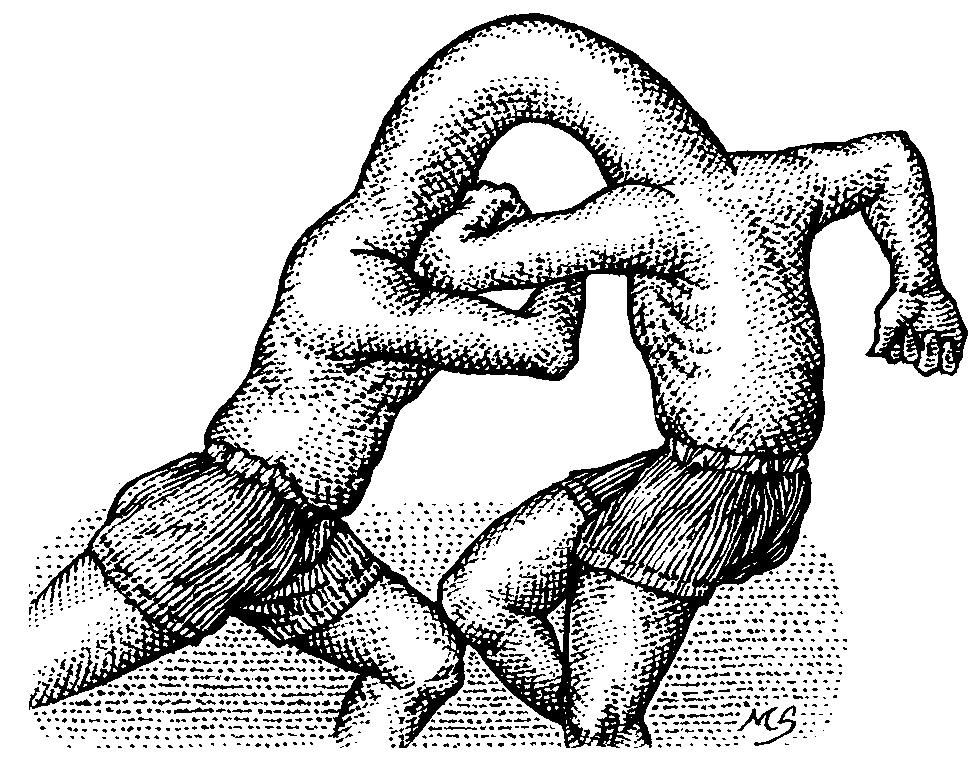
Illustration to American Candide by Mahendra Singh
Above American Candide in the stack so lazily pictured above is Yuri Herrera’s neon noir novella The Transmigration of Bodies, which I also highly recommend. I managed a few words on it here.
If you were to describe Henri Michaux’s Miserable Miracle 1956 book to me, I might politely decline with a small gesture of my hand. It’s about a guy who takes mescaline and writes about the experience and he draws these pictures and then he later takes “Indian hemp” and compares it— you might say to me, you, knowing as you know that I dig weird books, but I would cut you off at with an em dash, polite but firm, Not interested in drug novels these days (and besides dude, you know that Aldous Huxley did kinda the same thing at kinda the same time). And then you, having the book with you might press it into my hand, declaring, No, look—
—and I would say Thanks and consume the book in two sittings.
And so after a few years of false starts, I finally broke through the second chapter of Stanley Elkin’s satire The Franchiser. The many years of recommendations, exhortations (and scoldings) to read The fucking Franchiser were correct and good and now appreciated, as I work my way into the novel’s rich fat middle—but I admit it was Mr. William Gass who finally sold me on a commitment. I read his introduction published elsewhere—in A Temple of Texts—and that was that.
Thanks to Jon for sending me Ursula K. Le Guin’s essay collection The Language of the Night. The collection collects the collective introductions to Le Guin’s so-called Hainish collection, which I read this winter, and wrote about here. Not one of my editions featured the reflections Le Guin (or more likely her editors) called “Introductions” in later essays, and reading the Hainish intros is, in a very slight sense, like rereading those books. Lovely.
Last and never least: Tom Clark’s The Last Gas Station and Other Stories. I’ve thought often of Clark’s poems as stories pretending to be poems so maybe these are poems pretending to be stories. Or maybe I have no idea what the fuck I’m talking about. (Plink plink plink). I read most of them except for the longest one, “Incident at Basecamp,” which I will save save save for the future, an old habit, maybe a bad habit, that, to read all but one story in a collection, to maybe keep the collection afresh somehow or not wholly discovered—eh? Plink plink plink. Wag.
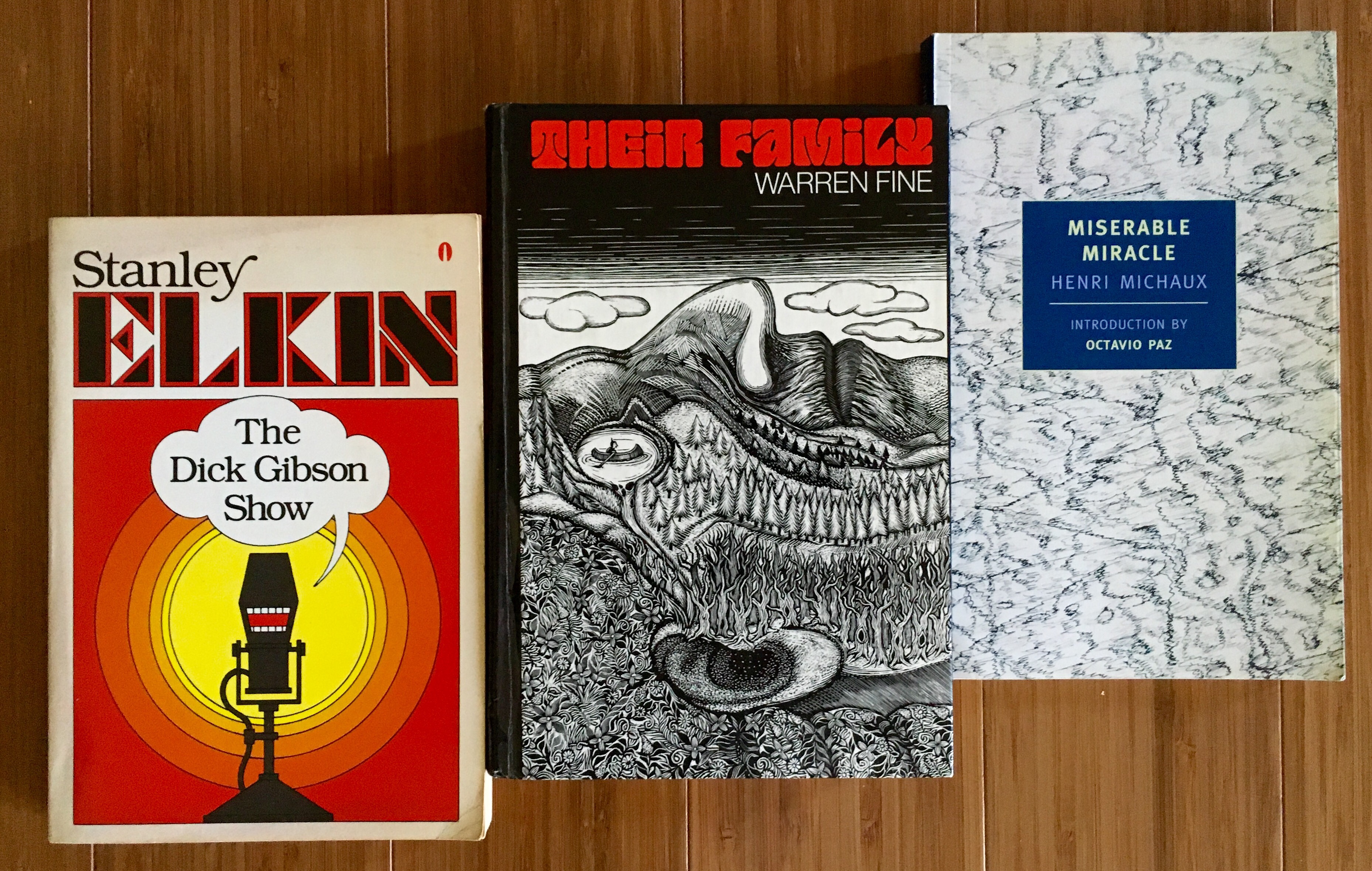
I swung by my favorite used bookstore this afternoon; it’s right near the grocery store and I needed to pick up some mint and some ricotta. I was hoping to pick up Elena Ferrante’s novel My Brilliant Friend at the bookstore. I started the audiobook of My Brilliant Friend today, after finishing the audiobook of Adrian Jones Pearson’s novel Cow Country this weekend. (Full review of Cow Country forthcoming but a real quick review: great performance/reading of a very strange book which I enjoyed very much, but which I also suspect will have very limited appeal. Cow cult classic to come). But so anyway, I’m really digging the Ferrante, and decided I wanted to obtain a physical copy to reread passages (and maybe share some on this blog). My store had several copies of four of Ferrante’s novels–but no Friend. While scanning the F section, my eye alighted (alit?) on a strange-looking hardback spine—Warren Fine’s Their Family. I turned it around and the cover…well, I knew I was gonna leave with it. Knopf, 1972—a few years before Gordon Lish was to become editor there, sure, but interesting bona fides I suppose. Fine does not seem to be beloved by anyone on the internet, and his books seem to have failed to go into second printings of any kind. The Fs are near the Es, and I glanced over the works of Mr. Stanley Elkin, who has his own section there, somehow. I finally broke through the second chapter of his novel The Franchiser this weekend (it’s all unattributed dialog, that chapter, sorta like Gaddis’s JR); I’m really digging The Franchiser now that I’ve tuned into the voice. (It also helps to not try reading it exclusively at night after too many bourbons or wines). Again, the spine of the novel looked interesting so I flipped The Dick Gibson Show around and, again, I knew I was gonna leave with it. Henri Michaux’s Miserable MiracleI found in the “Drugs” section—which I was not perusing (because I am no longer 19)—well I guess I was perusing it, but that’s only because it happens to be right next to this particular bookshop’s collection of Black Sparrow Press titles, which I always scan over. Anyway, the Michaux’s Miserable Miracle was turned face out; NYRB titles always deserve a quick scan, and the cover reminded me of a Cy Twombly painting. Flicking through it revealed a strange structure, full of marginal side notes and doodles and diagrams and drawings. And oh, it’s about a mescaline trip, I think. You can actually read it here, but this version is missing all the drawings and sidenotes.
Oh, and so then I forgot to go pick up the ricotta and the mint.



 Biblioklept