David Lynch Interview (The Guardian Lectures, 1985)

Iceberg Slim Talks About His Novel Trick Baby

William Gass: “Ways of Reading Are Adversaries”

William Gass, in his 1977 Paris Review interview

INTERVIEWER

Is the reader an adversary for you?

GASS

No. I don’t think much about the reader. Ways of reading are adversaries—those theoretical ways. As far as writing something is concerned, the reader really doesn’t exist. The writer’s business is somehow to create in the work something which will stand on its own and make its own demands; and if the writer is good, he discovers what those demands are, and he meets them, and creates this thing which readers can then do what they like with. Gertrude Stein said, “I write for myself and strangers,” and then eventually she said that she wrote only for herself. I think she should have taken one further step. You don’t write for anybody. People who send you bills do that. People who want to sell you things so they can send you bills do that. People who want to tell you things so they can sell you things so they can send you bills do that. You are advancing an art—the art. That is what you are trying to do.

Hunter S. Thompson Interviews Keith Richards (Video, 1993)

Brian Wilson Goes on The Rock & Roll Chef; Discusses Surfer Chicken, His Deafness, and His Love of Thai Food; Raps a Little (1990 Interview)

William Gass on Gaddis, Calvino, Bernhard and More

In his Paris Review interview from 1977, William Gass riffs on the writers he admires:

INTERVIEWER

Who are some living novelists you respect?

GASS

Well, the question leaves out so many dead ones who are more alive. I think Barth is one of the great writers. I have admired his work since I first encountered it. I think he is incredible. Several of his books, in particular The Sot-Weed Factor, are the works which stand to my generation as Ulysses did to its. His habits of work are wholly unlike mine, and the kind of thing which engages him is quite different too. He is a great narrator, one of the best who ever plied the pen, as they used to say. He has been accused of being cold, purely mental, but I find him full of passion and excitement. And what I like about his work in great part is the unifying squeeze which that great intellectual grasp of his gives to his work, and the combination of enormous knowledge with fine feeling and artistic pride and energy and total control. I really admire a master. He’s one.

A lot of the work of Hawkes is extraordinary, breathtaking. Everybody likes Beckett. Now. It’s silly to mention Bellow, Borges, Nabokov—so obvious. And of course Stanley Elkin’s work I like enormously. Some of Coover’s, too, I find extraordinarily interesting. Control again. Gaddis. Control. Also Barthelme—a poet. A great many South American writers write rings around us. Infante’s Three Trapped Tigers is a great book. I taught Hopscotch once. I’ll never get over it. Márquez, Fuentes, Lima, Llosa . . . it is always an exciting time to be a reader. Lots of European writers are overblown, especially some of the French experimentalists, but Italo Calvino is wonderful. Thomas Bernhard’s The Lime Works is impressive. In general, I would think that at present prose writers are much in advance of the poets. In the old days, I read more poetry than prose, but now it is in prose where you find things being put together well, where there is great ambition, and equal talent. Poets have gotten so careless, it is a disgrace. You can’t pick up a page. All the words slide off.

Steve Kemper Talks to Biblioklept About A Labyrinth of Kingdoms, His New Book About Explorer Heinrich Barth

Steve Kemper’s latest book A Labyrinth of Kingdoms tells the story of Heinrich Barth, a German scientist who led a British-backed expedition into the central Sudan. While Barth’s name is not nearly as well-known as Livingstone or Stanley, Kemper makes a solid argument for a reappraisal of Barth’s neglected work. Barth explored Bornu and Sokoto, learned the ways of the nomadic Tuareg people, traveled to Timbuktu, and filled in many of the missing gaps that had been previously left to the guesswork of European geographers. Perhaps most importantly, Barth made numerous cultural connections in his time in Africa.

Barth’s story comes alive in Kemper’s capable hands; A Labyrinth of Kingdoms is erudite but never stuffy—at its core, the book is an excellent adventure story. Kemper’s first book, Code Name Ginger, traced the arc of invention and commerce by telling the story of the creation of the Segway transport. His work has also appeared journals like Smithsonian and National Geographic. To find out more about A Labyrinth of Kingdoms, check out Kemper’s blog .

Kemper was kind enough to talk to me about his book and Barth’s life in a series of emails.

A Labyrinth of Kingdoms is new in hardback from W.W. Norton on June 25th, 2012.

Biblioklept: What drew you to the story of Heinrich Barth? What made you want to write A Labyrinth of Kingdoms?

Steve Kemper: I got interested in Barth when I read a couple of paragraphs about him in Ryszard Kapuścińksi’s The Shadow of the Sun, a book of dispatches about Africa. In Timbuktu, Kapuścińksi notices a plaque on a house where Barth spent many months in 1853-1854, and he calls the explorer “one of the greatest travelers in the world” for his five years exploring the Sahara. He says that Barth survived death many times, including once by drinking his own blood. Kapuścińksi added that despite Barth’s accomplishments, he died young, unappreciated and almost forgotten. All of that sounded like the bones of a great story.

Biblioklept: Obviously, Barth’s tale is a great adventure story—but what are his greatest accomplishments?

SK: One of the reasons Barth isn’t better known is that he didn’t return with a headline accomplishment—the source of the Nile, a traverse of the continent, the location of a lost explorer. He did “discover” the Benue River and showed that it flowed into the Niger (that river’s major tributary) rather than into Lake Chad, and he settled the exact location of Timbuktu. But the reason that his work remains important to scholars is that he came back with reams of invaluable information and data about geography, anthropology, ethnography, and languages. He traveled across an immense territory and spent time with the major peoples of north-central Africa—Hausas, Kanuris, Tuaregs, Arabs, Songhais, Fulanis. The material he collected is still relevant. That can’t be said of most of Barth’s more famous peers. But then as now, headlines are more likely than scholarship to capture the public’s attention.

Biblioklept: North Africa, and the Islamic world in-general have captured more of the Western public’s attention in recent years though—what can we learn from Barth’s travels and experiences?

SK: Many things. First, that the region and the religion are not monolithic. Barth’s work (and my book) are full of a tremendous variety of peoples and cultures. Most Westerners—and I include myself in this, prior to writing this book—have a vague, fuzzy, and simplified image of the region that distorts everything about it—its many cultures, its complicated history, its complexity. Barth returned convinced that Islam was a great religion—not a popular view, then as now—but added that in some places it had been hijacked by thugs who used it as an excuse to pillage non-Muslims, or by fanatics, who used it as an excuse to kill or enslave non-Muslims. This still sounds familiar. But he also added that Islam wasn’t much different in this way from Christianity, another great religion sometimes hijacked by the greedy or the self-righteous. Barth met Muslim scholars and Muslim thieves, and tried to be clear about both. I could keep typing on this subject for a while but I don’t want the answer to get too long. I plan to write a couple of op-eds on the subject in time for the book’s pub date.

Biblioklept: In A Labyrinth of Kingdoms, you point out that Barth’s open-minded ideas were not well-received by his contemporaries, in part because these ideas conflicted with the emerging age of imperialist Europe. Is this also one of the reasons he hasn’t been canonized like other explorers?

SK: The short answer is yes, I believe so, though there are not straight lines connecting the two. But it seems clear that Barth’s ideas at least contributed to the reception of his work, along with Britain’s changing commercial and political goals, the interests of the public, and Barth’s own difficult personality.

Biblioklept: In what ways was Barth a difficult personality?

SK: During his journey and afterwards in England, Barth occasionally felt that he was being slighted by the British government or that his honor was being questioned (especially by one tormentor at the Royal Geographical Society). He was often right, but he reacted to these things with the touchiness of an anemone. An anemone’s touchiness is pretty to see; Barth’s was blunt and haughty and could even verge into petulance. His own strict sense of honor and proper conduct left him appalled at some of the machinations against him in England (and also in Germany). Barth’s brother-in-law and close friend wrote about him, “Heinrich is always too gruff and unyielding, and yet too modest and too imprudent. His pride doesn’t permit him to give in at the right moments. In the river of life he is a bold and persevering swimmer, but not a very agile one.”

Some of Barth’s difficulties stemmed from the fact that he was German, and the British liked their heroes home-grown. Some people in England couldn’t gracefully accept that the success of a British expedition had depended almost solely on a foreigner. (The British government funded the expedition, which began with an English leader. Barth was contracted as an independent scientist.)

Another part of Barth’s difficult personality stemmed from his sense of high calling. He truly did devote his life to science and the pursuit of truth, and he could be harsh when lesser mortals fell short of his standards.

It interests me that when he was in Africa, Barth showed far more patience and diplomacy than he did when back in Europe. In Africa, patience and diplomacy were often necessary to accomplish what he wanted and even to survive, but in Europe I think he expected better conduct and sometimes reacted poorly when he was disappointed.

Biblioklept: Barth’s story is one of culture and discovery, but it’s also an adventure story—can you share a favorite anecdote about Barth the adventurer?

SK: Tough question, since there are so many good ones, including death threats and narrow escapes. But I prefer the ones that reveal something about Barth. So: early in the journey, when he still considered himself nearly indestructible, he foolishly set off on foot one morning, with little water and no food, to climb a distant mountain. He soon ran out of water, got lost, and began to die of dehydration. Eventually he cut his arm and drank his own blood, which didn’t help. The following morning, at the caravan, the Tuareg guides told the expedition’s leader that no man could have survived the long Saharan day and night without water, but they agreed to search for him. Late that afternoon they found him, nearly comatose. The Tuaregs were amazed at his survival. They were also amazed the next day when, even though he couldn’t eat or speak, he rode seven hours with the caravan. This close call was a tough lesson, but Barth took it to heart and learned from it.

Another favorite, because it epitomizes how understated Barth always is about his adventures, occurred when he entered Kabara, a village on the Niger River not far from Timbuktu. Barth took up lodgings and was eating supper when a Tuareg warrior entered, glaring, and attempted to intimidate Barth into giving him a fine gift. Barth said he was eating and to go away. The Tuareg replied that he was a very dangerous man who was about to do something terrible. Barth writes, “After a very spirited altercation, I got rid of him.” I love the dry modesty of that. Imagine how Burton or Stanley would have handled it. After Barth expelled the warrior, 200 other men came in and silently eyed the stranger. Barth responded by staring back while lying across his smaller bags and protecting the bigger ones behind him. Very cool. Very Barth.

Biblioklept: I ran a blurb of your book the other day and a reader asked if the theologian Karl Barth might be a descendant of Heinrich’s. Any clue?

SK: I wondered the same thing, but haven’t come across anything that suggests they were related.

Biblioklept: You provide a fairly extensive set of end notes as well as a large bibliography for Labyrinth–clearly a lot of reading and research went into the book. Can you describe how you synthesized the information? What were some of your most important sources?

The principal source, of course, was Barth’s colossal book, Travels and Discoveries in North and Central Africa, which was originally published in five volumes and covered nearly 3500 pages. Other crucial primary sources were the extensive Foreign Office files in the British National Archives, which include dispatches from consuls, receipts, letters, and all the thorough bureaucratic documentation of the Victorian age. Barth’s brother-in-law and close friend, Gustav von Schubert, wrote a biography that I had translated; it provided many private glimpses of Barth.

The scholarship, of course, was invaluable, and I immersed myself in it to understand the era. Remember, I’ve spent the last 30 years as a journalist, writing about living people. I knew how to write narrative, but I had to learn how to do that with history. My goal with the book was to write an exciting, informative narrative that put readers inside the expedition with Barth, so all the scholarship is all folded into the action. I don’t quote many scholars in the text proper, because I didn’t want to intrude on the readers’ experience of the expedition. That’s all writer’s talk about technique and is probably more than your readers want to know.

Biblioklept: Actually, our readers seem to enjoy insights about writing technique, so I’m sure they’ll be interested in this stuff. (I’m interested, anyway). How long did it take to research and write the book?

SK: It’s hard to say, because I was also working on smaller jobs while researching and writing the book. The research just for the proposal was time-consuming, starting with Barth’s 3500 pages. Because I’m not a scholar of 19th century Africa or Europe, the background research took many months. The writing, including interruptions from other jobs, took about 9 months—probably 7 months net.

Biblioklept: What’s your next big project?

SK: I’m working on another book for W. W. Norton about another undeservedly obscure adventurer whom I stumbled across in my reading. An American this time, who lived the sort of epic life that’s no longer possible, on frontiers in several countries. I think I’ll keep his name to myself for the time being.

Biblioklept: Have you ever stolen a book?

SK: Yes, once, while in college—a paperback of several Sean O’Casey plays. It was also a library book, which I later realized compounded the crime, since I deprived others who could have gotten pleasure from it. I’ve since donated hundreds of dollars’ worth of books to libraries. Maybe I’ve subconsciously been seeking atonement.

“Give me half a bottle. Justice reigns” — Charles Olson in The Paris Review

Charles Olson’s interview with The Paris Review is one of the best things I’ve read in ages. Here’s a nice big chunk from the beginning:

CHARLES OLSON

Get a free chair and sit down. Don’t worry about anything. Especially this. We’re living beings and forming a society; we’re creating a total, social future. Don’t worry about it. The kitchen’s reasonably orderly. I crawled out of bed as sick as I was and threw a rug out the window.

INTERVIEWER

Now the first question I wanted to ask you. What fills your day?

OLSON

Nothing. But nothing, literally, except my friends.

INTERVIEWER

These are very straight questions.

OLSON

Ah, that’s what interviews are made of.

INTERVIEWER

Why have you chosen poetry as a medium of artistic creation?

OLSON

I think I made a hell of a mistake. That’s the first confidence I have. The other is that—I didn’t really have anything else to do. I mean I didn’t even have enough imagination to think of something else. I was supposed to go to Holy Cross because I wanted to play baseball. I did, too. That’s the only reason I wanted to go to Holy Cross. It had nothing to do with being a priest.

INTERVIEWER

Are you able to write poetry while remaining in the usual conditions of life—without renouncing or giving up anything?

OLSON

That’s the trouble. That’s what I’ve done. What I’ve caused and lost. That describes it perfectly. I’ve absolutely.

INTERVIEWER

Are the conditions of life at the beginning of a work . . .

OLSON

I’m afraid as well at the end. It’s like being sunk in a cockpit. I read the most beautiful story about how Will Rogers and Wiley Post were lost; they stomped onto a lake about ten miles from Anchorage, Alaska, to ask an Indian if Anchorage was in that direction and when they took off, they plunged back into the lake. The poor boy was not near enough to rescue them, so he ran ten miles to Anchorage to get the people to come out. He said one of the men had a sort of a cloth on his eye and the guy then knew Post and Rogers were lost. Wiley Post put down on pontoons; so he must have come up off this freshwater lake and went poomp. Isn’t that one of those great national treasures. I’ll deal you cards, man. I’ll make you a tarot.

INTERVIEWER

Does poetry constitute the aim of your existence?

OLSON

Of course I don’t live for poetry; I live far more than anybody else does. And forever and why not. Because it is the only thing. But what do you do meanwhile? So what do you do with the rest of the time? That’s all. I said I promised to witness. But I mean I can’t always.

INTERVIEWER

Would you say that the more you understand what you are doing in your writing, the greater the results?

OLSON

Well, it’s just one of those things that you’re absolutely so bitterly uninterested in that you can’t even live. Somehow it is so interesting that you can’t imagine. It is nothing, but it breaks your heart. That’s all. It doesn’t mean a thing. Do you remember the eagle? Farmer Jones gets higher and higher and he is held in one of the eagle’s claws and he says you wouldn’t shit me would you? That’s one of the greatest moments in American poetry. In fact, it is the great moment in American poetry. What a blessing we got.

INTERVIEWER

Does Ezra Pound’s teaching bear any relevance to how your poems are formed on the page?

OLSON

My masters are pretty pertinent. Don’t cheat your own balloon. I mean—literally—like a trip around the moon—the Jules Verne—I read that trip . . . it is so completely applicable today. They don’t have any improvements yet.

INTERVIEWER

Do you write by hand or directly on the typewriter? Does either method indicate a specific way in which the poem falls on the page?

OLSON

Yeah. Robert Duncan is the first man to ask me the query. He discovered when he first came to see me that I wrote on the machine and never bothered to correct. There’s the stuff. Give me half a bottle. Justice reigns.

Kurt Vonnegut Interview (Video/1991)

Ray Bradbury Interview on the TV Show Day at Night

William Friedkin Interviews Fritz Lang

Matt Bell Chats with Biblioklept About Apocalypse, Hairy Infants, Cures for Writer’s Block, and His New Book Cataclysm Baby

When an advance copy of Matt Bell’s new novella-in-stories Cataclysm Baby showed up in the mail a few months ago, I was immediately intrigued. Post-apocalyptic fiction is right up my proverbial alley, and the book’s conceit—Bell’s site describes the book as “twenty-six post-apocalyptic parenting stories, all narrated by fathers, each revealing some different family, some new end of the world”—seemed refreshingly different than the “family issues” novels that publishers tend to send my way. I was not a jot disappointed in Cataclysm Baby either; in my review I write:

Bell’s apocalypse is discontinuous; each tale evokes its own paradigm, its own idiom of grief. He’s less interested in the invention and world-building that marks so much of sci-fi and fantasy than he is in tapping into the mythological undercurrents of end-of-the-world narratives. The short pieces in Cataclysm Baby unfold (or burst, or twist) like strange, dark fairy tales, each proposing another vision of collapse.

Matt was kind enough to talk to me over an exchange of emails. In the margins of our exchanges—those little quips that aren’t part of the interview proper—I found Matt to be a very nice, generous fellow. I enjoyed talking with him.

Matt teaches writing at the University of Michigan; he also works for Dzanc Books, where he runs the literary magazine The Collagist.

Cataclysm Baby, new from indie Mud Luscious Press, is Matt’s second book after the collection How They Were Found.

Cataclysm-Baby-Final-Cover-Front

Biblioklept: Cataclysm Baby is a highly structured work that follows a clear pattern. Where did Cataclysm Baby begin? At what point did you start using the alphabet as an organizing principle for apocalypse family fiction?

Matt Bell: The writing of Cataclysm Baby began with its first story, “Abelard, Abraham, Absalom,” although I didn’t have that title for it then: I was just starting off to write a standalone short about this father, who was describing the birth of his son in what turned out to be fairly grim circumstances, and I didn’t know anything more than that—as is often the case with me, I was probably more interested in the voice than in the content or the character, at least at the very beginning. At some point in that draft, I wrote an early version of these lines: “For our baby, a name chosen from a book of names. Each name exhausted one after another, a sequence failure.” It was that suggestion of the baby name book that offered up that narrative’s title, and then alphabetizing as an organizing principle for more stories. Before that, I hadn’t intended to write a series, or this novella that they became, but the book’s structure was held in those lines, and that structure ended up driving a lot of the rest of the book’s drafting, by giving a shape for the other narratives to attach to.

Biblioklept: “Abelard, Abraham, Absalom” contains a horrifying image—the baby is born with a “furred esophagus,” and the dad must pull a hairball from the baby’s mouth. The following stories build on this horror: mutant offspring, forced-breeding, still birth, monster birth . . . You say that your initial concern was more with voice than content or character—but did you have any of these images in mind at the outset?

MB: It’s always a little hard to remember exactly—I wrote the first drafts of Cataclysm Baby in mid-2009—but I think that I would probably say that I didn’t have the imagery of the “furred esophagus” and that hair-choked baby before I started, but I might have had some of the others before starting their sections. Some of the sections were suggested by the names I chose, which in certain cases came first: Including the name “Cain” in the title of the third story, for instance, suggested at least a fratricide, if not exactly what that killing might entail.

For the most part, I’m typically not much of a planner, at the plot or situation level: I don’t have particularly good ideas, and so if I start there, I tend to end up with stories that are all surface, or that at least capture only the most surface stuff of me. By starting at the level of the sentence or the sound or the image—and then by staying at that level as long as I can—I feel more likely to dredge a little deeper, to discover something a little stronger. It’s in subsequent drafts that I do a lot of the plot and character shaping, and even some of the conceptual thinking. I need a certain critical mass of workable language before I can do too much story-work with it.

Bibliokept: Your language—tone, syntax, diction, etc.—inheres across the collection and works to unify the themes and images in Cataclysm Baby. Still, there’s a sense of disconnection of time and place between these stories, as if each one is its own discrete apocalypse or dystopia, even as they blend together.

In a sense, you seem to be playing obliquely with the tropes of end-of-the-world fiction, but resisting the heavy exposition and tendency for world-building we see in so much sci-fi. I suppose I’m pointing toward what I see as restraint in CB, but might have actually been editing on your part—how much of CB came from pruning and paring down?

MB: Generally I’d say that it’s my process to overwrite and then to cut back to the best version of any given story. That said, Cataclysm Baby was never a dramatically longer book, either as a whole or in its individual pieces. For me, many of these stories often operate more like fairy tales or biblical stories than contemporary sci-fi, and so have to do their world-building in different ways. I often write in fragments, and try to create useful spaces in the white spaces between—some regions of ambiguity or juxtaposition—and I think that when that’s working well those regions can end up standing in for what might otherwise require a lot of connective tissue and explanatory exposition.

Biblioklept: Why are end of the world stories are so compelling?

MB: The apocalyptic goes deep in us: Every civilization has its origin story, and also its story of how it’ll all end. Less of us might believe in more supernatural apocalypses now than in the past, but we’ve replaced those fears with secular ones, made all the more frightening for being manmade—global warming and constant war and economic inequality are the results of choices we’ve made, not the supernatural nature of the universe. We’re also within the first few generations that grew up during the environmental movement, taught to see the earth as something that needed to be saved by human action, from human action. All that adds to the gravity of certain kinds of apocalyptic stories: Our ending is now an act of agency instead of prophecy, and for me that changes everything.

Biblioklept: In what ways?

MB: What I mean is that if the end of the world is completely out of our control—if it’s the second coming or an unstoppable asteroid headed for earth —then we don’t bear any responsibility for it happening, and probably be can’t be tasked with stopping it. But if it’s a side effect of the way we live or the way we exploit the earth’s resources or of the way we treat each other, then I think we can be held responsible, both for what has already happened and our failures to make things better. The problem is that most of don’t actually have the chance to make a direct impact, or at least we don’t get to feel like we’re making one very often. It’s hard to make the links between our individual lives and our communal fates, in the biggest ways. But that doesn’t free us from the anxiety or the fear: If anything it probably makes it worse, because someone is making the decisions that might cost us everything, but it’s hard to pin down who it is, or to hold them accountable for their actions.

To bring it back toward Cataclysm Baby: The fathers in the book are rarely if ever responsible for the situations they and their families are in, and they aren’t generally given opportunities to improve things in a large-scale way. All they can do is focus on themselves and their families—which is, of course, what most of us do too, no matter how badly things are going outside our doors. This tension between what we know is wrong (climate change and oppression and war and every other kind of global problem) and what we are best suited for (caring for ourselves and the people closest to us) is problematic, and the solutions to that closing that gap aren’t particularly obvious, or at least they’re not obvious to me.

Biblioklept: I think that Cataclysm Baby has a positive ending—not necessarily a happy ending—but a positive one, or at least one that points to a future and generative capability. I’m curious if you tried out other ways to close the collection than those last few lines of “Zachary, Zahir, Zedekiah.”

MB: I’m so glad you read the ending that way: It’s definitely not a happy ending—and couldn’t be, after what’s come before—but I’d like to think that it at least leaves open the possibility of hope. That seems like such a slim solace, but it’s something, and sometimes enough.

As for whether there were other ways to end the novella: As I said above, I’m not generally a planner, and I ideally like to reach the final pages of a book or story in a burst, writing headlong, possessed by a sort of measured recklessness, in hopes that by moving as strongly as possible from sentence to sentence in a controlled sprint I might arrive at the end surprised and invigorated by what I find there, rather than overthinking or over-determining it. The final sentence of Cataclysm Baby was almost certainly tweaked through the rewriting process, but I arrived at its basic shape for the first time in much the same way I imagine a reader might, coming out of that run of repetitions and endings into something else, some possible future. I was glad that it contained that hope you felt, glad to know that was the way I instinctively responded when I reached the last page.

Biblioklept: Cataclysm Baby bears two epigraphs; one from the King James bible, and one from Cormac McCarthy’s The Road. The content of both quotations resonates with your work, as does the style.

McCarthy has said that “books are made out of books.” What writers or books were especially important or influential when you were composing Cataclysm Baby?

MB: I  love that McCarthy quote, and couldn’t agree more: I think that for me a lot of my formative experiences didn’t happen in “real life,” but inside of books, in that space between what’s printed on the page and what happens in the reader. So the books I’ve read are at least as important an influence as the things I’ve done.

The Bible is obviously an influence on the voice of the book, but it also owes a debt to texts like Beowulf or the Greek mythsthere’s a purposeful attempt here to use a more archaic-seeming way of speaking to talk about these futures. Fairy tales are an important part of how I structure stories and character development, and I think that way of thinking was a huge help when working with all of these compressed narratives. And of course there are all the end-of-the-world tales I read when I was a kid or a teenager or more recently: I grew up almost exclusively on science fiction and fantasy and horror, and so much of that still filters into the work. It’s some of that stuff from when I was younger that sticks with me the most, the different world-ending plots of Swan Song and The Stand and Robots and Empire and so on. And then there’s stuff I read later, like Beckett’s Endgame, like Shirley Jackson and McCarthy and Brian Evenson. But of course all of this is over-simplifying, or choosing only the most direct or obvious choices, the ones I couldn’t deny anyway: As I said above, I’ve lived a rather large part of my life inside the books I love, and so it’s no surprise that part of my books would end up being set in some combined world, some landscape they’ve all been mashed into inside me.

Bibliokept: You work as both an editor and a writing teacher. How do those jobs overlap or contrast or influence your own fiction writing?

MB: By the time I finished grad school I was doing most of these things in some form: I was teaching writing there too, and I’d started The Collagist and was just about to join Dzanc full-time. I truly love my teaching and my editing, and am very grateful to have them both as part of my daily work. I think that more than anything they’ve allowed me to see all of these pursuits as part of a bigger literary life, and that this life was the real goal I wanted to realize. I’m very lucky to get to spend my days as a writer and as a reader and teacher and editor and reviewer and whatever else, and I think that all of these different activities add up to one satisfying whole. If there ever came a time when I couldn’t write—where I lost my nerve or my drive to create—I’d like to think that these other activities might sustain me through that loss.

Biblioklept: What about just plain old writer’s block? I seem to be suffering from it these days. Any suggestions you offer your students?

MB: First, my sympathies: I know how frustrating that sensation can feel. Personally, I think I rarely have true writer’s block, the kind where I don’t write. Instead I have days where I write only badly, and sometimes miserably so —and sometimes those days stretch into weeks. When I’m working on a project, there’s almost always something to do, so if I can’t go forward I just move backward in the story and try to revise my way into forward motion again. If I’m between projects, I try to start something new every day until one catches. Immediately after finishing Cataclysm Baby I must have written the beginnings of a dozen terrible short stories, not letting myself abandon one before my writing time was over for the day. So maybe I spent a month writing three or four hours a day on work I wasn’t going to continue with—but at least I was writing. That’s the only way I know to get past writer’s block that isn’t dumb luck.

Biblioklept: Obviously Cataclysm Baby is just out, but do you have any other books or writing projects on the horizon?

MB: I do, thankfully: I’ve been working almost exclusively on a novel for the past three years, and am in the very final phases of that book. I can’t say much more about it yet, but hopefully soon. Once that’s finished, who knows? I’m looking forward to getting back to that place of surprise and uncertainty, after a couple years of knowing what to work on every day.

Biblioklept: Have you ever stolen a book?

MB: Not from a store, I don’t think. Mostly, I probably have some borrowed books I never gave back, and after some number of years those have become something like a theft. When I was 21 or so, I believed someone lent me a copy of Sam Lipsyte’s Venus Drive, which absolutely blew me away, and was hugely influential on me as a writer. I had no idea who Lipsyte was, and at the time there weren’t any other books of his to read. I was sure my friend Irene had borrowed me the book, but she said she hadn’t, and later I tried to return it to a few other friends, but they wouldn’t claim it either. So maybe I did buy it, but I don’t remember doing so, and every time I see it on the shelf I wonder who it really belongs to. Assuming it does belong to some friend of mine, I owe them far more than the cover price: I wouldn’t be the same writer without having found Lipsyte then, or even the same person.
David Lynch Talks (in Vague, Elusive Terms) About the Meaning of Mulholland Drive

Matt Mullins Talks to Biblioklept About His New Collection, Three Ways of the Saw

The twenty-five short (and short-short and micro) stories that comprise Matt Mullins’s Three Ways of the Saw bristle with gritty, buzzing energy—these are crack-shot tales, simultaneously precise and off-center. Mullins offers a world of stumbling rock bands and day-drinkers, sorry sons and ugly lovers, all fumbling for meaning against the world’s sharp edges. Organized into three novellas-(of sorts)-in-stories, Saw is spiky, stinging, but also deeply moving, probing some of the darker places we’ve all been (or might be headed to).

Matt was kind enough to talk to me about his work over a series of emails, even though I’m sure he was busy—he had just gotten back from this year’s Association of Writers & Writing Programs (AWP) conference in Chicago where he helped promote Saw, which is fresh from Atticus Books. Matt teaches creative writing at Ball State University. In addition to his writing, he’s also a musician and filmmaker. Check out his blog.

Biblioklept: How was AWP?

Matt Mullins: I had an excellent time at AWP. Things had come full circle. Three years ago at AWP Chicago, I’d interviewed for the tenure-track job I now have teaching creative writing at Ball State University. Two years ago in Denver, I was part of the hiring committee that brought us our most recent fiction hire, Cathy Day. Last year in DC I found out Three Ways of the Saw had been accepted by Atticus Books. This year I was back in Chicago signing the book for people at the Atticus booth in the book fair, and hustling boxes of wooden matches with a picture of book cover on them. I believe AWP is in Boston next year  If I go, I’m planning on buying a lotto ticket and a twelve pack at the first party store I see inside the city limits.

Biblioklept: The twelve pack will come in use if your luck is bold or ill (but I hope your luck remains good).

MM: Truly, the beer shares its love with us whether we’re drowning sorrows or celebrating.

The writer, in repose, enjoys a libation and book

Bibliokept: Could you describe the vibe at AWP for those of us who’ve never been? How important is it for authors?

MM: The vibe at AWP, the book fair specifically, always reminds me that there is a hell of a lot of love for books out there, regardless of what the cyber-world might cause us  to think with the rise of e-readers and online literary magazines. Hundreds of tables filled with beautifully crafted books, some of them hand typeset, hand-stitched, custom illustrated, others slicker and more traditional, but all of them filled with an astonishing breadth of literature.  More great books than anyone could read in a lifetime.  There’s definitely that going on, a serious love for the book as an object.

Then there’s the conference.  8,000 writers descending upon a swanky hotel in City X (Austin, Chicago, New York, Vancouver, D.C., etc. It changes each year.) to attend panels on a wide variety of subjects of concern to writers who teach in university/college creative writing programs. Readings by notable authors in both the literary and indie publishing worlds.   Fancy receptions with open bars put on by various sponsors. Serious networking.

Then there’s all the crazy “off site” events. Parties put on by lit magazines and publishers. Readings in bars and clubs.  All the things you can imagine happening when you let thousands of writers and artistically inclined people loose on a city en masse for a long weekend. One of the interesting things I’ve noticed with AWP over the last few years is that there are now two strains that intermingle at will. There is what I would call the “indie-lit” community, the more recent community of people running small non-university affiliated presses and online literary magazines, and there is the longer standing community of university affiliated presses and creative writing programs. It’s been great to see how the coming together of these two communities (which have communities within and across their own larger communities) has energized the whole situation. It’s brought more people who love good writing together. This year the conference sold out for the first time in its forty-some year history.

In terms of its importance for authors: Many writers can take it or leave it. It’s a great place to meet editors of literary magazines and otherwise make connections with people who are potentially interested in reading your work. And personally, I’ve always enjoyed wandering through the book fair with a back pack and picking up submission guidelines at each journal’s table that I’ll sort through later as I get ready to send out a round of stories or poems. But it’s not a make or break situation for a writer by any means. I’m sure there are many writers out there to whom this conference would not appeal one bit.  More power to them.

Biblioklept: Well, it sounds like you’ve had a lot of success at AWP. I hope that Three Ways of the Saw picked up some traction there. It’s a cool book, somehow simultaneously raw and refined. There’s a gritty energy to your prose, but it’s also precise and even elegant in its economy. Some of my favorite pieces in the book, like “Steam” and “Accepting Inner Change at the Grocery Store,” are these succinct moments that somehow encode epiphanies that aren’t forced, that are, for lack of a better word, naturalistic (this is a long-winded way of me saying: I completely identify with the truth of these moments as a reader, as a human). I’m curious about how you draft and execute them.

MM: For me there’s a certain grace inhabiting those things living at the very edge of our understanding. When, for various reasons, they spill over into some kind of sense we can apprehend we get a feeling of momentary clarity that can resonate forward into a longer lasting epiphany that changes the way we see ourselves and the world. There are those things born of a raw truth that come to us like a slap in the face. And there are those things that slide over us with a gentle sadness or joy.  Whatever their type, they’re always there. They surround us. What brings them into focus is life context bumping up against individual consciousness.

When I’m trying to work that mechanism in a story, I don’t really know what that moment might be when I start out. Or if I do think I know what it is when I start out, it usually ends up being something else. What tends to happen, though, is that I end up writing my character into outer circumstances that allow a kind of collision, subtle or raw, with the character’s inner circumstances that result in this third element, this realization (or failed realization) of that new collided inner/outer state.

The language is the delivery mechanism for this idea, so it must be precise if the meaning is to come across. But language is sound and rhythm and even shape as well as meaning so all of those elements need to come together if this “third thing” as I’m calling it is to emerge fully. I think maybe it’s the attention to the language and the fact that these true moments don’t need to be conjured so much as revealed and caused to shine anew through the method of their delivery that makes their arrival feel natural rather than forced.  Saying something the reader already intuits to be true in an unexpected way makes the gut say yes even as it makes the head tease out the complexities of the idea.

Biblioklept: There’s a moment in the title story, “Three Ways of the Saw,” when the narrator connects the scientific fact that matter can never be created nor destroyed, only changed, to the philosophical implication that, “if this is true it means the whole universe already contains everything that ever was or will be” — and hence all people are intrinsically connected (the narrator goes on to link himself to Nixon and Hitler and Gandhi and Jesus and rubber bands). Your collection contains a strong, unifying tone, but you also get inside the heads of lots of different kinds of people. Where do your characters come from?

MM: My characters come from within and from without. By within I mean two things. First, every character, no matter where it comes from, has a little part of me in its chemistry, if only by virtue of the fact that it’s being filtered through my consciousness. Secondly, some characters are wholly products of my imagination. That is, they are born in my head and I evolve them from there.

By without, I mean some of my characters are based partly on my experience with others.  Some are inspired by people I know well.  Others come from people I’ve seen or encountered indirectly. But even these characters that come from without have to be filtered through me to end being in the story, so they invariably take on facets of my perception, intentional or not, which makes them that first type of character I mentioned that comes from within. So, to untangle that, I guess the answer is that all my characters come from within–eventually–regardless of if they were born in my head or were filtered through it.

But more than where they come from is what I want from them. I want them to be compelling, flawed, multi-faceted and someone a reader can attach themselves to, whether it’s by way of sympathy or interest in “what’s going to happen to this person next.”

You make a good point about the collection’s unifying tone across its variety of characters. I believe in the idea of universality through specifics. That is, the more specific you get with a character’s mind, world and situation, the more universal your story becomes. It appears antithetical at first glance and I’ve had many a student tell me they wrote something purposefully vague because they wanted everyone to “Get it.”  But what happens with vagueness is detachment and disinterest. So I always tell them to get that vaseline off the camera lens and start showing me the facets of the diamond.  Because this much I’ve learned: When things vividly emerge for the reader, they descend into the story and the resulting empathy/interest allows them to attach themselves to the character and their experience.  That’s why we could all relate to a well written story about astronauts that might say something universal about loss or isolation or perspective, or whatever, even though 99.99999% will never be in outer space.

Biblioklept: I teach basic college composition, not fiction writing, but I have a similar mantra: get to the abstract through what’s concrete. I’m curious about your teaching: Has it influenced how you write?

MM:  Teaching influences my writing in that it keeps the creative process, revision and the idea of reading good examples by writers I admire in the forefront of my mind.  Those are the general practices I try to pass along to my students.  I’ve been teaching a lot of screenwriting over the last few years, and this has given me certain ideas about plot and character arc and scene and dialogue that have influenced the shape of some things I write as well, the more narrative stories particularly.  I also have a clearer understanding of how to book end scenes I want to purposefully withhold so they emerge in the reader’s mind without literally appearing in the story.  But screenwriting also pushes me toward more non-narrative forms of storytelling, because sometimes I want to get away from that more traditionally narrative mode.  So this makes me more experimental in my approaches at times.  But In general, teaching influences my writing by keeping me engaged in the idea of craft, how to talk about it,  what I understand it to be.  It keeps my mind focused on the practical application of techniques, which is where the true guts of writing are, at least for me, whether it’s in a traditional narrative or experimental mode.

Biblioklept: One of the techniques you use in a few of the stories is second-person perspective.  What are the risks and payoffs in writing in this POV?

MM: Second person is much maligned, I think sometimes rightly so, for being presumptuous.  Forcing the reader into a story as the protagonist–it’s a leap some readers aren’t willing to make, especially if they can’t connect themselves to the characterization or the outer realities of the character.  2nd person requires that leap of faith on the reader’s part.  Especially when the reader gets drug through some shit and those “you’s” aren’t dwelling in very happy places.  So there’s a risk in alienating the reader due to the nature of the leap you’re asking of them.  Also, it’s a self-conscious device to create “intimacy” between the reader and the story, something that brings attention to what is usually a more subconscious relationship between reader/character that’s different from the objective subjectivity of the first person and the more distant narrative omniscience of 3rd; and that self-consciousness can put people off.  This is why I only use 2nd person sparingly, and when I do it’s for very specific reasons.  For me, unless 3rd person is essential to some aesthetic element of the story, I won’t use it.

For example, in “Getting Beaten” I’m using it to get the reader in close on a rather lost, though I hope sympathetic, character who undergoes a violent experience.  I wanted to put the reader as close to that experience and subsequent catharsis as possible.  2nd person seemed the best way to bring across that character’s inner turmoil while attaching the reader to the outer situation.  But that in itself wouldn’t justify its use for me.  That story can be told just as well in 1st or 3rd person.  2nd person became integral to that story when I realized its true ending, which involves the projection of a second “you” into the story that pulls up next to the “you” the reader has been associating with the entire time–this effect of one you watching the other you in the context of how the story makes the idea of those two presences interact with each other would be impossible to write in the 1st or 3rd person.

“Accepting Inner Change in the Grocery Story” is a kind of companion piece in that it’s assumed the “you” is the same character if you were to view him objectively.  With that story there’s also this idea of the doppelgänger, you confronting you, and this idea of a kind of psychic time travel.  Using 2nd person here allowed me to get a character to confront himself literally while also throwing the idea of the reader inside that same mirror while pulling them back and forth in time.

In “The Bachelor’s Last Will and Testament” I shift between the 2nd person and that 1st person legalese of the will.  So using 1st person for the beginning of the piece wasn’t working and 3rd felt too distant.

In “How to Time an Engine” I’m using it more in the poetic tradition of direct address, though I’ve angled the address to the character on the receiving end of my marveling over luck and timing versus karma, divine providence and fate and how maybe they’re all just different versions of the same thing.  Using second person in that piece allows me to turn the reader into the example itself (the you) as we (reader and narrator) consider the idea together.

So, for me, when I’m trying to bend the whole idea of what “person” means in fiction, I might employ 2nd person.  But, knowing its risks, I don’t make that choice too often.  I think if a writer takes that kind of considered approach to 2nd person they’ll probably reap the rewards rather than suffer the risks.

Biblioklept: I’m curious what you’re working on now—more short stories? Music? Film? Do you have plans for a novel? Another Mortal Kombat film? (Oh, wait, I think that’s a different Matt Mullins . . .)

MM:  Yeah, that other Matt Mullins.  He’s something else.  You’ve got to check him out on YouTube.  He does all that acrobatic flying through the air ass-kicking type stuff.  He also looks a little bit like I did when I was younger.  When I first stumbled upon him it was almost like seeing an alternate reality version of myself, as if after the last time I had my nose busted in a fist fight I said, “Forget this reading and writing bullshit,” and started studying the martial arts instead.  It makes me wonder how many Matt Mullins are out there and what they’re into.  Maybe one likes to write.  Maybe we can trade books one day or have a beer.

As for what I’m working on now: My interactive literary project in progress currently lives at lit-digital.com.  I’ve been working on some videopoems and short, experimental films when I have the time.  I have a manuscript of prose-poem type things called The Roaring Engine of Here that I want to finish up and start shopping around.  I have a couple feature-length screenplays roughed out that I need to finish, and I have an idea for a novel that blows up my time spent as copywriter in corporate America.  Basically, I just need to nail down what I want to focus on and get to it.

Biblioklept: Have you ever stolen a book?

MM: I went to an all-boys Catholic boarding school. We actually had to wear suit jackets with a crest on the breast pocket.  But it was not some quasi Ivy League prep school. It was like the knock off version of that–an ignorant, ugly, cruel, violent place, but it taught me something of life’s truths early. You were required to bring your Bible to theology class under threat of “detention” and/or “demerits.”  One day, I found I’d lost my Bible . . .

George Boorujy Talks to Biblioklept About Painting Animals and People, His New Show Blood Memory, and Throwing Bottled Drawings into New York Waterways

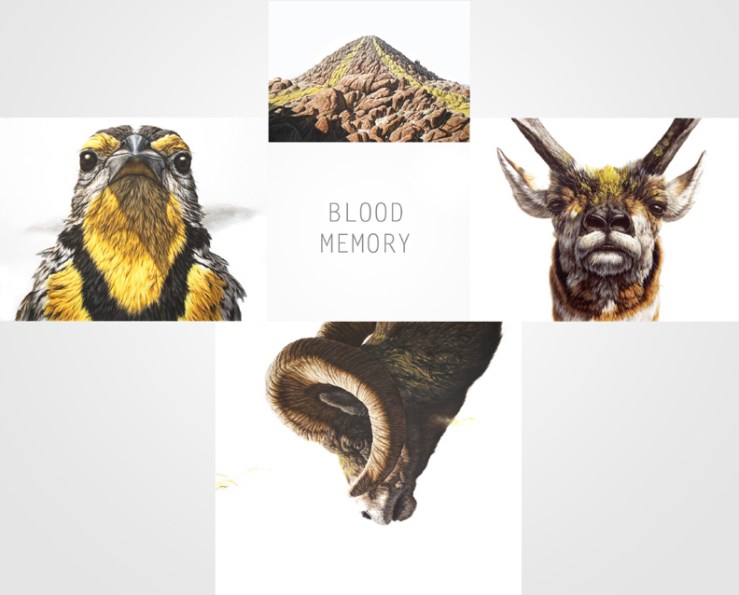
George Boorujy’s marvelous paintings explore humanity’s paradoxical engagements and disengagements with “Nature” — a system that we are manifestly a part of, yet nevertheless philosophically define ourselves against. The first Boorujy painting I saw, a gorgeous bluebird, stunned me: simultaneously delicate and fierce, it emanates pride but also an ineffable quality that surpasses rational, systematic thought. The painting’s vivid colors and subject recalled to me Albrecht Dürer’s Wing of a Blue Roller. I soon found more of Boorujy’s work at the P.P.O.W. Gallery home to the artist’s second solo show, Blood Memory (535 W. 22nd St., NYC, March 15th — April 14th). Blood Memory continues Boorujy’s depiction of animals and landscapes, subjects that resonate with his extensive travels across the US as well as his background in marine biology, a subject the New Jersey native initially pursued at the University of Miami before switching to a BFA. He completed his MFA at the School of Visual Arts in NYC. Boorujy is based out of Brooklyn; he paints and teaches, and works a project called New York Pelagic, where he launches original drawings of water birds (along with a questionnaire) in glass bottles into New York waterways. Check out his website.

Father -- George Boorujy -- Part of Blood Memory

I was thrilled to talk to George over a series of emails: he was personable, funny, and very generous. He ended his first email with one of the best sign-offs I’ve ever read: “I’m gonna go drink in the shower now.” Like many folks of delicate sensibilities and fine upbringing, I too enjoy shower beers. We rapped about Florida, ecology, Swamplandia!, the arts and sciences, the Hipster Mujahideen, the possibility of a racist ibis, and much more.

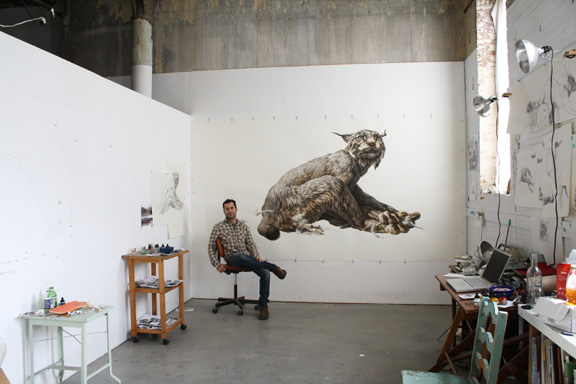
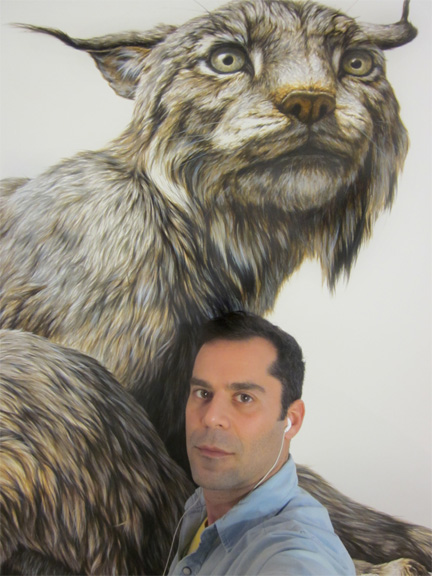
The Artist in repose next to the freshly completed work When Was It That I Knew You

Biblioklept: Tell us about your solo show at the P.P.O.W. Gallery. It’s called Blood Memory—what kind of pieces are you showing?

George Boorujy: Animals. Surprise! But really this is the most purely animal show or body of work that I’ve done. I think there’s only one piece that isn’t of an animal. They’re mostly portrait type pieces, some quite large. I’m finishing up a lynx which is 6 by 11 feet. It sort of looks like Goya’s Colossus. There’s a black white-tailed doe, a meadowlark, a blue jay, a ram, a pronghorn, a frigate bird, a cormorant, another few deer, a Burmese python (hi Florida!). And a mountain. I always seem to need a mountain.

Biblioklept: Your past work has often focused on animals and landscapes, often with implicit ecological arguments. I know you initially studied marine biology in school—how did that course of study influence your art?

GB: I think my brain is somewhat organized like a school where arts and sciences are lumped together. So I’m using the practice of art instead of the practice of science to explore the things I’m interested in. Art and science are very similar in many ways. They are often both a pursuit of the truth. Just different tools and methods are used. Although I am an environmentalist (whatever that actually means) I try not to have any explicit agenda with the work. I want it to stir the viewer or trigger something within them, but not give them an answer or a specific point of view. If I make a piece that shows a manipulated landscape, I’m not necessarily saying it is wrong to manipulate the landscape. We all do it, and we all take advantage of fossil fuels – I love fossil fuels! They’re amazing and we should respect them more and conserve them more – I just want to show what is. Same goes for the treatment of an animal. I’m sure they’re stand-ins for something in my deep sub-conscious, but they are also just what they are, with all attendant veins and ticks and dust in their fur.

Biblioklept: How do you make your animals look so imperious, so proud?

GB: I think maybe it’s because I make them big. I try to actually give them a very indifferent expression so that people can read whatever they want into it. I suppose there is an inherent pride in the form of the animal itself because it is the result of millions of years of evolution that have made it this far. A lot of people think they look sad, which isn’t intended either. I was leaving the studio a few months back when I had a lot of them up and they all looked very judgmental. But then it was better the next day.

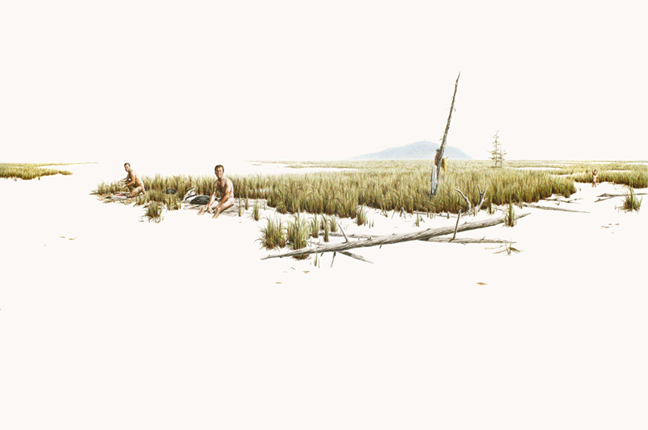
Hunters, George Boorujy

Biblioklept: Let’s shift to people for a moment (although people are animals too, of course). In works like Moraine and Hunters there’s a sense—at least for me—of distance, or almost intrusion (even voyeurism, if I’m being honest). I find your picture of Lincoln fascinating too. I’m curious about how you actually create these pictures: How do you plan them? How do you execute them? What motivates them?

GB: I’m happy that you felt like a voyeur. I never want the pieces to be just observations, I want them to be interactions. Those two pieces in particular could have ended up looking like dioramas or re-enactments or something if there wasn’t the eye contact and the acknowledgement of the viewer. In Hunters, there’s even a small boy hailing the viewer on the right hand side. As though the viewer was coming up in a canoe or something.

As much as I love to draw people, it’s tricky. As soon as you see someone you immediately jump to, “Who’s that? What’s her deal?” We have so much baggage and built in signifiers that it’s difficult to represent someone as a human not of a particular era or class or culture.  I wanted both of those pieces to look as though they could be taking place a thousand years in the future or ten thousand years in the past. Hence, no clothes. But no clothes in situations where there would be no clothes – on the beach (a clue there with the title, Moraine, as in a glacial moraine. I live in Brooklyn down the hill from a glacial moraine, and really all of Long Island is a glacial moraine), or in the case of Hunters, people who have just come out of the water or are doing something in the water. I had to be careful with how to depict the men – one of which is me – would they be bearded? I was afraid they’d look too caveman-ish, or too much like the Hipster Muhajideen (I coined that by the way). I wanted them to be kempt as I wasn’t interested in depicting a post apocalyptic scenario or a definable Paleolithic one either. I also like the play between the indifferent expressions on the men and the smiling hailing boy.

As far as creating them, with the animals I usually make a sculpture first and then make the two-dimensional image out of that because there would be no pictures of the animals in the poses and situations that I put them. With the people, I took some pictures of myself and my friends. Then I changed some things here and there. The girls are my sister and her childhood best friend – but they weren’t naked! They had on bathing suits! And the guys are me and my friend, although it’s my body both times because I changed my mind on a pose. Nudity is a funny thing – I wanted to show them naked, but not in a sexy way. So that’s why they’re pretty modest, even though I guess you can see my dick in the one.

That same issue came up with the Lincoln piece. Originally I thought about doing him full body. But then I knew people would just be looking at his penis, which wasn’t the point. It’s easy to be sensationalistic. Harder to go for the slow burn. And I love the slow burn. Not saying that I always get there, but I am more interested in that generally. I looked at as many pictures of Lincoln that I could find and then came up with a good amalgam. With him it was almost the opposite of what I do when depicting people. Instead of going for neutrality, I was interested in showing one of the most recognizable figures as what he – and all of us – was. A human, an animal. It’s sort of like what I’m always doing, trying to make people re-see what they have seen a million times. Like, what was Lincoln? What does a jack-rabbit really look like? What are we? What are these other beings, what makes a horse?.

"I really do mix my inks in shot glasses. I'm not that much of a drunk."

Biblioklept: What are you reading now?

GB: This seems like a set-up but I actually am reading that biography of Audubon by Rhodes. It is such a good read. Tracing Audubon really traces the beginning of the country, and that guy got around. So you get these really interesting portraits of cities we know today in their infancy, and cities that were once prominent but are now considered backwaters. And the countryside and rivers before they were drastically changed. I often think about how weird it is that when my grandfather was a child we still had passenger pigeons and Carolina parakeets. That’s not so very long ago. Now the parakeets I see are introduced monk parakeets or escaped pets. If they become established then it will be less than a geological blip where we didn’t have parakeets here. The life between introduced and native is an interesting one to ponder.

Biblioklept: As we’re on birds, it seems like a good time to bring up your New York Pelagic project. You put original drawings of birds along with questionnaires in bottles and set them loose on New York waterways. Your blog discusses the motivations and goals behind the project in detail, but maybe you could give our readers a brief overview of your expectations? Is it difficult seeing your original work float away?

GB: It’s funny, I really had no idea what to expect. I was afraid none would ever be found. But, depending on how you count it, four or five have been found out of… 15? I actually have to update the blog and do some counting. So that’s a pretty good ration considering. I didn’t expect the project to become such an exploration of the city, I’ll tell you that much. But honestly, the history of New York is so amazing, and so rich, that you can’t pick your nose without flicking a booger on an old Dutch millstone or some such thing. And it is compelling. I didn’t expect to get so writer-y. I’ve never really written before, and it’s actually pretty fun. And as far as responses I was hoping people would be excited and happy. Which, except for once, they were.

As far as letting the work go, it is surprisingly easy. I thought I’d be more sad about it. But in actuality I’ve done some of them twice to make sure the one in the bottle is really good, not just middling. I want people to find something beautiful. And even if it never gets found there’s something very satisfying about letting something I’ve worked hard on go away. Christ, I ain’t no Buddhist, but there’s something zen about it I suppose. Maybe it’s a good foil to the other work I do which is so labor intensive and made to be seen and hopefully preserved. There’s also something so nice about it being pictures of seabirds that go (mostly) missing. We don’t see then really, just the gulls in the parking lot for most of us. The large majority of them live in habitats that don’t really overlap with ours.

Biblioklept: Let’s talk Florida — you went to Miami, I went to UF in Gainesville, and I live in Northeast Florida now, which is basically a different state than South Florida . . .

GB: Miami is totally a different country. From North Florida and from the rest of the U.S. I was always bummed about not doing a semester abroad when I was there, but then realized that going there is basically eight semesters abroad. So funny that you went to UF. Our big rivals were the Seminoles of course. Which I remember some people used to refer to as the Semen Holes. Which wasn’t as disturbing as a t-shirt I remember of our mascot — an ibis of all things! – jerking off on a Seminole Indian. I would kill for that shirt now, no matter how many racist nightmares it would induce. If an ibis can be racist against a Native American . . .

I love Florida in all it’s David Lynchian beauty. Hmmm . . . this brings me to something that I read recently having to do with Florida – [Karen Russell’s] Swamplandia! I hated it. And for very specific reasons. She is trying desperately to be funny, but she’s not. And it really brings down the whole thing.Every character in the book is trying so hard to out-quirk the next. There’s no straight man. Not that there has to be per se, but there is no anchor to the book. And I like flawed characters, but none of hers are particularly likeable. Even with all their quirks—in defter hands it would work. But like I said, she’s just not a funny writer and it seems like she thinks she has to be. Which is a shame, because there’s an interlude in the book (which I think was in The New Yorker) which is beautiful. So well written and evocative and moody. And well told. It’s not funny, but not everything has to be. I wish she had just expanded that into a whole novel instead of crowbarring a bunch of kooks around it. But now I’m listening to State of Wonder as I finish up a painting for the show and it is excellent.


Biblioklept:
Have you ever stolen a book?

GB: I thought I hadn’t, but then I realized I had. And this seems almost like a plant as well. It was a Swedish publication about Seabirds. And I really passively stole it from the New York Public Library. I honestly think I was the only one who ever took it out. And then I kept bringing it back late. And then one time it was so late that they just billed me for it as a lost book. I could have returned it, but it was only like 14 bucks! Over the years I had probably paid 20 in late fees on it already. Wait—maybe I didn’t steal one because I paid the 14 bucks. But it was somehow dishonest.

Michel Houellebecq: “I Still Haven’t Made Up My Mind Whether Sex Is Good or Not”

Michel Houellebecq talks sex, frustration, and prostitution in his 2010 Paris Review interview:

INTERVIEWER

Of course, it was the numerous sex scenes that got you a lot of attention in the media.

HOUELLEBECQ

I’m not sure that there are such an unusual number of sex scenes in my novel.
I don’t think that’s what was shocking. What shocked people was that I
depicted sexual failure. I wrote about sexuality in a nonglorifying way. Most of all I described a basic reality: a person filled with sexual desire who can’t satisfy it. That’s what people don’t like to hear about. Sex is supposed to be positive. Showing frustrated sexual desire is obscene. But it’s also the truth. The real question is, Who is allowed to have sex? I don’t understand, for example, how teachers survive with all these alarming young girls. When women become sexual tourists, that is even more hidden, shameful, and taboo than when men do it. Just as, when a woman professor puts her hand on a student’s thigh, it’s even worse, even more unspeakable.

INTERVIEWER

A constant refrain in your novels is that sex and money are the dominant values of this world.

HOUELLEBECQ

It’s strange, I’m fifty years old and I still haven’t made up my mind whether sex is good or not. I have my doubts about money too. So it’s odd that I’m considered an ideological writer. It seems to me that I am mostly exposing my doubts. I do have certain convictions. For example, the fact that you can pay a girl, that I think is a good thing. Undeniably. An immense sign of progress.

INTERVIEWER

You mean prostitutes?

HOUELLEBECQ

Yes. I’m all for prostitution.

INTERVIEWER

Why?

HOUELLEBECQ

Because everybody wins. It doesn’t interest me personally, but I think it’s a good thing. A lot of British and Americans pay for it. They’re happy. The girls are happy. They make a lot of money.

INTERVIEWER

How do you know that the girls are happy?

HOUELLEBECQ

I talk to them. It’s very difficult because they don’t really speak English, but I talk to them.

INTERVIEWER

What about the more commonly held idea that these women are victims who are forced into these circumstances?

HOUELLEBECQ

It’s not true. Not in Thailand. It’s just stupid to have objections about it.

“I Lost My One True Love” — Bob Dylan Riff (1966)

Bob Dylan gets extra-rambly in a 1966 interview with Playboy. I like to read the following riff as a surreal story-poem. If you want more context, the interviewer asks Dylan as a preamble to the ramble: “Mistake or not, what made you decide to go the rock-‘n’-roll route?”:

Carelessness. I lost my one true love. I started drinking. The first thing I know, I’m in a card game. Then I’m in a crap game. I wake up in a pool hall. Then this big Mexican lady drags me off the table, takes me to Philadelphia. She leaves me alone in her house, and it burns down. I wind up in Phoenix. I get a job as a Chinaman. I start working in a dime store, and move in with a 13-year-old girl. Then this big Mexican lady from Philadelphia comes in and burns the house down. I go down to Dallas. I get a job as a “before” in a Charles Atlas “before and after” ad. I move in with a delivery boy who can cook fantastic chili and hot dogs. Then this 13-year-old girl from Phoenix comes and burns the house down. The delivery boy – he ain’t so mild: He gives her the knife, and the next thing I know I’m in Omaha. It’s so cold there, by this time I’m robbing my own bicycles and frying my own fish. I stumble onto some luck and get a job as a carburetor out at the hot-rod races every Thursday night. I move in with a high school teacher who also does a little plumbing on the side, who ain’t much to look at, but who’s built a special kind of refrigerator that can turn newspaper into lettuce. Everything’s going good until that delivery boy shows up and tries to knife me. Needless to say, he burned the house down, and I hit the road. The first guy that picked me up asked me if I wanted to be a star. What could I say?