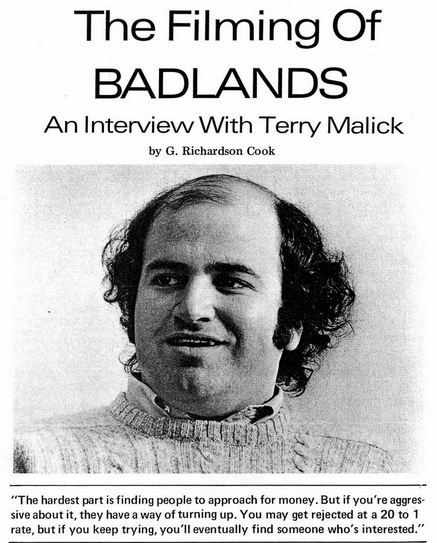
If you’re a fan of Terrence Malick, you may know how hard it is to come across interviews with the director. In the interview, Malick talks in some depth about making his moving début Badlands. Kudos to All Things Shining for unearthing a rare 1974 interview from Filmmakers Newsletter. (Chain of Twitter thanks: @NekoCase, @kurt_loder, @Coudal).
Joan Leegant’s latest novel Wherever You Go tells the story of three Americans in Israel whose lives intersect against the backdrop of Jewish extremism and the tension between democracy and terror. Wherever You Go is Joan’s second book; her first, An Hour in Paradise, a collection of stories that grapple with religion and identity, won the PEN/New England Book Award and was a finalist for the National Jewish Book Award. Joan was a lawyer and taught at Harvard for eight years before seriously pursuing a career in fiction writing. She splits her time between Boston and Israel, where she’s the visiting writer at Bar-Ilan University in Tel Aviv. Wherever You Go and An Hour in Paradise are both available from W.W. Norton. You can learn more about her and her work at her website. Joan was kind enough to talk to me about her writing over a series of emails.
Biblioklept: How did Wherever You Go come about? Can you talk about the genesis behind the plot?
Joan Leegant: I knew only a couple of things about the book when I began to write it: first, that I wanted to write a novel about Israel, and second, that I wanted to write about Americans in Israel, specifically American Jews. The impulse for that is pretty straightforward. I’ve spent a lot of my adult life either being in Israel, or thinking or reading or worrying or despairing about Israel. In fact, my adult life seems to have been bookended by long stays in Israel. I first went there from Massachusetts in 1978 as a young lawyer for what I thought would be six months; I stayed 3 years. Flash-forward 30 years when I was invited to be a visiting writer for a semester at an Israeli university that, lucky for me, keeps inviting me back.
So the experience of American Jews in Israel interests me — why they go there, what they do when they get there – and that’s what I wanted to write about. Some of that curiosity is personal in that I lived there for a time and thought I would stay but didn’t. So part of the impulse to write is the “what if” that fiction writers traffic in: what if I had stayed?
But I learned through writing the book that I have strong feelings, passions, related to the experience of Americans in Israel that aren’t strictly personal. Americans have been among the most notorious Jewish extremists in Israel. Americans also comprise a segment of the radical settlers. Their numbers are small, but some Israelis hold a stereotype of American Jews in Israel as fanatics. Obviously there are plenty of American Jews living there who are not fanatics of any sort. But I was interested in exploring those who were.
There’s another source of this curiosity, which someone reading the book would be hard-pressed to guess. And it’s this: I was a college student in the late 1960s, during the heyday of SDS (Students for a Democratic Society), the Weathermen, the anti-war movement, the push to get ROTC off campus. At my university there were student take-overs of university buildings, faculty protest strikes. My school was no Kent State, but I remember the president of the university calling in the National Guard at some point. And who was making all this happen, yelling into the megaphones on college campuses and morphing from heiress Patty Hearst into the SLA’s Tanya with a machine gun? Young twenty-somethings convinced of the rightness of their cause. As a cautious, careful person, I was intrigued by their passion. Often their cause was just even if their methods were violent or wrong-headed. This came back to me while I was writing Wherever You Go.
But I didn’t know any of this when I began the novel. I’m one of those writers who gropes her way into a story. I don’t think anything through in advance. I don’t even like to think much about a story while I’m writing it. It’s like I have to turn off my head to write. I don’t know if that’s because of my legal training (linear, organized, concerned with relevance, and in my case, probably a bit rigid) or if it’s one of those left-brain right-brain things. Whatever the reason, I’ve learned to trust my instincts and have faith that something will emerge if I’ve got a reasonably promising premise or situation or character to work with. I wrote short stories for a long time before attempting a novel, and that turned out to be good practice for learning to let the story run the show. So I began Wherever You Go with some characters, went where they led me. Not accidentally, they led me straight into my own passions.
The plot emerged from the characters. Fairly early on, I knew that one of them, Aaron, was going to do something violent. I wrote the scene where he commits the violent act, and for a long time I kept that scene as a prologue. I thought I might structure the book so that the reader knew about the act from the start. Eventually it occurred to me that keeping it as the prologue had been a kind of place-holder for me, a helpful signpost: all things in the book needed to either lead up to that event or be the aftermath of the event. Once all that was written, I moved the event into the body of the book.
I also intuited at a point early on that the lives of the three main characters would intersect around this violent act, though I didn’t know how that would come about — how or why their paths would cross — until I wrote it all out. This enabled me to envision a structure. It also allowed me to use points of view I felt reasonably proficient in, which were three third-person narratives. From all this — the characters, the specific event, the structure, the points of view — a plot emerged.
Biblioklept: That structure gives you the tools to explore these characters, who are all in very different places in their relationships to Israel and the Jewish faith. Obviously, Wherever You Go will appeal to a Jewish audience (American or otherwise), but were you ever worried about alienating certain readers who may feel that your complex approach might sometimes portray Jewish people in a less than flattering light?
JL: I did worry. After I’d finished the book and it was at the publisher, in production, I began contacting Jewish venues about giving book talks. One of the first people I reached was the program director of a prominent Jewish cultural institute. She enthusiastically requested a review copy and then called two weeks later to say that, though she’d loved the book, she couldn’t host me there; her board simply wouldn’t have it—she knew this without even having to ask. This worried me and I thought I’d killed the possibility of a book tour. As you may know, the Jewish community is very well-organized for book events. Nearly every city has an annual book fair where authors speak, and most synagogues regularly host writers for book talks. So when this institute turned me down early in the outreach effort, I thought: uh oh.
But then, remarkably, the opposite happened: Jewish organizations were eager to have me come speak. In the ten months following the initial publication of Wherever You Go, I spoke at 100+ Jewish venues up and down the east coast, in Chicago, California, Seattle. It turns out that a great many American Jews are worried about the same things I’m worried about; namely, the rise of extremism in Israel, the power and influence of the settlement movement, and the drift to the right in Israeli politics and policy. Like me, many are deeply devoted to Israel and care passionately about its survival; yet we also believe there must be a Palestinian state, and that the Palestinian narrative must be heard as well as the Jewish narrative.
Who were these audiences who turned out for my book talks? They weren’t young lefties or radicals associated with, for instance, the movement promoting sanctions or divestment. They were mostly middle-aged women and men who identify strongly as Jews and Zionists but are worried about where Israel is headed and dismayed about the hijacking of the Jewish tradition by those with fundamentalist views. Instead of being angry that I was talking about Jewish extremism, they wanted to know more about it, to become better informed. I think this feeling is best captured by a line from the review of Wherever You Go that ran in The Forward, the pre-eminent American Jewish newspaper: “Finally, a novel about Israel by an American Jew that’s written well and without sentimentality.” American Jews don’t want an update to Exodus. Certainly those who are knowledgeable about Israel, who’ve been there or follow the news, want to read books that depict the country, as it is today, with more nuance.
Which is not to say that some people didn’t get upset with me. I got some nasty reviews, most which I’m pretty sure were motivated not by literary critique but political animus. One early reviewer for a well-regarded Jewish newspaper was startlingly honest about his discomfort. In a measured and articulate piece, he praised the book for its insight, character development and accuracy–and then said he just wished I hadn’t written it. Couldn’t I have used my novelistic talent to write about something else? he asked. Frankly, I admired him, and still do, for being up front about his personal reaction instead of feeling the need to find a reason to rip the book apart.
I seem to be one of those writers capable of remaining oblivious of her readers while engaged in the act of writing. I didn’t much think about alienating readers or reviewers while I was working on the book. It took me seven years to complete this work, and for a long time I simply didn’t know if I would produce a novel at all, let alone publish one. So that enabled me to sink into the material without giving a lot of thought to its reception. I also didn’t know until quite a ways in that the book would contain such charged material, since I began with character, not theme or idea. This also helped me wade in deep while maintaining a kind of happy ignorance about what I was heading toward, subject-wise.
Nonetheless, I’ve come to understand that writers working out of a particular ethnic or religious or regional tradition often upset members of their own group when their work is released into the wider world. Philip Roth infuriated many in the Jewish community when he published Goodbye, Columbus in 1959 (National Book Award notwithstanding) because of the less than flattering light in which he portrayed his characters. I hope I’m not misremembering, but I believe I once read that Sherman Alexie’s work was not happily received by his fellow Native Americans, for the same reason. I have a friend who is a playwright; she is also Armenian. She told me that with her next play, her first about being Armenian, she expects to be nearly excommunicated. This is part of the territory of writing. You tell the truth, not, to my lights, in order to be outrageous or provocative or snide or even merely clever, but because honesty is essential. Not everyone is going to like it.
Biblioklept: I imagine (if you’ll permit me that license) that although Alexie would like for Indians to read his books and relate, and perhaps your Armenian friend wishes that Armenians will be able to identify the truth in her work, I imagine that both writers hope for audiences beyond their own ethnic backgrounds. Do you worry about your books being perceived as “Jewish books”—not necessarily during the crafting (as you’ve already described), but perhaps in the nitty-gritty of the marketing and so forth?
JL: I don’t worry about that kind of labeling very much, though perhaps I should. Maybe this comes out of initially publishing short stories. The first piece I ever published was about a 75-year-old rabbi thrown into a spiritual crisis when a pair of Siamese twins appears at his morning minyan — he’s been waiting for a sign from the Divine for a long time and wonders if they are it — and it was published in Nimrod, a very fine literary journal out of the University of Tulsa. Several things came out of that publishing experience. First, I learned that, like the old advertisement for Levy’s Rye Bread (“You don’t have to be Jewish to love Levy’s”), you didn’t have to be Jewish to connect to and enjoy a good Jewish story. Now, of course, I knew intellectually that non-Jewish readers could, and did, appreciate intensely Jewish fiction all the time. One of my literary beacons is Bernard Malamud, many of whose short stories are masterpieces, particularly those in The Magic Barrel,another National Book Award winner from the 1950s. When it comes to Jewish stories, you can’t get much more Jewish than that. But I’m no Malamud, and until I began to publish, I didn’t know where my work might end up. When Nimrod took that first piece, I understood that the work had transcended a strictly ethnic readership, something, I might add, that my wonderful teacher, Bret Lott, had already told me. It was Bret who pushed me to send that story out in the first place.
The second thing that came from the Nimrod experience was attending their annual writers conference. The story they took — it’s called “The Tenth”– had won third place in Nimrod’s Katherine Anne Porter Prize; they flew me to Tulsa to accept the prize and participate in the conference, where I also met the judge, novelist Anita Shreve. And what I found while talking to people all weekend and being at an awards dinner with a couple hundred guests was that the truths I was exploring in that story — the wish to connect to the Divine, the terror of having glimpsed the Angel of Death – were indeed universal. This gave me the impetus to keep mining the Jewish vein, and I did the classic obsessed-writer thing: I scribbled potential story titles and opening paragraphs all over the backs of the conference materials on the plane ride home. The prize and the talky weekend were the boosts I needed to say to myself, OK, write those Jewish stories. If they’re good, people will read them.
Marketing that first book as a Jewish book, then, became primarily a business decision, and it was by my doing, my choice. That holds true for my novel, Wherever You Go, as well. As I mentioned earlier, the Jewish community is well-organized in terms of providing opportunities for writers to get the word out. So the community has been a natural launching pad for my work. I was also very lucky with my first book, An Hour in Paradise, in that it was selected early on for the Barnes & Noble Discover Great New Writers Program and then won the Winship/PEN New England Book Award, two honors that kept it from being perceived as exclusively of interest to Jewish readers.
That said, I’d love both books, and especially the novel, Wherever You Go, to reach more readers in the broader world. Wherever You Go deals with religious fanaticism, and while the focus is the Arab-Israeli conflict, and Jewish extremism in particular, much of what’s explored in the book applies to any kind of fundamentalism. Which, as we know, is happening all over the globe. What allows people to commit violence in the name of God? What draws certain individuals to embrace the fanatic’s worldview? How do families deal with the rifts within them caused by differences in ideology? These are questions I think a lot of us are asking in this new century. Then there are the themes of forgiveness and atonement and repairing relationships. I’m hoping general readers will be interested in exploring these issues through the lens of fiction.
Biblioklept: What are you working on next? What projects are on your horizon?
JL: I’m working on stories as well as a larger project. I won’t say much about the larger work because I’m still finding my way into it, except to say that it’s set in central Massachusetts in apple growing country. The stories are set in Israel and are about secular Israelis — a departure from the world I explored in my novel, Wherever You Go. The new stories are also a change for me stylistically in that they are written in first-person, which is not a voice or point of view I’ve used much at all. But that’s just how they’re coming out. And you have to go with the demands of the story.
The new stories and new novel are both leaps for me both in terms of subject matter and style (narrative structure, voice, etc.). While that can feel unsettling, it’s also great to be pushing into uncharted territory. I didn’t start writing fiction until I was almost 40; now I’m 60, a slow writer, and hope I have enough time to keep trying new things.
Biblioklept: Have you ever stolen a book?
JL: I am the quintessential good girl and have never stolen anything. I even became a lawyer because I liked rules. The closest I came to stealing a book was when I stayed for a week at the home of friends who were away for a semester and began reading their copy of Francine Prose’s novel, Blue Angel. I was loving the book but wasn’t going to be able to finish before I had to leave. So I took it with me. But I felt so guilty that I bought another copy for myself and slipped back into my friends’ unoccupied house to return theirs. I know they would have given it to me had I asked. But I felt so tarnished by my original conduct that I couldn’t even ask.
You say that literature demands more involvement and more effort from the reader than the visual media. Is this why your last two novels have been so spare?
KOSINSKI
Yes. I do trust the reader. I think he is perfectly capable of filling in the blank spaces, of supplying what I purposefully withdrew. Steps attempts to involve the reader through nonuse of the clear and discernible plot. From the first sentence of the book, “I was traveling further south,” when the reader starts traveling down the page, he is promised nothing, since there is no obvious plot to seduce him. He has to make the same decisions my protagonist is making: Will he continue? Is he interested in the next incident?
INTERVIEWER
Your intent, then, is subversive. You want to involve, to implicate the reader via his own imagination.
KOSINSKI
I guess I do. Once he is implicated he is an accomplice, he is provoked, he is involved, he is purged. That’s why my novels don’t provide easy moral guidelines. Does life? The reader must ask himself questions about what is good or what is evil about my characters. Was it his curiosity that dragged him into the midst of my story? Was it recognition of his complicity? For me this is the ultimate purpose of literature.
INTERVIEWER
Do you want to be remembered as . . .
KOSINSKI
No bookkeeper is as false and fraudulent as collective memory. It’s best to be forgotten.
Lars Iyer’s début novel Spurious is about two would-be intellectuals, W., the book’s comic hero, and his closest friend, our narrator Lars. They bitch and moan and despair: it’s the end of the world, it’s the apocalypse; they find themselves incapable of original thought, of producing any good writing. The shadow of Kafka paralyzes them. They travel about Europe, seeking out knowledge and inspiration — or at least a glimpse of some beautiful first editions of Rosenzweig. They attend dreadful academic conferences; they write letters. They flounder and fail. In the meantime, a fungus of seemingly metaphysical proportions infects Lars’s apartment, soaking it through, compounding his desperation, as no one can figure out how to get rid of it—
No one understands the damp. It’s Talmudic. The damp is the enigma at the heart of everything. It draws into it the light of all explanation, all hope. The damp says: I exist, and that is all. I am that I am: so the damp. I will outlast you and outlast everything: so the damp.
The passage is a lovely example of Iyer’s humor, which pervades the book just as the damp creeps through his narrator’s home, absurd and bewildering. Iyer is willing to play with tropes of theology and philosophy in ways that are simultaneously absurd, hyperbolic, and deadly serious. “These are the End Times, but who knows it but us?” his hapless heroes wonder. W. is not without solutions though—-
Every conversation must be driven through the apocalyptic towards the messianic, that’s W.’s principle; the shared sense that it’s all at an end, it’s all finished. He loves nothing better than conversations of this kind, W. says, when everything’s at stake, when everything that could be said is said.
That’s when messianism begins, W. says, You have to wear out speech, to run it down. And then? And then, W. says, inanity begins, reckless inanity. The whole night opens up. You have to drink a great deal to get there. It’s an art.
The dialogue (or monologue pretending to be dialogue, more accurately) highlights the verbal slapstick of Spurious, its willingness to shift direction while retaining tone. “Both characters are mesmerised by a real disaster,” Iyer told me in a recent interview (the interview, by the way, makes a better case for reading Spurious than I can hope to here) . “And both — particularly W. — are mesmerised by their partial responsibility for this disaster. The ‘strained and unreasoning’ laughter of Spurious is a response to the grimness of the world that is of our making.”
W.’s response to our grim, apocalyptic world is a mix of absurd humor and real cruelty toward his friend Lars. And if W. is willing to mock and laugh at his friend, he also mocks and laughs at the world, and himself—only his laughter never absolves or forgives or otherwise deflects the cruelty and grimness of the world (or his own cruelty, in turn). When W. calls Lars fat or chastises his laziness or derides his intellect, there’s a recursive angle to his jabs, a sense that they will return to rest on his own brow. It’s all in good fun except when it’s not.
W. and Lars face the same trial that all thinking people face during the End Times, the inescapable, all-devouring nightmare of history, art, philosophy. Perhaps a passage will explicate better than I—
Kafka was always our model, we agree. How is it possible that a human being could write like that?, W. says, again and again. It’s always at the end of the night when he says this, after we’ve drunk a great deal and the sky opens above us, and it is possible to think of what is most important.
At the same time, we have Kafka to blame for everything. Our lives each took a wrong turn when we opened The Castle. It was quite fatal: there was literature itself! We were finished. What could we do, simple apes, but exhaust ourselves in imitation? We had been struck by something we could not understand. It was above us, beyond us, and we were not of its order.
If our heroes are disciples of literature (or the purity of “literature itself”), they are also its prisoners, its slaves, the tormented. W. attempts to find ways out through mathematics and Talmudic theology, but these disciplines entail their own weight and chains—and ultimately, W.’s own shortcomings in these areas only point back to his own reliance on literature (and, in turn, his own shortcomings there again). Still, W. (or Lars, or Iyer, I guess), is willing to share his citations with us, quoting or paraphrasing from a rich intellectual diet.
Although in some ways Spurious is fragmentary and elliptical, a series of riffs, vignettes, and skits, it is also in many ways a traditional novel, with emotionally drawn characters in Lars and W., whose friendship resounds with a deep reality and psychological honesty with which most readers will identify. W. suggests that companionship and friendship are reasons enough to continue existence in the face of despair and absurdity; he then turns around and accuses Lars of being a terrible friend. Iyer offers the kind of truth that has become a cliché, offers it perhaps without cynicism or irony, and then immediately punctures it, even as he reinforces its original truth. Spurious is full of such vacillations, reeling like its often-drunk heroes at times, but always unified by a consistent tone and tight prose. Funny and lively, even when it’s erudite and depressive, Spurious is a lovely little book for drinking and thinking. Read it and pass it on to a dear friend.
Orson Welles talks about acting and directing in a 1960 interview in Paris. The interviewer steers the conversation to Charlie Chaplin, who bought Orson Welles’s idea for the film Monsieur Verdoux—and then cut Welles out of the creative process.
Lars Iyer’s first novel Spurious (Melville House) is by turns, witty, sad, and profound, and garnered serious acclaim on its release earlier this year. Spurious originated in a blog of the same name. There are two sequels on the way—Dogma should be on shelves in early 2012, and Exodus the year after. Lars teaches philosophy at Newcastle University (so it’s no wonder that Spurious reads like a discursive philosophy course by way of the Marx brothers). Lars was kind enough to talk to Biblioklept in depth about his work and writing. In addition to his teaching, writing, and blogging, you will also find Lars on Twitter.
Biblioklept: Your novel Spurious began as a blog and then was published by Melville House, a thriving indie publisher that also began life as a blog. At a recent talk you gave at the HowTheLightGetsIn philosophy and music festival, you discuss the freedom blogging allows for writers to develop their “legitimate strangeness.” Why is “legitimate strangeness” important for writers, and how does blogging help facilitate it?
Lars Iyer: Sometimes it is necessary to depart. Sometimes it is necessary to leave it all behind. That’s how I understood the act of blogging, back when I started Spurious, the blog which shares thesame name as the novel.
As someone who had made some progress as an academic – a journey which implies valuable training as well as compromise and despair – I thought a kind of exodus was necessary, from existing forms of published writing. Leave it all behind!, I told myself. Leave the Egypt of introductory books and academic journals and edited collections behind. Leave the slave-drivers behind, and the sense you have of being a slave. Leave capitalism and capitalist relations behind. Leave behind any sense of the importance of career and advancement. Leave behind those relationships that are modelled on investment and return.
Sometimes a kind of solitude is necessary. You need to be alone, to regather your forces, to marshall your strength. But what is really necessary is a solitude in community. You’re on your own, depending on your own resources. But your solitude is lightened: because you know that there are others like you, who have likewise expelled themselves from captivity; because you know that others share your sense of disgust and self-disgust, that they too have gone out to the desert to do battle with the demons sent by capitalism into each of our souls; because there are others, like you, who see writing as both scourge and liberation, others who see it as a spiritual trial, others looking to destroy who they were and be reborn, and to keep themselves in rebirth.
In the end, the desert is paradise, and the world the blogger has left behind, with its whips and fleshpots, is the real desert.
Cultivate your legitimate strangeness: that was my mantra. ‘Cultivate’, because it is a struggle, a kind of asceticism. To drive the demons out, you have to know that they are there. A kind of self-knowledge is necessary – not the petty narcissism we find in the ‘misery memoir’, but a growing awareness of those forces that have constituted you, that have made you what you are. ‘Your legitimate strangeness’: ‘Your’, because it is yours, your space, the person you are, that you have become, even as you might alter this space, remake it. ‘Legitimate’ – that part of you that is not yet subsumed by capitalism, that free part of yourself that is not a slave. ‘Strangeness’ – because it must appear strange to the slaves and their masters, to everyone around you.
Why is this important to the writer? Some of us write because of our alienation. We have had no one to speak to, no friends, no conversations. There was no one around. Thoreau went to the woods to find himself. We went to our rooms. We went to literature, and philosophy, without knowing anything of literature and philosophy. We worked on our own.
There is something pathetic about this. Shouldn’t we have been fighting the world instead? Shouldn’t we have been ready on the barricades? But there were no barricades. There was no solidarity. We belonged to nothing, and had gone a little mad, a little reclusive, from belonging to nothing.
In one sense, since we lacked education, lacked culture, since our world was not one which valued the ideas and writers that we came to, our exodus was pathetic. We were imitators, play-pretending at being what we are not. We’d come too late; the party was over. We stood in the ruins, and the ruins mocked us. What could we have achieved, that had not been achieved to a much higher level before? What could we have made, that had not already been made, and much more competently, much more measuredly? We lacked the basic skills. We lacked the ability to write – even that. We lacked the breadth of culture, the breadth of scholarship.
But seen in another light, we discovered ourselves as outsiders, like those outsider artists who practiced their vocation outside of institutions. What we made was crude and simple, true — especially when compared to what went before – but it did have a certain power to affect. It had an urgency, a desperation, which might, perhaps, appeal to others. We were capable of only scraps and fragments, to be sure – dreck – but dreck marked by a moving sincerity.
I wondered – and this was the beginning of Spurious, the novel, and of its sequels – whether there was a way of folding this sense of posthumousness, of coming too late and lacking the old skills, into the practice of writing. Maybe it was time to come back from the desert, which had taught me only the extent and depth of my stupidity. Maybe it was time to write with a new kind of writing . . .
A Portrait of the Novelist as a Smiling Man
Biblioklept: That “sense of posthumousness, of coming too late” figures heavily in Spurious. Is Spurious the “new kind of writing” you are aiming for? While the book has a fragmentary, even elliptical quality, it also reminds me of novels in the picaresque tradition. What form does this new kind of writing you invoke take?
LI: Spurious is a book on its hands and knees. For me, it feels like the last book, the last burst of laughter before the world ends. But it also feels like the first one, because it has loosened the hold of the past. It says: a whole form of literary pretence is over.
Writing to a friend, in 1916, before the composition and publication of the work that would make him famous, the philosopher Franz Rosenzweig wrote, ‘My true book will appear only as an opus posthumum: I do not want to have to defend it or know about its “influence”’. He writes something similar, a year later, in another letter: ‘I will only truly speak after my death …, I place my entire life beneath the sign of that “posthumousness”’. Rosenzweig was confident that there would be a culture to evaluate his work. He was confident that there would be a place for his posthumous work among the greats – that there would still be greats, such that he might find his place among them. He was sure, in other words, that the old world would continue as it was; that there would still be master-works, still be the geniuses who wrote them, and still be the critics whose evaluations would be trusted by a general public.
A similar confidence in an author today would be a sign of delusion. Literature is one strand among many in our multi-braided culture. True, it retains something of its prestige; it is studied at universities, reviewed in serious newspapers — but it occupies an increasingly marginal role. The ‘great names’ are, for the most part, only cultural markers, ready for commercialisation (Kafka oven gloves in the tourist shop in Prague; the Brontë Balti House in Haworth; the Pride and Prejudice fully immersive interactive environment). But it is not only marginalisation that should be feared; recognition, too, should be. I think of the stupidity of documentary ‘infotainment’ on writers and artists, and rise of the vast, say-everything biography, that says nothing at all (as Mark Fisher has written, the biography is an end of history form, making the reassuring claim that ‘it was all about people’).
Literature continues. But it does so, in contemporary literary fiction, as a kind of empty form. As the anonymous blogger of Life Unfurnished has put it: contemporary literary fiction gives ‘the appearance alone of literature’; it is a genre ‘in which, for the writer, the sense of Writing Literature is dominant, and, for the reader, the sense of Reading Literature is dominant’.
Reviewing Jean-Luc Godard’s film Every Man For Himself, Pauline Kael writes, ‘I got the feeling that Godard doesn’t believe in anything anymore; he just wants to make movies, but maybe he doesn’t really believe in movies anymore, either’. Without agreeing with Kael’s assessment of Godard, I’d like to paraphrase her formulation: I think literary writers want to write literary fiction without believing in literature – without, indeed, believing in anything at all.
It seems to me that the literary gestures are worn out – the creation of character, plot, the contrivance of high-literary language and style as much as the avoidance of high-literary language and style, and the abandonment of most elements of the creation of character and plot. The ‘short, elliptical sentences’ of which the blogger of Life Unfurnished writes, the ‘absence of fulsome description’, the ‘signs of iconoclastic casualness’, the ‘colloquialisms’, the ‘lack of trajectory’, the ‘air of the incidental’: all are likewise exhausted.
What, then, is to be done? As writers, as readers, we are posthumous. We’ve come too late. We no longer believe in literature. Once you accept this non-belief, once you affirm it in a particular way, then something may be possible.
Witold Gombrowicz seems to advocating a return to older forms of literary insouciance: ‘Where are the good old days, when Rabelais wrote as a child might pee against a tree, to relieve himself? The old days when literature took a deep breath and created itself freely, among people, for people!’ But we cannot simply return to Rabelais, as Gombrowicz knew. Too much has happened! If a kind of self-consciousness is a distinguishing mark of the contemporary literary novelist, this is not something that can be relinquished altogether. The role of centuries of writing – of the rise of the nineteenth century bourgeois novel, of modernism and so on – must be marked.
But it can be marked by portraying our distance now from the conditions in which the great works of literature and philosophy were written. W. and Lars, the characters in Spurious, revere Rosenzweig. But this is also reverence for a culture that would deem Rosenzweig and his work important – a culture that is completely different from the one which W. and Lars occupy. True, they revere contemporary masters, too – the filmmaker Béla Tarr, for example – but Tarr lives far away, in very different conditions. W. and Lars occupy the world of the present, and the world that valued the ideas they value, the world that sustained those ideas and nurtured their production, has disappeared. Much of the humour of the book comes from the fact that its characters are men out of time – gasping in awe at Rosenzweig’s work at one moment, leafing through gossip magazines at another; proclaiming a great love of Kafka one minute, playing Doom on a mobile phone the next.
It is in this sense that there might appear to be an overlap between Spurious and novels in the picaresque tradition, which extends from sixteenth century Spain to the present day. Picaresque, it has been argued, appears as a result of a tension between an old world and a new one. The Spain of the first picaresque novels was in a period of difficult transition, from the stability of the medieval order to the age of a new, self-assertive individuality. Poverty and war were all around. The picaresque is produced in a world where human solidarity is lacking, and the individual no longer has a place in the world. The episodic journeys of the picaresque novel reflect the lack of coherence of its central characters, the lack of secure identity – a kind of cosmic loneliness.
Some picaresque features can be found in Spurious. The novel is episodic, and its characters lack a place in the world, even a place in history. W. and Lars play-pretend at various roles, trying on the mantle of the religious person or the philosophical thinker. W., in particular, yearns after friendship. But the characters are not roguish, as the picaro of a picaresque novel is supposed to be. W. is perfectly sincere. And picaros do not usually come in pairs.
Biblioklept: Speaking of your pair Lars and W., there’s a strong friendship there that strikes me as very realistic and actually quite moving. Reading Spurious I was reminded strongly of one of my own friendships, which is perhaps based on equal parts degradation and love. Lars and W. evoke both extreme pathos and a kind of deep existential anxiety that manifests in humor. Parts of Spurious read almost like verbal slapstick (if that metaphor can hold any water). How important is humor—what do you think the humor in Spurious is “doing”?
LI: Humour? I’m with Gilbert Sorrentino: ‘In a country such as ours we have reached a point at which there is hardly anything left to do but laugh or cry. It’s a kind of hysterical laughter, it’s strained and unreasoning laughter, or it is a morbid, bleak sobbing. I don’t think that anything is going to get changed in this country except that it’s going to become grimmer’.
Sorrentino’s referring to the USA, but he could just as well be referring to the UK. We lack the grounds for belief, for hope, for a future. There’s economic disaster — not simply the credit crunch, but neoliberalism in general: corporatisation, unemployment, job insecurity, casualisation, the privatisation of public utilities. Beyond this, there are the effects of climate change: drought and hunger, failure of whole nations, wars, migrants. The temptation of ‘morbid, bleak sobbing’ is extreme, as is the desire to drink oneself into oblivion like the barflies in Béla Tarr films.
Sometimes, it feels that there is an imposture in the very fact of being alive. It is as though getting out of bed in these terrible conditions were already an imposture, let alone trying to think or write. What can we do, really do, about the disaster? ‘To hope is to contradict the future’, Cioran says somewhere. Better to lie down and wait for the end. Better to give up before you begin.
‘I think joy is a lack of understanding of the situation in which we find ourselves’, Andrei Tarkovsky says, with marvellous ill-temper. And, on another occasion: ‘I accept happiness only in children and the elderly, with all others I am intolerant’. It’s true that joy and happiness seem ill-suited to our times, all the more in that joy and happiness are promoted in that ideology of positivity which is everywhere today. But perhaps there is a sense in which one might legitimately laugh at the apocalypse, albeit with what Sorrentino calls a ‘hysterical laughter’.
A sage in the Ramayana tells us that there are three things which are real: god, human folly, and laughter. ‘Since the first two surpass human comprehension’, he says, ‘we must do what we can with the third’. So we must laugh at folly, laugh at greed and smugness, opportunism and corruption, as eternal flaws in the human condition; laugh, and dream of a better world, knowing that it won’t come.
But this kind of laughter is too genial for me. It treats human folly as eternal, which I’m sure in many ways it is, but ignores suffering, dying, the real hell of our globalised world. And I worry that it also spares the one who laughs. True, you can laugh retrospectively at your own stupidities. What an idiot I was when I young!, you might say. But there is a broader sense in which we are, each of us, implicated in the present state of the world. It is our responsibility, in some important way. For me, to laugh sagely at one’s own foolishness is still too little.
What is the humour of Spurious doing, then? As many reviews of the novel have shown, the ‘verbal slapstick’ of the characters is part of a whole tradition of double acts and comic routines. I wanted W.’s insults of Lars to exhibit the same virtuosity as the physical humour of the Marx Brothers or Buster Keaton. I think there is a whole art of the insult. But I think something else is going in the novel, too.
Alenka Zupančič argues that comedies are never truly intersubjective. ‘[C]omedy is above all a dialogical genre’, she grants; but comic heroes are ‘extracted, by their passion, from the world of the normal intersubjective communication’. What they are really doing is seeking ‘to converse solely with their ‘it/id”’. Dialogues, in comedy, are really monologues; the hero is really only obsessed with his basic, chaos-ridden drives. As Zupančič suggests, ‘The comedy of such dialogues does not come from witty and clever exchanges between two subjects, or from local misunderstandings that make (comic) sense on another level of dialogue, but from the fact that the character is not really present in the dialogue he is engaged in’. On this account, the cruelty of the ‘verbal slapstick’ of the friendship in Spurious, which sees W. continually berating his poor friend, would actually be directed at W. himself. W., the only candidate for being the ‘comic hero’ of Spurious, would use Lars as merely the occasion for the continuation of his monologue.
But this interpretation doesn’t quite work for me, either. The ‘it’ that drives the exchanges of the characters is not only a feature of W.’s psychic makeup, of the chaos of his drives. Both characters are mesmerised by a real disaster. And both — particularly W. — are mesmerised by their partial responsibility for this disaster. The ‘strained and unreasoning’ laughter of Spurious is a response to the grimness of the world that is of our making.
Biblioklept: For me, that “strained and unreasoning” laughter is a big part of why I enjoyed the book—I identified with the characters. Spurious isn’t really, to borrow a phrase from David Shields, a “novelly-novel,” but it does have elements of a “novelly-novel” (including characters with whom some readers will strongly identify). At the same time, its short sections, fragmentary nature, and willingness to cite entire paragraphs of other texts point to a new kind of writing, one perhaps anchored in its origins as a blog. How did you compose Spurious? How does the novel differ from the blog?
LI: ‘A page is good only when we turn it and find life urging along …’, says one of Calvino’s characters in Our Ancestors. I hope that’s what a reader can find in Spurious: life urging along. I hope readers recognise something of their own friendships in that of W. and Lars. Spurious is not, I think, a ‘novelly-novel’. It’s new in some way – it has characters, some elements of plot, but it doesn’t resemble other books. And I think this is due to its origins. Blogging, and then combining different categories of posts, allowed me to discover, through editing, a new kind of novel.
Blogging demands immediacy. Telling the story of W. and Lars, I couldn’t rely on readers having followed it from the start. Every day, with my blog posts, I had to present these characters and their situation anew, and in a manner vivid enough to engage any potential reader. In doing so, I felt rather like the writer of a strip cartoon. Charles Schultz’s Peanuts had longer narrative arcs, but each sequence he published in daily newspapers had to stand on its own. Likewise with the posts at the blog. Each post had to have its own internal drama, a kind of ‘verbal slapstick’, even as it could be contained within a larger narrative arc.
My loyalty was, for a long time, to the readers of my blog, and I produced new material for them daily. But I thought some of the thematic strands developing at the blog – the trips to Freiburg and Dundee, for example, or the reflections on Kafka and on the Messiah – were being obscured by the quantity and disparateness of W. and Lars material. A selection had to be made. This is where the work of editing began, of the practice of literary montage that would lead to Spurious.
Tarkovsky, in his book about film, narrates the long process of assembling the various fragments that comprise the finished film, Mirror. ‘I am seeking a principle of montage which would permit me to show the subjective logic — the thought, the dream, the memory — instead of the logic of the subject’, he said. He was looking for a way to combine various elements – short narrative sequences, pieces of music and poetry, etc. – into a living whole.
I was doing the same thing, in my own way. Spurious is a hybrid of many elements of the blog. There was a story about W. and Lars, but also one about damp –– a real story, which I wrote about at the blog. I added quotations, too, as well as incorporating the narratives of the lives of various thinkers. And I edited until I felt that life was urging along.
Biblioklept: Have you ever stolen a book?
LI: I have thousands of pages of photocopies, which I made, full of ardour, during my first jobs as an academic. I thought I’d never get a permanent job, and wanted to make my own library of knock-off books in my rented room. Perse, Trakl, Tsvetayeva, Duras, and so many others: no printed book could mean as much to me as my annotated duplicates.
In a fantastic 1974 interview with noted translator Philippe Mikriammos, William Burroughs discusses the picaresque novel (and much, much more)—-
PM: Have you been influenced by Celine?
WB: Yes, very much so.
PM: Did you ever meet him?
WB: Yes, I did. Allen [Ginsberg] and I went out to meet him in Meudon shortly before his death. Well, it was not shortly before, but two or three years before.
PM: Would you agree to say that he was one of the very rare French novelists who wrote in association blocks?
WB: Only in part. I think that he is in a very old tradition, and I myself am in a very old tradition, namely, that of the picaresque novel. People complain that my novels have no plot. Well, a picaresque novel has no plot. It is simply a series of incidents. And that tradition dates back to the Satyricon of Petronius Arbiter, and to one of the very early novels, The Unfortunate Traveler by Thomas Nashe. And I think Celine belongs to this same tradition. But remember that what we call the “novel” is a highly artificial form, which came in the nineteenth century. It’s quite as arbitrary as the sonnet. And that form had a beginning, a middle, and an end; it has a plot, and it has this chapter structure where you have one chapter, and then you try to leave the person in a state of suspense, and on to the next chapter, and people are wondering what happened to this person, and so forth. That nineteenth-century construction has become stylized as the novel, and anyone who writes anything different from that is accused of being unintelligible. That form has imposed itself to the present time.
AVC: In 20,000 years, could it be our culture that’s discovered in a cave somewhere?
WH: In 20,000 years, there will be significant things in the environment that will be preserved, like certain dams. Like Vajont Dam near Longarone [Italy], where there was this catastrophic event almost 50 years ago now. An incredibly massive landslide came down into the lake. The entire lake, over 50 billion cubic meters, shot up into the air in a tsunami of 700 feet that came down in this gorge and wiped out the town of Longarone. I have studied the place over and over. I do my pilgrimages to the place. At its base, [the dam] is something like a hundred feet thick. The steel-reinforced concrete. The whole thing is about 180 meters at its highest, and it withstood the landslide coming into it. It’s still intact, and most of it will be intact hundreds of thousands of years from now. So in the future, when people are looking for the Neanderthals of the 21st century, they will see our traces standing in open air. They will see the sarcophagus of Chernobyl, which is going to be built over it now. It will be there in 20,000 years. They won’t have to search in a cave.
But about the guns. When you left Alabama, there was an incident . . .
HANNAH
Yes, I was a tenured professor there, and I was fired. I had just been voted in, but I was too heavily into drinking. I was holding class at home or in my studio and they said, Don’t hold any more classes in your studio. And I said, Well, I will. I brought in an empty pistol once and, as I recall, twirled the chambers to explain six movements in a short story. And that is where the gun—pointing a gun at a student—rumor started, but I never pointed a loaded gun at anybody in my life. Even dead drunk. Never, never. I really don’t like that rumor now because of the school shootings. The world has changed so much. I still love my old .22’s from my youth, for shooting beer cans and rats in the city dump. I love the instrument. It’s just a beautiful, clean instrument—and the history —but I have never had any interest in pointing a gun at a person.
INTERVIEWER
Do you remember what the six movements were?
HANNAH
No. I could make up something, but it would be untrue. There’s just three, anyway: beginning, middle, and end. I was com-plicating something that didn’t need to be any more complicated. At one time I’m sure I had six points in my head and they may have been decent, but I refuse to remember them because they’re not necessary now.
INTERVIEWER
The rumor about pointing the gun was that you were playing your trumpet, trying to get their attention. When that didn’t work, you brought out the gun.
HANNAH
I did play my trumpet in class at Alabama. And at the University of Chicago. Blues solo. Ta da na tee. And I was pretty good sober but real loud and inappropriate in a small chamber. The people at Chicago enjoyed it, but a student complained at Alabama. Still, the trumpet’s a much better idea than bringing a pistol. It’s all alcoholism.

 Lars Iyer’s first novel Spurious (
 Biblioklept