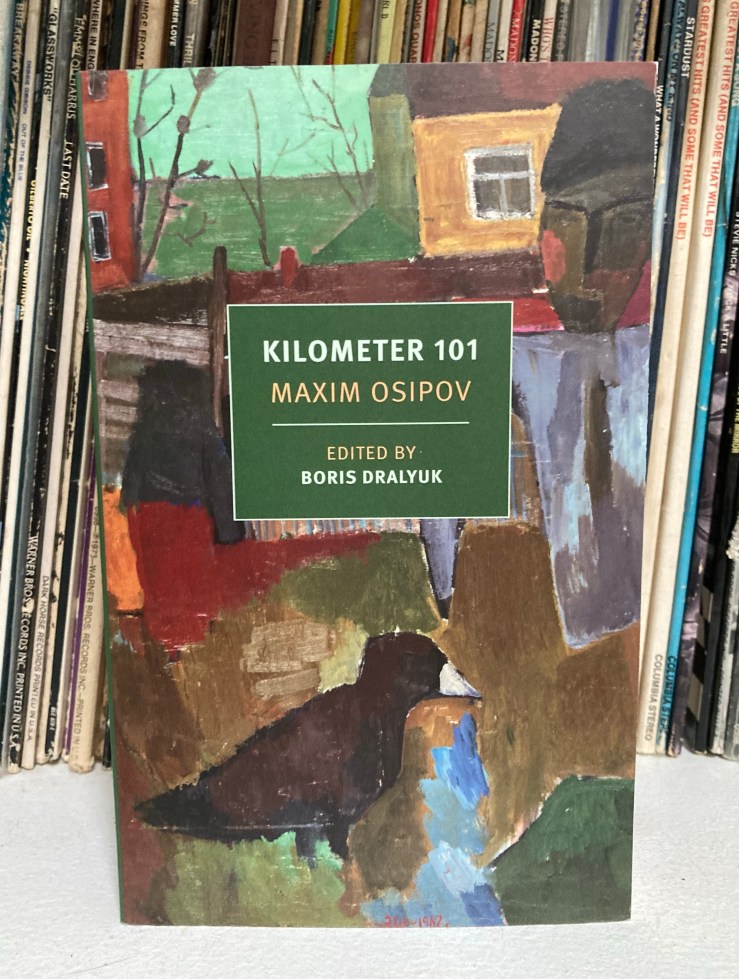
Maxim Osipov’s Kilometer 101 (Book acquired, early Sept. 2022)

Maxim Osipov’s Kilometer 101 collects six stories and four essays by the Russian author. The translations are by Boris Dralyuk, Nicolas Pasternak Slater, and Alex Fleming. Kilometer 101 is out next month from NYRB. Their copy:

The town of Tarusa lies 101 kilometers outside Moscow, far enough to have served, under Soviet rule, as a place where former political prisoners and other “undesirables” could legally settle. Lying between the center of power and the provinces, between the modern urban capital and the countryside, Tarusa is the perfect place from which to observe a Russia that, in Maxim Osipov’s words, “changes a lot [in the course of a decade], but in two centuries—not at all.” The stories and essays in this volume—a follow-up to his debut in English, Rock, Paper, Scissors—tackle major questions of modern life in and beyond Russia with Osipov’s trademark blend of daring and subtlety. Deceit, political pressure, ethnic discrimination, the urge to emigrate, and the fear of abandoning one’s home, as well as myriad generational debts and conflicts, are as complexly woven through these pieces as they are through the lives of Osipov’s fellow Russians and through our own. What binds the prose in this volume is not only a set of concerns, however, but also Osipov’s penetrating insights and fearless realism. “Dreams fall away, one after another,” he writes in the opening essay, “some because they come true, but most because they prove pointless.” Yet, as he reminds us in the final essay, when viewed from ground level, “life tends not towards depletion, towards zero, but, on the contrary, towards repletion, fullness.”

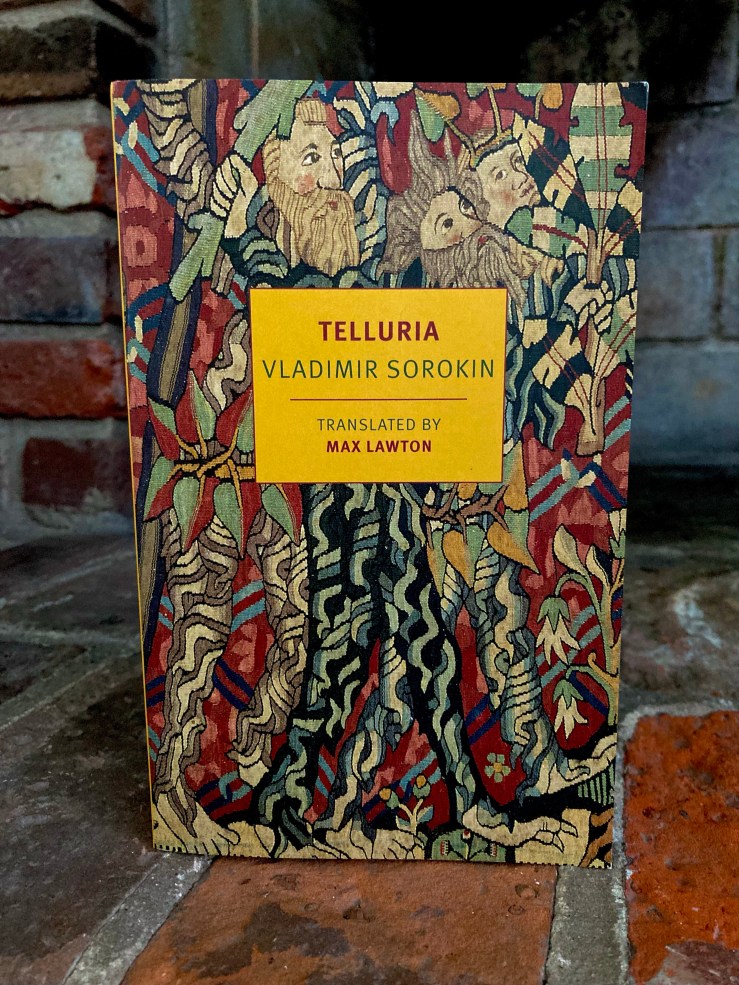
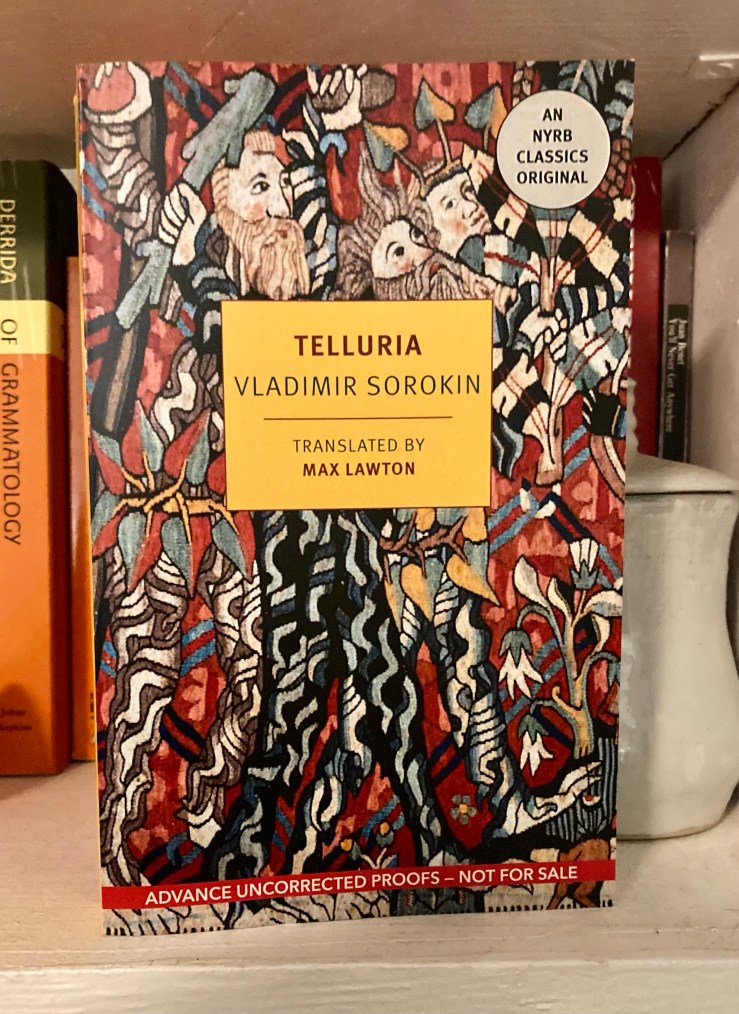
Vladimir Sorokin’s novel Telluria is a polyglossic satirical epic pieced together in vital miniatures


Vladimir Sorokin’s 2013 novel Telluria, in its first English translation thanks to the estimable talents of Max Lawton, is one of the best contemporary novels I’ve read in a long time. Telluria is a polyglossic satirical epic pieced together in vital miniatures. Its fifty sections are simultaneously discrete and porous, richly dense but also loose and funny. It teems with life and language, exploding notions of stable storytelling into a carnival of wild voices.

The world Sorokin conjures in Telluria is best experienced without map or gloss. My joy in reading the novel came from wandering through its fifty chapters and slowly building my own sense of this post-collapse world. You explore Telluria, finding footing after stumbling initially over the disorienting newness of a particular section. And just as you’ve tuned into the particular section’s frequency, you find yourself in a new chapter, a new idiom, a new voice. It’s a goddamn linguistic picaresque best enjoyed on its own terms, terms it refuses to spell out in simple exposition.

Telluria does not have a plot in the traditional sense, although its sum is greater than its parts. The fifty sections are not mere exercises in style, but rather a reflection of post-twentieth century consciousness: fractured, paranoid, hallucinatory, kaleidoscopic, chaotic, joyous, dystopian, utopian, ironic, earnest, strange…The reader who wanders through the fifty chapters will piece together a brave weird world where our contemporary nation states and political alliances have splintered into a cacophony of fiefdoms, city states, monarchies, republics, and so on. (There’s even a system of “enlightened theocratocommunofeudalism.”)

The needle that threads through it all is tellurium, a real (if earth-rare) element (as you’ll undoubtedly recall from your high-school chemistry class). In our world, tellurium is mostly employed in creating alloys for machines. In the world of Telluria, it is a drug that can take its user on a transcendental journeys, Those lucky enough to get their hands on a tellurium spike might find themselves transported into metaphysical spaces. Expert “carpenters” hammer tellurium nails into the heads of seekers, and these seekers go on to communicate with the dead, rampage fearlessly in battle, meet Christ in heaven, fly above mountaintops, or, in some cases, simply perish.

I should have by now offered a taste of the language in Telluria. A nice chunk of text set within the gum of context, no? But I don’t know how to do that effectively–Telluria is a dazzle of tongues. Offering a taste of just two or three of the sections would insufficient. It would amount to something like the parable of the blind men and the elephant.

Instead, I’ll offer Max Lawton’s thoughts on translating Telluria, from an interview he granted me earlier this year

Sorokin’s conceit in writing the thing was not to symbolically represent a particular historical period or something like that, but to give voice to difference itself. 50 voices and 50 differences. Because of that, my task was monomaniacal in its complexity: to follow Sorokin out into deep waters of difference and, like him, give birth to 50 absolutely unique voices…I had to be impenetrable where he was impenetrable, ungainly where he was ungainly, and senseless where he was senseless; anything less would have been a betrayal of what makes the book worth reading. As such, I appealed to Chaucer (for the centaur), Céline (for the bagmen), Turgenev translations (for the hunting), Faulkner and McCarthy (for the oral narratives about highly rural situations…), Ginsberg (for the “Howl” rip-off), Mervyn Peake (for the overripe fantasy-novel fun), and a great many others.

Telluria’s verbal carnival matches (and, really, engenders) seemingly endless imaginative invention on Sorokin’s part. We get dog-headed mutants engaged in philosophical discourse, “litluns” planning a revolution over the normies, the Carpenters of Western Europe hammering tellurium spikes into an army of Knights Templar who are about to set off on their thirteenth flying crusade against Islamic invaders. There are late-night, drug-fueled, multilingual bullshitting sessions, orgies, a princess who gets her kicks slumming it in disguise and fucking the serfs. There are lovers separated by thousands of miles, mutated horses larger than three-story houses, tourists in the USSR — the Ultra-Stalinist Soviet Socialist Republic. A centaur falls in love. Etc.

I copped out of citing any passages from Telluria above, protesting that it might offer an incomplete picture—and that’s true. But reviewing my notes, I think it’s worth sharing one passage at some length, a passage that I think both describes the milieu of the novel as well as approaches a kind of moral vision for the novel (with the strong caveat that any one distinct moral vision is necessarily exploded and ironized by the other voices that thread through the novel—as Lawton stated in our interview, Telluria is “an ode to difference….For Sorokin, the world is a million different textures, a million different languages, and no ONE can be said to triumph.”)

“We must not take anyone else’s karma upon ourselves, not even in small matters,” the brigadier continued. “Especially now in our renewed, post-war world. Take a look at the Eurasian continent: after the collapse of ideological, geopolitical, and technological utopias, it was finally plunged back into the blessèd and enlightened Middle Ages. The world returned to human scale. Nations found themselves. Man ceased to be the sum of the technology around him. Mass production is living out its final years. There aren’t two identical nails beaten into humanity’s head. Man regained a sense of the thing, started to eat healthy grub and ride horses again. Genetic engineering helps man to feel his true size. Man has regained faith in the transcendental. Regained his sense of time. We’re not rushing anywhere anymore. Most importantly–we understand that there can be no technological heaven on earth. And, and in broader terms, no heaven at all. Earth has been given to us as an island of overcoming. Everyone chooses what to overcome and how to overcome it. And they make that choice themselves!”

Sorokin’s post-collapse world doesn’t seem all that bad to me. 

Telluria was my first encounter with Sorokin, and I think it makes a grand introduction. I’ve since read Day of the Oprichnik (translated by Jamey Gambrell) and Blue Lard (forthcoming next year from NYRB and also translated by Max Lawton). I’m currently reading Lawton’s translation of Their Four Hearts. While I think Blue Lard is the strongest of these titles (and I look forward to/dread reviewing it in the future), Telluria is an excellent introduction to Sorokin’s work, offering an engaging taste of his methods (all through Lawton’s lively translation). The book’s energy and imagination offer a nice counter to the dour dystopian narratives that abound these days.

Telluria is Not For Everyone. Readers interested in clear “worldbuilding” or plots that tie up all the loose ends will find themselves exasperated, as will readers who actively resist the linguistic playfulness of Lawton’s translation. Similarly, readers searching for a moral analogy for contemporary Russian politics and culture will find themselves straining to apply whatever mold they’ve already forged in their minds. Neither is this book particularly interested in the Americas or Western Europe. Sorokin’s province is the vast vacillating mass of Eurasia. In his 2012 book Russia: A Very Short History, Geoffrey Hosking notes “the arduous and challenging task of building a coherent polity on the flat open plains of northern Eurasia,” arguing that although Russia “has been a remarkable success story,” it is nevertheless a country “which had its own weaknesses programmed into it.” Hoskings continues: “[Russia] rested on a tacit compact between ruler, elites, and communities of ordinary people, renewed after periods of upheaval and crisis, yet never wholly harmonious, always subject to internal strains.” Telluria is an ecstatic and jarring exploration of those upheavals, those crises, those wonderful strains, a satire on the very notion of a coherent polity.

I loved it. Very highly recommended.

Vasily Grossman’s The People Immortal (Book acquired, 30 Aug. 2022)

A copy of by Vasily Grossman’s 1943 novel The People Immortal arrived at Biblioklept World Headquarters. It’s a new translation by Robert Chandler and Elizabeth Chandler, available next month from NYRB.

(It’s also a reminder to pick up the copy of Grossman’s massive novel Life and Fate that’s been staring me down for years).

NYRB’s blurb:

Vasily Grossman wrote three novels about the Second World War, each offering a distinct take on what a war novel can be, and each extraordinary. A common set of characters links Stalingrad and Life and Fate, but Stalingrad is not only a moving and exciting story of desperate defense and the turning tide of war, but also a monumental memorial for the countless war dead. Life and Fate, by contrast, is a work of moral and political philosophy as well as a novel, and the deep question it explores is whether or not it is possible to behave ethically in the face of overwhelming violence. The People Immortal is something else entirely. Set during the catastrophic first months of the German invasion of the Soviet Union, this is the tale of an army battalion dispatched to slow the advancing enemy at any cost, with encirclement and annihilation its promised end. A rousing story of resistance, The People Immortal is the novel as weapon in hand.

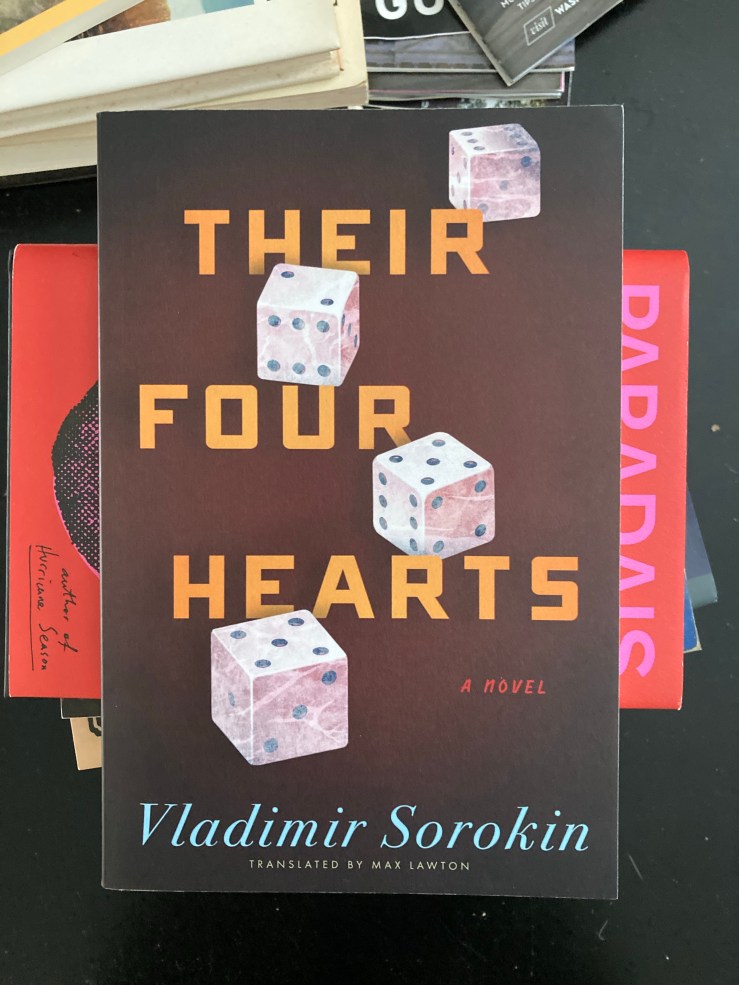
Vladimir Sorokin’s Their Four Hearts (Book acquired, 30 July 2022)

I ordered a copy of Vladimir Sorokin’s 1991 novel Their Four Hearts in translation by Max Lawton a couple of weeks ago when I was interviewing Max about his translation of Sorokin’s latest (in English), Telluria. In our discussion, Max told me,

I recommend any new reader of Sorokin to immediately chase TELLURIA with THEIR FOUR HEARTS: those two combined give something like a complete picture of the master at work.

Here’s the back copy, which Max might’ve written:

In many respects, Their Four Hearts is a book of endings and final things. Vladimir Sorokin wrote it in the year the Soviet Union collapsed and then didn’t write fiction for ten years after completing it––his next book being the infamous Blue Lard, which he wrote in 1998. Without exaggerating too much, one might call it the last book of the Russian twentieth century and Blue Lard the first book of the Russian twenty-first century. It is a novel about the failure of the Soviet Union, about its metaphysical designs, and about the violence it produced, but presented as God might see it or Bataille might write it.

Their Four Hearts follows the violent and nonsensical missions carried out by a group of four characters who represent Socialist Realist archetypes: Seryozha, a naive and optimistic young boy; Olga, a dedicated female athlete; Shtaube, a wise old man; and Rebrov, a factory worker and a Stakhanovite embodying Soviet manhood. However, the degradation inflicted upon them is hardly a Socialist Realist trope. Are the acts of violence they carry out a more realistic vision of what the Soviet Union forced its “heroes” to live out? A corporealization and desacralization of self-sacrificing acts of Soviet heroism? How the Soviet Union truly looked if you were to strip away the ideological infrastructure? As we see in the long monologues Shtaube performs for his companions––some of which are scatological nonsense and some of which are accurate reproductions of Soviet language––Sorokin is interested in burrowing down to the libidinal impulses that fuel a totalitarian system and forcing the reader to take part in them in a way that isn’t entirely devoid of aesthetic pleasure.

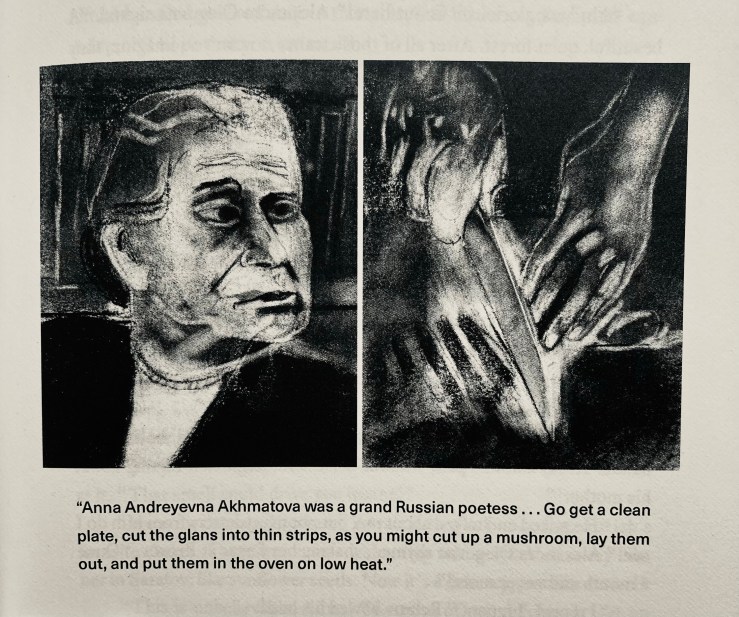
As presented alongside Greg Klassen’s brilliant charcoal illustrations, which have been compared to the work of Bruno Schulz by Alexander Genis and the work of Ralph Steadman as filtered through Francis Bacon by several gallerists, this angular work of fiction becomes a scatological storybook-world that the reader is dared to immerse themselves in.

And here’s one of Greg Klassen’s illustrations:

“Legend,” a very short tale from Jorge Luis Borges

“Legend” by Jorge Luis Borges

Translated by Andrew Hurley


Cain and Abel came upon each other after Abel’s death. They were walking through the desert, and they recognized each other from afar, since both men were very tall. The two brothers sat on the ground, made a fire, and ate. They sat silently, as weary people do when dusk begins to fall. In the sky, a star glimmered, though it had not yet been given a name. In the light of the fire, Cain saw that Abel’s forehead bore the mark of the stone, and he dropped the bread he was about to carry to his mouth and asked his brother to forgive him.

“Was it you that killed me, or did I kill you?” Abel answered. “I don’t re-member anymore; here we are, together, like before.”

“Now I know that you have truly forgiven me,” Cain said, “because forgetting is forgiving. I, too, will try to forget.”

“Yes,” said Abel slowly. “So long as remorse lasts, guilt lasts.”

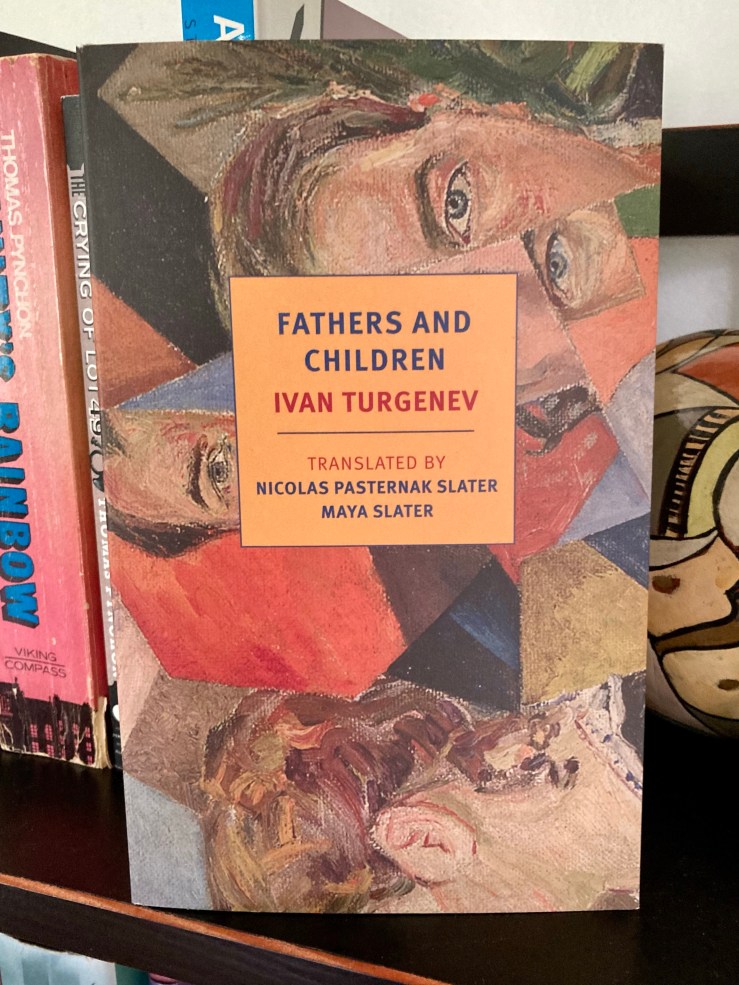
Ivan Turgenev’s Fathers and Children (Book acquired, 6 July 2022)

NYRB is publishing Ivan Turgenev’s novel Fathers and Children next month, in English translation by Nicolas Pasternak Slater and Maya Slater. NYRB’s blurb:

Ivan Turgenev’s Fathers and Children is a masterpiece not only of the nineteenth century but of the whole of Russian literature, a book full to bursting with life. It is a novel about the relationships between the young and the old; about love, families, politics, religion; about strong beliefs and heated disagreements, illness and death. It is about the clash between liberals and conservatives, revolutionaries and reactionaries. At the time of its publication in 1862, the book aroused indignation in its critics who felt betrayed by Turgenev’s refusal to let his novel serve a single ideology; it also received a spirited defense by those who saw in his diffuse sympathies a greater service to art and to humanity. Fathers and Children is not a practical manifesto but a lasting work of art and a timely book for our present age, newly and ably translated by Nicolas Pasternak Slater and Maya Slater.

Fifty similes, really more than fifty similes, from Roberto Bolaño’s novel 2666

  1. She looks like a nun, thought Quincy, or like she belongs to a dangerous cult.
  2. the movie in the dream was like a negative of the real movie
  3. clouds that looked like cathedrals or maybe just little toy churches abandoned in a labyrinthine marble quarry one hundred times bigger than the Grand Canyon
  4. like the work of a lunatic
  5. like a miniature Russian Orthodox church
  6. what it was most like was an enchanted island
  7. like the lilies that bloom and die in a single day
  8. a dream that breaks away from another dream like one drop of water breaking away from a bigger drop of water
  9. a metaphor is like a life jacket
  10. there are life jackets that float and others that sink to the bottom like lead
  11. I went through books like they were barbecue.
  12. friendly words that sounded like obscenities to my ear and that, thinking about it now, might actually have been obscene
  13. Reading is like thinking, like praying, like talking to a friend, like expressing your ideas, like listening to other people’s ideas, like listening to music (oh yes), like looking at the view, like taking a walk on the beach.
  14. gestured and bobbed like a rapper
  15. Hollows in the ground, like World War I bomb craters
  16. Fate headed down the stairs, taking them in threes as if he were dashing for the street, like a boy heading out for a free afternoon with his friends.
  17. smiling a catlike smile
  18. everyone, I mean everyone, is like the ancient Christians in the Roman circus
  19. Sunsets in the desert seem like they’ll never end, until suddenly, before you know it, they’re done. It’s like someone just turned out the lights
  20. She had a hoarse, nasal voice and she didn’t talk like a New York secretary but like a
    country person who has just come from the cemetery.
  21. like butterflies summoned by his prayers
  22. something like happiness
  23. stood to attention like a soldier
  24. the story grows like a snowball until the sun comes out and the whole damn ball melts and everybody forgets about it and goes back to work
  25. The fucking killings are like a strike, amigo, a brutal fucking strike.
  26. “It’s like a dream,” said Guadalupe Roncal. “It looks like something alive.”
  27. it looks like a woman who’s been hacked to pieces. Who’s been hacked to pieces but is still alive. And the prisoners are living inside this woman.”
  28. two Mexican reporters who stared at him like dying men
  29. the knowledge slipped like water through his fingers
  30. she smiled like a goddess
  31. This place is like hell
  32. A black sky like the bottom of the sea.
  33. like fucking a man who isn’t exactly a man
  34. like becoming a little girl again
  35. like being fucked by a rock. A mountain.
  36. it’s like you’re fucking a mountain but you’re fucking inside a cave
  37. In other words it’s like being fucked by a mountain in a cave inside the mountain itself
  38. Well, it feels like being fucked by the air. That’s exactly how it feels.
  39. So fucking a policeman is like being fucked by a mountain and fucking a narco is like being fucked by the air.
  40. like a tour guide with an eye for local color
  41. he treated her like his slave
  42. like a joke
  43. like the title of a David Lynch film
  44. narrow room like a monk’s cell
  45. the shadows dispersed by the flashes of car lights like comet tails in the dark
  46. It’s odd that someone would hang a book out like a shirt
  47. like a huge hearse
  48. She looked like an athlete from the 1940s.
  49. All of this is like somebody else’s dream
  50. the highway was like a river

These similes are from “The Part About Fate,” the third part of 2666, a novel by Roberto Bolaño, in English translation by Natasha Wimmer.

A metaphor is like a life jacket | From Roberto Bolaño’s 2666

Really, when you talk about stars you’re speaking figuratively. That’s metaphor. Call someone a movie star. You’ve used a metaphor. Say: the sky is full of stars. More metaphors. If somebody takes a hard right to the chin and goes down, you say he’s seeing stars. Another metaphor. Metaphors are our way of losing ourselves in semblances or treading water in a sea of seeming. In that sense a metaphor is like a life jacket. And remember, there are life jackets that float and others that sink to the bottom like lead. Best not to forget it. But really, there’s just one star and that star isn’t semblance, it isn’t metaphor, it doesn’t come from any dream or any nightmare. We have it right outside. It’s the sun. The sun, I am sorry to say, is our only star. When I was young I saw a science fiction movie. A rocket ship drifts off course and heads toward the sun. First, the astronauts start to get headaches. Then they’re all dripping sweat and they take off their spacesuits and even so they can’t stop sweating and before long they’re dehydrated. The sun’s gravity keeps pulling them ceaselessly in. The sun begins to melt the hull of the ship. Sitting in his seat, the viewer can’t help feeling hot, too hot to bear. Now I’ve forgotten how it ends. At the last minute they get saved, I seem to recall, and they correct the course of that rocket ship and turn it around toward the earth, and the huge sun is left behind, a frenzied star in the reaches of space.

From “The Part About Fate,” the third part of 2666, a novel by Roberto Bolaño, in English translation by Natasha Wimmer.

Blixa Bargeld’s “semi-fictional” tour diary, Europe Crosswise: A Litany (Book acquired, 6 June 2022)

Blixa Bargeld, the lead singer and guitarist of the German experimental noise band Einstürzende Neubauten published a “semi-fictional” account of his bands 2008 tour a year after the tour’s completion. That book, Europe Crosswise: A Litany is now available in English translation by Mark Kanak from Contra Mundum. Their blurb:

In this semi-fictional account, Blixa Bargeld recounts life on tour in 2008 with Einstürzende Neubauten — from Lisbon to Moscow, Oslo to Naples, criss-crossing Europe. Along the way we encounter mind numbing routines, interesting restaurants (good and bad), colorful museums, rocky bus rides, mundane hotels, odd characters and old friends — they’re all there.  Along with the structure holding it all together, namely, a recurring setlist that is invoked as a litany.  In the end the book proves to be a declaration of love for Europe, and in the current dark times we are presently living through, more immediate than ever.

The book, first published in German in 2009 and something of a semi-fictional travel journal from the “Alles Wieder Offen” Tour, will be published soon by Contra Mundum Press in an English translation by author, translator, and radioplay artist Mark Kanak.

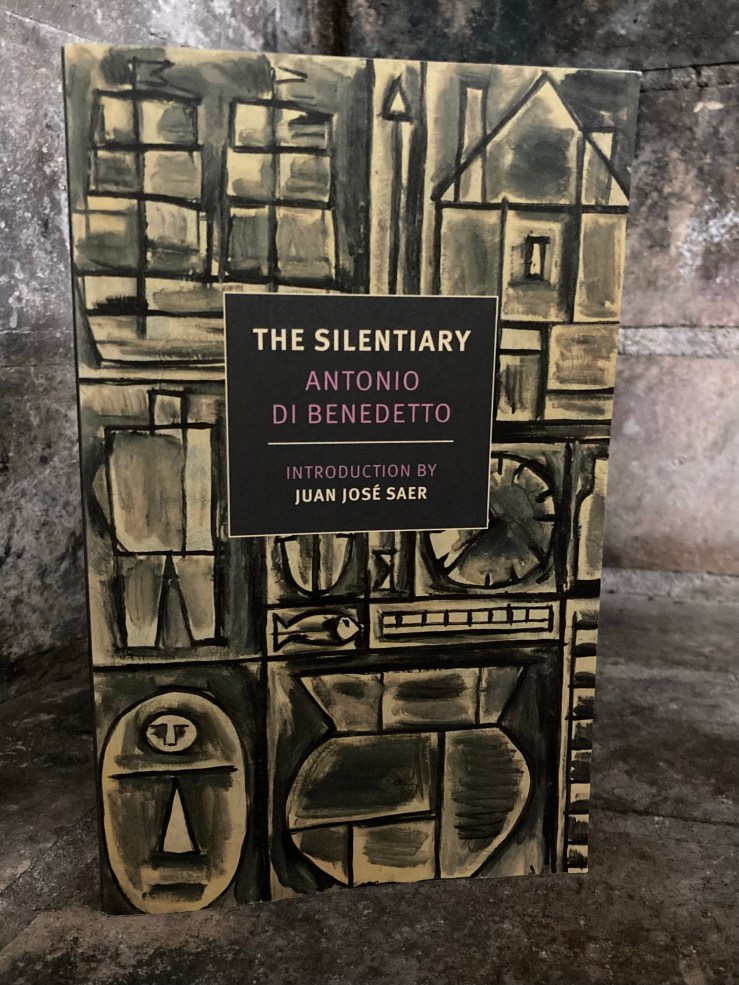
Not toward peace | On Antonio di Benedetto’s novel The Silentiary

“I don’t live well,” the unnamed narrator of Antonio di Benedetto’s novel The Silentiary tells the young woman he will soon marry. “The excuse isn’t clear to her, though she tries to follow its meaning,” he continues, this time to the reader. While the narrator seems, on the surface, a man with a good job as a clerk who lives in a respectable house with his mother, he doesn’t live well—the adverb modifies the verb live in a literal, visceral sense: our hero is an anxious wreck who cannot tune in to the modern condition. He “can’t sleep or eat or read or speak in the chaos of sound” that is the modern, post-war condition.

And that is the central problem of The Silentiary: the chaos of sound. Set in an unnamed, rapidly-growing Latin American city in the early 1950s, Di Benedetto’s 1964 novel belongs to the same canon of Kafkaesque, existentialist postwar novels like Albert Camus’s The Stranger and Walker Percy’s The Moviegoer. Like those novels, The Silentiary follows the nonadventures of a disaffected young man out of tune with his society.

There’s no need to summarize The Silenciary at length. The narrator works in an office, has a crush on his neighbor but ends up marrying her friend, and converses with his flighty philosophical foil, Besarion. He also dreams of completing a novel (to be called The Roof), but alas can never set about even getting started because of the “chaos of sound” that ever encroaches upon him. And that is the real plot of The Silentiary: our poor hero is ever retreating from modernity’s cacophony, only to find new, louder sounds piercing his repose.

His attempts to evade noise are simultaneously mundane and absurd. At one point, he’s schlepping around an old piano that no one can play (symbol of his mother’s middle-class respectability) like a giant anchor, trying to jam it into small quarters. Another sequence finds him moving to a small town, only to end up with a tragic punchline. He’s moved next door to a blacksmith: “Forge and bellows, the anvil and its hammers.”

The narrator’s wife loves him without understanding him, but he finds a confessor in his friend Besarion. This enigmatic character pops in and out of the novel, engaging in puzzling dialogues with the narrator, who is wary and possibly jealous of his friend: “He’s free. He has managed to make his life a long digression, or a kind of multiple metaphor.” Years ago, before the narrator had married and before Besarion had gone on a series of religious travels, he had diagnosed the narrator thusly: “Your quest against noise is metaphysical.” Upon return though, Besarion ironizes that diagnosis, stating that even though his friend believes that his “adventure is metaphysical,” it is actually “physiological, or psychic, or nervous.” This can’t relieve the narrator’s pain though: the chaos of noise “won’t let me exist,” he protests. Besarion solemnly tells him, “Bear up. Make do.”

For all its seriousness, The Silentiary is often a funny, wry novel. Consider the narrator’s description of the automechanics who’ve moved next door: “They seem to have abandoned themselves entirely to their passion for the hygiene of all that has four wheels and an engine.” Or our anxious guy getting dyspepsia: “The food I ingest at lunch does not resign itself to its destiny.”

The phrasing in such moments recalls Di Benedetto’s 1956 novel Zama, also ably translated by Esther Allen. Again, Allen captures something crisp and wry, subtle and precise that is surely native to Di Benedetto’s prose. The results are often beautiful, like in a strange little haiku-like moment early in the novel:

Last night the big gray cat of my childhood came to me.

I told him that noise stalks and harries me.

Slowly, intensely, he cast his animal, companionable gaze upon me.

Or the beautiful phrasing of another strange moment:

…I come across a photo of the lion tamer we dined with after the circus performance.

The tamer’s mane is as untamed as ever, in all the dishevelment of bad nights to which no comb can offer a morning remedy. He’s under double guard.

Lovely!

Yet for all its humor and beauty, The Silentiary is ultimately a sad, though never dour, read. The novel does not wax elegaic for a romanticized, quieter past, nor does it call to make peace with cacophony. There’s only Besarion’s stern intonation to “Bear up [and] Make do.” We’ve the portrait of one man who cannot escape or mute the chaos of sound. Ultimately, he cannot bear up and make do. So he resists, becoming a martyr for silence…but it doesn’t end well. The novel concludes darkly: “The night flows on…and not toward peace.” Recommended.

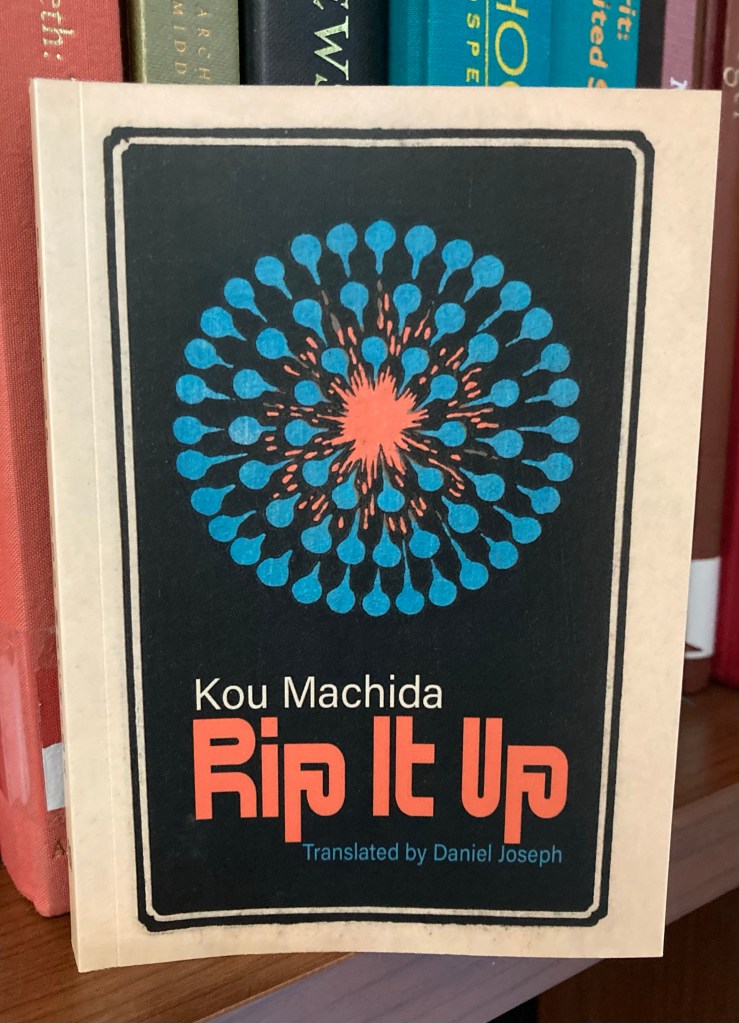
Kou Machida’s Rip It Up (Book acquired, 15 April 2022)

So I got into Kou Machida’s short novel Rip It Up last night. This Japanese novel (original title, きれぎれ [Kiregire]) gets its first English translation, via Daniel Joseph and Mercurial Editions, a new translation imprint from Inpatient Press. This is how the publisher describes Rip It Up:

Set in a kaleidoscopic hyperreal Japan circa Y2K, Rip It Up catalogues the misdeeds and misgivings of a down-and-out wannabe debonair who ekes out a meager living at the fringes of the art world, wracked by jealousy at his friend’s success and despondency of his own creative (and moral) bankruptcy. In turn hilarious and also horrifying, Machida’s pyrotechnic prose plumbs the discursive depths of the creative spirit, a head-spinning survey of degeneration and self-sabotage.

Machida’s psychedelic punk prose takes a few pages to tune into. The (as-yet?) unnamed narrator’s voice is tinged with madness and soaked with vitriol for the conformist society he can’t seem to get out of. He’s a rich kid, a lout, and a bum, obsessed with Satoe the horse-headed girl. Her head isn’t really a horse’s head; rather, it’s a mask she’s wearing when he first runs into her at a drunken Setsubun party at the “panty bar” where she works. He’s stumbled in after getting drunk at his friend’s funeral. The scene Machida conjures is simultaneously vile, hallucinatory, and hilarious, with salarymen and “little people gotten up to look like Fukusuke dolls” crashing about the place in a bizarre karaoke showdown. The narrator takes the mic, belting out malapropisms that synthesize and parody the lyrics of Western pop songs:

It’s not unusual to hi-de hi-de hi-de-hi

You’re as chaste as ice

And baby we were born to nun

Rollin’, rollin’, rollin’ on Moon River

Any way the lunch grows, doesn’t really matter

A few pages later, the narrator still pines for the horse-headed girl, spending all his money at the panty bar. He has to go visit his rich mother for a “loan,” but she makes him embark on a stolid omiai, a marriage interview, which he torpedoes by declaring to the prospective partner and her dour mother “exactly what kind of person I am”:

That I spend all my free time at the panty bar. That I dropped out of high school. That I’m a spendthrift. That I’ve got my head in the clouds and I’ve never done an honest days work in my life because I despise hard work. That’s all.

I’m digging Rip It Up so far; it’s alienating, self-indulgent stuff. Daniel Joseph’s translation conveys a desperate, stuffy world, and shows how linguistic resistance might puncture stifling conformity. More thoughts to come. Check out Kou Machida’s seminal punk band Inu,


Hiroko Oyamado’s subtle novel The Hole captures the banal surreal loneliness of modern life

Hiroko Oyamada’s novel The Hole is a subtle, slim, slow-burn low-stakes horror story that tiptoes neatly between banality and surrealism. Our first-person narrator is Asahi, a young, recently-married woman. Asahi–or Asa, as she thinks of herself–is a part-time employee in a large city somewhere in Japan. She doesn’t really have any friends or hobbies, let alone any ambitions. When her husband Muneaki gets a job transfer to the countryside, Asa’s mother-in-law Tomiko offers the young couple the house next to hers, rent-free. The young couple’s economic situation means they can’t refuse, so they don’t. Asa’s only real acquaintance, a work buddy, remarks how lucky she is to be a housewife, but Asa is ambivalent.

That ambivalence radiates throughout The Hole. In David Boyd’s spare, direct translation, Oyamada pushes her hero into a stifling, stuffy, overheated summer. The skinny novel is an exercise in boredom-as-horror: Even before Asa arrives in her husband’s rural hometown, everything’s just a wee bit off. The cicadas vibrate at a different pitch; the locals seem to come from a different era; time seems to run backwards and forwards.

Without a car or job, Asa is essentially stranded, spending her days guilty over running the AC, and unable to communicate with her husband’s grandfather, who mutely gardens his hours away.

Her only cultural landmark is a 7-Eleven convenient store, where mother-in-law Tomiko sends her on an errand one day. The banal errand becomes a bizarre Carollonian quest—but a quest without a clear object. On her route to the convenience store (what could be more boring and inconvenient?) Asa spies a large, strange, dark-furred creature:

 It had wide shoulders, slender and muscular thighs, but from the knees down, its legs were as thin as sticks. The animal was covered in black fur and had a long tail and rounded ears. Its ribs were showing, but its back was bulky, maybe with muscle or with fat.

Frantically following it, she falls into a hole that fits her nearly perfectly (like a proscribed role, or a coffin, or like, whatever):

As I tried to move, I realized how narrow the hole really was. The hole felt as though it was exactly my size – a trap made just for me. The bottom of the hole was covered with something dry, maybe dead grass or straw. Looking toward the river through a break in the grass, all I could see was white light.

A mysterious white-clad neighbor named Sera (who calls Asa “the bride”) pulls her out from the hole, and she makes her way to the 7-Eleven, where a gang of strange children block her mission. She also meets an oddball who later claims to be the white rabbit to her lost Alice. He claims to be an unacknowledged mystery brother-in-law who lives in a shed, having relinquished adult responsibility. There are centipedes and bug bites and other strange goings on—and Asa  talks about absolutely none of it with her husband or mother-in-law.

The Hole captures the stifling omnipresence of loneliness. Asa is a sympathetic character, and while many of the details of her circumstance are particular to Japanese culture, the narrative resonates with the larger absurdities of contemporary life. Asahi’s loneliness burns all the more real for the novel’s surrealism. Her loneliness is the realest thing in The Hole, its presence never acknowledged because it cannot fully be named. The “loneliness” is more real than the quasi-mystical hole-digging creature that plagues the countryside, or the manic brother-in-law-who-lives-in-a-shed-in-the-backyard whom no one ever mentions. But unlike these surreal entities, Asa’s loneliness is never directly invoked.

The Hole will be somewhat familiar with anyone who’s climbed about in the Kafka tree. While Oyamada directly evokes Carroll’s Alice stories, her story is far less fanciful, its dire core obscured with a thin veneer of the banal. The Hole recalls the tone and mood of Kobo Abe’s The Woman in the Dunes, where the protagonist comes to be in an uncanny scenario that becomes uncannier by the moment. But Oyamada’s narrator doesn’t seem to demarcate the separation into unreality; rather, the novel absorbs its narrator into a new unreal-real reality.

The Hole is wonderfully dull at times, as it should be. It’s layered but brittle, with notes of a freshness just gone sour. It’s a quick, propulsive read—a thriller, even, perhaps—but its thrills culminate in sad ambiguity. Recommended.

New books by Caren Beilin and Cristina Rivera Garza from the Dorothy Project (Books acquired, 28 March 2022)

Two new enticing titles from the Dorothy Project: Caren Beilin’s novel Revenge of the Scapegoat and Cristina Rivera Garza’s collection New and Selected Stories. 

The Beilin seems like a picaresque surrealist joint, which is right up my alley. Press copy:

One day Iris, an adjunct at a city arts college, receives a terrible package: recently unearthed letters that her father wrote to her in her teens, in which he blames her for their family’s crises. Driven by the raw fact of receiving these devastating letters not once but twice in a lifetime, and in a panic of chronic pain brought on by rheumatoid arthritis, Iris escapes to the countryside—or some absurdist version of it. Nazi cows, Picassos used as tampons, and a pair of arthritic feet that speak in the voices of Flaubert’s Bouvard and Pécuchet are standard fare in this beguiling novel of odd characters, surprising circumstances, and intuitive leaps, all brought together in profoundly serious ways.

I spent a half hour reading a few of the stories in the Rivera Garza collection, going from an older track to a few that haven’t yet been published in Spanish yet. The later stories seem more daring in form and content–exciting stuff.

New and Selected Stories brings together in English translation stories from across Rivera Garza’s career, drawing from three collections spanning over 30 years and including new writing not yet published in Spanish. It is a unique and remarkable body of work, and a window into the ever-evolving stylistic and thematic development of one of the boldest, most original, and affecting writers in the world today.

The collection seems like a great introduction to Rivera Garza’s three decades of work. The translations are by Sara Brooker, Lisa Dillman, Francisca González Arias, Alex Ross, and Rivera Garza herself.

Antonio di Benedetto’s The Silentiary (Book acquired, 6 Jan. 2022)

This afternoon I finally jumped in to Esther Allen’s new translation of Antonio di Benedetto’s novel The Silentiary (the original title, El silenciero means something like “the silencer,” I think). We have an unnamed narrator living in an unnamed Latin America in a not-entirely unspecified time (“as of the late postwar era”). Our narrator is an office worker who lives with his mother. He dreams of being a writer and is in love with a neighbor. He despises noise, which is too bad because an autoshop has just opened up right next to his bedroom wall.

There’s a Kafkaesque vibe to The Silentiary—everything’s a bit uncanny, a wavelength off. The narrator is a wavelength off, I suppose. The prose is sometimes crisp and economic, and then zips out into wonderfully estranging images, like this odd sentence just a few pages in:

At dawn, the daylight a glaze of watery milk on the widowpanes, as my mind, jerked into a state of alertness, discerns a noise attached to the rear wall of my room, something like my heart grows agitated within me.

Or this little moment, longer than a haiku but still in the same spirit:

Last night the big gray cat of my childhood came to me.

I told him that noise stalks and harries me.

Slowly, intensely, he cast his animal, companionable gaze upon me.

It took me a few dozen pages to attune to the humor of The Silentiary. It’s just as odd and dry as the dark humor in Di Benedetto’s 1965 novel Zama,  but again, a wavelength off, a different flavor from the same palate. An episode of drinking that ends with our narrator carried home by his fellows is particularly entertaining. When I type out the description the bit seems hardly subtle. But it is.

More thoughts to come, but for now here’s NYRB’s blurb:

The Silentiary takes place in a nameless Latin American city during the early 1950s. A young man employed in middle management entertains an ambition to write a book of some sort. But first he must establish the necessary precondition, which the crowded and noisily industrialized city always denies him, however often he and his mother and wife move in search of it. He thinks of embarking on his writing career with something simple, a detective novel, and ponders the possibility of choosing a victim among the people he knows and planning a crime as if he himself were the killer. That way, he hopes, his book might finally begin to take shape.

The Silentiary, along with Zama and The Suicides, is one of the three thematically linked novels by Di Benedetto that have come to be known as the Trilogy of Expectation, after the dedication “To the victims of expectation” in Zama. Together they constitute, in Juan José Saer’s words, “one of the culminating moments of twentieth-century narrative fiction in Spanish.”

Vladimir Sorokin’s Telluria (Book acquired, 13 Jan. 2022)

I read the first few bits of Vladmir Sorokin’s postapocalyptic novel Telluria today. The book is forthcoming from NYRB in translation by Max Lawton. The fantastic blurb captured my interest right away:

Telluria is set in the future, when a devastating holy war between Europe and Islam has succeeded in returning the world to the torpor and disorganization of the Middle Ages. Europe, China, and Russia have all broken up. The people of the world now live in an array of little nations that are like puzzle pieces, each cultivating its own ideology or identity, a neo-feudal world of fads and feuds, in which no one power dominates. What does, however, travel everywhere is the appetite for the special substance tellurium. A spike of tellurium, driven into the brain by an expert hand, offers a transforming experience of bliss; incorrectly administered, it means death.

The fifty chapters of Telluria map out this brave new world from fifty different angles, as Vladimir Sorokin, always a virtuoso of the word, introduces us to, among many other figures, partisans and princes, peasants and party leaders, a new Knights Templar, a harem of phalluses, and a dog-headed poet and philosopher who feasts on carrion from the battlefield. The book is an immense and sumptuous tapestry of the word, carnivalesque and cruel, and Max Lawton, Sorokin’s gifted translator, has captured it in an English that carries the charge of Cormac McCarthy and William Gibson.

Telluria is forthcoming this summer; NYRB plans to publish three more by Sorokin, including Blue Lard, “which included a sex scene between clones of Stalin and Khrushchev [and] led to public demonstrations against the book and to demands that Sorokin be prosecuted as a pornographer.”

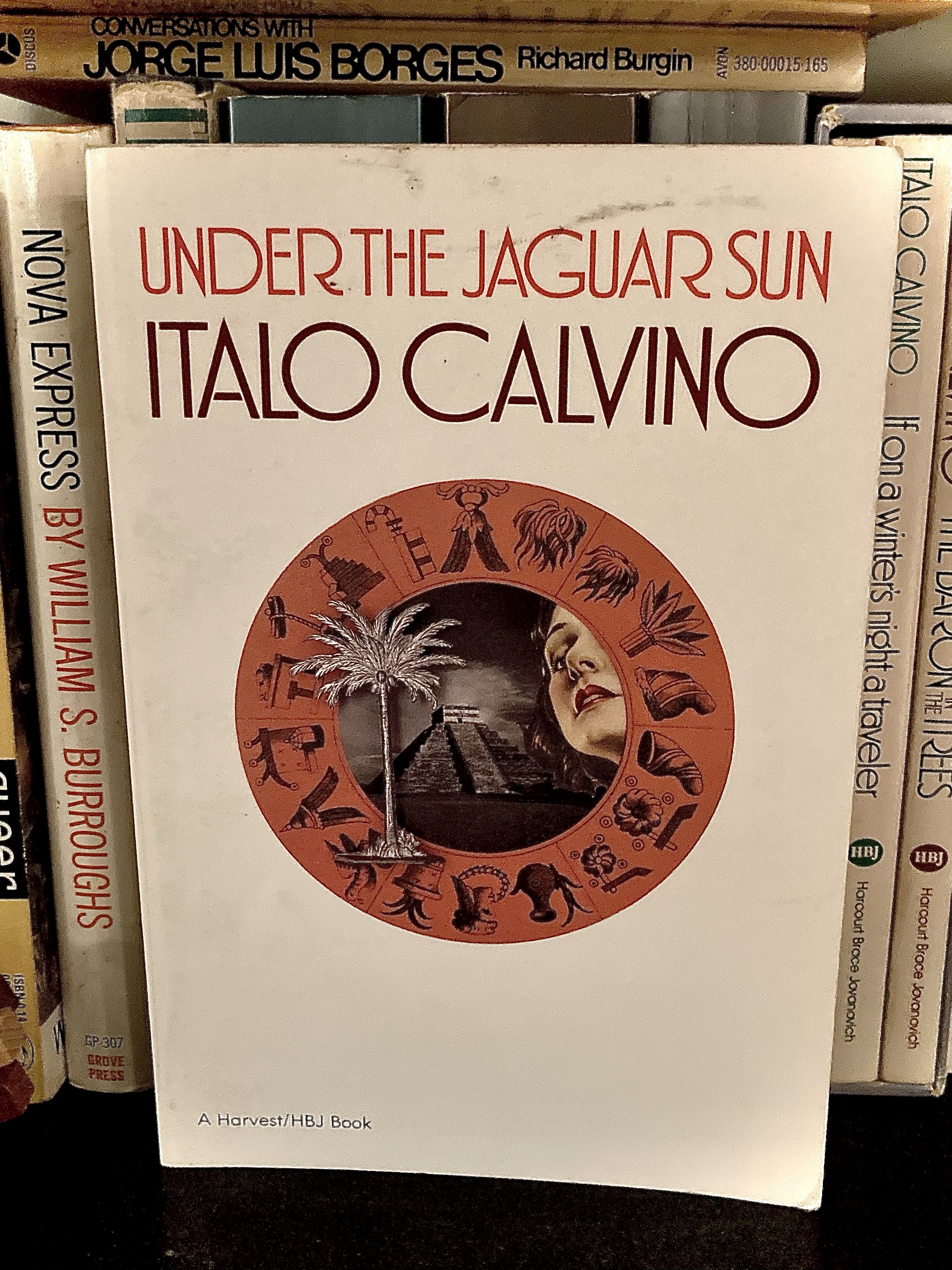
Darker sensations | A review of Italo Calvino’s Under the Jaguar Sun

I read Italo Calvino’s posthumous collection Under the Jaguar Sun over the past three days (in William Weaver’s 1988 translation). When I bought it last month I had no idea that it was a collection of stories (and not a novella), nor posthumous. I didn’t read the summary on the back. I just knew it was a thin Calvino I hadn’t read and I’ve been into thin reads lately. (I have two fat novels in translation staring me down from across the room as I write this. Their accusations linger.)

But Under the Jaguar Sun is posthumous, and it is a collection–a thin collection, sure, but the stories are strong. In her note at the end of the book, Esther Calvino offers the following:

In 1972 Calvino started writing a book about the five senses. At his death, in 1985, only three stories had been completed: “Under the Jaguar Sun,” “A King Listens,” and “The Name, the Nose.” Had he lived, this book would certainly have evolved into something quite different.

Esther Calvino suggests that Italo “would have provided a frame, as in If on a winter’s night a traveler, a frame that amounts to another novel, virtually a book in itself,” but concludes that the book should be read “simply as three stories written in different periods of his life.” That conclusion was the last thing I read in the book, which I think is fortunate–my reading wasn’t colored by a sense of lack, a sense of what could have been.

The first story, “Under the Jaguar Sun” (1982), is the strongest. The unnamed narrator and his companion Olivia (presumably his wife) are traveling through the state of Oaxaca in Mexico. They visit temples, soak in history, but mostly enjoy the food. “Under the Jaguar Sun” is the “taste” episode of Calvino’s would-be five senses novel, and at times the story reads like a gourmand’s travelogue. The couple, led by Olivia, seek newer, stranger flavors. Calvino’s narrator renders the gustatory titillation in fatty detail. Our boy gets his first taste of guac:

… we found guacamole, to be scooped up with crisp tortillas that snap into many shards and dip like spoons into the thick cream (the fat softness of the aguacate — the Mexican national fruit, known to the rest of the world under the distorted name of “avocado” — is accompanied and underlined by the angular dryness of the tortilla, which, for its part, can have many flavors, pretending to have none); then guajolote con mole poblano — that is, turkey with Puebla-style mole sauce, one of the noblest among the many moles, and most laborious (the preparation never takes less than two days), and most complicated, because it requires several different varieties of chile, as well as garlic, onion, cinnamon, cloves, pepper, cumin, coriander, and sesame, almonds, raisins, and peanuts, with a touch of chocolate; and finally quesa-dillas (another kind of tortilla, really, for which cheese is incorporated in the dough, garnished with ground meat and refried beans).

The real flavor the pair (again, led by Olivia) seems to truly hanker after though is, uh, human flesh. There’s a light parody of tourism happening in “Under the Jaguar Sun,” but the story’s core is cannibalism, victors and victims, the predatory past. Olivia repeatedly seeks to learn about “that flavor” — the flavor of humans sacrificed by Aztecs through ritual sacrifice. She even asks if the priests who oversaw the sacrifices left any recipes.

The cannibal motif slithers into the couple’s (perhaps-failing) relationship. The narrator imagines himself as a willing victim to his partner:

It was the sensation of her teeth in my flesh that I was imagining, and I could feel her tongue lift me against the roof of her mouth, enfold me in saliva, then thrust me under the tips of the canines. I sat there facing her, but at the same time it was as if a part of me, or all of me, were contained in her mouth, crunched, torn shred by shred. The situation was not entirely passive, since while I was being chewed by her I felt also that I was acting on her, transmitting sensations that spread from the taste buds through her whole body. I was the one who aroused her every vibration — it was a reciprocal and complete relationship, which involved us and overwhelmed us.

“Under the Jaguar Sun” is unusually dark for Calvino. The sinister pulse in the background and the enthralling unresolved mystery recall the work of one of Calvino’s descendents, Roberto Bolaño—or really any descendent of the Marquis de Sade.

The next story, “A King Listens” (1984) is also uncharacteristically dark for Calvino, although it is composed in the master’s standby, the second-person perspective. Here, the you is a king. Despite its shadowy contours, “A King Listens” finds Calvino in familiar territory, playing with semiotics:

A king is denoted by the fact that he is sitting on the throne, wearing the crown, holding the scepter. Now that these attributes are yours, you had better not be separated from them even for a moment.

That core anxiety—holding onto the attributes of rule, of the symbols and signs of kingness—form the backbone of the fevered plot. The You-King finds himself imperiled by the ever-present specter of a coup. And the ever-present threat of a coup is, of course, part and parcel of the kingness of being king.

“A King Listens” plays out like something out of Poe:

Your every attempt to get out of the cage is destined to fail: it is futile to seek yourself in a world that does not belong to you, that perhaps does not exist. For you there is only the palace, the great reechoing vaults, the sentries’ watches, the tanks that crunch the gravel, the hurried footsteps on the staircase which each time could be those announcing your end. These are the only signs through which the world speaks to you; do not let your attention stray from them even for an instant; the moment you are distracted, this space you have constructed around yourself to contain and watch over your fears will be rent, torn to pieces.

With its paranoid court intrigues and shadowy dream-logic, “A King Listens” reminded me very much of a sketch that might find its way into Mervyn Peake’s Gormenghast trilogy.

The last piece in Under the Jaguar Sun is “The Name, The Nose” is the shortest and earliest (1972). I imagine Calvino might have expanded (and improved on) it had he lived to see (taste smell feel hear) his five senses book to completion. The narrative trick behind the “The Name the Nose” is a fairly straightforward postmodern conceit: three narrators from different eras tell stories that are archetypically identical. Their stories are all versions of Cinderella, only told from the prince’s perspective. Oh, and that glass slipper is a very specific scent. We get a 17th. century French dandy, a 1960s rock star, and a caveman (had Calvino read William Golding’s The Inheritors?) all sniffing after a particular lady’s singular scent. Calvino’s conceit allows him to riff on anthropology and biology, and the conclusion seems to be that all of the manners, modes, and airs that we might put on doesn’t change the fact that we are beings who sense, who smell to survive and procreate. Our caveboy:

 Odor, that’s what each of us has that’s different from the others. The odor tells you immediately and certainly what you need to know. There are no words, there is no information more precise than what the nose receives.

The dark trajectory of each male pursuant is again Edgar Allan Poe territory, gothic ground. In the end, the odor that haunts them is death. (I wonder if Patrick Süskind read this story, which seems like a condensation of his novel Perfume.)

Under the Jaguar Sun is probably the darkest thing I’ve read by Calvino. The stories here suggest that human perception is inexorably linked to death and sex, and that attempts to turn those links into signs and symbols are survival mechanisms. There might not be a soul in this world. But perhaps the darker sensations here are really just senses evading signs, senses just sensing. The world is dark without sense; sensation illuminates darkness. That’s what Calvino has done here.

I don’t think this collection is the best introduction to Calvino for those interested (although I think anyone interested probably knows to start with If on a winter’s night a traveler or Invisible Cities—or, hey, listen to me, start with The Baron in the Trees). I think Under the Jaguar Sun does offer a different flavor, or scent, or tone to Calvino’s oeuvre, though, and I enjoyed my time in these tales.
Heimito von Doderer’s The Strudlhof Steps (Book acquired, 15 Nov. 2021)

Heimito von Doderer’s The Strudlhof Steps is forthcoming in translation by Vincent Kling from NYRB. Their blurb:

The Strudlhof Steps is an unsurpassed portrait of Vienna in the early twentieth century, a vast novel crowded with characters ranging from an elegant, alcoholic Prussian aristocrat to an innocent ingenue to “respectable” shopkeepers and tireless sexual adventurers, bohemians, grifters, and honest working-class folk. The greatest character in the book, however, is Vienna, which Heimito von Doderer renders as distinctly as James Joyce does Dublin or Alfred Döblin does Berlin. Interweaving two time periods, 1908 to 1911 and 1923 to 1925, the novel takes the monumental eponymous outdoor double staircase as a governing metaphor for its characters’ intersecting and diverging fates. The Strudlhof Steps is an experimental tour de force with the suspense and surprise of a soap opera. Here Doderer illuminates the darkness of passing years with the dazzling extravagance that is uniquely his.