Reminder: David Foster Wallace Archive’s Live Webcast Tomorrow Night

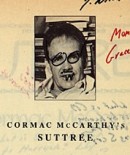
Wallace's edition of McCarthy's "Suttree"

A reminder for interested parties: the David Foster Wallace Archive at the Harry Ransom Center at the University of Texas will début the collection tomorrow night at 8:00pm EST with a live webcast featuring readings of Wallace’s works. You can access the webcast here.

(Ed. note — We got the date wrong the first time. Thanks to @MattBucher for the correction!)

Tom McCarthy Reads from His Novel C (. . . and We Gripe about Michiko Kakutani)

At The Guardian, Tom McCarthy reads from his novel C. Here’s Biblioklept’s review of C.

And, while we’re on reviews of C, I want to gripe about Michiko Kakutani’s negative review of the book at The New York Times. If you don’t like a book, fine. But if you’re a critic at an organ that purports to be the nation’s beacon of journalistic excellence, you need to practice better criticism than what Kakutani’s done here. I think it’s pretty much a given that a critic should judge a book on its own terms–in terms of what the author was trying to do. Instead, Kakutani faults McCarthy’s book for not living up to a standard she finds in Ian McEwan’s Atonement, of all things–

But unlike Mr. McEwan’s masterpiece “C” neither addresses larger questions about love and innocence and evil, nor unfolds into a searching examination of the consequences of art. Worse, “C” fails to engage the reader on the most basic level as a narrative or text.

Kakutani provides no real evidence for that second claim but I’ll let that alone for a moment, simply because I think she’s wrong, and that she doesn’t bother to back her subjective judgment reveals a rushed reading. What really bothers me though is this idea that C was supposed to address “larger questions about love and innocence and evil”–where did she get that idea? She tells us where she got it: a novel by Ian McEwan.

Here she is again dissing McCarthy for not meeting the Kakutani standard–

Although Mr. McCarthy overlays Serge’s story with lots of carefully manufactured symbols and leitmotifs, they prove to be more gratuitous than revealing.

Just what was the novel supposed to reveal to Kakutani? The same mysteries that McEwan plumbed in his earlier novel? Why, exactly? One of C’s greatest pleasures is its resistance to simple answers, to its willingness to leave mysteries unresolved (I believe this is what Keats meant by negative capability).

Kakutani devotes a few sentences to C’s dominant theme of emerging technology and communication–

As for the repeated references to radio transmissions and coded messages sent over the airwaves, they are apparently meant to signal the world’s entry into a new age of technology, and to underscore themes about the difficulties of communication and perception, and the elusive nature of reality. But while the many technology references also seem meant to remind the reader of Thomas Pynchon’s use of similar motifs in “Gravity’s Rainbow,” Mr. McCarthy’s reliance on them feels both derivative and contrived.

Notice how instead of talking about McCarthy’s novel she retreats to another novel? Why? Why does she assume that C is echoing Gravity’s Rainbow? This isn’t a rhetorical question–she doesn’t bother to tell us. She just uses Pynchon’s book to knock McCarthy’s, not to enlarge any analysis of it. That is the laziest form of criticism.

The New York Times did better by publishing a review of C by Jennifer Egan this weekend. Egan’s review is positive–and I loved C–but that’s not why the review redeems the Times’ standard. Egan’s review actually considers the book, discusses its language and themes, and tackles it on its own terms. When Egan does reference another book–Dickens’s David Copperfield–she does so in a way that enlarges a reader’s understanding of McCarthy’s project–not her own ideal of what a book should be.

“Just Asking” — David Foster Wallace’s 9/11 Thought Experiment

Here’s David Foster Wallace’s “Just Asking,” from the November, 2007 issue of The Atlantic

Are some things still worth dying for? Is the American idea* one such thing? Are you up for a thought experiment? What if we chose to regard the 2,973 innocents killed in the atrocities of 9/11 not as victims but as democratic martyrs, “sacrifices on the altar of freedom”?* In other words, what if we decided that a certain baseline vulnerability to terrorism is part of the price of the American idea? And, thus, that ours is a generation of Americans called to make great sacrifices in order to preserve our democratic way of life—sacrifices not just of our soldiers and money but of our personal safety and comfort?

In still other words, what if we chose to accept the fact that every few years, despite all reasonable precautions, some hundreds or thousands of us may die in the sort of ghastly terrorist attack that a democratic republic cannot 100-percent protect itself from without subverting the very principles that make it worth protecting?

Is this thought experiment monstrous? Would it be monstrous to refer to the 40,000-plus domestic highway deaths we accept each year because the mobility and autonomy of the car are evidently worth that high price? Is monstrousness why no serious public figure now will speak of the delusory trade-off of liberty for safety that Ben Franklin warned about more than 200 years ago? What exactly has changed between Franklin’s time and ours? Why now can we not have a serious national conversation about sacrifice, the inevitability of sacrifice—either of (a) some portion of safety or (b) some portion of the rights and protections that make the American idea so incalculably precious?

In the absence of such a conversation, can we trust our elected leaders to value and protect the American idea as they act to secure the homeland? What are the effects on the American idea of Guantánamo, Abu Ghraib, Patriot Acts I and II, warrantless surveillance, Executive Order 13233, corporate contractors performing military functions, the Military Commissions Act, NSPD 51, etc., etc.? Assume for a moment that some of these measures really have helped make our persons and property safer—are they worth it? Where and when was the public debate on whether they’re worth it? Was there no such debate because we’re not capable of having or demanding one? Why not? Have we actually become so selfish and scared that we don’t even want to consider whether some things trump safety? What kind of future does that augur?

FOOTNOTES:
1. Given the strict Gramm-Rudmanewque space limit here, let’s just please all agree that we generally know what this term connotes—an open society, consent of the governed, enumerated powers, Federalist 10, pluralism, due process, transparency … the whole democratic roil.

2. (This phrase is Lincoln’s, more or less)


David Foster Wallace Archive Will Open with Live Webcast

The Independent reports that the David Foster Wallace Archive at the Harry Ransom Center at the University of Texas will debut the collection with a live webcast on September 14, 2010 featuring readings of Wallace’s works. You can access the webcast here. (But, like, obviously not until next Tuesday night).

Wallace's annotations of DeLillo's novel Ratner's Star

The AV Club Interviews James Ellroy

The AV Club interviews noir postmodernist James Ellroy about his forthcoming memoir, The Hilliker Curse. Here’s Ellroy, the cranky old man–

I very much enjoyed the process of interdicting the culture. I’m older; I have a great love of the English parlance. I can’t stand dipshit, tattooed, lacquered, varnished, depilatoried younger people talking their stupid shit, stage-sighing, saying “It’s like, I’m like, whatever,” and talking in horrible clichés, rolling their eyes when they disapprove of something. I saw that the culture was pandering more and more to this kid demographic. And in the course of driving from here to there, I began to see more and more billboards for vile misogynistic horror films, white-trash reality-TV shows, neck-biting fucked-up vampire flicks, and stoned-out teenage-boy pratfall comedies. Bad drama, bad comedy, that portrayed life preposterously, frivolously, and ironically, and that got to me. So I would drive here, there, and elsewhere through residential neighborhoods in order to avoid billboards. Since I wasn’t married and had no more in-law commitments, and was starting over again in a new locale, I developed strong friendships with male colleagues where we share the common goal of work and earning money, and I became fixated on women in my late 50s more than I’ve ever been fixated on women in my woman-fixated fucking life. My time in the dark felt productive rather than reductive, and the rest of the chronology, you know from the book. And I’m comfortable living in this manner, which people find hard to believe that I’m happy. It’s a gas. It’s a gas.

Richard Yates — Tao Lin

Tao Lin has made the choice to be a very visible, very public author, one whose antics might lead audiences to form opinions on the 27 year old’s work before even reading it. I mention his age because he’s young, and not only is he young, he seems to be gunning to speak for his generation–always a precarious position.

Lin’s new novel Richard Yates is about young people. Specifically, it’s about a 22-year-old slacker named Haley Joel Osment and his 16-year-old girlfriend Dakota Fanning (I’ll address those names in a moment). Haley Joel Osment lives in Manhattan where he apparently is trying to make it as a writer–something that the book rarely delves into. Haley Joel Osment (Lin always writes the entire name out, part of the book’s numbing, trance-inducing program) meets fellow weirdo Dakota Fanning, and soon begins paying furtive visits to her New Jersey home, hiding in closets and under covers to avoid Dakota Fanning’s mother–who nevertheless soon discovers their illicit romance.

This is the primary conflict in the book–the age-of-consent gap between the young lovers–but the real trauma of the book lies in the couple’s urge toward self-annihilation. In conversations with each other–in person or in email, but primarily in Gmail chat–Haley Joel Osment and Dakota Fanning frequently promise to kill themselves, usually in a casual, detached tone. If “I will probably kill myself later this week” is one of their mantras, the other is “I’m fucked” or “We’re so fucked.” These are not happy people. Here’s Haley Joel Osment writing an email to Dakota Fanning, summarizing his philosophical position: “At each moment you can either kill yourself, try harder to detach yourself from people and reality, or be thinking of and doing what you can for the people you like.”

The bulk of the book consists of such conversations, mopey or mordant or mean. Haley Joel Osment accuses Dakota Fanning of being the type of person who wants to detach from others and reality, yet he’s just as guilty. Lin allows the audience into Haley Joel Osment’s interior, where we find a deeply troubled young man, alienated by his own inability to stop over-processing everything he sees. The problem is that Haley Joel Osment is the core referent of all of Haley Joel Osment’s observations; his solipsism prevents him from actually really knowing anyone else. Mulling over Dakota Fanning’s minutest movements, he repeatedly reads in them signs about her own regard for him. Even when he attempts to be the type of person who is “thinking of and doing what [he] can for the people” he likes, he’s not. He’s selfish and cannot see his own selfishness. The kernel of self-destruction at the heart of Haley Joel Osment and Dakota Fanning’s relationship doesn’t emerge from their age difference but rather his slow, cruel manipulation of her self-image. As the book progresses, Haley Joel Osment’s “advice” cripples Dakota Fanning, leading her down a path of bulimia and self-mutilation.

Lin’s style is flat, dry, and utterly concrete. The only metaphors or similes he employs come (quite artlessly) from his characters. Furthermore, these figures of speech seem incidental; even the couple’s code word “cheese beast” feels like a metaphor with no referent (or perhaps too many referents). There are no symbols (or perhaps the book is all symbols). In many ways, Richard Yates recalls Bret Easton Ellis’s early work, although Lin’s observations and comments on twenty-first century materialism are even more oblique and ambiguous than the moralism of Less Than Zero. The most immediate rhetorical technique, of course, is the book’s title. Although the text refers to the writer Richard Yates several times, his name seems utterly arbitrary, perhaps an obscure joke meant to purposefully confuse. And those character names. For the first few pages, Lin’s choice to name his protagonists after famous child stars seems gimmicky or overdetermined, but in time these names displace their original referents, as well as any other associations. They become like placeholders; Lin might as well have named them X and Y. As if to flatten out his characters even more, Lin also transliterates all of their speech. Much of the novel takes place in conversations over Gmail chat, email, and text messages, but Lin turns these truncated forms into full, affectless sentences. He even removes most contractions. His characters often speak like androids, albeit androids prone to spouting non sequiturs.


Lin also makes the odd decision to include an index to the book, part of which you can see above. In a sense, reading the index is like reading a condensed version of the book. It’s a lump sum of nouns that the book treats with more or less equal weight. The long list under the entry “facial expression” perhaps reveals the most about the book’s program, about its refusal to yield insights or give away anything beyond surfaces–it reads almost like a cheat sheet for someone with Asperger syndrome. The index seems like a postmodern gesture but it’s something else–I’m not sure exactly what else–but there’s nothing sly or even self-referential about it: it’s literal, it’s surface, it’s referential. In turn, Lin resists commenting on or satirizing the sundry brand names and corporate locations that populate his index (and, of course, his novel)–a marked contrast to the postmodern tradition.

This is all perhaps a way of saying that Lin is clearly attempting something new with his fiction, a kind of writing that abandons most conceits of post-modern cleverness and self-commentary, yet also compartmentalizes the pathos that characterizes social realist novels. This latter comparison might seem odd unless one considers the concreteness of social realist works, their emphasis on the body, on food, on places. Richard Yates shares all of these emphases, yet it divorces them from ideology; or, more accurately perhaps, it documents an as-yet-unnamed ideology, a 21st century power at work on body and soul. If Lin’s goal then is to document these forces, he succeeds admirably–but I want more; more soul, more insight, more, yes, abstraction. Richard Yates gives us the who and the what, replicates the when and where with uncanny ease; it even tells us how. But many readers, like me, will want to know the why, even if it is just a guess. And I’d love to hear Lin’s guess.

Richard Yates is new this week from Melville House.
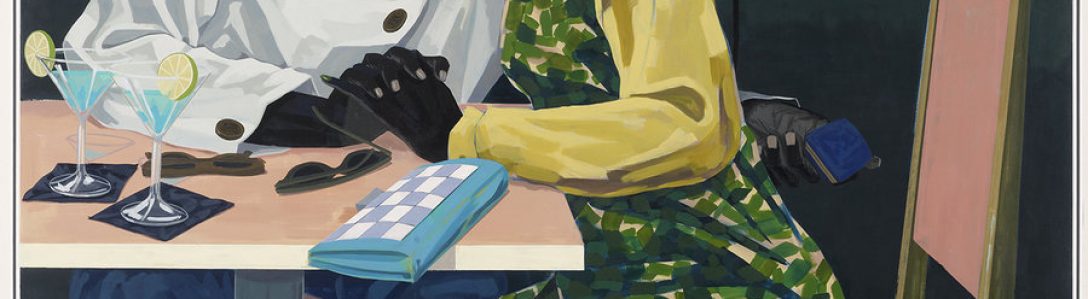
“How to Be ‘Artsy’ and Mean It” — David Foster Wallace and Mark Branaman

(Via).

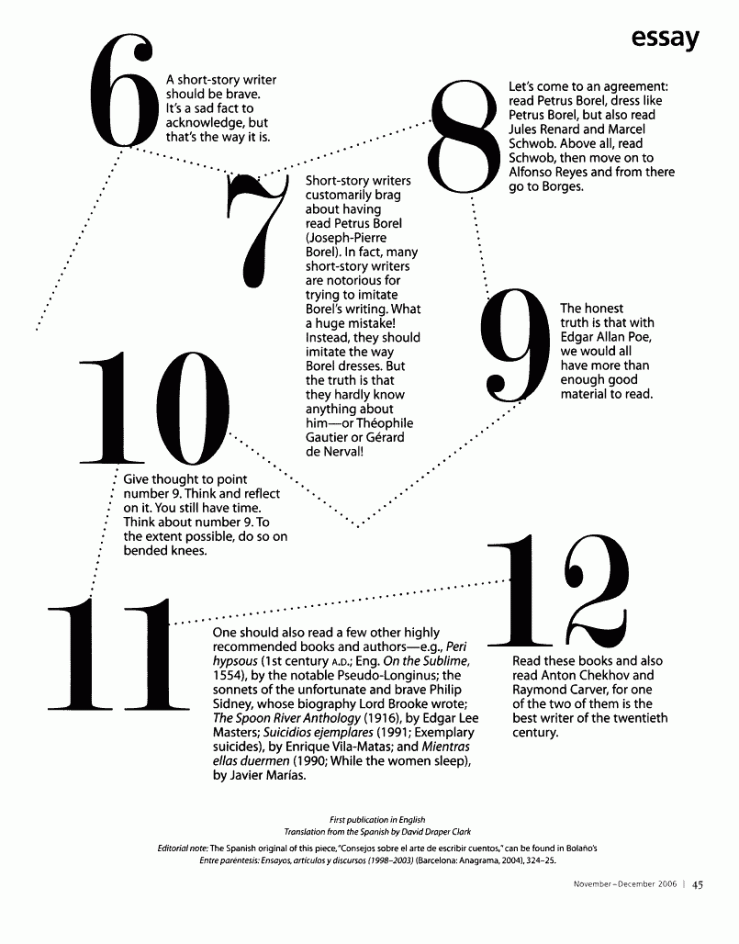
“Advice on the Art of Writing Short Stories” — Roberto Bolaño

Originally published in World Literature Today. Images via Defining Myself Secondhand.

“The Landlord” — New Fiction from Wells Tower

The New Yorker has published a new short story by Biblioklept fave Wells Tower. It’ called “The Landlord” and would have fit fine in Tower’s collection Everything Ravaged, Everything Burned. An excerpt from the story–

My daughter has come from Los Angeles to live with me. Rhoda is thirty-one, and she used to work in advertising, but now she’s a painter and a maker of other art that I’m not sure how to describe. Her field is bummers. Rhoda’s past exhibitions include leukemia-cluster art, floating-yuan art, water-rights art, and mental-health-funding-cuts art, which was piles of clothes painted bronze and rigged up with speakers that yelled. She has also made a lot of hand art and hair art. Eight years ago, shortly into her new career, while getting the hang of a radial-arm saw, Rhoda severed the index, middle, and ring fingers of her left hand. The surgeons reattached them, and Rhoda recovered nearly complete range of motion, but the shock of the injury caused some of her hair to fall out. She keeps her head shaved close now, a style that improves the plainness of face she inherited from me. Bald, she looks about fifteen years older than she is, but also terrifyingly smart and owlish, Lady Malcolm McDowell.

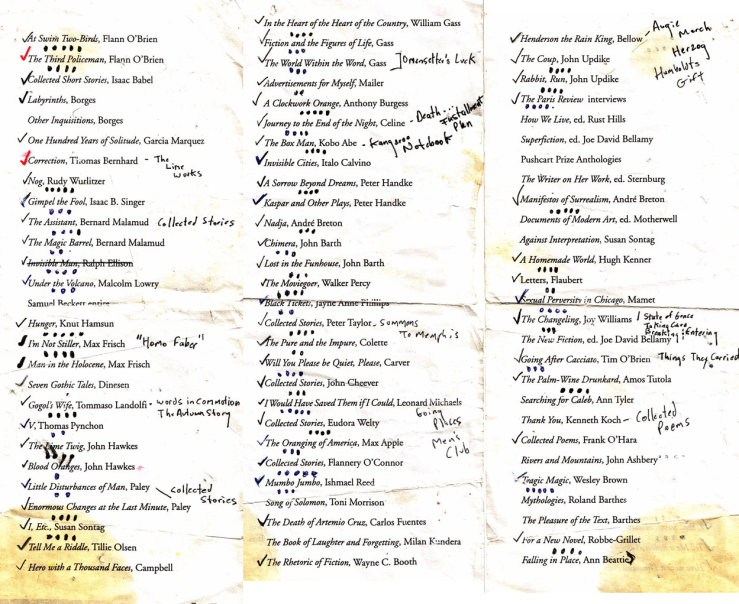
Donald Barthelme’s Syllabus

Read more here. (Via).

Samuel Coleridge’s Death Mask

Wolf Hall — Hilary Mantel

Wolf Hall, Hilary Mantel’s revisionist retelling of the Tudor saga through the eyes of Thomas Cromwell, is new in trade paperback this week from Picador. When the book won the Man Booker Prize last year, chairman James Naughtie credited its success to the “bigness of the book . . . [its] boldness [and] scene setting.” In The Atlantic, Christopher Hitchens noted that the book put Mantel “in the very first rank of historical novelists.” In The New York Review of Books, Stephen Greenblatt pointed out that this “is a novel too in which nothing is wasted, and nothing completely disappears.” Here’s what Biblioklept had to say:

I’m coming to the end of Hilary Mantel’s brilliant treatment of the Tudor saga,Wolf Hall. Sign of a great book: when it’s finished, I will miss her characters, particularly her hero Thomas Cromwell, presented here as a self-made harbinger of the Renaissance, a complicated protagonist who was loyal to his benefactor Cardinal Wolsey even though he despised the abuses of the Church. Mantel’s Cromwell reminds us that the adjective “Machiavellian” need not be a pejorative, applied only to evil Iago or crooked Richard III. The Cromwell of Wolf Hall presages a more egalitarian–modern–extension of power. Cromwell here is not simply pragmatic (although he is pragmatic), he also has a purpose: he sees the coming changes of Europe, the rise of the mercantile class signaling economic power over monarchial authority. Yet he’s loyal to Henry VIII, and even the scheming Boleyns. “Arrange your face” is one of the book’s constant mantras; another is “Choose your prince.” Mantel’s Cromwell is intelligent and admirable; the sorrows of the loss of his wife and daughter tinge his life but do not dominate it; he can be cruel when the situation merits it but would rather not be. I doubt that many people wanted yet another telling of the Tudor drama–but aren’t we always looking for a great book? Wolf Hall demonstrates that it’s not the subject that matters but the quality of the writing. Highly recommended.

Presenting all these reviews is simply a way of pointing out that if you know anything about contemporary lit, you probably already know that there’s a strong critical consensus that the book is excellent. Which it is. And if you like historical fiction, particularly of the English-monarchy variety, it’s likely you’ve already read it (and if not, why not? Jeez). However, I think it’s important–particularly now, with the current brouhaha over what literary fiction is and how female writers are treated by critics–to point out that what makes Mantel’s novel so excellent–and distinctly literary–is the writing: the narrative craft, the intensity of characterization, the vitality of prose. There’s nothing gimmicky about Wolf Hall even though its hero Cromwell has been traditionally reviled. Furthermore, Mantel resists fetishizing her set pieces, unlike so many writers of historical fiction, who feel the need to bombard their readers with extraneous details, as if the author’s painstaking research were a weapon rather than a tool.

My original review of Wolf Hall overlapped with a reading of James Wood’s essay on Thomas More from his collection The Broken Estate (also, incidentally, available in paperback from Picador). More is the major villain of Wolf Hall, and Wood savages him in “Sir Thomas More: A Man for One Season.” It was strange then (not too strange, though) to see Mantel and Wood intersect again a few months later, in Wood’s New Yorker review of David Mitchell’s historical novel The Thousand Autumns of Jacob de Zoet. Here’s Wood–

Meanwhile, the historical novel, typically the province of genre gardeners and conservative populists, has become an unlikely laboratory for serious writers, some of them distinctly untraditional in emphasis and concern. (I am thinking not just of Mitchell but of Thomas Pynchon, Susan Sontag, Steven Millhauser, A. S. Byatt, Peter Carey.) What such novelists are looking for in those oldfangled laboratories is sometimes mysterious to me; and how these daring writers differ from a very gifted but frankly traditional and more commercial historical novelist like Hilary Mantel is an anxiously unanswered question.

Wood is typically dismissive of the historical novel even as he admits its attraction–one he doesn’t understand (or pretends not to understand)–to “serious writers,” a collective from which he deems to exclude Mantel. Wood’s rubric seems to be that Mantel is too “commercial” and “traditional” to warrant her inclusion in his club (even as he damns her with faint praise), but I think that his Mitchell review reveals a deep antipathy to anything that seems, y’know, approachable for most readers. That Pynchon leads Wood’s list is telling. Pynchon’s historical fictions range from fantastic and funny (V.Gravity’s Rainbow) to belabored and difficult (Mason & Dixon) to dense and inscrutable (Against the Day). But Pynchon is Pynchon and it’s not fair to exclude Mantel from the “serious writers” club for not being Pynchon (I sometimes think that poor James Wood has just been a book critic too long and hates reading). This is a roundabout way of arguing that, yes, Wolf Hall is serious writing, that it is literary writing, that it transcends its subject matter and comments on the human condition, on soul, on psyche, on spirit. That it happens to entertain at the same time is, of course, why we care. Highly recommended.

Biblioklept’s 777th Post Spectacular

Welcome to Biblioklept’s 777th Post Spectacular*

*Not guaranteed to be spectacular.

777 seems like a beautiful enough number to celebrate, and because we’re terribly lazy, let’s celebrate by sharing reviews of seven of our favorite novels that have been published since this blog started back in the hoary yesteryear of 2006. In (more or less) chronological order–

The Children’s Hospital–Chris Adrian — A post-apocalyptic love boat with metaphysical overtones, Adrian’s end of the world novel remains underrated and under-read.

The Road — Cormac McCarthy That ending gets me every time. The first ending, I mean, the real one, the one between the father and son, not the tacked on wish-fulfillment fantasy after it. Avoid the movie.

A Mercy — Toni Morrison –Slender and profound, A Mercy should be required reading for all students of American history. Or maybe just all Americans.

Tree of Smoke — Denis Johnson — Nobody knew we needed another novel about the Vietnam War and then Johnson went and showed us that we did. But it’s fair to say his book is about more than that; it’s an espionage thriller about the human soul.

2666 — Roberto Bolaño — How did he do it? Maybe it was because he was dying, his life-force transferred to the page. Words as viscera. God, the blood of the thing. 2666 is both the labyrinth and the minotaur.

Asterios Polyp — David Mazzucchelli — We laughed, we cried, and oh god that ending, right? Wait, you haven’t read Asterios Polyp yet? Is that because it’s a graphic novel, a, gasp, comic book? Go get it. Read it. Come back. We’ll wait.

C — Tom McCarthy — Too much has been made over whether McCarthy’s newest novel (out in the States next week) is modernist or Modernist or post-modernist or avant-garde or whatever–these are dreadfully boring arguments when stacked against the book itself, which is complex, rich, enriching, maddening.

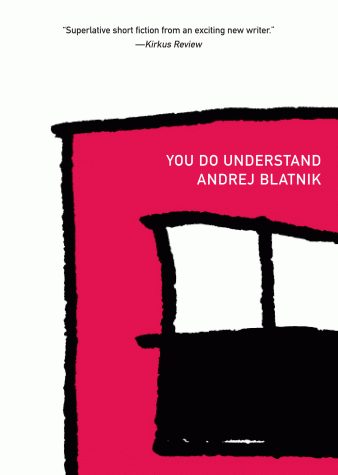
You Do Understand — Andrej Blatnik

There’s a central irony that emanates throughout Slovenian author Andrej Blatnik’s new collection, You Do Understand–namely, this is a book about misunderstanding. Take the first piece, “Few Words,” for example. Here it is in full–

“Do you believe in a tomorrow together?”

“First I’d like to believe that tonight really happened.”

Or, even more to the point (if that’s possible), here’s “Misunderstanding” (again, in full)–

“You’re even more beautiful when you come,” he said.

How would you know, she thought.

These two stories are probably the shortest of the fifty or so pieces in the collection, but even the longest selections barely pass four pages, creating a terse, clipped rhythm that lends You Do Understand a poetic immediacy. This rhythmic consistency, along with the book’s central theme, give it the feel of a novel-in-vignettes as opposed to a collection of unrelated stories.

You Do Understand begins with a series of miserable young single people shambling from failed romantic encounter to dismal hookup to ugly awkward sex. Take the (non)couple in “Do It Quickly, She Said” who both just want to get the sex over with so that one of them can leave, or the pair in “Melting Point” who trip over their own expectations. The narrator of “Say That” defers his drunken confusion and guilt by speaking his story in the second person. “Say that you’re kissing a strange girl,” he begins. As the microstory unfolds, it turns out that “your” dilemma is twofold–it’s not just that “you” are approaching cheating on “your” wife (if “you” haven’t already crossed a line), but also that this “strange girl” just might be a guy.

Blatnik never names his characters, but by drawing them in spare, concrete details, he makes them real nonetheless. The effect is uncanny–these are aliens you probably know in your own life, only, y’know, not. Stories like “Words Matter,” where a man fails to order a hooker for his hotel room, or “I Write These Words,” where another hotel-dweller finds his writing interrupted by paramedics fetching a dead body, express a core loneliness intrinsic to modern, transient existence.

There are other travelers in You Do Understand–although none of them seem to have a clear destination in mind. In “Other Paths,” a stranger arrives in a village in what might be a Third World country, perhaps with a romanticized notion of getting away from civilization. His illusion dissipates when he realizes that the villagers cannot even spare a bowl of rice for him to eat. In “Stains,” an expedition picks up a man in the middle of the desert, robbed and dehydrated. As he drinks their precious water, they nervously wonder if he’ll ask for the help that they don’t want to give him. It’s a cruel world, and at times You Do Understand is a cruel book, although it’s also quite funny–but never at the expense of the humanity of its cast, whom Blatnik measures with a distant compassion and a deep cynicism, as if human beings were programmed to fail, but also programmed to try again. Tamara Soban’s nimble English translation highlights Blatnik’s telegraphic style in these brisk but heavy stories, which call for rereading. Recommended.

You Do Understand is available September 7th, 2010 from Dalkey Archive Press.

“I’m Not Too Concerned What Happens to My Books After I’m Dead” — The AV Club Interviews Jonathan Franzen

The AV Club interviews Jonathan Franzen. Topics include his new book Freedom, posterity, Glenn Beck, Ian McEwan, and why Franzen still has an AOL account. Here’s Franzen, from the interview, discussing contemporary references in his books–

I’m not too concerned what happens to my books after I’m dead. And I am very concerned by what’s going on with the culture of reading and writing now. So I would not wrap myself in a toga and speak of timelessness regarding my work. It’s my experience that reading Dostoevsky, say, or reading Balzac—the books are full of these contemporary references, and there are feuds going on, and names are dropped, and you know that they’re significant. If you have a good edition, it’ll have six pages of notes at the back explaining what the reference is, because some good scholar has actually looked all of the stuff up. But I don’t really feel like it detracts from my reading of that, and in a perverse way, it actually makes it feel… [Pauses.]

I want to say something can’t become timeless unless it had first inhabited its own time. Undoubtedly, we only get 70 percent of Shakespeare, because the other 30 percent is references that are just completely lost. There are all of these in-jokes, these insider references and contemporary references. We’re so removed from that culture, we don’t even know they’re there. But he was having so much fun writing those plays, and part of the fun was putting all this other stuff in—all of the wordplay, taking a jab at this actor and that theater. He was having so much fun that it just became inseparable from the general fun of those plays, and reading them, and going to performances of them. And he maybe needs those little references to make it fun for him. Not to compare myself to Shakespeare. [Laughs.] But any writer nowadays, I think… I don’t think the book is about those references. It’s not a collection of in-jokes. It’s not some snarky contemporary satire. It’s no dis-fest. It’s about other things, and those things are there for the enjoyment of people who might get them.

Lil Wayne vs DFW

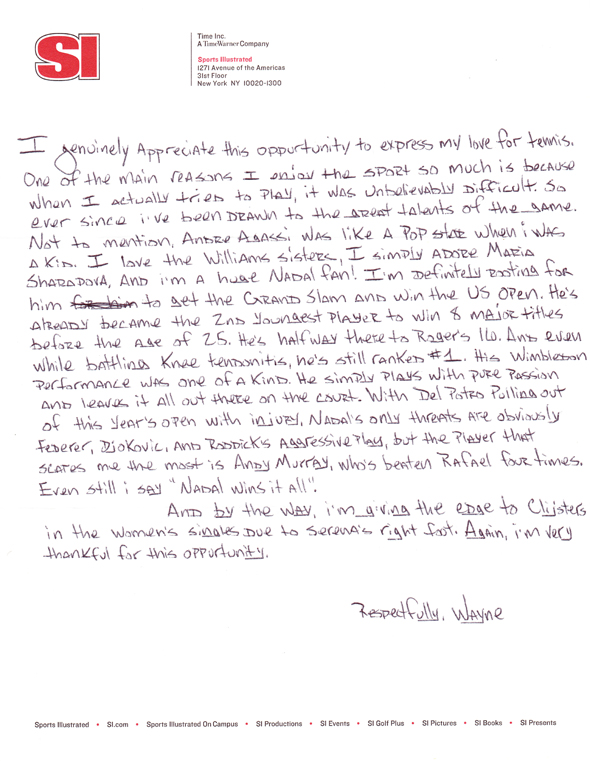
At BlackBook, Adam Wilson pits two literary luminaries against each other on the subject of tennis: Lil’ Wayne vs David Foster Wallace. From Wilson’s piece–

On Understanding Limitations
Lil Wayne: “One of the main reasons I enjoy the sport so much is because when I actually tried to play, it was unbelievably hard.”
David Foster Wallace: “I thus further confess that I arrived in Montreal with some dim unconscious expectation that these professionals—at least the obscure ones, the nonstars—wouldn’t be all that much better than I. I don’t mean to imply that I’m insane: I was ready to concede that age, a nasty ankle injury in 1988, and a penchant for nicotine (and worse) meant that I wouldn’t be able to compete physically with a young unhurt professional, but on TV (while eating junk and smoking), I’d seen pros whacking balls at each other that didn’t look to be moving substantially faster than the balls I’d hit. In other words, I arrived at my first professional tournament with the pathetic deluded pride that attends ignorance. And I have been brought up sharply. I do not play and never have played even the same game as these qualifiers.”

Winner: Wallace. Though Weezy is once again clear and concise, Wallace wins for honesty and breadth of experience.

Lil Wayne on the US Open, Sports Illustrated

The Obligatory Jonathan Franzen Post

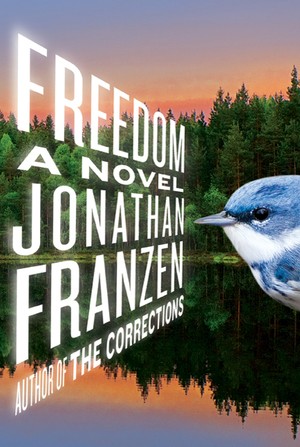
So, Jonathan Franzen’s Freedom is out today. The follow-up to 2001’s The Corrections was already in a second printing before its release today, pretty much pointing to the book being “the literary event” of 2010 (whatever that means). I haven’t read Freedom yet so I don’t have an opinion about it–but it’s hard to not have an opinion about the opinions about Freedom, at least if you follow literary-type news. The reviews have been overwhelmingly positive, even when they can find something to nitpick or quibble with. Obama picked up a copy last week on vacation. In an act of hyperbole so ridiculous as to turn comical, The Guardian’s Jonathan Jones called it “the novel of the century.” (Nevermind that the century isn’t even a decade old). But it’s probably the fact that Franzen appeared on the cover of Time magazine–the first writer in a decade to do so (the last was Stephen King)–that’s caused some professional jealousy and a backlash against Franzen. Again, this is all before the book has been released.

Yes, Franzenfreude. Authors Jodi Picoult and Jennifer Weiner felt the need to speak out against coverage of Freedom, crying foul that their books were not receiving the same critical attention as the “white male literary darling.” You can read an interview with the pair here, where their position seems to be that their work, frequently on the bestseller lists, is dismissed as genre fare. I don’t know Weiner’s stuff but Picoult’s novels strike me as the sort of maudlin crap that get turned into Lifetime movies (which they do). Picoult and Weiner don’t just play the gender card though. No, they also whip out a populist argument, the idea that literary critics ought to give more weight to “what people actually read.” In a series of recent columns on the attention Freedom has garnered, Lorin Stein pointed out that “It has become immensely hard to get a “literary” writer the attention he or she deserves.” (The comments section of Stein’s posts showcase a remarkable debate about just what “literary fiction” is).

Stein is absolutely right of course. (Weiner and Picoult will have to console themselves by sobbing into their piles of money). Franzen’s Freedom has become an opportunity for those who love literary fiction–which might be an endangered species–to call attention to the fact that novels are important, that they can somehow diagnose and analyze the spirit of an age. In his article for The Guardian, William Skidelsky strips the rhetoric away and gets to the point–

Underneath the words “Great American Novelist”, Time‘s strapline ran: “He’s not the richest or most famous. His characters don’t solve mysteries, have magical powers or live in the future. But in his new novel, Jonathan Franzen shows us all the way we live now.” It isn’t hard to unpick the subtext here: “Remember, folks, there’s such a thing as serious literature; it has little to do with Dan Brown or Harry Potter, and these days most of us tend to ignore it, but it’s actually kind of important.”

At The Faster Times, Lincoln Michel is even brassier–

There has always been a segment of the population that does not like it when intelligent artistic work gets praise. These people cry foul when an Academy Award goes to a well-crafted film with limited distribution instead of the latest Hollywood blockbuster, they moan when magazines cover innovative indie musicians instead of the most recent Nickelback CD, and you better believe they can’t stand it when that elitist literary fiction gets awards and coverage that should be reserved for books that people are “actually reading.”

Much of the critical reception of Freedom, then, is more about how the public–the reading public–is to connect with and interact with novels in an age of new media, in an age where some like to pretend the literary novel has lost its relevance, in an age where bozos go around declaring manifestos against novels. While Freedom need not be the novel to “save” the novel, it also shouldn’t be an occasion for backbiting, jealousy, and backlash. Maybe everyone should just calm down and read the damn thing.

[UPDATE: Read our obligatory review of Freedom].