Paul Auster Reads from Sunset Park

Paul Auster reads from his forthcoming novel, Sunset Park:

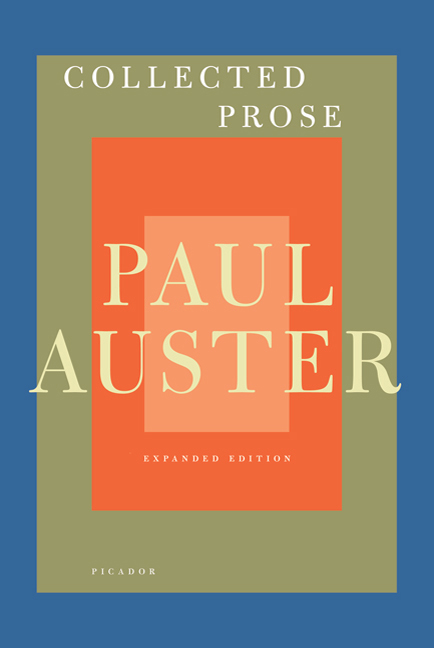
Collected Prose — Paul Auster

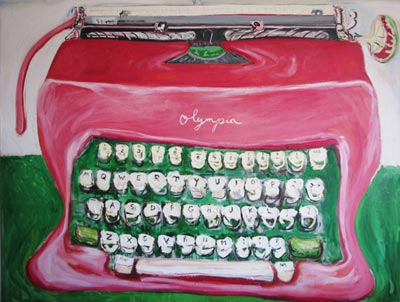
This month, the good folks at Picador are issuing an expanded edition of Paul Auster’s essays, memoirs, prefaces, true stories, anecdotes, and interviews. Inconspicuously titled Collected Prose and running to just under six hundred pages, the volume includes Auster’s début work The Invention of Solitude in its entirety. Solitude is a strange blend of personal memoir, an account of the young writer’s reaction to and relationship with the death (and life) of his father, as well as a philosophical meditation on the absurdity of family, art, and time. Collected Prose also includes the later memoir, Hand to Mouth, a reflective piece on Auster’s early failures as he tries to make it as a writer, including his time in Paris, his marriage to Lydia Davis, his hunger, and his poverty. While Solitude inaugurates many of the experimental structures and postmodern tropes that Auster would be identified with throughout his career as a novelist, the flatter, more direct style of Hand to Mouth is more indicative of the tone of much of Collected Prose. There’s a journalistic directness and keen earnestness to Auster’s essays that perhaps belie his postmodern bona fides. That’s a good thing, allowing Auster to communicate directly about his sometimes challenging subjects to a wider audience. Style aside, both of the book-length memoirs at the front end of Collected Prose neatly delineate the themes that preoccupy much of the rest of the book: art, language, writing, writers, poverty, absurdity, movement, New York City, and so on. And although the book turns away from Auster’s memoirs and true stories in its second half, presenting his essays, editorials, and prefaces, there’s still a sharp sense of Auster in each essay. These are personal essays. Auster writes about his friend Philippe Petite, the French high-wire artist; he writes about the literal hunger artists face, using Knut Hamsun and Franz Kafka as examples; he writes a vindication for Dada daddy Hugo Ball; he writes on over half a dozen relatively obscure poets to let us know why they matter. There are wonderful little moments, like “The Story of My Typewriter,” where Auster exclaims his love for his quiet Olympia (he buys 50 typewriter ribbons fearing the specie’s eventual extinction). The book reprints the Sam Messner paintings that originally accompanied Auster’s text (or, perhaps, vice versa).

Another great moment is the essay “Hawthorne at Home,” which takes a look at a little known piece by Nathaniel Hawthorne called Twenty Days with Julian & Little Bunny. Hawthorne’s piece is more or less a straightforward narrative account of Hawthorne alone with his five-year old son Julian and his pet rabbit for three weeks while wife Sophia visited the Peabodys. While Auster gives the reader a lesson on Hawthorne and his composition of The Scarlet Letter here, the essay focuses on the idyllic charm of a father and son, a rare subject in Hawthorne’s oeuvre. As a bonus, Herman Melville makes a cameo. “Hawthorne at Home” is the sort of essay that makes you want to go read the source material; it sent me hunting for a used copy of American Notebooks.

As one might imagine, Collected Prose is absolutely larded with writers, and lovingly so. Auster does not suffer from the inclination toward meanness that so many critics feel toward their peers, perhaps because he writes foremost from the perspective of an artist. Not that it’s difficult to praise Art Spiegelman (“The Art of Worry”) or pray for Salman Rushdie (um, “A Prayer for Salman Rushdie”) or speak to the genius of Samuel Beckett (“Remembering Beckett on His One Hundredth Birthday”) and Jim Jarmusch (“Night on Earth: New York”)–but Auster illuminates their work in a way that transcends the postmodern concerns of technique, place, and politics, and speaks directly to a certain aesthetic excellence. His love for storytellers extends beyond the pros, of course, evinced in his work with NPR’s National Story Project. He credits wife Siri with coming up with the idea of having NPR listeners write and submit their own original stories, but his enthusiasm for her idea resonates in his warm preface to the eventual book that collected the listeners’ submissions. Auster writes, “I learned that I am not alone in my belief that the more we understand of the world, the more elusive and confounding that world becomes.” The world becomes more “confounding” after the 9/11 attacks, of course, and like so many other writers Auster attempted to somehow measure the tragedy in words. “Random Notes–September 11, 2001–4:00 PM” is a scrap, a fragment, a shell-shocked missive that ends with the haunting words “And so the twenty-first century finally begins.”

It might be misleading to call Collected Prose a good introduction to Paul Auster’s nonfiction–can a work so comprehensive, so massive be a mere starting point?–but it is a great introduction, so there. It’s also a fantastic overview of critical, literary, and artistic theory, written from a deeply personal perspective. Let’s hope that fifteen years from now we’ll have another expanded edition of Auster’s prose; in the meantime, we can look forward to his new novel Sunset Park this November. Highly recommended.

A Very Short Review of a Very Good Book — Tom McCarthy’s C

Finished Tom McCarthy’s newest novel C last night. It doesn’t come out until this autumn–and I’ll post, y’know, a long, detailed review then–but for now–

The book is tremendous. You should start looking forward to it now. Great, great stuff. Loved it. Will read it again. Very highly recommended. You get the idea.

How to Read James Joyce’s Ulysses (and Why You Should Avoid “How-to” Guides Like This One)

Bloomsday, an annual celebration of James Joyce’s Ulysses, is upon us today with more excitement than ever. Even with the festivities, the book’s reputation for density, erudition, and inscrutability still daunts many readers–leading to a glut of guidebooks, summaries, and annotations. Ironically, rather than inviting first-time readers to the text, the sheer volume of these guides to Ulysses can paradoxically repel. Their very existence seems predicated on an intense need, and although some of the guides out there can be helpful, others can get in the way. This need not be. Ulysses deserves its reputation as one the best books in the English language. It generously overflows with insight into the human experience, and it’s very, very funny. And, most importantly, anyone can read it.

Here are a few thoughts on how to read Ulysses, enumerated–because people like lists:

1. Ignore all guides, lists, maps, annotations, summaries, and lectures. You don’t need them; in fact, they could easily weigh down what should be a fun reading experience. Jump right into the text. Don’t worry about getting all the allusions or unpacking all the motifs.

Pretty soon though, you’ll get to the third chapter, known as “Proteus.” It’s admittedly hard to follow. You might want a guide at this point. Or you might just want to give up. (Of course, you might be a genius and totally get what Stephen is thinking about as he wanders the beach. Good for you). If frustration sets in, I suggest skipping the chapter and getting into the rich, earthy consciousness of the book’s hero, Leopold Bloom in chapter four, “Calypso.” It’s great stuff. You can always go back to chapter three later, of course. The real key, at least in my opinion, to reading (and enjoying) Ulysses is getting into Bloom’s head, matching his rhythm and pacing. Do that and you’re golden.

I’ve already advised you, gentle reader, not to follow any guides, so please, ignore the rest of my advice. Quit reading this post and start reading Ulysses.

For those who wish to continue–

2. Choose a suitable copy of the book. The Gabler edition will keep things neat and tidy and it features wide margins for all those clever game-changing annotations you’ll be taking. Several guides, including Harry Blamire’s The New Bloomsday Book align their annotation to the Gabler edition’s pagination.

3. Make a reading schedule and stick to it. The Gabler edition of Ulysses is nearly 700 pages long. That’s a long, long book–but you can read it in just a few weeks. There are eighteen episodes in Ulysses, some longer and more challenging than others, but reading one episode every two days should be no problem. If you can, try to read one episode in one sitting each day. As the book progresses, you’ll find yourself going back to previous chapters to find the figures, motifs, and traces that dance through the book.

4. So you’ve decided you need a guide. First, try to figure out what you want from the guide. Basic plot summary? Analysis? Explication? There’s plenty out there–too much really–so take the time to try to figure out what you want from a guide and then do some browsing and skimming before committing.

The most famous might be Stuart Gilbert’s James Joyce’s Ulysses, a dour book that manages to suck all the fun out of Joyce’s work. In a lecture on Ulysses, Vladimir Nabokov warned “against seeing in Leopold Bloom’s humdrum wanderings and minor adventures on a summer day in Dublin a close parody of the Odyssey,” noting that “it would be a complete waste of time to look for close parallels in every character and every scene in the book.” Nabokov scathingly continued: “One bore, a man called Stuart Gilbert, misled by a tongue-in-cheek list compiled by Joyce himself, found in every chapter the domination of one particular organ . . . but we shall ignore that dull nonsense too.” It’s perhaps too mean to call Gilbert’s guide “nonsense,” but it’s certainly dull. Harry Blamire’s The New Bloomsday Book is a line-by-line annotation that can be quite helpful when Joyce’s stream of consciousness gets a bit muddy; Blamire’s explications maintain a certain analytical neutrality, working mostly to connect the motifs of the book but letting the reader manage meaning. Don Gifford’s Ulysses Annotated is an encyclopedia of minutiae that will get in the way of any first time reader’s enjoyment of the book. Gifford’s notes are interesting but they can distract the reader from the text, and ultimately seem aimed at scholars and fanatics.

Most of the guidebooks I’ve seen for Ulysses share a common problem: they are obtrusive. I think that many readers who want some guidance or insight to aid their reading of Ulysses, rather than moving between books (what a chore!), should listen to some of the fantastic lectures on Joyce that are available. James Heffernan’s lectures for The Teaching Company provide a great overview of the book with some analysis; they are designed to be listened to in tandem with a reading of the book. Frank Delaney has initiated a new series of podcast lectures called re:Joyce; the first lecture indicates a promising series. The best explication I’ve heard though is a series of lectures by Joseph Campbell called Wings of Art. Fantastic stuff, and probably the only guide you really need. It’s unfortunately out of print, but you can find it easily via extralegal means on the internet. Speaking of the internet–there’s obviously a ton of stuff out there. I’ll withhold comment–if you found this post, you can find others, and have undoubtedly already seen many of the maps, schematics, and charts out there.

5. Keep reading. Reread. Add time to that reading schedule you made if you need to. But most of all, have fun. Skip around. If you’re excited about Molly’s famous monologue at the end of the book, go ahead and read it. Again, the point is to enjoy the experience. If you can trick a friend into reading it with you, so much the better. Have at it.

Radio Bloomsday to Feature Jerry Stiller, Bob Odenkirk, Alec Baldwin and More

New York’s WBAI will continue their 32 year tradition of celebrating Bloomsday tomorrow with a live broadcast featuring a host of actors reading aloud from James Joyce’s Ulysses. Readings begin at 7pm and continue until 2am. Performers include Paul Muldoon, Alec Baldwin, Jerry Stiller, Charles Busch, T. Ryder Smith, Bob Dishy, Judy Graubart, Aaron Beall, Amy Stiller, Paul Dooley, Bob Odenkirk, John O’Callaghan, Brian O’Doherty, Kate Valk, Mara McEwin, James Kennedy, Jim Fletcher, Richard Maxwell, Anna Goodman-Herrick, Janet Coleman, David Dozer, Emily Mitchell, and Tara Bahna-James. More at their blog.

John Turturro Reads Italo Calvino’s Short Story “The False Grandmother”

John Turturro does Italo Calvino. “The False Grandmother,” illustrated by Kevin Ruelle, evokes dark shades of Little Red Riding Hood.

In Brief–New Novels by Janelle Brown, Loretta Stinson, and Tracy Winn

In This Is Where We Live, Janelle Brown’s follow-up to her 2008 début All We Ever Wanted Was Everything, an artsy newly wed couple find their dreams and their marriage unraveling when the payments on their adjustable rate mortgage suddenly double. Claudia and Jeremy are happy at the novel’s outset, living comfortably in their Los Angeles bungalow. Her film Spare Parts garners a huge buzz at Sundance and he reforms a new band after the breakup of his old group The Invisible Spot; they envision their new neighborhood as a contemporary counterpart to the Laurel Canyon creative scene of the 1960s. But then their ARM adjusts and Spare Parts flops. Claudia has to take a job teaching (Gasp! Oh, the terror! In a particularly funny scene, she shows The Graduate to her film students and one of them raises her hand to declare that her father was one of the film’s executive producers). The couple soon has to take in a roommate. Complicating matters even more is the return of Aoki, Jeremy’s unstable–and now famous–ex-girlfriend, who manipulates him every chance she gets. Aoki, a cartoonishly unhinged avant-gardiste, serves as a foil to the more grounded figure of Claudia; as Claudia begins to mature into a more pragmatic, adult personality, Aoki’s siren song calls Jeremy to return to chaos. This Is Where We Live is timely, of course, and Brown takes pains to show how these two “creatives” could overlook such meaningful financial details when looking to buy a home. Some will find Brown’s sympathetic vision of the privileged L.A. art scene off-putting or even shallow, but the novel’s core exploration of a troubled young marriage will resonate with many readers. This Is Where We Live is available in hardback from Spiegel & Grau on June 15, 2010.
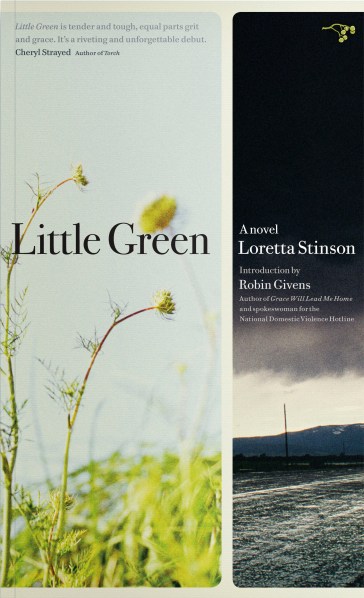
Little Green, Loretta Stinson’s début novel, tells the story of Janie, an orphan who runs away from her stepmother. Life on the road is tough, and Janie has to make money somehow, dancing in strip bars and even bartering for sex when necessary. When she meets a charmer named Paul who is ten years older than her, she feels instantly closer to him–and naturally hits the road again. Hitchhiking is never a good idea though, kids, especially in a loner’s van, and Janie is brutally beaten. She finds herself under the care of the man who owns the last bar she danced at, and in time, under the care of Paul, reiterating one of the novel’s major themes of cyclical violence and female dependence on a man. Paul is a small-time drug dealer whose habits extend beyond weed and acid into heroin and meth. As his drug addiction spirals, he tries to find some control by manipulating Janie; in time, he beats her so terribly that she has to go to the hospital. Janie leaves him but he stalks her wherever she goes, forcing her to find her own strength and self-reliance as the novel reaches its redemptive climax. Paul is probably the most interesting character in Little Green, and although it would be unfair to call Janie a flat character, she spends much of the novel as a victim. In contrast, Paul’s addiction and behaviors are studied with a psychological depth that attempts to understand–without ever rationalizing–his actions. While the novel is hardly sympathetic to him, Stinson resists painting Paul as a static monster; the payoff is a villain far-more frightening because of his authenticity. Authenticity is what keeps Little Green (for the most part) from verging into melodramatic Lifetime movie of the week territory. Stinson’s finely detailed evocation of the Pacific Northwest of the late 1970s explores how attitudes about gender roles, women’s rights, and drugs came to a seething breaking point a decade after the summer of love. Significantly (and sadly), the novel’s depiction of domestic violence reads with a wholly contemporary immediacy. Little Green is new in handsome trade paperback this month from Hawthorne Books, who will donate a portion of sales revenue to the National Domestic Violence Hotline.
Tracy Winn’s debut, Mrs. Somebody Somebody covers over half a century–from Korea to Iraq, in the book’s terms–in the lives of the regular folk of the mining town of Lowell, MA. The book comprises ten stories that can easily stand on their own, but combined together form a novel-in-stories, an evocative portrait of a working-class town under duress. Winn weaves blood lines through generational and political conflicts and re-examines her book’s themes through a variety of perspectives. The result is a layered, detailed reckoning with history and place, class and conflict, drawn in rich, resonant colors. Mrs. Somebody Somebody is new in trade paperback this month from Random House.

The Canal — Lee Rourke

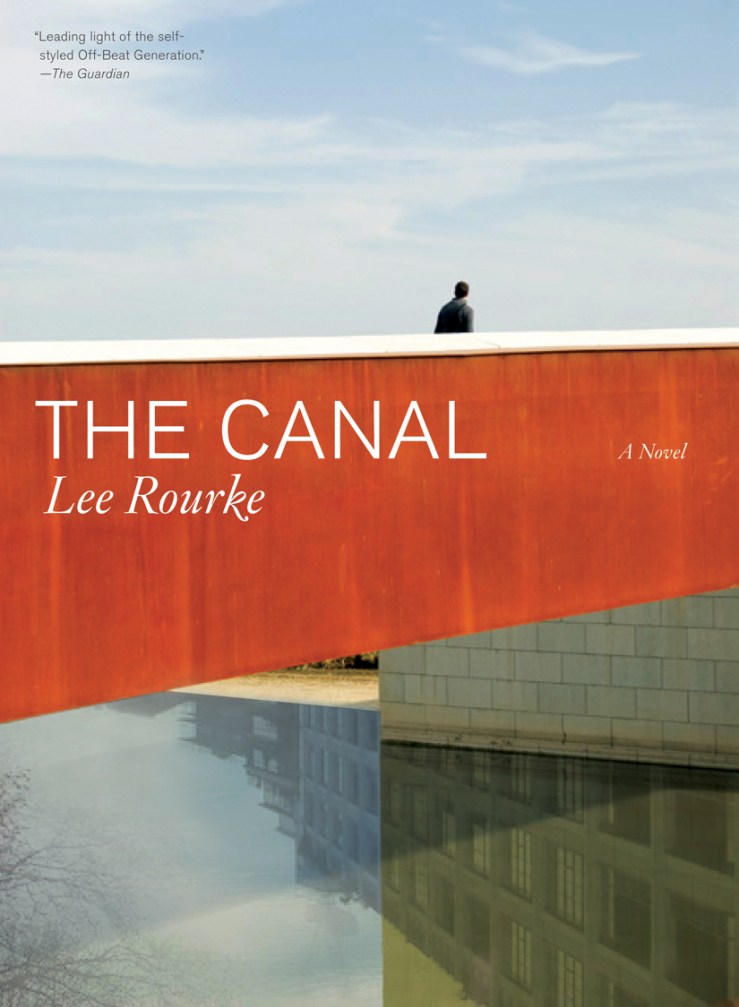
In Lee Rourke’s début novel The Canal, the unnamed narrator quits his job and begins walking to a canal everyday. Why? Out of boredom. At the titular canal, he watches (and describes in banal detail) the geese, swans, and coots that swim in the filthy water. He also keeps one eye on the drudges who go about emailing and faxing in the office building across from the bench on which he sits each day. A strange, icy young woman soon begins sharing the bench with the narrator; in time, she also shares her morbid secrets with him. Complicating the narrator’s paradise of boredom is a gang of youths who terrorize the area with random violence. The novel’s steady pace escalates to frantic tragedy as the narrator’s bored repose gives over to desperate obsession with his erstwhile bench mate and her horrific past.

The Canal takes boredom as its explicit subject. In the second paragraph of the book, the narrator tells us–

Some people think that boredom is a bad thing, that it should be avoided, that we should fill our lives with other stuff in order to keep it at bay. I don’t. I think boredom is a good thing: it shapes us; it moves us. Boredom is powerful. It should never be avoided. In fact, I think boredom should be embraced. It is the power of everyday boredom that compels people to do things–even if that something is nothing.

The canal seems (at first) the right place for the narrator to embrace his boredom, but it soon becomes a space–a “real” space, as the narrator eventually realizes–of transformation and excitement. This space quickly complicates the narrator’s will toward “nothing,” that pull toward nihilism. He’s keenly interested in the various birds that make the canal their home, and his obsessive derision toward the office workers highlights the fact (a fact he doesn’t seem to see) that his apathy is not as pure as he would like it to be. Rather, his “boredom” is a direct response to the apparent meaninglessness of 21st century life in general and, specifically, life in post-Blair London. His horror and fear at the four hoodied teens from a nearby estate (the English equivalent of an American housing project) who insult and attack him is grounded in a relatively conventional morality, one that belies his enduring belief in his own apathy.

The most dramatic challenge to his philosophy of boredom though is his unnamed female foil. Through cryptic, elliptical dialogues he soon becomes a bizarre confessor to her strange sins. Yet she’s remorseless in her unrepentant nihilism. In one conversation she tells him that “There’s nothing left to believe in anywhere. All is fiction. Somehow, we have to invent our own reality. We have to make the unreal real.” This cheerful little aphorism comes after she reveals her empathy for (and sexual attraction to) the perpetrators of the July 7, 2005 suicide bombings in London. Terrorism, particularly the 7/7 attacks and the 9/11 WTC attacks are a major motif of The Canal; the unnamed narrator obsesses about flight (both of airplanes and birds) and dwells on the image of the planes crashing into the towers. Although he never admits it, it seems that both flight and death are possible forms of escape from the very boredom he claims to embrace. At the same time, the violence of terrorism seems part and parcel of his philosophy of boredom–

“It is obvious to me now that most acts of violence are caused by those who are truly bored. And as our world becomes increasingly boring, as the future progresses into a quagmire of nothingness, our world will become increasingly more violent. It is an impulse that controls us. It is an impulse we cannot control.”

And yet the violent acts of the estate youths shock and disgust the narrator. In one of the book’s most stunning passages, he watches them in horror as they destroy a stolen motor scooter and then cast it into the creek while filming the whole business on a cell phone. The scooter upsets the resting birds and becomes one more piece of detritus clogging up the canal–part of the “quagmire of nothingness,” perhaps. Repeatedly in the novel, the narrator wishes that long-overdue dredges will come along to clean the canal, to restore it, an impulse to control the stochastic violence of life that doubles his horror at the teen gang’s violence. In short, despite what he tells us, the narrator cannot embrace his boredom–although he does wish to name it, recognize it, and perhaps treat it.

This treatment comes in the form of the anti-ingenue he meets with daily by the canal. His obsession with her soon gives way to outright stalking. For a man who claims to embrace boredom, he’s awfully interested in her. The narrator’s stalking feeds into the novel’s deft discourse on surveillance in the 21st-century world, where CCTV, mobile phone cameras, and live pictures of spectacular disaster make people feel alternately safe or horrified (or at least alleviate some of their boredom). The narrator’s relationship with the woman tests the bounds of his devotion to boredom and reveals to both him and the novel’s audience that opting out is not always opting out. Rourke uses a quote from Martin Heidegger – “We are suspended in dread” – as an epigraph to the novel; the narrator must learn how to live in that suspension.

What makes The Canal such a remarkable read is watching the disconnect between the narrator’s would-be solution to life-as-state-of-dread (“embrace boredom”) and his actual responses to the effects of boredom in the world around him (literal and figurative waste, violence). Although he seeks to mitigate the pain of his dread and boredom by submitting to it, the novel repeatedly finds him engaging–and resisting–the cruelty and inhumanity he perceives. While parts of The Canal occasionally seem forced or overdetermined, there is much to commend here and the novel clearly suggests Rourke as a rising talent to watch out for. Recommended.

The Canal is available from Melville House on June 15, 2010.

Devoid of Original Content, We Offer Instead These Links

Barbara King has to forget everything she thought she knew about Rick Steves after reviewing his new book Travel as a Political Act at Bookslut. Here’s a taste of her review:

The book is an eye-opener. Steves describes himself as a traveler and “a historian, Christian, husband, parent, carnivore, musician, capitalist, minimalist, member of NORML, and a workaholic.” The marijuana habit (I have discovered) has been headlined for a while now; the reveal here is Steves’s brand of forthright liberalism.

Promising not to “take the edge off” his opinions, Steves embraces geopolitical philosophizing “with the knowledge that good people will respectfully disagree with each other.” Speaking of assumptions, that’s a generous one. Given the mood of a large segment of the American public and Steves’s penchant for pointed passages, anyone care to wager how his fan mail is running?

Ahmad Saidullah reviews Keri Walsh’s compendium The Letters of Sylvia Beach at 3 Quarks Daily. This gives us a chance to plug our own interview with Keri Walsh from last month about the book (See? There’s some original content here after all–even if it’s recycled. Recycling is good, right?)

As part of the new partnership between Salon and McSweeney’s, you can read Nick Hornby’s latest “Stuff I’ve Been Reading” column online. The column has returned to The Believer after a too-long hiatus; it’s easily one of our favorite features in the magazine. It’s also one of the major inspirations for this site.

At The New York Times, Dave Itzkoff uses Kristen Stewart’s reaction shots as a way to review the cultural black hole that was the 2010 MTV Movie Awards. Hilarious.

The New Yorker has begun coverage on their “20 Under 40” collection of writers. The editors on their thought process:

The habit of list-making can seem arbitrary or absurd, leaving the list-makers endlessly open to second-guessing (although to encourage such second-guessing is perhaps the best reason to make lists). Good writing speaks for itself, and it speaks over time; the best writers at work today are the ones our grandchildren and their grandchildren will read. Yet the lure of the list is deeply ingrained. The Ten Commandments, the twelve disciples, the seven deadly sins, the Fantastic Four—they have the appeal of the countable and the contained, even if we suspect that there may have been other, equally compelling commandments, disciples, sins, and superheroes. What we have tried to do, in selecting the writers featured in this issue, is to offer a focussed look at the talent sprouting and blooming around us.

Finally, here’s one of those celebrated writers, Wells Tower, in an interview at a bar:

Five Favorite Fictional Sons

A son is born to The Biblioklept! To celebrate–and, perhaps to respond to last year’s Father’s Day post, Five Favorite Fictional Fathers–I offer five favorite fictional sons. In the earlier post, I suggested that Western literature holds a certain ambivalence toward fatherhood, one that evinces in one of its most ubiquitous tropes–the hero-as-orphan. These orphan-heroes tend to have father-figures, but their biological dads are usually displaced in some way. So, to set some ground rules for the post, I chose heroes whose narratives are still deeply intertwined with their biological parents–particularly their fathers. Yet in the cases below, parental displacement remains.

1. Telemachus, The Odyssey (Homer)

The original angry young man. And who can blame him, what with dad away (having all the fun, tricking gods and monsters and bagging nymphs) and rude would-be step-dads gobbling up all the goods (and, uh, trying to bang your mom to boot). Although the swineherd Eumaeus was probably more of a dad to Telly-Mack than Odysseus was, there’s something touching about the end of The Odyssey, when the pair slaughter the suitors wholesale.

2. Hamlet, Hamlet (William Shakespeare)

Poor, grieving Hamlet–dad departed–a ghost!–revenge me!–uncle usurping dad’s role (and his promised throne (and banging mom to boot))–wait–I think we’ve hit a theme here. This has to be a theme, right? Kids need guidance, and Hamlet has none. No wonder he goes bonkers.

3. Stephen Dedalus, A Portrait of the Artist as a Young Man and Ulysses (James Joyce)

OK, we’ve definitely hit a theme. Through the sympathetic yet often repulsive figure of Stephen Dedalus, Joyce reworked Telemachus and Hamlet (and Icarus and everything else (hang on, shouldn’t Jesus be on this list?)). Bloom gets too much credit as a father figure. Reread Portrait–Simon looms large enough.

4. Quentin Compson, The Sound and the Fury and Absalom, Absalom! (William Faulkner)

The theme is readily conceded. Compson funnels Hamlet’s neuroses and Dedalus’s intellectual acumen through a channel of Southern alienation. Plus, like Stephen, his dad’s a drunk. Like Hamlet, Quentin is ultimately a tragic figure, but he’s nonetheless a hero, a son who attempts to reconcile the traditions of his father’s world against the shifting dimensions of his own time (or something like that).

5. Hal Incandenza, Infinite Jest (David Foster Wallace)

A tennis champ with a secret marijuana addiction (or, more accurately, an addiction to secret behaviors) cursed with an eidetic memory, Prince Hal is easily one of DFW’s finest inventions. And yes, yes, yes, his relationship with dad James (again, a drunk) repeats the drama of Hamlet–right down to the ghost-demands-revenge scene and its usurping uncle (although Charles Tavis ain’t so bad). So, unwittingly, the theme finds its summation in Hal, a kid anyone would be proud to call son.

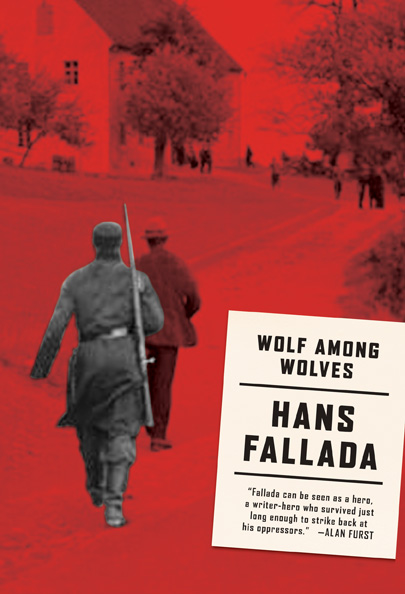
Ethical Realism (and Grim Decadence) in Hans Fallada’s Wolf Among Wolves

On the heels of last year’s hugely successful first-time-in-English publication of Every Man Dies Alone, the good folks at Melville House have issued another of Hans Fallada’s epic novels, Wolf Among Wolves. Set during Germany’s 1923 economic collapse, Wolf centers on Wolfgang Pagel, a former soldier and itinerant gambler languishing in the corruption of Weimar Berlin.The beginning of the novel focuses on a single summer day in Berlin; Fallada’s naturalist, realist eye paradoxically puts all the minutiae of this world under a microscope even as it expands to capture a holistic vision of life in morally-decadent, post-war Germany. The effect is both devastating and enlightening. It is epic realism, the condensation of the everyday existence of an alien world. Another paradox–behind Fallada’s omniscient, steady, neutral narrative, so plain and descriptive and frank, there lies another voice, a moral, ethical voice that prompts Pagel to transcend the wolf-eat-wolf world. Indeed, Fallada presents a vision of moral cooperation in a world dominated by self-interest. Here’s a passage describing some of Berlin’s heady post-war decadence:

But the girls were the worst. They strolled about calling, whispering, taking people’s arms, running alongside men, laughing. Some girls exposed their bodies in a way that was revolting. A market of flesh–white flesh bloated with drink, and lean dark flesh which seemed to have been burned up by spirits. But worst of all were the entirely shameless, the almost sexless: the morphine addicts with their contracted pupils, the cocaine sniffers with their white noses, and the cocaine addicts with high-pitched voices and irrepressibly twitching faces. They wriggled, they jiggled their flesh in low-cut or cunningly-slashed blouses, and when they made room for you or went round a corner they picked up their skirts (which, even so, didn’t reach their knees), exhibiting between stockings and drawers a strip of pale flesh and a green or pink garter. They exchanged remarks about passing men, bawled obscenities to each other across the street, and their greedy eyes searched among the slowly drifting crowd for foreigners who might be expected to have foreign currency in their pockets.

Melville House’s edition of Wolf Among Wolves is the first unabridged English translation ever–scholars Thorsten Carstensen and Nicholas Jacobs have restored  passages originally omitted in Philip Owens’s contemporaneous translation.In his insightful afterward, Carstensen addresses why certain passages were not included in Owens’s original translation, pointing out that most omitted passages showed an inclination toward fairy-tale or mythic structures, aesthetics that “contradict the claim to naturalistic representation” one expects in Fallada’s work. By preserving the occasional “almost surreal mode of perception” omitted in the original, Carstensen argues that:

In short, the fully reconstructed text, with its enhanced inconsistency, provides the reader with insight into a literary aesthetics that is unique among the novels of German modernism: Fallada combines realist prose and ethical concerns with a narrative technique that renders ambiguous what is supposedly a semi-documentary representation, shaped by his very own experiences in the country.

We’re eating up Wolf Among Wolves right now, and will have a full review in time); for now, we recommend you pick it up for some good summer reading.

Paul Auster Explains Why Philip Roth Is Wrong

Paul Auster explains why Philip Roth is wrong about the death of the novel:

“Extreme Solitude” — New Fiction from Jeffrey Eugenides

“Extreme Solitude” — a new story from Jeffrey Eugenides at The New Yorker. Read the whole story here. Here’s an excerpt that might ring true to many an English major:

Madeleine had met Leonard in an upper-level semiotics seminar taught by a renegade from the English department. Michael Zipperstein had arrived at Brown thirty-two years earlier filled with zeal for the New Criticism. He’d inculcated the habits of close reading and biography-free interpretation into three generations of students before taking a Road to Damascus sabbatical, in Paris, in 1975, where he’d met Roland Barthes at a dinner party and been converted, over duck cassoulet, to the new faith. Now Zipperstein taught two courses in the newly created Program in Semiotic Studies: Introduction to Semiotic Theory, in the fall, and, in the spring, Semiotics 211. Hygienically bald, with a seaman’s mustacheless white beard, Zipperstein favored French fisherman’s sweaters and wide-wale corduroys. He buried people with his reading lists: in addition to all the semiotic big hitters––Derrida, Eco, Barthes––the students in Semiotics 211 had to contend with a magpie nest of reserve reading that included everything from Balzac’s “Sarrasine” to issues of Semiotext(e) to xeroxed selections from E. M. Cioran, Robert Walser, Claude Lévi-Strauss, Peter Handke, and Carl Van Vechten. To get into the seminar, you had to submit to a one-on-one interview with Zipperstein during which he asked bland personal questions, such as what your favorite food or dog breed was, and made enigmatic Warholian remarks in response. This esoteric probing, along with Zipperstein’s guru’s dome and beard, gave his students a sense that they’d been spiritually vetted and were now—for two hours Wednesday afternoons, at least––part of a campus lit-crit élite.

Almost overnight it became laughable to read writers like Cheever or Updike, who wrote about the suburbia Madeleine and most of her friends had grown up in, in favor of reading the Marquis de Sade, who wrote about anally deflowering virgins in eighteenth-century France. Madeleine had become an English major for the purest and dullest of reasons: because she loved to read. The university’s “British and American Literature Course Catalogue” was, for Madeleine, what its Bergdorf equivalent was for her roommates. A course listing like “English 274: Lyly’s Euphues” excited Madeleine the way a pair of Fiorucci cowboy boots did Abby. “English 450A: Hawthorne and James” filled Madeleine with an expectation of sinful hours in bed that was not unlike the sensation Olivia got from wearing a Lycra skirt and leather blazer to Danceteria. Right up through her third year of college, Madeleine had kept wholesomely taking courses like “Victorian Fantasy: From ‘Phantastes’ to ‘The Water-Babies,’ ” but by senior year she could no longer ignore the contrast between the blinky people in her Beowulf seminar and the hipsters down the hall reading Maurice Blanchot. Going to college in the moneymaking eighties lacked a certain radicalism. Semiotics was the first thing that smacked of revolution. It drew a line; it created an elect; it was sophisticated and Continental; it dealt with provocative subjects, with torture, sadism, hermaphroditism––with sex and power.

New Titles from Hawthorne Books

A lovely little crop of new titles from independent publisher Hawthorne Books arrived at Biblioklept World Headquarters earlier this week. We solicited for a reading copy of Monica Drake’s 2007 novel (okay, they weren’t all like, totally new) Clown Girl and the folks at Hawthorne were kind enough to send along their two newest titles as well, Frank Meeink’s The Autobiography of a Recovering Skinhead and Loretta Stinson’s début novel, Little Green. Little Green tells the story of a teenage runaway coming of age in the drug culture of the Pacific Northwest in the late 1970s. Frank Meeink’s The Autobiography of a Recovering Skinhead–told to Jody M. Roy (in the tradition of The Autobiography of Malcolm X, as told to Alex Haley)–chronicles how one of America’s most notorious neo-Nazis spiraled into a cycle of criminal violence before eventually finding redemption and purpose. Meeink was a guest on NPR’s Fresh Air a few months ago–you can listen to that story here. While Clown Girl doesn’t seem nearly as immediately grave as Meeink’s book or Little Green, it does have its gritty side. Set in the weird world of Baloneytown, Clown Girl follows the tragicomic life of Nita (aka Sniffles) as she tries to realize her dreams of artistic freedom through, uh, clowning. But economic realities threaten to force her into satisfying the dark needs of clown fetishists. Damn! Earlier this month Collider reported that SNLer Kristen Wiig is planning to write and star in an adaptation of Clown Girl.

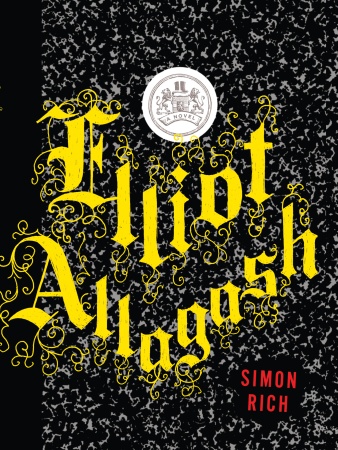
Hawthorne has created some really marvelous aesthetic objects here, and the Portland, Oregon based indie seems to have achieved a pleasing house style. These trades are a bit taller than what most of the big publishing houses put out, with heavy, thick covers and double French flaps. The thick bright white acid-free pages are also a nice touch. Full, in-depth reviews forthcoming.

Elliot Allagash — Simon Rich

Poor Seymour Herson, protagonist of Simon Rich’s début novel, Elliot Allagash. Overweight, unpopular, and often bullied, he becomes yet another target when Elliot Allagash shows up as a new student in his school. Not that Elliot bullies Seymour. Instead, Elliot targets Seymour as part of a weird Pygmalionesque experiment to manipulate the social hierarchies of Glendale, the middling Manhattan private school the two attend. Why is billionaire Elliot attending such a low-rent school? Simple: He’s been kicked out of every other school in New York at one point, and Glendale needs his father’s largesse. Elliot, bored evil genius that he is, spies Seymour sitting all alone and quickly singles him out as his chief puppet in a Machiavellian scheme, one that soon pays off for Seymour as well. Under Elliot’s supervision (or manipulation), Seymour sheds his weight, becomes a figurative and literal baller, and soon earns (or, uh finagles) the respect of his peers and teachers. In time though, Elliot’s creation craves autonomy–and turns on him.

Although Elliot repeatedly insists that his work with Seymour is a mere experiment to occupy his interest during his tenure in the hell that is Glendale, it becomes clear that he genuinely craves Seymour’s friendship, and, at times, he even admires aspects of his puppet. “You’re lucky you can still experience pleasure,” he tells Seymour early in their relationship, “I’ve become accustomed to a level of decadence so extreme that to go without luxury for even a minute fills me with a powerful rage.” The line is a great example of Rich at his best in Elliot Allagash–cartoonish comedy that tips into pathos. The roots of Elliot’s decadence are revealed a few pages later when we meet his awful, awful father Terry, a billionaire monster of the Mongomery Burns school. In a scene both funny and painful, Terry explains to an artistic genius that, not only will no one besides Terry ever see the paintings he’s commissioned from the artist, but that those paintings, along with the rest of his “Personal Museum” will be destroyed when he dies. The artist cries and pleads to renege the Faustian bargain he’s struck with his patron; Terry counters with a chilling (and hilarious) story about making a Pulitzer Prize-winning author write a “profoundly beautiful novel . . . in longhand” in front of him. “I read his book in a single sitting and then burned it in my fireplace,” he tells the shocked artist. Talk about decadence. While the scene is both funny and dreadful, the relationship between Terry and his son is downright sad. He attaches a note to a gift that he gives to Seymour when he and Elliot visit Seymour and his parents (they all play Monopoly in a scene of awkward comedy). The note says: “Dear Seymour, Thank you for spending so much time with my strange, strange boy. What is it like? You must remind me to ask you sometime.”

Terry’s note about his son is just one of many instances in this novel that speaks to the alienation that many adolescents feel. These themes match nicely with Rich’s tight, descriptive writing, which moves quickly, propelled by snappy dialogue (and plenty of punchlines, both verbal and visual). I don’t think that Elliot Allagash is being promoted directly as a Young Adult novel, but it will have a ready audience in the same smart crowd who dig funny, bright novels like C.D. Payne’s Youth in Revolt and Sherman Alexie’s The Absolutely True Diary of a Part-Time Indian. Recommended.

Elliot Allagash is available today in hardback from Random House.

Home Land — Sam Lipsyte

In Sam Lipsyte’s 2004 novel Home Land, minor loser Lewis Miner sends missives to his high school alumni newsletter, Catamount Notes, about his awful, sad misadventures in small-time drug use, petty copy-writing, itinerant busboyism, and chronic masturbation (he has a strong erotic disposition toward leg warmer porn. If this idea repels you (with no reciprocal attraction) this book is not for you). Miner wants to be sweet but he can be mean. He’s obsessed with the past–and who can blame him? His nickname in high school was Teabag, an appellation literally thrust upon him by the dumbest of jock-bullies. He carries this kernel of spite for years like a pebble in the sock, one that rubs up a giant blister–Miner is all blister. Writing ostensibly to his former classmates, but really just for himself, another form of masturbation:

It’s always been this way, as many of you might recall. Somebody chucks a snowball, I’m scouring the school yard for rocks. The bully just wants to shove sadness around, shake me down for spare change, I’m looking to scrape out his eye. I lack a sense of proportion. I have no sensitivity to sport. I’m the aggrieved rider on the grievous plain. I’m still pissed about the parade.

For all his anger though, Miner is an engaging, preternaturally sensitive voice. Along with his best friend/foil Gary, he muddles through a wretched life, finding solace (and an outlet for an outsized comic voice) in his letters to Catamount Notes–even if disgraced Principal Fontana won’t publish them. Despite his censorious discretion, Fontana reignites a downright silly mentorship with Miner. Fontana, a man after Holden Caulfield’s heart who calls everyone a “phony,” plays a weird father-figure to our favorite loser (even though Lewis’s own “Daddy Miner” is an ever-present terror in this tragicomedy).

Fontana, Daddy Miner, and the other characters in Home Land often feel like props rather than fully-drawn beings. Take the aforementioned Gary, for example, flush with cash after suing the hypnotherapist who convinced him that his parents sexually abused him repeatedly as part of elaborate Satanic rituals. His ridiculous past is par for course in the book. Such characters are the stock-in-trade of Home Land; they are, paradoxically, both its strength and weakness, beings who seem to speak entirely in misplaced metaphors and fucked-up aphorisms. There are too many of them for the book’s 200 pages. The fast writing never sags under the huge cast, but, nonetheless, its spine, its plot, its quick rhythm can’t bear their weight. There’s a much bigger novel here, but I don’t think I’d want to read it. Even Lipsyte’s normals are grotesques–or maybe it’s just Miner’s bilious perspective. In any case, sympathy is in short supply in Catamount country.

None of this is meant to disparage the reading experience of Home Land, which is marvelous, quick, funny, and a little bit gross (in a good way). Lipsyte crafts his sentences with a concrete, witty excellence that is near unrivaled in contemporary lit. It’s true that he sacrifices the depth of his characters here from time to time, and then includes passages that add nothing to the plot as a whole, like this one:

An older shapely woman swerved past on rollerblades. Bronzed, undulant in black Lycra, she clutched a pack of menthol cigarettes, danced on her wheels to something pumped through headphones. It was an admirable kind of ecstasy, hard-won. I wanted her for a lewd aunt.

That last line, of course, tells us so much about Lewis Miner and is also indicative of his overall method of storytelling. Not that he sees his letters to his alumni newsletter as part of a larger narrative–indeed, he’s to be forgiven all his esoterica, his mean, incisive commentary on contemporary life that doesn’t add up. Halfway through the book he tells us:

It occurs to me, Catamounts, sitting here composing this latest update, that someday, if and when the collected works of Lewis Miner ever see the light of day, some futuristic editor-type might attempt to assemble these dispatches in a certain manner, to, for example, tell a story, or else effect some kind of thematic arrangement of interwoven leitmotifs: Work, Love, Masturbation, Gary.

This would be a mistake. There are no leitmotifs. There is no story.

Miner then goes on to makes a pretty convincing case against stories (or at least against narrative arcs) and, tellingly, Home Land is better as a series of ugly, gross, hilarious anecdotes than it is as a novel with a traditional character arc. Which it is–a novel with a traditional character arc, climax, all that good stuff. Strangely, this is the book’s biggest failure. But that failure doesn’t get in the way of what is a pretty great and often very funny reading experience. Miner’s voice is a pleasure to inhabit for a while, a postmodern Falstaff heavy on the self-loathing. Home Land is a quick, easy read, a novel destined for cult-status, and Lewis Miner’s pathetic ironic braggadocio will hit home for many folks. Recommended.

Home Land is available in trade paperback from Picador.

James Wood on Harold Bloom

In his essay “Shakespeare in Bloom,” critic James Wood performs one of the strangest, most backhanded (and yet earnest) defenses I’ve ever read of Harold Bloom‘s aesthetic reaction to (what Bloom has called) “The School of Resentment” — deconstruction, Marxism, gender and queer theory, postcolonial theory, all that good stuff. Wood comes out strong, arguing, that in his prolific output, Bloom “has kidnapped the whole of the English literature and has been releasing his hostages, one by one, over a lifetime, on his own spirited terms.” Wood suggests that “this ceaselessness has produced some hurried, fantastical, and repetitive work,” before going on to throw around words like “garrulous” and “shallow.” Wood then takes Bloom to task over his famous (and improbable) claim that “Shakespeare invented us,” situating the claim against Bloom’s own most famous theory, the anxiety of influence. Wood says–
In truth, Bloom’s word invention is an enthusiastic Wildean necessary exaggeration. It is Bloom’s way of registering our almost religious sense that we live in Shakespeare’s shadow and that he does not simply represent human beings but brings new life, more life, into the world. . . . Bloom’s determination to honor Shakespeare’s godly primacy is a kind of secular theology.

The second section of Wood’s essay should be required reading for all English majors (or anyone serious about literary criticism). Here, Wood provides a wonderfully succinct overview of the history of literary criticism, connecting Freudian analysis and the New Critics to the various theories that Bloom would come to call the “The School of Resentment.” As we bring up the term again, we should note that we consider it a bit pejorative and utterly reactionary, and, to borrow from (and perhaps misapply) Wood, shallow. Wood points out that “Deconstruction brings a generalized suspicion to bear on language and in particular on metaphor (or ‘rhetoric’), which it suspects of hiding something–namely, its own metaphoricity.” In short, literature always metaphorizes, and thus hides, some other impulse, one always politicized. Wood continues: “Political criticism, including cultural materialism, converts Freud’s analytical suspicions into political ones. . . . The poem is read as if it were covering something up, as if it were an alibi that is rather too fluent to be entirely trusted.” It must be interrogated to reveal its secret, the secret prejudices of its age. Wood continues, after a page or two–

This is a long way around to Bloom, but it may explain the venom and desperation of his attacks. For although deconstruction did not intend to, it has produced mutant modes of reading that, when combined with leftish political guilt or ressentiment, seem to threaten the existence of literature as a discipline.

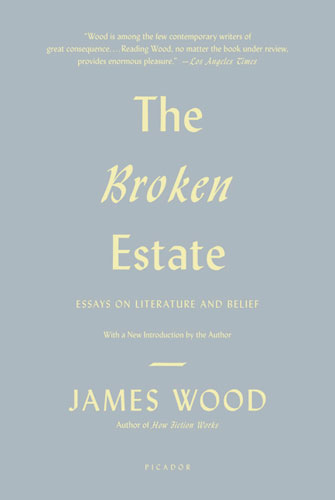
Wood espouses some common sense here uncommon in literary criticism, taking a long view that recognizes–and attempts to step outside of–the fact that it’s not all academic when it comes to how we read our books. History and politics matter, but so does our passion, our love for our books (as silly as that may sound). He defends Bloom’s work even as he calls it an overreaction. He credits deconstruction as having “produced some brilliance and many distinguished readings (no one could deny the acuities of Derrida, of Paul de Man, of Barbara Johnson).” Wood’s essay “Shakespeare in Bloom” is the kind of thing that students and aspiring critics alike should read before they feel the need to draw arms. You can read it in the second printing (the first in a decade) of Wood’s essay collection The Broken Estate, which debuts in June, 2010 from Picador.