John Updike’s Rules for Reviewing Books

From Picked-up Pieces (1975):

1. Try to understand what the author wished to do, and do not blame him for not achieving what he did not attempt.

2. Give him enough direct quotation—at least one extended passage—of the book’s prose so the review’s reader can form his own impression, can get his own taste.

3. Confirm your description of the book with quotation from the book, if only phrase-long, rather than proceeding by fuzzy precis.

4. Go easy on plot summary, and do not give away the ending. (How astounded and indignant was I, when innocent, to find reviewers blabbing, and with the sublime inaccuracy of drunken lords reporting on a peasants’ revolt, all the turns of my suspenseful and surpriseful narrative! Most ironically, the only readers who approach a book as the author intends, unpolluted by pre-knowledge of the plot, are the detested reviewers themselves. And then, years later, the blessed fool who picks the volume at random from a library shelf.)

5. If the book is judged deficient, cite a successful example along the same lines, from the author’s ouevre or elsewhere. Try to understand the failure. Sure it’s his and not yours?

To these concrete five might be added a vaguer sixth, having to do with maintaining a chemical purity in the reaction between product and appraiser. Do not accept for review a book you are predisposed to dislike, or committed by friendship to like. Do not imagine yourself a caretaker of any tradition, an enforcer of any party standards, a warrior in an idealogical battle, a corrections officer of any kind. Never, never (John Aldridge, Norman Podhoretz) try to put the author “in his place,” making him a pawn in a contest with other reviewers. Review the book, not the reputation. Submit to whatever spell, weak or strong, is being cast. Better to praise and share than blame and ban. The communion between reviewer and his public is based upon the presumption of certain possible joys in reading, and all our discriminations should curve toward that end.

Chris Andrews at The New Yorker

The New Yorker‘s Book Bench blog interviews Chris Andrews. The magazine published Andrews’s translation of Roberto Bolaño’s short story “Prefiguration of Lalo Cura” earlier this week. From the interview:

A book that’s a joy to read can be frustrating to translate when, for whatever reason, the process keeps jamming up. And it’s very hard to predict just how hard a book will be to translate until you really get down to it, because smallish but time-consuming problems can be virtually invisible on a first reading. But of course translating has its joys as well: moving in slow motion through a fictional world, exploring its dimmer recesses, listening to what echoes in it, handling rich vocabularies …

In Brief — New (and Not So New) Noir Novels

Got a great little gang of new noir (or at least noirish) novels from Picador last week. These handsome trade paperbacks are all available April 27, 2010. Full reviews all around forthcoming, but until then–

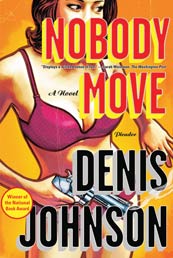
Denis Johnson’s Nobody Move is a tight snare drum of a comedy crime novel. Jimmy Luntz, still decked out in his white barbershop chorus tux (don’t ask) gets into trouble with a big gorilla he owns money too. On the run, he meets smoldering bombshell Anita. More trouble ensues. Nobody Move, originally serialized in Playboy, is a dark, funny genre exercise propelled by Johnson’s sharp dialogue and keen eye for detail. Johnson’s restraint and economy demonstrate writerly chops, but its his story and his characters that made me stay up too late reading last night.

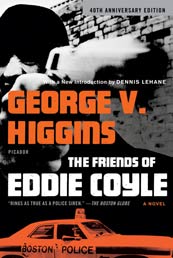
I’m kind of embarrassed that I’d never heard of George V. Higgins’s seminal crime novel, The Friends of Eddie Coyle, the story of a down-on-his luck gunrunner trying to get a break on a three-year sentence. Picador’s new edition celebrates the book’s 40th anniversary. Higgins’s electric dialogue thrusts the reader right into the action, trading narrative clarity for a smoky milieu of backroom deals and gritty alleys. But my phrasing here sounds way too corny and trite. Forgive me, I don’t really know how to write about good crime fiction because I’m so unused to it. I’ll lazily favorably compare The Friends of Eddie Coyle to David Simon’s Baltimore crime epic The Wire.

I’ve been too engrossed with Coyle and Nobody Move the past few days to do more than skim over Clancy Martin’s How to Sell, a novel about grifters and scam artists in the jewelery world, but I did read and very much enjoy its first chapter, where the protagonist pawns his mother’s wedding ring (“the only precious thing she had left”) and yet still manages to keep reader sympathy (mine, at least). Martin worked for years in the fine jewelery business. He also translates Nietzsche and Kierkegaard. Zadie Smith says of How to Sell: “It’s a little like Dennis Cooper with a philosophical intelligence, or Raymond Carver without hope. But mostly it’s like itself.” I like that.

If you’re still not in a  noirish mood, I’ll make one more attempt to piqué your interest. In what has to be one of the greatest opening shots in the history of cinema, Orson Welles begins his dark crime thriller Touch of Evil with a continuous tracking shot of a car that . . . hang on, I shouldn’t tell you what happens if you don’t know yet. Just watch the scene. It mines the same border-horror that those other noir-masters Roberto Bolaño and David Lynch also evoke so well.

“Prefiguration of Lalo Cura” — Roberto Bolaño

The New Yorker has published another short story by Roberto Bolaño. It’s called “Prefiguration of Lalo Cura” and it backgrounds a character from 2666, Olegario Cura Exposito (page 384, if you want to correlate things). The first paragraph:

It’s hard to believe, but I was born in a neighborhood called Los Empalados: The Impaled. The name glows like the moon. The name opens a way through the dream with its horn, and man follows that path. A quaking path. Invariably harsh. The path that leads into or out of Hell. That’s what it all comes down to. Getting closer to Hell or farther away. Me, for example, I’ve had people killed. I’ve given the best birthday presents. I’ve backed projects of epic proportions. I’ve opened my eyes in the dark. Once, I opened them by slow degrees in total darkness, and all I saw or imagined was that name: Los Empalados, shining like the star of destiny

Yann Martel Talks About His New Novel, Beatrice and Virgil

Yann Martel talks about autobiography, animals, and more in his new novel Beatrice and Virgil.

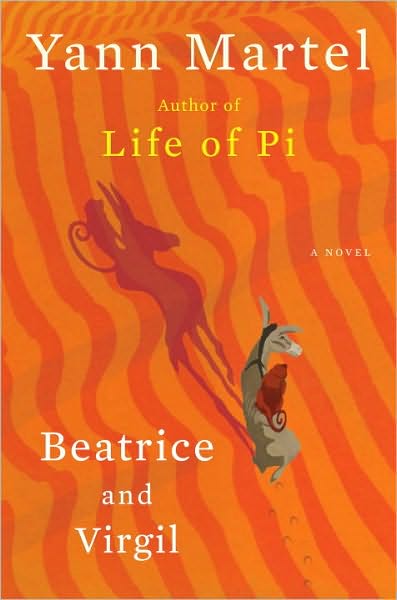
Beatrice and Virgil — Yann Martel

Yann Martel’s Beatrice and Virgil tells the story of a writer named Henry whose follow-up novel to a surprise smash hit is rejected. He moves to a large metropolitan city, gets a dog and a cat, takes clarinet lessons, joins an amateur theater group, and slowly forgets about writing fiction altogether. One day a stranger sends Henry a short story by Gustave Flaubert called St. Julian the Hospitator.” The sender has highlighted passages about Julian’s delight in slaughtering animals and also included a few pages of an original manuscript, a Beckettian play featuring two characters, Beatrice and Virgil. There’s also a note asking for help. Intrigued, or maybe bored, Henry visits the mysterious author, an old, creepy taxidermist (also named Henry). His play features two characters, Virgil, a howler monkey, and Beatrice, a donkey, who are trying to come to terms with a series of events they call The Horrors. The taxidermist’s project reignites Henry’s passion for writing and he’s soon helping the would-be playwright with revisions, blind to the inconsistencies and gaps in the old man’s strange behavior.

Beatrice and Virgil is a page turner, engaging, propulsive, and quite easy to read. It injects the philosophical and artistic concerns of literary fiction into the frame and pacing of a book designed for broader audiences. Martel displays his keenest literary skill in the early part of the novel, flitting through the kinds of subjects that bookish nerds of a certain postmodernist bent tend to obsess over: the possibilities and challenges of writing in a particular language, the complexity of pseudonymous fame, the intellectual allure of the essay versus the power of fiction to narrativize higher truth. To address this latter problem, Henry proposes that his new book comprise two sections–a work of narrative fiction and an essay to explicate that work. Why the need for an essay? Henry proposes to write an artful, fictive account of the Holocaust. The essay, which Henry wants published on the flip side of the fiction, thus eliminating a front/back cover distinction, is meant to explicate the fiction. In many ways the first section of Beatrice and Virgil functions as counterpoint to Henry’s proposed essay, concisely addressing the problems of using anything other than historical facts to represent the Holocaust.

After Henry gets the taxidermist’s package and reads “St. Julian the Hospitator,”Beatrice and Virgil moves into a faster rhythm and continues to accelerate to its end, never sagging. At times, Martel relies on stock phrasing and overt exposition to afford this pacing. I found myself wishing a few times that he would trust his audience a bit more. Is it really necessary to directly explain the titular allusion to Dante’s Divine Comedy? He could also be a bit less free with his narrator’s everyman style of questioning, a device employed often to propel the plot, but one somewhat inconsistent with Henry’s obvious intellectual acumen. Martel’s occasional use of lazy devices of the Dan Brown school directly contrasts the more experimental or postmodern aspects of his book. There’s the book’s initial section, which reads very much like a lyric essay; there’s the exegesis of “St. Julian”; there’s the taxidermist’s play, Beatrice and Virgil; there’s the book’s final section, “Games for Gustav.” This final section comprises thirteen short epigrams written in second-person perspective. “Games for Gustav,” Henry’s Holocaust art, demands audience identification with the victims of the Holocaust. Its brevity and ambiguity correlate to the narrative’s ahistorical engagement with the Holocaust and communicate a sense of apprehension and distance toward the subject. Is that subject Martel’s or Henry’s? In a piece I wrote last month about Beatrice and Virgil and the challenges of an aesthetic response to the Holocaust, I suggested that “Henry, a young French Canadian with no Jewish roots is utterly divorced from any authentic response to the Holocaust. He could write an academic essay on the subject, or a navel-gazing bit of metafiction that dithered over storytelling itself, but he essentially already has an answer to his own question of why there are so few artistic responses to the Holocaust–that to re-imagine or re-interpret or otherwise re-frame the real events of the Holocaust in art is to, at once, open oneself to dramatic possibilities of failure.”

Is Beatrice and Virgil an authentic response to the Holocaust? I won’t accuse Martel of using the Holocaust as a mere prop in his novel; indeed, anticipation of such an accusation is precisely what leads Henry to suffer over an essay to explicate his fiction. Martel’s book is about murder, horror, and how one might witness to or otherwise narrativize murder and horror; Henry’s “Games for Gustav” is just one of those attempts to witness. The novel engenders multiple readings then. We can take Henry’s “Games” as part and parcel of Martel’s program, read them perhaps as Martel’s own attempt at poetry after Auschwitz. This reading would subscribe to a traditional narrative arc–Henry faces a challenge, endures a perilous task, and finds resolution in his art: a valid artistic response to the Holocaust is possible. I think, however, that there is another, more complicated reading available, one far more ambiguous, one that places any aesthetic response to the Holocaust under suspicion. If we scrutinize the elements of traditional narrative fiction at work in the novel, we can see multiple ironies in Henry’s “hero arc,” ironies outside of Henry’s otherwise perspicacious gaze. To write an authentic aesthetic response to the Holocaust, Henry must face some kind of deathly extreme that will license such art. But is such a licensing, a conferring of authority possible? I won’t point to spoilers here but will say that I read the novel’s climax ironically. I believe it complicates Henry’s (and perhaps Martel’s) attempt to engage the Holocaust via metaphor and artifice and calls the novel’s resolution into question.

But these matters are probably better reserved for the detailed dialogues the book will no doubt inspire. Beatrice and Virgil raises essential questions of post-postmodernity, exploring the porous boundaries between autobiography and fiction, history and myth, and the limits of allegory. Its rewards are not in its answers but in its questions.

Beatrice and Virgil is new in hardback from Spiegel & Grau on April 13, 2010.

In Brief — Wolf Hall, Eddie Signwriter, Salinger Betrayed, and Wizard People, Dear Reader

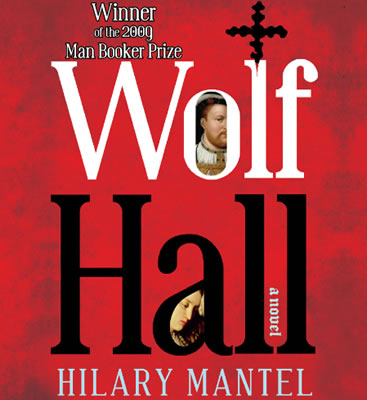
Started a new audiobook: Hilary Mantel’s Wolf Hall, read competently by Simon Slater. Wolf Hall tells the familiar story of Henry VIII, only Mantel focuses (at least so far) mostly on Thomas Crownwell and Cardinal Wolsey. Most of the men in the story have the first name “Thomas.” I’m not particularly interested in the Tudor saga but I’m enjoying Mantel’s novel so far–its clean, precise style, its pacing, and, particularly Mantel’s sparing use of details. Historical novels sometimes succumb to the weight of the author’s passion with her subject. Thankfully, Mantel does not overload her prose with superfluity; instead she appoints detail in her narrative with care and precision, giving character and plot room to grow. Good dialogue too. More later.

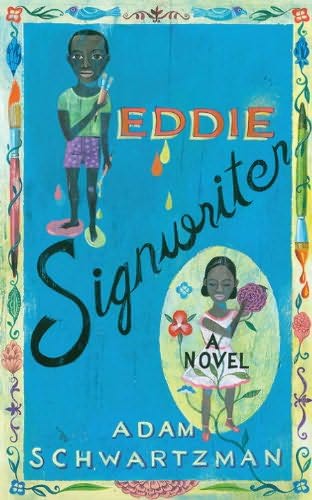
I got a review copy of Adam Schwartzmann’s début novel Eddie Signwriter last week and haven’t had a good chance to read any of it until today. The novel tells the story of Kwasi Edward Michael Dankwa aka Eddie Signwriter, who journeys from his native Ghana to Senegal, and then to France, where he takes up a new life as an illegal immigrant in Paris. The story opens in a burst of action. Nana Oforwiwaa, a village elder has died and authorities are blaming Kwasi. So far, I find Schwarzmann’s prose a bit heavy. Sentences need pruning–too many redundant verbs and clauses in his sentences for my taste. Eddie Signwriter is better when Schwartzmann moves the narrative of young Kwasi along in shorter, declarative sentences. Eddie Signwriter is available now from Pantheon.

Great article in New York magazine by Roger Lathbury. “Betraying Salinger” details Lathbury’s attempt to publish J.D. Salinger’s last story, Hapsworth 16, 1924. Sad and strange. Here’s the first paragraph:

The first letter I got from J.D. Salinger was very short. It was 1988, and I had written to him with a proposal: I wanted my tiny publishing house, Orchises Press, to publish his novella Hapworth 16, 1924. And Salinger himself had improbably replied, saying that he would consider it.

If you haven’t heard any of Wizard People, Dear Reader, Brad Neely’s reimagining of Harry Potter and the Sorcerer’s Stone you should do so now. Download Neely’s audiobook (to be played concurrently with a version of the (muted)  film) from Illegal Art. Neely’s revision of the first HP volume taps into the story’s primal, dark mythos; it’s hilarious. Neely’s writhing delivery sounds like a dead-on impression of Brad Dourif (particularly like Dourif’s Deadwood character, Doc Cochran). If you don’t want a full screening, YouTube is full of short, sweet solutions, like this one — “The Cribbage Match” —

Two Visions of Apocalypse: Margaret Atwood’s The Year of the Flood and Martin Bax’s The Hospital Ship

I finished Martin Bax’s surreal dystopian romance The Hospital Ship last night and then finished the audiobook version of Margaret Atwood’s hyperreal dystopian anti-romance The Year of the Flood today. Both books take their cues from that first apocalypse story, the story of Noah and his ark, and continue that tradition imagining a version of the end of the world. Despite their mythical-biblical origins, such books tend to get ghettoized into a certain genre of science fiction — let’s call it apocalypse fiction — despite the artistic power or literary merit of the author’s prose itself. Apocalypse books like Kurt Vonnegut’s satire Cat’s Cradle, Cormac McCarthy’s The Road, and Aldous Huxley’s Ape and Essence diverge in style, tone, and execution. It’s their subject that compels us, each vision a proposition, a promise of some kind of future, a future after the future. Many of these apocalypse books remain prescient today. However, others feel dated simply because so much of what the author wrote twenty or fifty or more years ago more or less came true. For instance, is the homogenized, greenzoned aristocracy of Brave New World who lavish in the trivial culture of the feelies and centrifugal bumblepuppy all that different from contemporary exurbanites who basically live in walled-off compounds, little homogenized townships that strive to exist outside of civic reality and history? Robert Siegel’s recent report for NPR on the The Villages, an eerie Florida compound for senior citizens, illustrates how willing people are to buy into a company-owned, company-governed greenzone. The Villages even has its own whimsical fake “history,” complete with markers and plaques. It’s like The Prisoner or something. But enough about real life. We have apocalypse lit to tell us about the present.

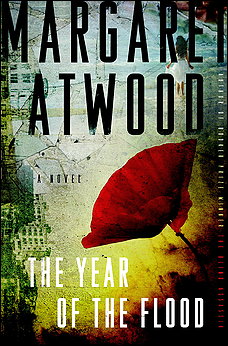
The heroes of Atwood’s The Year of the Flood are not, for the most part, from the corporate-controlled compounds that keep the rest of the world at bay. There’s Toby, the orphan who grows up tough yet learns the healing arts. There’s Ren, a young girl trying to find her identity wherever she can. There’s their would-be spiritual guide, Adam One, and his lieutenant/rival Zeb. They are outsiders, members of an eco-cult called The Gardeners who worship saints like Rachel Carson, Ernest Shackleton, and Sojourner Truth. Flood is the sprawling companion to Atwood’s 2003 novel, Oryx and Crake, which I enjoyed very much. Both take place in a world where the “Waterless Flood,” a SARS/mega-flu type virus brought about via genetic tinkering, has turned most people into zombie-goo. I could go and on about the world Atwood shapes here, one full of genetic modification, eco-terrorism, religious fervor, and radical disparity, but other folks have already done it. So, in the grand tradition of internet laziness, I point you to excellent reviews here and here, which do a better job explicating the plot than I’m willing to do now (and it was an audiobook, remember, so I don’t exactly have it in front of me. Mea culpa). Apocalypse lit isn’t so much predictive as it is descriptive of the contemporary world, and Atwood’s dystopian vision is no exception. Viscerally prescient, Flood paints our own society in bold, vibrant colors, magnifying the strange relationships with nature, religion, and our fellow humans that modernity prescribes. Atwood ends her book in media res, with Toby and a handful of other characters somehow still alive, ready, perhaps, to become stewards of a new world. Flood concludes tense and, in a sense, unresolved, but Atwood implies hope: Toby will lead her small group to cultivate a new Eden. Despite all the ugliness and cruelty and devastation, people can be redeemed. The audiobook rendition of The Year of the Flood is very good, employing three actors to play the three principal roles, Ren, Toby, and Adam One. There are also terribly cheesy full-band versions of the hippy-dippy songs the Gardeners like to sing on certain Saint Days that are witty as parody but ultimately distracting. Atwood’s prose sometimes relies on placeholders and stock expressions common to sci-fi and YA fiction, and her complex plot (disappointingly) devolves to a simple adventure story in the end, but her ideas and insights into what our society might look like in a few decades are compelling reading (or, uh, listening in this case). Recommended.

The doctors, specialists, sailors, and patients of the titular vessel in Martin Bax’s The Hospital Ship are afloat in their own greenzone of sorts, a moving compound that seeks to treat the troubled world. What’s the trouble with the world? No one’s sure, exactly–there’s permanent all-out-war, of course, famine perhaps, insanity for sure. There’s also a bizarre army of bureaucrats going from continent to continent crucifying men and raping women for no clear reason. The ship’s psychiatrists diagnose it “The Crucifixion Disease.” Euan, Bax’s erstwhile lead, tries to figure out how to love and how to heal in the middle of hate and extinction. Aided by the eccentric, Falstaffian Dr. Maximov Flint, Euan conducts an experimental therapy between a Moi prostitute named V and a suicidal Wall Street broker named W. He also finds a lover and partner in an American girl named Sheila. About half of The Hospital Ship comprises citations from a variety of non-fiction texts, including medical textbooks, psychiatric studies, sociology texts, travelogues, war diaries, and more. The technique is bizarre and jarring, and Bax often imitates the style of such texts, most of which linger on sex or death. There’s also an obsession with the Vietnam War, which makes sense as the book was published in 1976. There’s a lovey-hippie type vibe to the hospital ship’s personnel, and like Atwood with her Gardeners, Bax is satirical and loving to his heroes at the same time. He mocks some of the silly idealism of the movement even as he finds solace in their vision of love and healing in an apocalyptic world. Bax’s book is wholly weird, disconnected, lurching and farcical, a madcap dystopian Love Boat on peyote. I spotted it at my favorite used bookstore, intrigued first by the (now retro-)futurist font, then the name, echoing Chris Adrian’s The Children’s Hospital, another book about a hospital-as-ark. If the black-and-white collage cover art didn’t seal the deal, then the blurb from J.G. Ballard comparing Bax favorably to William Burroughs did. Burroughs is an appropriate reference point, with the sexual alienation and the medical flavor and the cut-up technique and all, but Bax’s writing is utterly Ballardian (he even directly cites Ballard among other authors–like, you know APA style in-text citations). The Hospital Ship is a cult novel which might not have a big enough cult. It definitely belongs in print again; until then, pick up a copy if you can find one.

Mourning Icarus — Sam Kimball at the MOCA

If you’re in Jacksonville, Florida this Thursday, make sure to check out Dr. A. Samuel Kimball’s talk at the Museum of Contemporary Art. I’ll let the flier speak for itself, but I will add that Dr. Kimball’s talks are always enlightening and inspirational.

Hotel Iris — Yoko Ogawa

Seventeen-year-old Mari, the narrator and subject of Yoko Ogawa’s new novel Hotel Iris, is something of a Cinderella figure. Her dad dies a violent death when she is only eight years old and her grandparents soon pass on as well, leaving her in the sole custody of her money-grubbing mother who works poor Mari like a slave in the upkeep of their shabby hotel. The titular Iris is a crumbling structure with only one seaside view, frequented in the off-season by prostitutes and only bustling in the sweltering summer months. It’s in the off-season when Mari first spies the transformative figure in her life–a man fifty years her senior who gets into a raucous fight with a hooker in the hotel. Transfixed by his commanding voice, Mari follows the man the next day as he performs banal errands. When he confronts her, the two strike up a strange friendship (very strange, it will turn out). The man lives on a small island where he works translating mundane Russian texts like tourist pamphlets–although he is hard at work at a passion project, translating a strange Russian novel. The translator begins writing Mari letters and she eventually sneaks away to meet him. In the seaside town he treats her with quiet deference, but when Mari visits his small, austere home on the island she undergoes a bizarre, sadistic sexual awakening. To continue a proper review of Hotel Iris will necessitate some mild spoilers. I won’t reveal any major plot points, but those intrigued may wish to stop reading here. Otherwise, on to the aforementioned bizarre, sadistic sexual awakening.

It’s pretty simple, really. The translator, a sexual sadist, has found in Mari a perfect masochist, a young girl so alienated and lonely that she can only find pleasure in extreme pain, beauty in brutal ugliness, and freedom in bondage. Her initial attraction to the translator, his commanding voice, goes to extremes in his isolated house on the island, where he strips her naked, ties her up, and forces her into all sorts of sexual humiliations. In a strange mirror of her Cinderella-life at Hotel Iris, he forces her to clean his house while strapped to a chair. He takes thousands of degrading photographs of her. In a scene reminiscent of “Bluebeard” he hangs her from the ceiling of a tiny pantry and whips her with a riding crop. He never engages in direct coitus with her; in fact, he never even removes the suit and tie he wears even in the sweltering summer. In each scenario Mari expresses the true happiness and pleasure she finds in the translator’s torture. “Only when I was brutalized, reduced to a sack of flesh, could I know pure pleasure,” she tells us.

That young, naïve Mari should narrate the novel is the genius of Ogawa’s program. Her first-person immediacy communicates the confusion and despair of a neglected, overworked teen trapped in a dead-end job in a Podunk town. As the plot spirals it tempts the reader to endorse the “love” that Mari feels for the old man who tortures her. Just as Nabokov manipulates his readers via the charms of Humbert Humbert, Ogawa, writing her reverse-Lolita, repeatedly cons us into normalizing the relationship, in viewing it only from Mari’s perspective. It’s through the slipped, oblique details of Mari’s past that we construct a more coherent image of a long pattern of abuse. Her mother, always bragging about Mari’s beauty, tells the story of a sculptor who used Mari as a model (Mari, of course, believes herself ugly). “The sculptor was a pedophile who nearly raped me.” The only maid in the hotel repeatedly claims to be “like a mother” to Mari, yet she attempts to blackmail and humiliate the poor girl, and even tells her that she was Mari’s father’s “first lover.” Late in the novel, a drunken hotel guest gropes Mari’s breast and her mother brushes the abuse off, blaming implicitly on her daughter. The focused, purposeful sadism of the translator–a result of the man’s own painful past–is thus a form of love for Mari. Yet we see what Mari can’t see, even as we accept the savage doom of their romance.

Hotel Iris recalls the dread creepiness of David Lynch, as well as that director’s subversion of fairy tale structures (perhaps “subversion” is not the right word–aren’t fairy tales by nature subversive?). There are also obvious parallels between Mari’s story and The Story of O and Peter Greenaway’s fantastic film The Cook, the Thief, His Wife, & Her Lover. But these are perhaps lazy comparisons–I should talk about Ogawa’s deft writing, her supple, slippy sentences, her sharpness of details, the exquisite ugliness of her depictions of sex and eating. She’s a very good writer, and translator Stephen Snyder has done a marvelous job rendering Ogawa’s Japanese into smooth, rhythmic sentences that resist idiomatic placeholders. Hotel Iris is not for everyone, but if you’ve read this far you’ve probably figured that out already. Readers who venture into Ogawa’s dark world will find themselves rewarded with a complex text that warrants close re-reading. Recommended.

Hotel Iris, a Picador trade paperback original, is available today.

Size Matters

I went to my favorite local bookstore this afternoon and for reasons beyond me I was compelled to pick up Jonathan Littell’s divisive 2009 novel The Kindly Ones, a massive tome running to almost 1000 pages in its trade paperback edition. Okay. The reasons I bought it are not completely beyond me: they mostly stem from Paul La Farge’s essay “A Scanner Darkly,” published in the May, 2009 issue of The Believer. Previous Believer feature essays have led to me picking up excellent books by writers I’d never heard of, including 2666 and The Rings of Saturn. Anyway, the book is massive, and I don’t really have time to read it any time soon. There is a hobbit-sized stack of review copies lingering by my nightstand, more arriving all the time, not to mention the books I habitually pick up weekly. Which, more often than not, tend to be pretty big like, uh, The Kindly Ones.

Why is this? Why the attraction to big books? In his essay included at the end of Bolaño’s 2666, Ignacio Echevarría cites a passage from the book where literature professor Amalfitano wonders that:

Now even bookish pharmacists are afraid to take on the great, imperfect, torrential works, books that blaze paths into the unknown. They choose the perfect exercises of the great masters. Or what amounts to the same thing: they want to watch the great masters spar, but they have no interest in real combat, when the great masters struggle against something that terrifies us all, that something that cows us and spurs us on, amid blood and mortal wounds and stench.

The “bookish pharmacist” in question has explained that he favors the preciseness of “Bartleby” over Moby-Dick, the polish of The Metamorphosis over The Trial. Amalfitano, Bolaño’s stand-in, points out that it takes “the great, imperfect, torrential works” to “blaze paths into the unknown.” Put another way, the masters need space; space to overflow, make errors, experiment, joust with other masters, play in and with time. Obviously, the passage (as Echevarría and a million other critics have noted) is a defense for the sprawl of 2666 itself, but I think it speaks to why many readers are drawn to the big books. They can be ragged and overflowing but they also have more room to take the measure of spirit, soul, life. They can evoke this world and others. They can be grand.

Not to say that the smaller books can’t do this in turn. Denis Johnson’s Jesus’ Son is masterful in its precision and humor. But Tree of Smoke is the better book. David Foster Wallace’s Infinite Jest trumps everything else the man wrote. White Noise is more manageable than (and perhaps superior to) Underworld, but the bigger book allows Don DeLillo the space he needs to explore so much of American history and American psyche. And these are just contemporary examples. There’s James Joyce and Marcel Proust, Dostoevsky and Tolstoy. Sterne. Cervantes. Supply your own names.

But I also love novellas and those long short stories of strange size like Joyce’s “The Dead” or, yes, “Bartleby” (sidebar: Really, what is “Bartleby”? A long short story? A short novella? What is it?). There’s something pure and refreshing about them, especially when consumed quickly, especially when consumed between a few of those long books. And a confession: I love it when review copies come in that hover around 200 pages, particularly when the novel is the writer’s first or second. There’s a glut, a horrendous, miserable glut, of first-time novelists who feel they must say everything about everything in 380 or 450 or, God forbid, 500+ pages. It’s really too much. I suppose the rule, if there has to be a rule (there doesn’t) is impossibly simple (and perhaps just impossible): if you’re going to write a really, really big book, make sure it’s addictive, compulsive reading. I’m not sure if The Kindly Ones is great art or a potboiler posing as art, but I am pretty certain that its length alone, for whatever reason, is part of its attraction.

Reviews in Brief: All the Living, The Winter Vault, and Jenniemae & James

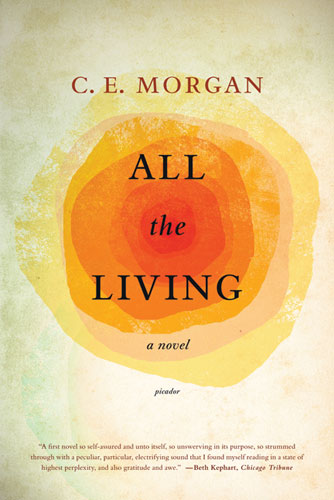
In her debut novel, All the Living, C.E. Morgan tells the story of Aloma, a would-be pianist who forgoes her dreams of artistic freedom to play wifey to her young lover Orren who must take sole responsibility of running the family tobacco farm after his family dies in a car accident. Aloma knows nothing about farming and even less about the grief Orren suffers. She’s an orphan herself, but with no memory of her own parents, she finds it hard to connect to overworked Orren as he slowly slips away. A nearby minister who hires her to play church services paradoxically relieves and exacerbates Almoa’s despair when he enters her life. Morgan’s novel is a slow-burn, often painful, sometimes slow, but also guided by a poetic spirituality that resists easy interpretations. (Oh, and she’ll also make you run for a thesaurus every few pages). All the Living is new in trade paperback from Picador, available now.

Anne Michaels’s The Winter Vault begins in Egypt, in 1964, where Canadian engineer Avery Escher is part of a team trying to help the Nubians who will be displaced by the Aswan High Dam. He and his wife Jean share a houseboat on the Nile, but what might have been a year of romantic adventure devolves into the tragedy of a culture displaced and a family eroded. The pair separate and return to Canada, where Jean takes up with Lucjan whose stories of Nazi-occupied Warsaw inform the novel’s second half. The Winter Vault is poetically dense and often overly-lyrical, sometimes offering self-important and ponderous dialogues in place of concise plotting. And while Michaels treats the tragedies of the occupied Poles and Nubians with a certain sensitivity, her engagement veers awfully close to what Lee Siegel has termed Nice Writing.The Winter Vault is new in trade paperback from Vintage on April 6, 2010.

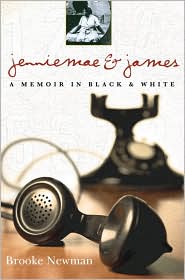
Jenniemae & James is Brooke Newman‘s new memoir about her father’s unlikely relationship with the family maid. James Newman was a brilliant mathematician (he coined the term “googol”); Jenniemae Harrington “was an underestimated, underappreciated, extremely overweight woman who was very religious, dirt poor, and illiterate.” Newman wants us to see a unique–and deep–friendship between the pair that defies 1940s/50s norms in Washington D.C., but it’s hard not to think that there’s at least some whitewashing going on here. Undoubtedly the two shared an affinity and connected through a love of numbers, but it’s hard to see more in this than an employer-employee relationship–and one still colored by the politics of the pre-Civil Rights era. Jenniemae, black mammy, sassy, Southern, larger-than-life, quick with folk wisdom and colorful quips–it all seems like a one-sided vision, a take on the Magical Negro trope that resists human complexity. Still, Newman’s tone is sincere, her pacing is swift, and the book reads with the pathos that memoir lovers demand. Jenniemae & James is new in hardback from Harmony/Random House March 30, 2010
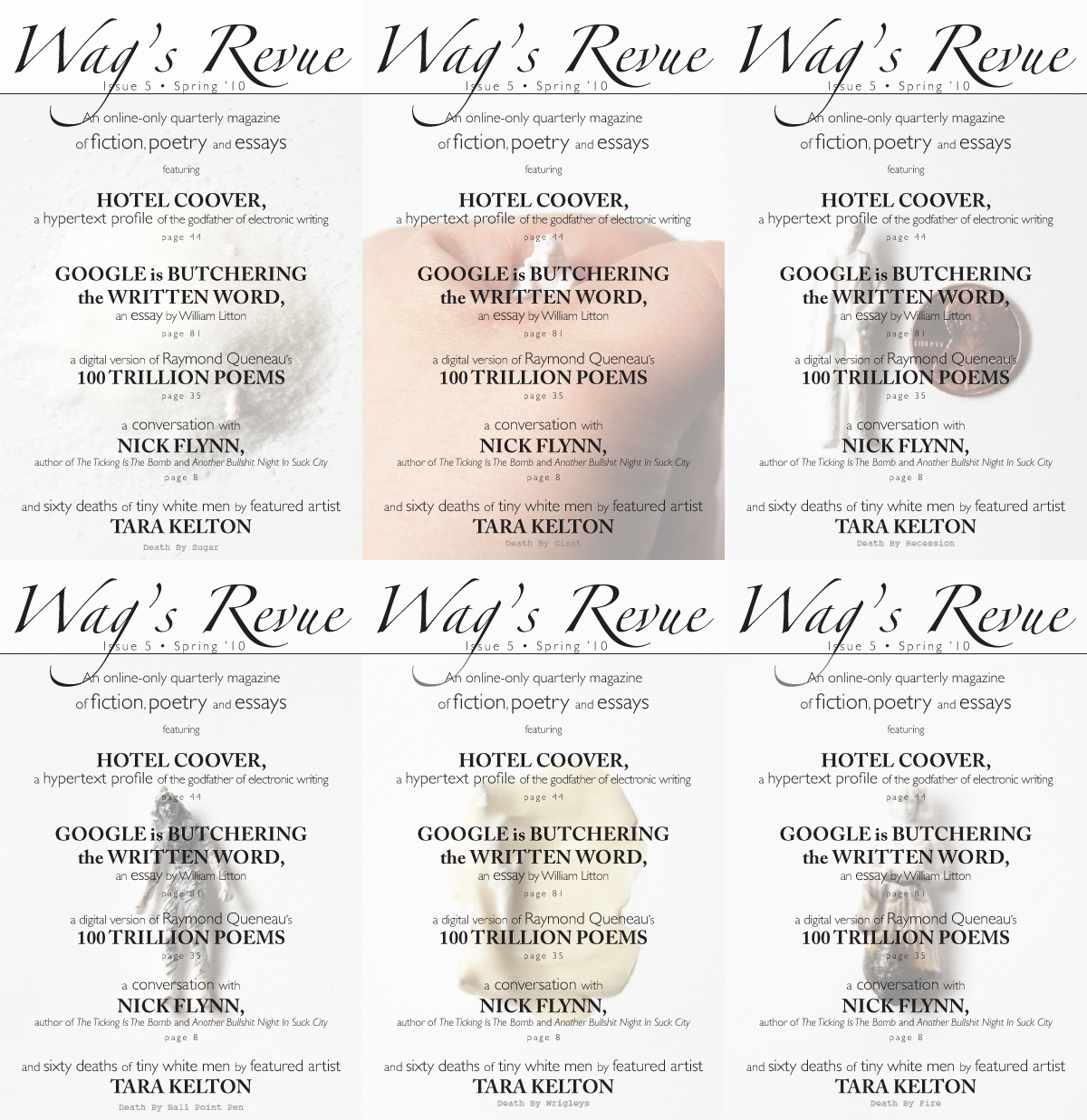
Wag’s Revue Issue 5 Out

The newest issue of the stylish and savvy online literary magazine, Wag’s Revue is out new this week. In addition to art, poetry, audio clips, and short fiction, the issue features a really cool essay by Robert Moor about Robert Coover’s groundbreaking hypertext exercise, The Hypertext Hotel. Fittingly, the essay is itself an exercise in ludic hyperlinked indeterminancy. Good stuff.

The Delighted States — Adam Thirlwell

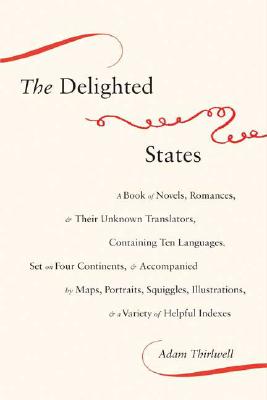
This weekend, I read and thoroughly enjoyed the first volume of Adam Thirlwell’s The Delighted States (new in a handsome trade paperback edition from Picador at the end of this month). The word “volume” seems to imply multiple, discrete editions, but really the term has more to do with Thirlwell’s sense of humor. Like an 18th century novel, The Delighted States comprises chapters, books, and volumes. That playfulness also echoes in the book’s subtitle: “A Book of Novels, Romances, & Their Unknown Translators, Containing Ten Languages, Set on Four Continents, & Accompanied by Maps, Portraits, Squiggles, Illustrations, & a Variety of Helpful Indexes.” Despite the mock-serious tone there, the subtitle is a pretty accurate description of the book. Not that Thirlwell is pompous or long-winded. Rather, he’s the rare literary critic who manages to show authority without being didactic, who balances scholarly insight with playful humor and a willingness not to answer to every little detail.
But what is it about? From Thirlwell: “This book — which I sometimes think of as a novel, an inside-out novel, with novelists as characters — is about the art of the novel. It is also, therefore, about the art of translation.” Thirlwell, a translator himself (the book flips over to his version of Vladimir Nabokov’s short story “Mademoiselle O”) uses translation (of books, of styles, of ideas) to relate a history of the rise of literary modernism. The first volume finds heroes in Gustave Flaubert and his would-be mistress, James Joyce and his French translator, Denis Diderot, Marcel Proust, and Balzac. There’s Gogol and Nabokov, Tolstoy and Borges–not to mention their characters, major and minor. It’s a lot of fun, but even better, it’s the kind of performance to which every literary critic should aspire. It makes you want to read the books you haven’t yet read and re-read the ones you already have.

Thirlwell, like any good avid reader, reads his books (and authors) in dialog with each other, and I can’t help but do the same. The hardback edition was published in 2008, but I can’t help read in Thirlwell’s work a response to David Shields’s new “manifesto” Reality Hunger. Both authors recognize that novelists attempt to represent or even re-enact “reality” in their works (despite Plato’s claim that mimesis was not the business of the poets). However, where Shields for some unclear reason nihilistically argues for the death of the novel, Thirlwell repeatedly demonstrates why a novelist’s depiction of reality is important. Thirlwell realizes that “The more a sign looks as if it’s real, the more it will have to be artificial,” citing Joyce’s interior monologues as an example. “The less artificial a sign is, the less likely it is to be convincing,” Thirlwell writes. Put another way, novels — and by proxy other narrative art forms — must use artifice to achieve reality. Like Shields, Thirlwell cites Joyce’s famous quote — “I am quite content to go down to posterity as a scissors and paste man” — but the effect is far more satisfying in The Delighted States, where it is contextualized evidence used to bolster a point, and not mere solipsistic indulgence. But maybe I’m still holding a grudge against Shields. And maybe it’s not fair to use Thirlwell’s work to rap at his (metaphorical) knuckles. Unlike the sensationalism, negativity, and gimmicks of Reality Hunger, Thirlwell’s argument for the novel is measured, patient, well-researched–and thus far less likely to cause as big a stir. In a single parenthetical aside he reveals more about his critical subjectivity than Shields is ever willing to admit in an entire book: “Good novelists (or, maybe more honestly, the novelists I like) are often not just avant-garde in terms of technique; they are also morally avant-garde as well.” It’s a good thesis on its own, but what’s really wonderfully refreshing is Thirlwell’s honesty about bias in criticism–that “Good novelists” are really “the novelists I like.” Fantastic stuff so far, and I’m itching to read more.

“A Strange Kind of Vibration” — Chris Andrews on Translating Roberto Bolaño

The Australian is running a new article about one of Roberto Bolaño’s English translators, Chris Andrews. Reporter Bernard Lane reveals that

Andrews had been badgering publishers for translation work. In 2001 he badgered the right publisher, Christopher MacLehose of Harvill Press in London, at the right time. MacLehose had just bought the first English rights to Bolano and his translator had fallen by the wayside. Andrews knew and admired Bolano’s [sic] writing, thanks to his acquisition of Spanish at the universities of Melbourne and La Trobe. He got the job and out came By Night in Chile.

Andrews on Bolaño–

“I think of him as a pan-American author, as an author of the western hemisphere,” says Andrews. Bolano’s reception in Britain had been slow at first, not that his prose was a problem.

“There are a lot of important features of Bolano’s style that can be transferred from one language to another,” Andrews says, “The big syntactic patterns, the patterns of repetition, the long sentences, the bursts, the parenthetical remarks; that comes across.”

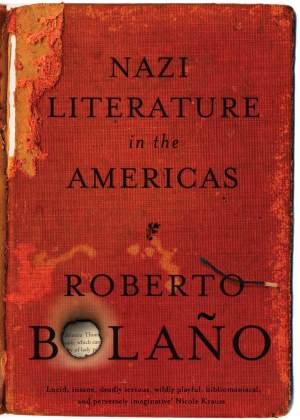
The article centers around Andrews’s translation of Nazi Literature in the Americas. We absolutely love the Picador edition’s cover for the UK, Australia, and similar markets. It captures the book’s apocryphal tone, its violence–and also its sharp sense of humor. On that book specifically (and Bolaño’s work in general)–
In a sea of allusion, English readers may feel adrift. “I don’t think it matters very much,” says Andrews. “It’s probably going to be read by people who have already got an interest in Bolano.

“One of the nice things about those bits of Bolano that are full of references and allusions is that it is hard to draw the line between the historical characters and the fictional ones.

“In different literary cultures, there are different norms about what you need to explain. In the French translation of Bolano, there are footnotes.”

Wouldn’t readers halfway familiar with Bolano suspect they were dealing with yet another level of artifice? “I think they would,” Andrews says, “even if it said ‘translator’s note’.”

The article details what techniques Andrews employs when stuck, particularly with regional dialects and slang. Andrews also talks about his correspondence with Bolaño himself,  in the last few years of the Chilean’s life. Here’s Andrews describing his attraction to Bolaño:

The prose has a mesmerising quality that intrigues Andrews.

“There’s a character in one of the stories I’ve just been translating who’s an actor called El Pajarito [Little Bird] Gomez. He’s a skinny, unimpressive-looking guy, but as soon as he appears on camera he vibrates in a weird way that almost hypnotises the viewer.

“When I read that, I thought, that’s a bit like what happens with Bolano’s prose for many readers, that it has a strange kind of vibration.”

Reality Hunger — David Shields

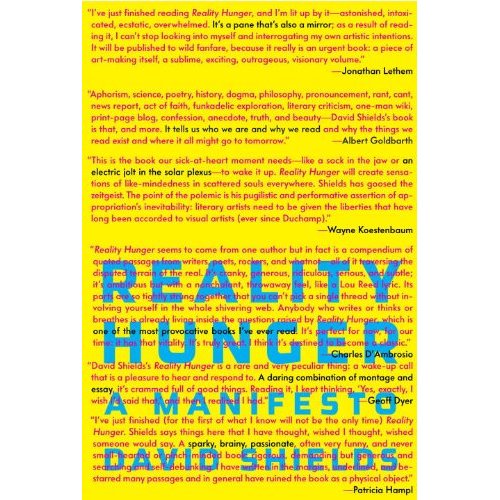
Just what, exactly, is David Shields’s Reality Hunger supposed to be about? He’s brazen enough to slap the subtitle “A Manifesto” right there under the title, suggesting a work of sustained principles calling for something to change or happen for some reason, but after reading the damn thing, I still have no real idea what he really wants or why I should care. If I had to venture a guess, it seems that Shields is suggesting that we quit reading, writing, and publishing “standard novels” and that “realism” in letters can only be located in lyric essays and other works free from genre constraint (even the memoir is too artificial for Shields, and autobiography ultimately represents facts without truth).

I think what he really wants is authenticity, which repeatedly gets called “reality,” a term he (repeatedly) fails to satisfactorily define. Reality Hunger seems to argue that authenticity in the 21st century must take the form of synthesis, must chop up and recombine disparate elements, genres, cultural artifacts. To that end, Shields’s book is a tour-de-force of citation and appropriation. Aspiring toward an aphoristic tone, Shields organizes the book into 618 short sections over 200 or so pages; most of the sections are not his work, but come rather from myriad sources across different cultures and eras. I have no problem with this (c’mon, this is Biblioklept!) and Shields clearly demonstrates that the practice is hardly new in the history of story-telling, rhetoric, or philosophy.

My real problem is the self-seriousness of it all. Shields aspires to “break” reality into his text by reapportioning and recombining varied citations, but this bid for authenticity is, of course, utterly artificial, often stolid, and not nearly as fun as such a playful medium would suggest. Even worse, it’s not really a proper synthesis; that is, in stacking bits of other people’s work together with some of his own thin connective tissue, Shields hasn’t achieved an authentic blend or, to use a term he’d hate, anything novel, anything new. The jarring stylistic shifts between sections will lead serious readers repeatedly to the book’s appendix to find out who originated the words Shields is copping.

If Reality Hunger approaches having a point, it comes in the book’s penultimate chapter, “Manifesto.” Here, he attacks “standard novels.” The term is appropriated from W.G. Sebald, a writer of marvelous and strange novels that Shields would love to be essays. In one of the few original lines in the book, Shields dismissively writes that “Novel qua novel is a form of nostalgia.” He goes on to argue that the personal/lyric essay is more closely aligned with philosophy, history, and science than novels, and that novels no longer have any legitimate response to these more “real” concerns. Which is utter bullshit, really, and seems more than anything to prove that Shields is probably not that well-read, despite his massive cut and paste catalog. Not that I think that he’s not that well-read. He just picks and chooses, according to his taste, what novels get to escape being “standard.” How can one read contemporary masterpieces like The Rings of Saturn or Infinite Jest or 2666 or Underworld and honestly say that they don’t hold value? Shields, of course, does/would presumably find room for these in his “manifesto.”

The most embarrassing chapter of Reality Hunger, “Hip-hop,” also reveals the most about Shields’s program. It’s also one of the few chapters to feature long sections of Shields’s own original prose. In a turgid, humorless, overly-analytical “defense” of hip-hop and “sampling culture,” Shields describes how hip-hop works, riffing on the function of “realness” in hip-hop, and grasping at the larger implications of a normalized recombinant art form within modern culture. And though I agree with pretty much everything that Shields has to say about piracy and copyright laws, the drastic artificiality of his style and tone is really too much here. It’s like someone trying to explain why a joke is funny.

The worst though is Shields’s assertion that “Our culture is obsessed with real events because we experience hardly any.” The sentence itself is a clever bit of sophistry that falls apart under any real scrutiny. I can name a dozen “real events” that I experienced in the last few hours alone, including eating dinner with my family, talking with my wife, and putting my daughter to bed. Complaining that we are denied “real events,” like the mopes Shields cites from Douglas Coupland’s Generation X who lament their “McLives,” is a way of excusing ourselves from the intensity of being present–at all times–in our own lives. The vapid philosophy of the spoiled whiners in Reality Bites wasn’t attractive back in the early nineties and it’s downright repellent now.

So what does it all add up to? I think that Reality Hunger works well as a description of post-postmodernity. And as much as I’ve ranted against it here it’s actually quite enjoyable as a compendium of clever quotations. As a manifesto though, it’s an utter failure. To be fair, he had no shot of convincing me that the novel is or should be dead. There’s just too much evidence to the contrary.

Reality Hunger is now available in hardback from Knopf.

Marginalia in the Digital Age

In her article in yesterday’s New York Times, Patricia Cohen reports on Emory University’s efforts to preserve Salman Rushdie’s archive. In addition to the regular files, folders, books, and other paper materials one might expect, Rushdie gave Emory four Apple computers. The school decided to create an emulator that would allow visitors to see–and play with–Rushdie’s work:

At the Emory exhibition, visitors can log onto a computer and see the screen that Mr. Rushdie saw, search his file folders as he did, and find out what applications he used. (Mac Stickies were a favorite.) They can call up an early draft of Mr. Rushdie’s 1999 novel, “The Ground Beneath Her Feet,” and edit a sentence or post an editorial comment.

Pretty neat. I love the idea of interaction and it’s great how technology has allowed for wider audiences to access archival materials. I’ve really been enjoying looking over the David Foster Wallace archive at the Harry Ransom Center, for instance, something made entirely possible through digital archiving. But Cohen’s article also details some of the problems and limitations of the “digital-born” material:

Electronically produced drafts, correspondence and editorial comments, sweated over by contemporary poets, novelists and nonfiction authors, are ultimately just a series of digits — 0’s and 1’s — written on floppy disks, CDs and hard drives, all of which degrade much faster than old-fashioned acid-free paper. Even if those storage media do survive, the relentless march of technology can mean that the older equipment and software that can make sense of all those 0’s and 1’s simply don’t exist anymore.

This got me thinking, again, about all the rosy-toned optimism surrounding e-readers like the Kindle and iPad. Marginalia, annotation, and scholia, whether from the quills of medieval monks, enlightenment scientists, or prickly book reviewers, has long served as a conduit of information and criticism often rivaling the importance of the document being marked. Kindle users can highlight, dog-ear, and annotate their e-texts now, but how permanent are these marginalia–especially when Amazon has already shown how easily the books can be removed from their owners (along with those owners’ notes!)? Given Apple’s penchant for DRM, it’s likely that you won’t be able to trust the iPad to secure your annotations either. And while my own paltry scribblings in the volumes I own are hardly on par with Coleridge’s annotations, the books that I have most heavily annotated are also those dearest to me. At best, my marginalia might call attention to some notable aspect of a great text; at least, they record something about the person I was when I saw fit to write in the book at that moment.