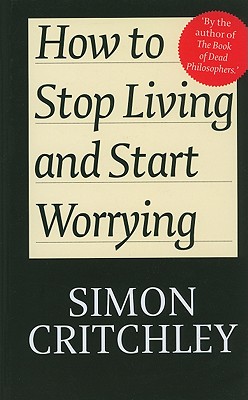
How to Stop Living and Start Worrying — Simon Critchley

Simon Critchley’s latest book How to Stop Living and Start Worrying picks up where his last work, The Book of Dead Philosophers, left off. Both works explore what Critchley contends to be the signal problem of all philosophy; namely, how one might live a meaningful life against the backdrop of inevitable death. In Dead Philosophers, Critchley plumbed this question by surveying the deaths of dozens of famous philosophers, ultimately affirming a positive reality in death (both our own deaths and the deaths of others), and arguing that philosophies (and religions) that advocate the idea of a spiritual afterlife ultimately negatively disrupt human existence and lead to inauthentic lives. How to Stop Living reiterates these themes in a new form, essentially arguing that in asking “how to live,” we must also ask “how to die” — and also how to love and how to laugh. How to Stop Living takes form as a series of conversations between Critchley and Carl Cederström, an Associate Professor at the Institute of Economic Research at Lund University in Sweden. There’s a warm rapport between the pair, and although Critchley does most of the talking, there’s a genuine dialog in play, not merely a flat interview. The book unfolds over six chapters. The first, “Life,” is a discussion of, well, Critchley’s life, both personal and academic. I originally thought I’d be doing a lot of skimming here, but it’s actually kind of fascinating; more importantly, though, it establishes Critchley’s contention that a philosopher’s work cannot be divorced from his biography. To philosophize is to live. This idea is reiterated succinctly at the beginning of the second chapter, “Philosophy,” when Critchley states—

The first thing to say is that philosophy is not a solely professional or academic activity for me. Philosophy is not a thing, it’s not an entity; it’s an activity. To put it tautologically: philosophy is the activity of philosophizing, an activity which is conducted by finite, thinking creatures like us. Now, my general view of philosophy is that this activity must for part of the life of a culture. Philosophy is the living activity of critical reflection in a specific context; it always has a radically local character.

What follows in “Philosophy” is a somewhat discursive overview of the philosophers who will pop up again and again in the book: Heidegger, Husserl, Kant, Nietzsche, and, of course, Derrida. While I’m laundry listing, I might as well add Freud, Lacan, Beckett, and Hegel as key figures in How to Stop Living. In the third chapter, “Death,” Critchley discusses how many of these philosophers frame a subject’s individual relationship to his or her personal death. In a particularly enlightening passage, Critchley explains Heidegger’s “possibility of impossibility,” the idea that to be authentic, to lead an authentic life, one must internalize and master the finitude of a personal death. The chapter continues, working through other conceptions of death, including those of Freud, Beckett, and Derrida. Perhaps because of its dialogic structure, How to Stop Living often feels like a rap session, a big brainstorm, a work in process, and nowhere is this more evident in a chapter called “Love,” where Critchley moves from Hannah Arendt to The Song of Solomon to Lacan and Freud to a story about his marriage proposal. It’s all a bit messy, a bit watery, a bit undefined, and therefore difficult to summarize, so I’ll let Critchley dish on love in his own words—

Love is the attempt to break the logic of masochism that defines the subject, and to behave in a different way. That’s something that has to be wound up everyday . . . and it’s something with no end; and it requires a constant experience of faith. That’s the only sense I can make of love.

The next section, “Humour,” is better defined—and one of the highlights of the book. Critchley discusses jokes against a backdrop of psychoanalysis and anthropology, ultimately arguing that humor has the power to disrupt an individual’s relation to time or place, and thus reconstitute that relation in some meaningful way. Critchley’s book itself is indeed a meta-joke, a play against the sophistry of New Age self-help books. Indeed, the very name of the book is an inversion of Dale Carnegie’s 1948 “classic” of the genre, How to Stop Worrying and Start Living. If you find the cover of Critchley’s book as off-putting and cheesy as I do, just remind yourself that it’s a parody of Carnegie’s cover. And yet Critchley’s sense of humor is not ultimately black irony, but rather a humor of affirmation of — and confrontation of — the absurdity of contemporary life. It’s not irony but authenticity he wants. “Authenticity” is thus the final chapter of this relatively short book, and here Critchley invites his friend (and partner in the International Necronautical Society) novelist Tom McCarthy to participate in the conversation. The chapter is lively, almost frenetic, and frankly all over the place, as Critchley and McCarthy rocket from subject to subject — Finnegans Wake, the Challenger explosion, Terrence Malick, J.G. Ballard, Levinas, A Midsummer Night’s Dream, McCarthy’s first novel Remainder — each reference seems to slip into the next, reined in occasionally by Cederström, who steers the conversation back to its center (leave it to deconstructionists to get off center). Good stuff.

How to Stop Living and Start Worrying, despite its tongue in cheek title and cover, and its discursive flow, is serious (if playful) about philosophy. Those interested in the thinkers and topics I’ve mentioned in this review may be interested, but it’s not necessary for one to have a working knowledge of Continental philosophy to enjoy Critchley’s latest. Recommended.

How to Stop Living and Start Worrying is available now from Polity Books.

Pascal’s Death Mask

“The Acceptance of What Is Miraculous in the Everyday” — David Milch on the Illusion of Separateness

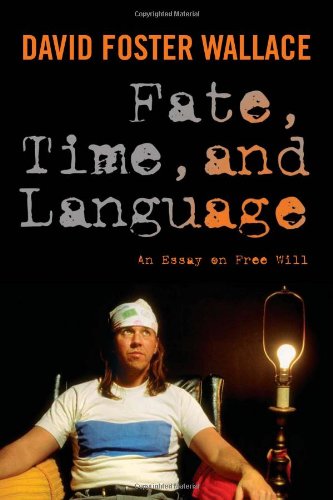
Fate, Time, and Language: An Essay on Free Will — David Foster Wallace

Sometime last year, during a rare visit to a big chain bookstore, I was disgusted to see what had happened to David Foster Wallace’s amazing Kenyon College commencement speech, “This Is Water.” Wallace’s speech, about 3,815 words, give or take (maybe twelve standard typed pages), was being sold as a 144 page hardback volume with only a sentence or two printed per page. The book was (and is) a nakedly commercial attempt to turn a text that is widely available on the web into the sort of thing that well-meaning uncles give to their nephews or nieces as graduation gifts. Of course, hardcore Wallace fans might want such a book — and I’d never begrudge them that — but it’s hard to imagine that Wallace would have been comfortable with how his book was marketed.

Which brings us to Fate, Time, and Language: An Essay on Free Will, new from Columbia University Press this week. The book publishes the 1985 honors thesis that Wallace submitted to the Amherst College’s Department of Philosophy, “Richard Taylor’s ‘Fatalism’ and the Semantics of Physical Modality.” The essay’s title alone signals a prohibitive level of academic specialization. In his introductory essay to the volume, “A Head That Throbbed Heartlike,” New York Times Magazine editor James Ryerson points out, “Its obscurity is easy to appreciate. A highly specialized, seventy-six page work of logic, semantics, and metaphysics, it is not for the philosophically faint of heart.” Ryerson then warns his reader to “Brace yourself for a sample sentence,” before offering a sample from Wallace’s essay that I do not have the patience or fortitude to type out (it would take me too long to locate all the diacritical marks and special logic symbols). Ryerson concludes the paragraph with this wry remark: “There are reasons that he’s better known for an essay about a cruise ship.”

Fortunately, the editors of Fate, Time, and Language make every effort to contextualize Wallace’s essay in a way that explains its aims, strengths, and even shortcomings. There’s Ryerson’s lengthy introduction, which provides an overview to Wallace’s life in philosophy. Then there’s Taylor’s “Fatalism” of course, a short, provocative argument combining six presuppositions that led Taylor to declare that humans have no control — none, whatsoever — over any future event. The volume collects four other essays by Taylor on fatalism, as well as eight other essays responding to his arguments, before delivering Wallace’s essay (the longest in the collection). Here’s Wallace—

So Taylor’s central claim, the Taylor problem, is that just a few basic logical and semantic presuppositions, regarded as uncontroversially true by most philosophers, lead directly to the metaphysical conclusion that human beings, agents, have no control over what is going to happen.

I ain’t even gonna front–pretty much everything that Wallace says after this was lost on me; if you want to read and comprehend the details of his argument you will need to have a grasp on the basics of Montague grammar and tensed modal logic. If you lack these skills, there will be skimming. Lots and lots of skimming. So, in short, I have no ideawhether Wallace’s logic is sound, although I find his conclusion (minus all the modal evidence) quite compelling—

This essay’s semantic analysis has shown that Taylor’s proof doesn’t “force” fatalism on us at all. We should now recall that Taylor was offering a very curious sort of argument: a semantic argument for ametaphysical conclusion. In light of what we’ve seen about the semantics of physical modality, I hold that Taylor’s semantic argument does not in fact yield his metaphysical conclusion.

After Wallace’s honors thesis, there’s a wonderful little memoir essay by his adviser on the project, Jay L. Garfield, who offers up this nugget—

I knew at the time, as I mention above, that David was also writing a novel as a thesis in English. But I never took that seriously. I though of David as a very talented young philosopher with a writing hobby, and did not realize that he was instead one of the most talented fiction writers of his generation who had a philosophy hobby.

These little pockets of insight appeal to me most in Fate, Time, and Language, and as such, Ryerson’s essay “A Head That Throbbed Heartlike” is the highpoint of the book. It weaves together Wallace’s personal life, writing career, and academic pursuits into a moving elegy of sorts, although one more rooted in ideas than feelings. He also spells out the book’s mission quite clearly—

For all its seeming inscrutability, though, the thesis is lucidly argued and–with some patience and industry on the part of the lay reader–ultimately accessible, which is welcome news for those looking to deepen their understanding of Wallace. The paper offers a point of entry into an overlooked aspect of his intellectual life: a serious early engagement with philosophy that would play a lasting role in his work and thought, including his ideas about the purpose and possibilities of fiction.

Many of us might shudder at the idea of our college essays being published posthumously. Of course, most of us aren’t Wallace, but there are undoubtedly critics out there who will cry foul at this publication. Fortunately, the team behind Fate, Time, and Language has produced a book of remarkable integrity, one that understands why it exists, readily acknowledges its obscurity without trying to gloss over that obscurity, and makes every effort to communicate with and engage its readers without sacrificing erudition. To return to my opening anecdote, this is not the naked commercialism that motivated a gimmicky edition This Is Water; rather, this is a book delivered by people who genuinely care about Wallace and his ideas. Make no mistake–it’s very dry and very specialized, but fanatics will no doubt want it.

Biblioklept Interviews Mahendra Singh About Fitting Lewis Carroll into a Protosurrealist Straitjacket with Matching Dada Cufflinks

Mahendra Singh’s new book is a graphic-novelization of Lewis Carroll’s epic poem The Hunting of the Snark (read our review). Singh was kind enough to talk to us about his project over a series of emails. The Hunting of the Snark is available now in hardback from Melville House. You can read more about Singh’s work at his website.

Biblioklept: Where did your interest in Carroll originate?

Singh: I read the Alice books as a child and only read the Snark when I was a teenager. The Alice’s were fun, as was the Snark, but it also puzzled me at first. It was hard-core Nonsense and it took me a while to digest it, and half-way understand it. It was a great mental stretching exercise, still is. Kids need that sort of thing if they want their brains to grow up to be something besides consumer units.

Alice’s game of Nonsense is really a warm-up to the Snark’s. When Carroll got to the Snark, he’d had a bit of practice and was in top form. The Snark is really Alice 2.0, the more expensive professional upgrade to Nonsense Making.

When I was young, I had odd reading tastes. From 70s SF to Aristophanes to the Ramayana; I was a little piggy. What I usually liked was a complex, completely furnished fictional world, along with a nice musicality with words. What really turned me on was when that fictional world would be logically intertwined with the real world, past or present. In short, one world would be a sort of code for the other.

I think a lot of kids still like that, it’s really the basic premise of most storytelling, although nowadays it is often so deeply monetized and predigested that it’s hard to really enjoy or even benefit from.

In any case, everything Carroll wrote fit my tastes, but the Snark was extra-special, the difference being that this epic poem (the only genuine Victorian epic poem and I’ll defend that claim against all comers), this epic took the Alice premise of mismatching appearances and meaning and took it to its logical conclusion, which itself is another Nonsense paradox doubled upon itself — beware these Carrollian infinite regressions!

In the Snark, the story-telling code of Nonsense is perfected. Most of the elements are still drawn from the familiar, real world but they are so recombined that their appearances and meaning are impossible to decipher anymore. And yet the persistent, nagging feeling of a genuine logic behind it all still remains.

I think for most young people who are thinking things over, the above Snarkian description is a pretty accurate of their budding world view. And anyway, breaking world-codes was pure catnip for me, it’s the essence of reading, good reading anyway.

And I have to mention the poetry. I’ve always loved poetry and Carroll’s verse skills in the Snark are the perfect vehicle for what he’s doing. Their anapestic bounce, their goofy mouth feel (the mouthfeel of Old English poetry charms and chants) make a perfect vehicle for the code. It’s a bit of a music hall, Gilbert & Sullivan feel to what is technically a tragic verse epic.

I wouldn’t say I’m a full-bore Carrollian Obsessive, I’ve met plenty of them and they’re dangerous … quiet, nattily dressed librarians with bow ties and a deadpan penchant for puns and parody. Book editors concealing rural silos crammed full of  highly addictive Carrollian Nonsense. Carrollian Illuminatis cleverly disguised as entomologists hanging out at obscure Snarkian forestry associations.

I’m just a Carrollian Nutter, I’m harmless as long as I have access to drawing materials. And pictures of Snarks.

Biblioklept: You’ve described your work on Snark as “fitting Lewis Carroll into a protosurrealist straitjacket with matching Dada cufflinks.” Why do the techniques of surrealism and Dada lend themselves to Carroll?

Singh: Surrealism is one of those things that everyone can point at but few can define. It’s the idea of awakening the sleeper within us and letting them speak to us in their own dream language of pictures and words. Since dreams are a universal form of memory that draw upon every possible human experience, Surrealism is sort of the simultaneous dream-memory of everything.

Protosurrealism is what I call the comfy, cozy Carrollian straitjacket I’ve trapped my Snark in. Carroll was himself hailed as a protosurrealist by the founding fathers of this odd cult, Breton, Aragon, etc. His work, with its dreamlike logic and free associations entranced them and they regarded him as a unique trail-blazer in their explorations. And his verse, to me, is the epitome of the dream world; all poetry (Nonsense or otherwise) must surely be the natural, Adamic language of dreams!

The Surrealist Max Ernst was an enormous inspiration to me — his technique of using 19th-century engravings to illustrate dream stories is brilliant; the old-fashioned, realistic visual style gives them a jarring sense of authority. Realism is the optimal style of the determined dreamer! The urban dreamscapes and dream-eroded objects of Giorgio de Chirico and his brother, the unjustly neglected Alberto Savinio, were also part of my bag of tricks. And of course, references to Rene Magritte are scattered everywhere in this Snark. Magritte’s various techniques for undermining systems of linguistic and visual meaning are ideally suited to navigating the Carrollian Multiverse.
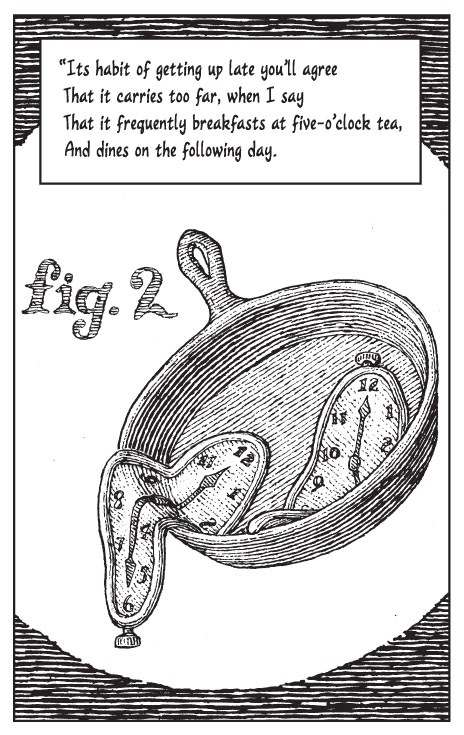
It’s hard to illustrate an idea and oddly enough, the Snark is really a poem of ideas, couched in the form of a tragic epic and then declaimed by a master comedian. One thing I wanted to avoid was doing literal drawings of the scenes in it; I wanted the Snark to constantly bring up a stream of associations, references, insinuations, all of them triggering more and faster allusions, what I call a gateway Surrealism that leaves readers hopelessly addicted and desperate for more! Don’t say no, kids!

I’ll add that protosurrealism is the 21st-century application of 19th-century answers to 20th-century problems. The application is this 21st century Snark, the answers are the Victorian rendering style I used and also Carroll’s entire invention of Victorian Nonsense, and the questions are the existential questions that 20th-century artists couched in the language of Surrealism.

Plus, let’s face it, Surrealism just looks cooler! Who wants a postmodernist or abstract expressionist Snark? And the smart kids love it, they’re still young enough to dare to question the sordid, official version of reality. Which is where Dada comes in — there’s a bit of it in my Snark and it’s there because Dada was the ultimate poke in Western Civ’s eye. If the idea of using a blank map isn’t pure Dada, what is it then?

It’s odd having to discuss this in words, proof positive that the Surrealist project remains unfinished. In a perfect Surrealist world, the meaning of my Snark would bleed out of the book and contaminate the reader’s world until they could not distinguish where the Snark began or reality left off. And that’s the essence of Carrollian Nonsense, fiddling with the logical doors of perception.

Biblioklept: Much of surrealist and Dadaist art seems to be an immediate response to mechanical reproduction. In Snark, you seem to at times be reconfiguring, recombining, recontextualizing otherwise familiar images. How do you work? How do you go about creating your art? Can you describe your process?

Singh: Mechanical reproduction can be a loaded phrase. Walter Benjamin gave it quite the kick in the pants, pointing out that it is a degradation of the cult object, a commodification, etc. But the problem is us, the public. A work of art has absolutely no meaning or value except what the viewer puts into it. This is a very important point. If art is degraded or degrades others, it is our choice.
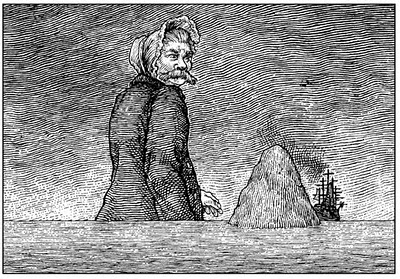
Poor Benjamin, a smart guy but always wriggling back into a Marxist strait-jacket just as useless as medieval Scholasticism or modern neoconservatism. At least Carrollian Nonsense makes the kiddies giggle! He never grasped that all philosophy is individual psychology (and wish-fulfilment) in essence. That’s why the Banker in my Snark is Karl Marx — revenge was sweet! I also included Nietzsche as the Bonnet-maker and Heidegger as the Barrister to round things off. I can assure you, several philosophers were injured in the course of this production. A broken ontology can be quite painful.

Nothing has meaning or value unless we decide it does. For years, readers have puzzled over the meaning behind the Snark. It’s another Carrolian Zen koan : the meaning is the meaning. It’s always been staring us in the face, the meaning of the Snark is a verb, it is to search for meaning and when doing so, one automatically generates a meaniningful purpose just as naturally as a spider ejects its web. Inside this silky web is the comfort of whatever logic you feel up to (and that is the secret pleasure of Carrollian Nonsense) and outside the web is just chaos, a Boojum!

In my Snark I’ve mashed up artists including Hieronymous Bosch, Grünewald, Titian, Théodore Géricault, David, Ingres, even George Herriman and also many Surrealists such as Man Ray, Dali, Magritte, etc. There are musicians and authors, the Beatles and Gilbert and Sullivan, Edgar Allan Poe, the Comte de Lautremont, even Victorian parlor games and optical illusions. The idea was to create a web, a labyrinth of allusions in which to hunt the Snark. Some of the references will be familiar but some will not and the reader, if so inclined, can hunt them down on their own. It’s a hunt within a hunt, another Carrollian regression.

The educational aspect is important to me. I really do hope some of the kids who read this will get curious and start off on their own, pillaging a library, ransacking a museum, sneaking into the opera, whatever turns them on. The smart kids are hungry for culture. We must get them thinking, to get them to manufacture and own their own meanings before a mass-marketing goon does it for them.
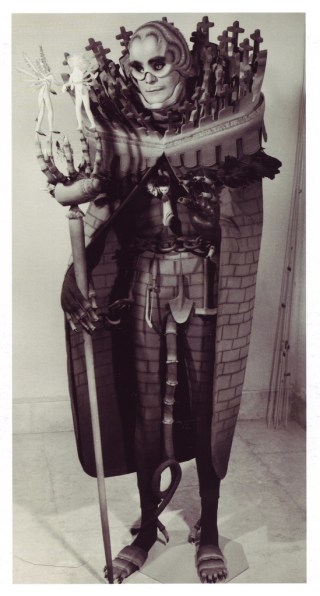
The actual process of creating the imagery was simple, it’s basically me lying on a sofa, maybe a quick snooze and then free-associating while pondering the text. The cover image is a good example, it’s also the illustration for the whiskered Snarks who scratch and the feathered Snarks who bite. This made me think of Old Scratch, the devil, AKA Lucifer, who was once an angel with feathered wings who also showed a nasty tendency to bite the hand that feeds. I had a vague visual memory of seeing a photo of a surrealist devil; I rummaged through some books until I found it — Denise Bellon’s photo of the Québécois Surrealist, Jean Benoit, at a costume party.

The slippers are what caught my eye, it made me think of Old Scratch lounging at home in Pandemonium, his day off, not bothering to shave, hence the whiskers that scratch. I made the toes unequal on a lark, it just seemed right to have Satan misshapen but afterwards I came up with a cabalistic explanation which I won’t bore you with for now.

I then did a pencil drawing on tissue paper, constantly refining and adding or deleting, this was the slowest part of the entire Snark, the pencils. Afterwards I did the pen and ink drawing atop the tissue, on Denril, a synthetic vellum. This is an old technical illustrator’s work habit, which is how I started out actually, in the 80s.

This business of free associating while simultaneously referring to one’s internal visual memory is only possible if one has spent many years romping though books and museums. You cannot be a serious illustrator if you don’t read and look voraciously, all the time. And above all, don’t look at too much rubbish or you will start drawing rubbish. Art students reading this, take heed! You are what you see.

Recombining Surrealism and other –isms, along with the free associations triggered by Carroll’s Nonsense verse, creates a matrix which allows the reader to move seamlessly back and forth between the worlds of dreams, culture, memory and emotion. Those readers who catch the references will enjoy the historical and even non-verbal logic binding them, the rest is up to you.

You are really bringing the meaning with you, and when confronted by my Snark I hope it triggers a cascade of free associations, a mental phenomenon which is the precursor to dreaming, the royal road of Surrealism and Carrollian Nonsense.

Biblioklept: How does your work respond to the nine illustrations by Henry Holiday that originally accompanied Carroll’s text?

Singh: Holiday’s illustrations are odd things, I’ve never been very keen on them. He was a graceful artist usually, very talented and yet these drawings are a bit grotesque, ugly perhaps. They just don’t look so appealing to me. The technique is flawless though, a very classic British style of line work that lasted well into the 1940s.

Some Snarkologists believe that Holiday worked with Carroll to hide a secret meaning in the art. Angles and distances have been measured, objects analysed,  hidden shapes discovered and reconfigured. Who knows? It’s unlikely but in any case, you can’t avoid Holiday if you’re doing the Snark.

I used some of his symbols, the bare-breasted woman and her anchor representing Hope, a very british motif which suits the nautical nature of much of the quest. His picture of the Beaver doing its math problem inspired me to treat that entire Fit the Fifth as a long variation upon the Temptation of St. Anthony, especially the version by Bosch. Holiday really nailed that one. I have to confess that Flaubert’s version is a favorite book of mine and I tried to give this part of the Snark the same baroque, over the top feeling of deranged pagan vs. Christian imagery.

Holiday also crammed a considerable number of small details in the Beaver illustration. It’s quite a contrast to the style of the other big Carroll illustrator, Sir John Tenniel, who favored a cleaner look. Nowadays this technique is called “chicken fat” and I used a lot of chicken fat in my Snark, more than Holiday. Of course, with only 9 drawings, he had to keep to a slower visual tempo. That was another reason I did it as a graphic novel — I could vary the tempo quite a bit and really overwhelm the reader with chicken fat when the verses demanded it.

On the other hand, doing it as a graphic novel required creating a narrative visual thread through the whole thing, something which Holiday really didn’t need. In this case, my idea was to make it a theatrical presentation, each Fit a new set change until the end, when Carroll is revealed as the spectator in the empty hall. Carroll was fond of theatricals and the Snark does have a stagey feel to it anyway.

Biblioklept: Have you ever stolen a book?

Singh: Yes, Aces High, a lavishly illustrated book about British fighter pilot aces of WWI. It once graced the shelves of the high school I once attended in a desultory manner (myself, not the book). I was, and still am, fascinated by all things aviation and I could not bear the sight of that wonderful book languishing there, unremarked, unappreciated. I still know the difference between a Sopwith Pup and a Sopwith Camel and I love a well-executed Immelman at the crack of dawn. It was wrong to do and I can only plead callow youth in my defence. Don’t do it, kids! It isn’t worth it! Gosh, I hope Mrs. Merrill isn’t reading this . .  .

Slavoj Žižek on Children of Men


J.M. Coetzee and Ethics — Anton Lesit & Peter Singer

In their introduction to J.M. Coetzee and Ethics, editors Anton Lesit and Peter Singer make the claim that the essays in the new collection “show the folly of Plato’s idea that literature has nothing to contribute to philosophical discussion. Instead they are an invitation to a dialogue that can sharpen the issues that literature raises while making philosophy more imaginative.” Lesit and Singer briefly review the philosophical tradition, from the time of Plato’s call to banish the poets to the current wars between pragmatists and postmodernists, specifically foregrounding the case for Coetzee’s literature as a legitimate source of philosophical inquiry. They identify three specific features of his works — reflectivity, truth seeking, and an exploration of social ethics — that merit critical attention. The essays in the volume address “the psychological and moral phenomenology of personal relationships; the consequences of human suffering, evildoing, and death for human rationality and reason; and the literary methods invoked to open areas of experience beyond the abstract language of philosophers.” The editors also point out that “Unsurprisingly, the ethics of animals looms large in this collection,” a concern that might attract animal ethicists and others interested in animal-human relationships who might not immediately turn to literature for answers (or questions). On the whole, J.M. Coetzee and Ethics, while obviously a specialty volume, strives to appeal to a wider audience, eschewing much of the acadamese that plagues (and obfuscates the arguments of) so many critical volumes. Fans of Coetzee will wish to take note. J.M. Coetzee and Ethics is new in hardback from Columbia University Press.
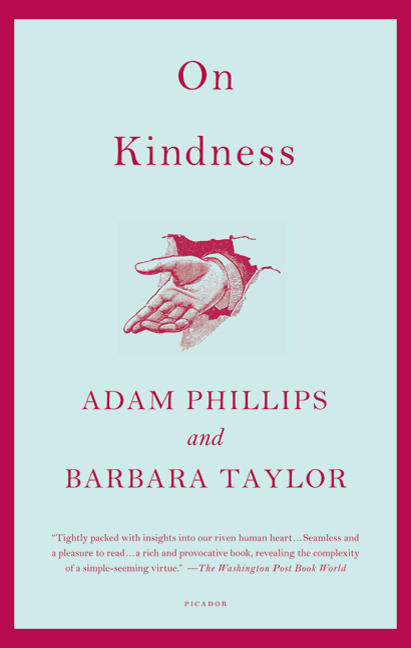
On Kindness — Adam Phillips and Barbara Taylor

On Kindness seeks to answer why “It is now generally assumed that people are basically selfish and that fellow feeling is either a weakness or a luxury or a more sophisticated form of selfishness.” Psychoanalyst Adam Phillips and historian Barbara Taylor quickly demonstrate that up until the “so-called dawn of modernity” in the Enlightenment, people simply believed themselves to be naturally kind. The advent of the ideals of self-reliance and independence (along with the appeals of aggressive mercantile capitalism) led to a zeitgeist–one that still exists–in which kindness is a form or weakness, or a type of duty, like philanthropy, that negates its own purity. In short, Phillips and Taylor point to a general feeling that real kindness might not exist–and then argue, quite convincingly, against this general feeling.

The book’s second chapter, “A Short History of Kindness” outlines the philosophy and social practice of kindness from the time of Seneca through to Freud. Phillips and Taylor choose Jean-Jacques Rousseau as their champion, with Thomas Hobbes (and his famous dictum of bellum omnium contra omnes) as a recurring villain. But it’s Freud who dramatically problematizes modern attitudes toward kindness, with the radical idea that “aggression itself can be a form of kindness; that when aggression isn’t envious rage or the revenge born of humiliation, it contains the wish for a more intimate exchange, a profounder, more unsettling kindness between people. In short, psychoanalysis makes sentimentality and nostalgia, not hatred, the enemies of kindness.” This complicates the relationships between children and parents; psychoanalysis renders kindness unnatural. The resulting confusion leaves us open to the idea that acts of kindness might leave us radically exposed or otherwise in harm’s way. Even worse, modern society elevates and idealizes kindness into “a virtue so difficult to sustain that only the magically good can manage it” — this “destroys people’s faith in real or ordinary kindness.” But, Phillips and Taylor want to assure us, real and ordinary kindness does exist. “We depend on each other not just for our survival but for our very being,” they argue in their final chapter. “The self without sympathetic attachments is either a fiction or a lunatic.” So, what are the solutions? Philips and Taylor clearly argue that the pleasures of kindness they advocate cannot stem from “moral superiority or domineering beneficence or the protection racket of good feelings. Nor are acts of kindness to be seen as acts of will or effort or moral resolution.” Instead, our authors argue for “a revived awareness of something that is already felt and known.”

On Kindness is a compact, tightly-wound tract of 114 pages that can be read quickly by a general audience, but nevertheless takes some time to digest. Picador’s trade paperback edition (new this month) is handsome and small enough to fit into a cargo pocket, purse, or beach bag. It seems of a piece with Picador’s Big Ideas/Small Books series, erudite works that consider big subjects without ever falling into traps of academic solipsism. Recommended.

“A Thoroughfare of Learning” — Nietzsche and Teacher Appreciation Week

National Teacher Appreciation Week winds down today. Have you thanked that special teacher in your life? Or at least thought about him or her? No? Maybe your teachers scarred you. Or ruined you. It’s possible. But probably not all of them. I’m sure at least one of them was really important to you, right?

Although Biblioklept World Wide Industries brings in the kind of moolah that allows me to literally swim in cash à la Scrooge McDuck, I retain my day job as a teacher of literature in the English language; I do this because, you know, I care. So me waxing heavy on why teachers matter and blah blah blah is sort of like waitresses overtipping other waitresses because, you know, they know. So I’ll just say that teachers are generally overworked, underpaid, and perhaps undervalued in our society, and I appreciate all of you–all of you who taught me and shaped me and mentored me and shared your wisdom with me, and all of you who I’ve worked with over the years who’ve inspired me to do better and be better. Thanks.

So well anyway, I’ve been skimming again through Nietzsche’s highly-aphoristic volume Human, All Too Human for the past week, and came across this passage, section 200, Caution in writing and teaching. Quoting in full:

Whoever has once begun to write and felt the passion of writing in himself, learns from almost everything he does or experiences only what is communicable for a writer. He no longer thinks of himself but rather of the writer and his public. He wants insight, but not for his own use. Whoever is a teacher is usually incapable of doing anything of his own for his own good. He always thinks of the good of his pupils, and all new knowledge gladdens him only to the extent that he can teach it. Ultimately he regards himself as a thoroughfare of learning, and in general as a tool, so that he has lost seriousness about himself.

Ouch! Did Nietzsche just call me a tool? I think his words are actually quite insightful–teachers do think of themselves as instruments through which they may better their pupils. But I don’t think that that is the only end for knowledge as far as teachers are concerned, and I don’t think that that makes teachers unserious about knowledge. Knowledge-as-enlightenment and self-improvement is great of course, but knowledge-as-transcendence–that is, knowledge as wisdom and experience that can be passed from person to person, shared, communicated–that’s what’s really meaningful in life.

Art Is The Proper Task of Life

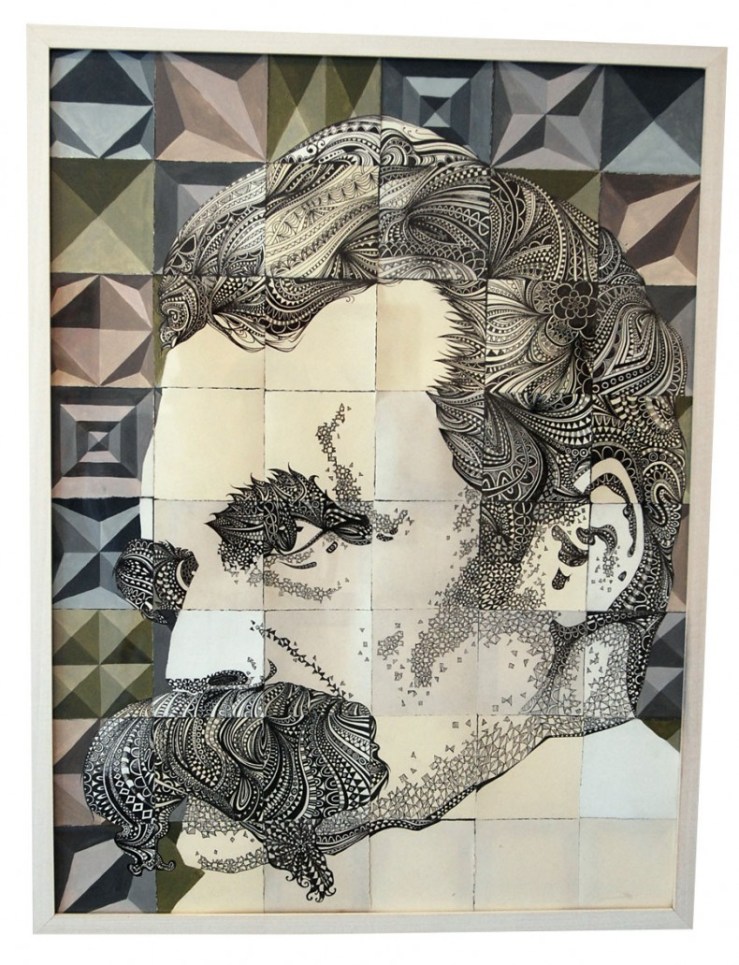
Portrait of Nietzsche by Damon Soule

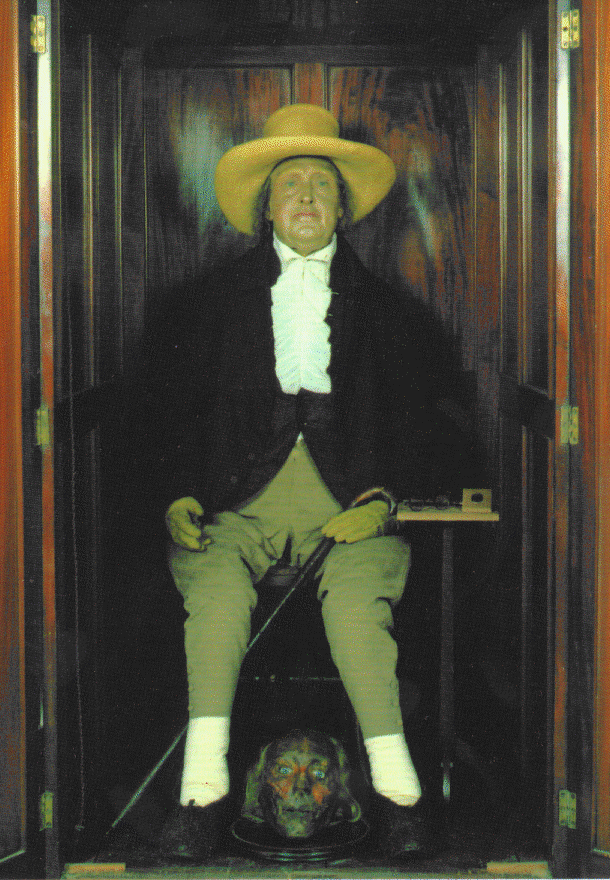
Jeremy Bentham’s “Auto-Icon”

jeremy_bentham_auto_icon

From Simon Critchley’s The Book of Dead Philosophers:

In a text called Auto-Icon: or, Farther uses of the dead to the living, Bentham gave careful instructions for the treatment of his corpse and its presentation after his demise. If an icon is an object of devotion employed in religious ritual, then Bentham’s “Auto-Icon” was conceived in the spirit of irreligious jocularity. The “Auto-Icon” is a godless human being preserved in their own image for the small benefit of posterity. [. . .] As such, Bentham’s body is a posthumous protest against the religious taboos surrounding the dead [. . .] Bentham’s body was dissected and his skeleton picked clean and stuffed with straw. [. . .] Sadly, the mummification process went badly wrong and a wax head was used as a replacement. The original, rotting and blackened head used to be kept on the floor of the wooden box between Bentham’s feet . However, the head became a frequent target for student pranks, being used on one occasion for football practice in the front quadrangle.

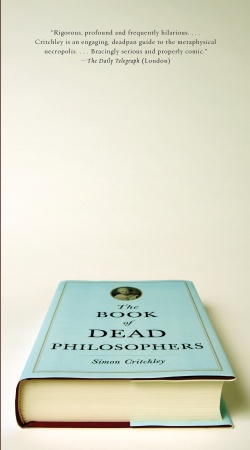
The Book of Dead Philosophers — Simon Critchley

the-book-of-dead-philosophers

A cursory glance at Simon Critchley’s skinny new work, The Book of Dead Philosophers, might lead one to misjudge the book as an ephemeral, superfluous, and even downright jokey sort of “Philosophy for Dummies.” That would be a mistake. While The Book of Dead Philosophers does aim for a broad, popular appeal, Critchley’s wily cataloging of the deaths of nearly 200 philosophers is hardly insubstantial reading. Working from Cicero’s maxim that “To philosophize is to learn how to die,” Critchley sets out to contextualize these philosophers’ writings on death against the very deaths of those philosophers. Ranging from the sophists of ancient Greece to the Classical Buddhists of China to post-modern gadflies like Foucault and Derrida, Critchley’s writing evokes both humor and pathos, and works in some ways as an overview of the history of philosophy without ever becoming didactic or overreaching its central goal.

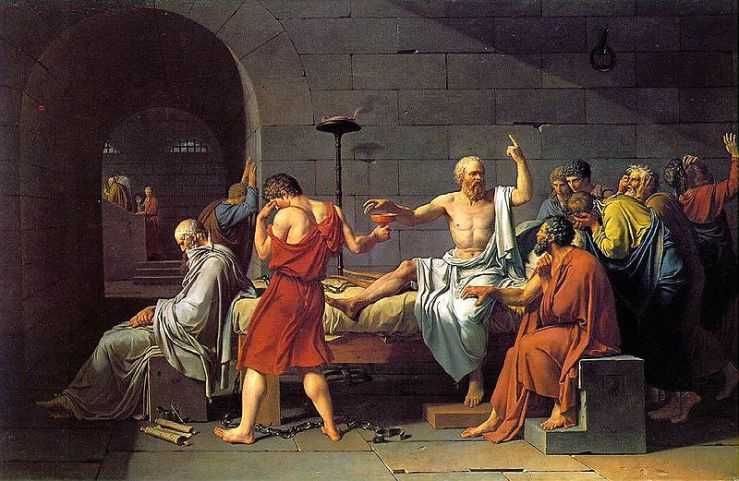
800px-david_-_the_death_of_socrates
The Death of Socrates - Jacques-Louis David

While Critchely’s main purpose in Dead Philosophers seems to be to entertain and perhaps enlighten, he doesn’t shy from injecting his own attitude about his subject. In his introduction he addresses philosophies that emphasize an afterlife, arguing “that they cultivate the belief that death is an illusion to be overcome with the right spiritual preparations. However, it is not an illusion, it is a reality that has to be accepted. I would go further and argue that it is in relation to the reality of death that one’s existence should be structured.” Later, Critchley condemns the metaphysical, Platonist tradition further, and, at the same time, provides a greater rationale for his book: “I hope to show the material quality of the many lives and deaths that we will review disrupts the move to something like “Spirit” and places a certain way of doing philosophy in question. To that extent, there is something intensely arrogant, even hubristic, about a philosopher’s disregard for the lives and deaths of other philosophers.” Critchley’s materialist philosophy leads to an occasionally snarky–and quite humorous–tone when writing about the likes of Anslem, Thomas Aquinas, or even Heidegger and Schopenhauer. His sympathies are more earnestly apparent when he addresses the death of someone whose outlook he shares. Critchley on Bertrand Russell: “Any conception of the immortality of the soul is therefore both iniquitous, because it is untrue, and destructive of the possibility of happiness, which requires that we accept our finitude.”

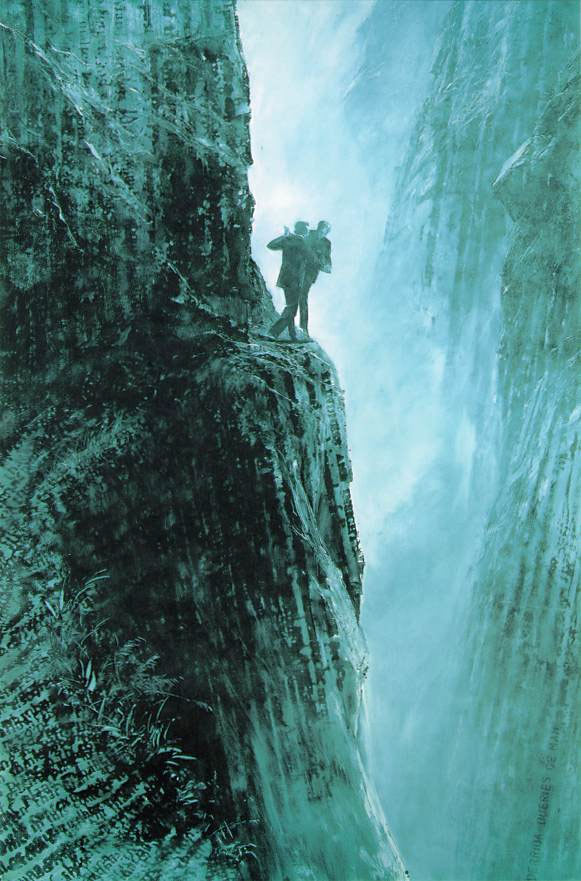
Derrida Queries DeMan -- Mark Tansey

Arranged both chronologically and geographically into short sections ranging from a few sentences to a few pages, Dead Philosophers encourages jumpy, discontinuous, and episodic readings. Still, despite his caveat that he is presenting a “messy and plural ragbag of lives and deaths that cannot simply be ordered into a coherent conceptual schema,” Critchley nonetheless manages to create nuance, layer, and perhaps even a touch of narrative to this work. In one of the final entries of the book, a touching tribute to Jacques Derrida (at three pages, one of the longest in the book–twice as long as the section on Plato), Critchley writes, “the dead live on, they live on within us in a way that disturbs any self-satisfaction, but which troubles us and invites on us to reflect on them further. We might say that wherever a philosopher is read, he or she is not dead. If you want to communicate with the dead, then read a book.” Lovely.

The American publication of The Book of Dead Philosophers is available February 10th, 2009 from Vintage Books.

Many readers will may also be interested in Simon Critchley’s essay on Barack Obama and metaphysical philosophy, “The American Void,” published in last November’s issue of Harper’s Magazine, or the post-victory essay, “What’s Left After Obama?” published last November in Adbusters.

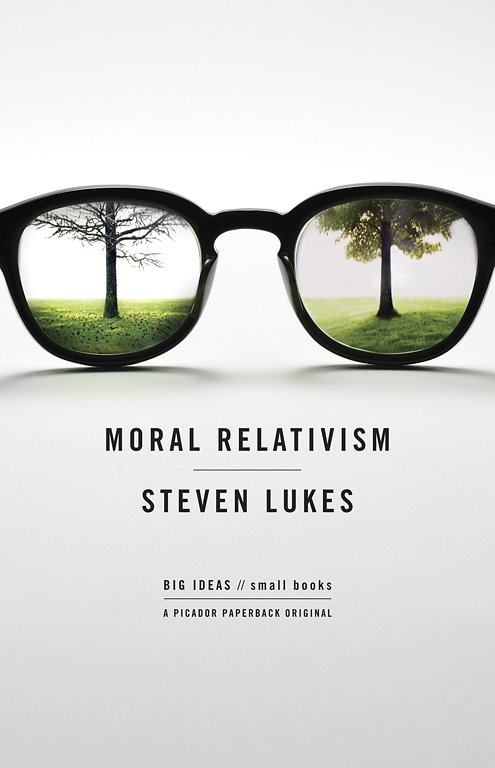
Moral Relativism — Steven Lukes

Moral relativism is the belief that ideals of right and wrong and good and bad are contextually determined by one’s local culture, as opposed to a theory of morality that holds that good and bad exist as absolute, metaphysical values existing cross-culturally, values intrinsic to one’s humanness. At the same time, individuals, even those (sometimes especially those) who see moral relativism as the overwhelmingly rational, sensical position, nonetheless are inextricably tied to their own sense of right and wrong, and this sense often leads them into a position of judgment–and perhaps action–against, over, and/or in reaction to the perceived wrongs of other cultures and societies.

In his new book Moral Relativism, NYU sociology professor Steven Lukes employs an interdisciplinary approach to tackle one of the biggest sticking points of contemporary thought. Using a variety of methods including philosophy, anthropology, history, and literature, Lukes addresses the fundamental conflict of moral relativism: that what’s right and good in one’s own culture may not be right and good in another’s culture, yet a will remains to believe in ideals of universal human rights. Lukes uses a number of timely concrete examples, including female genital circumcision, Islamic fundamentalism, and mass immigration, to assess the costs and payoffs of holding a view that says that no absolute morality exists. Perhaps the most fascinating part of Moral Relativism is Lukes’s negotiation of Western (or globally Northern, as he saliently points out) human rights actions as an extension of colonialism, with the one-time colonists imposing their values–again–upon the one-time colonized.

Lukes concludes that “the question Who are we to judge other cultures? is a bad question.” Arguing that the “postcolonial and multicultural contexts of our time do not require us to see the discourse and practice of human rights as ethnocentric,” Lukes takes up a position–well-argued–that a moral fundamentalist might claim is simply a liberal humanist wanting to have his cake and eat it too. Which, of course, is the problem with the book. It’s a fantastic argument for moral relativism, one that points out that no one–no one–is absolutely relativist, and that, in fact, being a moral relativist entails recognizing that within cultures certain perceived absolutes exist. The idea that right and wrong are relative doesn’t mean that right and wrong are arbitrary or don’t exist–it simply means that ideals of right and wrong have to be reconstituted within different systems of social and cultural order. Yet Lukes’s book isn’t going to convince the types that need convincing. Still, those of us who think that moral relativism is simple common sense will find plenty of concrete, contemporary, real world ammunition here in case we feel like arguing with a–gasp–moral fundamentalist.

Moral Relativism, available now, is part of the new BIG IDEAS // small books series from Picador Books.

Violence — Slavoj Žižek

Slavoj Žižek describes Violence as “six sideways glances” examining how our preoccupation with subjective violence (that is, the personal, material violence that we can see so easily in crime, racism, etc.) masks and occludes our understanding of the systemic and symbolic violence that underwrites our political, economic, and cultural hierarchies. Žižek believes that a dispassionate “step back enables us to identify a violence that sustains our very efforts to fight violence and promote tolerance,” and that a rampant “pseudo-urgency” to act instead of think currently (detrimentally) infects liberal humanitarian efforts to help others. This is where the fun comes in. Žižek delights here in pointing out all the ways in which we fool ourselves, all the ways in which we believe we’ve gained some kind of moral edge through our beliefs and actions.

I use the words “fun” and “delight” above for a reason: Violence is fun and a delight to read. Žižek employs a rapid, discursive method, pulling examples from contemporary politics, psychoanalysis, films, poetry, history, jokes, famous apocryphal anecdotes, and just about every other source you can think of to illustrate his points. And while it would be disingenuous to suggest that it doesn’t help to have some working knowledge of the philosophical tradition and counter-traditions to best appreciate Violence, Žižek writes for a larger audience than the academy. Yet, even when he’s quoting Elton John on religion or performing a Nietzschean reading of Children of Men, Žižek’s dalliances with pop culture always occur within the gravest of backdrops. Within each of Violence‘s six chapters, there’s a profound concern for not only the Big Questions but also the big events: Žižek frequently returns to the Iraq War, the 9/11 attacks, and the Israeli-Palestinian conflict as major points of consideration. This concern for contemporary events, and the materiality of contemporary events, is particularly refreshing in a work of contemporary philosophy. Undoubtedly some will pigeonhole Žižek in the deconstructionist-psychoanalytical-post-modernist camp (as if it were an insult, of course)–he clearly has a Marxist streak and a penchant for Lacanian terminology. Yet, unlike many of the writers of this philosophical counter-tradition, Žižek writes in a very clear, lucid manner. There’s also a great sense of humor here, as well as any number of beautiful articulations, like this description of the “dignity and courage” of atheism:

[A]theists strive to formulate the message of joy which comes not from escaping reality, but from accepting it and creatively finding one’s place in it. What makes this materialist tradition unique is the way it combines the humble awareness that we are not masters of the universe, but just a part of a much larger whole exposed to contingent twists of fate, with a readiness to accept the heavy burden of responsibility for what we make out of our lives. With the threat of unpredictable catastrophe looming from all sides, isn’t this an attitude needed more than ever in our own times?

I’m inclined to answer, “Yes.” Highly recommended.

Violence, part of the new BIG IDEAS // small books series from Picador Books, is available August 1st.

Alphonso Lingis to Speak at UNF

first-person.jpg

American philosopher and noted writer Alphonso Lingis will deliver a talk on “War and Splendor” at the University of North Florida, in Jacksonville, Florida, at 7:30 pm on Wednesday, October 3rd. Dr. Lingis is Professor Emeritus of Philosophy at Pennsylvania State University; his writing lyrically bridges the gaps between the liberal arts of anthropology and philosophy. Dr. Lingis’s current work, including his latest book, The First Person Singular, has focused on his travels to developing nations in Africa, South America, and Asia. By all accounts, Dr. Lingis is a fascinating speaker whose use of costumes, make-up, and music during his “lectures” creates an air of performance art. You can read more about Alphonso Lingis here. If you have the time, I highly recommend checking out Lingis’s paper “Our Uncertain Compassion.” Go here to reserve free tickets to see Dr. Lingis speak (your receipt will also provide directions. This promises to be both enlightening and entertaining–don’t miss it!

Jacksonville readers can look forward to more engaging speakers at UNF over the month of October, including resident genius Dr. Samuel Kimball and PBS documentary maker Ken Burns. Updates and info forthcoming.


Ontology 101: Introduction, Reading List, and Primer

Yes–now you too can better understand the way we conceptualize all that exists–from the comfort of your own home! It’s simple, free, and best of all, it’s fun! Biblioklept’s Ontology 101 is a course designed for working professionals who wish to approach the logic and philosophy of ontology, but don’t want to get bogged down in stodgy applications like taxonomy or geography. The different texts that comprise Biblioklept’s Ontology 101 course are contemporary, entertaining, highly visual, and applicable to modern social discourse.

Prerequisites: working knowledge of basic internet use. Adult level English language literacy. A few spare hours a week. A relatively open mind. A library card would be helpful. You’ll need a DVD player or VCR. If you can’t meet these requirements, you will need Biblioklept’s permission to join the class (you may have Biblioklept’s permission to join the class).

Credit hours: unfortunately, at this time Biblioklept remains an unaccredited (but nonetheless cherished) institution. However, all those who take the course are permitted a sense of smug self-satisfaction, a sharpened awareness of true irony, and existential crises galore.

Readings:

Week 1: Introduction, course overview, primer (below)

Week 2: Ways of Seeing, John Berger. Bertrand Russell overview.

Week 3: Mythologies, Roland Barthes. Baruch Spinoza overview.

Week 4: Persepolis, Marjane Satrapi, Understanding Comics, Scott McCloud. Martin Heidegger overview.

Week 5: Viewing–Rear Window, Alfred Hitchcock. Primer: Laura Mulvey’s theory of “the gaze” (forthcoming). “Feminist Cinema and Visual Pain,” John Haber. Gilles Deleuze overview.

Week 6: Viewing–various TV commercials. “Visual Semiotics and the Production of Meaning in Advertising”. Mythologies (Roland Barthes) revisited. Michel Foucault overview.

Week 7:  Viewing: Blade Runner (Ridley Scott). “Johnny Mnemonic,” William Gibson. “Simulacra and Simulations,” Jeanne Baudrillard. Georg Wilhelm Friedrich Hegel overview.

Week 8: Viewing: A Scanner Darkly (Richard Linklater). “We Can Remember It for You Wholesale,” Philip K. Dick. “The Second Coming of Philip K. Dick,” Frank Rose. Existentialism overview.

Week 9: Selections from Lost in the Funhouse, John Barth. Selections from Girl with Curious Hair, David Foster Wallace. Postmodernism overview.

Week 10: Excerpts from The Gay Science, Friedrich Nietzsche. Course summary and evaluation (primer revisited).

Primer: Before beginning John Berger’s Ways of Seeing, you’ll need a little background info about the history of philosophy. Biblioklept encourages you to go beyond the narrow confines of the following primer, but some of the ideas/thinkers presented here are essential building blocks for what will follow.

What is ontology? What better way to start an unaccredited online course from a flaky blog than to use Wikipedia as a beginning point! At the end of the course, we’ll revisit Wiki’s page and see if we can help it out–that would be meeting the true spirit of this endeavor. After you’ve perused the free encyclopedia that anyone can edit, treat yourself to SUNY’s own primer to ontology (follow the link “History of Ontology” at the top of the page to the “History of Ontology” link at the bottom of the page), which will make you like, at least ten times smarter.

Read up on Aristotle (follow the link “History of Ontology” at the top of the page to the “Aristotle” link). As far as we know, Aristotle seems to have initiated philosophical thinking. 

Are you familiar with Occam’s Razor? If not, read on!

Surely you’ve come across Descartes’ ridiculous proof of existence–cogito ergo sum–but it couldn’t hurt to brush up on why you may actually exist.

Once you’ve perused the above, no doubt you’ll be primed for all kinds of mad knowledge. Feel free to post comments and questions, or to email me at biblioklept.ed@gmail.com. And if you’re a real go-getter, get a jump start on next week’s assignment, Ways of Seeing.