
Tag: Poetry
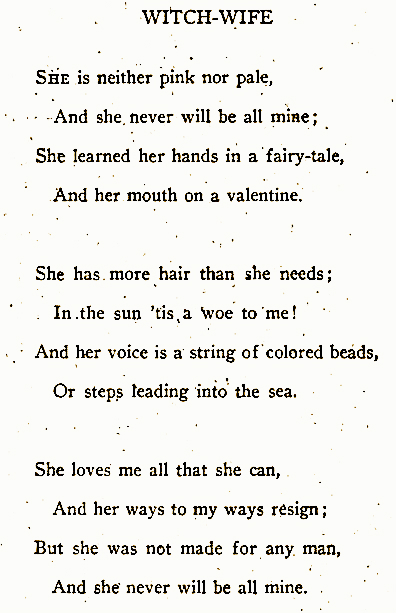
“Witch Wife” — Edna St. Vincent Millay
Poet Sleep (Samuel Johnson)
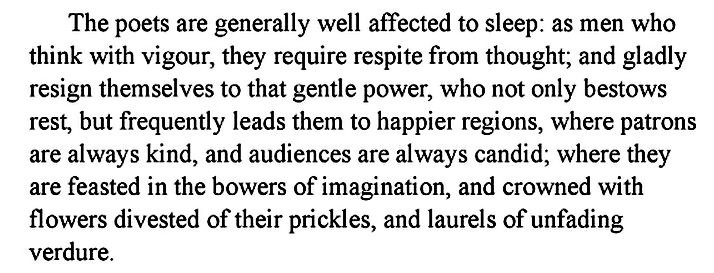
“On Sleep” — Samuel Johnson
“On Sleep” by Samuel Johnson (From The Idler, No. 39. Tuesday, March 20, 1753)
—[Greek: Oduseus phulloisi kalupsato to d ar Athaenae
Hypnon ep ommasi cheu, ina min pauseie tachista
Dusponeos kamatoio.]—HOM. E. 491
—Pallas pour’d sweet slumbers on his soul;
And balmy dreams, the gift of soft repose,
Calm’d all his pains, and banish’d all his woes. POPE.
If every day did not produce fresh instances of the ingratitude of mankind, we might, perhaps, be at a loss, why so liberal and impartial a benefactor as sleep, should meet with so few historians or panegyrists. Writers are so totally absorbed by the business of the day, as never to turn their attention to that power, whose officious hand so seasonably suspends the burthen of life; and without whose interposition man would not be able to endure the fatigue of labour, however rewarded, or the struggle with opposition, however successful.
Night, though she divides to many the longest part of life, and to almost all the most innocent and happy, is yet unthankfully neglected, except by those who pervert her gifts.
The astronomers, indeed, expect her with impatience, and felicitate themselves upon her arrival: Fontenelle has not failed to celebrate her praises; and to chide the sun for hiding from his view the worlds, which he imagines to appear in every constellation. Nor have the poets been always deficient in her praises: Milton has observed of the night, that it is “the pleasant time, the cool, the silent.”
These men may, indeed, well be expected to pay particular homage to night; since they are indebted to her, not only for cessation of pain, but increase of pleasure; not only for slumber, but for knowledge. But the greater part of her avowed votaries are the sons of luxury; who appropriate to festivity the hours designed for rest; who consider the reign of pleasure as commencing when day begins to withdraw her busy multitudes, and ceases to dissipate attention by intrusive and unwelcome variety; who begin to awake to joy when the rest of the world sinks into insensibility; and revel in the soft affluence of flattering and artificial lights, which “more shadowy set off the face of things.” Continue reading ““On Sleep” — Samuel Johnson”
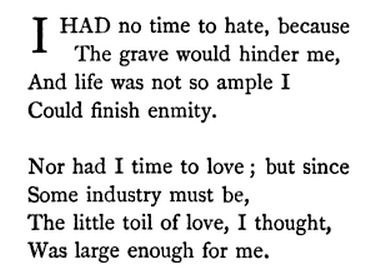
“I had not time to hate, because” — Emily Dickinson
“Man Carrying Thing” — Wallace Stevens
“Man Carrying Thing” by Wallace Stevens:
The poem must resist the intelligence
Almost successfully. Illustration:A brune figure in winter evening resists
Identity. The thing he carries resistsThe most necessitous sense. Accept them, then,
As secondary (parts not quite perceivedOf the obvious whole, uncertain particles
Of the certain solid, the primary free from doubt,Things floating like the first hundred flakes of snow
Out of a storm we must endure all night,Out of a storm of secondary things),
A horror of thoughts that suddenly are real.We must endure our thoughts all night, until
The bright obvious stands motionless in cold.
“Blizzard” — William Carlos Williams
“Blizzard” by William Carlos Williams–
Snow falls:
years of anger following
hours that float idly down —
the blizzard
drifts its weight
deeper and deeper for three days
or sixty years, eh? Then
the sun! a clutter of
yellow and blue flakes —
Hairy looking trees stand out
in long alleys
over a wild solitude.
The man turns and there —
his solitary track stretched out
upon the world.
The Worst Poetry I Have Ever Read
At the home of some good friends this past weekend, reclined nicely in a warm armchair, the warmth of various ales coursing through me, I picked off the shelf by my right hand a crumbling first edition of Modern Library’s A Comprehensive Anthology of Modern Poetry, edited by Conrad Aiken. I opened at random and found a small and perhaps undue joy that my stochastic flipping led to sections 10 and 11 of Song of Myself—maybe my favorite parts of Walt Whitman’s longassed poem.
Do you recall these bits? The trapper’s wedding? The runaway slave? The twenty-eight bathers and the woman who spies on them? I read them aloud to the room, ostensibly to the people in the room, but maybe just to myself. Walt Whitman’s storytelling is at its best when he moves most away from himself, when he puts on different hats, wears different ears, strolls around America a bit. I love his free verse in spite of—or even maybe because of—its swollen scope, its tendency toward bombast or even hamminess. O Walt! Get over yourself!—but not really, never change! Song of Myself is one of my favorite novels, or one of my favorite epics, or one of my favorite monologues—whatever it is, it’s one of my favorites (especially taken with doses of Emily Dickinson’s strange potions).
I don’t really know a lot about poetry, despite teaching the study of it in certain literature survey classes.
But hang on, it seems I was telling a story, or at least teasing out an anecdote, or at least going somewhere with all this: So, after riffling through the anthology a bit more, my friend says, Hey, if you want to read some really terrible poetry, check out that book to your right. Here is the book:

I had never heard of Walter Benton or his (unintentionally) hilarious volume This Is My Beloved until that moment. So what is it? Combining the worst elements of Whitmanesque free verse with a downright silly conceit that these are diary entries, This Is My Beloved attempts to be the erotic record of a passionate love affair. Benton tries to keep his language sultry, sexy, and sensuous without veering into pornography, but the results are bizarre and grotesque. Here’s an entire page as evidence:

“Your breasts are snub like children’s faces”?!
“…your lips match your teats beautifully”?!
And my favorite: “The hair of your arm’s hollow and where your thighs meet / agree completely, being brown and soft to look at like a nest of field mice.” A nest of field mice! Women love to be complimented on their matching pits and pubes, followed by a simile comparing said regions to a rodent’s hovel.
Indeed, Benton loves animal similes for his lady—later he writes: “Yes, your body makes eyes at me from every salient, / promises warm, lavish promises— / curved, colored . . . finished in a warm velvet like baby rabbits.”
But it’s not just the rabbits and mice that are gross. Lines like “We had loved hard—it’s all over your throat and hair” are simply queasy, bad writing. Or this nugget: “The white full moon like a great beautiful whore / solicits over the city, eggs the lovers on / the haves . . . walking in twos to their beds and to their mating. / I walk alone. Slowly. No hurry. Nobody’s waiting.”
Or this snippet:
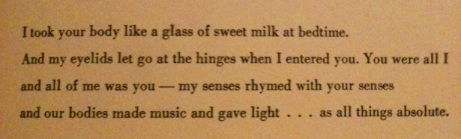
It’s just really, really bad—I mean, at least when Henry Miller is gross, he’s deeply, earnestly gross, abject even, depraved perhaps (recall the famous lines: “I have set the shores a little wider. I have ironed out the wrinkles. After me you can take on stallions, bulls, rams, drakes, St. Bernards. You can stuff toads, bats, lizards up your rectum. You can shit arpeggios if you like, or string a zither across your navel”).
So, to return to my little story, we read most of Benton’s book aloud, doubling over laughing at times at just how wonderfully awful it is. And, wiping the tears from my eyes, I went to my trusty dusty iPhone to do a little background research—surely the world knew of this awful, awful poetry? Surely folks were getting the same giggly fun as happy we from poor Benton’s lurid verse?
And here, really, comes the occasion for this post, the real reason I write: It turns out that folks love this book—in a sincere, earnest, serious way. No fewer than four audio recordings were made of the book, all set to music (the most famous seems to be by Arthur Psyrock); the book has near-perfect five star review averages on both Amazon and Goodreads; and, perhaps most shocking of all, the book has been continuously in print since it was first published in 1949—it’s in its 34th edition (prestigious hardback with prestigious deckle edges, by the way). And of course you can buy an ebook version! (Unlike, say, Georges Perec’s Life A User’s Manual). Even worse, hack crooner Rod McKuen cites Benton as a major influence, so we have that to thank him for as well.
I don’t know. Am I wrong? Is Benton’s stuff actually good? I mean, I’ll concede that I enjoyed reading the book, but only inasmuch as it made me laugh so much. I don’t know. I already admitted I don’t know much about poetry. (As I write this, I pause to watch and listen to Richard Blanco read his inauguration poem “One Day”; I have no idea if it’s good or not). Benton’s verse seems so hammy, clumsy, indelicate; too earnest, too priapic, tripping over its own boners. It reads like a bad cribbing of Whitman and Miller, with an occasional lift from Hemingway. Even worse, it strikes me as amateurish, as the sort of thing that a teen might scrawl in his Moleskine only to cringe at later before hiding it somewhere. I just can’t believe that this book has been in continual publication from a major house (Knopf) for more than a half-century.
But maybe I’m misreading. Maybe I’m cynical. Maybe the poem is beautiful and profound and not icky solipsistic dreck. But I doubt it.
“Birth of Wainamoinen” (Rune I of The Kalevala)
“Birth of Wainamoinen” — Rune I of The Kalevala, translated by John Martin Crawford
In primeval times, a maiden,
Beauteous Daughter of the Ether,
Passed for ages her existence
In the great expanse of heaven,
O’er the prairies yet enfolded.
Wearisome the maiden growing,
Her existence sad and hopeless,
Thus alone to live for ages
In the infinite expanses
Of the air above the sea-foam,
In the far outstretching spaces,
In a solitude of ether,
She descended to the ocean,
Waves her coach, and waves her pillow.
Thereupon the rising storm-wind
Flying from the East in fierceness,
Whips the ocean into surges,
Strikes the stars with sprays of ocean
Till the waves are white with fervor. Continue reading ““Birth of Wainamoinen” (Rune I of The Kalevala)”
“Cézanne” — Gertrude Stein
“Cézanne” by Gertrude Stein
The Irish lady can say, that to-day is every day. Caesar can say that
every day is to-day and they say that every day is as they say.
In this way we have a place to stay and he was not met because
he was settled to stay. When I said settled I meant settled to stay.
When I said settled to stay I meant settled to stay Saturday. In this
way a mouth is a mouth. In this way if in as a mouth if in as a
mouth where, if in as a mouth where and there. Believe they have
water too. Believe they have that water too and blue when you see
blue, is all blue precious too, is all that that is precious too is all
that and they meant to absolve you. In this way Cézanne nearly did
nearly in this way. Cézanne nearly did nearly did and nearly did.
And was I surprised. Was I very surprised. Was I surprised. I was
surprised and in that patient, are you patient when you find bees.
Bees in a garden make a specialty of honey and so does honey. Honey
and prayer. Honey and there. There where the grass can grow nearly
four times yearly.
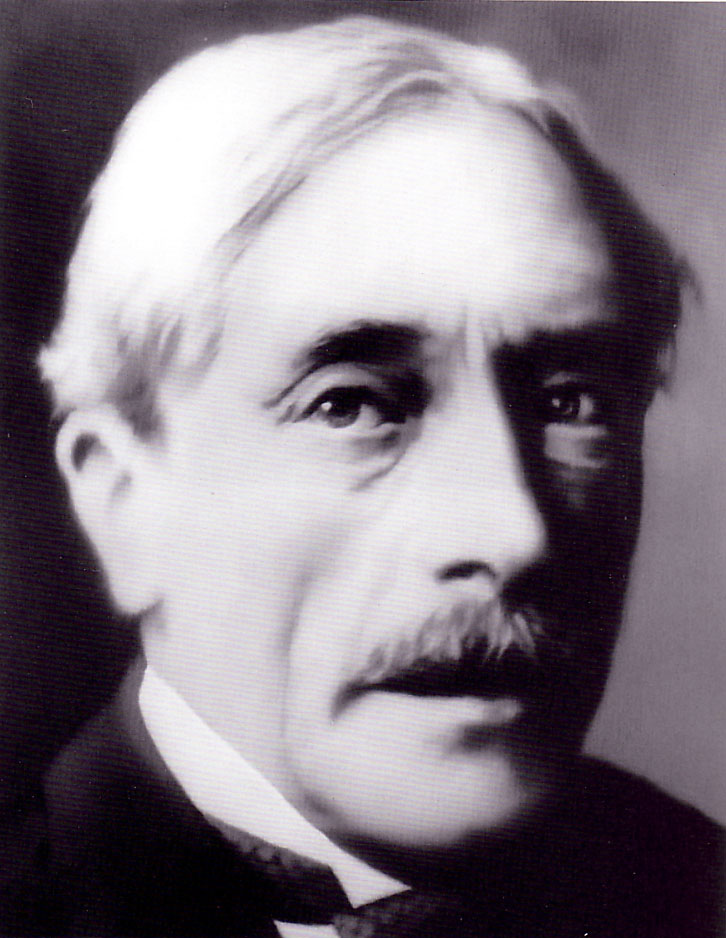
Valéry — Gerhard Richter
“Sweeney Among the Nightingales” — T.S. Eliot
“Sweeney Among the Nightingales” by T.S. Eliot
Apeneck Sweeney spreads his knees
Letting his arms hang down to laugh,
The zebra stripes along his jaw
Swelling to maculate giraffe.The circles of the stormy moon
Slide westward toward the River Plate,
Death and the Raven drift above
And Sweeney guards the hornèd gate.Gloomy Orion and the Dog
Are veiled; and hushed the shrunken seas;
The person in the Spanish cape
Tries to sit on Sweeney’s kneesSlips and pulls the table cloth
Overturns a coffee-cup,
Reorganized upon the floor
She yawns and draws a stocking up;The silent man in mocha brown
Sprawls at the window-sill and gapes;
The waiter brings in oranges
Bananas figs and hothouse grapes;The silent vertebrate in brown
Contracts and concentrates, withdraws;
Rachel née Rabinovitch
Tears at the grapes with murderous paws;She and the lady in the cape
Are suspect, thought to be in league;
Therefore the man with heavy eyes
Declines the gambit, shows fatigue,Leaves the room and reappears
Outside the window, leaning in,
Branches of wisteria
Circumscribe a golden grin;The host with someone indistinct
Converses at the door apart,
The nightingales are singing near
The Convent of the Sacred Heart,And sang within the bloody wood
When Agamemnon cried aloud,
And let their liquid droppings fall
To stain the stiff dishonoured shroud.
Everyday Reading: Poetry and Popular Culture in America (Book Acquired, Sometime in December of 2012)
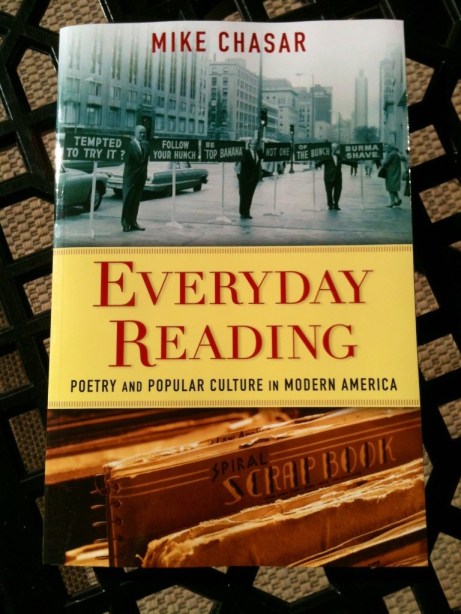
I got a little lax with these “books acquired” posts at the end of last year—chalk it up to end of semester deadlines and meetings, family-oriented holiday stuff, and an awful illness. Anyway–
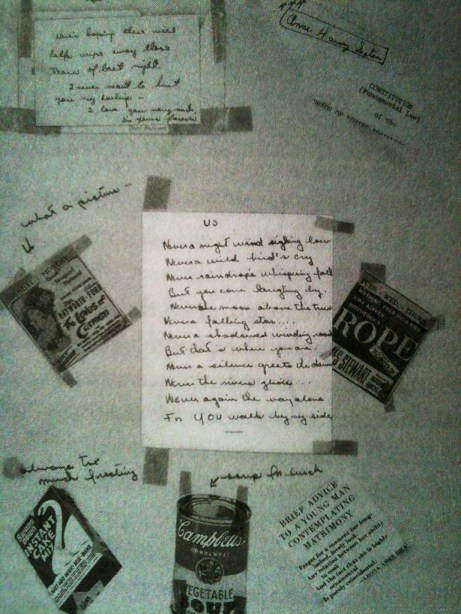
Mike Chasar’s Everyday Reading: Poetry and Popular Culture in Modern America, new from Columbia University Press is pretty cool: it’s kind of a dialogic study of how poetry evinces (or infiltrates or collides or emerges from or is bound by) a variety of popular media. Some of the most fascinating chapters dwell on scrapbooking. Here’s Columbia U of P’s blurb:
Exploring poetry scrapbooks, old-time radio show recordings, advertising verse, corporate archives, and Hallmark greeting cards, among other unconventional sources, Mike Chasar casts American poetry as an everyday phenomenon consumed and created by a vast range of readers. He shows how American poetry in the first half of the twentieth century and its reception helped set the stage for the dynamics of popular culture and mass media today.
Poetry was then part and parcel of American popular culture, spreading rapidly as the consumer economy expanded and companies exploited its profit-making potential. Poetry also offered ordinary Americans creative, emotional, political, and intellectual modes of expression, whether through scrapbooking, participation in radio programs, or poetry contests. Reenvisioning the uses of twentieth-century poetry, Chasar provides a richer understanding of the innovations of modernist and avant-garde poets and the American reading public’s sophisticated powers of feeling and perception.
A couple of snaps from the book—pics of pages from one of those scrapbooks—

And—
“Emily Dickinson” — Wendy Cope
“Emily Dickinson” by Wendy Cope:
Higgledy-piggledy
Emily Dickinson
Liked to use dashes
Instead of full stops.Nowadays, faced with such
Idiosyncrasy,
Critics and editors
Send for the cops.
“Old and New Year Ditties” — Christina Rossetti
“Old and New Year Ditties” by Christina Rossetti
I
New Year met me somewhat sad:
Old Year leaves me tired,
Stripped of favourite things I had
Baulked of much desired:
Yet farther on my road to-day
God willing, farther on my way.New Year coming on apace
What have you to give me?
Bring you scathe, or bring you grace,
Face me with an honest face;
You shall not deceive me:
Be it good or ill, be it what you will,
It needs shall help me on my road,
My rugged way to heaven, please God.II
Watch with me, men, women, and children dear,
You whom I love, for whom I hope and fear,
Watch with me this last vigil of the year.
Some hug their business, some their pleasure-scheme;
Some seize the vacant hour to sleep or dream;
Heart locked in heart some kneel and watch apart.Watch with me blessèd spirits, who delight
All through the holy night to walk in white,
Or take your ease after the long-drawn fight.
I know not if they watch with me: I know
They count this eve of resurrection slow,
And cry, “How long?” with urgent utterance strong.Watch with me Jesus, in my loneliness:
Though others say me nay, yet say Thou yes;
Though others pass me by, stop Thou to bless.
Yea, Thou dost stop with me this vigil night;
To-night of pain, to-morrow of delight:
I, Love, am Thine; Thou, Lord my God, art mine.III
Passing away, saith the World, passing away:
Chances, beauty and youth sapped day by day:
Thy life never continueth in one stay.
Is the eye waxen dim, is the dark hair changing to grey
That hath won neither laurel nor bay?
I shall clothe myself in Spring and bud in May:
Thou, root-stricken, shalt not rebuild thy decay
On my bosom for aye.
Then I answered: Yea.Passing away, saith my Soul, passing away:
With its burden of fear and hope, of labour and play;
Hearken what the past doth witness and say:
Rust in thy gold, a moth is in thine array,
A canker is in thy bud, thy leaf must decay.
At midnight, at cockcrow, at morning, one certain day
Lo, the Bridegroom shall come and shall not delay:
Watch thou and pray.
Then I answered: Yea.Passing away, saith my God, passing away:
Winter passeth after the long delay:
New grapes on the vine, new figs on the tender spray,
Turtle calleth turtle in Heaven’s May.
Though I tarry wait for Me, trust Me, watch and pray:
Arise, come away, night is past and lo it is day,
My love, My sister, My spouse, thou shalt hear Me say.
Then I answered: Yea.
“New Year’s Eve” / “New Year’s Night” — D.H.Lawrence
Two poems by D.H. Lawrence:
“New Year’s Eve”—
There are only two things now,
The great black night scooped out
And this fire-glow.This fire-glow, the core,
And we the two ripe pips
That are held in store.Listen, the darkness rings
As it circulates round our fire.
Take off your things.Your shoulders, your bruised throat!
Your breasts, your nakedness!
This fiery coat!As the darkness flickers and dips,
As the firelight falls and leaps
From your feet to your lips!
“New Year’s Night”—
Now you are mine, to-night at last I say it;
You’re a dove I have bought for sacrifice,
And to-night I slay it.Here in my arms my naked sacrifice!
Death, do you hear, in my arms I am bringing
My offering, bought at great price.She’s a silvery dove worth more than all I’ve got.
Now I offer her up to the ancient, inexorable God,
Who knows me not.Look, she’s a wonderful dove, without blemish or spot!
I sacrifice all in her, my last of the world,
Pride, strength, all the lot.All, all on the altar! And death swooping down
Like a falcon. ’Tis God has taken the victim;
I have won my renown.
“The Tuft of Kelp” — Herman Melville
“The Tuft of Kelp” by Herman Melville—
All dripping in tangles green,
Cast up by a lonely sea
If purer for that, O Weed,
Bitterer, too, are ye?
 Biblioklept