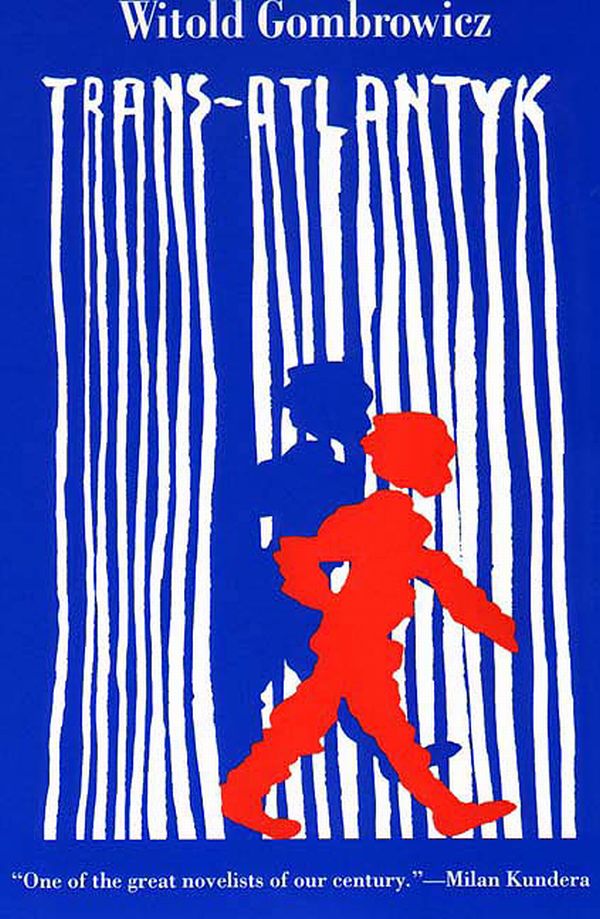
In the Company of Strangers — We Review Barry McCrea’s New Book About Queer Family Ties in Dickens, Joyce, and Proust

Barry McCrea’s In the Company of Strangers: Family and Narrative in Dickens, Conan Doyle, Joyce, and Proust is one of the more engaging works of literary criticism I’ve seen in some time. And while I’m interested in McCrea’s subjects (the weird lines between the Victorian era and modernism, family and marriage plots, Dickens and Joyce, etc.), it’s the clarity of his writing that I find most impressive. Clear, frank writing is too rare in current literary criticism. Here’s McCrea describing his project—
This book argues that the formal innovations of the high-modernist novel are inseparable from a fundamental rethinking of how family ties are formed and sustained. Genealogy was thematically and structurally central to the English nineteenth-century novel. In the Company of  Strangers shows how the formal strategies employed by Joyce and Proust grow out of an attempt to build a fully coherent narrative system that is not rooted in the genealogical family. Modernism’s rejection of the familiar and cultivation of the strange, in other words, are inseparable from its abandonment of the family and embrace of the bond with the stranger as an alternative to it.

[In the Company of Strangers] offers a reassessment of the relationship between the modernists and their Victorian predecessors, suggesting that the key precursor to this queer model of narrative can be located, paradoxically, in the genealogical obsession of the English nineteenth-century novel. Far from representing a clean break with the Victorian family novel, the radical narrative formalism of high modernism exploits the potential of an alternative queer plot that was already present as a formal building block in the nineteenth-century novel.

McCrea’s queer theory lens is keenly attuned to the homoerotic content present in the novels he examines, but his critical gaze is ultimately more interested in how “queer time” functions as an organizing principle throughout the structure of these narratives. McCrea argues that this queer model of time is a central and defining characteristic of literary modernism. The agent (or one agent) of queer time is “the stranger,” the character who figuratively threatens (and paradoxically defines) the family. McCrea points out that the typical Victorian marriage plot resolves the problem of the stranger by incorporating him or her into the family as a point of narrative resolution. In contrast, in “the queer modernist narrative strategies of Ulysses and the Recherche, the stranger rivals and ultimately usurps the family plot.”

McCrea sifts through family plots (and the strangers who would challenge or queer them) in Dickens (Oliver Twist, Bleak House, Great Expectations), Arthur Conan Doyle’s Sherlock Holmes stories, Ulysses (“a queer family epic”), and Proust’s big book. In the Company of Strangers constantly scrutinizes the ways that family organizes narrative (and narrative organizes family). The book also analyzes what “urban literature” might mean, examining what it means to live in proximity to one’s fellows, and the ways in which urban living necessitate ad hoc families.

In the Company of Strangers does a lovely job of tracing the strange currents that run from Victorian lit to modernism and beyond—currents that extend from our conceptions of family itself, and indeed, our conceptions of life and an end to life. McCrea’s writing is precise, supported by a close textual readings, and if I didn’t always agree with his conclusions, he achieved what every critic ought to aim for: he made me want to read the books he was writing about again.

In the Company of Strangers is new from Columbia University Press.

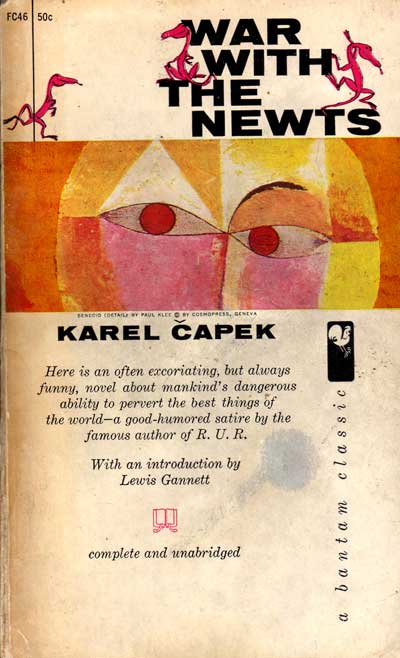
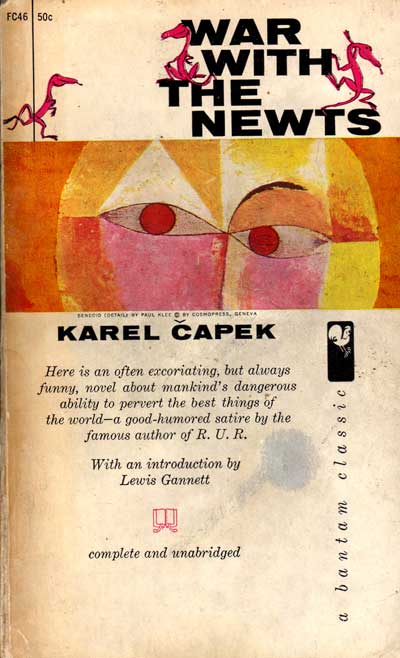
War With the Newts — Karel Capek


Even though the plot of War with the Newts may not shock audiences accustomed to its “human-invention-intended-for- good-becomes-in-the-end-not-so-good” story, readers shouldn’t neglect this often-overlooked science-fiction classic from 1937 by notable Czech writer and satirist Karel Capek.  Humans, motivated by a range of impulses: greed, curiosity, and sometimes even the best of intentions, have created an uncontrollable menace and brought about the end to their dominion over the planet.  Computers, robots, even monkeys have spelled doom for mankind, but Capek warned, in this short and sparkling book, that while masses of intelligent amphibians must be dealt with cautiously, true danger arises from our manipulation of the natural world, the unceasing capitalist drive to increase production by exploiting the weakest, and our inability to foresee the consequences of our actions.

The action begins when a drunk but benevolent sea captain discovers a new species of amphibians inhabiting the waters near an isolated island in the Pacific Ocean.  These docile creatures are able to breathe on land, walk on their hind legs, and communicate using rudimentary sounds and gestures.  The captain trains them to speak a pidgin English and dive for pearls before arming them so that they might fend off the sharks that prey on their young.  Once he receives generous financial backing from a Dutch conglomerate, he ships them to similar islands where pearl harvests have been been impossible or unproductive.  Eventually big business determines that the tireless and fecund newts are valuable for the expansion and development of economic activities near the coasts and under the seas and develop a global marketplace for trade in their labor and bodies.  Educated, well-equipped, and trained to use with the most advanced technologies, the newts produce the greatest expansion of wealth in the history of the world before taking it all for themselves, returning the continents to the bottom of the ocean while requiring a small cadre of humans, relocated to the mountains, to produce the steel and weapons required to support their new Atlantis.

Written as a history book, Capek brilliantly footnotes his narrative with carefully crafted primary sources: newspaper reports, academic studies, religious tracts, political manifestos and corporate minutes in order to illustrate human reaction to new, unsettling circumstance.  A nimble author blessed with the knowledge and skill to write comfortably about a wide variety of subjects, Capek captures both the progressive and cautious voices that shape human reaction to the slow advancement of a new and underestimated intelligence.  He shows that agreement against economic interest is impossible;  labor, for instance, bemoans loss of work to newt hordes while agriculture comes to rely on the millions of new mouths that have to be fed.  Scholars measure, analyze, and categorize; anonymous tract-writers urge an uneasy populace to take up arms against sea-dwelling usurpers while the young and fashionable flock to newt cults, giving themselves up to sexual licentiousness they relish the mysterious and taboo.

But though Capek capably documents trivialities, most of his accounts reflect the time in which he lived and wrote, between the two great European wars, situated between Stalin’s Russia and Hitler’s new Germany, at the height of colonial exploitation, not yet separated by a century from the horrors of the trans-Atlantic slave trade and the American Civil War.  In a report written by the “Salamander Syndicate,” the organization responsible for the organization and dissemination of the world trade in newts justifies the “humane” husbandry, categorization, and sale of newts according to their physical attributes.  Exemplary newts are invited to join committees and expound on their visions for a future shared with humans.  Echoes of American abolitionist thought appear in the debates waged in the media regarding the existence of newt art and culture, their assumed “soullessness,” and the minimal levels of education required for their lives as workers.

The newts, masters of human technology, eventually take over.  Humans, fleeing to higher ground,  are incapable of bringing the fight to the seas.   War with the Newts is an indictment not only of our ability to take without question unearned economic value, but also of our inability to halt the mechanisms by which we accrue those benefits once it becomes evident that the process of enrichment, by itself, is detrimental to the common good.  This is a very good book, a satire of the institutions that will fail when we need them the most, created by a writer whose demonstrated virtuosity deserves more attention.

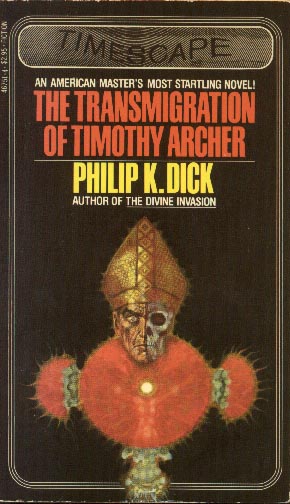
The Transmigration of Timothy Archer — Philip K. Dick

Suffering is the core of The Transmigration of Timothy Archer, a novel published just months after Philip Dick’s death in 1982. This is a book written by an author sure of his abilities, one who could confidently make this novel about big ideas turn on his characters’ struggles to control the trivialities of their day to day lives. While they attempt to make sense of the nature of God and unravel the mysteries of Christian teaching, they confront the questions that must have puzzled even Jesus’ own early advocates: is joy possible when good people are randomly confronted with confusion, pain, and death?  Dick tries to locate a mushy but viable middle ground in this sad, nimble, and touching novel.  Opening on the date of John Lennon’s assassination, Dick writes to commemorate the grinders, the survivors who manage to keep waking up, day after day, despite knowing that life often destroys those who dream too large.

The book is ostensibly based on the life and times of Timothy Archer, the iconoclastic American Episcopalian bishop of California in the 1960s whose unending search for truth led to his becoming friends with Robert Kennedy and Martin Luther King, Jr., advocating for the rights of women, homosexuals, and the transgendered, and time in the national spotlight.  The quest for knowledge led him also to adopt a number of intellectual positions that conflicted directly with his duties as a representative of the Episcopalian church — for example, he was brought to trial for heresy for openly questioning the existence of hell and the Holy Ghost.  The character of Bishop Archer was based almost entirely on the life of Bishop James Pike, Dick’s friend, who, like his fictional counterpart, died of exposure in Israel’s Dead Sea Desert searching for the sources of early Christian doctrine.  Bishop Archer is the bright flame in this book, the Gatsby who pulls in everyone he encounters — not because he’s influential and wealthy, but because his personality is that rare combination of knowledge and empathy, a true man of God who recognizes no difference between the important writer and the indigent cancer patient.  The actions of Bishop Archer form the arc of the book, and his deeds are a mirror to the other characters.  They struggle to shape their own individual visions for their lives because they must work in the shadow cast by a giant they love.

Angel Archer, the bishop’s daughter-in-law and the narrator of the novel, becomes one of Dick’s most realistically drawn characters.  She’s tough, articulate, and well-read.  While those around her succumb to suicidal impulses and mental illness she survives by searching her mind for poems and plays she’s read and committed to memory.  She finds uncomfortable parallels between books and her life.  She values her education and her self-identification as a “Berkeley intellectual” but makes light of her own pretension, telling us that she’s read all the long books but remembers nothing about them.  Do we become apathetic to our own experiences if we’ve read previously about something similar?  Angel fears ennui but describes her own artistic awakening as a ridiculous mixture of pleasure and pain — an agonizing night spent reading Dante’s Commedia while drinking a bottle of bourbon to dampen the pain of an abscessed tooth.  Aware that intellectual exercises and games both trivial and consequential have led to the deaths of her husband, the bishop, and his mistress, she still can’t escape her own self-made prison of words.  “The problem with introspection,” she states while contemplating her own death, “is that it has no end.”  When nobody is left, she soldiers on, dedicating herself, a fragile shell, to driving and working and walking and talking, a person “who records on a notepad the names of those who die.”

Like the narrator, this book reveals its depth rapidly, in spurts of astounding erudition and scholarship.  Dick writes masterfully about nuances of early Judaic law and the formation of Christian thought, illustrates the petty jealousy, kindness, and warmth that seems inherent to certain friendships between between intelligent, rival women, and indicts our perception and treatment of mental illness.  He quotes John Donne, Henry Vaughn, and discusses Virgil and Goethe without arrogance and without disturbing the flow of his story.  Like his best works — A Scanner Darkly, The Man in the High Castle, and Do Androids Dream of Electric Sheep?  — The Transmigration of Timothy Archer is fully drawn and completely real.  His best works seem to be filled with screwed up people trying to get by in a world that has been arbitrarily fucked up by war or technology or drug abuse.  This one is distinctly alive not because it’s set in an alternative world, but in sunny California that existed just three decades ago, close to the environs we currently abide.  A beautiful, moving coda from a man whose vision and prose changed and continues to challenge American writers.

The Garden of Eden — Ernest Hemingway

In general, I dislike reviews that frontload context—get to the book, right? So here’s a short review of Ernest Hemingway’s The Garden of Eden: it is stranger than most of what Hemingway wrote, by turns pleasant, uncomfortable, bewildering, and beautiful. And readable. It’s very, very readable. Young people (or older folks; let’s not be prejudiced) working their way through Hemingway shouldn’t put The Garden of Eden on the back-burner in favor of his more famous works, and anyone who might have written off Hemingway as unreflective macho bravado should take a look at some of the strange gender games this novel has to offer. So, that’s a recommendation, okay?

Now on to that context, which I think is important here. See, The Garden of Eden is one of those unfinished novels that get published posthumously, put together by editors and publishers and other book folk, who play a larger role than we like to admit in the finished books we get from living authors anyway. For various reasons, cultural, historical, etc., we seem to favor the idea of the Singular Artistic Genius who sculpts beauty and truth out of raw Platonic forms that only he or she can access (poor tortured soul). The reality of how our books get to us is a much messier affair, and editors and publishers and even literary studies departments in universities have a large hand in this process, one we tend to ignore in favor of the charms of a Singular Artistic Genius. There’s a fascinating process there, but also a troubling one. Editing issues complicate our ideals of (quite literally) stable authority—is this what the author intended?, we ask (New Critics be damned!). David Foster Wallace and Michael Pietsch, Raymond Carver and Gordon Lish, Franz Kafka and Max Brod, Mary Shelley and Percy Shelley . . .  not to mention Shakespeare, Chaucer, Beowulf, The Bible, Homer, etc. etc. etc. But you’re here to read about The Garden of Eden, right gentle reader? Mea culpa. I’ve been blathering away. Let me turn the reins over to the estimable talents of E.L. Doctorow, who offers the following context in his 1986 review of the book in The New York Times

Since Hemingway’s death in 1961, his estate and his publishers, Charles Scribner’s Sons, have been catching up to him, issuing the work which, for one reason or another, he did not publish during his lifetime. He held back ”A Moveable Feast” out of concern for the feelings of the people in it who might still be alive. But for the novel ”Islands in the Stream” he seems to have had editorial misgivings. Even more deeply in this category is ”The Garden of Eden,” which he began in 1946 and worked on intermittently in the last 15 years of his life and left unfinished. It is a highly readable story, if not possibly the book he envisioned. As published it is composed of 30 short chapters running to about 70,000 words. A publisher’s note advises that ”some cuts” have been made in the manuscript, but according to Mr. Baker’s biography, at one point a revised manuscript of the work ran to 48 chapters and 200,000 words, so the publisher’s note is disingenuous. In an interview with The New York Times last December, a Scribners editor admitted to taking out a subplot in rough draft that he felt had not been integrated into the ”main body” of the text, but this cut reduced the book’s length by two-thirds.

So, yeah. The version we have of The Garden of Eden is heavily cut, and also likely heavily arranged. But that’s what editors do, and this is the book we have (for now, anyway—it seems like on the year of its 25th anniversary of publication, and the 50th anniversary of Hemingway’s death that Scribner should work toward putting out an unedited scholarly edition) — so I’ll talk about that book a bit.

The Garden of Eden tells the story of a few months in the lives of a young newlywed couple, David Bourne, an emerging novelist, and his wife Catherine, a trust fund baby flitting about Europe. The novel is set primarily on the French Riviera, in the thin sliver of high years between the two big wars. David and Catherine spend most of their days in this Edenic setting eating fine food and making love and swimming and riding bikes and fishing. And drinking. Lots and lots of drinking. Lots of drinking. It all sounds quite beautiful—h0w about a taste?

On this morning there was brioche and red raspberry preserve and the eggs were boiled and there was a pat of butter that melted as they stirred them and salted them lightly and ground pepper over them in the cups. They were big eggs and fresh and the girl’s were not cooked quite as long as the young man’s. He remembered that easily and he he was happy with his which he diced up with the spoon and ate with only the flow of the butter to moisten them and the fresh early morning texture and the bite of the coarsely ground pepper grains and the hot coffee and the chickory-fragrant bowl of café au lait.

Hemingway’s technique throughout the novel is to present the phenomenological contours of a heady world. It’s lovely to ride along with David and Catherine, rich and free and beautiful.

Their new life together is hardly charmed, however. See, Catherine gets a haircut—

Her hair was cropped as short as a boy’s. It was cut with no compromises. It was brushed back, heavy as always, but the sides were cut short and the ears that grew close to her head were clear and the tawny line of her hair was cropped close to her head and smooth and sweeping back. She turned her head and lifted her breasts and said, “Kiss me please.”  . . .

“You see, she said. “That’s the surprise. I’m a girl. But now I’m a boy too and I can do anything and anything and anything.”

“Sit here by me,” he said. “What do you want, brother.”

David’s playful response—calling his wife “brother”—covers up some of his shock and fear, but it also points to his underlying curiosity and gender confusion. And indeed, Catherine’s new haircut licenses her to “do anything and anything and anything” — beginning with some strange bed games that night—

He had shut his eyes and he could feel the long light weight of her on him and her breasts pressing against him and her lips on his. He lay there and felt something and then her hand holding him and searching lower and he helped with his hands and then lay back in the dark and did not think at all and only felt the weight and the strangeness inside and she said, “Now you can’t tell who is who can you?”

“No.”

“You are changing,” she said. “Oh you are. You are. Yes you are and you’re my girl Catherine. Will you change and be my girl and let me take you?”

“You’re Catherine.”

“No. I’m Peter. You’re my wonderful Catherine. You’re my beautiful, lovely Catherine. You were so good to change. Oh thank you, Catherine, so much. Please understand. Please know and understand. I’m going to make love to you forever.”

David, partial stand-in for Hemingway, transforms into a girl who feels “something” during sex with Catherine (or, ahem, Peter)—note that that “something” has no clear referent. As their gender inverting games continue (much to David’s horror), Hemingway’s usually concrete language retreats to vague proforms without referents, “it”s without antecedents; his usually precise diction dissolves in these scenes, much as the Bournes’ marriage dissolves each time Catherine escalates the gender inversion. David gives her the nickname “Devil,” as if she were both Eve and Serpent in their Garden. Catherine’s transformations continue as she cuts her hair back even more, and sunbathes all the time so that she can be as dark as possible. She dyes her hair a silver blonde and makes David get his hair cut and dyed the same.

The bizarre behavior (shades of Scott and Zelda?) culminates in Catherine introducing another woman into the marriage. Marita falls in love with both David and Catherine, but her lesbian sex with Catherine only accelerates the latter’s encroaching insanity. David is initially radically ambivalent to the ménage à trois proposed by his wife; he has the good sense to see that a three-way marriage is ultimately untenable and that his wife is going crazy. He vacillates between hostility and love for the two women, but eventually finds a support system in Marita as it becomes increasingly apparent (to all three) that Catherine is depressed and mentally unstable, enraged that David has ceased to write about the pair’s honeymoon adventures on the Riviera. Catherine has been bankrolling David; jealous of good reviews from his last novel, she insists that he write only their story, but David would rather write “the hardest story” he knows—the story of his childhood in East Africa with his father, a big game hunter.

In some of the most extraordinary passages of The Garden of Eden, David writes himself into his boyhood existence, trailing a bull elephant with his father through a jungle trek. David has spotted the elephant by moonlight, prompting his father and his father’s fellow tracker and gun bearer Juma to hunt the old beast. As they trail the animal, David begins to realize how horrible the hunt is, how cruel it is to kill the animal for sport. The passages are somewhat perplexing given Hemingway’s reputation as a hunter. Indeed, this is one of the major features of The Garden of Eden: it repeatedly confounds or complicates our ideas about Hemingway the man’s man, Hemingway the writer, Hemingway the hunter. David describes the wounded, dying elephant—

They found him anchored, in such suffering and despair that he could no longer move. He had crashed through the heavy cover where he had been feeding and crossed a path of open forest and David and his father had run along the heavily splashed blood trail. Then the elephant had gone on into thick forest and David had seen him ahead standing gray and huge against the trunk of a tree. David could only see his stern and then his father moved ahead of him and he followed and they came alongside the elephant as though he was a ship and David saw the blood coming from his flanks and running down his sides and then his father raised his rifle and fired and the elephant turned his head with the great tusks moving heavy and slow and looked at them and when his father fired the second barrel the elephant seemed to sway like a felled tree and came smashing down toward them. But he was not dead. He had been anchored and now he was down with his shoulder broken. He did not move but his eye was alive and looked at David. He had very long eyelashes and his eye was the most alive thing David had ever seen.

David succeeds in writing this “hard” story, and the passages are remarkable in their authenticity—David’s story is a good story, the highlight of the book perhaps; it’s not just Hemingway telling us that David wrote a great story, we actually get to experience the story itself as well as the grueling process by which it was made. Hemingway and his surrogate David show us—make us experience—how difficult writing really is, and then share the fruit of that labor with us. These scenes raise the stakes of The Garden of Eden, revealing how serious David is when he remarks (repeatedly) that the writing is the most important thing—that it outweighs love, it surpasses his marriage. These realizations freight the climax of the novel all the more heavily, but I will avoid anymore spoilers.

The Garden of Eden has some obvious flaws. Marita is underdeveloped at best for such an important character, and her love for David and Catherine remains unexplored, and in fact barely remarked upon. The biggest problem with the book is its conclusion, which feels too pat, too obvious for such a strange, amorphous book. It is here that the presence of an editorial hand seems clearest, to the extent that I wonder if the short little chapter that concludes the novel wasn’t cobbled together from a few stray sentences throughout the manuscript. But The Garden of Eden, despite some shortcomings, is a book well worth reading. The novel complicates not just Hemingway’s reputation, but also our sense of Hemingway’s sense of himself. Recommended.

Spurious — Lars Iyer

Lars Iyer’s début novel Spurious is about two would-be intellectuals, W., the book’s comic hero, and his closest friend, our narrator Lars. They bitch and moan and despair: it’s the end of the world, it’s the apocalypse; they find themselves incapable of original thought, of producing any good writing. The shadow of Kafka paralyzes them. They travel about Europe, seeking out knowledge and inspiration — or at least a glimpse of some beautiful first editions of Rosenzweig. They attend dreadful academic conferences; they write letters. They flounder and fail. In the meantime, a fungus of seemingly metaphysical proportions infects Lars’s apartment, soaking it through, compounding his desperation, as no one can figure out how to get rid of it—

No one understands the damp. It’s Talmudic. The damp is the enigma at the heart of everything. It draws into it the light of all explanation, all hope. The damp says: I exist, and that is all. I am that I am: so the damp. I will outlast you and outlast everything: so the damp.

The passage is a lovely example of Iyer’s humor, which pervades the book just as the damp creeps through his narrator’s home, absurd and bewildering. Iyer is willing to play with tropes of theology and philosophy in ways that are simultaneously absurd, hyperbolic, and deadly serious. “These are the End Times, but who knows it but us?” his hapless heroes wonder. W. is not without solutions though—-

Every conversation must be driven through the apocalyptic towards the messianic, that’s W.’s principle; the shared sense that it’s all at an end, it’s all finished. He loves nothing better than conversations of this kind, W. says, when everything’s at stake, when everything that could be said is said.

That’s when messianism begins, W. says, You have to wear out speech, to run it down. And then? And then, W. says, inanity begins, reckless inanity. The whole night opens up. You have to drink a great deal to get there. It’s an art.

The dialogue (or monologue pretending to be dialogue, more accurately) highlights the verbal slapstick of Spurious, its willingness to shift direction while retaining tone. “Both characters are mesmerised by a real disaster,” Iyer told me in a recent interview (the interview, by the way, makes a better case for reading Spurious than I can hope to here) . “And both — particularly W. — are mesmerised by their partial responsibility for this disaster. The ‘strained and unreasoning’ laughter of Spurious is a response to the grimness of the world that is of our making.”

W.’s response to our grim, apocalyptic world is a mix of absurd humor and real cruelty toward his friend Lars. And if W. is willing to mock and laugh at his friend, he also mocks and laughs at the world, and himself—only his laughter never absolves or forgives or otherwise deflects the cruelty and grimness of the world (or his own cruelty, in turn). When W. calls Lars fat or chastises his laziness or derides his intellect, there’s a recursive angle to his jabs, a sense that they will return to rest on his own brow. It’s all in good fun except when it’s not.

W. and Lars face the same trial that all thinking people face during the End Times, the inescapable, all-devouring nightmare of history, art, philosophy. Perhaps a passage will explicate better than I—

Kafka was always our model, we agree. How is it possible that a human being could write like that?, W. says, again and again. It’s always at the end of the night when he says this, after we’ve drunk a great deal and the sky opens above us, and it is possible to think of what is most important.

At the same time, we have Kafka to blame for everything. Our lives each took a wrong turn when we opened The Castle. It was quite fatal: there was literature itself! We were finished. What could we do, simple apes, but exhaust ourselves in imitation? We had been struck by something we could not understand. It was above us, beyond us, and we were not of its order.

If our heroes are disciples of literature (or the purity of “literature itself”), they are also its prisoners, its slaves, the tormented. W. attempts to find ways out through mathematics and Talmudic theology, but these disciplines entail their own weight and chains—and ultimately, W.’s own shortcomings in these areas only point back to his own reliance on literature (and, in turn, his own shortcomings there again). Still, W. (or Lars, or Iyer, I guess), is willing to share his citations with us, quoting or paraphrasing from a rich intellectual diet.

Although in some ways Spurious is fragmentary and elliptical, a series of riffs, vignettes, and skits, it is also in many ways a traditional novel, with emotionally drawn characters in Lars and W., whose friendship resounds with a deep reality and psychological honesty with which most readers will identify. W. suggests that companionship and friendship are reasons enough to continue existence in the face of despair and absurdity; he then turns around and accuses Lars of being a terrible friend. Iyer offers the kind of truth that has become a cliché, offers it perhaps without cynicism or irony, and then immediately punctures it, even as he reinforces its original truth. Spurious is full of such vacillations, reeling like its often-drunk heroes at times, but always unified by a consistent tone and tight prose. Funny and lively, even when it’s erudite and depressive, Spurious is a lovely little book for drinking and thinking. Read it and pass it on to a dear friend.

Spurious is available now from Melville House; I encourage you again, dear reader, to read my interview with Lars Iyer.

We Review All Six Seasons of The Sopranos in a Relatively Short Post

1. The Sopranos is widely considered to be the best TV show of all time, but you already knew that, right? I watched all six seasons over the past few weeks; although I’d seen most of the episodes over the last decade, I was never a regular viewer, and I certainly didn’t evaluate the episodes I saw through any kind of critical lens. What follows is hardly an in-depth analysis, but rather my thoughts on the show. There are spoilers.

2. Tony Soprano is a vile character. Hard to relate to. He kills his friends and even family members; he lies to his family; he cheats on his wife. He’s a bad guy. He’s not a hero. He’s not an anti-hero. He’s both protagonist and villain of a series that begs us to identify with him, to see in him the expression of our own throbbing id. The gambit pays off at times, but over the duration of the series identifying with Tony becomes exhausting, painful, depressing.

3. I’ll go ahead and submit that I view the series as a study in existential nihilism against the backdrop of American-Dream-as-flow-of-capital. To put it in the series’ own terms, life is “all a big nothing.” In the series’ final scene in a diner, we’re reminded that the best we can hope for is to enjoy the “good times,” to focus on those moments of peace and happiness with our families. But ultimately, the series suggests nihilism, the “big nothing,” a void signaled in its famous closing shot of extended, abyssal blackness.

4. To be very clear, Tony dies at the end. I do not think that the ending is ambiguous. Any other reading is unsupported by the arc of not only the episode’s internal logic, but the arc of the sixth season, and indeed, the arc of the entire series. Any reading that allows Tony to live is wish fulfillment.

5. Pretty much everyone dies in The Sopranos. Again, “big nothing.”

6. There are lots of scenes of people eating sandwiches in The Sopranos.

7. The Sopranos is a commentary on and perhaps rejection of psychoanalysis as a mode of therapy, yet it uses the techniques of psychoanalysis to frame its stories.

8. The Sopranos is a Oedipal drama. I might submit that any drama about a family contains some kernel of Oedipal tension, but The Sopranos is formally Oedipal.

9. The Sopranos aired from 1999 to 2007. That’s a long time. When viewed successively over a short period, the series’ gaps and seams show prominently: characters appear from nowhere, story lines disappear, and key plot points often have to be explicated through clunky exposition.

10. A cultural value of The Sopranos: the series documents the Bush-era zeitgeist.

11. An easy criticism to make about The Sopranos: it’s ultimately an exercise in style and tone rather than plot and character development. Its themes and motifs build and simmer, but they are not enriched by this process. Rather, the series’ themes and motifs swell like thick plaster, obvious, concrete, depressing. Again, The Sopranos can only point to its own nihilism, to its “big nothing.”

12. The show is depressing. I mean, watching the show is a depressing process. It normalizes murders, lies, bullying, and violence—that’s pretty bad—but what becomes especially distressing is that the Sopranos are always fighting with each other. They are usually angry or sad. There aren’t really too many of those “good times”  to remember.

13. TVs are always on in The Sopranos, usually tuned to documentaries about war or war movies.

14. Some favorite episodes: “College,” “I Dream of Jeannie Cusamano” (season one), “Commendatori,” “Funhouse” (season two), “Mr. Ruggerio’s Neighborhood,” “University,” “Pine Barrens” (season three), “Calling All Cars,” “Whitecaps” (season four), “Rat Pack,” “Irregular around the Margins,” “The Test Dream,” “Long Term Parking” (season five), “Join the Club,” “Mayham,” “Live Free or Die,” “Soprano Home Movies,” “Made in America” (season six).

15. For years, I thought that the Comorra enforcer Furio Giunta, played by Federico Castelluccio, was played by Brent Spiner, who played Data on Star Trek: The Next Generation. Looking at pics of these actors, I do not understand my previous confusion. This comment is in no way germane to this “review.”

16. I don’t know if I’ve ever hated a character as much as I hate Paulie Walnuts.

17. Chris Moltisanti, played by actor Michael Imperioli, is probably my favorite character on the show. He too is vile—a drug addict, a thief, a woman-beater—but he’s also tender and funny. Maybe I just like Imperioli.

18. Steve Buscemi’s run on The Sopranos was pretty great, although it was part of a trope that the series leaned on too often—the guy-gets-out-of-prison-and-now-what? storyline.

19. Buscemi directed what might be the best episode of the series, “Pine Barrens.”

20. It’s easy to forget or overlook or understate the impact that The Sopranos had on HBO shows in particular and TV shows in general, but that impact should be noted here. Its formal elements either influenced or paved the way for the superior shows Deadwood and The Wire. It’s hard to imagine Mad Men without The Sopranos.

21. The early episodes of The Sopranos look and feel surprisingly cheap, perhaps in part due to the heavy use of canned music and an emphasis on longer takes. Plus, the need for exposition and character grounding leads to a kind of clunkiness. These episodes compensate with graphic violence and nudity.

22. Lots of strippers on The Sopranos.

23. You could argue that The Sopranos is a study in patriarchy, in patriarchy-as-capitalism.

24. One of the major themes of The Sopranos traces how women attempt to find agency within this strict patriarchy, a patriarchy that repeatedly objectifies, dehumanizes, uses, and discards women. Carmella, in particular, seeks to find voice in freedom, and her plan to do so invokes, again, the American Dream—the accumulation and sale of property. The flow of capital is freedom.

25. As a way of closing, I’ll return to the series’ final scene, probably one of the most remarked-upon moments in TV history (I cringe now at having written the execrable and odious phrase “TV history”). For me, the ending is unambiguous—the cut to black is a POV shift into Tony’s consciousness at the precise moment that he loses that consciousness forever. The ending is neither cheap nor gimmicky, but a formal masterstroke that corresponds to the series’ overarching themes of nihilism. This nihilism perhaps prevents the series achieving the cohesion of, say, The Wire, an equally dark series that takes capitalism as its major subject. The Wire proposes struggle itself as raison d’être. The Sopranos makes no argument for that struggle, finds no honor or humanity in it, instead shifting philosophical emphasis to “focus on the times that were good” against the face of a “big nothing.” The end of The Wire is a beautiful montage that suggests that even though history may be cyclical, this fact alone does not foreclose human agency. It is difficult to call the end of The Wire “happy,” but the series conclusion nevertheless suggests generative possibility: there might not be space for the viewer in that particular world, but David Simon suggests that that world will nevertheless continue without the viewer. In metaphorical terms, it lives. The formal device of the cycle-montage at the end of The Wire would feel cheap or even hackneyed had the series not earned it by establishing its threads years in advance. The end of The Wire shows us everything; it gives us the future. It is big everything, the perfect end for a show that attempt to measure the everything of one particular place. Similarly, the final shot of The Sopranos is formally and thematically appropriate. It gives us that “big nothing” that the series has repeatedly promised is ours to collect. The black thematizes the profound moral failures of its characters and dramatizes the loss of enlightenment and moral vision that permeates the family members in the final season. It’s a clever, elegant, and ugly way to end a very depressing show.

Edgar Allan Poe Reviews Nathaniel Hawthorne’s Twice-Told Tales

Edgar Allan Poe reviews Nathaniel Hawthorne’s Twice-Told Tales. Originally published in Graham’s Magazine, April, 1842—

We have always regarded the Tale (using this word in its popular acceptation) as affording the best prose opportunity for display of the highest talent. It has peculiar advantages which the novel does not admit. It is, of course, a far finer field than the essay. It has even points of superiority over the poem. An accident has deprived us, this month, of our customary space for review; and thus nipped in the bud a design long cherished of treating this subject in detail; taking Mr. Hawthorne’s volumes as a text. In May we shall endeavor to carry out our intention. At present we are forced to be brief.

With rare exception–in the case of Mr. Irving’s “Tales of a Traveller” and a few other works of a like cast–we have had no American tales of high merit. We have had no skilful compositions–nothing which could bear examination as works of art. Of twattle called tale-writing we have had, perhaps, more than enough. We have had a superabundance of the Rosa-Matilda effusions–gilt-edged paper all couleur de rose: a full allowance of cut-and-thrust blue-blazing melodramaticisms; a nauseating surfeit of low miniature copying of low life, much in the manner, and with about half the merit, of the Dutch herrings and decayed cheeses of Van Tuyssel–of all this,eheu jam satis!

Mr. Hawthorne’s volumes appear to us misnamed in two respects. In the first place they should not have been called “Twice-Told Tales”–for this is a title which will not bear repetition. If in the first collected edition they were twice-told, of course now they are thrice-told.–May we live to hear them told a hundred times! In the second place, these compositions are by no means all “Tales.” The most of them are essays properly so called. It would have been wise in their author to have modified his title, so as to have had reference to all included. This point could have been easily arranged.

But under whatever titular blunders we receive this book, it is most cordially welcome. We have seen no prose composition by any American which can compare with some of these articles in the higher merits, or indeed in the lower; while there is not a single piece which would do dishonor to the best of the British essayists.

“The Rill from the Town Pump” which, through the ad captandum nature of its title, has attracted more of public notice than any one other of Mr. Hawthorne’s compositions, is perhaps, the least meritorious. Among his best, we may briefly mention “The Hollow of the Three Hills;” “The Minister’s Black Veil;” “Wakefield;” “Mr. Higginbotham’s Catastrophe,” “Fancy’s Show-Box;” “Dr. Heidegger’s Experiment;” “David Swan;” “The Wedding Knell;” and “The White Old Maid.” It is remarkable that all these, with one exception, are from the first volume.

The style of Mr. Hawthorne is purity itself. His tone is singularly effective–wild, plaintive, thoughtful, and in full accordance with his themes. We have only to object that there is insufficient diversity in these themes themselves, or rather in their character. His originality both of incident and of reflection is very remarkable; and this trait alone would ensure him at least our warmest regard and commendation. We speak here chiefly of the tales; the essays are not so markedly novel. Upon the whole we look upon him as one of the few men of indisputable genius to whom our country has as yet given birth. As such, it will be our delight to do him honor; and lest,

The Third Reich: Part II — Roberto Bolaño

Literature has a unique power to echo not just from the past into the future, but also backwards through time—later works can somehow cast shadows on earlier ones, and later details of a writer’s biography sometimes seep into fiction that the writer produced earlier. Take for example Edgar Allan Poe. He published his long poem “The Raven,” about a man mourning his lost love, two years before the death of his wife, yet the autobiographical detail nevertheless freights the work with deeper emotional weight. Poe was a hero to Roberto Bolaño (“The honest truth is that with Edgar Allan Poe we would all have more than enough good material to read”), whose own early death seems to haunt the writing that came before it. In turn, the late opus 2666 seems to cast a huge shadow over the rest of Bolaño’s fiction, which of course preceded it. I’ve argued before that 2666 is the labyrinthine culmination of the Bolañoverse, a mirror-world of dread and paranoia and violence and literary criticism and strange beauty. The Third Reich, one of Bolaño’s earliest novels, now in its second part of a four-part serialization from The Paris Review, continues to show Bolaño gesturing toward the beast that would become 2666.

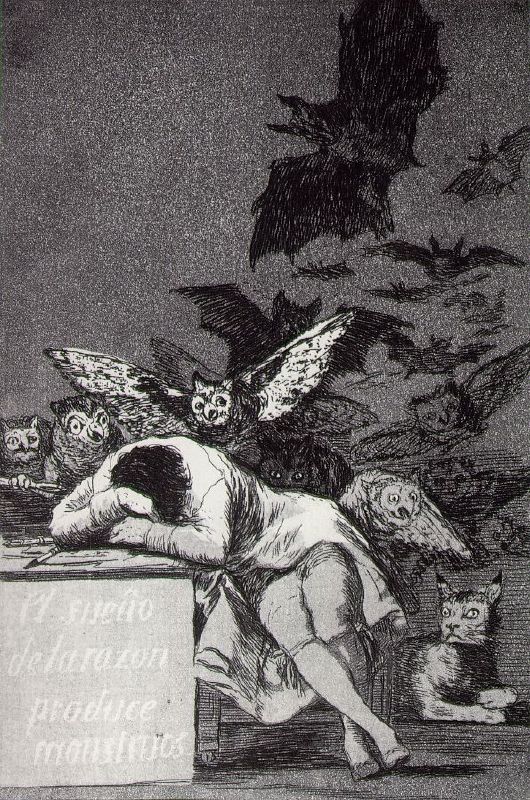
The Sleep of Reason Produces Monsters -- Goya (1797)

If 2666 impossibly haunts The Third Reich from the future, then paranoid Poe haunts it from the past. Last time we checked in, Udo Berger and his beautiful girlfriend Ingeborg had made tentative friends with another German couple while spending the summer at a seaside resort in Spain. Through this pair, they meet up with two nefarious locals, the Wolf and the Lamb; Udo also begins obsessing over a man named El Quemado, a burn victim who rents paddle boats to tourists. For Udo, the holiday is meant to be a working vacation—he’s a wargame enthusiast, and he plans to write a defining strategy for a new game called “The Third Reich” (implicitly, he plays the Nazi’s side). In the meantime, he’s also taken with the hotel’s owner, Frau Else, a German transplant who mysteriously disappears to take care of an ill husband who no one seems to see.

The first part of The Third Reich (published in the Spring ’11 issue) set the stage for dread, mystery, and extreme paranoia—all while on a sunny seaside holiday. The set-up recalls the seemingly innocuous first section of 2666, “The Part About the Critics,” where four European literature professors spend a vacation of sorts in sunny Mexico while ostensibly searching for a mysterious author. The Third Reich showcases the same sinister tension, describing—but never explaining—the stress between differing cultures, the radical alterity of “being on holiday,” of “vacating,” of being in a different place for a different purpose than what is usual, normal.

The second part of The Third Reich (in the new Summer ’11 issue) increases the dread and paranoia, all with a strange, mordant humor. The novel’s conceit is that the writing is Udo’s holiday’s journal; as such, he controls not only perspective and tone, but what details we learn—or don’t learn. It’s what Udo leaves out that becomes increasingly distressing and fascinating. Indeed, at a crucial point in the novel, Udo fails to explain to us why he remains in Spain after his holiday should be over, even as Ingeborg returns to Germany. There is an ostensible explanation—Charly has disappeared and Udo perhaps wants an answer to the mystery (I will withhold further details for fear of spoiling the plot). It seems more likely that Udo remains to work out his strategy for “The Third Reich”; he finds an unlikely gaming partner in El Quemado. Indeed, the wargame begins to define Udo’s perspective at all times—

When I saw from the balcony that the bathers were beating a mass retreat toward the hotels and campgrounds, I went down to the beach. It’s a sad time of day, and the bathers are sad: tired, sated with sun, they turn their gazes toward the line of buildings like soldier s already sure of defeat; with tired steps they cross the beach and the Paseo Maritimo, prudent but with a hint of scorn, of arrogance in the face of remote danger, their peculiar way of turning down side streets where they immediately seek out the shade leading them directly—they’re a tributue—toward the void.

German nihilism on holiday! Still, Udo finds perverse joy in his gaming sessions with El Quemado; in these episodes, his tone escalates to a manic pitch, reminiscent of some of Poe’s crazies (the narrator of “The Tell-Tale Heart” comes to mind in particular), as well as the mounting insanity of Oscar Amalfitano in 2666. And, just as in the early parts of 2666, The Third Reich begins to buzz with rumors of rape. Udo hints at these rumors, but is unwilling to explore them. Also mysterious is the identity of Frau Else’s husband, a pointedly Gothic conceit, of course, that nonetheless may be the beating heart of horror at the center of the story. He haunts Udo’s sleep—

I dreamed that someone was knocking at the door. It was nighttime and when I opened the door I saw someone slipping down the hall. I followed. Unexpectedly we came to a huge dark room filled with the outlines of heavy old furniture. The smell of mildew and dampness was strong. On a bed a shadowy figure was twisting and turning. At first I thought it was an animal. Then I recognized Frau Else’s husband. At last!

I’ve done my best to omit some of the sharp twists in this section of The Third Reich for fear of spoiling the book, but I will add that Part II ends with something of a subtle cliffhanger (as I write the term “subtle cliffhanger” I realize that it is pure oxymoron; mea culpa). In any case, I’m enjoying the serialization very much and look forward to reading Part III.

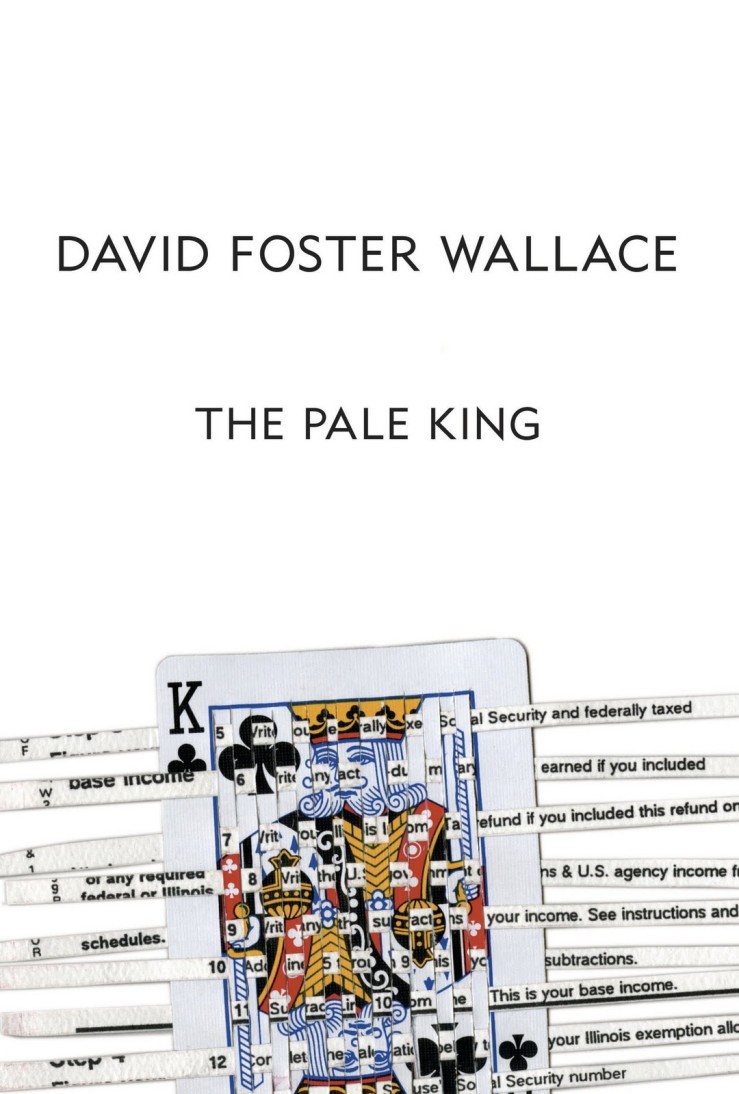
The Pale King — David Foster Wallace

In one of the notes at the end of David Foster Wallace’s incomplete novel The Pale King, the author writes, “Plot a series of set-ups for stuff happening, but nothing actually happens.” This is a fairly precise summary of The Pale King—if you take “nothing actually happens” to mean an absence of recognizable character arcs defined through readily identifiable conflicts progressing along a linear narrative. The Pale King is not a traditional novel. Hell, it’s not even really a novel, unless you decide to really stretch your definition of what a novel is. Which is all fine and good and dandy. Infinite Jest is not a traditional novel either, but it is, I believe, clearly identifiable as a novel: it coheres; it completes; it concludes—which The Pale King does not.

You know the context of The Pale King, and if you don’t you can look it up—there’s a glut of hand-wringing and buzz and backlash out there (out there=internet) that I’ve spent the past three or four months doing my best to ignore. And while I haven’t read a review of The Pale King yet (I’ll read Tom McCarthy’ s write up in The New York Times as soon as I finish my piece), I would have to be deaf dumb blind not to have missed all the headlines, the links, the tweets, the weight people have sought to attach to this book. Anyway, I’m approaching hand-wringing here myself, which is not my aim. I want to try to review the book. But, like I said, there’s all that context. It’s unfinished. Incomplete. Posthumous.

We know the context. You know it’s incomplete, I know it’s incomplete, we know that going in. Which is why it’s a far more satisfying read, I believe, to treat The Pale King as a fragmentary piece, a novel-in-stories, a collection of themes, riffs, dialogues and monologues, vignettes, bits and pieces. It’s closer in many ways to Brief Interviews with Hideous Men or Oblivion than it is to Infinite Jest, although there are plenty of novelly-novel elements. There’s a setting: mostly a sweaty Peoria, Illinois in the mid 1980s, and although much of the novel centers around an IRS regional center there, there are also bits in Chicago, various college classrooms, suburban homes, sad motels, crowded highways, fringe communities, surveillance vans, bars, psych wards, etc. There are recurring characters, all of them IRS employees.

Perhaps a bit on those characters: Some of the best moments of the book center on the bizarre mind of Claude Sylvanshine, a fact psychic who can’t control the flow of data that surges into his mind. Sylvanshine works with his partner and sometime rival Reynolds to help lay the groundwork for the arrival of Merrill Errol Lehrl in Peoria, where Lehrl will continue to machinize the IRS or something like that. There’s Toni Ware, easily the coolest character in the book. There’s not enough Toni Ware in The Pale King. There’s Leonard Stecyk, a person so impossibly good that he drives everyone to despair. There’s Lane Dean, a Christian who may or may not be slowly losing faith. There’s Chris Fogle, who tells us basically his life story in a 100 page novella that may or may not be the center of the book (there is no center though). There’s David Wallace, who claims to be writing a memoir, who claims to be, like, the David Foster Wallace, the author, who claims that he worked for the IRS for a few years between other gigs. As if to prove he’s the real David Wallace, his sections are crammed with diverting, annoying footnotes that repeatedly interrupt any rhythm the reader (or this reader anyway) could get going. It’s difficult to summarize or even describe the relations between the characters, who are defined repeatedly not just through their own telling, but through each others’ eyes, which makes it even more difficult to unpack the plot of The Pale King.

The conflict of the book, or at least the surface conflict, the plot-level conflict, seems to be (or seems to have intended to have been) about a movement within the IRS to essentially change its mission from one of service, of doing a job that no one wants to do that nevertheless has to be done for the greater good of democracy, to a more nefarious and machine-like agency bent on generating revenue—like a corporation. Thus humanity vs. bureaucracy, religious-type calling vs. mercenary machinery, selfless duty vs. selfish will, etc. etc. etc. Chapter 19 (§19, in the book’s terms) lays out these themes beautifully in a civics lesson (the chapter is set in a stuck elevator, I think). The civics lesson has even more resonance in these times of rampant Teabaggery. Here’s a taste—-

Corporations aren’t citizens or neighbors or parents. They can’t vote or serve in combat. They don’t learn the Pledge of Allegiance. They don’t have souls. They’re revenue machines. I don’t have any problem with that. I think it’s absurd to lay moral or civic obligations on them. Their only obligations are strategic, and while they can get very complex, at root they’re not civic entities. With corporations, I have no problem with the government enforcement of statutes and regulatory policy serving a conscience function. What my problem is is the way it seems that we as individual citizens have adopted a corporate attitude. That our ultimate obligation is to ourselves. That unless it’s illegal or there are direct practical consequences for ourselves, any activity is okay.

The IRS gives Wallace a perfect backdrop to explore the tension between civic virtue and the American right to be a selfish asshole, but it’s the book’s themes of boredom and attention that have been remarked upon the most. Simply put, the theme is pervasive, perhaps overdetermined within the narrative, and at once both obvious and complex. Infinite Jest explored the consequences and existential fallout of a society conditioned to believe that it had to be entertained at all times; The Pale King seems to respond to the same existential problem in kind, only from a different angle. There’s so much of this theme of boredom and attention throughout the book that I’ll lazily go to Wallace’s end notes again, where he concisely lays it bare for us (or not for us really but probably for himself)—

It turns out that bliss—a second-by-second joy + gratitude at the gift of being alive, conscious—lies on the other side of crushing, crushing boredom. Pay close attention to the most tedious thing you can find (tax returns, televised golf), and, in waves, a boredom like you’ve never known will wash over you and just about kill you. Ride these out and it’s like stepping from black and white into color. Like water after days in the desert. Constant bliss in every atom.

Wallace finds a kind of transcendental out in the ability to concentrate attention on tasks of despair-invoking boredom. This type of attention obviously recalls the intensity of fervent, even monastic prayer (indeed, the IRS agents are often implicitly compared to monks), yet the Midwest America of The Pale King is deeply desacralized. Although Lane Dean provides a figure of religion in crisis (underexplored for the perhaps obvious reason that the book is unfinished), for the most part The Pale King  presents a post-Nietzschean world without an authorizing center. Wallace’s work then is to find some kind of metaphysical solace in a world where God seems absent at best, and he finds it in paying close attention to the tedium of life. For me, it’s The Pale King’s strange metaphysical moments that are the most intriguing (and frustrating) then. We have the aforementioned Sylvanshine, a fact psychic who can parse data, but cannot glean real meaning from it—

The fact psychic lives part-time in the world of fractious, boiling minutiae that no one knows or could be bothered to know even if they had the chance to know. The population of Brunei. The difference between mucus and sputum. How long a piece of gum has resided on the underside of the third-row fourth-from-left-seat of the Virginia Theater, Cranston, RI, but not who put it there or why. Impossible to predict what facts will intrude. Constant headaches.

In a world of information-overload, attending deeply and meaningfully to data becomes prohibitively difficult, if not impossible. Sylvanshine’s blessing/curse dramatizes the paralyzing post-20th century crisis of too much information (and therefore too many choices). The Pale King’s metaphysical elements manifest again in the ghosts Garrity and Blumquist, who kinda-sorta haunt the IRS center in Peoria; one of them shows up to explain the etymology of the word “boring” to Lane Dean. There’s a boy whose devotion to kissing every square inch of his body (clearly an impossible feat) takes on a spiritual dimension. There’s Chris Fogle, who experiences a religious-type epiphany in an accounting class. There’s also a “fierce infant” who seems to have some metaphysical powers, although I don’t know why I’m lumping him in here. Like I said, (didn’t I say?) I don’t really know how to review this book (I’ve also had a few beers at this point). The infant is one of those threads that goes nowhere, that fails to cohere, that might have a missing piece somewhere else, somewhere unwritten. A more complete picture of the transcendental bliss that prolonged attention might hold comes late in the book, in a longish piece (§46) that details a tête-à-tête between Meredith Rand, who is too-pretty, a little crazy, and ultimately both boring and alienating to almost any guy she actually talks to, and Drinion, an asexual man I take to be autistic. Drinion pays absolute, intense, true, human attention to Meredith Rand’s story of being admitted to a psychiatric hospital in her teens for cutting herself; there she meets her future husband. During their conversation, Drinion begins to levitate—via his attention, he literally transcends gravity. And yet the catch of it all is that Drinion’s autism and aesexuality somehow make it easier for him to attend others, to truly connect to this beautiful woman who simultaneously bores and alienates most of the men she bothers to speak with.

Still, Wallace posits in Drinion—and elsewhere in the book, but hey, let’s face it, this is getting pretty long for a blog review—Wallace posits some kind of answer to existential despair and boredom, an answer that goes beyond a trite commonplace like “empathy,” in that empathy is ultimately about self-identification: the answer in The Pale King seems to be selfless identification, in the most literal sense. There’s no cheat here—the narrative bits with Toni Ware especially dramatize the brutal ugliness of life, its essential Darwinian unfairness, the random cruelty that might be there. This is a book about death and taxes, and Wallace works to sanctify these costs of life, to make them count in a in a world that has largely abandoned the sacred, in a society where many people are incapable or unwilling to think empathetically about their relation to (via taxes and social institutions) other humans whom they do not personally know.

The Pale King is not as rich or funny or sad as Infinite Jest; it has nothing to match Don Gately nor does it have a Prince Hal Incandenza. But why hold that against it? It is, after all, an unfinished thing, but as incomplete as it may be, its ends not just loose but frayed, it is still a marvel of heart and intellect. Highly recommended.

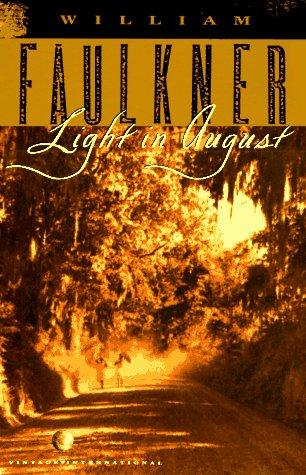
Light in August — William Faulkner

I can’t unpack William Faulkner’s novel Light in August here. There’s too much in it. It’s too thick. Faulkner piles on his sentences in a gelatinous mass, smearing words on top of words into a deep swamp of meaning, motif, and symbol. The novel is archaeological, a deep dig into the South’s abject wounds. It is the most Faulkneresque Faulkner novel I have read, a heady strange brew that tries to suss out racism, misogyny, fear of paternity, the scars of the plantation system, the fallout of the Civil War, the cold comfort of religion, and so much more. Like any good modern text, you could say it’s about a quest for identity, and how the quester must come into conflict with the codes and terms of the dominant social order to find that solid identity. But in Faulkner there is no stable identity, and Light in August dramatizes this problem, even as it points to a possible inherent payoff.

A book review should give some sense of what happens in the book, but as in much of Faulkner’s work, explaining “what happens” in a Light in August would spoil the puzzle, the synthesis, the game, the shock of it all. But some outlines should suffice. The novel is set in the Jim Crow South, mostly in Jefferson, seat of Yoknapatawpha County, the Faulknerverse. It opens with Lena Grove walking “all the way from Alabama” into Mississippi; she’s in her third trimester of pregnancy and still has no ring on her finger, a sign that every Southerner knows how to read. Lena is looking for the father’s child, Lucas Burch; she hears tell that a Burch might work at the planing mill. It’s not Burch though, but Byron Bunch, who falls for Lena right away, plays Joseph to her Mary. Meanwhile, Lucas Burch is around—only the rascal’s taken up the false name Joe Brown. He’s also taken up with the novel’s tragic anti-hero, Joe Christmas, helping that strange man bootleg whiskey out of old servant quarters adjoining a decaying plantation house. Joe Christmas, an abandoned orphan, may have black blood in him. In Jim Crow Mississippi this makes him black, even worse than black—an unknown, unknowable something. Christmas (is there a more overdetermined name in fiction?) is accused of killing the woman who lives the old plantation house, a woman the community of Jefferson shunned for her family’s abolitionist, carpetbaggin’ past, yet now the community must exact the only kind of justice suitable for a black man accused of killing a white woman in Mississippi in the 1920s. JC, always estranged, must now keep on the run to avoid being lynched.

In any other novel, the two protagonists would have to meet, but Faulkner never allows a scene between Christmas and Lena. Yet they are undeniably tied together: somehow he is both the metaphysical father of her child and the child itself, Faulkner’s answer to the inescapable violent fatalism that curses the South. There is no exit from the wounded past, but there might be new possibilities, and we might find them in Lena’s baby. Lena provides a feminine antidote to Christmas’s abject fear of women, his utterly Faulknerian despair of genitalia and menstruation; at the same time, Christmas becomes the sacrificial lamb for the South’s sins, the totem whose ritualistic dismemberment will at once reaffirm the dominant social patriarchal order of the plantation system at the very same time it reveals that system’s deep hypocrisy and radical instability.

In Light in August, Faulkner shows us a world where social codes are rigid, inflexible, immutable, unspoken, and bear absolutely no relation to the concrete reality of the phenomenal, external world they pretend to govern. It’s the primal sin of the plantation system, which paradoxically separated and joined blacks and whites; which said that miscegenation was abomination yet created the optimal circumstances for racial mixing; which proscribed the very concept of a multiracial family while enforcing the Darwinian circumstances that would necessitate such a collective. It is a world where nothing fits together, nothing connects, yet Faulkner finds a place for his misfits, although he must find it by mixing up the system.

Here’s Lena talking to Hightower, the defrocked minister and ersatz medicine man (I will not even begin to discuss Hightower). Lena’s concern is over Christmas’s grandmother, who through a bizarre series of events is present at the baby’s birth—-

“She keeps on talking about—–She is mixed up someway. And sometimes I get mixed up too, listening, having to . . . . . . .” Her eyes, her words, grope, fumble.

“Mixed up?”

“She keeps on talking about him like his pa was that—–that one in jail, that Mr Christmas. She keeps on, and the I get mixed up and it’s like sometimes I can’t——like I am mixed up too and I think that his pa is that Mr—–Mr Christmas too—–” She watches him; it is as though she makes a tremendous effort of some kind. “But I know that aint so. I know that’s foolish. It’s because she keeps on saying it and saying it, and maybe I ain’t strong good yet, and I get mixed up too. But I am afraid . . . . . . .”

“Of what?”

“I don’t like to get mixed up. And I am afraid she might get me mixed up, like they say how you might cross your eyes and then you can’t uncross . . . . . . .”

But the eyes and the I’s (both are ways of seeing, of course) do get crossed in Light. Faulkner mixes up the system, crosses the wires as a way out of the ugly circuit, even as he paradoxically reconfirms the circuit’s contours. This is not a writer who flinches from history and all its despair, even as he tries to find a metaphysical answer outside of religious doctrine and conventional morality.

I feel like I’ve made, at best, some very broad, superficial scratches into the surface of a very dense, thick book; even worse, I’ve barely provided even a hint of Faulkner’s astounding prose. Mea culpa. I’ll take a second, more specific shot at Light in August in an upcoming post. For now: Very highly recommended.

Hadji Murad — Leo Tolstoy

Like many readers of Leo Tolstoy’s final work, Hadji Murad, I read the novella based on Harold Bloom’s praise in his work The Western Canon, where he declares it “my personal touchstone for the sublime of prose fiction, to me the best story in the world, or at least the best I have ever read.” It wasn’t just Bloom’s praise that attracted me to Hadji Murad—I had just finished Jonathan Littell’s bizarre opus The Kindly Ones, which devotes a lengthy section to WWII’s Eastern front in the Caucus mountains; Littell’s chapter traces the fallout after decades of Russian incursions. Hadji Murad takes place in 1851 and 1852 as the Caucasian people resist the encroaching Russian Empire. Littell’s book piqued my curiosity about a part of the world that still seems strange and alien, a genuinely multicultural place that signals the traditional border of East and West.

I’ll also admit that I’ve never really read Tolstoy, and the prospect of beginning with a novella was intriguing.

Hadji Murad tells the story of the real-life Caucasian Avar general Hadji Murad who fought under Imam Shamil, the leader of the Muslim tribes of the Northern Caucuses; Shamil was Russia’s greatest foe. The story begins in media res as Hadji Murad and two of his lieutenants flee from Shamil’s camp. Because of a feud born from familial drama, Shamil decides that Hadji Murad must die. The Imam captures and imprisons the rebel’s family. Hadji Murad begins the process of going over to the Russians; he plans to defect and then head a Russian-backed army to defeat Shamil. This is the basic plot—I will spoil no more.

In his essay “Leo Tolstoy, Two Hussars” (collected in Why Read the Classics?), Italo Calvino suggests—

It is not easy to understand how Tolstoy constructs his narratives. What other fiction writers make explicit – symmetrical patterns, supporting structures, counterbalances, link sequences — all remain hidden in Tolstoy. But hidden does not mean non-existent: the impression Tolstoy conveys of transferring ‘life’ just as it is on to the page (‘life’, that mysterious entity to define which we have to start from the written page) is actually merely the result of his artistry, that is to say an artifice that is more sophisticated and complex than many others.

Although Calvino writes of Two Hussars, his remarks are equally true of Hadji Murad. Tolstoy’s radical realism at times so disorients that it becomes hard to pick up the themes of the novella. Tolstoy, the grand director, shifts the action from his hero Hadji Murad to train his camera on an apparently insignificant character—for example, Butler, a happy-go-lucky Russian soldier with a Romantic outlook and a gambling problem. Then Tolstoy might focus on Prince Vorontsov and his wife Maria, who command at the Russian fortress Vozdvizhenskaya. In a wonderful setpiece, Tolstoy shows us a state dinner bristling with gossip and mannered energy. In another section, Tolstoy lets his camera follow bulky Czar Nicholas I, a vain womanizer who cannot see how disconnected he is from his subjects. The Czar cannot fathom the visceral consequences of his decisions. Yet Tolstoy makes no effort to connect the bloodshed in a massacre of a Chechen village to the Czar’s ambivalence or the richness of the dinner party. These connections are left to the reader.

The novella is almost a puzzle: the chapters are distinct setpieces that the reader must connect in order to see a bigger picture. This analysis should not suggest, however, any murkiness or ambiguity in Tolstoy’s chapters (let alone sentences). Hadji Murad is lucid, clear, and very sober, even when it depicts violence, confusion, and drunkenness. As Calvino points out, Tolstoy’s art replicates the messiness of “real life” in a way that seems mimetically appropriate to “real life’s” complexity, and at the same time to allow the reader to intellectually engage the narrative. Calvino again—

That fullness of life which is so much praised in Tolstoy by experts on the author is in fact — in this tale as much as in the rest of his oeuvre — the acknowledgement of an absence. As in the most abstract of narrators, what counts in Tolstoy is what is not visible, not articulated, what could exist but does not.

Again, Hadji Murad should not be taken for a work of abstraction. It is crushingly literal and historically concrete. What Calvino refers to then is the abstraction of narrative construction, the apparent invisibility of motive and meaning. And this is why wise readers will enjoy Hadji Murad. It’s one of those texts that confronts its readers with a problem to puzzle out. It’s one of those books that one finishes, feels a little stunned—cheated even!—and then wakes up the next morning thinking about, possibly having dreamed about it that night. And what does one do then? Why, pick it up again of course. Highly recommended.

The Old, Weird America — Greil Marcus on The World of Bob Dylan’s Basement Tapes

This month, to celebrate Bob Dylan’s 70th birthday (which is, um, today), Picador is reissuing Greil Marcus’s Invisible Republic under the name The Old, Weird America. Marcus uses Dylan and The Band’s recording sessions at Big Pink in 1967 as the ultimate synthesis of “the old, weird America.” From these legendary sessions Marcus unpacks Moby-Dick and William Burroughs, Ralph Waldo Emerson and Jerry Lee Lewis, Puritans and cowboys, utopias and ranches, Harry Smith and Dock Boggs, the Reverend J.M. Gates and Jonathan Edwards’s “Sinners in the Hands of Angry God,” murder ballads and the Beats, Clint Eastwood and Frank Hutchison, and more, more, more.

While Bob Dylan and the guys in the Band–Levon Helm, Robbie Robertson, Rick Danko, Richard Manuel, and Garth Hudson–are the protagonists of Marcus’s pop history, Harry Smith is perhaps its signal hero. Marcus finds in Smith’s seminal work Anthology of American Folk Music a history of democracy and America “made by willful, ornery, displaced, unsatisfied, ambitious individuals.” Marcus figures Anthology as the direct antecedent for The Basement Tapes. And yet as he moves backward in time he also moves forward, tracing the spirit of the old, weird America through to Bruce Springsteen and Nirvana.

Marcus’s mission isn’t so much a to tell Dylan’s history (yet again) as it is to contextualize Dylan and The Band’s project against the backdrop of the American folk past. As such, Dylanphiles won’t exactly find a new version here of the narrative that they’re undoubtedly so familiar with (cantankerous Dylan goes electric and “betrays” the folkies). Instead, what we find in The Old, Weird America is a verbal attempt to match the discursive, rambling, reference-hopping spirit of those sessions in ’67, and if Marcus at times rumbles and tumbles all over the place, we can forgive him—his weirdness is merely an attempt to match the verve, audacity, and strangeness of The Basement Tapes.

Between Parentheses — Roberto Bolaño

Between Parentheses (new from New Directions and deftly translated by Natasha Wimmer) collects over 400 pages of Roberto Bolaño’s essays, speeches, introductions, and newspaper columns, composed between 1998 and 2003, the year Bolaño died. The bulk of the book, as well as its title, comes from a column that Bolaño wrote for the Chilean newspaper Las Últimas Noticias. As one would expect, these pieces are relatively short, sometimes under 500 words, punctuated with a depth that belies their brevity. Bolaño writes about everything (or, everything worth writing about, I suppose), but, as those familiar will guess, literature is his main subject, whether he’s reviewing a Spanish-language translation of McCarthy’s Blood Meridian, comparing Kafka and Philip K. Dick, explaining his affection for William Burroughs, or discussing the merits of translating literature. If these samples tantalize you, let me go further: Bolaño writes about detective novels, Walter Mosley, Jonathan Swift, Jorge Luis Borges, magic, devils, memoirs, Gunter Grass, murder, troubadours, the Hell’s Angels, poetry, and more, more, more.

Despite its discursive topics, a unified tone inheres throughout Between Parentheses, a distinctly Bolañonian tone, at once grand and romantic (and Romantic) and profound and cynical and biting and flippant. In her blurb on the back of the book, Marcela Valdes (The Nation) declares that in Between Parentheses “we hear Bolaño’s real voice, the one he often disguised through the ventriloquism of his fiction.” This is perhaps a too-bold statement—I’m not sure if Bolaño can be said to have a “real voice”—instead, we find an author who’s constantly inventing and then reinventing, inflating and deflating, expanding and contracting.

And yet I think we’ll have to take Between Parentheses as Bolaño’s “real voice”—it’s perhaps the closest thing we’ll get to memoir or autobiography from the man (at least for now: his literary estate seems to be  in a constant state of excavation, so who knows). But Bolaño, ever the winking imp, is there to warn us against taking memoir at face value—

Of all books, memoirs are the most deceitful because the pretense in which they engage often goes undetected and their authors are usually only looking to justify themselves. Ostentation and memoirs tend to go together. Lies and memoirs get along swimmingly.

If Bolaño may occasionally employ invention in some of the passages here, it’s all to his credit, and all perhaps in the service of Higher Artistic Truth (whatever that means). He shares much of himself in Between Parentheses, especially in the book’s first section, “Three Insufferable Speeches,” (you may have already read “Literature and Exile”) and its second section, “Fragments of a Return to the Native Land,” detailing the writer’s return to Chile in 1998. These are indeed fragments, sketchy, pained moments where we glimpse Bolaño trying to process a difficult and emotional journey. The tone is at once comic, analytical, and depressive—familiar territory to Bolaño’s readers, I suppose. Besides its obvious appeal as a Bolaño memoir, “Fragments” is also fine travel literature, as is the later section “Scenes,” which comprises evocations of various locales, chief among them Bolaño’s adopted home Blanes. Several of the pieces in “Scenes” seem to extend into the realm of pure fiction; a few are narrated by speakers who are only partly-Bolaño (if such a construction can be said to exist). In any case, they are the book’s closest approximations of short fiction.

The book’s fifth section, “The Brave Librarian,” features one of the highlights (and longer pieces) of the volume, a preface for The Adventures of Huckleberry Finn called “Our Guide to the Abyss,” where Bolaño parses Twain and Melville, delving into American literature. I’m sure that for many this piece alone will be worth the price of admission. If you still need convincing, the book’s final section offers a treatise on book theft, advice on the art of writing short stories, a transcript of Bolaño’s last interview before his death, and more, more, more. “More, more, more” might be a simple way to summarize this book.

Between the Parentheses does little, ultimately, to explicate Roberto Bolaño. If anything, it helps to further confound those of us who’ve been puzzling out his fiction for the past few years. And thank God for that. I’ve written before about “the Bolañoverse,” about Bolaño’s labyrinthine genre-crossing intertextuality. Between Parentheses, despite its claims to reality or truth, is nevertheless a part of Bolaño’s maze, a maze by turns dark or illuminating, tragic or comic, and stark and enriching. Most of all, this maze is a strange joy to get lost in. Highly recommended.

Wilson — Daniel Clowes

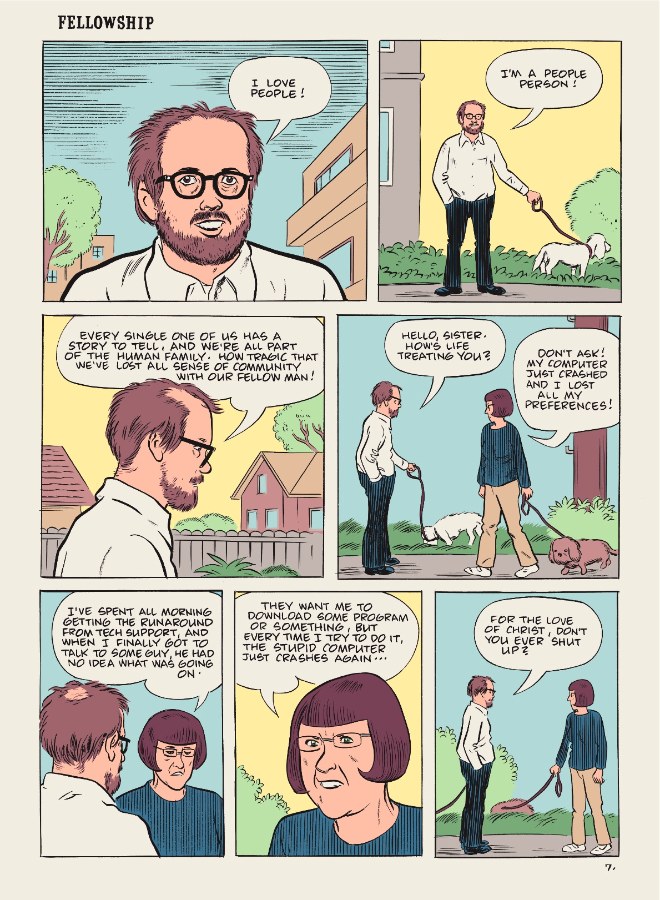
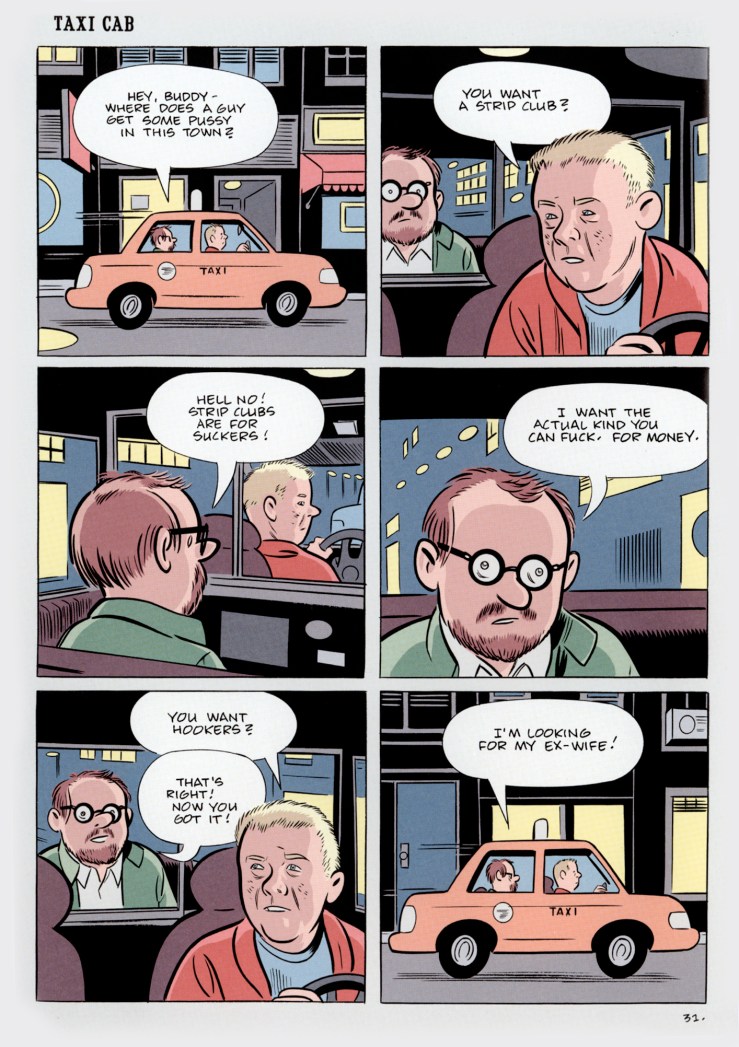
In the first line of the first panel of the first strip in Daniel Clowes’s graphic novel Wilson, the eponymous character, looking directly at the reader, claims, “I love people!” The statement is both ironic and strangely true. Our hero Wilson loves the idea of loving people, and goes about his daily business (walking his dog, drinking coffee, mailing boxes of shit to his former in-laws) in a way that maximizes human contact. With no real family of his own, Wilson reaches out to every person he passes by, addressing them as “brother” or “sister” in an embracing, Emersonian spirit. The problem is that, as much as he loves the idea of loving humanity, Wilson pretty much hates every person he meets. Here’s the opening episode—

Wilson comprises about 70 one-page episodes, each with six or seven panels, each essentially self-contained yet part of a loose plot. The episode above is indicative of the structure of each chapter: a build-up, a monologue, often delivered to disinterested stranger, and then an anti-punchline in which Wilson reveals the ironic cognitive dissonance at the core of his being. The effect can be hard to process, and Clowes’s acerbic humor is clearly not for everyone. Although Clowes uses a traditional Sunday comic page structure, his technique is unsettling: the humor is drawn not so much from the deflationary punchlines that end each chapter, but the overall disconnect between perception, desire, and reality that those punchlines reveal.

Clowes uses this method consistently throughout Wilson, but alternates styles and color palettes, moving from a classic-Clowes style familiar to anyone who’s read Eightball or Ghost World, to a bouncy, cartoony style (see: “Marriage”). The choice to change up the styles calls back, again, to the Sunday comic pages of yore; it also underscores Wilson’s unstable identity, as the narrative slips through gradations of more realistic to more cartoony representations. It is a consistent inconsistency.

Surprisingly, Wilson has a cohesive plot. After the death of his father, Wilson seeks to reunite with his ex-wife, whom he believes to be a drug-addicted hooker. He also hopes to meet the child she was pregnant with when she left him—

Wilson does find his wife. And then he finds his teenage daughter. And then he kinda sorta kidnaps her, or at least doesn’t bother to return her to her adoptive parents. And then he goes to prison. But maybe I’m spoiling the plot now. In any case, Wilson’s adventures are hardly zany. They are poignant and sad and pathetic and cringe-worthy. Clowes is willing to punish his already-tortured protagonist, and yet there’s a payoff for pour Wilson. Throughout the graphic novel, Wilson yearns for human connection, yet is always disappointed by the humans around him who can never measure up to his ideals. Like any sociopath, Wilson lacks a meaningful emotional core; throughout the narrative he longs to experience an epiphany, staring at the ocean, for example, in the hopes illumination. He finally earns this epiphany near the close of his life. The moment is unexpectedly touching, and provides the kind of balance that proves Wilson a work of art and not merely a collection of funny strips. Recommended.

Wilson is available now from Drawn & Quarterly.

First Love and Other Sorrows — Harold Brodkey

One way to measure how great a work of literature is might be to ask how true (or “True,” if one is feeling particularly romantic) the writing is. We can find facts anywhere, but details and data are not the same as art. Great literature happens in the arrangement of that data, by presenting details with the right ear and eye for truth—and also, the good sense to know what to withhold from the audience, who, after all, are a part of the equation. The stories collected in Harold Brodkey’s First Love and Other Sorrows, both inspiriting and crushing, are some of the most psychologically true pieces of fiction I’ve ever read.

First Love collects nine stories, all composed and published in the 1950s; all but one was originally published in The New Yorker. Although discrete entities, the stories function together. First Love is very much a novel-in-stories, with recurring characters, themes, and motifs. Brodkey’s stories document the strange little bubble of time between WWII and the turmoil of the sixties, and his writing, a kind of late modernism, reflects this period, when the ideal of the American Dream began to be redefined in terms of new modes of class and education.

The first few stories in the collection are told from the first-person perspective of an adolescent, likely an iteration of Brodkey himself. Opener “State of Grace” serves as an overture to the collection, introducing a family that will be transposed throughout the tales. There’s the narrator, a sensitive, awkward boy, beginning to feel strains of alienation from his older sister and his mother. Dad is out of the picture, and with him, the family’s fortunes have fallen: big sis is expected to marry the right man for money—and for class.

These themes are explored in greater length in the very-long short story “First Love and Other Sorrows,” a compact little novella, really, that everyone should read at some point. The narrator, likely the same boy from the first story, describes his life at the end of his high school career in St. Louis, as he prepares to move on to college soon. Again, the major explicit conflict of the story revolves around his sister’s romances, as their mother pressures her to marry the right man. The real conflict though is the boy’s emerging realization of his own dramatic detachment from his family; or, more accurately, the young man is coming to realize the underlying instability that adults tend to hide from children. The boy observes his older sister, whom he reveres—

It occurred to me that she didn’t really know what she was doing; she was not really as sure of everything as she seemed. It was a painfully difficult thought to arrive at, and it clung to me. Why hadn’t I realized it before? Also, she sort of hated me, it seemed to me. I had never noticed that before, either. How could I have been so wrong, I wondered. Knowing how wrong I had been about this, I felt that no idea I had ever had was safe. For instance, we were not necessarily a happy family, with the most wonderful destinies for my sister and me. We might make mistakes and choose wrong. Unhappiness was real. It was even likely…

The narrator’s epiphany is articulate and crushing and wholly real: it documents the ugly realization that the fantasies of a middle class childhood — “happily ever after” — are, indeed, mere fantasies. Brodkey twins this moment in another epiphany at the end of the story that I would love to discuss but fear spoiling; suffice to say that the final line of the story, forever etched in my brain, is simply one of the finest and most fitting moments I’ve ever read.

The next story, “The Quarrel,” finds our young hero, a bit more jaded, off to Harvard, where he falls in with a bitter rich kid named Duncan; they quickly make it their business to despise everything, adopting (unearned) world-weary poses and contrarian natures. Against the advice of their families, the two take a semester off college to tour Europe, spending much of their time bicycling across France. The story documents the kind of friendships that many young people emerging from adolescence engage in: fierce, passionate, identity-defining relationships that always buckle under their own weight. Hence—

Duncan enjoyed Pernod. It made me sick. Duncan hated talking to people. I talked to everyone. My French vocabulary was better than Duncan’s. His pronunciation was better than mine. I became terribly adept at not irritating Duncan before breakfast. I couldn’t see that he appreciated any of this, or that he responded with any similar awareness. For the fiftieth time, I thought him unfair. The moment came when I could no longer stand the sound of his voice, or his ideas. After traveling with him day and night, without a break, for fifty-three days, I felt my senses suffocating in an awareness of Duncan.

“The Quarrel” perfectly captures the strange paradoxes of youthful, immature friendships that can’t survive; reading it forced me to remember myself at eighteen, and to recall a friendship similar to that between the narrator and Duncan, an intense friendship that burned out bitterly and quickly, yet nevertheless helped me to define myself.

“The Quarrel” is the last story in the collection written in first-person perspective; indeed, Brodkey’s narrative shift signals a shift in development; as his characters age (as they do through the collection), he allows himself to step outside of them a bit, as if the psychological pain he explores is almost too much to bear. “Sentimental Education” tells the story of an intense first love (the male lead seems like another iteration of the narrator from the first three stories). In a free indirect style, Brodkey glamorizes, valorizes, and satirizes the young lovers, all at once, exploring the passion and shame and confusion of early adulthood. Here, he describes what happens when the pair begin a sexual relationship—

Their first dip in sensual waters left them nonplussed. They didn’t know what to make of it. They tried to persuade themselves that something had really happened, but the minute it was over, they couldn’t believe they had ever done such a thing. They rushed into further experiences; they broke off in the middle of embraces and looked at each other, stunned and delighted. “Is this really happening?” they both asked at different times, and each time the other said, “No,” and they would laugh. They knew that nothing they did was real, was actual. They had received a blow on the head and were prey to erotic imaginings, that was all. But at the same time they half realized it was true, they were doing these things, and then the fact that they, Caroline and Elgin, shared such intimacy dazed and fascinated them; and when they were together, they tried to conceal it, but this indescribable attraction they felt for each other kept making itself known and draining all the strength from their bodies.

“Sentimental Education” retraces the fallout explored in “The Quarrel,” as the young lovers inevitably fall apart.

After this love story, Brodkey shifts his attention to a character named Laura (or, in one version, “Laurie”), who seems to be a version of the narrator’s sister from the first few stories. The five Laura stories are much shorter than the other narratives. These tightly detailed miniature portraits trace the development of Laura as she chooses the man her mother didn’t approve of; this plot is very much in the background of the stories, though, an implicit detail that nevertheless hangs over Laura’s psychological development. The Laura stories seem to trace what it means to grow old but not mature. They recall the narrator in “First Love and Other Stories” epiphany that adulthood might be a murky or unhappy place. “Laura” documents postpartum depression and “Trio for Three Gentle Voices” subtly explores the ways in which parents seek to avoid repeating their own parents’ mistakes. “Piping Down the Valley’s Wild” is a simple, elegant story about Laura’s husband’s college roommate coming over for dinner. Reading it, I experienced an uncanny transposition, as if I were observing a reinterpretation of something I experienced a few weekends ago. The story ends with another sad epiphany—

She just wanted this day to go on forever and ever, unending, with all its joys intact, and no one changing, nothing new happening, just these same things occurring over and over. Because how did you know happiness would come back? Or if it came back, that it would be as good as this? Laura sighed and wiped her eyes surreptitiously. The trouble with being happy was that it made you frightened.

This realization again encodes the paradox of adulthood, pointing toward its radical instability. To grow up, in Brodkey’s terms (terms I again point out strike me as utterly true) is to face irretrievable loss at every single moment, even as you gain new friends, new lovers, or new children. The joys of life are predicated on the necessary loss of these joys: existence costs.

First Love and Other Sorrows is a book that deserves more attention. In its spirit and art, it matches (and perhaps surpasses) other mid-century American narratives like The Catcher in the Rye or The Glass Menagerie, and in its spare, precise, minimal style, it points toward the later fiction of writers like Raymond Carver. This is a beautiful, sad book, the kind that leaves a deep impression. Very highly recommended.

Diana Comet and Other Improbable Stories — Sandra McDonald

Fantasy gets a bad rap. While science-fiction has enjoyed something of a restoration of sanctified hipness in recent years, thanks in part to the genre-bending efforts of authors like David Foster Wallace and Jonathan Lethem, as well as a reappraisal of the works of authors like Philip K. Dick and Margaret Atwood, novels that find themselves classified in the fantasy genre can often be outright dismissed as having no artistic or literary merit. Amazingly, even the work of king daddy J.R.R. Tolkien still finds itself in need of critical defense from time to time. And while fantasy certainly has more than its fair share of rote genre exercises, including countless copycat cash-ins, it’s also an imaginative space buzzing with invention and the capacity for social commentary. Sandra McDonald’s Diana Comet and Other Improbable Stories exemplifies the best kind of invention and social commentary that we might expect from post-modern fantasy.

Diana Comet collects fifteen stories connected via shared motifs, characters, and settings. McDonald crafts a world that inverts or displaces our own. This world, with its lands like New Dalli and Massasoit, is slightly decentered from our own: we find familiar iterations of our history here—there’s war and imperialism, colonialism and poverty, homophobia and racism—but the idioms are all slightly off, displaced enough be paradoxically familiar and alienating at the same time. “Diana Comet and the Lovesick Cowboy,” for instance, seems set in a 19th-century American milieu amidst a civil war (there’s even a poet named Whit Waltman), yet the transposition, articulate as it is, is also nebulous, disturbing even. McDonald’s spare distortion forces the reader to reconsider his own notions of cultural history, and she does this to great effect, whether taking on gender ideologies (“Diana Comet and the Disappearing Lover”), homophobia (“The Fireman’s Fairy”), or racism (“Fay and the Goddesses”). None of these issues are presented glibly, didactically, or clumsily; indeed, it’s through the slightest distortions of fantastic imagination that the reader must re-examine his own society through McDonald’s reflective lens. Most of the stories end with enumerated discussion questions, often silly or whimsical, that serve to puncture the seriousness of the tales; they sometimes force details from our “real” world into the texts of Diana Comet in a way that’s doubly disconcerting. It’s a meta-textual gambit that pays off, however, both in belying any self-seriousness to the narrative proper as well as establishing a thin membrane between fantasy and reality—a membrane of questions that allows the reader to “play,” to disrupt that boundary through his or her own imagination.

McDonald’s world-building in Diana Comet never comes at the expense of good storytelling. With a few exceptions, most of the stories here piece together the frame of a world, leaving the reader’s imagination to fill in most of the gaps. Most of the stories seem to take place in an iteration of the nineteenth century, but some to be set earlier, later, and even in a displaced future, like “Kingdom Coming,” a playful apocalypse tale. McDonald’s expositive restraint does wonders; too many writers of inventive fiction feel the need to tell the reader every single detail and nuance of their worlds. I think here of Ursula K. LeGuin’s marvelous novel The Left Hand of Darkness, a book toward which I believe Diana Comet bears considerable comparison, particularly with respect to the exploration of how gender and sexuality functions in a society. While LeGuin’s book is terrific and fully-realized, she spends a bit too much narrative energy transmitting every detail of that realization to her audience. Diana Comet is rewarding in its gaps and mysteries, as well as its ability to evoke a sense of the uncanny in its reader. Oh, I should probably add that McDonald can write; her prose is elegant, lively, wry, and spare.

Diana Comet is a smart, thoughtful post-modern fantasy that may appeal to the kids out there who have outgrown the narrative simplicity of Harry Potter and are looking for a challenge; it will undoubtedly appeal to fans of writers like LeGuin and Atwood, writers who know how to channel narrative traditional tropes of imaginative fiction through distortion and ambiguity and force their readers to think, even as they entertain. Recommended.

Amulet — Roberto Bolaño

When one takes on the project of reading the novels of Roberto Bolaño — and 2666 is the sort of beast that is likely to hook a reader into such an endeavor — it becomes increasingly impossible to separate and compartmentalize his fictions. Instead, the reader becomes ever more entangled in a labyrinthine Bolañoverse, a chilling, dreadful mirror-maze world that discharges its echoes across continents and epochs. In a fascinating essay at The Quarterly Conversation, Javier Moreno attempts to map out this world. I’d read the essay (and commented on it) a few years ago, but I revisited it after finishing Amulet, mostly because I was pretty sure Moreno had already succinctly stated a key idea that I wanted to bring up in my review. He writes—

Amuleto, which tells the story of an Uruguayan poet that claims herself to be the mother of all Mexican writers, may be seen both as an extra chapter to Los Detectives or as a short introduction to 2666—or both at the same time.

Readers of 2666 and The Savage Detectives will find in Amulet a channel between Bolaño’s “big books,” just as Nazi Literature in the Americas serves as a strange, ironic connective tissue for the violence and chaos of the rest of Bolañoverse. Amulet is narrated by Auxilio Lacouture, and her story appears in a much shorter form in The Savage Detectives. I’ll let her summarize Amulet’s plot (such that it is)—

I am the mother of Mexico’s poets. I am the only one who held out in the university in 1968, when the riot police and the army came in. I stayed there on my own in the Faculty, shut up in the a bathroom, with no food, for more than ten days, for more than fifteen days, from the eighteenth to the thirtieth of September, I think, I’m not sure anymore.

I stayed there with a book by Pedro Garfias and my satchel, wearing a little white blouse and a pleated sky-blue skirt, and I had more than enough times to think things over. But couldn’t think about Arturo Belano , because I hadn’t met him yet.

In these two short paragraphs, late in the book, we get so many of the motifs that populate Bolaño’s world: the self-naming poet, the influence of violence in Latin America, the horrors inherent in resisting this violence, exile, hints of madness. We even get Bolaño’s elusive alter-ego, Arturo Belano, who floats through Amulet and the rest of the Bolañoverse like an unknowable specter.

The fact that Auxilio couldn’t think about Belano when she was stuck in the bathroom in 1968 does not actually stop her from doing so. She is, to borrow a phrase from Vonnegut, a woman unstuck in time. It is as if the entire novel, that is to say her narrative, her telling of her story, is tenuously anchored in the those traumatic days of September, 1968. She tells us, echoing Stephen Dedalus perhaps, that “History is a horror story”; unlike Dedalus, she can’t awake from the nightmare. Here’s a relatively early passage that describes what Auxilio can never really explain—

I don’t know why I remember that afternoon. That afternoon of 1971 or 1972. And the strangest thing is that I remember it prospectively, from 1968. From my watchtower, my bloody subway carriage, from my gigantic rainy day. From the women’s bathroom on the fourth floor of the Faculty of Philosophy and Literature, the timeship from which I can observe the entire life and times of Auxilio Lacouture, such as they are.

The life and times of Auxilio Lacouture, such as they are, will be somewhat familiar to anyone who’s read some of Bolaño’s other novels: plenty of dread, lots of sinister shadows, and many, many drunk poets. The anecdotes and small set pieces that fill Amulet seem culled from Bolaño’s own life (real or imagined), and can be alternately thrilling, dull, or even maddening. For my taste, the novel works itself into its finest moments when Auxilio’s grip on reality — both temporal and spacial — is at its weakest. At one point she tells us—

I don’t know if I’m in 1968 or 1974 or 1980, gliding, finally, like the shadow of a sunken ship, toward the blessed year 2000, which I shall not live to see.

Auxilio’s sanity both unravels and compresses, and Bolaño codes these movements in images of descent and ascension. Auxilio moves through fever dreams and nightmares, memories and prognostications, alternate realities and astral projections. Near the end of the novel, still in the bathroom, starving, probably in shock, she experiences her ordeal as a difficult climb up a frozen mountain. Along the way, she begins casting bizarre literary prophecies. A quick taste—

Virginia Woolf shall be reincarnated as an Argentinian fiction writer in the year 2076. Louis-Ferdinand Celine shall enter Purgatory in the year 2094. Paul Eluard shall appeal to the masses in the year 2101.

These pronouncements continue for a few pages. Underneath the madness, one can sense Bolaño’s goofy joy, but there’s more here than just list-making: Auxilio is pointing toward metempsychosis, suggesting her own soul’s migration, perhaps—here we find a way in which literature might transcend the violence and horror of history. And yet there’s also a sense of doom, of repeated violence and exile. Late in the novel Auxilio finds herself cast in the role of Erigone, daughter Aegisthus and Clytemnestra, forced from home by her half-brother, Orestes. There’s a sense that tragedy capitulates throughout time; that even if Auxilio can survive the army’s occupation, it will nevertheless scar her forever. Cycles of violence are bound to recur indefinitely.

This recurrence evinces in what might be the book’s most famous passage. Auxilio is walking home with some friends—

Then we walked down the Avenida Guerrero; they weren’t stepping so lightly any more, and I wasn’t feeling too enthusiastic either. Guerrero, at that time of night, is more like a cemetery than an avenue, not a cemetery in 1974 or in 1968, or 1975, but a cemetery in the year 2666, a forgotten cemetery under the eyelid of a corpse or an unborn child, bathed in the dispassionate fluids of an eye that tried so hard to forget one particular thing that it ended up forgetting everything else.

The passage names Bolaño’s opus: there is no mention of “2666” in 2666. The reference rests outside the book; or, perhaps Bolaño demands that we read his books intertextually. In any case, 2666 has its graveyards and its corpses, its own demanding geometry of memory. One gets the sense that this oblique reference to “2666” is really part of Bolaño crafting his own canon, an internal canon of the Bolañoverse, almost as if he were J.R.R. Tolkien or even Philip K. Dick. I think again of Auxilio’s prophecies, of her list of writers who will be reborn or forgotten, where we find Bolaño securing a historical place for the writers he loves and values.

Looking over this review, I realize that it might not be helpful for readers new to Bolaño: mea culpa. Amulet is a very fine novel, but not the right starting point. That would be 2666 or, if that prospect is too daunting, Last Evenings on Earth. To me, Amulet reads like the “Mexico” chapter in a trilogy about violence and exile in Latin America; the other two parts would be Distant Star (which I enjoyed more) and By Night in Chile. But perhaps I’m simply reaching for evidence to support this idea that Bolaño’s books are best read together. I’m sure that one can enjoy them on their own—only, at this point, I’m not sure how to do that.

Amulet, translated by Chris Andrews, is available now from New Directions.