White Meridian | More scattered thoughts on Cormac McCarthy’s novel The Passenger

He’d bought a small ruled notebook at the stationer’s in Ibiza. Cheap pulp paper that would soon yellow and crumble. He took it out and wrote in it with his pencil. Vor mir keine Zeit, nach mir wird keine Sein.

The Passenger, Cormac McCarthy

In the second paragraph of the last chapter of Cormac McCarthy’s new novel The Passenger, protagonist Bobby Western, now living on a Spanish island near Ibiza, writes in German a sentence in a cheap notebook. The sentence translates to something like, Before me there will be no time, after me there will be none.


Vor mir war keine Zeit, nach mir wird keine seyn,
Mit mir gebiert sie sich, mit mir geht sie auch ein.

Sexcenta Monodisticha Sapientum, III, II, Daniel von Czepko (1655)

Western’s line appears to be cribbed from an epigram by the early seventeenth-century German poet, Daniel von Czepko. Czepko’s epigram translates to something like, Before me there was no time, after me there will be none / With me she gives birth, with me she dies.


I deny, in a high number of instances, the existence of succession. I deny, in a high number of instances, contemporaneity as well.

“A New Refutation of Time,” Jorge Luis Borges, translated by James E. Irby

Did McCarthy find Czepko’s in Borges’ essay “A New Translation in Time,” where I found it when I first searched the German phrase?


All language is of a successive nature: it does not lend itself to reasoning on eternal, intemporal matters.

“A New Refutation of Time,” Jorge Luis Borges, translated by James E. Irby


I feel like I’ve jumped into the deep end here too quickly for this riff, what with the seventeenth-century German poet and the wonky Borges essay that feels like a gimmicky (and perhaps ironic) championing of idealism in service towards forging an aesthetics of time. Let me put in a simpler substitution for Western’s (McCarthy’s (Borges’ (Czepko’s))) epigram, a favorite line from another life-and-deather with oceanic motifs:

Perhaps an individual must consider his own death to be the final phenomenon of nature.

“The Open Boat,” Stephen Crane


Start again: This is a scattered mess. I finished The Passenger yesterday, punched in the face by the final chapter, where McCarthy condenses characters and tropes and symbols and allegories into a slim 19 pages that points to both infinity and death. The Passenger is possibly McCarthy’s baggiest novel, messier than Suttree, and eschewing even a glimmer of the precision of Blood Meridian. Like No Country for Old MenThe Passenger is bound in genre fiction tropes—crime novels, detective novels, 1970s paranoia novels, Westerns, and so on. Like No Country, The Passenger purposefully derails reader expectations for what the genre plot should do. The refusal to go forward with the initial promised plot (Who is the missing passenger, escaped or removed from the sunken plane?) reinforces the tense ambiguity in the core of McCarthy’s worldview. The apparent abandoning of a tight plot might alienate some readers, but I suspect most fans of the trajectory of McCarthy’s work would have been disappointed if he’d stuck to a story that Makes Sense and Follows a Clear Trajectory and Ultimately Resolves. I would have been furious if the end of The Passenger gave up some kind of easy answer.


For only Gossamer, my Gown –
My Tippet – only Tulle –
“Because I could not stop for Death” (poem 479), Emily Dickinson

In her white gown carrying the barnlantern out through the trees. Holding the hem of her gown, her slender form candled in the sheeting. The shadows of the trees, then just the dark. The cold in the stone amphitheatre and the slow turning of the stars overhead.

The Passenger, Cormac McCarthy


Last time I wrote about The Passenger, I wrote about its dominant incest motif. I suggested that the dummy Crandall was the dreamchild of incestuous Western union. I had not yet gotten to the episode where Bobby, on the lam in Idaho, dreams of an incestuous stillborn child, one with only the rudiments of a brain. Bobby queries the dream doctor of his dreamchild: “Does it have a soul?” Bobby’s True Love, his sister Alicia, is the barest slip of a ghost in the final chapter of The Passenger (in contrast to the ghost of Long John Sheddan, who gets a full last dialogue with Bobby), but she shows up again here—theatrical, ghostly, an echo of the speaker of Emily Dickinson’s “Because I could not stop for Death.” I hope we get more from Alicia Western in Stella Maris.


His father. Who had created out of the absolute dust of the earth an evil sun by whose light men saw like some hideous adumbration of their own ends through cloth and flesh the bones in one another’s bodies.

The Passenger, Cormac McCarthy


Père Western, coauthor of the atom bomb (“evil sun”/evil son, evil Adam) is a background wraith in The Passneger (although more present than Ma Western—but I’m sure the lack of mothers in McCarthy’s oeuvre has been commented on at length, perhaps in academic papers. Dude doesn’t include mothers, and mother figures, if they appear, are tangential, marginalized). Wait, where was I? Père Western, haunting the background of The Passenger, takes a bit more of the stage (just a bit) in the final chapter of The Passenger. His Big Crime seems to soak diver Bobby, even if Bobby can’t directly address it.

It was a lone tree burning on the desert. A herladic tree that the passing storm had left afire. The solitary pilgrim drawn up before it had traveled far to be here and he knelt in the hot sand and held his numbed hands out while all about in that circle attended companies of lesser auxiliaries routed forth into the inordinate day, small owls that crouched silently and stood from foot to foot and tarantulas and solpugas and vinegarroons and the vicious mygale spiders and beaded lizards with mouths black as a chowdog’s, deadly to man, and the little desert basilisks that jet blood from their eyes and the small sandvipers like seemly gods, silent and the same, in Jedda, in Babylon. A constellation of ignited eyes that edged the ring of light all bound in a precarious truce before the torch whose brightness had set back the stars in their sockets.

Blood Meridian, Cormac McCarthy


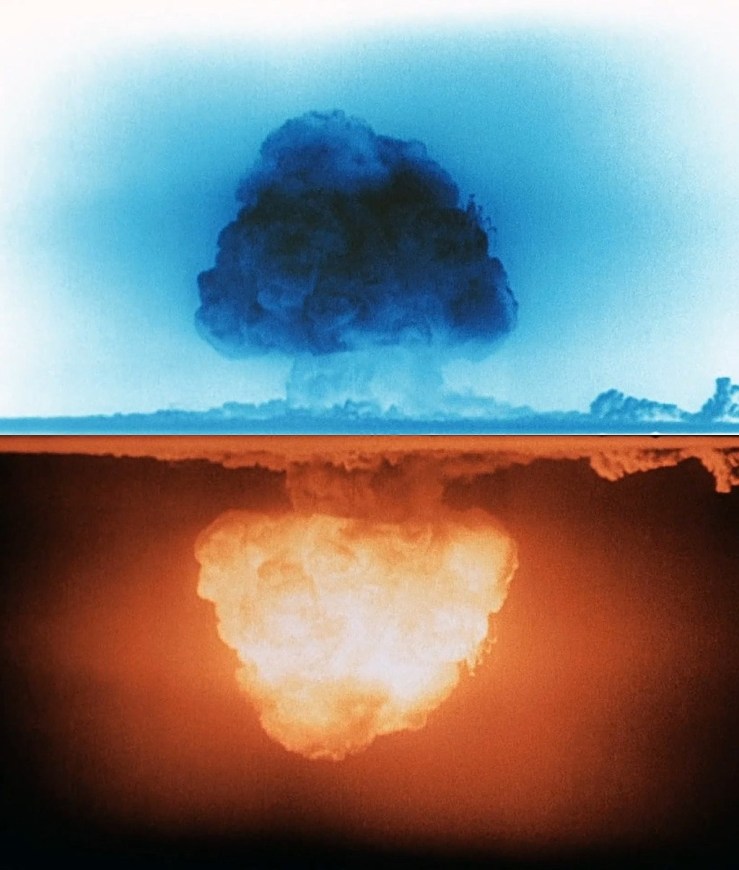
His father spoke little to them of Trinity. Mostly he’d read it in the literature. Lying face down in the bunker. Their voices low in the darkness. Two. One. Zero. Then the sudden whited meridian. Out there the rocks dissolving into a slag that pooled over the melting sands of the desert. Small creatures crouched aghast in the sudden and unholy day and then were no more. What appeared to be some vast violetcolored creature rising up out of the earth where it had thought to sleep its deathless sleep and wait its hour of hours.

The Passenger, Cormac McCarthy.


More than a decade ago, I suggested on this site that the moral core of McCarthy’s best novel Blood Meridian is a sequence wherein a host of creatures coalesce into a “constellation of ignited eyes…in a precarious truce” to observe a burning tree in the desert. Witness and attendant, his own eyes presumably ignited, is the kid, the hero of Blood Meridian. The sequence rebukes the pronouncements of Judge Holden, satanic anchor of that novel, pointing towards coexistence and peace.

The whited meridian sequence in The Passenger, evoking the first ever detonation of a nuclear weapon, reverses McCarthy’s previous passage—blanches it, makes a ghost of it, turns its blood white. Whites it.


(I have a few more thoughts scribbled on a cheap yellow legal pad but the hour grows late and a big storm looms—so, more thoughts to come (including a kind of peace with mules?)


The incest thing | More scattered thoughts on Cormac McCarthy’s novel The Passenger

He’s in love with his sister and she’s dead.

The Passenger, Cormac McCarthy


The theme of brother-sister incest haunts the early American novel on its lower levels of literacy as well as on the higher—a nightmare from which our writers do not choose to awake too soon, since it is one their readers are willing to pay to share.

Love and Death in the American Novel, Leslie Fiedler


When he woke she was leaning against his shoulder. He thought she was asleep but she was looking out the plane window. We can do whatever we want, she said.

No, he said. We cant.

The Passenger, Cormac McCarthy


She turned to the Kid. What does it say on the trunk?

What does what say? 

There’s a sticker on the trunk.

Yeah. It says progeny of Western Union.

Progeny?

The Passenger, Cormac McCarthy


The last in the series of quotes above is an exchange between Alicia Western and her hort/figment/projection the Thalidomide Kid. The Kid has caused to be brought to Alicia a wiseassed—cruel, even—ventriloquist dummy. The dummy is another fitting prop in the Alicia-Kid episodes that punctuate The Passenger. It again underlines the vaudevillian aspect of these interstitial pieces, while also highlighting the novel’s themes of ventriloquism—of how memory of the dead might speak through the living, as the living grapple with death.

The quips above feature another of the Kid’s malapropisms — in this case his substitution of “progeny of Western Union” for property of Western Union. The Freudian slip (never really a slip on our imp’s tongue) points to The Passenger’s incest motif. It turns out that the dummy’s name is Crandall (perhaps named for the typewriter?). It’s likely Alicia herself named Crandall, and her grandmother tailored his clothes. I think the strong implication is that handy Bobby Western built (fathered) Crandall. In this sense, Crandall is the dreamchild born of a Western union. “I was only six,” Alicia cries as he disappears back into his case.


The incest motif perforates the literary tradition. We find it in Oedipus, in Lot seduced by his daughters, in David’s children Tamar and Amnon–a tale recapitulated in Faulkner’s southern Gothic Absalom! Absalom! We find it coded in Poe’s tale “The Fall of the House of Usher” or made strange but more clear in Melville’s baffling Pierre. We find it in the tawdry attic of V.C. Andrew’s lurid Dollanganger novels (likely read by many more Americans than the other novels I’ve named).

The incest thing in literature is, of course, an exploration of taboo, and is such the rightful property (or progeny) of literature. In his seminal (and often bombastic) study Love and Death in the American Novel, Leslie Fiedler suggests that “brother-sister incest in particular comes to stand in Romantic symbology for the rebellion against paternal authority, for the spirit of revolution itself.” He continues, declaring that the “Oedipal significance” of this revolutionary spirit “projects not only the desire to revolt, but also to die; that is to say, beneath the yearning for rebellion lies hidden the wish to be punished for it.”


Le’ts follow Fiedler’s reading (ahem, rehashing of Freud) and stick it on to the Western children: What is the paternal authority they rebel against—that is, beyond the actual literal father (a marginal memory)? Père Western was one of the lead authors of the atomic bomb. He changed the American relationship to death, permanently.


I have a little under a hundred pages left to go in The Passenger, but if either Bobby or Alicia has expressed overt familiar guilt over their father’s work in engineering mass death, I’ve missed it. What does linger is a deep-seated, unspoken anxiety about their father’s deeds.


At the end of his own surreal and improbable conversation with the Thalidomide Kid, Bobby expresses the only loss of his life, the only ashes in his world:

There is no other loss. Do you understand? The world is ashes. Ashes. For her to be in pain? The least insult? The least humiliation? Do you understand? For her to die alone? Her? There is no other loss. Do you understand? No other loss. None.

The emotional outburst, with its plaintive tone and cycle of repetitions, is rare for Bobby Western: for the most part, when The Passenger juts its free indirect speech into Bobby’s skull, we get simple, direct (if increasingly paranoid) language.


It’s when he thinks of his sister Alicia that Bobby’s voice gives over to passion, to a kind of Gothic romantic language that recalls Poe more than Hemingway. Consider how Gothic frills in the following passage soon give way to an archaic and obscure (yet still ornate) style that recalls the Cormac McCarthy of Blood Meridian:

In his dreams of her she wore at times a smile he tried to remember and she would say to him almost in a chant words he could scarcely follow. He knew that her lovely face would soon exist nowhere save in his memories and in his dreams and soon after that nowhere at all. She came in half nude trailing sarsenet or perhaps just her Grecian sheeting crossing a stone stage in the smoking footlamps or she would push back the cowl of her robe and her blonde hair would fall about her face as she bent to him where he lay in the damp and clammy sheets and whisper to him I’d have been your shadowlane, the keeper of that house alone wherein your soul is safe. And all the while a clangor like the labor of a foundry and dark figures in silhouette about the alchemic fires, the ash and the smoke. The floor lay littered with the stillborn forms of their efforts and still they labored on, the raw half-sentient mud quivering red on the autoclave. In that dusky penetralium they press about the crucible shoving and gibbering while the deep heresiarch dark in his folded cloak urges them on in their efforts. And then what thing unspeakable is this raised dripping up through crust and calyx from what hellish marinade. He woke sweating and switched on the bedlamp and swung his feet to the floor and sat with his face in his hands. Dont be afraid for me, she had written. When has death ever harmed anyone?


(I had not intended to type out the entire passage above, but once I got going I couldn’t stop.)


Bobby’s dream begins as an erotic manifestation of his sister, a Gothic evocation in silk ribbon or Grecian garb. She takes to a “stone stage,” again underscoring the shift into high drama. “I’d have been your shadowlane, the keeper of that house alone wherein your soul is safe,” she declares. The word shadowlane here seems like a symbolic substitution for the near homphone chatelaine, an archaic word for a woman who keeps a castle or great house (readers of Wolfe’s Book of the New Sun series will be familiar with the word).

A chatelaine also refers to a chain belt used for holding keys, an image that carries over into the second half of Bobby’s dream, which shifts from eroticism to terror. Shadowy figures inhabit a “dusky penetralium,” an innermost chamber, a locked place. Here, the figures labor with red “half-sentient mud” (Adamic atoms) in an “autoclave” (self-key). Amidst a litter of stillbirths, the figures toil to bring a new creature into being.

Bobby’s dream moves from brother-sister incest to the Gothic terror of a laboratory creation coming to life—an evocation of the father’s sins. Bobby’s subconscious mind transmutes the Manhattan Project into a satanic ritual presided over by a clandestine “heresiarch” — the damning father figure whose strange experiment impede Bobby’s incestuous consummation. Instead, we get another Western union. And the promise of death.


(More thoughts to come.)

You never did the Thalidomide Kid | More scattered thoughts on Cormac McCarthy’s novel The Passenger

The Thalidomide Kid found her in a roominghouse on Clark Street. Near North Side. He knocked on the door. Unusual for him. Of course she knew who it was. She’d been expecting him. And anyway it wasn’t really a knock. Just a sort of slapping sound.

–The Passenger, Cormac McCarthy

Maybe you did fool the Philadelphia, rag the Rochester, josh the Joliet. But you never did the Kenosha kid.

–Gravity’s Rainbow, Thomas Pynchon.

Surely you must know who it is who cuts the ludicrous figure here.

Do I? Who you gonna ask? And don’t call me Shirley.

The Passenger, Cormac McCarthy

Either They have put him here for a reason, or he’s just here.

–Gravity’s Rainbow, Thomas Pynchon.

What do they want? What does who want?

The Passenger, Cormac McCarthy [italics mine]

The wankers had a word for it.

We saw it in a book Crosseyed Ruby showed us. Phocomelia. Ruby said that’s Greek and means seal limb. Fukkin seal limb!

Skin, Peter Milligan, Brendan McCarthy, and Carol Swain


I’m a bit over halfway through Cormac McCarthy’s new novel The Passenger and enjoying it very much. I haven’t read any reviews, but I’ve seen some tweets and some other internet buzz that seems to indicate that Reviews Are Mixed. I went into the novel with minimal expectations, as I admitted in my first little riff on it. 

But so far The Passenger has done what I hoped it might do: show McCarthy venturing into new territory, but territory still anchored in his roots. It also is, at least up through its first 200 pages, McCarthy’s most accessible novel.

As I write the words “McCarthy’s most accessible novel,” I realize that it’s entirely possible that previous McCarthy novels have taught me to read The Passenger—but I don’t think that’s so. The Passenger offers a somewhat-straightforward frame of alternating strands. Numbered chapters (composed in italics) hover in the mind of the schizophrenic genius Alicia Western, whose suicide (no spoiler) initiates the novel. These short chapters then give way to the main narrative thrust of The Passenger in unnumbered chapters that focus on Alicia’s brother Bobby Western, a near-genius with an eidetic memory and a hole in his soul.

Bobby Western is a salvage diver based out of New Orleans. In his initial chapter, he searches the wreck of a small plane in the Gulf of Mexico, and quickly realizes that–gasp!–a passenger from the manifest is missing (along with a control panel) from the wreck. Bobby’s subsequent investigations into the whereabouts of the missing passenger lead to his being tailed and surveilled by a nebulous They. Paranoia!

The prose mechanics of the Bobby chapters are reminiscent of No Country for Old Men (lots of men-doing-stuff in detail), as well as the genre fictions of George V. Higgins, Chester Himes, or James Ellroy. The Bobby chapters also lend a bagginess to the novel. They often sprawl out into long conversations with his friends that amount to pleasant asides from the plot proper—a Vietnam vet, a transwoman, a college buddy turned petty thief. We also start to cobble together the Western family history. Alicia and Bobby’s father was a physicist who worked with Oppenheimer to develop the atomic bomb.

With the specter of a They and the haunted past of the Bomb, The Passenger drifts into Pynchon territory. The Alicia chapters go a step beyond superficial connections, unexpectedly approaching Pynchonian prose, particularly in the figure of Alicia’s interlocutor, the Thalidomide Kid (usually simply called The Kid, an echo perhaps of Blood Meridian).

(Parenthetically–The Thalidomide Kid, who shows up almost immediately in The Passenger, is only the second so-called “thalidomide baby” that I’ve seen appear in a work of fiction. The first was Martin Atchet in the graphic novel Skin, written by Peter Milligan, with art by Brendan McCarthy, and colors by Carol Swain. Track it down if you dare.)

The Thalidomide Kid presides over the “horts,” the cohort of intelligences and personalities that vie for space in Alicia’s troubled mind. The Kid is part carny, part philosopher, slipping on malapropisms and dealing in corny jokes and bad puns. He could have walked right out of a Pynchon novel. He dons costumes, performs parlor tricks, and runs vaudeville routines. In one bit, wearing “frockcoat and frightwig,” he mocks modern psychiatry, playing false Freud to Alicia’s patient (she’s recently returned from analysis, soon on her way to electroshock therapy). Elsewhere, they discuss the philosophy of math. Or maybe the math of philosophy–these bits might be beyond my ken (and beyond McCarthy’s ken). The Thalidomide Kid episodes are simultaneously hallucinatory and lucid, zany and sinister, comic and tragic. The mode, again, strikes me as more Pynchonian than what we might think of as classic McCarthy (Blood Meridian and The Border Trilogy).

I’ve overemphasized (and foregrounded, both in the title of this post and the quotes I’ve pulled) a connection between The Passenger and Pynchon’s fiction, but to be clear, there is no sense that McCarthy is aping Pynchon. Indeed, I’d be surprised if McCarthy has ever read Pynchon. What I see in common between the fiction of these two old masters (just five years apart in age) is a kind of filtering of the twentieth century, a distillation of not just themes, but also style. Pynchon has always made his ventriloquist act clear to his audience, (even as he ironizes it). In The Passenger, McCarthy finally seems a bit looser, more relaxed, more willing to let the genres and voices bend and refract. It might not be as cutting and heavy as Blood Meridian or Suttree, but it’s every bit as vibrant and inventive. More thoughts to come.

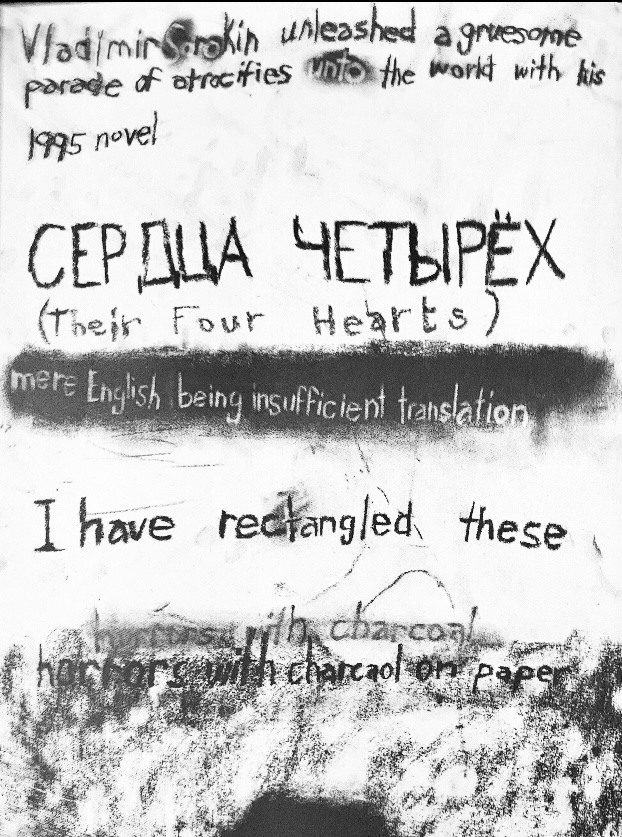
Vladimir Sorokin’s Their Four Hearts made me physically ill. (This is praise.)

Vladimir Sorokin’s novel Their Four Hearts (in English translation by Max Lawton) made me physically ill several times. To be clear, the previous statement is a form of praise. I finished it a few weeks ago and put it on a high shelf where no one in my family might come across it.

I picked up Their Four Hearts on the strength of the first Sorokin novel I read, Telluria, and the third, Blue Lard (both also in translation by Max Lawton). The kinetic energy of those novels evoked cinema in my mind’s eye—something akin to Alejandro Jodorowsky’s surreal Holy Mountain or Luis Buñuel’s comic masterpiece L’Age d’Or—narratives that engender their own new visual grammars. In Their Four Hearts, I again found a cinematic comparison, this time in Pier Paolo Pasolini’s study of depravity and cruelty, Salò, or the 120 Days of Sodom.

Like Salò, Sorokin’s Their Four Hearts explores seemingly every form of depravity in extreme detail. It is not for the faint of heart or stomach. (Sorokin’s potent language, in Lawton’s sharp translation, would eviscerate the cliches that precede this parenthetical aside.) Their Four Hearts is fairly short—200 pages, including over 30 pages of charcoal illustrations by Greg Klassen—but I had parcel it out over four distinct sittings. (After the second time I had to put it down because of nausea, I decided to avoid reading it close to mealtimes.)

Frontispiece for Their Four Hearts, Greg Klassen

Before I touch briefly on that depravity, it might be useful to interested readers to offer a gloss on the plot of Their Four Hearts. There is no recognizable plot. Or, rather, the plot hides behind the accumulation of violent, abject details, forever unavailable to a reader, no matter how keen a detective that reader might be. It is a cannibalizing plot, both literally and figuratively, stochastic, absurd, consuming its own horrific iterations.

But, like, what is it about?, hypothetical you might ask. In lieu of a list of depravities, let me cannibalize the back cover copy:

Their Four Hearts follows the violent and nonsensical missions carried out by a group of four characters who represent Socialist Realist archetypes: Seryozha, a naive and optimistic young boy; Olga, a dedicated female athlete; Shtaube, a wise old man; and Rebrov, a factory worker and a Stakhanovite embodying Soviet manhood. However, the degradation inflicted upon them is hardly a Socialist Realist trope. Are the acts of violence they carry out a more realistic vision of what the Soviet Union forced its “heroes” to live out? A corporealization and desacralization of self-sacrificing acts of Soviet heroism? How the Soviet Union truly looked if you were to strip away the ideological infrastructure? As we see in the long monologues Shtaube performs for his companions––some of which are scatological nonsense and some of which are accurate reproductions of Soviet language––Sorokin is interested in burrowing down to the libidinal impulses that fuel a totalitarian system and forcing the reader to take part in them in a way that isn’t entirely devoid of aesthetic pleasure.

Libidinal forces . . . totalitarian system . . . forcing the reader . . . aesthetic pleasure?

Aesthetic pleasure? Pleasure is doing a lot in that phrase, although I was admittedly alternately rapt by Their Four Hearts even while I was (quite literally) disgusted. I’ve read enough Sorokin to this point that I didn’t have to be forced into the surreal, jarring logic of the plot, finding instead deeply dark humor in it, where possible (although more often than not, horror without humor).

“Rebrov took a noose out of his pocket and put it around Alexandra Olegnova’s neck,” Greg Klassen

I have resisted turning this ostensible “review” into a catalog of the horrors Sorokin offers in Their Four Hearts. These horrors are all the more horrible for their sensory evocation set against their seemingly senseless (lack of) meaning. When the foursome, very early in the novel, drug and murder Seryozha’s parents, remove the glans from his father’s penis, and pop into the kid’s mouth to suck on, does that mean something exterior to the novel’s own aesthetics? That the quartet continues to trade the glans off, taking turns sucking on it throughout the novel—are we to plumb that for some kind of allegorical gloss? Or do we simply ride with it? Their Four Hearts confounds its readers, creating not only its own inventions of vocabulary, but its own grammar of storytelling.

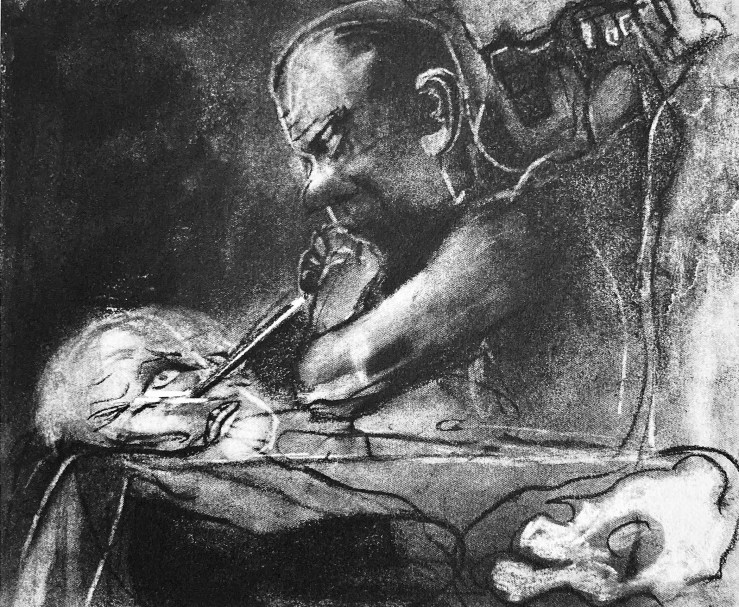
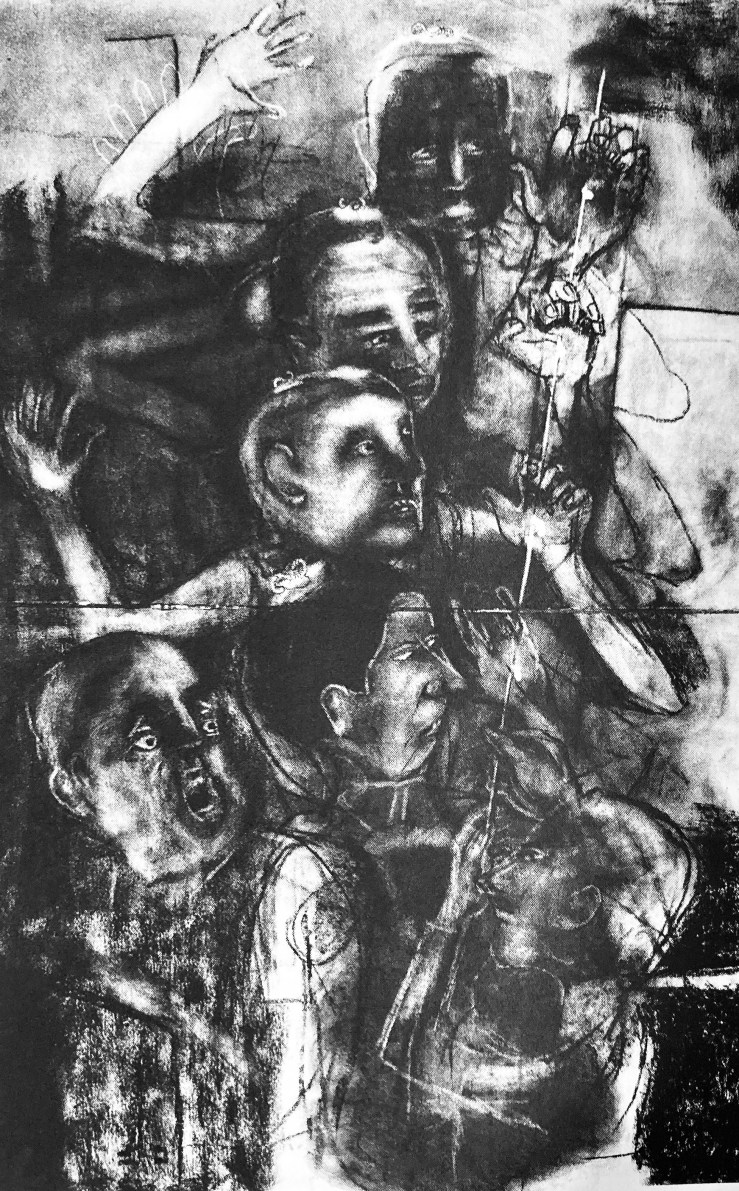
Instead of my describing further the horrors of Their Four Hearts (murder, pedophilia, parricide, torture, mutilation, coprophagia, rape, cannibalism, etc. ), it might be more profitable for interested readers to inspect the illustrations by Greg Klassen I’ve included in this review. Reminiscent of George Grosz or Hans Bellmer, Klassen’s charcoals capture the tone and vibe of Their Four Hearts. They add to the text’s cinematic quality. (Publisher Dalkey Archive should have given Klassen the cover.)

“With only a few strokes, Schtaube opened up the maxillary sinus cavities in the corpse’s face,” Greg Klassen

By now you likely have a clear idea if Their Four Hearts is For You or Not For You. I found the experience of reading Sorokin’s novel paradoxically compelling and repellent. (One of the closest experiences I can compare reading it to was eating beef chitterlings at a Korean restaurant in Tokyo. The waitress brought the raw gray intestines to our table, where we grilled them ourselves over charcoal, dipping them in sauces. We ate three orders.)

“He skewered all of their hands on the first meter-long spoke,” Greg Klassen

Telluria and the forthcoming Blue Lard are much better starting places for those interested in Sorokin, but his translator Lawton suggested in an interview that,

…any new reader of Sorokin [should] immediately chase TELLURIA with THEIR FOUR HEARTS: those two combined give something like a complete picture of the master at work.

It’s a strange chaser, and it leaves a flavor unlike anything else I’ve ever tasted. Highly recommended.

On Herman Melville’s novella Benito Cereno

Near the middle of Herman Melville’s 1855 novella Benito Cereno, our erstwhile protagonist Captain Amasa Delano encounters an old sailor tying a strange knot:

For intricacy, such a knot he had never seen in an American ship, nor indeed any other. The old man looked like an Egyptian priest, making Gordian knots for the temple of Ammon. The knot seemed a combination of double-bowline-knot, treble-crown-knot, back-handed-well-knot, knot-in-and-out-knot, and jamming-knot.

At last, puzzled to comprehend the meaning of such a knot, Captain Delano addressed the knotter:—

“What are you knotting there, my man?”

“The knot,” was the brief reply, without looking up.

“So it seems; but what is it for?”

“For some one else to undo,” muttered back the old man…

This knot serves as a metaphor for the text of Benito Cereno itself. We readers (along with our hapless surrogate Captain Delano) are the ones tasked with unknotting the text’s central mystery.

Part of the great pleasure of reading Benito Cereno for the first time rests in Melville’s slow-burning buildup to the eventual unknotting. I was fortunate enough to have been ignorant of the plot (and eventual revelation) of Benito Cereno when I first read it over a dozen or so years ago (although even then I cottoned on to what was really happening earlier than Captain Delano did). I read the novella again last week and marveled at Melville’s narrative control, enjoying it anew by seeing it anew.

Benito Cereno is a sharply-drawn tale about the limits of first-person consciousness and the cultural blinders we wear that prevent us from seeing what is right in front of us. The book subtly critiques the notion of a naturally-ordered morality in which every person has a right and fitting place, whether that be a place of power or a place of servitude. Melville shows the peril and folly of intrinsically believing in the absolute rightness of such a system. There is comfort in belief, but unquestioning belief makes us radically susceptible to being wrong. When we most believe ourselves right is often when we are the most blinded to the reality around us. We cannot see that we cannot see. And Benito Cereno is about how we see—about how we know what we know. Melville’s novella is also about how seeing entails not seeing, and, further, not seeing what we are not seeing—all that we do not know that we do not know. Melville makes his readers eventually see these unknown unknowns, and, remarkably, shows us that they were right before our eyes the entire time.

Forgive me—much of the previous paragraph is far too general. I want you to read Benito Cereno but I don’t want to spoil the plot. Let’s attempt summation without revelation: The novella is set in 1799 off the coast of Chile. Amasa Delano, captain of the American sealing vessel the Bachelor’s Delight, spies a ship floating adrift aimlessly, apparently in distress. Captain Delano boards one of his whale boats and heads to the San Dominick, a Spanish slaving ship, and quickly sees that the enslaved Africans on board dramatically outnumber the Spanish sailors. Delano offers aid to the San Dominick’s captain, Benito Cereno, who tells Delano that most of the Spanish crew perished in a fever (along with the “owner” of the slaves, Alexandro Aranda). Benito Cereno himself seems terribly ill and not entirely fit to command, so Delano waits aboard the San Dominick while his men fetch food and water from the Bachelor’s Delight. In the meantime, he tours the ship and talks with Benito Cereno and Cereno’s enslaved valet Babo.

Delano is frequently troubled by what he sees on the ship, but his good nature always affords him a natural and acceptable answer that assuages the sinister tension tingling in the background. Even though he’s troubled by the “half-lunatic Don Benito,” Delano’s “good-natured” sense of moral authority can explain away what he sees with his own eyes:

At last he began to laugh at his former forebodings; and laugh at the strange ship for, in its aspect, someway siding with them, as it were; and laugh, too, at the odd-looking blacks, particularly those old scissors-grinders, the Ashantees; and those bed-ridden old knitting women, the oakum-pickers; and almost at the dark Spaniard himself, the central hobgoblin of all.

For the rest, whatever in a serious way seemed enigmatical, was now good-naturedly explained away by the thought that, for the most part, the poor invalid scarcely knew what he was about…

These paragraphs not only summarize some of the images that give Delano pause, they also show Melville’s remarkable prose style, which follow’s Delano’s psychological state: laughing dismissal returns back to anxious image; anxious image gives way again to relieved certitude. All that is “enigmatical” in life can be “good-naturedly explained away.” And yet as the narrative progresses, good-natured explanations will fail to answer to visceral reality. Melville’s slow burn catches fire, burning away the veils of pretense.

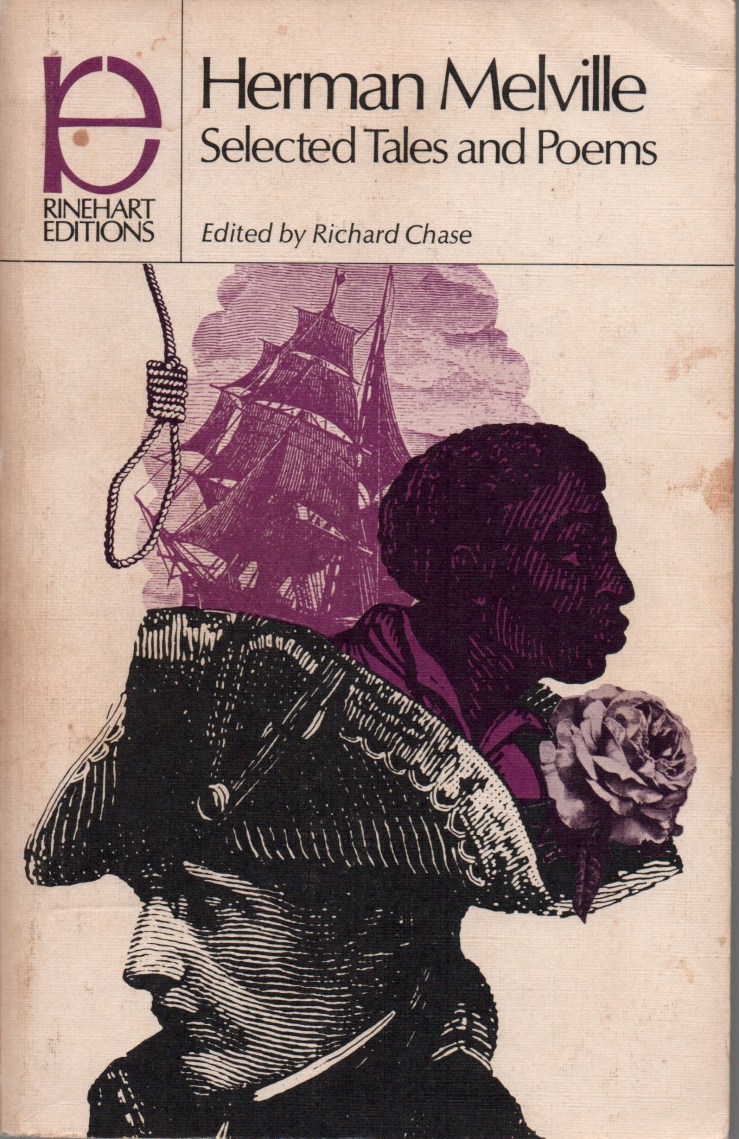
The rest of this post (after the image) contains significant spoilers. I highly recommend Benito Cereno, which is reprinted in any number of Melville collections (I read it again in Rinehart’s Selected Tales and Poems), including The Piazza Tales (which you can download for free at Project Gutenberg). While I think that Benito Cereno has gained more recognition in recent years, it remains under-read compared to Melville’s more famous novellas Bartleby and Billy Budd. Those are great books too, but I’d argue that Benito Cereno, with its critique of white supremacy, is more timely than ever. Check it out. (Again, spoilers ahead).

IMG_0160

Continue reading “On Herman Melville’s novella Benito Cereno”

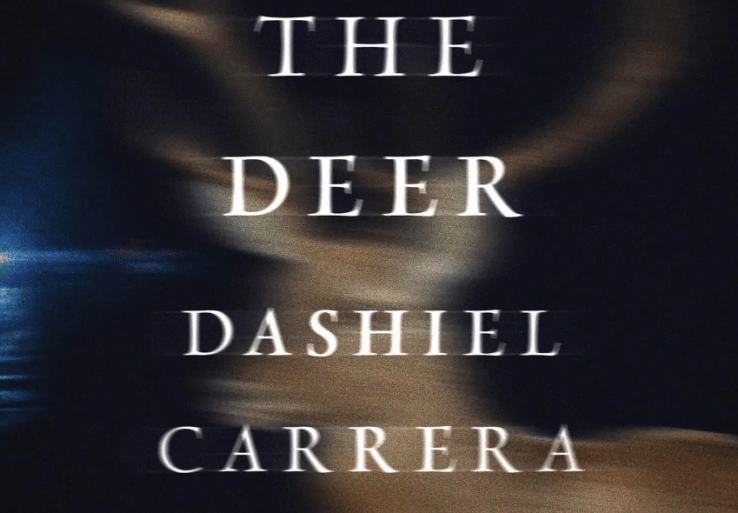
Schrödinger’s Deer | A review of Dashiel Carrera’s surreal debut novel The Deer

Dashiel Carrera’s debut novel The Deer is puzzling, sometimes brilliant, and occasionally frustrating. Gloomy, surreal, and terse, The Deer is at its best when it’s at its most sinister—namely, on its first half, “Side A.” Taking a record album as its model, The Deer has two sides (A and B), each divided into titled Tracks  (on side A) or Lessons (side B). This unusual structure results in a genuinely experimental novel, where some elements crackle with eerie verve and others fall flat. The result is a novel that simultaneously compels and baffles readers, while challenging their notions of what a novel can—or should—do.

“Side A” of The Deer follows a man who may or may not be quantum physicist Henry Haverford, who may or may not have been drunk when he may or may not have hit a deer with his automobile at the beginning of the story. Henry may or may not be going back to his parents’ home to bury his father. I could keep adding may or may not to pretty much everything else that happens in The Deer, which operates on its own nightmare logic. The name Schrödinger is invoked in the fourth paragraph. The Deer reads like an attempt to apply quantum superposition theory to a novel about family trauma.

The family trauma that resonates in the first half is dark and icky—dead dogs, dead deer, Henry’s aloof brother Arthur, their sinister father, a dying (dead) mother, and a mother-figure girlfriend. In the background murmurs jazz piano, messages from the International Space Station, baseball on the radio, and the stifling threat of the police force, which Henry Haverford’s father may or may not have been a member of.

Henry’s multiple encounters with the police, who are simultaneously local law enforcement officers as well as Kafkaesque Authorities — “the Force” — showcase some of the best writing in The Deer. An early run-in with the police at the grocery store unfolds with particularly menacing grace:

“What have you got there, Mr. Haverford?”
The cops sip their coffees and grin.
“Beets,” I say. “I’ve got to bring home some beets for
dinner.”
“We heard you were sick,” says one of the cops.
“You did?”
“Yes, we heard you’ve come down with something really awful.”
“Truly awful.”
“That you’ve been asking all sorts of strange questions.”
I frown. “Well, I’ve been remembering a few things here and there. It’s been a long time since I was home.”
“Yes, but very strange things, Mr. Haverford. You haven’t been thinking straight.”
I force a chuckle.
“Is that liquor in your bag?”
I fondle the cap and lean back. The sliding glass doors open. “Yes. It’s for Arthur.”
“Oh, Arthur.” The men exchange a smile.
“Yes—I should get back to him, actually.”
“Oh, of course, Mr. Haverford. We wouldn’t want to
keep Arthur waiting.”
“Thank you. Yes, I shouldn’t keep him waiting.” I turn.
“It’s just that—well—we’d like to have you come into
the station tomorrow. For a few questions.”
“Questions?”
The other man takes off his cap. “Just a routine follow-up, Mr. Haverford. I’m sure you understand.”
“Right. Sure.”
“Wonderful.” One of the cops glances at the other.
“Well, we must be off.” He grasps my forearm and smiles.
“Great to see you again, Mr. Haverford.”
I nod. “Right. Very good to see you too, Officer.”

When he goes to his first interrogation, things get even stranger, with the police asking Henry what they believe should be done with the dead deer. The interrogation culminates with an ominous line that shouldn’t feel like a threat, but nevertheless sounds like one:

“Am I free to go?”
“Yes,” says the man in the long grey coat. “But we’ll
have you back to see the fawn.”

From there, side A of The Deer edges further into a nightmare of superimpositions and displacements—Henry seems unstuck in time and reality, he’s a boy, a teen, a man, but also a deer, even a fawn, a victim. The situation climaxes in the final track on side A, “The Deer.” It’s another interrogation scene, far more intense, and by the end of it one senses that our Henry, like a character from a David Lynch film, has shifted identities by the time he’s left the room—although nothing is permanent or stable in the world Carrera’s constructed.

Side B continues exploring the may-or-may not themes of the first half, but in an entirely different setting. We move to a first-person narrator, a woman who cares for an ailing mother with her sister. They live in a vaguely post-apocalyptic world, with threats of marauding “riders,” illness, drought. Although the settings are radically different, Carrera takes pains to underscore the thematic line in his novel, invoking Schrödinger’s cat again:

Mother prepares another bowl. We eat slowly. The
kitchen light rocks back and forth. Sister leans back on the counter, popping bread in her mouth.
I read aloud to Mother. It is the Old Book, from the
Before Times. The title has long disintegrated.

I say, this is the story of a cat.

She nods slightly. Or maybe it is a rocking. Maybe her head was rocking, and I only thought it was a nod.

I say, the cat goes into a box.

I say, a man comes up to the box, and he leans down
next to it.

I say, the cat does not make a sound. Not even a scratch.

I say, the cat’s tail slowly curls around itself but the man does not know, because he cannot see the cat and the cat cannot see him.

I say, the man must decide if the cat exists.

At times the choppy, etiolated first-person voice of side B didn’t resonate as fully-realized in my ear, and I found some of the genre-bound descriptors (like “Before Times”) too on-the-nose in a book that is otherwise full of compelling obliquities. Other moments are stronger, like in the following passage, which again underscores the book’s theme of quantum superposition:

Read to me in the book how everything is shaking. Read to me how all the objects are composed of molecules and these molecules are fluid in structure. Read to me how all things twirl in recombination and the existence of objects is confirmed only through collective patterns of sensory perception. Read to me about how we must stay in sync, how these objects which we know to be real must be kept afloat by a rhythm of agreement, how this Earth which tilts so slowly pulls us all in the same direction. Read it to me again, Sister, because I can only feel the cool of the ink and the scratch of the parchment. Read it to me again, Sister, because I can only see the glimmers of this world.

It’s a remarkable paragraph, which feels both timely and timeless, for are we not always in a crisis of the “rhythm of agreement”?

Carrera studied writing under both Jason Schwartz and Evan Lavender-Smith, and the imprint of those writers, as well as the tree from which their own fiction might be said to extend, bears influence on The Deer. In his masterful John the Posthumous, Schwartz found sinister power in the vignette, in the cruel detail, which Carrera evokes in his novel as well. The Deer’s engagement with radical ambiguity also brings to mind Lavender-Smith’s novella Avatar, a study in untethered consciousness. Beyond that, Carrera branches from the Kafka tree, and The Deer will appeal to those who can hang in the surreal abject worlds of, say, João Gilberto Noll or Kōbō Abe or Anna Kavan or Hiroko Oyamada, without collapsing into goo. Good stuff.

The Deer is available from Dalkey Archive.


Roberto Bolaño’s 2666 | Rambling notes around a very long audiobook

img_3357

I listened to Roberto Bolaño’s opus 2666 on audiobook (in English translation by Natasha Wimmer) over the last month,

I listened while I took long early walks in my neighborhood before the big sun burned me back home; I listened while I gardened; I listened while I undertook a list of summer chores that included painting the interior of the house.

I was listening to the book when our fire alarm gave alarum to an accidental fire in our kitchen, which I put out quickly (I was hearing but not listening to the book during this exercise). I was walking, listening to the audiobook of 2666 when I started getting texts from friends about the Supreme Court’s overturning Roe. I was walking, listening to the audiobook of 2666 when my neighbor waved me down, approached me, told me while crying (she was walking her dog) that her ex-husband, who I was very close to, loved, frankly, a kind man who I spent a few hours a week drinking wine and discussing x and y and z, but especially discussing literature and civics film and local raptors, this man, my friend, had died unexpectedly the previous morning. I turned the audiobook off, finished my walk, and drove four hours to the Gulf shore, a nice place I take every July 4th holiday with my extended family. I took a week off 2666.

I finished the 2666 audiobook yesterday. This audiobook is 39 hours and 15 minutes long. A different reader reads each of the novel’s five distinct parts. (The readers are John Lee, Armando Durán, G. Valmont Thomas, Scott Brick, and Grover Gardner.)

Should someone who hasn’t read 2666 before try it on audiobook first?

I have no idea.

(Try it and tell me.)

I don’t think it would have worked for me, an audiobook on the first go around, for a lot of reasons, but the main one is that there are so so so many voices in the novel, and not all of the five readers necessarily fully capture those voices. (G. Valmont Thomas and Grover Gardner do; Armando Durán gets close; John Lee fares well for the most part; Scott Brick tries too hard at times and not hard enough at others).

Some people are pretty good at auditing audiobooks; other people have a difficult time zoning in. Forty hours is a long time, and if I opened with a list of “I” statements, related to the book, it was because it felt like a sharp chunk of life passed as I listened to 2666. (Sorry.)

img_3356

As for the actual novel, the story, the prose, whatever—it’s great. Just amazing. These are poor adjectives for a giant work. This was my fourth full trip through 2666, and it only confirms my impression that the novel is a labyrinthine masterpiece, sinister, brave, lurid, abject, often very funny, and stuffed with so much life and experience. I’ve written several “reviews” of the novel on this site over the years, if you want to be persuaded in greater detail. Probably the better of these riffs was a piece on intertextuality in the novel. There’s also my first review in early 2009 and one from my reread it in late 2009. I wrote about abjection and horror in 2666. At some point I wrote about werewolves and 2666 and argued that Dracula is a secret character in the book.

I probably also connected 2666 in some way to many, many other things while writing on this blog over the past thirteen years. I think it’s great, more than great, grand, gargantuan, giant stuff. I felt all sad and hollowed out when I got to the end yesterday, deflated, punctured, the final images of Archimboldi eating Neapolitan ice cream with a descendant of its creator, Fürst Pückler, kinda breaking my brain.

Put forty more hours in my ears.

If you follow this blog semi-regularly, you might’ve seen (and I hope read) excerpts I’ve posted from 2666 over the past few weeks. Something that initially caught me off guard, but that I soon came to predict, was that I would audit a section, and jot down notes, something like, Post this as an excerpt on the blog—and then it would turn out that I’d posted the same excerpt a decade ago.

I also remembered specific moments where I’d read some of the selections — on airplanes, or in hotel beds, or even on the beach of the Gulf, ten or eleven years ago over a July 4th vacation that wasn’t set against such a oh-wow-we’re-sliding-into-overt-authoritarian-oligarchy-dang backdrop. But also in blank or banal places, a black couch a now-dead cat clawed up, a chair my wife threatened to axe. Two different beds. And so much of what I audited the past month is blended into my experiences of the past month. (I will never ever forget that the moment when I found out about Roe, I was listening to a painful litany of misogynistic “jokes” told by a crooked cop to an audience of other cops in “The Part About the Crimes” — the section goes on and on, a little echo or prefiguration of the litany of rapes that formalize that particular section. I am looking for a way to use the word indelible here.)

(And while I’m in parentheses: Something I would have tuned out while reading 2666 that I certainly noticed while auditing it is how often Bolaño (and his translator Wimmer, of course) uses the phrase Around this time to begin a new paragraph.)

And so well anyway: A few remarks on the readers, translators all in their own right of the material:

John Lee reads “The Part About the Critics.” His posh British twang is well-suited to conveying the semi-serious/semi-ironic tone of this section, and if he sounds annoying as shit at times, that can be forgiven. Lee, who is often too arch, shows more restraint than in other audiobooks I’ve audited that he’s read.

Armando Durán reads “The Part About Amalfitano.” He’s perfect when conveying Amalfitano’s voice, as well as consciousness, but centers too closely to that consciousness. This is a very specific and petty criticism that is more about how I hear certain other voices in the novel. Great voice.

G. Valmont Thomas reads “The Part About Fate.” He inhabits the various voices the journalist Fate speaks to with aplomb, characterizing each voice with its own unique phrasing while staying true to the tone of the “Fate” section, which tip-toes to full-blown abject madness. My only gripe, and it’s not really even a gripe, is that he voices Fate himself as a total weirdo, a weirdo who simultaneously realizes he’s out of sync with everyone around him, but also doesn’t see to register that fact as a functioning human being might. Good interpretation, I guess, but still a bit of a bold choice.

Scott Brick reads “The Part About the Crimes.” Brick has the longest and arguably most-arduous section of 2666. I think the direction he takes (or the direction he was given) is a bit too intense — again this is a case of my own reading of the voices in the novel — I think the main narrative voice of “The Part About the Crimes” should be flat, affectless, reportorial, and that all drama and verve in that section should come from characters who ventriloquize the narrative — and Brick does a good job there.

Grover Gardner reads “The Part About Archimboldi” and I loved what he did, but I’m a big fan of his voice in general. And I love that particular section.

img_3360

If I have quibbled with these voices it comes from a place of love—I loved getting to reread 2666 through their voices. And, like I said above, they are ultimately translators too of the work. So I’ll close with Bolaño himself on translation (via his 2666 translator, Natasha Wimmer, from his essay “Translation Is an Anvil,” collected in Between Parentheses):

How to recognize a work of art? How to separate it, even if just for a moment, from its critical apparatus, its exegetes, its tireless plagiarizers, its belittlers, its final lonely fate? Easy. Let it be translated. Let its translator be far from brilliant. Rip pages from it at random. Leave it lying in an attic. If after all of this a kid comes along and reads it, and after reading makes it his own, and is faithful to it (or unfaithful, whichever) and reinterprets it and accompanies it on its  voyage to the edge, and both are enriched and the kid adds an ounce of value to its original value, then we have something before us, a machine or a book, capable of speaking to all human beings; not a plowed field but a mountain, not the image of a dark forest but the dark forest, not a flock of birds but the Nightingale.

I love the mountain, the forest, the Nightingale.

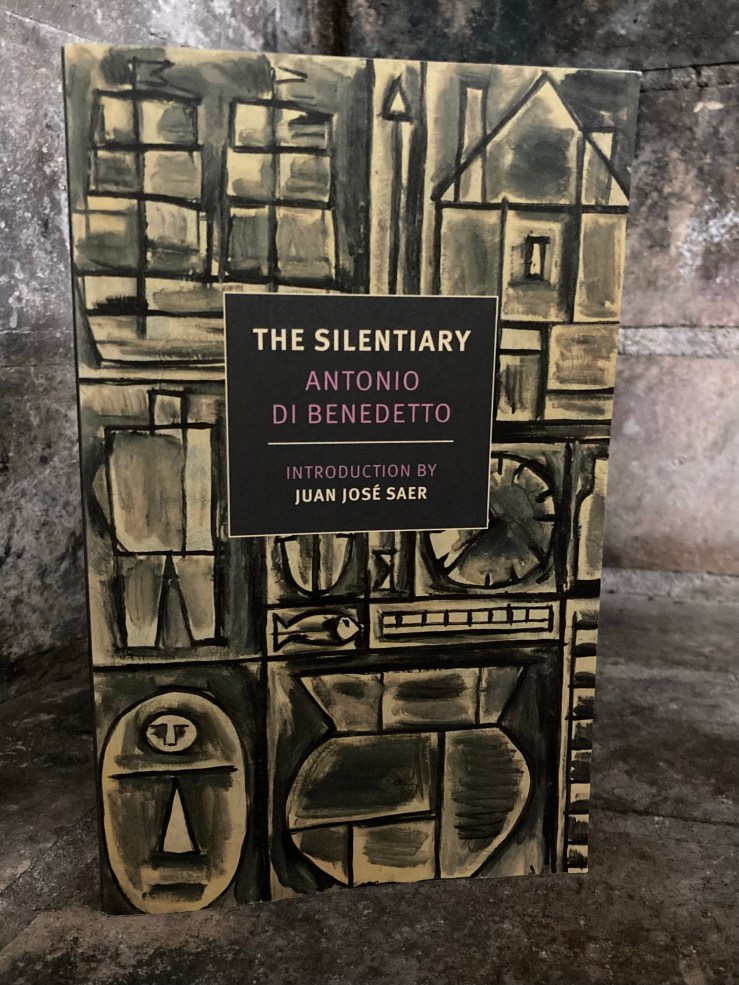
Not toward peace | On Antonio di Benedetto’s novel The Silentiary

“I don’t live well,” the unnamed narrator of Antonio di Benedetto’s novel The Silentiary tells the young woman he will soon marry. “The excuse isn’t clear to her, though she tries to follow its meaning,” he continues, this time to the reader. While the narrator seems, on the surface, a man with a good job as a clerk who lives in a respectable house with his mother, he doesn’t live well—the adverb modifies the verb live in a literal, visceral sense: our hero is an anxious wreck who cannot tune in to the modern condition. He “can’t sleep or eat or read or speak in the chaos of sound” that is the modern, post-war condition.

And that is the central problem of The Silentiary: the chaos of sound. Set in an unnamed, rapidly-growing Latin American city in the early 1950s, Di Benedetto’s 1964 novel belongs to the same canon of Kafkaesque, existentialist postwar novels like Albert Camus’s The Stranger and Walker Percy’s The Moviegoer. Like those novels, The Silentiary follows the nonadventures of a disaffected young man out of tune with his society.

There’s no need to summarize The Silenciary at length. The narrator works in an office, has a crush on his neighbor but ends up marrying her friend, and converses with his flighty philosophical foil, Besarion. He also dreams of completing a novel (to be called The Roof), but alas can never set about even getting started because of the “chaos of sound” that ever encroaches upon him. And that is the real plot of The Silentiary: our poor hero is ever retreating from modernity’s cacophony, only to find new, louder sounds piercing his repose.

His attempts to evade noise are simultaneously mundane and absurd. At one point, he’s schlepping around an old piano that no one can play (symbol of his mother’s middle-class respectability) like a giant anchor, trying to jam it into small quarters. Another sequence finds him moving to a small town, only to end up with a tragic punchline. He’s moved next door to a blacksmith: “Forge and bellows, the anvil and its hammers.”

The narrator’s wife loves him without understanding him, but he finds a confessor in his friend Besarion. This enigmatic character pops in and out of the novel, engaging in puzzling dialogues with the narrator, who is wary and possibly jealous of his friend: “He’s free. He has managed to make his life a long digression, or a kind of multiple metaphor.” Years ago, before the narrator had married and before Besarion had gone on a series of religious travels, he had diagnosed the narrator thusly: “Your quest against noise is metaphysical.” Upon return though, Besarion ironizes that diagnosis, stating that even though his friend believes that his “adventure is metaphysical,” it is actually “physiological, or psychic, or nervous.” This can’t relieve the narrator’s pain though: the chaos of noise “won’t let me exist,” he protests. Besarion solemnly tells him, “Bear up. Make do.”

For all its seriousness, The Silentiary is often a funny, wry novel. Consider the narrator’s description of the automechanics who’ve moved next door: “They seem to have abandoned themselves entirely to their passion for the hygiene of all that has four wheels and an engine.” Or our anxious guy getting dyspepsia: “The food I ingest at lunch does not resign itself to its destiny.”

The phrasing in such moments recalls Di Benedetto’s 1956 novel Zama, also ably translated by Esther Allen. Again, Allen captures something crisp and wry, subtle and precise that is surely native to Di Benedetto’s prose. The results are often beautiful, like in a strange little haiku-like moment early in the novel:

Last night the big gray cat of my childhood came to me.

I told him that noise stalks and harries me.

Slowly, intensely, he cast his animal, companionable gaze upon me.

Or the beautiful phrasing of another strange moment:

…I come across a photo of the lion tamer we dined with after the circus performance.

The tamer’s mane is as untamed as ever, in all the dishevelment of bad nights to which no comb can offer a morning remedy. He’s under double guard.

Lovely!

Yet for all its humor and beauty, The Silentiary is ultimately a sad, though never dour, read. The novel does not wax elegaic for a romanticized, quieter past, nor does it call to make peace with cacophony. There’s only Besarion’s stern intonation to “Bear up [and] Make do.” We’ve the portrait of one man who cannot escape or mute the chaos of sound. Ultimately, he cannot bear up and make do. So he resists, becoming a martyr for silence…but it doesn’t end well. The novel concludes darkly: “The night flows on…and not toward peace.” Recommended.

A few sentences on every Thomas Pynchon novel to date

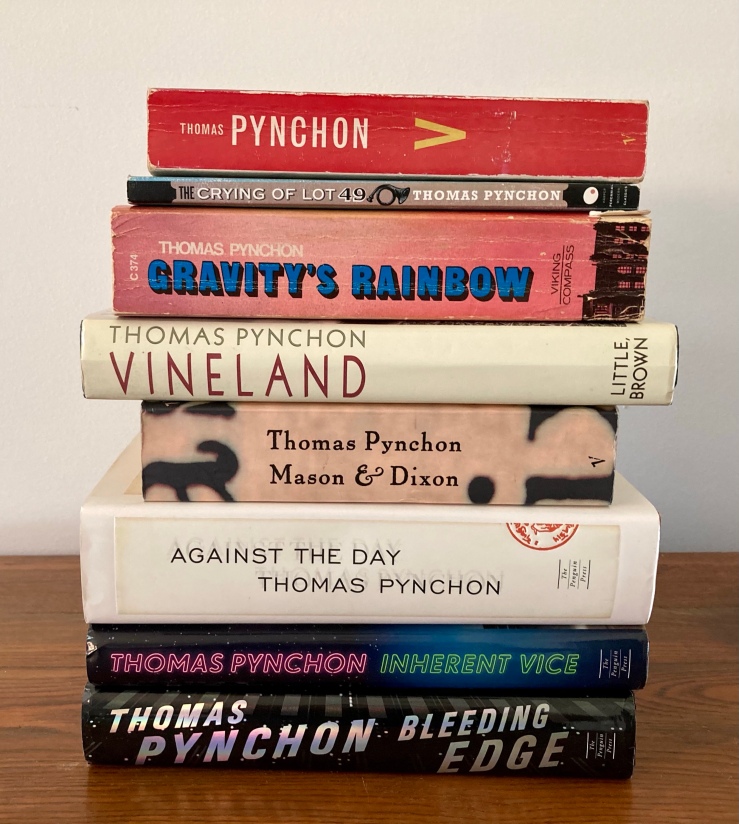
Today, 8 May 2022, is Thomas Ruggles Pynchon’s 85th birthday. Some of us nerds celebrate the work of one of the world’s greatest living authors with something called Pynchon in Public Day. In the past I’ve rounded up links to Pynchon stuff on Biblioklept and elsewhere. To celebrate, here are short riffs on Pynchon’s eight novels:

V. (1963)

I reread Pynchon’s first novel for the first time last year and found it far more achieved than I had remembered. For years I’ve always recalled it as a dress rehearsal for the superior and more complex Gravity’s Rainbow. And while V. certainly points in GR’s direction, even sharing some characters, it’s nevertheless its own entity. I first read V. as a very young man, and as I recall, thought it scattershot, zany, often very funny, but also an assemblage of set pieces that fail to cohere. Rereading it two decades later I can see that there’s far more architecture to its plot, a twinned, yoyoing plot diagrammed in the novel’s title. The twin strands allow Pynchon to critique modernism on two fronts, split by the world wars that mark the first half of the twentieth century. It’s a perfect starting point for anyone new to Pynchon, and its midpoint chapter, “Mondaugen’s Story,” is as good as anything else he’s written.

The Crying of Lot 49 (1966)

Pynchon’s shortest novel is not necessarily his most accessible: Crying is a dense labyrinth to get lost in. At times Pynchon’s second novel feels like a parody of L.A. detective noir (a well he’d return to in Inherent Vice), but there’s plenty of pastiche going on here as well. For example, at one point we are treated to a Jacobean revenge play, The Courier’s Tragedy, which serves as a kind of metatextual comment on the novel’s plot about a secret war between secret armies of…letter carriers. The whole mailman thing might seem ridiculous, but Pynchon’s zaniness is always doubled in sinister paranoia: The Crying of Lot 49 is a story about how information is disseminated, controlled, and manipulated. Its end might frustrate many readers. We never get to hear the actual crying of lot 49 (just as we never discover the “true” identity of V in V.): fixing a stable, centered truth is an impossibility in the Pynchonverse.

Gravity’s Rainbow (1973)

Unbelievably rich, light, dark, cruel, loving, exasperating, challenging, and rewarding, Pynchon’s third novel is one of a handful of books that end up on “difficult novel” lists that is actually difficult. The difficulty though has everything to do with how we expect a novel to “happen” as we read—Gravity’s Rainbow is an entirely new thing, a literature that responds to the rise of mass media as modernist painters had to respond to the advent of photography and moving pictures. The key to appreciating and enjoying Gravity’s Rainbow, in my estimation, is to concede to the language, to the plasticity of it all, with an agreement with yourself to immediately reread it all.

Vineland (1990)

It took Pynchon a decade and a half to follow up Gravity’s Rainbow. I was a boy when Vineland came out—it was obviously nowhere on my radar (I think my favorite books around this time would probably have been The Once and Future King, The Lord of the Rings trilogy, and likely a ton of Dragonlance novels). I do know that Vineland was a disappointment to many fans and critics, and I can see why. At the time, novelist David Foster Wallace neatly summed it up in a letter to novelist Jonathan Franzen: “I get the strong sense he’s spent 20 years smoking pot and watching TV.” Vineland is angry about the Reagan years, but somehow not angry enough. The novel’s villain Brock Vond seems to prefigure the authoritarian police detective Bigfoot Bjornsen of Inherent Vice, but Pynchon’s condemnation of Vond never quite reconciles with his condemnation of the political failures of the 1960s.  Vineland is ultimately depressing and easily my least-favorite Pynchon novel, but it does have some exquisite prose moments.

Mason & Dixon (1997)

If Mason & Dixon isn’t Pynchon’s best book, it has to be 1A to Gravity’s Rainbow’s 1. The novel is another sprawling epic, a loose, baggy adventure story chronicling Charles Mason and Jeremiah Dixon’s Enlightenment effort to survey their bit of the Western World. Mason & Dixon presents an initial formal challenge to its reader: the story is told in a kind of (faux) 18th-century vernacular. Diction, syntax, and even punctuation jostle the contemporary ear. However, once you tune your ear to the (perhaps-not-quite-so-trustworthy) tone of Rev. Wicks Cherrycoke (who tells this tall tall tale), Mason & Dixon somehow becomes breezy, jaunty, even picaresque. It’s jammed with all sorts of adventures: the talking Learned English Dog, smoking weed with George Washington, Gnostic revelations, Asiatic Pygmies who colonize the missing eleven days lost when the British moved from the Julian to the Gregorian calendar…Wonderful stuff. But it’s really the evocation of a strange, hedged, incomplete but loving friendship that comes through in Mason & Dixon.

Against the Day (2006)

Oof. She’s a big boy. At over a thousand pages, Against the Day is Pynchon’s longest novel. Despite its size, I think Against the Day is the best starting point for Pynchon. It offers a surprisingly succinct and clear summation of his major themes, which might be condensed to something like: resist the military-industrial-entertainment-complex, while also showing off his rhetorical power. It’s late period Pynchon, but the prose is some of his strongest stuff. The songs are tight, the pastiche is tighter, and the novel’s epic sweep comes together in the end, resolving its parodic ironies with an earnest love that I believe is the core of Pynchon’s worldview. I forgot to say what it’s about: It’s about the end of the nineteenth century, or, more accurately, the beginning of the twentieth century.

Inherent Vice (2009)

Inherent Vice is a leaner work than its two predecessors, but could stand to be leaner still. The book pushes towards 400 pages but would probably be stronger at 200—or 800. I don’t know. In any case, Inherent Vice is a goofy but sinister stoner detective jaunt that frags out as much as its protagonist, PI Doc Sportello. Paul Thomas Anderson’s film adaptation finds its way through those fragments to an end a bit different from Pynchon’s original (which is closer to an echo of the end of The Crying of Lot 49)—PTA’s film finds its emotional resolution in the restoration of couple—not the main couple, but adjacent characters—an ending that Pynchon pulled in his first novel V.

Bleeding Edge (2013)

While Bleeding Edge was generally well received by critics, it’s not as esteemed as his major works. I think that the novel is much, much better than its reputation though (even its reputation among Pynchon fans). Pynchon retreads some familiar plot territory—this is another detective novel, like Crying and Inherent Vice—but in many ways he’s doing something wholly new here: Bleeding Edge is his Dot Com Novel, his 9/11 Novel, and his New York Novel. It’s also probably his domestic novel, and possibly (dare I?) his most autobiographical, or at least autobiographical in the sense of evoking life with teenagers in New York City, perhaps drawing on material from his own life with wife and son in the city. It’s good stuff, but I really hope we get one more.

[Ed. note–Biblioklept ran a version of this post on 8 May 2021.]

A few thoughts on John Williams’ brilliant historical novel Augustus

At the beginning of April, an old friend (who wrote some excellent reviews on this site in the past) told me that I needed to read John Williams’ 1972 novel Augustus. I loved Williams’ Stoner, which I read (and reviewed) a decade ago, when its cult status seemed to explode thanks to a new edition from NYRB. After Stoner, I tried a few times to read Williams’ western, Butcher’s Crossing, but never got too deep into it. I handled copies of Augustus a few times at bookstores, but the subject didn’t appeal to me. But my friend recommended it, and he’s never steered me wrong, so I picked up a copy of Augustus and cracked it open.

I picked up a copy of Augustus and cracked it open and didn’t put it down that much, unless I had to, until I’d finished it. The novel tells a life story of Gaius Octavius Thurinus, grand nephew Julius Caesar, who suceeds and avenges his assassinated great uncle (and adoptive father) to become the first Emperor of Rome. I was surprised at how much Roman history I remembered—some of it through two Shakespeare plays, some of it through an old HBO show, but most of it from, like, school. And this is one of the most fascinating elements of Augustus—Williams takes an old story and revivifies it.

Essentially an epistolary novel, Augustus features a rotating cast of voices. Prominent among these voices are Augustus’ — or really, Octavian’s — core group of friends, Maecenas, Agrippa, and Virgil. We also hear from notables including Marc Antony, Cleopatra, Horace, and Ovid, as well as many other voices, both invented and historical. There’s something addictive about Williams’ lucid prose, which imbues each character’s voice with its own distinctive style without falling into rhetorical gimmickry.

The early parts of the novel focus on young Octavian’s rise—the assassination of Julius Caesar, the warring Triumvirate, the political intrigue which overlaps with familial duty. We see Octavian/Augustus from multiple perspectives, but Williams’ withholds his hero’s voice until late in the novel. It’s Augustus’ daughter Julia who emerges, slowly, as the novel’s most sympathetic (and ultimately tragic) hero. Her sections of the book are particularly poignant, and recall from Stoner the doomed relationship between William Stoner and his daughter Grace.

Augustus is sad and wise but never dour. Williams harnesses the intellect and soul of his characters, who are simultaneously mortal and timeless. So many passages seem to describe life in the present-day United States (as well as other Western democracies). Consider the lines Williams attributes to Augustus’ intellectual adviser Maecenas, writing late in his life to the historian Livy:

What you seem so unwilling to accept, even now, is this: that the ideals which supported the old Republic had no correspondence to the fact of the old Republic; that the glorious word concealed the deed of horror; that the appearance of tradition and order cloaked the reality of corruption and chaos; that the call to liberty and freedom closed the minds, even of those who called, to the facts of privation, suppression, and sanctioned murder. We had learned that we had to do what we did, and we would not be deterred by the forms that deceived the world.

The complacency, the greed, the cynical failure to not just live up to its expressed ideals, but to take for suckers those who would still believe in those ideals—there’s something heartbreaking about the way Augustus anticipates contemporary democracy in peril to spectacle, hypocrisy, and avarice.

The titular character takes over in the brilliant last act of Augustus. Our Emperor is an old man, melancholy, reflective, but ultimately hopeful that he’s left the empire in good hands (he hasn’t). His final letter echoes Maecenas’ concerns about the corruption of Roman ideals:

. . . I knew that my destiny was simply this: to change the world. Julius Caesar had come to power in a world that was corrupt beyond your understanding. No more than six families ruled the world; towns, regions, and provinces under Roman authority were the currencies of bribery and reward; in the name of the Republic and in the guise of tradition, murder and civil war and merciless repression were the means toward the accepted ends of power, wealth, and glory. Any man who had sufficient money could raise an army, and thus augment that wealth, thereby gaining more power, and hence glory. So Roman killed Roman, and authority became simply the force of arms and riches. And in this strife and faction the ordinary citizen writhed as helplessly as the hare in the trap of the hunter.

And yet Williams’ Augustus is a realist, but one who tempers his perceptions of reality in a compassionate idealism:

Do not mistake me. I have never had that sentimental and rhetorical love for the common people that was in my youth (and is even now) so fashionable. Mankind in the aggregate I have found to be brutish, ignorant, and unkind, whether those qualities were covered by the coarse tunic of the peasant or the white and purple toga of a senator. And yet in the weakest of men, in moments when they are alone and themselves, I have found veins of strength like gold in decaying rock; in the cruelest of men flashes of tenderness and compassion; and in the vainest of men moments of simplicity and grace.

I haven’t done enough to convey how wonderful Augustus is. Very highly recommended.

Hiroko Oyamado’s subtle novel The Hole captures the banal surreal loneliness of modern life

Hiroko Oyamada’s novel The Hole is a subtle, slim, slow-burn low-stakes horror story that tiptoes neatly between banality and surrealism. Our first-person narrator is Asahi, a young, recently-married woman. Asahi–or Asa, as she thinks of herself–is a part-time employee in a large city somewhere in Japan. She doesn’t really have any friends or hobbies, let alone any ambitions. When her husband Muneaki gets a job transfer to the countryside, Asa’s mother-in-law Tomiko offers the young couple the house next to hers, rent-free. The young couple’s economic situation means they can’t refuse, so they don’t. Asa’s only real acquaintance, a work buddy, remarks how lucky she is to be a housewife, but Asa is ambivalent.

That ambivalence radiates throughout The Hole. In David Boyd’s spare, direct translation, Oyamada pushes her hero into a stifling, stuffy, overheated summer. The skinny novel is an exercise in boredom-as-horror: Even before Asa arrives in her husband’s rural hometown, everything’s just a wee bit off. The cicadas vibrate at a different pitch; the locals seem to come from a different era; time seems to run backwards and forwards.

Without a car or job, Asa is essentially stranded, spending her days guilty over running the AC, and unable to communicate with her husband’s grandfather, who mutely gardens his hours away.

Her only cultural landmark is a 7-Eleven convenient store, where mother-in-law Tomiko sends her on an errand one day. The banal errand becomes a bizarre Carollonian quest—but a quest without a clear object. On her route to the convenience store (what could be more boring and inconvenient?) Asa spies a large, strange, dark-furred creature:

 It had wide shoulders, slender and muscular thighs, but from the knees down, its legs were as thin as sticks. The animal was covered in black fur and had a long tail and rounded ears. Its ribs were showing, but its back was bulky, maybe with muscle or with fat.

Frantically following it, she falls into a hole that fits her nearly perfectly (like a proscribed role, or a coffin, or like, whatever):

As I tried to move, I realized how narrow the hole really was. The hole felt as though it was exactly my size – a trap made just for me. The bottom of the hole was covered with something dry, maybe dead grass or straw. Looking toward the river through a break in the grass, all I could see was white light.

A mysterious white-clad neighbor named Sera (who calls Asa “the bride”) pulls her out from the hole, and she makes her way to the 7-Eleven, where a gang of strange children block her mission. She also meets an oddball who later claims to be the white rabbit to her lost Alice. He claims to be an unacknowledged mystery brother-in-law who lives in a shed, having relinquished adult responsibility. There are centipedes and bug bites and other strange goings on—and Asa  talks about absolutely none of it with her husband or mother-in-law.

The Hole captures the stifling omnipresence of loneliness. Asa is a sympathetic character, and while many of the details of her circumstance are particular to Japanese culture, the narrative resonates with the larger absurdities of contemporary life. Asahi’s loneliness burns all the more real for the novel’s surrealism. Her loneliness is the realest thing in The Hole, its presence never acknowledged because it cannot fully be named. The “loneliness” is more real than the quasi-mystical hole-digging creature that plagues the countryside, or the manic brother-in-law-who-lives-in-a-shed-in-the-backyard whom no one ever mentions. But unlike these surreal entities, Asa’s loneliness is never directly invoked.

The Hole will be somewhat familiar with anyone who’s climbed about in the Kafka tree. While Oyamada directly evokes Carroll’s Alice stories, her story is far less fanciful, its dire core obscured with a thin veneer of the banal. The Hole recalls the tone and mood of Kobo Abe’s The Woman in the Dunes, where the protagonist comes to be in an uncanny scenario that becomes uncannier by the moment. But Oyamada’s narrator doesn’t seem to demarcate the separation into unreality; rather, the novel absorbs its narrator into a new unreal-real reality.

The Hole is wonderfully dull at times, as it should be. It’s layered but brittle, with notes of a freshness just gone sour. It’s a quick, propulsive read—a thriller, even, perhaps—but its thrills culminate in sad ambiguity. Recommended.

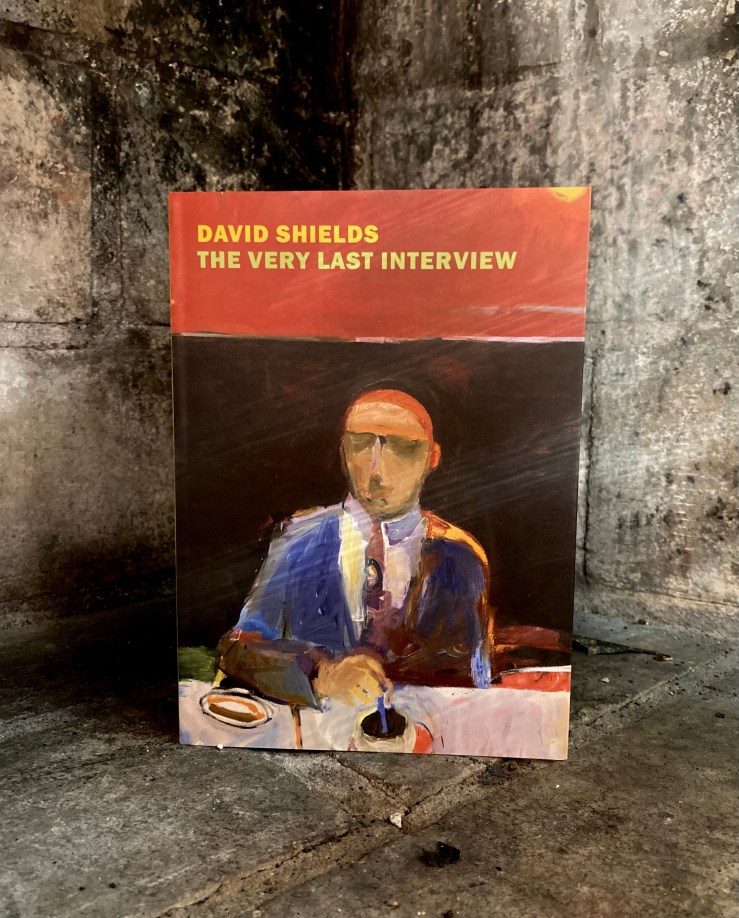
Is this a review of David Shields’ “autobiography” The Very Last Interview?

Is David Shields’ new book The Last Interview indeed an “autobiography in question form, with the reader working to supply answers based on the questions that follow,” as Bret Easton Ellis’ blurb attests?

Is it “Brilliant,” as Bret Easton Ellis’ blurb attests?

(Is this the same David Shields who authored Reality Hunger?)

Does, as Chris Kraus’ blurb states, Shields remix and reimagine “2,000 of the most annoying questions he’s been asked during his forty-year writing life”?

Is it really an “operatic tragic sojourn across American cultural life” (Kraus)?

Does The Very Last Interview confirm “Shields as the most dangerously important American writer since William S. Burroughs,” as Kenneth Goldsmith claims in his blurb?

(Is this the same Kenneth Goldsmith who was called out seven years ago for a publicly reading Michael Brown’s autopsy under the guise of “conceptual poetry”?)

Is it actually “very funny,” as Sheila Heti’s blurb contends?

Should I flip it over and actually dig in?

Is that a Richard Diebenkorn painting adorning the cover?

Are there actually five more blurbs once one opens the book?

Does Shields organize this “remix: of questions he’s (supposedly) been asked into chapters with titles like “Process,” “Truth,” “Art,” “Failure,” “Criticism,” and “Suicide”?

Does Shields open each chapter with epigraphs?

Does he attribute the authors of the epigraphs?

Is there an epigraph from Nietzsche?

Why doesn’t he attribute any of the interviewers at any point in The Very Last Interview?

Does David Shields believe he is a genius?

Does he believe that his audience will find delight or joy or even a momentary reprieve from reading The Very Last Interview?

When Jonathan Lethem (whose blurb makes the inside but not the back cover) claims he “blasted through it in one night,” is it possible that by “night” he means a thin hour or two?

Is the book skinnier than its 150 pages might suggest?

Are there any bits of the book that are, as Heti blurbed, “Very, very funny”?

How about this trio?

“When we are not sure, we are alive” — are you sure this is something that Graham Green said?

Can you prove it?

Do you know what “JSTOR” stands for?

Does this little blip skate closer to mildly amusing as opposed to very very funny?

But is there a general undertone of contempt that radiates in Shields’ curation of questions?

What about these?

Do you share my contempt for Greenpoint hipsters who look and act cool but whose work is about as challenging as a Toblerone bar?

Did you every study with Gordon Lish?

What did he like about your bracelet-cum-watch?

(What would we get if we removed the hyphens from the phrase bracelet-cum-watch?)

Is it possible that David Shields overestimates how interesting he is?

Does he really want us to empathize at points, to provide answers for questions, such as the ones below?

What’s the matter with you?

No, seriously. What is your underlying impasse?

Why can’t you feel?

What’s buried beneath that seeming numbness?

Anything?

Is The Last Interview pretentious, solipsistic, shallow, bathetic, and also very readable?

Is The Last Interview available in paperback from NYRB next month?

Are we done?

Are we?

Sunday equinox blog | Atlanta, Di Benedetto, a Paley poem, ghosting William S. Burroughs, etc.

My spring break, which is to say the spring break of the community college which employs me to teach English, rarely coincides with my children’s spring break, but this year it did, and we took full advantage, spending a week in Atlanta. We stayed in Inman Park, enjoying the BeltLine and the city’s vibe in general. Airport aside, I hadn’t been to Atlanta in twenty years, and I took pleasure in our week there. (I dug the High Museum in particular, and shared some favorites from our visit on Twitter.)

I can’t remember the last time I visited a city and didn’t buy a book. A Capella Books was a short walk from our place; it’s a small, well-curated bookshop with a limited selection. A Capella offered a number of signed books by musicians, including Billy Bragg and Chris Frantz. I thought I might regret not picking up a signed copy of Frantz’s memoir Remain in Love (which I read last year), but I feel no regret as I type this sentence. I also visited Posman Books at Ponce Market. It veers close to something like a tasteful gift shop/stationery joint, but the small fiction and poetry selection is pretty good, even if a lot of it is shelf candy. I think if I’d been willing to drive farther out I might’ve found some deeper cuts. (My wife pointed out that our local used bookstore, 1.1 miles away, has utterly spoiled me.)

Anyway: No books acquired in Atlanta. (I did buy some records though: Fat Mattress’s debut and Fleetwood Mac’s Heroes Are Hard to Find.)

I brought Esther Allen’s new translation of Antonio di Benedetto’s novel The Silentiary with me to reread on the trip. I read it back in January, dogeared it, and started a review, but found that I wanted to let it settle a bit. I liked it the first time round, but the reread revealed a sadder, deeper novel than I had initially estimated.

Other stuff I’ve been reading:

Grace Paley’s late collection of poems, Fidelity. Grand stuff. Sample:

I’ve also been picking through Helen Moore Barthelme’s biography Donald Barthelme: Genesis of a Cool Sound, although there’s nothing particularly revelatory about it.

I picked up the Paley and Barthelme when I swung by our campus library to get Don’t Hide the Madness, a series of conversations between Allen Ginsberg and William S. Burroughs. Burroughs is getting pretty close to the end of his life here, and Ginsberg seems to want to get him to further cement a cultural legacy through a late oral autobiography. Burroughs repeatedly derails these attempts though, which is hilarious. Burroughs talks about whatever comes to mind (often his guns). The cover by Robert Crumb is worth sharing:

I initially requested the Burroughs book because I’ve been rereading Cities of the Red Night—and absolutely loving it—and I was trying to figure out who it was who may or may not have played a role in ghostwriting the book with Burroughs. Cities is straighter than much of Burroughs’ work—but it’s still thoroughly Burroughsian. It’s entirely possible that a straighter hand cobbled Burroughs’ images and fragments together, at least to some extent, although I think it’s erroneous to refer to the novel as ghostwritten. As far as I can tell, the claim originates with Dennis Cooper’s obituary in the October 1997 issue of Spin:

My initial guess was that Cooper here insinuates that Victor Bockris helped arrange Cities of the Red Night. Bockris was around Burroughs a lot when Burroughs was working on Cities; however, Bockris suggests that it was Burroughs who corrected his prose:

From 1979 to 1981, I had the privilege of working with William Burroughs (aged sixty-five to sixty-seven) editing two books: my portrait With William Burroughs: A Report from the Bunker (St. Martins, 1996), and his selected essays, The Adding Machine (Arcade, 1996). At the same time, Burroughs was finishing his long-awaited novel, Cities of the Red Night (Holt, 1981), which would inaugurate a whole new person and period in his career, opening the doors to sixteen highly productive, positive years (1981-97) writing, painting, acting, performing, recording. Consequently, I suppose I am one of the ten to twelve people who ever got close enough to Bill professionally to see into his writing center. When I gave him the manuscript of With William Burroughs (75 percent of which was taped dialogue of conversations between Burroughs and fifteen other celebrities), he not only corrected the sometimes atrocious writing, he added a handful of precious inserts.

More digging seems to suggest that it was the artist Steven Lowe who helped Burroughs arrange Cities. Rick Castro’s appreciation of Lowe goes as far as to assert that, Lowe “was a ghostwriter for Burroughs, assisting on Cities of the Red NightJunkie, and a few other titles.”

Ultimately, I agree with Jamie Russell in Queer Burroughs (2001), that

The rumor that the post-Red Night trilogy texts were partly ghostwritten is perhaps…more of a compliment than the criticism it was intended to be, since it highlights Burroughs’ central theme of the 1980s and 1990s texts: the creation of a post-corporeal real. Who needs a body to write with anyway?

Typing that out, I realize that I’ve inserted an entirely different post into this Sunday equinox post. Oh well.

I love Cities of the Red Night—it’s funny and gross and oddly sweet and even sentimental, an ironic pastiche of the so-called “boys books” genre, as well as a howl against war, conformity, and the military-industrial-entertainment complex. The novel it most reminds me of (apart from other Burroughs’ novels) is Thomas Pynchon’s Against the Day.

I’m also, thanks to the audiobook, into the third section of Marlon James’ Moon Witch, Spider King. The second section focused on the protagonist Sogolon’s domestic life. Frankly, the section sags, although I understand that it likely girds the emotional core of the events to come. The novel pivots dramatically in section three, “Moon Witch.” Sogolon has lost her memory, and is in a strange sunken city centuries in the future. That’s the good shit. More thoughts to come.


A voice in her head that sound like her voice | Another report from Marlon James’s novel Moon Witch, Spider King

My last report from Marlon James’s Moon Witch, Spider King found the novel’s political machinations kicking in after its first seven chapters. Our hero Sogolon finds herself in the Northern Kingdom’s capital Fasisi. The capital is soaked in paranoia. The king is dying, a fact that cannot be admitted publicly or even privately (“The King is about his business,” courtiers and officials repeat). According to custom, it is the son of the king’s daughter who will take up his crown—only Princess Emini has been unable to conceive a child. Meanwhile, her brother Prince Lukid plots a coup, assisted (and likely designed, really), by the Aesi, a Machiavellian who may or may not have magic powers. The Aesi has engineered a literal witch hunt, accusing, arresting, and executing any woman who threatens his hold on power, with the aid of the Sangomin, a band of children necromancers with mutant powers (there’s a two-headed boy, a “razor boy,” a lizard girl, etc.)

The Aesi takes special note of Sogolon, recognizing an emerging power in her that others overlook. She’s wary of him, a feeling that only intensifies as she strikes up an odd friendship with Commander Ulu, a former commander of the Royal Guard who has no memories. Sogolon intuits that it’s likely that the Aesi is responsible for the memory loss, a suspicion that solidifies later in the novel. In an attempt to retain his memories, Ulu writes them down, filling every surface of his living quarters, and even writing in blood. Over time, Sogolon learns to read, with Ulu as a kind if unwitting teacher. Sogolon’s relationship with Keme also deepens, although she learns he has a wife and family.

The relative stability of Sogolon’s life ends when the king dies and Prince Likud claims the throne, taking up the mantle Kwash Moki. The Aesi’s schemes bear fruit-in a sequence that foregrounds the novel’s background trope of witch hunting, princess Emini is put on a trial for adultery. She’s exiled to a walled city of nuns, where she is to spend the rest of her life, and Sogolon is sent with her.

They never make it to the nunnery though. Presumably at the secret command of the Aeisi, the Sangomin attack their caravan killing everyone except Sogolon. She escapes, but the Sangomin track her down. As they attack, she seems to black out. She awakes to a scene of devastating violence she has no memory of. She appears to be in a giant crater, a “smooth bowl that she will have to climb out of.” There, she sees

…them floating, first the top half of the razor finger boy, his entrails dangling, his eyes gazing into nothing, and his legs nowhere to be seen. Slabs of loose white rock and cut white stone—the big man shattered in a multitude of pieces. She climb out and walk past the red and blue girl with the lizard tongue, her hands and legs swaying as if underwater, her face sleepy, the back of her head exploded with all of her shooting out. Perplexing it be, all three floating in air like they underwater, but everything stuck as if whatever happen don’t finish.

Sogolon comes to realize that she was the author of this destruction. When her life is threatened, Sogolon musters a telekinetic force that she refers to sometimes as “wind” or as the “push”–but she can’t control it (yet).

After wandering in the wilderness and cold, she’s found by Keme and other former members of the royal guard who are now part of the Red Army—the king Kwash Moki’s army. Keme has no memory of Sogolon. He brings her back to Fasisi, despite her protest (“They sent us on a fact finding mission, and you are the fact that we found”). Thus ends part one of Moon Witch, Spider King.

I’ve cobbled together a plot summary here, but I’m sure there are many gaps (and maybe some mistakes). In Moon Witch, we’re only privy to what Sogolon sees and hears, and while she’s a curious and perceptive girl, she’s also quite young and lacks any formal education. Much of our understanding of the plot is filtered through Sogolon’s intuition, and a major motif that emerges in these chapters is memory loss, as well as the power that controlling a narrative confers. The Aesi is able to rewrite history, to make people believe things that they witnessed first-hand could not be true.

At the same time the first part of Moon Witch, subtitled “No Name Woman,” is about a consciousness creating itself. Sogolon grew up imprisoned first in a termite mound, then in a whorehouse, then in the home of a fallen aristocrat. She had to name herself, teach herself to read, to scrape together her memories into a slim personal history. In the final sections of “No Name Woman,” the narrator repeats an attribution each time Sogolon enters into a dialogue with her emerging consciousness, as in the following example:

Wake up early girl, will yourself, say a voice in her head that sound like her.

This “voice in her head that sound like her” is Sogolon’s self-making, a consciousness reaching toward the “I” that disappears after the novel’s opening sentences:

One night I was in the dream jungle. It was not a dream, but a memory that jump up in my sleep to usurp it. And in the dream memory is a girl. See the girl.

After that second sentence, the first-person narrator disappears—only to reappear in the beginning of part two, “A Girl Is a Hunted Thing.” More thoughts to come.

A review of Ishmael Reed’s sharp satire The Last Days of Louisiana Red

img_2323

Ishmael Reed’s 1974 novel The Last Days of Louisiana Red is a sharp, zany satire of US culture at the end of the twentieth century. The novel, Reed’s fourth, is a sequel of sorts to Mumbo Jumbo (1972), and features that earlier novel’s protagonist, the Neo-HooDoo ghost detective Papa LaBas.

In Mumbo Jumbo, Reed gave us the story of an uptight secret society, the Wallflower Order, and their attempt to root out and eradicate “Jes’ Grew,” a psychic virus that spreads freedom and takes its form in arts like jazz and the jitterbug. The Last Days of Louisiana Red also employs a psychic virus to drive its plot, although this transmission is far deadlier. “Louisiana Red” is a poisonous mental disease that afflicts black people in the Americas, causing them to fall into a neo-slave mentality in which they act like “Crabs in the Barrel…Each crab trying to keep the other from reaching the top.”

The Last Days of Louisiana Red begins with Ed Yellings, “an american negro itinerant who popped into Berkeley during the age of Nat King Cole. People looked around one day and there he was.” Yellings is the West Coast counterpart to New-York-based Papa LeBas, a fellow Worker of Neo-HooDoo who fights against the secret forces of psychic slavery.

Sliding into the mythological motif that ripple through Louisiana Red, Reed writes,

When Osiris entered Egypt, cannibalism was in vogue. He stopped men from eating men. Thousands of years later when Ed Yellings entered Berkeley, there was a plague too, but not as savage. After centuries of learning how to be subtle, the scheming beast that is man had acquired the ability to cover up.

Yellings’ mission is to destroy the psychic cannibalism that afflicts his people. He gets to it, and earns “a reputation for being not only a Worker [of the voodoo arts] but a worker too.” Yellings’ working class bona fides helps solidify his sympathies and his mission:

Since he worked with workers, he gained a knowledge of the workers’ lot. He knew that their lives were bitter. He experienced their surliness, their downtroddenness, their spitefulness and the hatred they had for one another and for their wives and their kids. He saw them repeatedly go against their own best interests as they were swayed and bedazzled by modern subliminal techniques, manipulated by politicians and corporate tycoons, who posed as their friends while sapping their energy. Whose political campaigns amounted to: “Get the Nigger.”

As always, Reed’s diagnosis of late 20th-century American culture seems to belong, unfortunately, just as much to our own time, giving his novels a perhaps-unintended sheen of prescience. Reed’s work points to dystopia, even as his heroes work for freedom and justice. And yet Reed gives equal air time to the forces that oppress freedom and justice, forces that find expression in “Louisiana Red”:

Louisiana Red was the way they related to one another, oppressed one another, maimed and murdered one another., carving one another while above their heads, fifty thousand feet, billionaires few in custom-made jet planes equipped with saunas tennis courts swimming pools discotheques and meeting rooms decorated like a Merv Griffin Show set….

The miserable workers were anti-negro, anti-chicano, anti-puerto rican, anti-asian, anti-native american, had forgotten their guild oaths, disrespected craftsmanship; produced badly made cars and appliances and were stimulated by gangster-controlled entertainment; turned out worms in the tuna fish, spiders in the soup, inflamatory toys, tumorous chickens, d.d.t. in fish and the brand new condominium built on quicksand.

As a means to fight the culture of erosion, decay, and entropy, Yellings founds the Solid Gumbo Works. Here, he manufactures a gumbo—a spell, really—to combat “Louisiana Red.” In the process he manages to cure cancer, which pisses off a lot of big corporations, and pretty soon Yellings is murdered. Papa LeBas is sent in from New York to solve the case.

Papa LeBas runs into trouble pretty quickly, mostly by way of Yellings’ adult children: Wolf, Street, Sister, and the provocative and gifted Minnie, who leads a group of militants called the Moochers. Each of the children seem to embody an allegorical parallel to some aspect of the American counterculture of the late sixties and seventies, allowing Reed to mash up genres and skewer ideologies. There are a lot flavors in this gumbo: voodoo lore and California history bubble in the same pot as riffs on astrology and Cab Calloway’s hit “Minnie the Moocher.” Reed frequently compares and contrasts East with West, New York with California, underscoring the latter’s anxieties of influence about being the New World of the New World. Throughout the novel, we get routines on Amos & Andy, slapstick pastiches straight out of George Herriman’s Krazy Kat comix, hysterical nods to Kafka. Reed plays off early blaxploitation films like Sweet Sweetback’s Baadasssss Song and Superfly (not to mention Putney Swope), and synthesizes these tropes with kung fu imagery and neo-Nazi nostalgia garb. He turns Aunt Jemima into a loa at one point.

Reed’s prose ping-pongs between genres, skittering from pulp fiction noir to surrealist frenzies, from bizarre sex to raucous action, from political essaying to postmodernist mythologizing. Through these stylistic shifts, Reed satirizes a host of ideologies that feed into “Louisiana Red.” Aspects of the Berkeley youth movement, radical feminism, free love, and intellectual hucksterism all get skewered, but through an allegorical lens—Reed dares us, often explicitly (by way of a character named Chorus) to read Louisiana Red as an allegorical retelling of Sophocles’ Antigone.

This retelling is both tragic and comic though, premodern and postmodern, a carnival of varied voices. The chapters are short, the sentences sting, and the plot shuttles along, pivoting from episode to episode with manic picaresque glee. Reed’s narrator is always way out there in front of both the reader and the novel’s characters, hollering at us to keep up.

Ultimately, The Last Days of Louisiana Red is a bit of a shaggy dog. It’s not that it doesn’t have a climax—it does, it has lots of climaxes, some quite literal. And it’s not that the novel doesn’t have a point—it very much does. Rather, it’s that Reed employs his detective story as a frame for the larger argument he wants to make about American culture. Sure, Papa LaBas gets to the bottom of Yellings’ murder, but that’s not ultimately what the narrative is about.

When we get to the final chapter, we find LaBas, sitting alone “on a plain box” in the empty offices of the Solid Gumbo Works reflecting on the case in a way that, in short, sums up what The Last Days of Louisiana Red is about:

He thought of the eaters and the eaten of this parable on Gumbo…all ‘oppressed people’ who often, like Tod Browning ‘Freaks,’ have their own boot on their own neck. They exist to give the LaBases, Wolfs and Sisters of these groups the business, so as to prevent them from taking care of Business, Occupation, Work. They are the moochers who cooperate with their ‘oppression,’ for they have the mentality of the prey who thinks his destruction at the fangs of the killer is the natural order of things and colludes with his own death. The Workers exist to tell the ‘prey’ that they were meant to bring down killers three times their size, using the old morality as their guide: Voodoo, Confucianism, the ancient Egyptian inner duties, using the technique of camouflage, independent camouflages like the leopard shark, ruler of the seas for five million years. Doc John, ‘the black Cagliostro,’ rises again over the American scene. The Workers conjure and command the spirit of Doc John to walk the land.

So here, near the end of The Last Days of Louisiana Red, Papa LeBas—and Ishmael Reed, of course—conjures up the spirit of Doctor John, the voodoo healer who escaped slavery and brought knowledge of the hoodoo arts to his people. There’s a promise of hope and optimism here at the novel’s end, despite its many bitter flavors. But the passage cited above is not the final moments of Louisiana Red—no, the novel, ends, despite what I wrote about its being a shaggy dog story, with a marvelous punchline.

Ishmael Reed remains an underappreciated novelist whose early work seems as vital as ever. The Last Days of Louisiana Red is probably not the best starting place for him, but it’s a great novel to read right after Mumbo Jumbo, which is a great starting place to read Reed. In any case: Read Reed. Highly recommended.

[Ed. note–Biblioklept first published this review in March, 2019.]

A review of Zora Neale Hurston’s Barracoon

151835599518773205

Zora Neale Hurston’s 1931 book Barracoon: The Story of the Last “Black Cargo” has finally been published. The book is based on Hurston’s 1927 interviews with Cudjo Lewis, the last known survivor of the transatlantic slave trade. Barracoon went previously unpublished due in part to Hurston’s refusal to revise the prose into a “standard” English. Hurston wrote Barracoon in a phonetic approximation of Cudjo’s voice. While this vernacular style may pose (initial) challenges for many readers, it is the very soul of the book in that it transmits Cudjo’s story in his own voice, tone, and rhythm. Hurston used vernacular diction throughout her work, but Cudjo’s voice is singular; it bears a distinctly different sound than the characters of Their Eyes Were Watching God, Hurston’s most famous novel. It is hard to conceive a more compelling version of Barracoon than this one, the one Hurston refused to compromise, with its intense, vital orality.

What is Barracoon about? I shall liberally borrow my summary from the book’s introduction, penned by Hurston scholar and biographer Deborah G. Plant:

On December 14, 1927, Zora Neale Hurston took the 3:40 p.m. train from Penn Station, New York, to Mobile, to conduct a series of interviews with the last known surviving African of the last American slaver—the Clotilda. His name was Kossola, but he was called Cudjo Lewis. He was held as a slave for five and a half years in Plateau-Magazine Point, Alabama, from 1860 until Union soldiers told him he was free. Kossola lived out the rest of his life in Africatown (Plateau). Hurston’s trip south was a continuation of the field trip expedition she had initiated the previous year.

Oluale Kossola had survived capture at the hands of Dahomian warriors, the barracoons at Whydah (Ouidah), and the Middle Passage. He had been enslaved, he had lived through the Civil War and the largely un-Reconstructed South, and he had endured the rule of Jim Crow. He had experienced the dawn of a new millennium that included World War I and the Great Depression. Within the magnitude of world events swirled the momentous events of Kossola’s own personal world.

Zora Neale Hurston, as a cultural anthropologist, ethnographer, and folklorist, was eager to inquire into his experiences. “I want to know who you are,” she approached Kossola, “and how you came to be a slave; and to what part of Africa do you belong, and how you fared as a slave, and how you have managed as a free man?” Kossola absorbed her every question, then raised a tearful countenance. “Thankee Jesus! Somebody come ast about Cudjo! I want tellee somebody who I is, so maybe dey go in de Afficky soil some day and callee my name and somebody say, ‘Yeah, I know Kossula.’”

Those final sentences should give you a quick taste of Barracoon’s central rhetorical conceit. After her own introductory chapter (which details the historical circumstances of the Clotilda’s illegal journey to West Africa), Hurston lets Cudjo inspirit the text, telling his own story in his own voice. Hurston, who spent three months with Cudjo, initially interposes herself in the story, as we see early in the book’s first chapter:

“My grandpa, he a great man. I tellee you how he go.”

I was afraid that Cudjo might go off on a tangent, so I cut in with, “But Kossula, I want to hear about you and how you lived in Africa.”

He gave me a look full of scornful pity and asked, “Where is de house where de mouse is de leader? In de Affica soil I cain tellee you ’bout de son before I tellee you ’bout de father; and derefore, you unnerstand me, I cain talk about de man who is father (et te) till I tellee you bout de man who he father to him, (et, te, te, grandfather) now, dass right ain’ it?

This brief “cutting in” is one of the last moments in the narrative that Hurston attempts to steer Cudjo in a particular direction. Instead, she befriends the old man, bringing him watermelons, hams, peaches, and other treats. These little gifts serve to frame Cudjo’s narrative as he moves from one episode to the next. Otherwise, Hurston disappears into the background, an ear for Cudjo’s voice, a witness for his story.

Cudjo’s story is astounding. He describes life in his own West African village and the terrible slaughter of his people at the hands of “de people of Dahomey,” a tribe that eventually sells Cudjo and the other young people of his village to white men. Cudjo describes his early enslavement in Alabama, which took place in secret until the Civil War, and his eventual freedom from bondage. He tells Hurston about the founding of Africatown, a community of West Africans. He describes his life after capture and slavery—his marriage, his children, his near-fatal railroad accident. Cudjo’s life and his children’s lives were incredibly difficult. They were always othered:

“All de time de chillun growin’ de American folks dey picks at dem and tell de Afficky people dey kill folks and eatee de meat. Dey callee my chillun ig’nant savage and make out dey kin to monkey.

“Derefo’, you unnerstand me, my boys dey fight. Dey got to fight all de time. Me and dey mama doan lak to hear our chillun call savage. It hurtee dey feelings. Derefo’ dey fight. Dey fight hard. When dey whip de other boys, dey folks come to our house and tellee us, ‘Yo’ boys mighty bad, Cudjo. We ’fraid they goin’ kill somebody.”

Somehow most devastating in a narrative full of devastation are the deaths of Cudjo’s children. After his daughter dies in infancy, his namesake is killed by a sheriff, a scene that resonates with terrible pain in 2018:

Nine year we hurtee inside ’bout our baby. Den we git hurtee again. Somebody call hisself a deputy sheriff kill de baby boy now.

He say he de law, but he doan come ’rest him. If my boy done something wrong, it his place come ’rest him lak a man. If he mad wid my Cudjo ’bout something den he oughter come fight him face to face lak a man. He doan come ’rest him lak no sheriff and he doan come fight him lak no man.

Another of his sons is decapitated in a railroad accident. A third son, angry with the injustice of the world, simply disappears: “My boy gone. He ain’ in de house and he ain’ on de hill wid his mama. We both missee him. I doan know. Maybe dey kill my boy. It a hidden mystery.”

Cudjo, ever the survivor, went on to outlive his wife and all of his children.  In her foreword to Barracoon, Alice Walker captures the pain and pathos of this remarkable position:

And then, the story of Cudjo Lewis’s life after Emancipation. His happiness with “freedom,” helping to create a community, a church, building his own house. His tender love for his wife, Seely, and their children. The horrible deaths that follow. We see a man so lonely for Africa, so lonely for his family, we are struck with the realization that he is naming something we ourselves work hard to avoid: how lonely we are too in this still foreign land: lonely for our true culture, our people, our singular connection to a specific understanding of the Universe. And that what we long for, as in Cudjo Lewis’s case, is gone forever. But we see something else: the nobility of a soul that has suffered to the point almost of erasure, and still it struggles to be whole, present, giving.

I cannot improve on Walker’s phrase here. Hurston brings that “nobility of soul” to life via Cudjo’s own rich language.

While Barracoon is of a piece with Hurston’s anthropological collections Mules and Men and Tell My Horse, it does not read like an autoethnography. It is rather a compelling first-person narrative. Hurston collecteed stories from Cudjo–fables, parables, games—but these are included as an appendix, a wise narrative choice as any attempt to integrate them into the main narrative would hardly be seamless. The appendix adds to the text’s richness without imposing on it, and links it to Hurston’s work as a folklorist.

I’ve noted some of the additional material already—Walker’s foreword, the appendix of folklore, as well as Plant’s introduction. Included also is an afterword by Plant that contextualizes Barracoon within Hurston’s academic career, a list of the original residents of Africatown, a glossary, a bibliography, and a lengthy compendium of endnotes. This editorial material frames the historic and academic importance of Barracoon, and will be of great interest to anyone who wishes to study the subject more. However, Cudjo’s narrative stands on its own as a sad, compelling, essential story. It’s amazing it took this long to reach a wider audience. Recommended.

[Ed. note–this review originally ran in May, 2018.]

A review of Octavia Butler’s dystopian novel Parable of the Sower

joga-put-k-samosozidaniyu-i-zdorovyu-iz-tryoh-shagov
Cover art for Parable of the Sower by John Jude Palencar 

Octavia Butler’s 1993 novel Parable of the Sower imagines what a radical affirmation of life might look like set against a backdrop of impending extinction. Set between 2024 and 2027, Parable of the Sower conjures  a crumbling America. Hyperinflation abounds, infrastructure is falling apart, water is scarce, environmental collapse is imminent, and the social institutions that bind the nation have all but frayed.

When we first meet our narrator Lauren Olamina, she is one of the lucky few who has a life of moderate comfort, stability, and security. Lauren lives in a gated community in a sort of compound with her brothers, stepmother, and father, an academic/preacher. Lauren’s father is the ersatz leader of this community,  He leads the neighborhood’s shooting practices, trains them in survival skills, and organizes a perimeter watch against the thieves and arsonists that constantly threaten their survival. He is the central role model for Lauren, who takes his lessons to heart. When the community finally fragments under an attack it can’t endure, Lauren is the only one of her family to survive. She even has the presence of mind to grab her bug-out bag.

After this initial staging of events, Parable of the Sower turns into a road novel. Lauren and two other survivors of the compound head north along the California freeways, slowly gathering followers. Lauren’s leadership drives the novel and inspires those around her. She offers her followers an alternative to the predation around them, a predation most strongly figured in the roving bands of arsonists that prey on travelers and communities alike. She offers her followers the prospect of belonging to a We—an interracial, inter-generational collective.

Lauren’s leadership capability derives from two strands. The first strand is the religion she is creating, an idea she calls “Earthseed.” The basic premise of Earthseed (one that the novel repeats ad nauseum) is that “God is Change.” Another tenet is that people are the seeds of the earth (like, uh, Earthseed—get it?). Lauren’s long-term vision is that humanity might seed a new planet. The post-WW2 dream of NASA and the futurity of exploration—a Manifest Destiny of the stars—glows in the background of Sower, and often points to a more interesting conclusion than the novel finally musters.

The second source of Lauren’s drive comes from a condition she suffers called hyperempathy or “sharing,” a mutation that’s the result of her birth-mother’s drug addiction during pregnancy. Simply put, when Lauren witnesses another person’s injury, she feels their pain. This affliction is a devastating weakness in a predatory, violent (non)society: for Lauren, self-defense entails self-harm. At the same time, Lauren’s hyperempathy is a strength—it makes her understand, at the most visceral level, the need for a community to work together in order to thrive in a world that seems to be dying.

Perhaps the greatest strength of Butler’s novel is that she shows her readers what Lauren can never quite see—namely that Lauren’s hyperempathy is a strength. Sower assumes the form of a journal, Lauren’s first-person recollections scrawled out in rare moments of respite from the terrors of the road. While her first-person perspective is generously broad (she seems to see a lot), she still never quite realizes that her hyperempathy contributes to her strength as a leader. Lauren’s hyperempathy necessitates imaginative forethought; it also entails a need to act decisively in times of crisis. And Parable of the Sower is all crisis, all the time.

Lauren’s journal style mixes the high with the low. She cribs the poetry of her Earthseed religion from the King James Version of the Bible, with often corny results. (I am pretty sure the corniness is unintentional). She’s also occasionally psychologically introspective, going through thought experiments to better understand those around her.

Despite its Earthseed flights into poetical musings and boldly-declared profundities, most of Lauren’s narrative is strangely mundane in its accounting of a slow apocalypse though. There are seemingly-endless lists of supplies to be bought or scavenged, survival chores to be checked off, and California roads to be traversed (sections of Parable of the Sower often reminded me more of the SNL recurring sketch “The Californians” than, say, Cormac McCarthy’s The Road). The bulk of Butler’s book hovers around disaster prepping, finding temporary shelter, and looting bodies, motifs that won’t seem strange to contemporary audiences reared on cable television and addicted to battle royale video games.

Lauren is 15 at the novel’s outset in 2024, yet she seems fully mature. If this was a coming-of-age novel, I missed it—Lauren, while far from perfect, is generally self-assured in her powers of decision making. At a quite literal level, she commands the narrative, propelling it forward without any of the wishy-washiness we might get from the narrator of, say, The Handmaid’s Tale. If Lauren second-guesses herself, she doesn’t bother to second-guess her second guesses. Butler seems to envision her rather as a hero-model for the coming disaster the novel anticipates. Much of Parable of the Sower reads like a checklist of What To Do After the End of Civilization.

The novel’s biggest weakness is that it can’t quite articulate just how bad things have gotten. Is this actually The End of Civilization? Butler paints a bleak picture. Drought is the new norm. Most Americans are illiterate. Work is hard to find. The roads are too dangerous to travel at night. Packs of feral dogs hunt down humans. Packs of feral children eat humans. Women live with the constant threat of rape. Overt racism is fully normalized. Company towns make a comeback, issuing scrip instead of currency, leading to indentured servitude. Water is a commodity to literally kill for, the police are essentially an organized gang, and a large portion of the population are addicted to a drug that makes setting fires better than sex. Murder is an open business, and there is no recourse to any established justice.

And at the same time that it evokes all of these apocalyptic images and themes, Butler’s novel points to tinges of normalcy—a presidential election carried out sans violence, the sense that a university system is still in play, various notations of different regulatory bodies. Parable of the Sower often reads like The Walking Dead or The Road, but then it might turn a weird corner to uncanny normalcy, where characters shop in a Walmart-like (if hyperbolized) superstore. As one character puts it,

Federal, state, and local governments still exist— in name at least— and sometimes they manage to do something more than collect taxes and send in the military. And the money is still good. That amazes me. However much more you need of it to buy anything these days, it is still accepted. That may be a hopeful sign— or perhaps it’s only more evidence of what I just said: We haven’t hit bottom yet.

Perhaps what I perceive here is simply Butler showing her narrator’s essential naivete, a naivete that doesn’t evince on the surface of the first-person narration. Lauren doesn’t know what she doesn’t know. She doesn’t fully understand how bad things have gotten because she doesn’t fully understand the potential in America that existed before her own life. But she does intuit how bad things are. Despite her intuition, she’s hopeful. This hope, and the despair that foregrounds it, evinces strongly in the final moments of the book. Lauren has finally made it to a kind of promised-land, a frontier-space where she can create a new life with a new love, a much-older man named Bankole. Bankole was a doctor in his old life, but now he’s a survivor. At the end of the novel, he mourns the American dream, the American we, and mourns that Lauren cannot mourn it with him:

He said nothing for a while. Then he stopped and put his hand on my shoulder to stop me. At first he only stood looking at me, almost studying my face. “You’re so young,” he said. “It seems almost criminal that you should be so young in these terrible times. I wish you could have known this country when it was still salvageable.”

“It might survive,” I said, “changed, but still itself.”

“No.” He drew me to his side and put one arm around me. “Human beings will survive of course. Some other countries will survive. Maybe they’ll absorb what’s left of us. Or maybe we’ll just break up into a lot of little states quarreling and fighting with each other over whatever crumbs are left. That’s almost happened now with states shutting themselves off from one another, treating state lines as national borders. As bright as you are, I don’t think you understand—I don’t think you can understand what we’ve lost. Perhaps that’s a blessing.”

Banokole’s summary of America in the late 2020s seems like a dire if hyperbolic prognostication of our current trajectory. More than a quarter century ago, Butler knew what was up. Butler also offered an answer to the problem in her mouthpiece Lauren, who replies to her (way-too-much older) lover Bankole, “We’ve got work to do.”

Parable of the Sower is not a particularly fun novel, although of course, it never intends to be. The dour tone is appropriate to its subject matter, I suppose, but that grim tone can become exhausting. The novel’s trajectory and moral vision keep it from falling into an exercise in nihilism or apocalypse porn, like, say, The Walking Dead. But like The Walking Dead, Butler’s novel often plods along. Maybe this is a rhetorical feature—maybe Butler intends her reader to feel just as weary and depressed as Lauren.

Parable of the Sower was published just a year after a superficially-similar novel, Neal Stephenson’s Snow Crash, which also presciently envisions a fragmenting America where like-groups seal themselves off from each other. In contrast though, Stephenson’s novel is zany and vibrant, a cartoon world devoid of any hyperempathy that might get in the way of anarchic fun. Over 25 years old now, many of the tropes in both Snow Crash and Parable of the Sower have so fully infiltrated our media—books and video games, films and television shows—that their initial vital strangeness is hard to detect.

The dystopian tropes of Parable of the Sower don’t feel particularly fresh in 2019, but the novel’s prescience still has an alarming bite. (Her sequel, Parable of the Talents, features a right-wing Presidential candidate who runs on the promise to “Make America great again”). Sower works best as an extended thought experiment on what might happen to society—to democracy in particular—when impending ecological collapse threatens our very existence. And Butler proposes a solution to the problems posed in her thought experiment: “We’ve got work to do.”

“We’ve got work to do” not only summarizes Parable of the Sower’s central message, it also describes current zeitgeist. Lauren would have been born in 2009; my daughter was born in 2007 and my son in 2010. She could be one of their classmates; she could be my own daughter. The novel’s vision of hyperempathy in the face of brutality and creeping fascism points back to that phrase — “We’ve got work to do” — which of course, requires a We. The we here is a radical affirmation, an echo even of the We the People that so boldly engendered a U.S. America. But Butler’s vision, conveyed through Lauren, is far more pluralistic and diverse than the We the framers evoked in the Preamble to the Constitution. Butler’s we names the namelessness of a coming society, a society that seems impossible and yet is possible, its possibility instantiated in the simple proof that it can be imagined. Parable of the Sower ultimately points toward the seeds of that imagining.

[Ed. note—Biblioklept first published this review in March of 2019.]