Lincoln (Louis CK)

Definition of Politics (Ambrose Bierce)

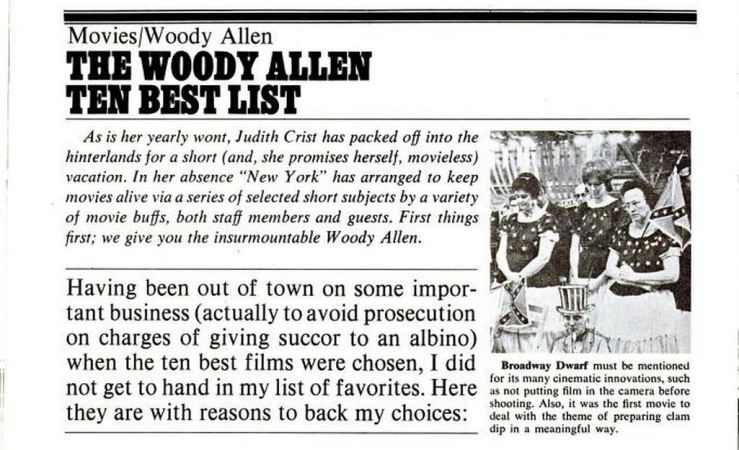
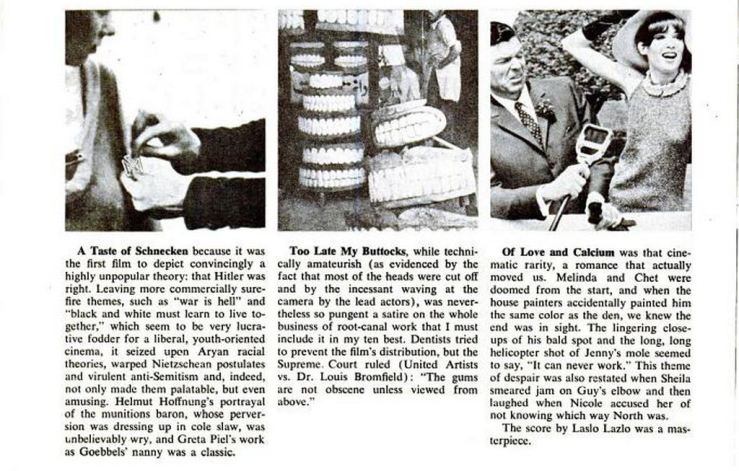
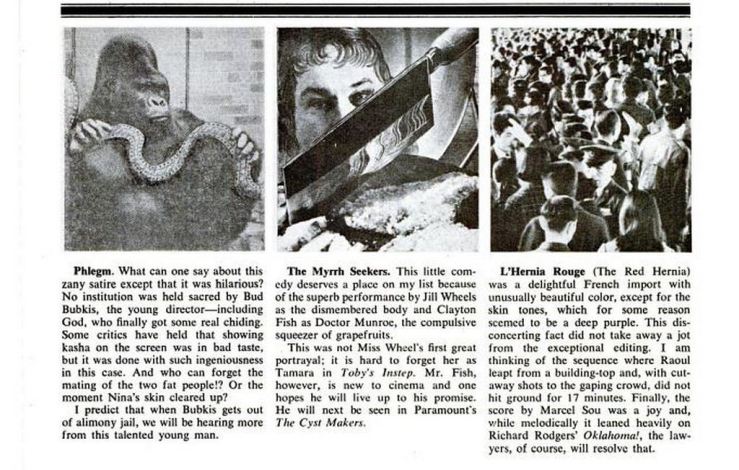
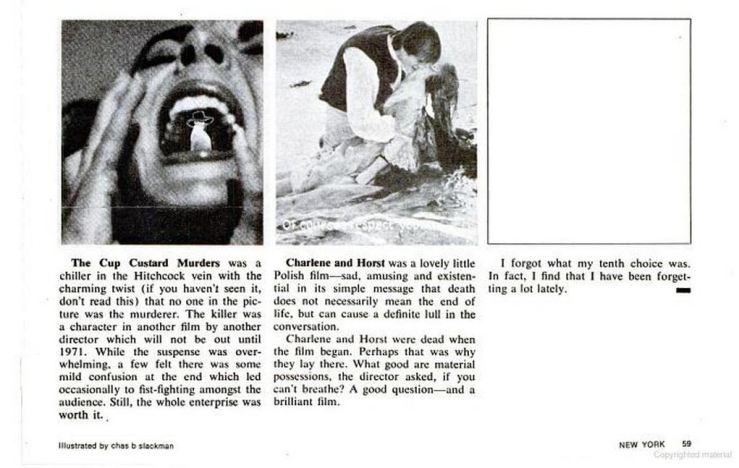
The Woody Allen Ten Best List

From New York Magazine, August 3, 1970. Via Matt Singer’s Twitter

“Diagetic, dialogic, hegemonic” — David Markson Weighs in on Contemporary Literary Criticism

Diagetic, dialogic, hegemonic. Privilege, as a verb. Foreground, as a verb. Valorize. Praxis, Simulacra. Metafiction. Logocentrism. Phallocentrism. Discourse. Signifier/signified.

Aporia.

Late capitalism. Gynophobia.

Text.

None of the above.

From David Markson’s novel Reader’s Block.

“And God Help You If You Use Voiceover in Your Work, My Friends!” (Screenwriting Seminar Scene, Adaptation)

“My Precious!”

“I’d Buy That for a Dollar!”

Maurice Sendak on The Colbert Report (In Case You Missed It)

Vodpod videos no longer available. Vodpod videos no longer available.

Hark! A Vagrant Does Wuthering Heights

At Hark! A Vagrant, satirist supreme Kate Beaton sends up Wuthering Heights. Beaton’s book is now available for preorder.

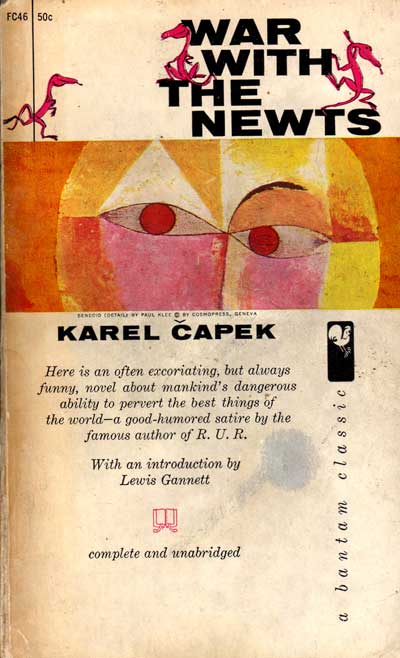
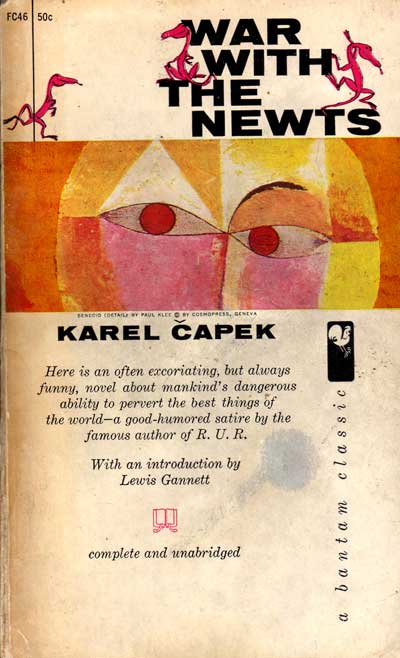
War With the Newts — Karel Capek


Even though the plot of War with the Newts may not shock audiences accustomed to its “human-invention-intended-for- good-becomes-in-the-end-not-so-good” story, readers shouldn’t neglect this often-overlooked science-fiction classic from 1937 by notable Czech writer and satirist Karel Capek.  Humans, motivated by a range of impulses: greed, curiosity, and sometimes even the best of intentions, have created an uncontrollable menace and brought about the end to their dominion over the planet.  Computers, robots, even monkeys have spelled doom for mankind, but Capek warned, in this short and sparkling book, that while masses of intelligent amphibians must be dealt with cautiously, true danger arises from our manipulation of the natural world, the unceasing capitalist drive to increase production by exploiting the weakest, and our inability to foresee the consequences of our actions.

The action begins when a drunk but benevolent sea captain discovers a new species of amphibians inhabiting the waters near an isolated island in the Pacific Ocean.  These docile creatures are able to breathe on land, walk on their hind legs, and communicate using rudimentary sounds and gestures.  The captain trains them to speak a pidgin English and dive for pearls before arming them so that they might fend off the sharks that prey on their young.  Once he receives generous financial backing from a Dutch conglomerate, he ships them to similar islands where pearl harvests have been been impossible or unproductive.  Eventually big business determines that the tireless and fecund newts are valuable for the expansion and development of economic activities near the coasts and under the seas and develop a global marketplace for trade in their labor and bodies.  Educated, well-equipped, and trained to use with the most advanced technologies, the newts produce the greatest expansion of wealth in the history of the world before taking it all for themselves, returning the continents to the bottom of the ocean while requiring a small cadre of humans, relocated to the mountains, to produce the steel and weapons required to support their new Atlantis.

Written as a history book, Capek brilliantly footnotes his narrative with carefully crafted primary sources: newspaper reports, academic studies, religious tracts, political manifestos and corporate minutes in order to illustrate human reaction to new, unsettling circumstance.  A nimble author blessed with the knowledge and skill to write comfortably about a wide variety of subjects, Capek captures both the progressive and cautious voices that shape human reaction to the slow advancement of a new and underestimated intelligence.  He shows that agreement against economic interest is impossible;  labor, for instance, bemoans loss of work to newt hordes while agriculture comes to rely on the millions of new mouths that have to be fed.  Scholars measure, analyze, and categorize; anonymous tract-writers urge an uneasy populace to take up arms against sea-dwelling usurpers while the young and fashionable flock to newt cults, giving themselves up to sexual licentiousness they relish the mysterious and taboo.

But though Capek capably documents trivialities, most of his accounts reflect the time in which he lived and wrote, between the two great European wars, situated between Stalin’s Russia and Hitler’s new Germany, at the height of colonial exploitation, not yet separated by a century from the horrors of the trans-Atlantic slave trade and the American Civil War.  In a report written by the “Salamander Syndicate,” the organization responsible for the organization and dissemination of the world trade in newts justifies the “humane” husbandry, categorization, and sale of newts according to their physical attributes.  Exemplary newts are invited to join committees and expound on their visions for a future shared with humans.  Echoes of American abolitionist thought appear in the debates waged in the media regarding the existence of newt art and culture, their assumed “soullessness,” and the minimal levels of education required for their lives as workers.

The newts, masters of human technology, eventually take over.  Humans, fleeing to higher ground,  are incapable of bringing the fight to the seas.   War with the Newts is an indictment not only of our ability to take without question unearned economic value, but also of our inability to halt the mechanisms by which we accrue those benefits once it becomes evident that the process of enrichment, by itself, is detrimental to the common good.  This is a very good book, a satire of the institutions that will fail when we need them the most, created by a writer whose demonstrated virtuosity deserves more attention.

Candide — Voltaire

I liked pretty much all of the assigned reading in high school (okay, I hated every page of Tess of the D’Ubervilles). Some of the books I left behind, metaphorically at least (Lord of the Flies, The Catcher in the Rye), and some books bewildered me, but I returned to them later, perhaps better equipped (Billy Budd; Leaves of Grass). No book stuck with me quite as much as Candide, Voltaire’s scathing satire of the Enlightenment.

20110911-025457.jpg

I remember being unenthusiastic when my 10th grade English teacher assigned the book—it was the cover, I suppose (I stole the book and still have it), but the novel quickly absorbed all of my attention. I devoured it. It was (is) surreal and harsh and violent and funny, a prolonged attack on all of the bullshit that my 15 year old self seemed to perceive everywhere: baseless optimism, can-do spirit, and the guiding thesis that “all is for the best.” The novel gelled immediately with the Kurt Vonnegut books I was gobbling up, seemed to antecede the Beat lit I was flirting with. And while the tone of the book certainly held my attention, its structure, pacing, and plot enthralled me. I’d never read a book so willing to kill off major characters (repeatedly), to upset and displace its characters, to shift their fortunes so erratically and drastically. Not only did Voltaire repeatedly shake up the fortunes of Candide and his not-so-merry band—Pangloss, the ignorant philosopher; Cunegonde, Candide’s love interest and raison d’etre and her maid the Old Woman; Candide’s valet Cacambo; Martin, his cynical adviser—but the author seemed to play by Marvel Comics rules, bringing dead characters back to life willy nilly. While most of the novels I had been reading (both on my own and those assigned) relied on plot arcs, grand themes, and character development, Candide was (is) a bizarre series of one-damn-thing-happening-after-another. Each chapter was its own little saga, an adventure writ in miniature, with attendant rises and falls. I loved it.

I reread Candide this weekend for no real reason in particular. I’ve read it a few times since high school, but it was never assigned again—not in college, not in grad school—which may or may not be a shame. I don’t know. In any case, the book still rings my bell; indeed, for me it’s the gold standard of picaresque novels, a genre I’ve come to dearly love. Perhaps I reread it with the bad taste of John Barth’s The Sot-Weed Factor still in my mouth. As I worked my way through that bloated mess, I just kept thinking, “Okay, Voltaire did it 200 years earlier, much better and much shorter.”

Revisiting Candide for the first time in years, I find that the book is richer, meaner, and far more violent than I’d realized. Even as a callow youth, I couldn’t miss Voltaire’s attack on the Age of Reason, sustained over a slim 120 pages or so. Through the lens of more experience (both life and reading), I see that Voltaire’s project in Candide is not just to satirize the Enlightenment’s ideals of rationality and the promise of progress, but also to actively destabilize those ideals through the structure of the narrative itself. Voltaire offers us a genuine adventure narrative and punctures it repeatedly, allowing only the barest slivers of heroism—and those only come from his innocent (i.e. ignorant) title character. Candide is topsy-turvy, steeped in both irony and violence.

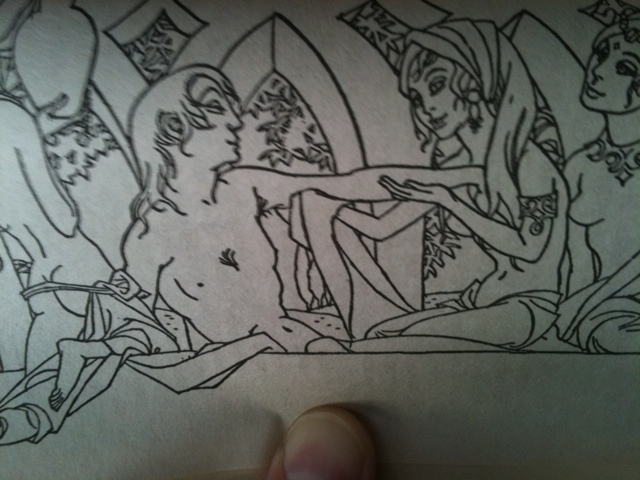
As a youth, the more surreal aspects of the violence appealed to me. (An auto-da-fé! Man on monkey murder! Earthquakes! Piracy! Cannibalizing buttocks!). The sexy illustrations in the edition I stole from my school helped intrigue me as well—
20110911-025719.jpg

The self who read the book this weekend still loves a narrative steeped in violence—I can’t help it—Blood Meridian, 2666, the Marquis de Sade, Denis Johnson, etc.—but I realize now that, despite its occasional cartoonish distortions, Candide is achingly aware of the wars of Europe and the genocide underway in the New World. Voltaire by turns attacks rape and slavery, serfdom and warfare, always with a curdling contempt for the powers that be.

But perhaps I’ve gone too long though without quoting from this marvelous book, so here’s a passage from the last chapter that perhaps gives summary to Candide and his troupe’s rambling adventures: by way of context (and, honestly spoiling nothing), Candide and his friends find themselves eking out a living in boredom (although not despair) and finding war still raging around them (no shortage of heads on spikes); Candide’s Cunegonde is no longer fair but “growing uglier everyday” (and shrewish to boot!), Pangloss no longer believes that “it is the best of all worlds” they live in, yet he still preaches this philosophy, Martin finds little solace in the confirmation of his cynicism and misanthropy, and the Old Woman is withering away to death. The group finds their only entertainment comes from disputing abstract questions—

But when they were not arguing, their boredom became so oppressive that one day the old woman was driven to say, “I’d like to know which is worse: to be raped a hundred times by Negro pirates, to have one buttock cut off, to run the guantlet in the Bulgar army, to be whipped and hanged in an auto-da-fé, to be dissected, to be a galley slave—in short, to suffer all the miseries we’ve all gone through—or stay here and do nothing.

“That’s a hard question,” said Candide.

It’s amazing that over 200 years ago Voltaire posits boredom as an existential dilemma equal to violence; indeed, as its opposite. (I should stop and give credit here to Lowell Blair’s marvelous translation, which sheds much of the finicky verbiage you might find in other editions in favor of a dry, snappy deadpan, characterized in Candide’s rejoinder above). The book’s longevity might easily be attributed to its prescience, for Voltaire’s uncanny ability to swiftly and expertly assassinate all the rhetorical and philosophical veils by which civilization hides its inclinations to predation and straight up evil. But it’s more than that. Pointing out that humanity is ugly and nasty and hypocritical is perhaps easy enough, but few writers can do this in a way that is as entertaining as what we find in Candide. Beyond that entertainment factor, Candide earns its famous conclusion: “We must cultivate our garden,” young (or not so young now) Candide avers, a simple, declarative statement, one that points to the book’s grand thesis: we must work to overcome poverty, ignorance, and, yes, boredom. I’m sure, gentle, well-read reader, that you’ve read Candide before, but I’d humbly suggest to read it again.

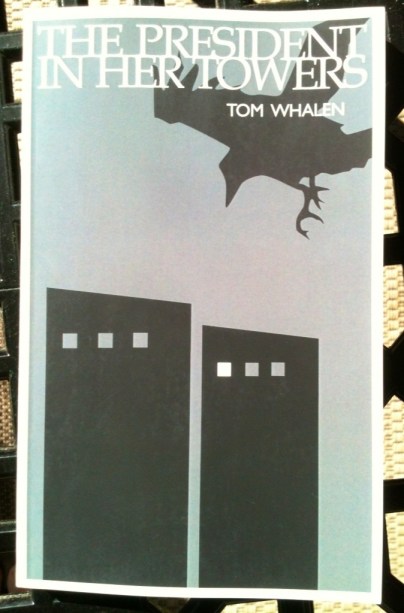
New in the Stack: Banana Republican, Ether, and The Oregon Experiment

As always, the stack overfloweth. Here are a few of the more interesting titles that have landed at Biblioklept International Headquarters recently.

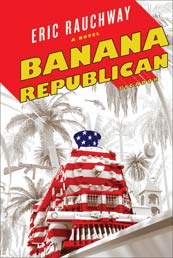
Banana Republican is the first novel by historian Eric Rauchway. The book is a send up of American Imperialism in the 1920s, satirizing the naked greed, corrupt capitalism, and ugly jingoism that infused the rise of the global economy. Fortunately, all of these ills have left American foreign policy forever, right? Satire! Seriously though, Banana Republican looks to the past to reveal that our current foreign debacles are merely an extension of policies that have been around for decades. The protagonist is Tom Buchanan (yes, that Tom Buchanan, the racist football-playing, mistress-slapping lout of The Great Gatsby). Rauchway sends Buchanan into the fiasco of American intervention in Nicaragua in the early 20th century. In an interview with The St. Petersburg Times, Rauchway points out how this scenario allows for an exploration of the American dream from a decidedly different viewpoint than the one we find in Fitzgerald—-
People always see Gatsby as the novel about the American dream. But the character who represents that dream of upward mobility ends up floating facedown in a swimming pool. Tom Buchanan represents the real American dream: having it all and not having to suffer the consequences. I wanted to get away from the somewhat suspect view of the narrator in Gatsby and let Tom speak for himself. . . .

I was interested in writing about the irresponsibility of American foreign policy, so if you take Tom Buchanan in the 1920s, where are we? We’re in Nicaragua. When you look at American foreign policy, in Europe we do pretty well. In South America, not so much. And there’s that tradition in places that are on the edges of empire: Dissolute people get to go there and act badly and no one calls them on it.

Evgenia Citkowitz’s Ether collects seven short stories and a novella, all united by psychological and emotional complexity. Citkowitz’s characters explore moral dilemmas as they quest for identity, and if that sounds like the stock of contemporary fiction (which it is), the prose, terse, often chilly, and darkly funny, is what set these apart. Here’s Ligaya Mishan, reviewing the hardback edition last year in The New York Times

Citkowitz’s book is peopled by mothers and fathers who are fumblers at best, unrepentant alcoholics at worst. A few are simply absentees, like the father of Beatty, the British schoolgirl in “Leavers’ Events,” who is omitted from family suppers, “disqualified by his status as a heroin addict.” The girl’s mother, a high-level fashion editor, is hardly more present. The only grown-up in Beatty’s life who actually behaves like one is, oddly enough, the rakish novelist she invites to the opera. After initiating a lazy seduction, he wisely thinks better of it. Again, Citkowitz flouts expectations: her heroine may be momentarily crushed, but soon she has moved to New York, ascended the editorial ladder at a chic magazine, landed her own office and effectively supplanted her mother — a modern-day Electra.

Ether and Banana Republican are both new in trade paperback from Picador.

In his promo vid (below) for The Oregon Experiment, author Keith Scribner suggests that, “It’s a novel that explores the ways in which the political, the social, the personal, the domestic are inseparable.” Those are some pretty grand claims, so here are the details: The Oregon Experiment recounts the story of Scanlon and Naomi Pratt, a couple who move from the East Coast to Oregon, where Scanlon begins his first tenure-track job as a professor who studies radical action mass movements. Naomi was once a “genius nose” who worked for perfume companies, but she’s lost her sense of smell; she’s also pregnant with the couple’s first child. Scanlon quickly becomes enamored of Oregon, and becomes particularly intrigued by local separatists and anarchists; Naomi’s nose returns, but she isn’t quite as thrilled as Scanlon about the new scene (particularly Scanlon’s enchantment with Sequoia, leader of the secessionists), although she does connect with Scanlon’s young subject Clay, an anarchist. Scribner propels his novel with ideas rendered in crisp, realistic dialogue. The Oregon Experiment is new from Knopf.
Better Book Titles

Check out the frank and funny images at Better Book Titles (via @MelvilleHouse). A few of our favorites–

Beaton Does Gatsby

Cartoonist Kate Beaton lampoons F. Scott Fitzgerald’s The Great Gatsby at her site Hark, A Vagrant. Wonderful send-up of what has to be one of America’s most overrated novels.

Post-postmodern Satire and More Juggalo Wonder

Two weeks ago, I wrote a piece about the Insane Clown Posse and Juggalo culture where I argued that ICP’s project, so heavily distorted in the tropes and defenses of postmodernity, is essentially resistant to ironic satire and even parody. My piece was prompted largely by ICP’s newest video, Miracles,” a mawkish, sweetly dumb anthem brought to life as a mutant Spencer’s Gifts blacklight poster. A day or two after I posted, a friend sent me Daniel O’Brien’s article in Cracked, Learn Your Motherf#@kin’ Science: A Textbook for Juggalos.O’Brien’s piece seeks to correct ICP’s notion that “rainbows,” “giraffes,” and “magnets” are somehow unexplainable “miracles”; he uses Juggalo vernacular to address the myriad questions (and misapprehensions) expressed in “Miracles.” O’Brien juxtaposes Juggalo-speak against the schema of school texts to point out that “Miracles” is insanely, almost heroically stupid. He does this to be funny, of course, but I think that there’s a sense of exasperation to his parody. It buckles under the strain of mocking something already so radically open to an ironic viewpoint as to render said viewpoint null and void.

About a week after O’Brien and I ran our pieces on “Miracles,” Saturday Night Live attempted another parody of ICP (see my first post for more on their first attempt). Here’s their spoof of “Miracles”:

Again, it’s not very funny. There’s no insight or satirical value, no allegorical leap–it’s just an ironic viewpoint. But what else could it be? What’s left to a satirist when his subject is literally a clown in oversized shorts rapping about the magical mysteries of magnets? In her review of the episode at AV Club, Claire Zullkey wondered, “if SNL should get much credit for a near line-by-line parody of an Insane Clown Posse video that is already ridiculous and ironic,” and Annie Wu at TV Squad noted that “it quickly became obvious that the real Insane Clown Posse video was funnier. Sorry, ‘SNL,’ but no matter how hard you try, you cannot top unintentional ICP hilarity.”

But are ICP unintentional? As I argued in my previous post, they clearly tap into authenticity or “realness” in their project, both in their music and in their connection to their fans, the Juggalos. At the same time, this authenticity is bolstered by commonplace idioms and tropes of postmodernism–code names, fictional personas, costumes, make-up, self-invented mythos, argot, and a keen emphasis on self-referentiality. These postmodern defenses render the question of intentionality radically ambiguous. This is why the old techniques of satire and parody do not hold up very well against ICP: the realness of the thing in itself transcends the ironic viewpoint. Cracked did a much better job with this video:

It’s hardly hilarious, but its mash-up technique actually surpasses ironic-viewpoint-as-parody: there’s some real commentary here. The mash-up artist juxtaposes two “real” sources–a Glade Plug-in ad and clips from the original “Miracles” video and the result is genuine satire. What’s being mocked though isn’t the inanity of the Insane Clown Posse, but the larger inanity of mass commercial culture itself, in which people are encouraged to lose critical perspective, to be reduced to a child-like state of wonder by a fucking air freshener, a consumer product. The satire works by pointing out that the ICP video isn’t really any dumber than most other commercials–it’s just so brazenly over-the-top that we notice its inanity. Indeed “Miracles” calls attention to its inanity. It’s self-aware (perhaps). In any case, this juxtaposition of “the real” shows us that successful post-postmodern satire will not invoke an ironic viewpoint, but rather call attention to the limits of an ironic viewpoint. The “loudness” of ICP’s stupidity is so extreme that we take an ironic view, but what of the far-more subtle stupidities of Glade Plug-in commercials and their ilk? If “Miracles” is to be instructive, let us learn from its distortions, for what it distorts is really just part and parcel of 21st century American culture. It is a priori irony. It is meta-criticism. But it need not be instructive. It can simply be enjoyed for (whatever) it is.

Self-Ironizing Anti-Satiric Culture and a Juggalo’s Sense of Wonder

Last year, Saturday Night Live ran an unfunny parody of an infamous viral video. SNL sought to mock the 2009 Gathering of the Juggalos Infomercial which advertised the tenth anniversary spectacular for that venerable event. The Gathering of the Juggalos is an annual outdoor music and culture festival initiated by and starring Insane Clown Posse. The best way to (try to) understand it is to watch the infomercial. You can watch the infomercial and SNL‘s parody at Current, which I suggest you do now. Done? Okay.

SNL‘s parody is not funny, it is merely observational; that is to say, it doesn’t ever approach satire. It is unfunny mimicry of something far funnier. There is no topping the riotous authenticity of the thing in itself. The original Juggalo infomercial’s joyful exuberance resists SNL‘s ironic aims–it can’t really be satirized. It is beyond kitsch, and eventually even schadenfreude. It does not seem real. Can the ICP enterprise be in earnest, though? Take their new video “Miracles,” for example–are these guys for real? Take a few minutes to watch this. I insist. (NB: Lyrics NSFW).

The video, apparently directed by Lisa Frank, communicates a sincere adoration and sense of wonder and possibility in a world of shit that’ll shock your eyelids, like: long neck giraffes, pet cats and dogs, fucking shooting stars and fucking rainbows, UFOs, crows, ghosts, moms, kids . . . you know, pure motherfucking magic. There’s a paradox in Shaggy 2 Dope and Violent J in full malevolent get-up vamping in front of rainbows and stars and expressing anger at scientists who would dare to explain how fucking magnets work. Even more perplexing, earlier this year, ICP released the trailer for their Western film, Big Money Rustlas the deadly tale of debauchery, hedonism, and family love set in a small town of Mudbug. Again, I insist you watch the trailer. (NB: Language NSFW).

How might one go about satirizing that? It already seems framed as a parody of a parody. It’s anti-satiric. It self-ironizes. But again: How sincere are ICP?

Thomas Morton’s “In the Land of the Juggalos” (Vice magazine), the authoritative, in-depth investigation into the 2007 Gathering, reveals a close-knit culture of rejects reveling in “the worst aspects of goth, punk, gangsta rap, rave, nu-metal, and real metal to create a sub-culture so universally repulsive as to forestall any attempts at outside involvement.” Equally good, and more immediately accessible is Derek Erdman’s photo essay documenting the 2009 Gathering–the one advertised in the promo video. His marvelous, grotesque photos show a sincere audience, eager members of the Psychopathic Records “family.” Take a few minutes to suck it all in. These people are serious in their Juggaloness. But again, what of ICP themselves? They can’t be art-pranksters or scammers, can they? They are clearly serious about ICP as a money-making enterprise but what about as a form of art or cultural commentary? Can they be serious about the absurd sentimental content of “Miracles” or their woefully dumb Western film? Are they for real?

There is a radical authenticity about ICP’s project. It’s an autochthonous monster engendering a legion of mutant fans. Yet it also seems potently aware of its position. ICP/Juggalo culture strikes me as a form of ritual theater assuring a sense of belonging and even meaning in life to a group of people who choose to see themselves as outcast or othered. It is inconceivable to suggest that they are wholly or even partly unaware of how others see them; indeed, awareness of how others perceive them is exactly what gives meaning to being a down-assed ninja, a true Juggalo. They see you seeing them (seeing you seeing them).

Hence a condition of post-postmodernity, of a ludic and labyrinthine culture that produces subcultures resistant to irony, to parody, to the defenses of Modernism and the techniques of postmodernism. If we contrast the gap between SNL’s parody and the real thing, we might be led to what I think David Shields is trying to describe in his book Reality Hunger, a situation where the narrative techniques of modernity (and their counterparts in postmodernism) are no longer tenable forms of discourse and analysis in an increasingly technologically mediated world.

Experiment: Imagine that you wish to satirize (or parody) Walmart. Envision the details and observations you will use to mock the behemoth, its customers, its gross place in America. Then go to a Walmart. You are trumped. Hyperbole and irony are beyond you. There is no way to top the thing in itself. You are left merely with a set of observations, not insights. An ironic viewpoint does not cease to exist, but it can’t be supported via the traditional methods of Modernism or postmodernism. Contrast South Park‘s Walmart satire with the website People of Walmart. The former attempts to justify an ironic viewpoint through the logic of satire and mimesis. The latter is an ironic viewpoint of an objective reality. It’s not even parody. It’s “real.”

And this is why SNL’s Juggalo spoof signals the limits of parody and cultural parody’s satirical, mimetic aims. Like People of Walmart, it’s just an ironic viewpoint of an objective reality. The postmodern distortions of ICP (their clown paint, their mythos, their argot, their identities, their Faygo) and the surreal, trashy carnival of the Gathering present an objective reality radically open to a host of ironic semiotic machinations delivered in an earnestness that trumps satire. ICP have already done the work for you. Their world hosts ironic oppositions; their nihilistic anthem “Fuck the World” directly contradicts the sugary magical wonder of “Miracles.” The weird identity-symbiosis they share with their fans is wholly defined by radical otherness and alienation. If you take the time to wade through comment boards on ICP related videos, news, and articles (you shouldn’t do that, btw, dear reader), you’ll find a fierce hatred of Juggalos–a fierce hatred that paradoxically defines and confers identity upon the Juggalo. This is a priori irony. ICP’s aesthetic identity resists mockery, renders mockery moot. A recent internet video, “The Juggalo News,” attempts to satirize Juggalo culture. It’s mildly amusing but ultimately offers no insight. It’s failed satire.

Far better to dispense with pointless parody and enjoy ICP’s works for whatever they are. Re-watch “Miracles.” Around 1:09 or so Violent J raps: “I fed a fish to a pelican at Frisco bay / It tried to eat my cell phone” and Shaggy responds: “He ran away,” kicking a leg back and thrusting an arm forward in a pose evocative of Superman to illustrate the action of his bosom companion’s narrative. This is more precious than gold, Shaggy’s gesture, a miracle in “Miracles,” and I will take it as an earnest gift. ICP has brought me some measure of joy, and yes, tears (of laughter) in my time, so I do thank them.