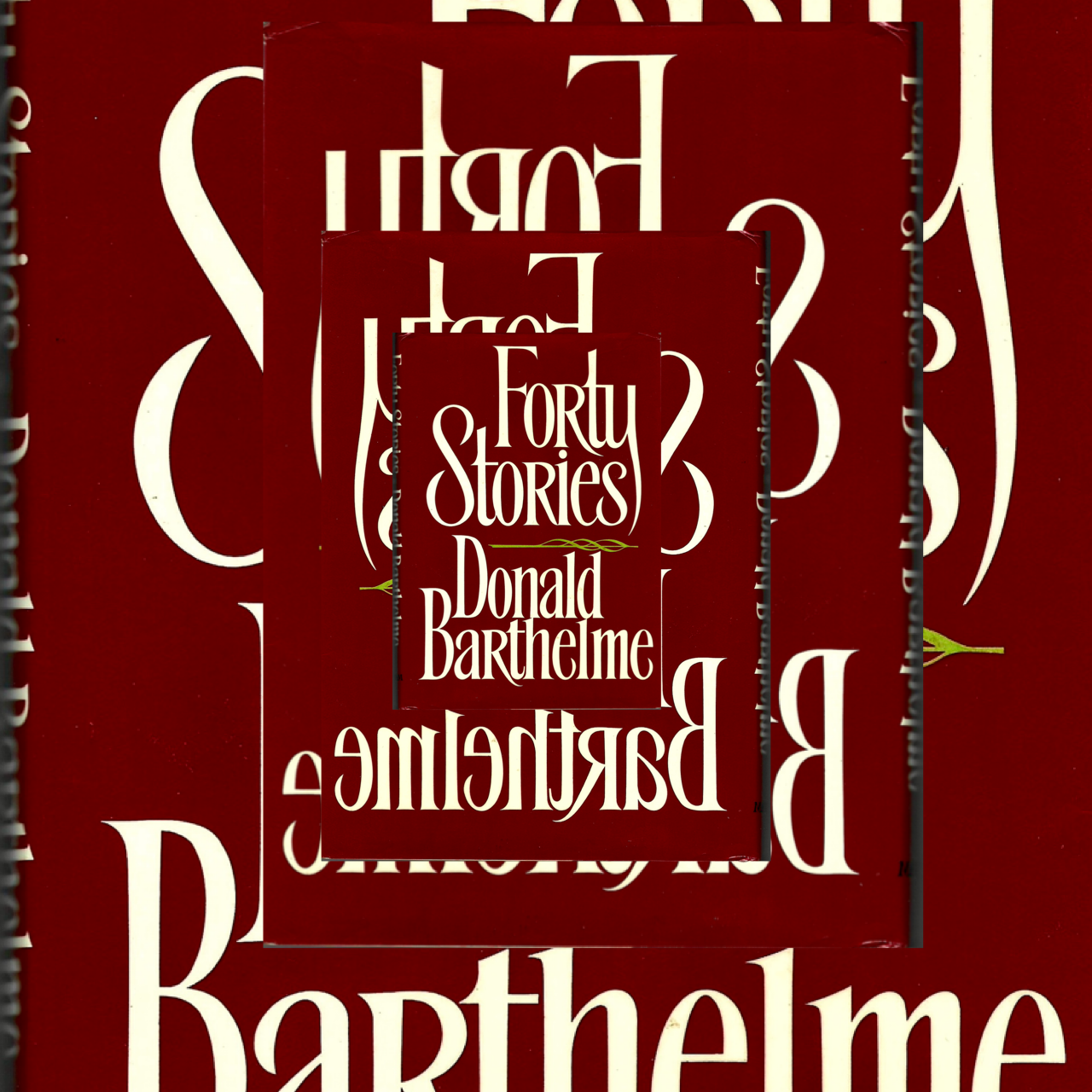
Donald Barthelme’s Forty Stories in reverse, Part V

Previously,

Stories 40-36

Stories 35-32

Stories 31-28

Stories 27-24

23 . “A Few Moments of Sleeping and Waking” (Unspeakable Practices, Unnatural Acts, 1968)

I’ve been reading the stories in Forty Stories as kinda-sorta palate cleansers, usually ingesting one or two between novels; my method is to take a few initial notes to come back to, cross-reference against Tracy Daugherty’s Barthelme biography Hiding Man, and then riff on my general impression. Sometimes a few weeks go by from the time I’ve read or reread one of these stories and the time I actually get around to writing about them. Until now, the title alone has activated some memory or aesthetic impression about the story, but “A Few Moments of Sleeping and Waking” was a total blank for me. I suppose in my memory it simply segued out of the story that preceded it in Barthelme’s excellent 1968 sophomore collection, Unspeakable Practices, Unnatural Acts. That story was “Edward and Pia,” metapseudoautobiographical stand-ins for Barthelme and his third wife Birgit. “A Few Moments” is more droll low-stakes tension between the pair; there’s a little here on films and dreams and their interpretations. The best bit of the story is a moment on cabbage:

Pia was chopping up an enormous cabbage, a cabbage big as a basketball. The cabbage was of an extraordinary size. It was a big cabbage.
“That’s a big cabbage,” Edward said.
“Big,” Pia said.
They regarded the enormous cabbage God had placed in the world for supper.

22 . “The Flight of Pigeons from the Palace” (Sadness, 1972)

A lovely little story, so short and sweet it really can’t be summarized! But I’ll give it a shot: “The Flight” is a comic riff on the audience’s addiction to novelty and sensation. The third-person “we” who narrates “Flight” is a kind of postmodern carnival barker, barking new wonders into existence:

The lineup for opening night included:

A startlingly handsome man

A Grand Cham

A tulip craze

The Prime Rate

Edgar Allan Poe

A colored light

We asked ourselves: How can we improve the show?

We auditioned an explosion.

Barthelme’s not really a moralist, hardly a Hawthorne, but I think he does offer oblique lessons, or warnings really, to his reader. “Flight” culminates thus:

The supply of strange ideas is not endless.

The development of new wonders is not like the production of canned goods. Some things appear to be wonders in the beginning, but when you become familiar with them, are not wonderful at all.

The story concludes in the threatening specter of newly-contracted volcano.

21 . “At the Tolstoy Museum” (City Life, 1970)

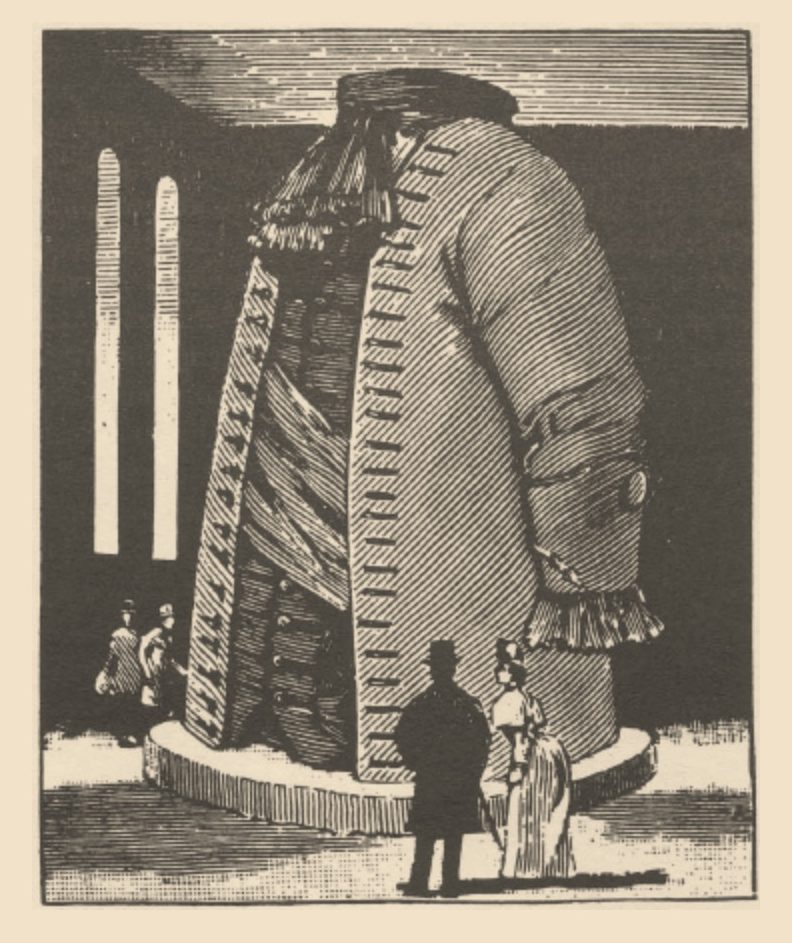
Like “Flight,” “At the Tolstoy Museum” is one of Barthelme’s literal cut-and-paste collage stories — that is, a story to include the author’s own visual collages, juxtaposed against his verbal collages. In “Flight,” the collages seem incidental. They aren’t exactly affectations, and they don’t add anything to the story–but they don’t detract either. The visual collages in “At the Tolstoy Museum” are deployed more judiciously, serving as punchlines that resound off of the narrator’s flat, affectless pose:

I was eating a sandwich at the Tolstoy Museum. The Tolstoy Museum is made of stone—many stones, cunningly wrought Viewed from the street, it has the aspect of three stacked boxes: the first, second, and third levels. These are of increasing size. The first level is, say, the size of a shoebox, the second level the size of a case of whiskey, and the third level the size of a box that contained a new overcoat. The amazing cantilever of the third level has been much talked about. The glass floor there allows one to look straight down and provides a “floating” feeling. The entire building, viewed from the street, suggests that it is about to fall on you. This the architects relate to Tolstoy’s moral authority.

Tolstoy’s Coat

In Hiding Man, Daugherty relates that after “At the Tolstoy Museum” was published in The New Yorker (24 May 1969) “a family from Holly Hill, Florida [wrote to the magazine to learn the location of the Tolstoy Museum.” About two weeks later, Tolstoy’s daughter, the Countess Alexandra L. Tolstoy sent a more indignant letter to the magazine, referring to the story as “Donald Barthelme’s absurd article…What is the aim of such an article? To make people laugh? … How funny! Ha, ha, ha.” Great stuff all around.

20 . “The Wound” (Amateurs, 1976)

A surreal sketch featuring a bullfighter, his mother, his mistress, a bishop, and a famous aficionado (of, implicitly, bullfighting, and, explicitly, breasts), as well as a cast of grumbling minions and peons. Barthelme’s stories are often collage-like, anti-real, hyper-real, or outright absurd, but they are, at least in my estimation, rarely dreamlike. But “The Wound” moves like a dream — a brief, stifled dream, one that reveals something about himself to the dreamer, who later might lament, But I already knew that, like the Bishop who laments his therapy:

The Bishop begins to talk about his psychoanalysis: “I am a different man now,” the Bishop says. “Gloomier, duller, more fearful. In the name of the Holy Ghost, you would not believe what I see under the bed, in the middle of the night.” The Bishop laughs heartily. The torero joins him. The torero’s mistress is filming the Bishop. “I was happier with my whiskey,” the Bishop says, laughing even harder.

The Queen of Gypsies arrives, claiming wounds. There’s “An ecstasy of shrinking” and the final vision of “an immense black bull” blocking the door way. It “begins to ring, like a telephone.”

“The Wound” is a short example that might be handed off to any young person clamoring for meaning or theme or symbolism from every text they read. Sometimes it’s just a dream, a goof, an aesthetic gesture. Sometimes there’s just a surreal punchline that needs to erupt, like a giant black bull ringing like a telephone, blocking the only exit in sight.

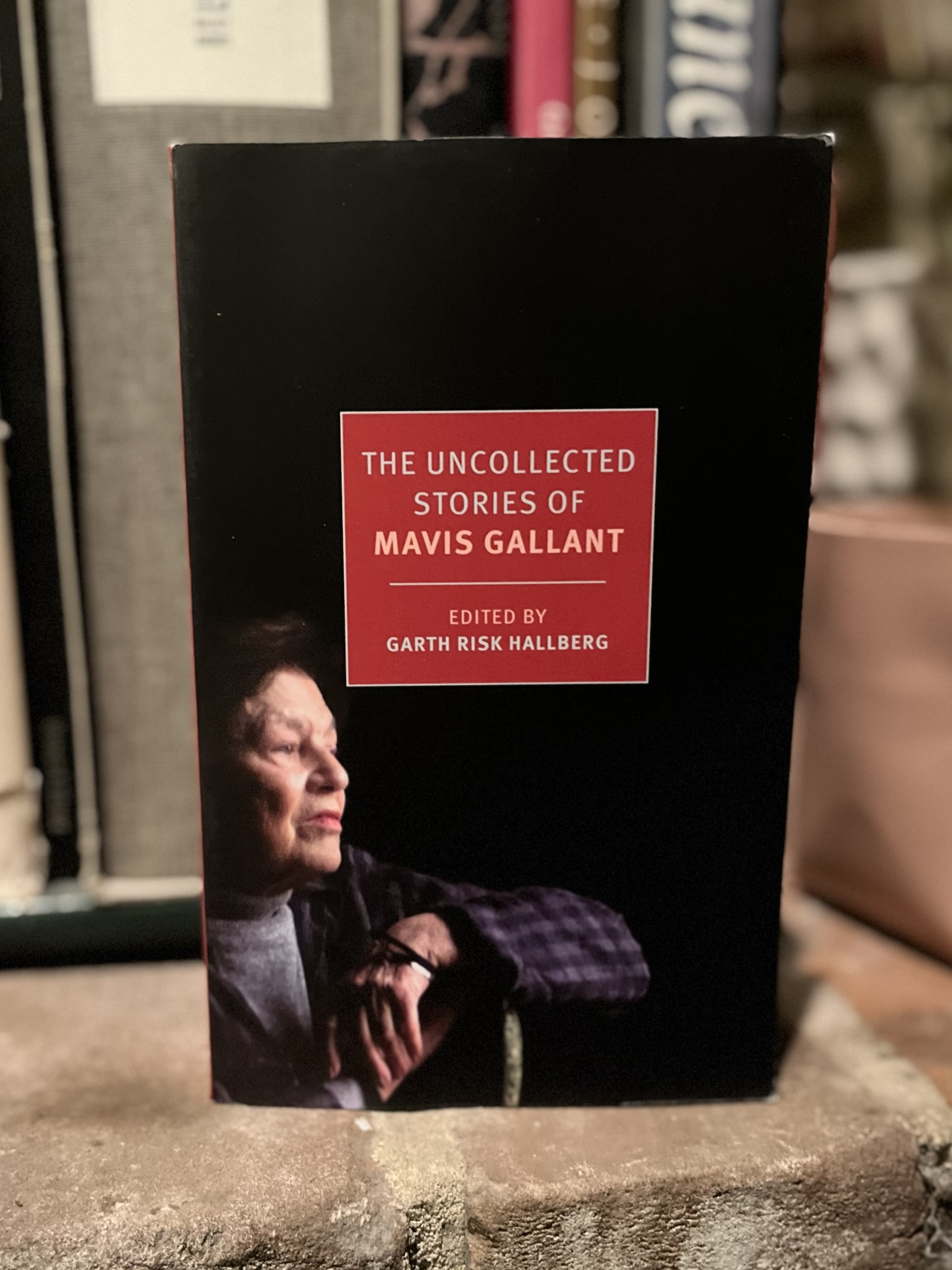
The Uncollected Stories of Mavis Gallant (Book acquired, 2 Jan. 2025)

The Uncollected Stories of Mavis Gallant publishes later this month from NYRB. And oof is she a big boy! NYRB’s blurb:

Mavis Gallant’s extraordinary mastery of the short story remains insufficiently recognized. She may be the best writer of stories since the early-1950s prime of John Cheever, Eudora Welty, and Flannery O’Connor, and even in such august company, her work is sui generis. Gallant’s short fiction refines the art of the story even as it expands the boundaries of what a story can be. Above and beyond that, however, it constitutes a striking, almost avant-garde reduction. To read her is to discover something about the very nature of story: how for better or worse life is caught up in it, and how on the page that common predicament can come to life.

The Uncollected Stories of Mavis Gallant includes more than thirty stories never before gathered into one volume, including “The Accident” and “His Mother” and “An Autobiography” and “Dédé.” With the publication of this book, finally all of this modern master’s fiction will be in print.

Donald Barthelme’s Forty Stories in reverse, Part III

Previously,

Stories 40-36

Stories 35-32

31. “Sakrete” (first published in The New Yorker, 25 Sep. 1983)

“Sakrete” is a silly little domestic riff about garbage can theft, rats, and an alcoholic trying to work with concrete. It’s not a very good story and I have no idea why it was included in Forty Stories. I do like that it shows a general respect for garbage cans and garbage collection (very interested parties should check out Stephen Dixon’s excellent novel Garbage). Here is the last paragraph, the highlight of the story:

 There are now no garbage cans on our street—no garbage cans left to steal. A committee of rats has joined with the Special Provisional committee in order to deal with the situation, which, the rats have made known, is attracting unwelcome rat elements from other areas of the city. Members of the two committees exchange secret grips, grips that I know not of. My wife drives groups of rats here and there in her yellow Pontiac convertible, attending important meetings. The crisis, she says, will be a long one. She has never been happier.

30. “Porcupines At The University” (Amateurs, 1976)

Another trifle—am I regretting this project, this rereading of Forty Stories? The stories in Sixty Stories are so, so much stronger—and those stories were organized chronologically. Going backwards through these is not really going backwards through time, through the artist’s anti-maturation, but rather just, like, making it more difficult to find one’s place in a book. “Porcupines” is a goof on academia that — and I say this as a compliment — at best reads like an alcoholic’s surrealist riff on a college film. Skip it!

29. “The Catechist” (Sadness , 1972)

This is a good story, “The Catechist.” But also a very Catholic one, without being, like, small-c catholic. There’s a bit of narrativizing here that Barthelme would eventually dispense with in his dialogues, the form that he would eventually settle on for his short stories. I say “settle on” but Barthelme died quite young, or, it seems to me, at 45, quite young—dying at 58. Barthelme died from throat cancer, probably a result of his alcoholism (pure conjecture on my part, this last clause):

The catechist reads from his book. “The candidate should be questioned as to his motives for becoming a Christian.”
I think: My motives?
He says: “Tell me about yourself.”
I say: “I’m forty. I have bad eyes. An enlarged liver.”
“That’s the alcohol,” he says.
“Yes,” I say.
“You’re very much like your father, there.”
“A shade more avid.”

28. “Lightning” (Overnight to Many Distant Cities, 1983)

This is a great story. Or at least a very good story, unexpectedly so, written a mode approaching near-realism or even near-dirty-realism. Was Barthelme flexing his muscles in the mirror after having read a story by Raymond Carver? Probably not, but I like to imagine it (I imagine his muscles beefier and musclier than they likely were). “Lightning” has a fairly straightforward ( and unBarthelemesque) plot:

Edward Connors, on assignment for Folks, set out to interview nine people who had been struck by lightning. “Nine?” he said to his editor, Penfield. “Nine, ten,” said Penfield, “doesn’t matter, but it has to be more than eight.” “Why?” asked Connors, and Penfield said that the layout was scheduled for five pages and they wanted at least two people who had been struck by lightning per page plus somebody pretty sensational for the opening page. “Slightly wonderful,” said Penfield, “nice body, I don’t have to tell you, somebody with a special face. Also, struck by lightning.”

The story is ultimately a romantic comedy, with reporter Edward finally finding his “face”:

People would dig slant wells for this woman, go out into a producing field with a tank truck in the dead of night and take off five thousand gallons of somebody else’s crude, write fanciful checks, establish Pyramid Clubs with tony marble-and-gold headquarters on Zurich’s Bahnhofstrasse. What did he have to offer?

He finds something to offer. This is probably the best one yet in Forty Stories (in reverse, anyway).

Mass-market Monday | American Short Stories since 1945

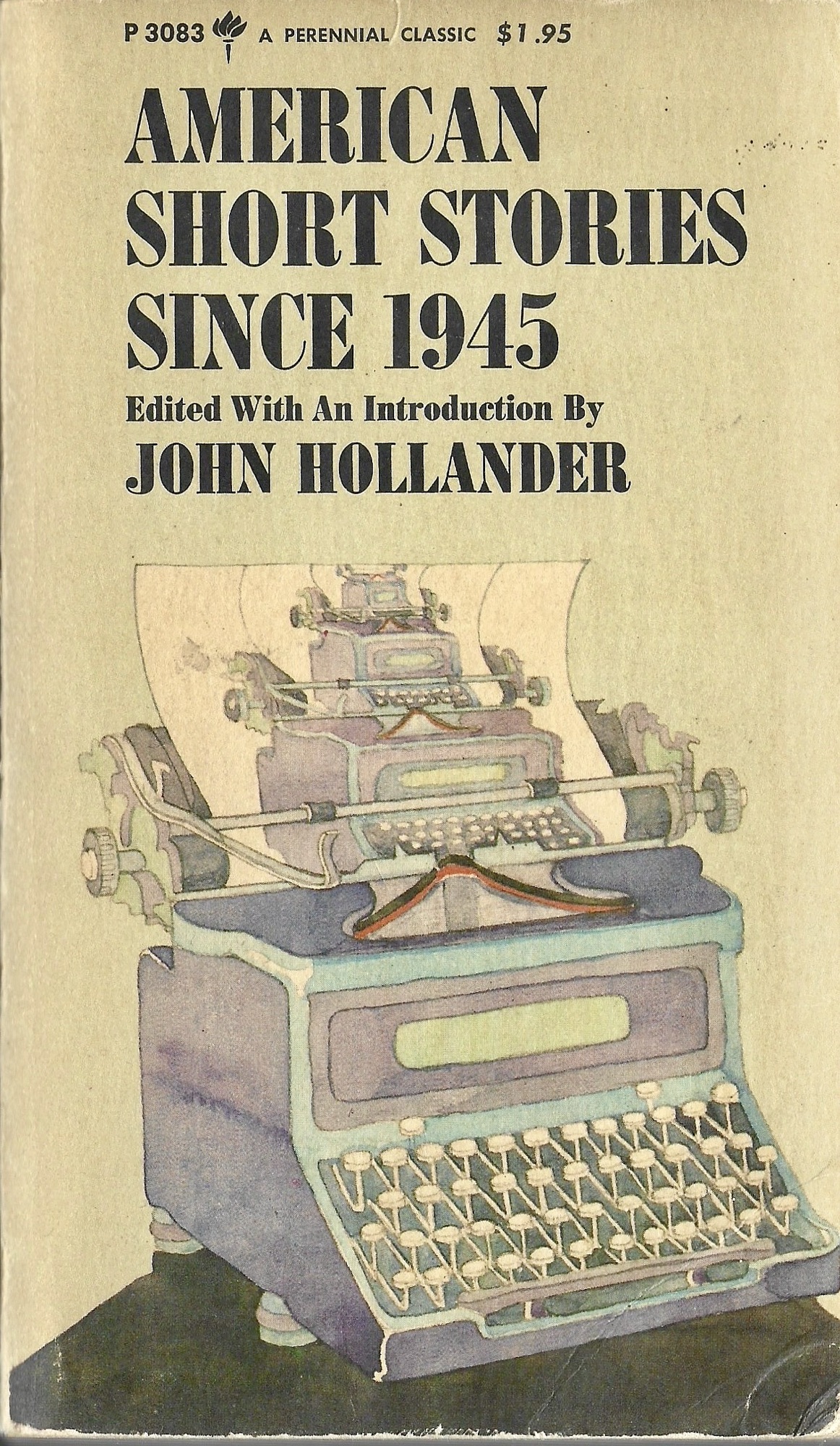
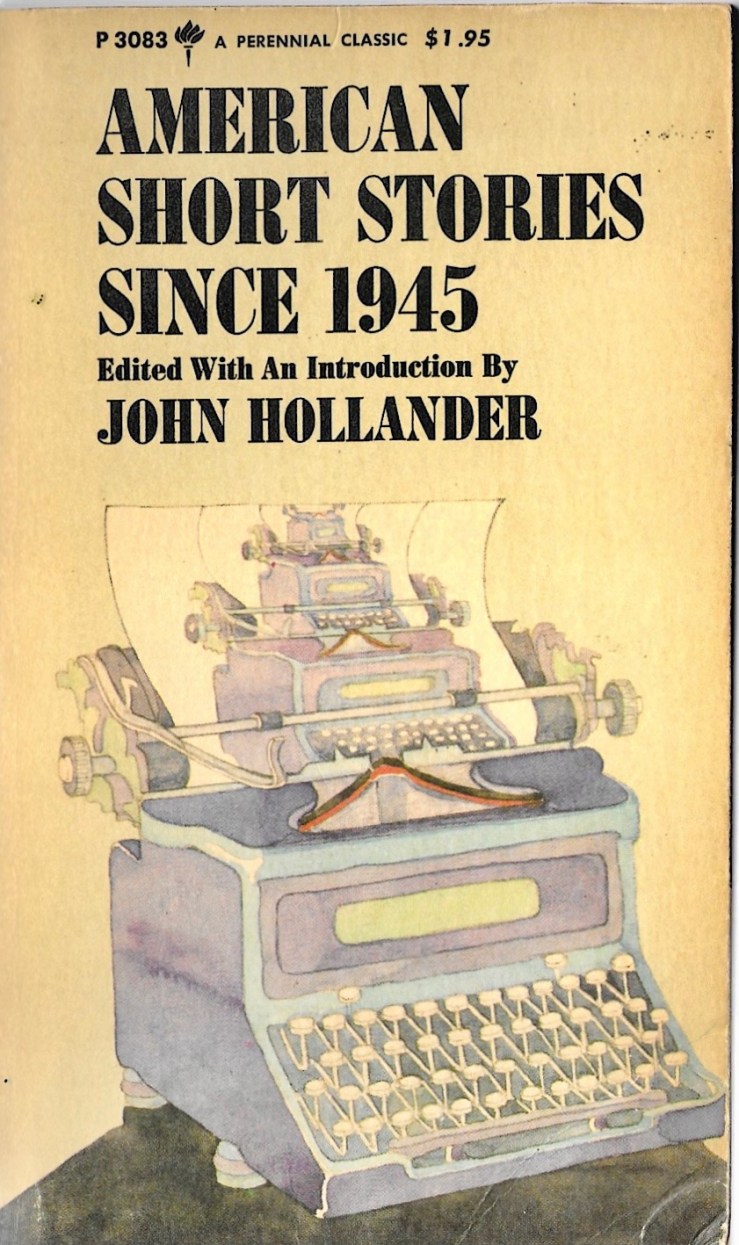
American Short Stories since 1945, edited by John Hollander. Perennial Classics, first edition, 1968. Cover design by Emanuel Schongut. 525 pages.

I think it was the title and the spine that first intrigued me when I pulled American Short Stories since 1945 from the shelf of a used book store: What would the selections be? How many years does the collection span? If Emanuel Schongut’s exquisite cover didn’t sell me on the book (which it did, all two dollars of it!), then the track list on the back certainly would have. And not so much for the authors I’d already read–Gass, Pynchon, Barthelme, O’Connor, Baldwin, and so on—but for the ones I hadn’t heard of, or at least didn’t think I’d heard of. Paul Goodman? Gilbert Rogin? Jeremy Larner? George P. Elliott? The poet who compiled the collection, John Hollander, writes in his introduction that it “aims to show the major shapes taken by shorter fiction in America since the end of World War II.” It’s the sort of book I wish I’d found when I was much, much younger, the kind of mixtape that would have sent me a lot of strange, wonderful directions.

October recommendation: Fireworks, Angela Carter’s collection of sadomasochistic erotica

It’s October, and maybe you want some light heavy reading, something titillating but deep, sharp, maybe a little gross at times, always unnerving, right?

How about reading Angela Carter’s 1974 collection Fireworks?

Subtitled Nine Profane Pieces, the collection features nine profane pieces. Actually, I don’t think profane is the right adjective (although I’d always cede to Carter’s judgment in matters of diction). Many, no, most, of these stories approach the spiritual—albeit in a roundabout, okay, profane, manner. In the phallically-titled “Penetrating to the Heart of the Forest,” for example, Carter reimagines Adam and Eve in a new garden through a lens that ironizes both Rousseau’s notion of the noble savage as well as the European colonial project in general. There’s also some mild incest in the tale, to boot—so, okay, sure, profane.

The noun in Carter’s subtitle, pieces, is wholly accurate: the selections in Fireworks have a unified tone, but are disparate in form. There are fabulous thrillers here (“The Loves of Lady Purple,” the story of a puppet prostitute who sucks the life out of her ventriloquist master), morality tales (“Master,” a riff on the Great White Hunter with a figurative middle finger pointed in the general direction of Defoe’s Crusoe), and reminiscences that approach so-called autofiction (“A Souvenir of Japan” and “The Smile of Winter,” mementos of the years Carter lived in Japan). “Flesh and the Mirror” expands on Carter’s years in Japan, but swerves into Borgesian territory; “Reflections” goes straight through the Borgesian mirror into Burroughs world (William S., with just a touch of Edgar R.).

The strongest piece in the collection, at least in my estimation, is “The Executioner’s Beautiful Daughter,” which reads like a travelogue into incestuous abjection. “Here we are, high in the uplands,” our detached narrator begins, before offering up an anthropological catalog of life in that upland. The barest ghost of a plot clutches onto “The Executioner’s Beautiful Daughter,” and the piece is all the stronger for it. Instead, we get a cold, ugly study in cruelty and horror.

Readers new to Carter might prefer to start with her seminal 1979 collection The Bloody Chamber, a book whose inverted fairy tales eviscerate the adjective I used in the previous clause, that adjective seminalThe Bloody Chamber is great! (Check out “Wolf-Alice” for a taste.) (And while I’m hanging out in parentheses, I’ll point out that Burning Your Boats collects pretty much all of Carter’s short fiction.) But back to Fireworks—if the pieces here are not as refined and unified as the anti-fairy tales that comprise Carter’s more-celebrated collection The Bloody Chamber, they are all the more fascinating as studies in sadomasochism, alienation, and the emerging of a new literary consciousness. Great stuff.

Check out my Personal Anthology featuring Southern literature

For about five years, the writer Jonathan Gibbs has curated a project called A Personal Anthology, where guest editors offer up a dozen short stories. Sometimes the anthologies are Greatest Hits, sometimes they’re personal favorites or central to the development of the editor’s own writing, sometimes they’re themed. Jonathan was kind enough to invite me to edit this week’s Personal Anthology. Putting it together was much, much harder than I had expected it would be, but once I imposed a limit on myself —namely “Southern literature” — the tracklist came together neatly. You can read my Personal Anthology here.

Here’s the introduction:

I live in Florida, and although I’m not a native, I consider myself a Southerner. “The South” is a nebulous, diverse, and perplexing region in the United States of America, often romanticized, vilified, ridiculed, championed, and misunderstood. It’s difficult to define exactly where the South begins and ends. Georgia, Alabama, and Mississippi are the South, but what about Kentucky or Missouri? Texas is the South, but at some point, it also becomes the West. A common joke is that Florida stops being the South the farther south one goes into Florida. The boundaries are murky.

So too is so-called “Southern literature” hard to pin down. The great Georgian moralist Flannery O’Connor declared that “anything that comes out of the South is going to be called grotesque by the Northern reader reader, unless it is grotesque, in which case it is going to be called realistic.” Here I think we might let the word “Northern” stand for any reader not from the South. O’Connor imbued her work with grotesque distortions to bring “alive some experience which we are not accustomed to observe every day, or which the ordinary man may never experience in his ordinary life.”

In compiling this Personal Anthology, I have sought to offer up a dozen tales from/of the nebulous, dirty, fecund South that bring unaccustomed experience to life for the reader.

See which stories I picked.

Donald Barthelme’s Sixty Stories in reverse: Chapter the Last, featuring Thirty Stories, Fifteen Stories, and Ten Stories

Previously,

Stories 60-55

Stories 54-49

Stories 48-43

Stories 42-37

Stories 36-31

Stories 30-25

Stories 24-19

Stories 18-13

Stories 12-7

Stories 6-1

I don’t know if there’s a need for a defense of Donald Barthelme, and I do know that I am not the person to mount that defense. I spent the last two months re-reading Sixty Stories along with/against Tracy Daugherty’s 2010 biography of Barthelme, Hiding Man. I read some other stuff, but most of the writing on this cursed website was about Barthelme’s stories.

Here’s the thing: these stories, even when soaked in the juices of their zeitgeist (“The Sandman,” “The Indian Uprising,” “Robert Kennedy Saved from Drowning”) more than hold up. They are still fresh, funny, strange, charming. I suppose they could be more upsetting–Barthelme’s world is never raw, and always displaces the visceral through a heavy salve of ironic refinements (and a three-martini haze).

But Barthelme’s rhetorical contortions vivify the forms that he parodies here—early French modernism (“Eugénie Grandet”) or Kafkaesque existentialism (“Me and Miss Mandible,” “The Sergeant”) or faux-academic essaying (“On Angels”). He transmutes the material into something more. In his introduction to the 2003 Penguin Classics edition of Sixty Stories that I read, David Gates remarks that,

Barthelme is a quintessential writer of the twentieth century, looking Janus-faced to both the past and future, and with a third eye turned inward. Yet he’s also an anomaly. Nobody before him really reads much like him: neither Beckett or Nabokov, nor such minimalist realists as Hemingway, nor such fabulists as Kafka and Borges…Nor has he become anyone’s Dead Father.

Gates’s appellation “Dead Father” is a nod to Barthelme’s best novel as well as the oedipal undercurrent that surges over and under his ouevre. Gates tries to situate Barthelme’s modernism, a modernism beholden to Dead Father Beckett, himself beholden to Dead Father Joyce.

But Gates never comes out and states what I think is clear after re-reading Sixty Stories (especially against Daugherty’s Barthelme biography)–Barthelme’s success is that he is a failed modernist. In his 1981 interview with J.D. O’Hara, Barthelme stated,

…my father was an architect of a particular kind—we were enveloped in modernism. The house we lived in, which he’d designed, was modern and the furniture was modern and the pictures were modern and the books were modern.

Raised a Modernist, Barthelme transcends Modernism.

And yet he was reticent of any terms that might fix him as something other. In a 1980 interview with Larry McCaffery, he called “‘postmodernism’…the least ugly, most descriptive” of the terms that had been used to pigeonhole his fiction.

He hedged more in his 1987 essay “Not Knowing,” musing that it was “not altogether clear as to who is supposed to be on the bus and who is not.” Postmodernism though is really just a descriptor. And we’re all on the bus.

Gates eventually settles on Barthelme as a “Dark Uncle” of literature, as opposed to a Dead Father. Like Nabokov, Gates suggests Barthelme may have imitators, but not true followers. (Gates does posit the potential of George Saunders to get there, and I’d argue no other living American writer (that I know of) would have at one time been fit to take up the Barthelme mantle, but kudos to Saunders for forging his own schmaltzy overly-empathetic path.)

But enough of Gates’s intro. It’s good. It’s very 2003–mentions of David Eggers, Harold Bloom, a lot of handwringing about postmodernism. (Somehow, unless I’m forgetting, Barthelme’s true contemporary Robert Coover isn’t mentioned.)

Anyway. The stuff in Sixty Stories still shines, still sings–and much of it is far more poignant than I would’ve initially credited.

So here are the silly lists.

If you want to turn Sixty Stories into Thirty Stories, here’s my edit (in reverse chronology):

“Bishop,” (previously uncollected, 1981)

“The Emerald,” (previously uncollected, 1981)

“The King of Jazz,” (Great Days, 1979)

“Cortes and Montezuma,” (Great Days, 1979)

“The Great Hug,” (Amateurs, 1976)

“The School,” (Amateurs, 1976)

“I Bought a Little City,” (Amateurs, 1976)

“At the End of the Mechanical Age,” (Amateurs, 1976)

“A Manual for Sons,” (The Dead Father, 1975)

“Eugénie Grandet,” (Guilty Pleasures, 1974)

“Nothing: A Preliminary Account” (Guilty Pleasures, 1974)

“Daumier” (Sadness, 1972)

“The Rise of Capitalism” (Sadness, 1972)

“The Sandman” (Sadness, 1972)

“The Glass Mountain” (City Life, 1970)

“The Policemen’s Ball” (City Life, 1970)

“Kierkegaard Unfair to Schlegel” (City Life, 1970)

“The Phantom of the Opera’s Friend” (City Life, 1970)

“On Angels” (City Life, 1970)

“Paraguay” (City Life, 1970)

“Views of My Father Weeping” (City Life, 1970)

“The Indian Uprising” (Unspeakable Practices, Unnatural Acts, 1968)

“See the Moon?” (Unspeakable Practices, Unnatural Acts, 1968)

“Report” (Unspeakable Practices, Unnatural Acts, 1968)

“Robert Kennedy Saved from Drowning” (Unspeakable Practices, Unnatural Acts, 1968)

“Game” (Unspeakable Practices, Unnatural Acts, 1968)

“The Balloon” (Unspeakable Practices, Unnatural Acts, 1968)

“For I’m the Boy” (Come Back, Dr. Caligari, 1964)

“Me and Miss Mandible” (Come Back, Dr. Caligari, 1964)

“A Shower of Gold” (Come Back, Dr. Caligari, 1964)


If you want to turn Sixty Stories into Fifteen Stories, here’s my edit (in reverse chronology):

“The Emerald,” (previously uncollected, 1981)

“The School,” (Amateurs, 1976)

“At the End of the Mechanical Age,” (Amateurs, 1976)

“A Manual for Sons,” (The Dead Father, 1975)

“Eugénie Grandet,” (Guilty Pleasures, 1974)

“Daumier” (Sadness, 1972)

“Kierkegaard Unfair to Schlegel” (City Life, 1970)

“On Angels” (City Life, 1970)

“Paraguay” (City Life, 1970)

“Views of My Father Weeping” (City Life, 1970)

“The Indian Uprising” (Unspeakable Practices, Unnatural Acts, 1968)

“Robert Kennedy Saved from Drowning” (Unspeakable Practices, Unnatural Acts, 1968)

“Game” (Unspeakable Practices, Unnatural Acts, 1968)

“The Balloon” (Unspeakable Practices, Unnatural Acts, 1968)

“Me and Miss Mandible” (Come Back, Dr. Caligari, 1964)

If you want to turn Sixty Stories into Ten Stories, here’s my edit (in reverse chronology):

“The Emerald,” (previously uncollected, 1981)

“A Manual for Sons,” (The Dead Father, 1975)

“Eugénie Grandet,” (Guilty Pleasures, 1974)

“Daumier” (Sadness, 1972)

“Kierkegaard Unfair to Schlegel” (City Life, 1970)

“Views of My Father Weeping” (City Life, 1970)

“The Indian Uprising” (Unspeakable Practices, Unnatural Acts, 1968)

“Game” (Unspeakable Practices, Unnatural Acts, 1968)

“The Balloon” (Unspeakable Practices, Unnatural Acts, 1968)

“Me and Miss Mandible” (Come Back, Dr. Caligari, 1964)

The world is unsatisfactory | Donald Barthelme

We are left, I submit, with the problem of her depressions. They are, I agree, terrible. Your idea that I am not “supportive” enough is, I think, wrong. I have found, as a practical matter, that the best thing to do is to just do ordinary things, read the newspaper for example, or watch basketball, or wash the dishes. That seems to allow her to come out of it better than any amount of so-called “support. ” (About the chasmus hystericus or hysterical yawning I don’t worry any more. It is masking behavior, of course, but after all, you must allow us our tics. The world is waiting for the sunrise.) What do you do with a patient who finds the world unsatisfactory? The world is unsatisfactory; only a fool would deny it. I know that your own ongoing psychic structuralization is still going on-you are thirty-seven and I am forty-one-but you must be old enough by now to realize that shit is shit. Susan’s perception that America has somehow got hold of the greed ethic and that the greed ethic has turned America into a tidy little hell is not, I think, wrong. What do you do with such a perception? Apply Band-Aids, I suppose. About her depressions, I wouldn’t do anything. I’d leave them alone. Put on a record.

From Donald Barthelme’s short story “The Sandman.”

Donald Barthelme’s Sixty Stories in reverse, Part IV

I am rereading Donald Barthelme’s Sixty Stories, starting with the sixtieth story and working my way to the first and writing about it.

Previous entries:

Stories 60-55

Stories 54-49

Stories 48-43

This post covers stories 42-37.

47. “The Crisis” (Great Days, 1979)

“The Crisis” is a bit of a toss off, a bricolage of the last decade (’69-’79) that never coheres into a duet, monologue, theme, or even punchline. Its plot, such as it is, details (details is not the correct verb) the circumstances of an absurd failed revolution. Ostensibly a dialogue (or is it a chorus?), “The Crisis” doesn’t add up to much, and is perhaps best summarized in one of its closing images:

Distant fingers from the rebel forces are raised in fond salute.

Is Barthelme shooting his readers the bird?

The story feels like a slapdash riff on Walker Percy’s weird and wonderful satirical novel Love in the Ruins. (Barthelme was a huge Percy fan.)

46. “Our Work and Why We Do It” (Amateurs, 1976)

“Our Work and Why We Do It” is self-consciously postmodern, a mash-up of Beckett’s absurdism, Benjamin’s seminal “The Work of Art in the Age of Mechanical Reproduction,” burgeoning Marxist aesthetic philosophy, and the modes and means of modernism. The opening line seems to satirize capital’s relationship between art, artist, and the means of production: “As admirable volume after admirable volume tumbled from the sweating presses . . . ” The ellipses are not mine; rather, Barthelme sets the stage here for a print economy of capitalist transactions. The Wells Fargo man arrives, gun in hand, to pick up the “bundle of Alice Cooper T-shirts we had just printed up.” He hurries the “precious product” — that’s all it is, product, content — to the “glittering fans”.

We then learn there’s a bit of conflict between the owners and the workers.

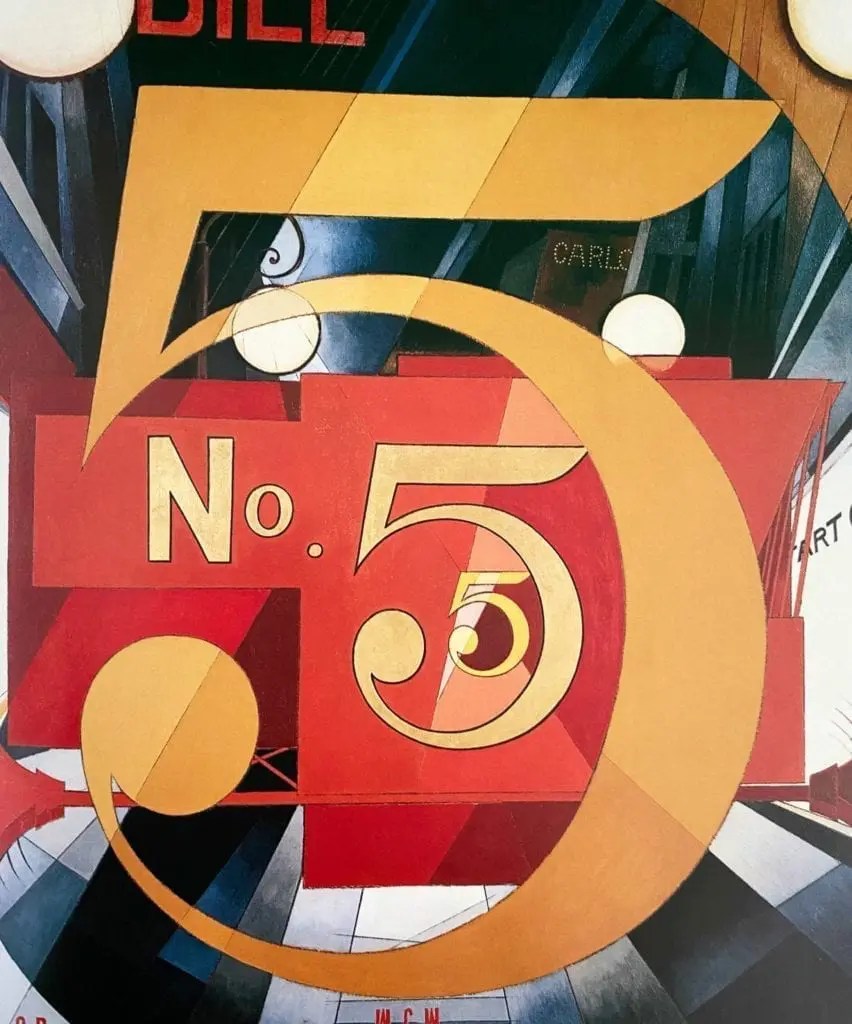
A few lines later, the narrator quips, “And I saw the figure 5 writ in gold.” Barthelme copies-cuts-pastes the modernists into his collage here—we get the visual of Charles Demuth’s painting, itself copying-cutting-pasting Willliam Carlos Williams’ “The Great Figure.”

Publication is a rough business: “If only we could confine ourselves to matchbook covers!” laments the narrator–

But matchbook covers are not our destiny. Our destiny is to accomplish 1. 5 million impressions per day. In the next quarter, that figure will be upped by twelve percent, unless

The hanging “unless” is Barthelme’s rhetorical trick and not my oversight—the punchline is “leather,” by the way.  “Leather is the way to accomplish more impressions. But the real hanging punchline is that word “impressions,” with its many connotations.

45. “The Great Hug” (Amateurs, 1976)

Such a great weird little story—is it about a toxic relationship between the Balloon Man and the Pin Lady? is it a metaphor for relationships in the modern era? is it an autobiographical riff, Barthelme’s love woes scribbled into a weird parody? —an oblique comment on e.e. cummings “in Just” — look, I don’t fucken know, maybe read it here. It’ll only take a few minutes, and then you can think about it for a week or so.

44. “The School” (Amateurs, 1976)

“The School” is wonderful stuff, and will take you like, what, 9, 10 minutes to read, if not less.

It’s a monologue I guess, delivered by a sorry educator whose schooling has killed off all manner of creatures. In the first three paragraphs we learn about the school’s failure to keep alive trees, snakes, and herb gardens, but then there’s a more drastic turn:

Of course we expected the tropical fish to die, that was no surprise. Those numbers, you look at them crooked and they’re belly-up on the surface. But the lesson plan called for a tropical fish input at that point, there was nothing we could do, it happens every year, you just have to hurry past it.

We weren’t even supposed to have a puppy.

We weren’t even supposed to have a puppy—goddammit Donald Barthelme. This line made me laugh out loud. And then it made me sad.

Reviewing my summary of the first three paragraphs, I’m tempted to make something religious out of it all—trees, snakes, gardens, and the like—but I don’t think that’s the gist. Or maybe it is the gist (Barthelme grew up Catholic). Is this a goof on the Eden thing? Humanity’s failure to be good stewards of the planet, etc. etc. etc.? I don’t know. Look, it’s a funny little story, read it.

43. “The Sergeant” (Amateurs, 1976)

“The Sergeant” reads like an oddity in Barthelme’s catalog—although not really, I guess, when that catalog is all oddity.

On one hand, “The Sergeant” is narrated in a seemingly-straightforward Hemingwayesque first-person I. This narrator is clearly based on a version of Barthelme. Barthelme served in the Korean War, but the real backdrop of “The Sergeant” is the Vietnam War–which was also the backdrop of much of Barthelme’s writing career (he arguably best addresses that folly in his 1968 story “The Indian Uprising,” which I’m still a ways from).

On the other hand, “The Sergeant” comes from the school of Kafka—it’s the bad dream we’ve all had, the nightmare repetitions of past duties we didn’t even sign up for. “The Sergeant” reads like a short blueprint for much of the Kafkaesque fiction that would follow it, including the labyrinths of Kazuo Ishiguro.

But Barthelme punctuates his nightmare-tale with a mythological touch: “Penelope!” cries the narrator, extending Barthelme’s anxiety riff into an ageless epic.

42. “I Bought a Little City” (Amateurs, 1976)

I Bought a Little City” is likely regarded as one of Barthelme’s greatest hits, possibly because it’s a more straightforward affair than his collages, pastiches, and oblique parodies. There’s a mean streak to this story about a rich man who buys Galveston, Texas. The story is about a lot things—control, desire, community, and creativity, maybe best summed up in two of its early lines: “What a nice little city, it suits me fine. It suited me fine so I started to change it.” People love to blow up their lives, but the asshole narrator citybuyer starts to blow up other people’s lives. He shoots six thousand dogs, for example. He humiliates a cop by making said cop buy him some fried chicken. He tries to steal another man’s wife, but it doesn’t work out. Maybe “I Bought a Little City” is about creative failures; maybe it’s a satire of capitalism. Or maybe it’s just another Barthelme goof.

Summary thoughts: Uh…the stories in Amateurs are generally better than those in Great Days. The weakest one here is “The Crisis,” from Great Days; the other stories feel more of a piece with each other. I enjoyed “The Sergeant” the most, but mostly because it has a different flavor from the other stories. “The School” is probably the best of the batch.

Going forward (in reverse): We continue backwards through the seventies, where we eventually hit (what I think might be a top-ten Barthelme hit) “Eugénie Grandet.”

Donald Barthelme’s Sixty Stories in reverse, Part III

I am rereading Donald Barthelme’s Sixty Stories, starting with the sixtieth story and working my way to the first. I wrote about stories 60-55 here and stories 54-49 here,

This post covers stories 48-43.

48. “The Death of Edward Lear” (Great Days, 1979)

Like many of the stories culled from Great Days, the humor in “The Death of Edward Lear” is tinged with melancholy. Perhaps it’s because of its subject matter, or perhaps it’s knowing that Great Days was the last collection of originals Barthelme would write, but “The Death of Edward Lear” feels like the work of a much older man. In fact, it was first published in The New Yorker in 1971, when Barthelme was forty, barely middle aged. (For whatever reasons, Barthelme didn’t include the piece in his collections Sadness (1972) or Amateurs (1976.))

The story begins in the most straightforward manner:

The death of Edward Lear took place on a Sunday morning in May 1888. Invitations were sent out well in advance. The invitations read:

Mr. Edward LEAR
Nonsense Writer and Landscape Painter
Requests the Honor of Your Presence
On the Occasion of his DEMISE.
San Remo 2:20 a.m.
The 29th of May Please reply

One can imagine the feelings of the recipients. Our dear friend! is preparing to depart! and such-like. Mr. Lear! who has given us so much pleasure! and such-like. On the other hand, his years were considered. Mr. Lear! who must be, now let me see… And there was a good deal of, I remember the first time I (dipped into) (was seized by)…But on the whole, Mr. Lear’s acquaintances approached the occasion with a mixture of solemnity and practicalness…

Lear treats his many guests to a strange spectacle of rants, rhymes, and mandolin-playing. He also delivers a “short homily on the subject of Friendship.” Then he dies.

His audience is initially confused, before realizing that Lear had crafted his death into a piece of absurdist art:

People who attended the death of Edward Lear agreed that, all in all, it had been a somewhat tedious performance. Why had he seen fit to read the same old verses, sing again the familiar songs, show the well-known pictures, run through his repertoire once more? Why invitations? Then something was understood: that Mr. Lear had been doing what he had always done and therefore, not doing anything extraordinary. Mr. Lear had transformed the extraordinary into its opposite. He had, in point of fact, created a gentle, genial misunderstanding.

And Lear’s performance engenders future performances:

The death of Edward Lear can still be seen, in the smaller cities, in versions enriched by learned interpretation, textual emendation, and changing fashion. One modification is curious; no one knows how it came about. The supporting company plays in the traditional way, but Lear himself appears shouting, shaking, vibrant with rage.

That final angry image is sad, haunting even. It recalls that other Lear, mad on the heath, as well as Dylan Thomas’s most famous villanelle.

In his biography Hiding Man, Tracy Daugherty speculates that the idea for “Lear” might be attributed in part to the “farewell parties” Susan Sontag hosted in the mid-seventies when she thought she might die from cancer. There’s a human reality coursing under the story’s apparent absurdity that makes it a memorable, enjoyable tale about making art out of life and death.

Edward Lear’s actual death sounds much sadder. According to the Edward Lear Society, “Lear’s funeral was said to be a sad, lonely affair by the wife of Dr. Hassall, Lear’s physician, not one of Lear’s many lifelong friends being able to attend.”

47. “Morning” (Great Days, 1979)

In Hiding Man, Daugherty claims that “Morning” is about “the limits of the educational system,” but I don’t see it. It’s an absurdist dialogue, almost impenetrable in its obliquity—which would be fine if the sentences were better. There had to have been better stories in Great Days than “Morning” — the superior “Concerning the Bodyguard” is from that collection, and eventually ended up in Forty Stories—but I’m sure Barthelme had his reasons for including it. Those reasons, like the story, are inscrutable to me.

46. “The King of Jazz” (Great Days, 1979)

A great little ditty told (almost) entirely in dialogue, “The King of Jazz” takes place over the first few minutes of Hokie Mokie’s reign as the new, um, king of jazz. Hokie’s tenure comes under threat almost immediately when Hideo Yamaguchi, a stranger from Tokyo, appears seemingly from nowhere to challenger the new king. A musical duel ensues, helpfully described by one of the musicians in attendance:

“What’s that sound coming in from the side there?”

“Which side?”

“The left.”

“You mean that sound that sounds like the cutting edge of life? That sounds like polar bears crossing Arctic ice pans? That sounds like a herd of musk ox in full flight? That sounds like male walruses diving to the bottom of the sea? That sounds like fumaroles smoking on the slopes of Mt. Katmai? That sounds like the wild turkey walking through the deep, soft forest? That sounds like beavers chewing trees in an Appalachian marsh? That sounds like an oyster fungus growing on an aspen trunk? That sounds like a mule deer wandering a montane of the Sierra Nevada? That sounds like prairie dogs kissing? That sounds like witchgrass tumbling or a river meandering? That sounds like manatees munching seaweed at Cape Sable? That sounds like coatimundis moving in packs across the face of Arkansas? That sounds like – ”

“Good God, it’s Hokie! Even with a cup mute on, he’s blowing Hideo right off the stand!”

Barthelme here and elsewhere excels at pushing and pulling language in ways with which we are unfamiliar. There’s a synesthetic quality to his best writing, writing which so frequently attempts to engage with and evoke other arts—visual, arts, poetry.

“The King of Jazz” also continues the thread of Oedipal anxiety that courses throughout Barthelme’s work. That anxiety here is not necessarily father-son oriented, but rather the anxiety of the outsider who becomes established, the experimenter who succeeds—and then finds his work challenged by new comers.

45. “The Zombies” (Great Days, 1979)

“The Zombies” is another fun story—and one of the rare late stories not told entirely in dialogue. I’m not really sure if “The Zombies” is a specific parody or just a goof, but it makes me laugh:

In a high wind the leaves fall from the trees. The zombies are standing about talking. “Beautiful day!” “Certainly is!” The zombies have come to buy wives from the people of this village, the only village around that will sell wives to zombies. “Beautiful day!” “Certainly is!” The zombies have brought many cattle. The bride price to a zombie is exactly twice that asked of an ordinary man. The cattle are also zombies and the zombies are in terror lest the people of the village understand this.

There are good zombies and bad zombies. Gris Grue is the hero of the good zombies. There’s a Bishop involved. Watch out: “The kiss of a dying animal, a dying horse or dog, transforms an ordinary man into a zombie.”

And watch out too for bad zombies: “If a bad zombie gets you, he will scarify your hide with chisels and rakes. If a bad zombie gets you, he will make you walk past a beautiful breast without even noticing.”

44. “The New Music” (Great Days, 1979)

“The New Music”: Another dialogue, another synesthetic excursion into Oedipal territories—this time focused on the mother:

–She had a lot on her mind. The chants. And Daddy of course.

–Let’s not do Daddy today.

Two brothers discuss “the new music,” which both is and is not music. As in much of Barthelme’s work, elements of art and culture might be patched and pasted in new designs, new collages.

–The new music burns things together, like a welder. The new music says, life becomes more and more exciting as there is less and less time.

–Momma wouldn’t have ‘lowed it. But Momma’s gone.

With their disallowing mother out of the way, the boys can now move forward into the new music.

43. “Cortés and Montezuma” (Great Days, 1979)

“Cortés and Montezuma” is the strongest tale in this batch. The story tells a version of the “friendship” between the Spanish conquistador and the Aztec emperor. Unlike the quippy, often absurd dialogue pieces, “Cortés and Montezuma” is told in a simple, direct (even flat) third-person voice. Here’s how the story opens:

Because Cortés lands on a day specified in the ancient writings, because he is dressed in black, because his armor is silver in color, a certain ugliness of the strangers taken as a group-for these reasons, Montezuma considers Cortés to be Quetzacoatl, the great god who left Mexico many years before, on a raft of snakes, vowing to return.

Montezuma gives Cortés a carved jade drinking cup.

Cortés places around Montezuma’s neck a necklace of glass beads strung on a cord scented with musk.

Montezuma offers Cortés an earthenware platter containing small pieces of meat lightly breaded and browned which Cortés declines because he knows the small pieces of meat are human fingers.

The story repeats the image of Cortés and Montezuma walking and holding hands, exchanging gifts, and not really trusting each other. There is plenty of intrigue and paranoia. Cortés is sleeping with his translator, but she’s also taken a high-ranking Aztec for a lover. The nobles are starting to turn on Montezuma. Various folks employ detectives to trail other folks. Assassination plots loom.

Much of the strength of “Cortés and Montezuma” derives from Barthelme’s decision to tactically employ the occasional anachronism. Consider the “powdered wigs” and “limousines” here:

Montezuma writes, in a letter to his mother: “The new forwardness of the nobility has come as a welcome relief. Whereas formerly members of the nobility took pains to hide among the general population, to pretend that they were ordinary people, they are now flaunting themselves and their position in the most disgusting ways. Once again they wear scarlet sashes from shoulder to hip, even on the boulevards; once again they prance about in their great powdered wigs; once again they employ lackeys to stand in pairs on little shelves at the rear of their limousines. The din raised by their incessant visiting of one another is with us from noon until early in the morning.”

These anachronisms highlight language’s inability to accurately translate reality. Barthelme gives us images that we identify with wealth and power — “powdered wigs” and “limousines” — but they do not fit within the historical context of Montezuma’s Aztec Empire, and they do not square historically with each other. The anachronisms do offer the contemporary reader an idea of the power of the Aztec aristocracy, and at the same time, their inclusion highlights how incomplete our picture of historical reality is—absurdly incomplete.

Indeed, Barthelme was working from a translation when he crafted “Cortés and Montezuma.” His fourth (and final) wife, the writer Marion Knox, had brought home a copy of Bernal Diaz del Castillo book about Spain’s invasion of the Aztec Empire. Barthelme translated that translation into a new translation, adding a postmodern wink to his story in the process: “Bernal Diaz del Castillo, who will one day write The True History of the Conquest of New Spain, stands in a square whittling upon a piece of mesquite.”

Behind the metatextual cleverness and intentionally-flat tone though, there is a strong, sympathetic core to “Cortés and Montezuma,” a deep sorrow summed up in the final line:

The pair walking down by the docks, hand in hand, the ghost of Montezuma rebukes the ghost of Cortés. “Why did you not throw up your hand, and catch the stone?”

Summary thoughts: It was a bit of an unexpected relief to get out of the dialogue stories. I appreciate what Barthelme did with them, but they are too often constrained but their form, despite highlights like “The Emerald,” “The Leap,” and “The King of Jazz,” which is the strongest dialogue in this batch. I found “Morning” an ugly irritation, some sub-Gertrude-Stein stuff, and “The New Music,” while better, is not especially strong. “Cortés and Montezuma” was the highlight of the six for me.

Going forward (in reverse): One last Great Days stories, and we get into the (stronger) collection Amateurs. 

Donald Barthelme’s Sixty Stories in reverse, Part II

I am rereading Donald Barthelme’s Sixty Stories, starting with the sixtieth story and working my way to the first. I wrote about stories 60-55 here, stories collected in 1981.

This post covers stories 54-49.

54. “How I Write My Songs” (previously uncollected, 1981)

Like his postmodernist contemporaries Robert Coover and William H. Gass, many of Donald Barthelme’s stories are, on at least some level, about the act of writing itself. “How I Write My Songs,” is, as its title suggests, a story about writing. Our narrator the songwriter offers tips and advice, most of it pretty straightforward, and he peppers his monologue with recitations of his own songs. Each time he offers up a song though, we’re treated to copyright notice at the end—little interjections from a faceless corporate voice. The copyright notices are ironic, especially given that the narrator’s songs are clearly based in folk traditions like blues and Appalachian music. The narrator acknowledges these traditions, positing his writing as a synthesis:

Songs are always composed of both traditional and new elements. This means that you can rely on the tradition to give your song “legs” while also putting in your own experience or particular way of looking at things for the new.

In the end, the story’s ironies don’t bite too hard—it it’s a parody of teaching creative writing, it’s loving, and full of practical advice. The narrator’s revelation of his name—Bill B. White—is also a nice punchline.

53. “The Emerald” (previously uncollected, 1981)

I love “The Emerald.”

It’s the longest story in Sixty Stories, a 29-page epic that Barthelme culled from an aborted novel, according to Tracy Daugherty’s biography Hiding Man. Unless I’m wrong, it’s the only piece Barthelme published in Esquiremost of his stories showed up in The New Yorker, whose editor Roger Angell was an early champion of Barthelme. Angell rejected “The Emerald” though. In his biography, Daugherty points out that Angell initially did not like Barthelme’s turn toward stories composed entirely in dialogue.

“The Emerald” (and the other stories discussed in this riff) is such a story. Barthelme adeptly commands the various voices here, but without exposition or stage directions of any kind, the story is challenging the first time around. Repeated readings reveal a rich, funny, strange fable.

Here’s what happens: Our hero Mad Moll, a bearded witch, is impregnated by “the man in the moon,” Deus Luna (she has a three-hour orgasm). After a seven-year pregnancy, she gives birth to a sentient emerald. This strange birth attracts the attention of the news media as well as hordes of would-be kidnappers who are after the emerald. Most of the bandits after the emerald want him because, well, he’s an enormous emerald. The emerald understands that they “want to cut me up and put little chips of me into rings and bangles.” When the emerald asks Moll if she values him, she replies that he’s “Equivalent I would say to a third of a sea.” However, our villain, a mage named Vandermaster, has different designs. Vandermaster wants to imbibe the emerald to obtain a second life: “Emerald dust with soda, emerald dust with tomato juice, emerald dust with a dash of bitters, emerald dust with Ovaltine.” He’s discovered a formula, “Plucked from the arcanum,” which will let him live again—and hopefully, find love. Oh, and Vandermaster has a secret weapon: The Foot, a sentient reliquary with devastating powers.

The final moments of “The Emerald” are lovely. Hero Moll gives an exit interview to Lily (“a member of the news media”) in which the young witch states that the gods are not done with us yet:

But what is the meaning of the emerald?  asked Lily.  I mean overall?  If you can say.

I have some notions, said Moll.  You may credit them or not.

Try me.

It means, one, that the gods are not yet done with us.

Gods not yet done with us.

The gods are still trafficking with us and making interventions of this kind and that kind and are not dormant or dead as has often been proclaimed by dummies.

Still trafficking.  Not dead.

Just as in former times a demon might enter a nun on a piece of lettuce she was eating so even in these times a simple Mailgram might be the thin edge of the wedge.

Thin edge of the wedge.

Two, the world may congratulate itself that desire can still be raised in the dulled hearts of the citizens by the rumor of an emerald.

Desire or cupidity?

I do not distinguish qualitatively among the desires, we have referees for that, but he who covets not at all is a lump and I do not wish to have him to dinner.

Positive attitude toward desire.

Yes.  Three, I do not know what this Stone portends, whether it portends for the better or portends for the worse or merely portends a bubbling of the in-between but you are in any case rescued from the sickliness of same and a small offering in the hat on the hall table would not be ill regarded.

Moll’s final questioner though is her child the emerald:

And what now?  said the emerald.  What now, beautiful mother?

We resume the scrabble for existence, said Moll.  We resume the scrabble for existence, in the sweet of the here and now.

52. “Aria” (previously uncollected, 1981)

Another monologue, this time in two paragraphs. Like “Grandmother’s House,” (story #60), “Aria” is an oblique reflection on parenting. In a 1982 interview, Barthelme claimed that the story was a mother’s monologue, but it could just as easily be a father. The monologue condenses the parent’s experience of parenting after the children have left home into an often absurd catalog of pleas, mixed metaphors, and bits of received wisdom. Like a lot of the later work, there are tinges of an empty nester’s melancholy here.

51. “The Leap” (Great Days, 1979)

Another dialogue–however, I think that this piece can actually be read as an internal dialogue–a central consciousness engaging in self-debate. That debate centers (“centers” is a very loose verb here) on whether or not to take the titular leap of faith. As David Gates points out in his explanatory notes for Sixty Stories,

In his Concluding Unscientific Postscript to the Philosophical Fragments (1846),
Kierkegaard rejects the notion of a ladder of logical steps to spiritual certainty in favor of a “leap of faith” toward the Absolute.

Those familiar with Barthelme will know his early deep engagement with existentialism, and with Kierkegaard in particular. (In his biography Hiding Man, Tracy Daugherty makes a strong case that it was not just Kierkegaard’s ideas that informed Barthelme’s work, but Kierkegaard’s style as well—disparate voices, pseudonyms, juxtapositions, aesthetic and literary references deployed ironically, etc.)

The interlocutor(s) of “The Leap” begin by trying to catalog the glories of the creator before realizing that the task is impossible. They eventually work themselves into the existential crises of the day (some of which seem dated, and dare I say, downright lovely compared to our current, ahem, climate).

In the final moments of the story, one of the speakers—or, in my estimation, one of the singular speaker’s internal voices—declares “Can’t make it, man.” What can’t he make? The leap. And again: “Can’t make it. I am a double-minded man.” (The latter phrase underlines the notion that a single voice authors this dialogue.) And so well: “What then?” Barthelme echoes lines of one of his other heroes, Samuel Beckett:

–Keep on trying?

–Yes. We must.

The conclusion is sad and beautiful, a list of earthly consolations that can inspire the leap:

-Try again another day?

-Yes. Another day when the plaid cactus is watered, when the hare’s-foot fern is watered.

-Seeds tingling in the barrens and veldts.

-Garden peas yellow or green wrinkling or rounding.

-Another day when locust wings are baled for shipment to Singapore, where folks like their little hit of locust-wing tea.

-A jug of wine. Then another jug.

-The Brie-with-pepper meeting the toasty loaf.

-Another day when some eighty-four-year-old guy complains that his wife no longer gives him presents.

-Small boys bumping into small girls, purposefully.

-Cute little babies cracking people up.

-Another day when somebody finds a new bone that proves we are even ancienter than we thought we were.

-Gravediggers working in the cool early morning.

-A walk in the park.

-Another day when the singing sunlight turns you every way but loose.

-When you accidentally notice the sublime.

-Somersaults and duels.

-Another day when you see a woman with really red hair. mean really red hair.

-A wedding day.

-A plain day.

-So we’ll try again? Okay?

-Okay.

-Okay?

-Okay.

50. “On the Steps of the Conservatory” (Great Days, 1979)

I initially started rereading Sixty Stories in reverse order as a fluke, but I quickly found it interesting to think about Barthelme’s development as a thinker and writer by going backwards instead of forwards. I think I would have enjoyed “The Farewell” (story #55) much more if I had read it after “On the Steps of the Conservatory,” to which it is the sequel. It’s a neat little parody, but I think the sequel is even funnier, even meaner.

49. “The Abduction from the Seraglio” (Great Days, 1979)

A postmodern riff on Mozart’s opera Abduction from the Seraglio. Barthelme told an interviewer the story originated from an assignment he gave to his writing class that he ended up doing himself. We have pure monologue here; the speaker seems to be a sculptor. He crafts “welded-steel four-thousand-pound artichokes” and plays around on his “forty-three-foot overhead traveling crane which is painted bright yellow.” He occasionally breaks into song.

There are a number of references to architecture and architects in “Abduction.” Again, it’s tempting to read for autobiographical traces here. Barthelme’s father, Donald Barthelme Sr., was a modernist architect who cast a large shadow over his son’s life. But I’m not too tempted by those traces—or, rather, I’m not sure what to make of them, just as I’m not sure of what to make of “Abduction.”

Summary thoughts: “The Emerald” is a fabulous late-period Barthelme–the best in this batch for sure. It’s much, much longer than most of Barthelme’s stories though, so my other pick would be “The Leap.” I didn’t remember “The Abduction from the Seraglio” even as I was rereading it, and I reread it once more before writing about it, and I don’t really think Barthelme pulls it off here.

I’ve enjoyed these late-period dialogue stories, but I’m also looking forward to some new (older) flavors ahead (behind).

I will keep going forward (in reverse) and resume the scrabble for existence, in the sweet of the here and now.

Couple of Ghost Dances, I begin to look up and take notice | A cocktail from Donald Barthelme

Mrs. Vandermaster.
Yes.
Please be seated.
Thank you.
The red chair.
You’re most kind.
Can I get you something, some iced tea or a little hit of Sanka?
A Ghost Dance is what I wouldn’t mind if you can do it.
What’s a Ghost Dance?
That’s one part vodka to one part tequila with half an onion.  Half a regular onion.
Wow wow wow wow wow.
Well when you’re eighty-one, you know, there’s not so much.  Couple of Ghost Dances, I begin to take an interest.
I believe I can accommodate you.
Couple of Ghost Dances, I begin to look up and take notice.
Mrs. Vandermaster, you are aware are you not that your vile son has, with the aid of various parties, abducted my emerald?  My own true emerald?
I mighta heard about it.
Well have you or haven’t you?
‘Course I don’t pay much attention to that boy myself.  He’s bent.
Bent?
Him and his dog.  He goes off in a corner and talks to the dog.  Looking over his shoulder to see if I’m listening.  As if I’d care.
The dog doesn’t–
Just listens.  Intently.
That’s Tarbut.
Now I don’t mind somebody who just addresses an occasional remark to the dog, like “Attaboy, dog”, or something like that, or “Get the ball, dog”, or something like that, but he confides in the dog.  Bent.
You know what Vandermaster’s profession is.
Yes, he’s a mage.  Think that’s a little bent.
Is there anything you can do, or would do, to help me get my child back?  My sweet emerald?
Well I don’t have that much say-so.
You don’t.
I don’t know too much about what-all he’s up to.  He comes and goes.
I see.
The thing is, he’s bent.
You told me.
Wants to live twice.
I know.
I think it’s a sin and shame.
You do.
And your poor little child.
Yes.
A damned scandal.
Yes.
I’d witch his eyes out if I were you.
The thought’s appealing.
His eyes like onions…

From Donald Barthelme’s story “The Emerald.”

If any one is inclined to try a Ghost Dance, let me know how it goes.

Donald Barthelme’s Sixty Stories in reverse, Part I

I am rereading Donald Barthelme’s 1981 collection Sixty Stories.

I am reading the stories in reverse chronological order.

This reverse reading came about in this way: I read an intense, shocking, horrifying novel, and then I read it again. Then I tried to get into three or maybe four novels with no luck.

So I picked up the Barthelme book, a perfect book, a palate cleanser. Inside was a bookmark from a Catholic book store in St. Augustine, Florida; the bookmark marked the beginning of the final story in Sixty Stories, “Grandmother’s House.”

I recalled almost nothing about it. I read it, and kept going in reverse.

So here we go–thoughts on the last six stories in Sixty Stories:

60. “Grandmother’s House” (previously uncollected, 1981)

Like many of Barthelme’s late stories, “Grandmother’s House” consists entirely of dialogue. And, like many of Barthelme’s late stories, there’s an elegiac tone–mock-elegiac at times, but still tinged with a soft melancholy. The story begins in the by-now-traditional-postmodern mode of invoking fairy tales. One of the speakers alludes to figures from “Little Red Riding Hood” and “Beauty and the Beast.” They then move on to another trope of fairy tales—changelings, child thefts: “…we could steal a kid. A child. A kid. Steal one. Grab it and keep it. Raise it for our very own.” The dialogue is filled with non sequitur and oblique shifts, evoking the collage work of Barthelme’s prime work while also trundling along a more realistic course. The story ultimately conflates raising children with the creative arts; there’s something slightly sad about the two speakers’ desire to steal children so that they can start again, take a mulligan, improve on past failures. They want a new newness: “Of course this is not to say that what has been demystified cannot be remystified.”

59. “Bishop” (previously uncollected, 1981)

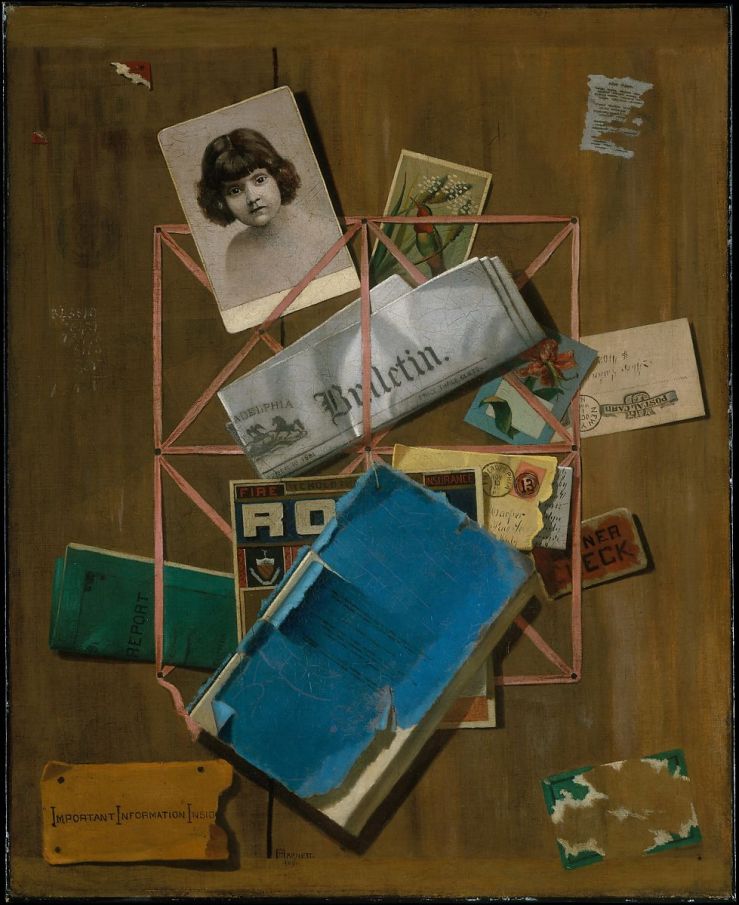
“Bishop” feels like it should be the last story in Sixty Stories. It’s a miniature portrait of an alcoholic writer, the titular Bishop who, in the course of writing a biography of the painter William Michael Harnett, discovers another painter,  John Frederick Peto.

Still Life with Three Castles Tobacco, 1880 by William Michael Harnett (1848-1892).

The story is easily one of Barthelme’s most straightforward, “realistic” pieces, employing very little of the rhetorical arsenal he’d built over the past two decades.

Old Souvenirs, c. 1881–1901 by John Frederick Peto (1854-1907)

However, his collage technique is on display throughout “Bishop,” where sentences jut brusquely against each other without the protection of transitions. Consider the economy of this opening salvo:

Bishop’s standing outside his apartment building.

An oil struck double-parked, its hose coupled with the sidewalk, the green-uniformed driver reading a paperback called Name Your Baby.

Bishop’s waiting for Cara.

The martini rule is not before quarter to twelve.

Eyes go out of focus. He blinks them back again.

He had a beer for breakfast, as usual, a Pilsner Urquell.

Imported beer is now ninety-nine cents a bottle at his market.

The oil truck’s pump shuts off with a click. The driver tosses his book into the cab and begins uncoupling.

Cara’s not coming.

The painter John Frederick Peto made a living Playing cornet in a camp meeting for the last twenty years of his life, according to Alfred Frankenstein.

Bishop goes back inside the building and climbs one flight of stairs to his apartment.

His bank has lost the alimony payment he cables twice a month to his second wife, in London. He switches on the FM, dialing past two classical stations to reach Fleetwood Mac.

Bishop’s writing a biography of the nineteenth-century American painter William Michael Harnett. But today he can’t make himself work.

Cara’s been divorced, once.

At twenty minutes to twelve he makes himself a martini.

Hideous bouts of black anger in the evening. Then a word or a sentence in the tone she can’t bear. The next morning he remembers nothing about it.

As Tracy Daugherty notes in Hiding Man, his biography of Barthelme, “it’s impossible to miss the parallels between author and character” in “Bishop”: “…same age, same physical appearance, same home city, same general profession.”

Barthelme himself protested the comparison in his 1981 Paris Review Interview:

…when [“Bishop”] appeared I immediately began getting calls from friends, some of whom I hadn’t heard from in some time and all of whom were offering Tylenol and bandages. The assumption was that identification of the author with the character was not only permissible but invited. This astonished me. One uses one’s depressions as one uses everything else, but what I was doing was writing a story. Merrily merrily merrily merrily.

There is nothing merry about “Bishop,” but there’s a lot of beauty in its odd realism.

58. “Heroes” (previously uncollected, 1981)

Another piece composed entirely in dialogue, this time between two dudes riffing on the relationship between the media, information, politics, democracy, and the average citizen. There’s a clever bit on TV screens as a “clear glass” through which we now see “darkly,” but the piece seems terribly dated in 2021.

57. “Thailand” (previously uncollected, 1981)

“Thailand” isn’t exactly a dialogue, but it’s again a piece with two speakers, an “old soldier” who served in the “Krian War” and the young man who listens to him—or, more to the point, doesn’t really listen to him. He’s introduced as “his hearer.” Instead of truly listening to the sweet old sergeant’s story about serving along the Thai military, the young hearer speaks to himself, his fragmented inner monologue intermixing with the vet’s exterior monologue, all along a similar vein: “I am young, thought the listener, young, young, praise the Lord I am young.” Again, it’s tempting to read autobiography into the story. Barthelme was drafted into the U.S. Army in 1953, but didn’t really see any action in his sixteen months there. And “Thailand” reflects that—it isn’t an old war story, but a gentle appreciation of time spent in another culture. In one memorable moment, the old soldier recalls a “golden revel” featuring thirty-seven washtubs of curry: “Beef curry, chicken curry, the delicate Thai worm curry, all your various fish curries and vegetable curries.” All the while, the young would-be interlocutor dismisses the old “demento,” culminating in the young man’s cruel final line: Requiescat in pace. The old man gets the punchline though: “They don’t really have worm curry, said the sergeant. I just made that up to fool you.” In my estimation, Thailand” isn’t so much a reminiscence of Barthelme’s army days as it is a story about an aging storyteller. Barthelme was a teacher, and while I’m sure most of his students were rapt, the older author had to know how that old Oedipal thing works.

56. “The Emperor” (previously uncollected, 1981)

A nice, precise little story of nine paragraphs. On one hand, it’s an accumulation of historical details (and some speculation) about China’s first emperor Ch’in Shih
Huang Ti, and his mad quest toward an unattainable perfection. At the same time, the story can be read as a take on the creative imagination at work, striving toward an ideal that the physical world can never quite accumulate. It can be read as a story about writing—writing as a means to attain immortality. Here’s Barthelme on the story, in his 1981 Paris Review interview:

I’ve just done a piece about a Chinese emperor, the so-called first emperor, Ch’in Shih Huang Ti. This came directly from my wife’s research for a piece she was doing on medical politics in Chinatown—she had accumulated all sorts of material on Chinese culture, Chinese history, and I began picking through it, jackdaw-like. This was the emperor who surrounded his tomb with that vast army of almost full-scale terra-cotta soldiers the Chinese discovered just a few years ago. The tomb, as far as I know, has yet to be fully excavated, but the scale of the discovery gives you some clear hints as to the size of the man’s imagination, his ambition. As I learned more about him—“learned” in quotation marks, much of what I was reading was dubious history—I got a sense of the emperor hurrying from palace to palace, I gave him two hundred some-odd palaces, scampering, almost, tending to his projects, intrigues, machinations. He’s horribly, horribly pressed for time, both actually and in the sense that many of his efforts are strategies against mortality. The tomb itself is a strategy, as is the imposition of design on the lives of his people, his specifications as to how wide hats shall be, how wide carriages shall be, and so forth.

55. “The Farewell” (previously uncollected, 1981)

A minor if entertaining dialogue between Maggie and Hilda, “The Farewell” is a sequel to “On the Steps of the Conservatory” (Great Days, 1979), and like that tale, it satirizes hierarchy in academia (and pseudo-intellectualism in general). And as silly as the whole thing is, there’s a kernel of pathos there in the story’s (off-centered center). Poor Hilda (who cannot for some reason see that she should tell her snooty snobby toxic friend Maggie to Fuck off) has finally made into the Conservatory, only to find that it’s old hat—it’s the Institution that folks are flocking to get into. And why not? As Maggie boasts, “The teachers are more dedicated, twice as dedicated or three times as dedicated.” The boasts continues. At the Institution,

Savory meals are left in steaming baskets outside each wickiup door. All meals are lobster, unless the student has indicated a preference for beautifully marbled beef. There are four Olympic-sized pool tables for every one student.

In the end though, poor Hilda comes up with that classic solution: Well, fuck it.

Summary thoughts: These late and previously-uncollected stories are tinged with melancholy and even resignation at time, and generally follow the same rhetorical mode of a two-person dialogue. Notable themes include anxiety over parenthood, writing, and one’s legacy. The weakest of the six is “Heroes” and the strongest is “Bishop.”

I will keep going (in reverse).

American Short Stories Since 1945 (Book published in 1968 and acquired, 30 April 2021)

I was perusing the anthologies, looking for a book called Anti-Story: An Anthology of Experimental Fiction (1971). I didn’t find it, but the spine of American Short Stories Since 1945 interested me enough to pull it out, and the wonderful cover (by Emanuel Schongut) intrigued me more. The tracklist on the back cover is what got to me:

I’ve read seven of the stories and fourteen of the twenty-six authors here. You probably have too. But there are close to a dozen authors here I’ll admit I’ve never even heard of—authors rectangle-pressed in with favorites of mine like Barthelme, Gass, Jackson, and Pynchon, whose piece “Under the Rose”is part of V., which I recently re-read. (I opened the “Acknowledgements” page to see that “Under the Rose” was first published in Noble Savage 3, May 1961—I checked the “N” anthologies and found Noble Savage #2, but no three for me.)

Edited and introduced by the poet John Hollander, Since 1945 “aims to show the major shapes taken by shorter fiction in America since the end of World War II.” Published in 1968, it’s heavy on the white guys, but I think there’s an attempt here to point toward not just “major shapes,” but new shapes.

I couldn’t not pick it up (I’d brought in some paperbacks to trade, anyway). Maybe I’ll try to read it this summer, posting on each piece. I’m most interested in how the selection of authors shows a tipping over in to postmodernism, a postmodernism many of these guys never signed up for.


Read “The Aurelian,” a short story by Vladimir Nabokov

“The Aurelian”

by

Vladimir Nabokov


I
Luring aside one of the trolley-car numbers, the street started at the corner of a crowded avenue. For a long time it crept on in obscurity, with no shop windows or any such joys. Then came a small square (four benches, a bed of pansies) round which the trolley steered with rasping disapproval. Here the street changed its name, and a new life began. Along the right side, shops appeared: a fruiterer’s, with vivid pyramids of oranges; a tobacconist’s, with the picture of a voluptuous Turk; a delicatessen, with fat brown and gray coils of sausages; and then, all of a sudden, a butterfly store. At night, and especially when it was damp, with the asphalt shining like the back of a seal, passers-by would stop for a second before that symbol of fair weather. The insects on exhibit were huge and gorgeous. People would say to themselves, ‘What colors—amazing!’ and plod on through the drizzle. Eyed wings wide open in wonder, shimmering blue satin, black magic—these lingered for a while, floating in one’s vision, until one boarded the trolley or bought a newspaper. And, just because they were together with the butterflies, a few other objects would remain in one’s memory: a globe, pencils, and a monkey’s skull on a pile of copybooks.

As the street blinked and ran on, there followed again a succession of ordinary shops—soap, coal, bread—with another pause at the corner where there was a small bar. The bartender, a dashing fellow in a starched collar and a green sweater, was deft at shaving off with one stroke the foam topping the glass under the beer tap; he also had a well-earned reputation as a wit. Every night, at a round table by the window, the fruiterer, the baker, an unemployed man, and the bartender’s first cousin played cards with great gusto. As the winner of the current stake immediately ordered four drinks, none of the players could ever get rich.

On Saturdays, at an adjacent table, there would sit a flabby elderly man with a florid face, lank hair, and a grayish moustache, carelessly clipped. When he appeared, the players greeted him noisily without looking up from their cards. He invariably ordered rum, filled his pipe, and gazed at the game with pink-rimmed watery eyes. The left eyelid drooped slightly.

Occasionally someone turned to him, and asked how his shop was doing; he would be slow to answer, and often did not answer at all. If the bartender’s daughter, a pretty freckled girl in a polka-dotted frock, happened to pass close enough, he had a go at her elusive hip, and, whether the slap succeeded or not, his gloomy expression never changed, although the veins on his temple grew purple. Mine host very humorously called him ‘Herr Professor.’ ‘Well, how is the Herr Professor tonight?’ he would ask, coming over to him, and the man would ponder for some time in silence and then, with a wet underlip pushing out from under the pipe like that of a feeding elephant, he would answer something neither funny nor polite. The bartender would counter briskly, which made the players at the next table, though seemingly absorbed in their cards, rock with ugly glee.

The man wore a roomy gray suit with great exaggeration of the vest motif, and when the cuckoo popped out of the clock he ponderously extracted a thick silver watch and gazed at it askance, holding it in the palm of his hand and squinting because of the smoke. Punctually at eleven he knocked out his pipe, paid for his rum, and, after extending a flaccid hand to anyone who might choose to shake it, silently left.

He walked awkwardly, with a slight limp. His legs seemed too thin for his body. Just before the window of his shop he turned into a passage, where there was a door on the right with a brass plate: PAUL PILGRAM. This door led into his tiny dingy apartment, which could also be reached by an inner corridor at the back of the shop. Eleanor was usually asleep when he came home on those festive nights. Half a dozen faded photographs of the same clumsy ship, taken from different angles, and of a palm tree that looked as bleak as if it were growing on Helgoland, hung in black frames above the double bed. Muttering to himself, Pilgram limped away into bulbless darkness with a lighted candle, came back with his suspenders dangling, and kept muttering while sitting on the edge of the bed and slowly, painfully, taking off his shoes. His wife, half-waking, moaned into her pillow and offered to help him; and then, with a threatening rumble in his voice, he would tell her to keep quiet, and repeated that guttural ‘Ruhe!’ several times, more and more fiercely.

After the stroke which had almost killed him some time ago (like a mountain falling upon him from behind just as he had bent towards his shoestrings), he now undressed reluctantly, growling until he got safely into bed, and then growling again if the faucet happened to drip in the adjoining kitchen. Eleanor would roll out of bed and totter into the kitchen and totter back with a dazed sigh, her small face wax-pale and shiny, and the plastered corns on her feet showing from under her dismally long nightgown. They had married in 1905, almost a quarter of a century before, and were childless because Pilgram had always thought that children would be merely a hindrance to the realization of what had been in his youth a delightfully exciting plan but had now gradually become a dark, passionate obsession.

He slept on his back with an old-fashioned nightcap coming down on his forehead; it was to all appearances the solid and sonorous sleep that might be expected in an elderly German shopkeeper, and one could readily suppose that his quilted torpor was entirely devoid of visions; but actually this churlish, heavy man, who fed mainly on Erbswurst and boiled potatoes, placidly believing in his newspaper and quite ignorant of the world (in so far as his secret passion was not involved), dreamed of things that would have seemed utterly unintelligible to his wife or his neighbors; for Pilgram belonged, or rather was meant to belong (something—the place, the time, the man—had been ill-chosen), to a special breed of dreamers, such dreamers as used to be called in the old days ‘Aurelians’—perhaps on account of those chrysalids, those ‘jewels of Nature,’ which they loved to find hanging on fences above the dusty nettles of country lanes.

On Sundays he drank his morning coffee in several sloppy sessions, and then went out for a walk with his wife, a slow silent stroll which Eleanor looked forward to all week. On workdays he opened his shop as early as possible because of the children who passed by on their way to school; for lately he had been keeping school supplies in addition to his basic stock. Some small boy, swinging his satchel and chewing a sandwich, would slouch past the tobacconist’s (where a certain brand of cigarettes offered airplane pictures), past the delicatessen (which rebuked one for having eaten that sandwich long before lunchtime), and then, remembering he wanted an eraser, would enter the next shop. Pilgram would mumble something, sticking out his lower lip from under the stem of his pipe, and, after a listless search, would plump down an open carton on the counter. The boy would feel and squeeze the virgin-pale India rubber, would not find the sort he favored, and would leave without even noticing the principal wares in the store.

‘These modern children!’ Pilgram would think with disgust, and he recalled his own boyhood. His father—a sailor, a rover, a bit of a rogue—married late in life a sallow-skinned, light-eyed Dutch girl whom he brought from Java to Berlin, and opened a shop of exotic curios. Pilgram could not remember now when, exactly, butterflies had begun to oust the stuffed birds of paradise, the stale talismans, the fans with dragons, and the like; but as a boy he already feverishly swapped specimens with collectors, and after his parents died butterflies reigned supreme in the dim little shop. Up to 1914 there were enough amateurs and professionals about to keep things going in a mild, very mild, way; later on, however, it became necessary to make concessions, a display case with the biography of the silkworm furnishing a transition to school supplies, just as in the old days pictures ignominiously composed of sparkling wings had probably been a first step towards lepidopterology. Continue reading “Read “The Aurelian,” a short story by Vladimir Nabokov”

Read “The Great Simoleon Caper,” a short story by Neal Stephenson

“The Great Simoleon Caper”

by

Neal Stephenson


Hard to imagine a less attractive life-style for a young man just out of college than going back to Bismarck to live with his parents — unless it’s living with his brother in the suburbs of Chicago, which, naturally, is what I did. Mom at least bakes a mean cherry pie. Joe, on the other hand, got me into a permanent emotional headlock and found some way, every day, to give me psychic noogies. For example, there was the day he gave me the job of figuring out how many jelly beans it would take to fill up Soldier Field.

Let us stipulate that it’s all my fault; Joe would want me to be clear on that point. Just as he was always good with people, I was always good with numbers. As Joe tells me at least once a week, I should have studied engineering. Drifted between majors instead, ended up with a major in math and a minor in art — just about the worst thing you can put on a job app.

Joe, on the other hand, went into the ad game. When the Internet and optical fiber and HDTV and digital cash all came together and turned into what we now call the Metaverse, most of the big ad agencies got hammered — because in the Metaverse, you can actually whip out a gun and blow the Energizer Bunny’s head off, and a lot of people did. Joe borrowed 10,000 bucks from Mom and Dad and started this clever young ad agency. If you’ve spent any time crawling the Metaverse, you’ve seen his work — and it’s seen you, and talked to you, and followed you around.

Mom and Dad stayed in their same little house in Bismarck, North Dakota. None of their neighbors guessed that if they cashed in their stock in Joe’s agency, they’d be worth about $20 million. I nagged them to diversify their portfolio — you know, buy a bushel basket of Krugerrands and bury them in the backyard, or maybe put a few million into a mutual fund. But Mom and Dad felt this would be a no-confidence vote in Joe. It'd be,'' Dad said,like showing up for your kid’s piano recital with a Walkman.”

Joe comes home one January evening with a magnum of champagne. After giving me the obligatory hazing about whether I’m old enough to drink, he pours me a glass. He’s already banished his two sons to the Home Theater. They have cranked up the set-top box they got for Christmas. Patch this baby into your HDTV, and you can cruise the Metaverse, wander the Web and choose from among several user-friendly operating systems, each one rife with automatic help systems, customer-service hot lines and intelligent agents. The theater’s subwoofer causes our silverware to buzz around like sheet-metal hockey players, and amplified explosions knock swirling nebulas of tiny bubbles loose from the insides of our champagne glasses. Those low frequencies must penetrate the young brain somehow, coming in under kids’ media-hip radar and injecting the edfotainucational muchomedia bitstream direct into their cerebral cortices.

“Hauled down a mother of an account today,” Joe explains. “We hype cars. We hype computers. We hype athletic shoes. But as of three hours ago, we are hyping a currency.”

“What?” says his wife Anne.

“Y’know, like dollars or yen. Except this is a new currency.”

“From which country?” I ask. This is like offering lox to a dog: I’ve given Joe the chance to enlighten his feckless bro. He hammers back half a flute of Dom Perignon and shifts into full-on Pitch Mode.

Read the rest of “The Great Simoleon Caper.”

Watch Robert Enrico’s short film adaptation of Ambrose Bierce’s “The Mockingbird”


“The Mockingbird”

by

Ambrose Bierce


The time, a pleasant Sunday afternoon in the early autumn of 1861. The place, a forest’s heart in the mountain region of southwestern Virginia. Private Grayrock of the Federal Army is discovered seated comfortably at the root of a great pine tree, against which he leans, his legs extended straight along the ground, his rifle lying across his thighs, his hands (clasped in order that they may not fall away to his sides) resting upon the barrel of the weapon. The contact of the back of his head with the tree has pushed his cap downward over his eyes, almost concealing them; one seeing him would say that he slept.

Private Grayrock did not sleep; to have done so would have imperiled the interests of the United States, for he was a long way outside the lines and subject to capture or death at the hands of the enemy. Moreover, he was in a frame of mind unfavorable to repose. The cause of his perturbation of spirit was this: during the previous night he had served on the picket-guard, and had been posted as a sentinel in this very forest. The night was clear, though moonless, but in the gloom of the wood the darkness was deep. Grayrock’s post was at a considerable distance from those to right and left, for the pickets had been thrown out a needless distance from the camp, making the line too long for the force detailed to occupy it. The war was young, and military camps entertained the error that while sleeping they were better protected by thin lines a long way out toward the enemy than by thicker ones close in. And surely they needed as long notice as possible of an enemy’s approach, for they were at that time addicted to the practice of undressing–than which nothing could be more unsoldierly. On the morning of the memorable 6th of April, at Shiloh, many of Grant’s men when spitted on Confederate bayonets were as naked as civilians; but it should be allowed that this was not because of any defect in their picket line. Their error was of another sort: they had no pickets. This is perhaps a vain digression. I should not care to undertake to interest the reader in the fate of an army; what we have here to consider is that of Private Grayrock. Continue reading “Watch Robert Enrico’s short film adaptation of Ambrose Bierce’s “The Mockingbird””