Blog about recent (non)reading

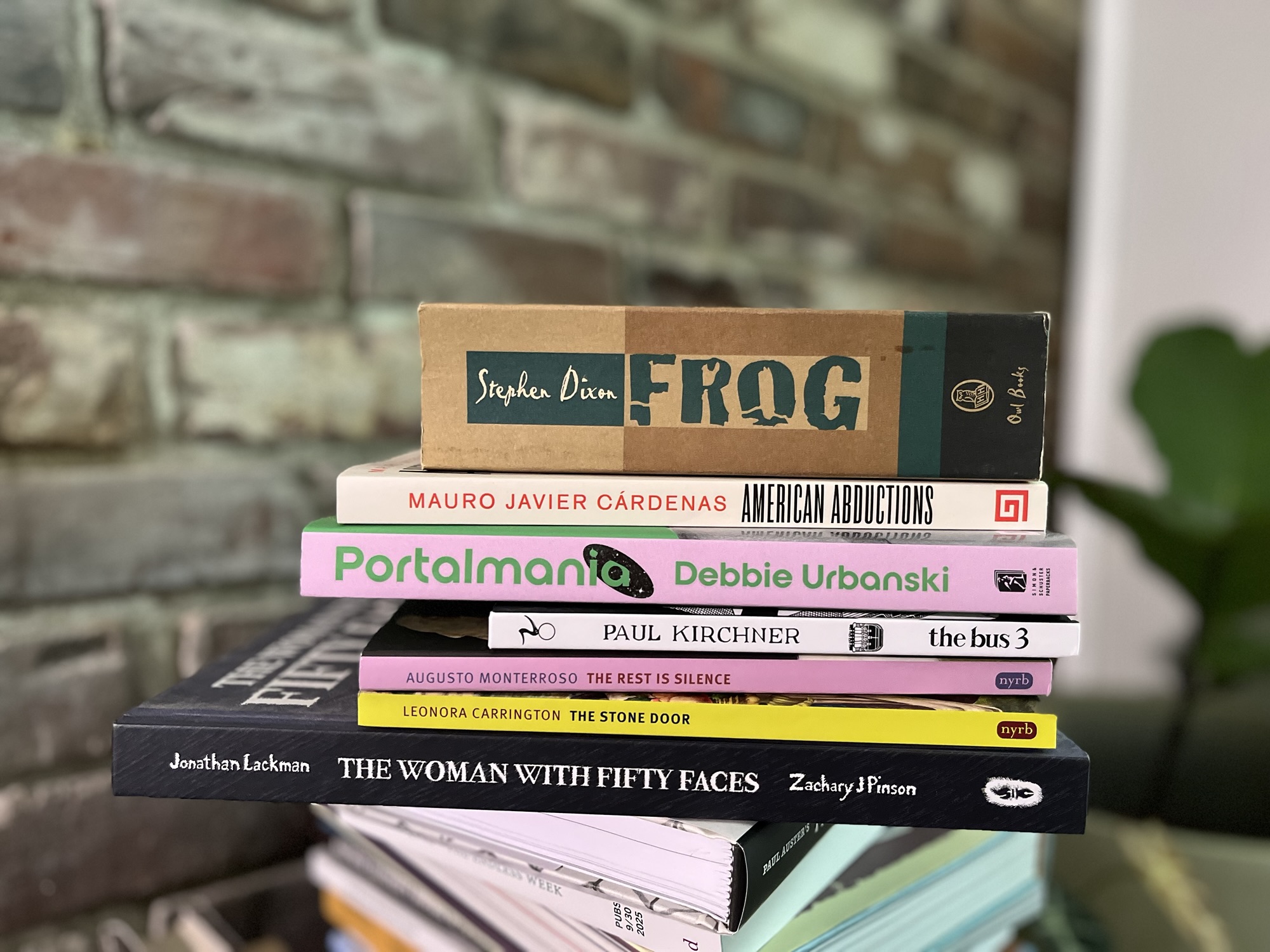
I read one novel in May 2025, the historical graphic biography The Woman with Fifty Faces: Maria Lani and the Greatest Art Heist That Never Was, by Jon Lackman and Zack Pinson. I think it was the only book I’ve read in full in the past two months. It was excellent and I owe it a full review.

I’ve read so so so many Wikipedia pages lately, tunneling down there almost every night (even all night) over the last six weeks. Last night I think I started, for some reason I can’t recall, on Julia Lennon’s page, maybe around eleven pm, and a few hours later I was reading about the visual systems of cuttlefish (this is when my wife woke up and told me to go to sleep). I didn’t start Leonora Carrington’s The Stone Door and I didn’t finish Augusto Monterroso’s The Rest Is Silence, even though they were on my cute little night stand.

I read a big chunk of The Rest Is Silence last Monday at the beach. I took my son and his friends there; despite their claims to being “goth” (or whatever, false claims) they wanted to hang out all day at Hannah Park. So we did that. I walked for a few miles and then discreetly drank a carton of sauvignon blanc and almost finished The Rest Is Silence and then promptly forgot all of the feeling of having read it, having replaced that feeling with the blazing Florida heat (a heat obscured by a heavy gray Atlantic breeze). There was a camp of young musicians wading in the water. I don’t know how I recognized them as teenage musicians, other than years of recognizing such persons in public — the same way I can recognize, say, college football coaches out for barbecue on a Saturday afternoon or late Friday. Some people just look like some people. I chatted with one of the music camp coaches. A lot of these kids hadn’t ever been to the ocean, he assured me, which he didn’t have to. Their movements against the waves showed it. I’m sure they are all graceful with their chosen instruments. Like I said, the slim novella was gone. The sand covered it over (this is a stupid metaphor; I am all rotten inside lately).

I have also not finished Paul Kirchner’s The Bus 3, mostly because I wanted to not finish it, to save it for a different shade of my disposition that is sure to arrive any day now. I love what Paul Kirchner has done, and I have never felt the strips whimsical; or, rather, their whimsy struck me as wise, a sharper whimsy. I’m having a hard time laughing lately.
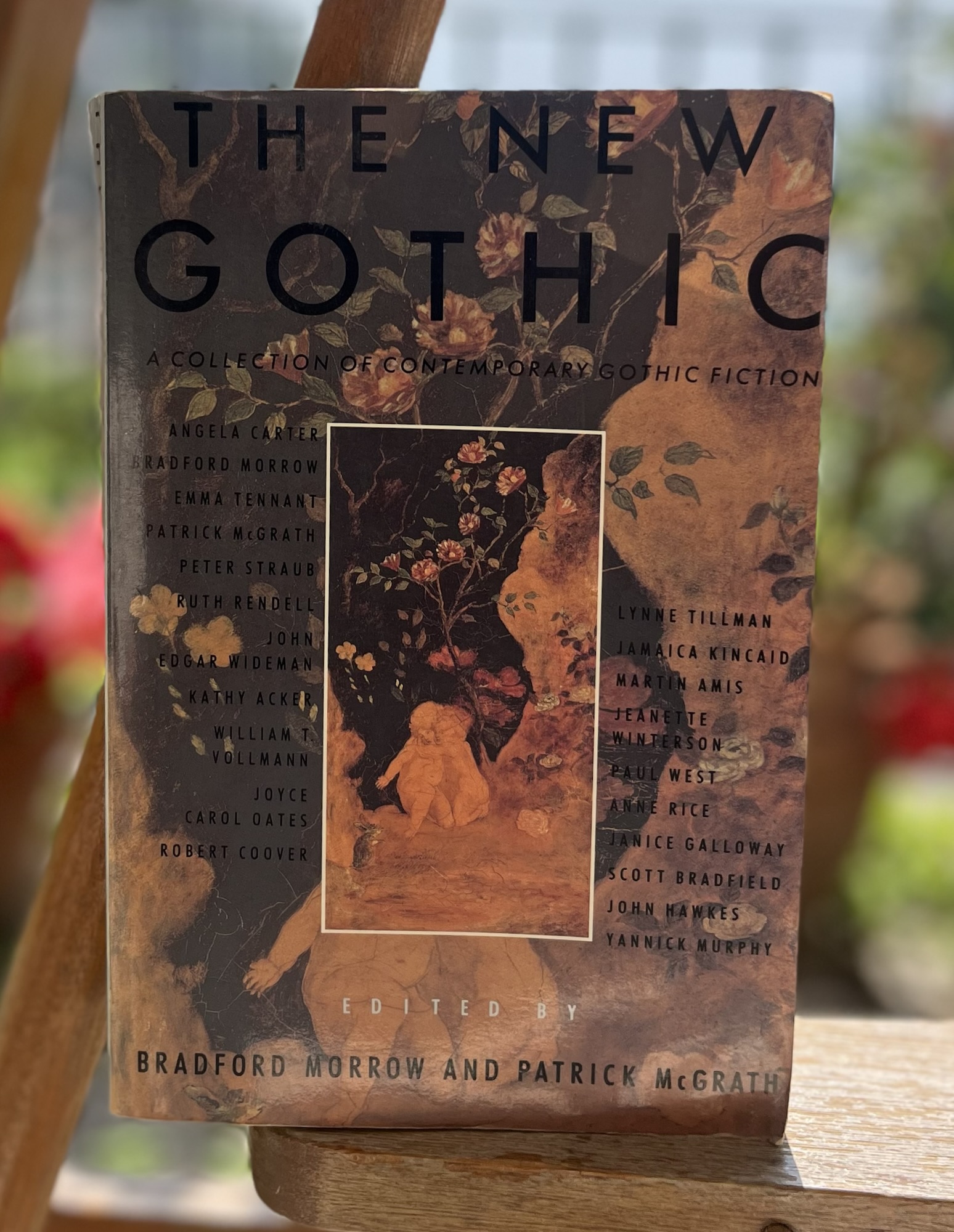
I read a big chunk of an anthology called The New Gothic about three weeks ago. It was in the house we — we my family, my wife and kids — were staying at in Minori, a smallish town in the Amalfi Coast of Italy. We spent the first fifteen days of June in Italy to celebrate my daughter’s 18th birthday and high school graduation. In a lovely little house on the side of a mountain (maybe it was a big hill, I’m a Florida boy), in a small shelf of mostly non-English language books, I picked out The New Gothic and read tales by Coover, Carter, Vollmann and others. The book is a love letter to Poe, really, with a wonderful introductory essay by editors Bradford Morrow and Patrick McGrath.

The story that really stood out though was Lynne Tillman’s “A Dead Summer.” This particular paragraph made me cry:

The Mets were doing better, but with so many new players on the team, she didn’t have the same relationship to them. Her dead friend had loved the Mets too. Sometimes she watched a game just for him, as if he could use her as a medium. She was sure his spirit was hovering near her, especially at those times. But she did not speak of this to her boyfriend who was talking about breaking up. That night she let him gag her. She didn’t have anything to say anyway, not anything worthwhile. She read that the Ku Klux Klan had marched in Palm Beach.

The story is about grief and bad dreams set against a terrifying American political backdrop. The notion of witnessing something so that one’s dead friend might use your eyes as a medium is what did me in. I’ve had such thoughts a few times in the last two months after my best friend died unexpectedly, moments where I thought I might somehow channel his spirit to, say, listen to the new Pulp record. But I don’t think he’s haunting me.

(I didn’t steal The New Gothic from the house in Minori, although I thought about it for two or three minutes.)

I have almost finished reading the stories in Debbie Urbanski’s collection Portalmania (it is a “collection” but I suspect it is a stealth novel — about escapes, transitions, aesexuality, monsters, uh, portals, etc.). Review to come. (I will absolutely get might shit together, any day now.)

I read and reviewed Mauro Javier Cárdenas’s American Abductions back in March. It’s only in this stack — this organizing picture that I use as an outline — because it is the most timely novel in America right now. It is a novel I read, loved, and highly recommend. Its narrative power surpasses the timeliness I’ve imposed upon it.

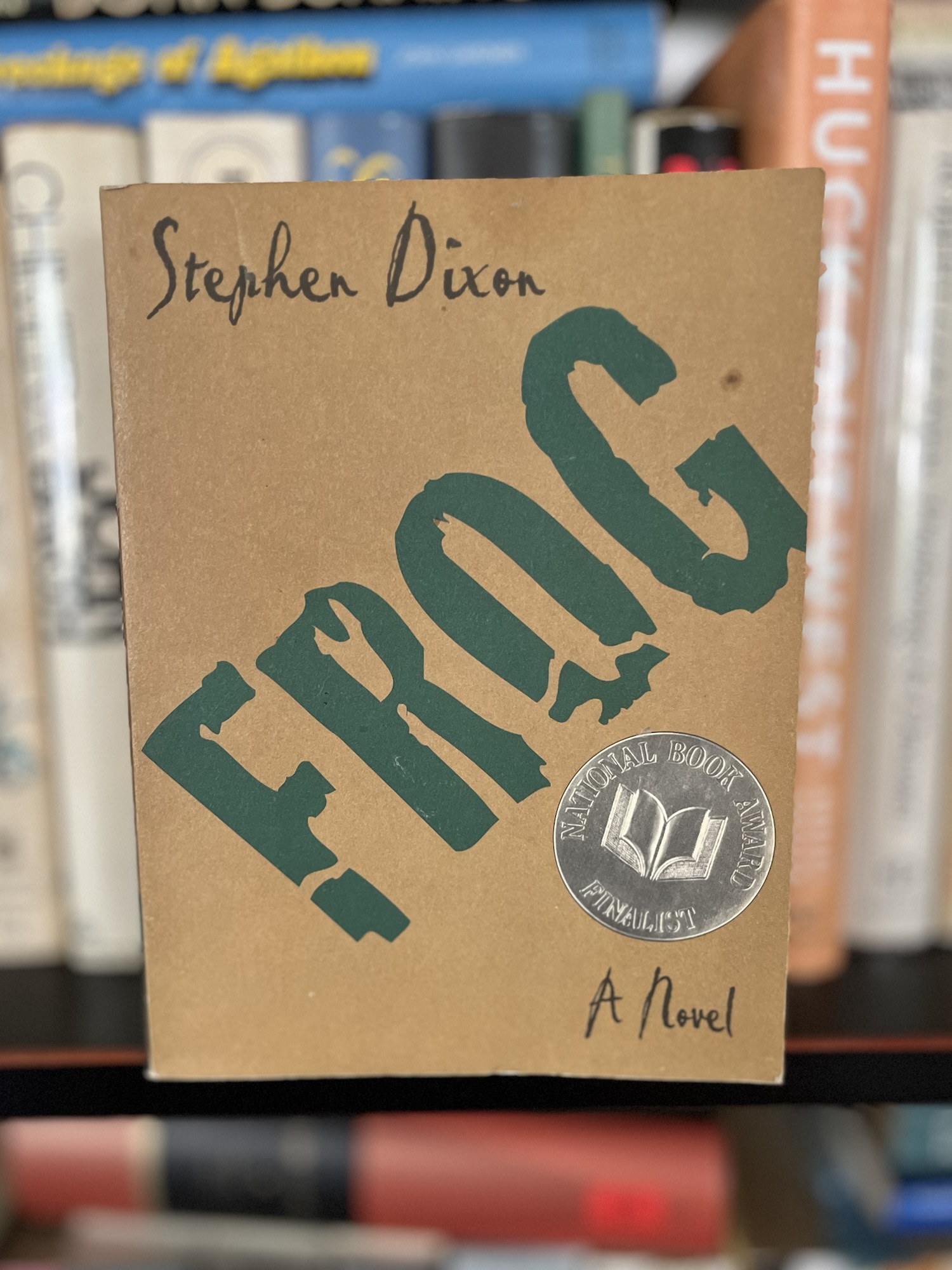
I was, what?, maybe 200, 225 pages? into Stephen Dixon’s massive novel Frog before I abandoned it. I was really loving it, its tics, repetitions, its noisy monotonous howl, its droll jabs at normal fucking people. It could have been one of my favorite novels ever, I think, but I’m not sure I’ll ever wade back in. I tried a few times, but it’s all enmeshed with some bad intense feelings I felt in early May.

Which is what? I guess? another way of saying that reading is just a series of feelings for me now. Maybe at some point I thought of reading novels as an intellectual exercise, and maybe at one point I turned that into an ideal of an aesthetics of reading — but I don’t care about any of that shit now.

I believe in reading for

pleasure

pain

other feelings, in between and otherwise.
873 words from Stephen Dixon’s 1991 novel Frog, followed by 469 words on Stephen Dixon’s 1991 novel Frog

Here are 873 words from Stephen Dixon’s long looping loopy lucid antilaconic 1991 novel Frog; the words are a segment of the ninth chapter, “Frog’s Brother”:

Alex was the only passenger on the freighter. His father’s patient called his son in England and asked as a favor to the man who’s treated his family’s teeth for forty years if he could take Alex aboard free. Alex was in London then, wanted to get back home, had little money, could have borrowed plane or ocean liner fare from his parents or Jerry, wanted the experience of being on a freighter during a long crossing. Though he got free passage, he asked to work without pay at any job the captain wanted him to. He’ll clean latrines, even, he said in his last letter to Howard. Anything the lowest-grade seaman does, just to get the full feel of it and perhaps seaman’s papers for a paid trip later. He was a newsman turned fiction writer. Two months after the ship disappeared a parcel of manuscripts arrived at their parents’ apartment from England by surface mail. Maybe the manuscripts he didn’t much care about. Maybe the ones he cared most about he took with him on the ship. Howard read the stories and vignettes soon after and then some of them every three or four years till about ten years ago. He never found them very good, but Alex was just starting. Two diaries and some oriental figurines in the parcel also, and lots of letters from his parents, brothers, friends. He’d traveled around the world. Saved up for three years to do it. Did it for a year. A prostitute in a dilapidated hut in a small village outside Bangkok. Why’s that experience come to mind first? It was in a letter to Howard, not the diaries. He searched the diaries for it, thinking an elaboration of it might be interesting, revealing, sexually exciting. She was fourteen years old. That made Alex sad. She asked him to marry her. She said she’d be devoted, would learn to cook and make love American, bear him many children if he wanted, all boys if he wanted (she knew how), would return to grade school. He gave her his silver ID bracelet, pleaded with her to give up prostitution. Then he did it a third time with her the same day and came back the next. Talk about hypocrisy! he said. What’s the trick of turning a customer into a suitor? he asked. But one who’ll be good to her and an adequate provider. If he knew, he’d give it to her. Sent her a pearl necklace from Manila. If he got a venereal disease from her he’d worry more about her than himself. He might go back for her before he leaves for India, or send for her once he gets back to America, and maybe even marry her when she comes of age. Keep this between them just in case it does happen. Taught English to Malaysian businessmen for a month. Met two old men in New Guinea—Canadians—who were living the primitive jungle life. They were good friends of his till they tried to drug and rape him. He’s afraid he had to kick them both in the balls to get out of there and then steal their canoe to get back to town. Fell in love with a witch. Read Proust’s Remembrances in five nearly sleepless days, an experience that’s left him dreaming of the books every night for the last six weeks. A Goan fortuneteller told him his trip would end badly. He said to go home by plane, don’t sail. Remind him when the time comes, for the man wouldn’t take any money. Had a fifteen-year-old girl in Nairobi. What can he tell Howard?—he likes young girls. It’s more than just the way their hair blows and breasts point and bellybuttons dimple and thighs are so even. Maybe it’s because of all the girls who barely let him pet them when he was a teenager. Rode a camel through part of the Sahara. Ate lizard, locusts, grasshoppers, grubs. Never felt very Jewish before till he started hitting all the old synagogues and Jewish cemeteries he could find in the Orient and Middle East. Wait’ll he gets to Poland and Prague and also tries to look the old families up. He’s afraid it’s converted him, but not to the point of wearing a skullcap. Hitchhiked with a sixteen-year-old sabra through Turkey and Yugoslavia, though she might have been younger. When she had to go back she said she thinks he got her pregnant—her device wasn’t put in right a few times, she was so new at it. He told her he’s heard that one before, but if she has the baby and the calendrical configurations fix it as his, or just if she still says it is, he’ll love and provide for it, adopt it if she wishes and take it to America with or without her or emigrate to Israel if she prefers, marry her if that’s what she wants—she’s quite striking and clever and potentially very artistic and smart. He’s written what he thinks is fairly decent work recently, he said in his last letter. He’s glad he’s found something he wants to do for the next twenty to thirty years, has Howard?

The titular “Frog’s Brother” is Alex. (“Frog,” by the way, is “Howard,” the protagonist of Frog.) Alex’s freighter goes missing in the North Atlantic; the ship is never recovered nor are lifeboats. No bodies. The only evidence of the disaster is absence.

In this absence, Frog imagines and reimagines Alex’s death at sea in different looping cycles; these reimaginings are also framed within Frog’s attempt to accurately recall his receiving the news that his brother Alex is lost at sea–was it by phone, that he received this awful news? in his other brother’s apartment? what were the specific conditions of this heartbreak?

Imagining and then reimagining the specific details of a horrifying, horrible, horrendous event is the rhetorical gist of Dixon’s 1995 follow-up to Frog, Interstate, a fucked-up eight-way riff on the narrator’s daughter’s murder by way of random highway violence.

I have read around 120 of Fog’s near 800 pages, and many of those pages feature the same rhetorical and narratological techniques or repetitions with differences that were so off-centered in Interstate: fraying phrases, looping tics, paranoid passages. In the absence of the one thing, Dixon’s narrators pony up iteration after iteration, something after something. But the narrators know that there’s not enough somethings to ever even come close to approximating everything. The iterations sharpen and highlight the beauty of the absence’s abyss.

That abyss was real, or true, or True, for Stephen Dixon, whose brother “Jimmy, a magazine writer, died in 1960 when the freighter he was on in the North Atlantic disappeared,” as the New York Times reported in Dixon’s 2019 obituary. The Times obituary continued: “Mr. Dixon felt that he was continuing his brother’s work. Jimmy Dixon had a short story published after his death.” If Jimmy Dixon was prototype to Alex Frogbrother, what are we to make of the fantastic paraphrase of his letters, above? The passage reads like a bizarre failed adventure tale, something we might expect from William T. Vollmann, who, with his heart of gold, tried to “free” sex workers. It’s also quite queasy when it comes to sex (a constant I’ve noticed in Dixon): “What can he tell Howard?—he likes young girls,” our narrator flatly, grossly reports.

The saddest and realest bit might be this though, the admission that “Howard read the stories and vignettes soon after and then some of them every three or four years till about ten years ago. He never found them very good, but Alex was just starting.” But Alex was just starting. The last bit of the section, “He’s glad he’s found something he wants to do for the next twenty to thirty years, has Howard?” seems both boon and curse, a door that opens and shuts simultaneously, cursing our Stephen Dixon, our Frog, to write write write write write write write write write…


“On the Beach,” a very short story by Stephen Dixon

“On the Beach”

by

Stephen Dixon


Eva, Olivia and Eric are on a beach trying to drag a rowboat into the water. “This thing will never budge,” Eric says. “My father could make it budge,” Eva says. “Here she goes again,” Olivia says. “No, let her, what?” Eric says. “My father was so strong he could lift it on his back and carry it into the water. He’d need both arms and it’d be heavy but he could do it.” “I’m sure he could. Or push, even, or at least drag it into the water by himself, but I can’t, honey. I’m simply not as strong as your father was.” “As my father is. My father’s very strong.” “As he is then. As you say. I’ve heard of his physical exploits—how strong he was, I’m saying.” “She knows what exploits are,” Olivia says. “You don’t have to teach it to either of us. I know the word and I’ve told her the word.” “I didn’t realize that. For you see, I didn’t know that word till I was twice your age, maybe three times. How old are you? I’m only kidding. I know how old. I even know how old both of you are put together. A hundred six, right. No. But good for you—both of you for knowing so many big impressive words. Like ‘impressive.’ You know that word too, right?” “Right.” “Sure, just as my father knows all those words and more,” Eva says. “He knows words that haven’t even been born yet. Like kakaba. Like oolemagoog.” “He does? He knows those? Wow. Very impressive. Anyway, I’d hoped we got past that subject. I said that to myself. But if we didn’t, some men are just stronger than others. That’s a fact. I’d be the last to deny it. You both know what ‘deny’ means, I know. And some men are smarter than others. And kinder and nicer than others and have more hair and so on. But I bet no man has more than two arms. Anyone want to bet?” “My father’s stronger, nicer, kinder than others and much much more than that,” Eva says. “He’s taller than most others. And handsome. Much more than any others. His photos say so. Others say so.” “Well that’s a good thing for a man to be,” Eric says. “For an older woman to be too,” Olivia says. “That’s what Mother says.” “Good. She knows. She’s smart. Me, I was never considered handsome. That should come as no surprise to you two, as it doesn’t to your mother. Not handsome even when I was a young man, an older woman, a small piggy, or even now as a fairly not-so-young-maybe-even-old hog. Most of that was supposed to be funny. Why aren’t you laughing?” “Because it wasn’t funny and we’re talking about someone else now, right, Olivia?” “I don’t know,” Eva says. “Daddy. All that he is.” “Okay,” Eric says, “I’ll bite. Meaning, well, just that I’m all pointy ears and curly tail uncoiled and extended snout—I want to know. What else was he? Is he. Sorry. But tell me.” “Funny,” Eva says. “He’s more funny than anyone alive. Sometimes people died laughing at things he said. But really, with big holes in their chests and all their bones broken and blood.” “Yes, that’s true,” Olivia says, “the streets covered with broken laughed-out dead bodies, for funniest is what he is and always was. And liveliest too. A real live wire, our father. You’re excellent, Eric—honestly, this is not to go stroke-stroke to you. And lively and smart, but not at all handsome, and kind and wonderful in some ways and we love you, we truly do, even if what Eva said and how she acted just now, but you’re not livelier than our dad. No sir. Our real dad was live-ly! Oh boy was he. A real live wire. He was also so sad. We shouldn’t leave that out if we want to be fair. A real sad wire. ‘Mr. Sad Wire’ we should’ve called him, right, Eva? If you could have talked then. For you couldn’t even say three words in a row that made sense. No sentence-sense I used to say about her then, Eric.” “I could so say sad wire.” “Hey, stop a moment, for where are we?” Eric says. “Was? Is? Which one is he?” “Is,” Eva says. “Daddy’s definitely an ‘is.’ And sometimes when I hear from him, like I did just yesterday, I say ‘Daddy Live Wire, Daddy Sad Wire, how dost your farting grow?’ Because that’s what he also does best—just ask Olivia.” “That’s right, she’s a true bird, we have to be fair,” Olivia says. “He was probably the world’s greatest most productive farter for more years in a row than anybody and still is.” “Is for sure,” Eva says. “The whole world knows of him. He’s been in newspapers, on TV. People have died from it everywhere, and not happy laughing deaths. In planes and parks. Hundreds of dead bodies in your way sometimes. Flat on the ground, piled ten deep sometimes, black tongues hanging out, their own hands around their necks. Vultures in trees all around but refusing to pick at them the smell’s so bad. And much worse. I won’t even go into it more. Like whole cities dying, dogs and cats too—not a single breathing thing left alive. Maybe that’s an exaggeration. Rats always survive. But ‘Killer Dad’s been at it again,’ I always say to Olivia when we see this, and that time we walked through that ghost city. It doesn’t hurt us because we got natural, natural…what is it again we got, Olivia?” “Impunity. Immunity. Ingenuity. That’s us. We never even smell it when we’re in the midst of it but we can see when we see all this that it can only be he who did it.” “You girls are really funny today,” Eric says. “Inherited from him, no doubt.” “Oh no we didn’t,” Olivia says. “He inherited it from us, didn’t you know? Something strange happened in life when we were born. But everything he’s best at he got from us, or almost. We’re sad live wires or lively dad wires or just mad love wires. That’s because we brought up our father and are still doing it yet. Now that’s a real switch, isn’t it, Eva, bringing up your own dad? How’d we do it?” “I’m not sure, but that’s for sure what we’re doing. We didn’t want to, we had our own lives to bring up, but we had no choice, right, Olivia?” “No, why?” “No, you.” “He was left on our doorstep, right? Came in a shoe box with a note glued to it saying…what?” “It said ‘Feeling blue? Nothing in life’s true? Cat’s got your goo? So do something different in your loo today. Bring up your own dad. But don’t leave him in a shoe box for squirrels to build their nests in on top of him. Take him out, brush him off, give him a good cleaning. Treat him as good as you would your best pair of party shoes.’ Wasn’t that what it said, Olivia?” “Or was it a hat box he came in? ‘Put him on your bean against the sun, sleet and rain and your brain will seem much keener.’ No, that wasn’t it. ‘Treat him as gently as you would your own mentally…’ I forget everything it said. But we did. And I know it was some kind of box.” “A suggestion box. A lunch box. ‘What’s inside is nutritious and suspicious. Open hungrily and with care.’ And when we’ve brought him up all the way, Eric, I’m afraid the sad news is you’ll have to move out. Because he’ll be moving back in, all grown up then. Because no bigamists allowed in our family, right, Olivia?” “Right, Eva.” “So?” “So maybe in yours, Eric, it’s allowed, but not in ours. Family honor. Horses’ code. New York telephone directory. We’re very sorry. Unbreakable rule. But let’s stop, Eva. I’ve spun out and so have you. And we’re not being nice to Eric who’s been so nice to us. Renting this boat. Helping us push it into the water. Doing most of the work. Probably getting a heart attack from it. Dying for us just so we can have some summer fun.” “Hey, don’t worry about me, kids. Let it out. Have it out. Thrash it to me. Money and abuse are no object. Listen, I know how you’re both feeling, but you have to know I also of course wish he had never died.” “He never did, how can you say that?” Eva says. “Whatever. And easy as it is for me to say this after the fact and much as I would have missed if he had lived—I’ll be straightforward with you—I didn’t know him but have heard so many wonderful things about him that I only wish I had.” “Had what?” Olivia says. “That he can’t be replaced. By me. I know that. Never deluded myself otherwise. And that I wish I’d known him.” “So, it can be arranged,” Eva says, “can’t it, Olivia?” “Let’s stop—really. We’re spoiling our day and being extra extra lousy to Eric.” “Okay, he’s dead, heave-ho, hi-heave, what d’ya say, Joe, bury the problem? For what I want most now is to get out there to fish, splash and row.” “Well,” Eric says, “it seems we’ll have to wait for a couple of strapping guys to come along and help us or come back when the tide comes in. Anyone think to bring that card with the tide times?” “Daddy will come help,” Eva says. “Sometimes it only takes one and he’s the one. So hey, hi, daddy of mine, come and pull our boat into the water. You’ll see. I’ve wished. Daddy come now,” and she sits down hard in the sand, puts her thumb in her mouth and sucks it while she twiddles her hair in back and looks off distantly. “Eva, get up, get up quickly, you hear me?” Olivia says. “You’re scaring the shit out of us.”

Stephen Dixon’s Frog (Book acquired, 7 March 2025 — thanks Tilford!)

A big thank you to one of my oldest friends, P. Tilford, for sending me a copy of Stephen Dixon’s Frog.

From “Frog in Prague”:

They stand still. “And Kafka?” Howard says.

“Kafka is not buried here.”

“No? Because I thought—what I mean is the lady at my hotel’s tourist information desk—the Intercontinental over there—and also the one who sold me the ticket now, both told me—”

The man’s shaking his head, looks at him straight-faced. It’s up to you, his look says, if you’re going to give me anything for this tour. I won’t ask. I won’t embarrass you if you don’t give me a crown. But I’m not going to stand here all day waiting for it.

“Here, I want to give you something for all this.” He looks in his wallet. Smallest is a fifty note. Even if he got three-to-one on the black market, it’s still too much. He feels the change in his pocket. Only small coins. This guy’s done this routine with plenty of people, that’s for sure, and he’d really like not to give him anything.

Eight notes on Stephen Dixon’s novel Interstate

1,  It upset me deeply, reading Stephen Dixon’s 1995 novel Interstate. It fucked me up a little bit, and then a little bit more, addicted to reading it as I was over two weeks in a new year.

2,  What is it about, Stephen Dixon’s 1995 novel Interstate? I mean, you probably won’t like it, but that wasn’t the stupid rhetorical question that led this point. (And also but maybe like, you will like it.) Interstate was a finalist for the 1995 National Book Award. It didn’t win. The NBA’s website’s one-sentence summary fucks up: “In the author’s first novel since Frog, a Finalist for the National Book Award, a father mentally replays, in eight variations, the shooting of his daughters on an interstate highway.”

3,  There is (or is it are?) one too many esses in the NBA’s summary of Stephen Dixon’s 1995 novel Interstate—there are two daughters, plural, but only one is shot, and shot tragically, awfully, fatally—and really, as its variations play out, it’s not entirely clear if anyone was shot, if anyone was even on the highway, if anyone was even real. Are all the so-called events of the novel simply (there’s no simply about it) in the narrator’s imagination? “…but there I go again, the world’s easiest and most desirable copy out, the dream,” muses the narrator at one point. Not even a dream though, it’s all just words.

4,  It’s all “just” words, and if someone told me they read and hated Stephen Dixon’s 1995 novel Interstate, I’d shrug and ask if they made it all the way through all the words and still hated it. If someone told me that they made it all the way through Interstate and found it to be a strange and unappealing writing experiment, I’d mildly agree with them, and then tell them that I loved that particular flavor and if they didn’t like that particular flavor, well, cool.

5,  If someone read all the words in Stephen Dixon’s 1995 novel Interstate and concluded that it seemed like an ambitious and highly-achieved creative writing exercise — writing experiment, rather — I’d likely initially agree and then hedge a bit before mumbling something like, I don’t think it was an exercise or experiment on the author Stephen Dixon’s part. It might make for experimental reading, but I think he absolutely knew what he was doing; this wasn’t practice or exercise — it was the real thing.

6, I have, thus far, done a lousy job, not even really a job, of describing the force of language in Stephen Dixon’s 1995 novel Interstate. Normally I’d crib a few choice passages—and to be clear, Interstate s fat and juicy with choice passages—but we are talking about long, twisty, tangled passages, sentences that go on for pages, sentences that find the predicate verb sundered for a few paragraphs from its eventual object, sentences that move us through thought, how divergent thought can be how, how imprecise, indirect, yet still sharp and often painful. An easy, lazy comparison would be to liken Dixon’s paragraphs to Thomas Bernhard’s (although Dixon denied the influence, much like William Gaddis did in his final novel)—there’s a different flavor here but our guys are working in a similar mode. (Think too of László Krasznahorkai or Gabriel García Márquez or Faulkner or Mauro Javier Cárdenas or any number of practitioners of the long paragraph). John Domini, in his contemporary review in the Portland Oregonian (reprinted in his excellent collection The Sea-God’s Herb) does a better job of describing Dixon’s style than I can do:

Characters talk themselves through backwaters of memory (sometimes creating comic relief) or sail into dreamy what-ifs, all in order to put off some looming and drear inevitability. In conversation, one may mention an important insight that he or she has to share, then spiral away through a half-dozen distractions before revealing what matters. The format feels like a natural fit to the shuttered claustrophobia of worry and loss. So do the jam-packed paragraphs, sometimes running several pages without a break. Better still, these blocks of talky phrasing flicker with light, even (every now and again) with happier possibilities.”

(Maybe I just wanted to quote that lovely phrase of Domini’s, “blocks of talky phrasing flicker with light.”)

7,  “Better still, these blocks of talky phrasing flicker with light, even (every now and again) with happier possibilities,” Domini wrote of Stephen Dixon’s 1995 novel Interstate. The last of Dixon’s eight Interstates is an unexpected gift — a happy ending, or, rather a banal ending, a plain ending, an ending without tragedy or comedy or epic heroism. An ending where everyone gets to bed in time to fit in a little light reading before shuteye. It sounds hokey when I write it out, but there’s nothing trite about the conclusion. The reader purchases this moment of catharsis from all the terror (and horrifying comedy, which I’ve neglected in this riff and will continue to neglect) — the reader purchases the cathartic conclusion from the preceding horror.

8,  I wonder how I might have reacted to Stephen Dixon’s 1995 novel Interstate if I had read it, say, when it was first published, back when I was a junior in high school. Or how would I have reacted to it ten years after that, not yet a parent? (And writing these thoughts out now, I realize that, more than anything by Bernhard or Krasznahorkai or Faulkner or the other Dixon I’ve read, Interstate most reminds me of (at least at this moment that I write) of Frank Capra’s 1946 film It’s a Wonderful Life. I’ve watched It’s a Wonderful Life once a year for the past four decades, finding it strangely different every few years — first baffling and even a bit scary, then boring, then exasperating, infuriating even, then schmaltzy, sentimental, ludicrous, and then magical, endearing, heartbreaking, perfect–I’ve veered off course, where was I?) I wonder how being a parent has colored my psychic engagement with the novel Interstate? I was not so much manipulated by the tragedy of losing a child through violent, chaotic, meaningless death but rather the more banal tragedy the novel repeatedly engages — losing a child through half-neglect, through half-listening, through selfishness, through an inability to focus on now — not really so much losing a child but losing out on connections, memories, time you’ll never get back. It fucked me up, Interstate, and I don’t think I’d like to go down its road again — but I loved it. Very highly recommended.

Nonjoke | From Stephen Dixon’s Interstate

A passage from Stephen Dixon’s novel Interstate


So you go with the doctor to the room Julie’s in and the doctor says, right outside it—door closed, no little window in it, legs so weak while you walked that the doctor had to hold your arm, you said “I think I’m going to fall, grab me,” and he did, while you walked you thought “It’s like an execution I’m going to, mine, hanging, shooting, injection, gas; fear, weakness, feeling you want to heave,” sign on the door saying “Do Not Enter, Medical Staff Only, Permission Required”—“She’s in there on the bed. It’s not really a bed, we call it something else, but for our purposes we’ll call it that.” “What do you call it normally, meaning the technical calling—the word, you know?” and he says “‘Bed’ will do.” “But I’d like to know, if you don’t mind. I’m not sure why, peculiar reasons probably, but just, could you?” “An examination table, that’s all it is, but now it’s made up to look like a bed—sheets, a pillow.” “For under her head.” “Under her head, yes.” “You’re giving me a lot of your time, I’m sorry.” “It’s okay, what I do.” “I’ve been thinking of her head, only before, I think, on a pillow when she was alive. Everybody’s sure she’s dead?” He nods. “Then I’ll see her in there. I mean, I would, of course, if she were alive, but I’m saying for now.” You put your hand on the door. It has no knob or bar, only needs a push. Which side of the room will the bed be? The left, you guess. But it’s a table, so may be in the middle. “Yell for me, ‘Dr. Wilkie,’ if all of a sudden you need assistance. Or if you want, I’ll come in with you.” “You’ve seen her?” “Uh-huh.” “No, I want to see her alone.” “I can go in and leave when you want. Or with a flick of your finger, if you can’t speak, or point to the door.” “Nah, I want it to be now just me and her. ‘Me and she’ sounds better but it’s ‘me and her, me and her.’ Meaning, they go together, correctly, though in that case it could be ‘she and I’ for all I know. Why do I bring these things up? Delaying.” “No matter what, I won’t budge from here unless there’s an emergency I’m absolutely needed for. Chances of that are minimal, and I’ve asked another doctor to fill in for me. But you never know.” “You never know,” you say. “And I suppose I should go in now, get it over with. Somehow I imagine her in the middle of the room on that table-bed, head on the left side of it, so, perpendicular to us,” and you show with your hands in a T what you mean. “I believe that’s the way it is.” “So there. And all my life, you know, I’ve been getting things over with—no window in the room, probably.” “None.” “Lots of lights, some side tables with instruments and things on them, and so on. In fact, there’s a standard joke, a running one, rather, around my household—no, it’s no time for lines or jokes. This isn’t one, what I was about to say, but might sound like it. I haven’t told you it yet?” “If you mean now or before, not that I know of.” “I think I’ve told everyone else in the world. I have so few things to say. Of interest. Though it always had a serious degree to it. Side. It borders. Straddles.” “Go on, tell me if it’ll help relax and prepare you for going inside. Remember, here and now, anything you do or say is okay.” “Right, better I feel that way, relaxed, prepared, so I don’t crash first thing on seeing her, my dear kid, truly the dearest little girl-child-kid there ever was,” and you start crying and you cry and say “Everybody says ‘ever was,’ I bet, everybody, in a situation like this, and I should stop all this kind of talk. Just saying it, of course I know what it’ll do, so I have to wonder if I didn’t say it just to go to pieces and delay some more my going in. There,” patting yourself under the eyes, tears, “these goddamn these. Stop, stop, stop,” slapping your cheeks. “But my nonjoke. Nonintended for one, the something I was going to say and will probably say it that I said might sound like a joke, and other times it could be. Now it’s just a fact. An insight into me. So I’m telling it as an illustration of my always wanting to get things over with—trips, books, days, work, housecleaning, even sex sometimes. Cooking, quick, quick, quick. A joke to everyone I know, I can tell you, as if work to get rid of to clear yourself for the real or more important work, stuff that’s killing you for you to do and which turns out to be the same thing, get rid of it, clear yourself for something else, and so on. So say it. Or do it. My hand’s on the door again but I’m not pushing it even a quarter-inch. I can’t seem to get in there. Whyever why? The example’s this. That I want on my tombstone for it to read—Rather, that I want my epitaph to say on my tombstone, chiseled in—Rather, for ‘tombstone’ sounds so Western western—in other words, fake—that I want my head-or footstone—my gravestone epitaph to say, you know, under my name, birth and death dates—anywhere on the stone—‘So, I got it over with.’ Just that. You see the point; message is clear, isn’t it? It’s not funny now. Of course, nothing is, goes without saying, and long way I told the story, end of it was dead before I got there,” dropping your head, crying again, hand off the door. “This is too hard. Impossible. Why does it have to be? Her, I mean. I know, old question, but couldn’t this all somehow be a wake-up dream? All that’s done-before crap too, everybody must say it in a situation like this, and especially to you, true?” “But any other time your epitaph line would be humorous. I understand that. You got it over with—you’re a man who likes getting things over with, and the big thing, the biggest, life, you’re saying in this fictitious epitaph, you did.” “Maybe it was ‘Well, I finally got it over with’ what I told my wife and friends countless—endless amounts—countless times. Or no ‘well,’ but a ‘finally.’ So just ‘I finally’—and no ‘so’ either, so just i finally got it over with.’ I think that’s it. It is. Anyway, what’s the damn difference? One of those. And I should get it over with, finally. I know I have to see her, I want to.” “You’re right when you imply I know how difficult it is,” he says. “I’ve been through this with plenty of other people.” “Other fathers? But ones who adore their kids? Love them, adore them, worship them; if there was one word for those three, then that?” “Fathers, mothers, husbands, children for their sisters or brothers—everyone close.” “Okay. You close your eyes, you hold your breath, you push open the door and walk in. That’s all you have to do, just those.” You do them, push the door shut behind you without turning around, let your breath out and smell; nothing unusual, something medicinal; and open your eyes.

Blog about some recent reading

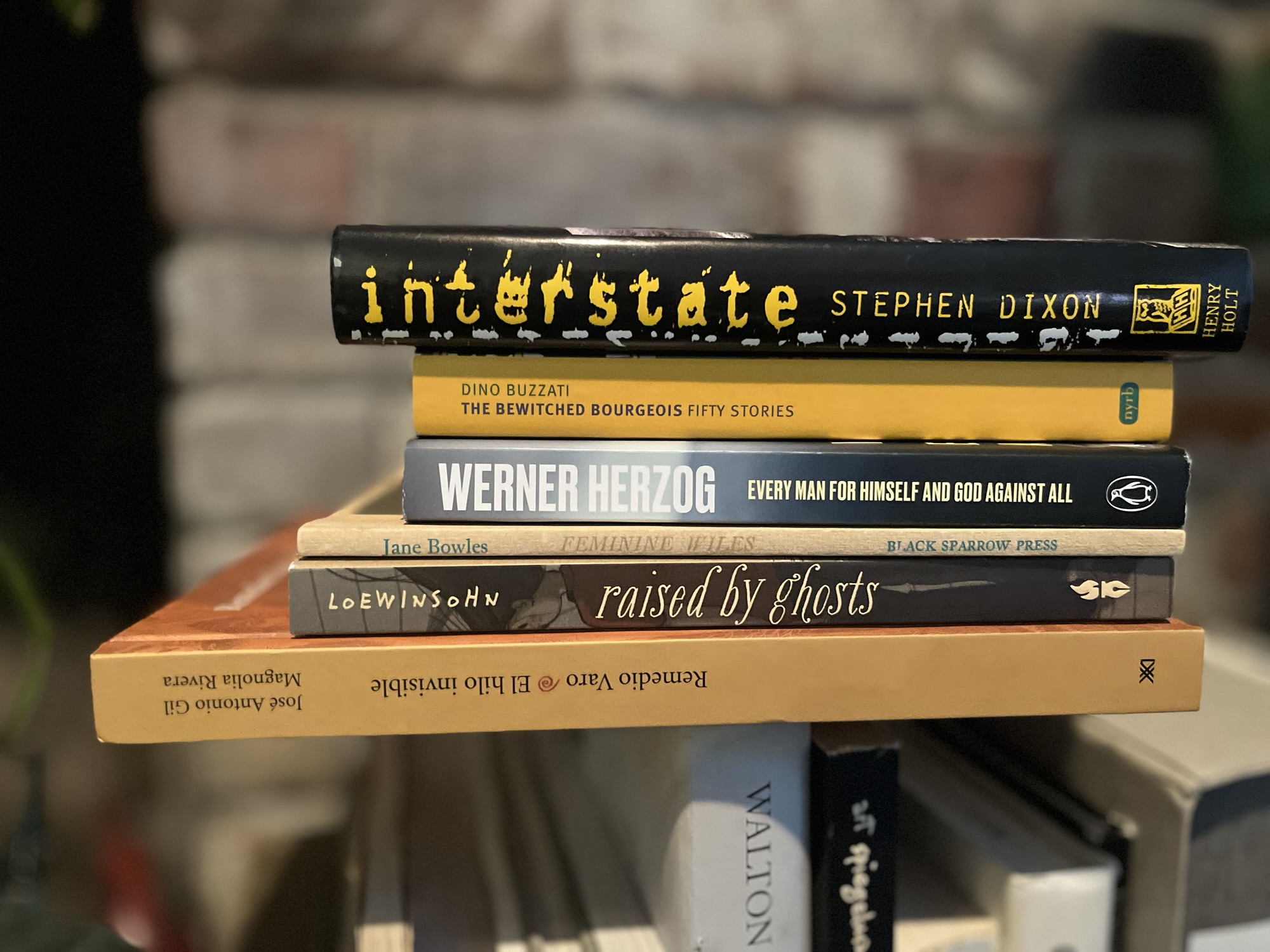
What an interesting few weeks it’s been! Here’s (some of) what I’ve been reading so far this year:

I’m in the middle of Stephen Dixon’s novel Interstate. It is a devastating, ugly, addictive, beautiful novel; I have no idea if it is “good” or not but I love it. I can’t really think of a single person I know (in real life) I could recommend it to. We played cards with some friends and one of them asked about what I was reading, and I said a novel called Interstate by this guy Stephen Dixon, and she asked of course What’s it about? and I said something, Well, this guy’s driving on the interstate with his daughters and two guys in a van pull up along side him and start shooting at them, killing his younger daughter–this happens in like, the first few paragraphs–and then we see how this event destroys his life–but then Dixon repeats the initial scenario like seven more times with different (but all really tragic so far) outcomes–and it’s written in this addictive vocal style that might be really off-putting to many readers, and it also makes really fascinating use of the coordinating conjunction for, which may just be a verbal tic –and it’s also really funny at times? I am not trying to sell this novel to anyone but I love it.

My reading experience of Briana Loewinsohn’s graphic novel Raised by Ghosts was kinda sorta the opposite of Dixon’s Interstate in that after I finished it I immediately pressed it on my wife and then my kids and then texted some of my oldest friends about it (oldest in the previous clause should be understood to modify the friendship, not the actual friend’s years–although we’re all getting older). We’re all getting older, all the time, and Raised by Ghosts provoked an aged nostalgia in me. I’m about half a year older than Loewinsohn and so much of her semi-autobiographical novel resonated with me. She gets everything right about what it was like to be a little bit of a weirdo at school in the nineties. There’s this wonderful passage on how important it was to get a handwritten note from a friend; there’s a page that’s nothing but a notebook page filled with band names; there’s a marvelous scene where our hero loses her shit watching You’re a Good Man, Charlie Brown. I should have a proper review this week or next, but great stuff. (The whole family loved it, by the way.)

I’ve been reading a collection of Dino Buzzati short stories translated by Lawrence Venuti; my technique is to read one of the shorter stories when I feel a bit of dread or anxiety from, like, reading something else. (The collection is called The Bewitched Bourgeois by the way.) I’ve enjoyed reading them, and have especially enjoyed allowing myself to read them at random instead of following the collection’s chronological trajectory. Very Kafka, very Borges, but also very original.

Not in the picture above, but I’ve also been working my way through a digital copy of Vladimir Sorokin’s short story collection Dispatches from the District Committee, in translation by Max Lawton (and illustrated by Gregory Klassen). Great gross stuff.

I picked up a collection of Jane Bowles’ sketches, letters, and other ephemera a few weeks ago–I love her stuff, but really it was that these were contained in the somewhat-rare Black Sparrow Press edition Feminine Wiles. I’m pretty sure all of the stuff here is collected in My Sister’s Hand in Mine, but I’ve enjoyed dipping into this one more. It’s slim, not bulky, but that bulky boy’s around her (My Sister’s) if I need him.

My uncle sent me a copy of Werner Herzog’s 2022 memoir Every Man for Himself and God Against All for Christmas (in translation by Michael Hofmann). I devoured the first few chapters and then a colleague hipped me to the fact that there’s an audiobook of Herzog reading his memoir (available on Spotify and other platforms) — so on my commute I’ve been listening to him read his own memoir, which is just amazing. Like fucking amazing. Hearing him say phrases like “the escapades of Christopher Robin, Winnie-the-Pooh, Piglet, and Eeyore” or that “chipmunks…have something consoling about them” is surreal. There are like fifty insane things that happen in every chapter, and if Dwight Garner of the failing New York Times attested that he didn’t “believe a word” of the memoir, I take the opposite tack. Everything is true, everything is permitted.

Finally, I can’t really say I’ve been “reading” Remedios Varo: El hilo invisible by Jose Antonio Gil and Magnolia Rivera. My grasp of Spanish cannot graspingly grasp too much of the Spanish (although my iPhone’s picture-text-translate thing works fine when I’m really curious), but the book is a lovely visual catalog of not just one of my favorite artist’s works (including many pieces I haven’t seen before), but also documents her visual influences. I picked it up at the Museo de Arte Moderno in Mexico City back in January, still floating on the high of seeing many of Varo’s lovely paintings there that afternoon.

Stephen Dixon’s Interstate (Book acquired, 27 Jan. 2025)

I finally broke down and bought a copy of Stephen Dixon’s 1995 novel Interstate via an online bookseller; I’d been trying to pick up a used copy of it or his novel Frog for a while now, after devouring 1988’s Garbage last year. I was able to get a signed first edition for less than the novel’s original price listing, which is maybe a little depressing? The novel has eight sections; I read the first last night, in something like a trance. Here is the novel’s first paragraph:

He’s in the car with the two kids, driving on the Interstate when a car pulls up on his side and stays even with his for a while and he looks at it and the guy next to the driver of what’s a minivan signals him to roll down his window. He raises his forehead in an expression “What’s up?” but the guy, through an open window, makes motions again to roll down his window and then sticks his hand out his window and points down at the back of Nat’s car, and he says “My wheel, something wrong with it?” and the guy shakes his head and cups his hands over his mouth as if he wants to say something to him. He lowers his window, slows down a little while he does it, van staying alongside him, kids are playing some kid card game in back though strapped in, and when the window’s rolled almost all the way down and the hand he used is back on the steering wheel, the guy in the car sticks a gun out the window and points it at his head. “What? What the hell you doing,” he says, “you crazy?” and the guy’s laughing but still pointing, so’s the driver laughing, and he says “What is this? What I do, what do you want?” and the guy puts his free hand behind his ear and says “What, what, what? Can’t hear ya,” with the driver laughing even harder now, and he says “I said what do you want from me?” and the guy says “Just to scare you, that’s all, you know, and you’re scared, right?—look at the sucker, scared shitless,” and he says “Yeah, okay, very, so put it away,” and the kids start screaming, probably just took their eyes off the card game and saw what was happening, or one did and the other followed, or they just heard him and looked or had been screaming all the time and he didn’t hear them, but he doesn’t look at them through the rearview, no time, just concentrates on the gun and guy holding it and thinking what to do and thinks “Lose them,” and floors the gas pedal and gets ahead of the van but it pulls even with him and when he keeps flooring it stays even with him and even gets a little ahead and comes back with the guy still pointing the gun out the window and now grinning at him, driver’s in hysterics and slapping the dashboard, things seem to be so funny, and he thinks “Should I roll the window up or keep it down, for rolling it up the guy might take it the wrong way and shoot, if he’s got bullets in there,” and he looks around, no other cars on their side of the Interstate except way in the distance front and behind, no police cars coming the other way or parked as far as he can see on the median strip, and he yells “Kids, get down, duck, stop screaming, do what Daddy says,” and sees them in the rearview staring at the van and screaming and he shouts “I said get down, now, now, unbuckle yourselves, and shut up, your screaming’s making me not think,” and slows down and rolls the window up and van slows down till it’s alongside him, the guy holding the gun out and one time slapping the driver’s free hand with his, and then the guy points the gun at the backseat with the kids ducked down in it and crying, maybe on the floor, maybe on the seat, for he can’t see them, and he swerves to the slow lane and the van gets beside him in the middle lane, and then he pulls onto the shoulder, stops, shifts quickly and drives in reverse on it bumping over some clumps, and the van goes on but much slower and from about a hundred and then two and three and four hundred feet away the guy steadies his gun arm with his other hand and aims at his car and he yells “Kids, stay down,” for both are now looking out the back, maybe because of the bumping and sudden going in reverse, and bullets go through the windshield. He screams in pain, glass in his head and a bullet through his hand, yells “Girls, you all right?” for there’s screaming from in back but only one of them, and his oldest daughter says “Daddy, Julie’s not moving, Daddy, she’s bleeding, Daddy, I don’t see her breathing, I think she’s dead.”

“Frog in Prague” — Stephen Dixon

“Frog in Prague”

by

Stephen Dixon


They stand still. “And Kafka?” Howard says.

“Kafka is not buried here.”

“No? Because I thought—what I mean is the lady at my hotel’s tourist information desk—the Intercontinental over there—and also the one who sold me the ticket now, both told me—”

The man’s shaking his head, looks at him straight-faced. It’s up to you, his look says, if you’re going to give me anything for this tour. I won’t ask. I won’t embarrass you if you don’t give me a crown. But I’m not going to stand here all day waiting for it.

“Here, I want to give you something for all this.” He looks in his wallet. Smallest is a fifty note. Even if he got three-to-one on the black market, it’s still too much. He feels the change in his pocket. Only small coins. This guy’s done this routine with plenty of people, that’s for sure, and he’d really like not to give him anything.

“Come, come,” the man said.

“You understand?” Howard said. “For Kafka’s grave. Just as I told the lady at the ticket window, I’m sure the other parts of this ticket for the Old Synagogue and the Jewish Museum are all very interesting—maybe I’ll take advantage of it some other time—but what I really came to see—”

“Yes, come, come. I work here too. I will show you.”

Howard followed him up a stone path past hundreds of gravestones on both sides, sometimes four or five or he didn’t know how many of them pressed up or leaning against one another. The man stopped, Howard did and looked around for Kafka’s grave, though he knew one of these couldn’t be it. “You see,” the man said, “the governor at the time—it was the fourteenth century and by now there were twelve thousand people buried here. He said no when the Jewish elders of Prague asked to expand the cemetery. So what did the Jews do? They built down and up, not outwards, not away. They kept inside the original lines of the cemetery permitted them. Twelve times they built down and up till they had twelve of what do you call them in English, plateaus? Places?” and he moved his hand up in levels.

“Levels?”

“Yes, that would be right. Twelve of them and then the ground stopped and they also couldn’t go any higher up without being the city’s highest cemetery hill, so they couldn’t make any levels anymore.”

“So that accounts for these gravestones being, well, the way they are. All on top of one another, pressed togetherlike. Below ground there’s actually twelve coffins or their equivalents, one on top of—”

“Yes, yes, that’s so.” He walked on about fifty feet, stopped. “Another governor wouldn’t let the Jews in this country take the names of son-of anymore. Son of Isaac, Son of Abraham. They had to take, perhaps out of punishment, but history is not clear on this, the names of animals or things from the earth and so on.” He pointed to the stone relief of a lion at the top of one gravestone. “Lion, you see.” To a bunch of grapes on another stone: “Wine, this one. And others, if we took the time to look, all around, but of that historical era.”

“So that’s why the name Kafka is that of a bird if I’m not mistaken. Jackdaw, I understand it means in Czech. The Kafka family, years back, must have taken it or were given it, right? Which?”

“Yes, Kafka. Kafka.” Howard didn’t think by the man’s expression he understood. “Come, please.” They moved on another hundred feet or so, stopped. “See these two hands on the monument? That is the stone of one who could give blessings—a Cohen. No animal there, but his sign. Next to it,” pointing to another gravestone, “is a jaw.”

“A jaw?” The stone relief of this one was of a pitcher. “Jar, do you mean?”

“Yes. Jaw, jaw. That is a Levi, one who brings the holy water to wash the hands of a Cohen. That they are side by side is only a coincidence. On the next monument you see more berries but of a different kind than wine. Fertility.”

“Does that mean a woman’s buried here? Or maybe a farmer?”

“Yes. Come, come.” They went past many stones and sarcophagi. All of them seemed to be hundreds of years old and were crumbling in places. Most of the names and dates on them couldn’t be read. The newer section of the cemetery, where Kafka had to be buried, had to be in an area one couldn’t see from here. He remembered the photograph of the gravestone of Kafka and his parents. Kafka’s name on top—he was the first to go—his father’s and mother’s below his. It was in a recent biography of him he’d read, or at least read the last half of, not really being interested in the genealogical and formative parts of an artist’s life, before he left for Europe. The stone was upright, though the photo could have been taken many years ago, and close to several upright stones but not touching them. The names and dates on it, and also the lines in Hebrew under Kafka’s name, could be read clearly. It looked no different from any gravestone in an ordinary relatively old crowded Jewish cemetery. The one a couple of miles past the Queens side of the Fifty-ninth Street Bridge where some of his own family were buried.

The man walked, Howard followed him. “Here is the monument of Mordecai Maisel. It is much larger than the others because he was a very rich important man. More money than even the king, he had. The king would borrow from him when he needed it for public matters. Later, after he paid it back, he would say to him ‘Mordecai, what can I give you in return for this great favor?’ Mordecai would always say ‘Give not to me but to my people,’ and that did help to make life better in Prague for the Jews of that time. He was a good wealthy man, Mordecai Maisel. Come, come.”

They stopped at another sarcophagus. Hundreds of little stones had been placed on the ledges and little folded-up pieces of paper pushed into the crevices of it. “Here is Rabbi Low. As you see, people still put notes inside his monument asking for special favors from him.”

“Why, he was a mystic?”

“You don’t know of the famous Rabbi Löw?”

“No. I mean, his name does sound familiar, but I’m afraid my interest is mostly literature. Kafka. I’ve seen several of his residences in this neighborhood. Where he worked for so many years near the railroad station, and also that very little house on Golden Lane, I think it’s translated as, across the river near the castle. A couple of places where Rilke lived too.”

“So, literature, what else am I talking of here? The Golem. A world famous play. Well? Rabbi Low. Of the sixteenth century. He started it. He’s known all over.”

“I’ve certainly heard of the play. It was performed in New York City—in a theater in Central Park—last summer. I didn’t know it was Rabbi Low who started the legend.”

“Yes, he, he. The originator. Others may say other rabbis might have, but it was only Rabbi Low, nobody else. Then he knocked the Golem to pieces when it went crazy on him. Come, come.”

They went on. The man showed him the grave of the only Jewish woman in medieval Prague who had been permitted to marry nobil
ity. “Her husband buried here too?” Howard said. “No, of course not. It was out-of-religion. The permission she got to marry was from our elders. He’s somewhere else.” The stone of one of the mayors of the Jewish ghetto in seventeenth-century Prague. The stone of a well-known iron craftsman whose name the man had to repeat several times before Howard gave up trying to make it out but nodded he had finally understood. Then they came to the entrance again. After the man said Kafka wasn’t buried here and Howard said he wanted to give him something for all this, he finally gives him the fifty note, the man pockets it and Howard asks if he might know where Kafka is buried.

“Oh, in Strašnice cemetery. The Jewish part of it, nothing separate anymore. It isn’t far from here. You take a tube. Fifteen minutes and you are there,” and he skims one hand off the other to show how a train goes straight out to it. “It’s in walking distance from the station. On a nice day unlike today the walk is a simple and pleasant one. And once you have reached it you ask at the gate to see Kafka’s grave and someone there will show you around.”

Riff on some books I’m reading, have read, and should really review

Hurricane Milton passed far enough south last night to leave our city relatively untroubled. There were power outages here but not the expected flooding. Most of my anxiety was focused on my family in the Tampa Bay area, all of whom are safe; we’re just not sure about the material conditions of the things they left behind.

Milton seemed to suck the summer air out of Northeast Florida; when I got out of bed and went outside to investigate the loud THUNK that woke me up at four a.m., I was shocked at how cold the air felt. It was only about 66°, but all the humidity seemed gone, even in the cold sprinkling rain. (The THUNK was our portable basketball hoop toppling over.)

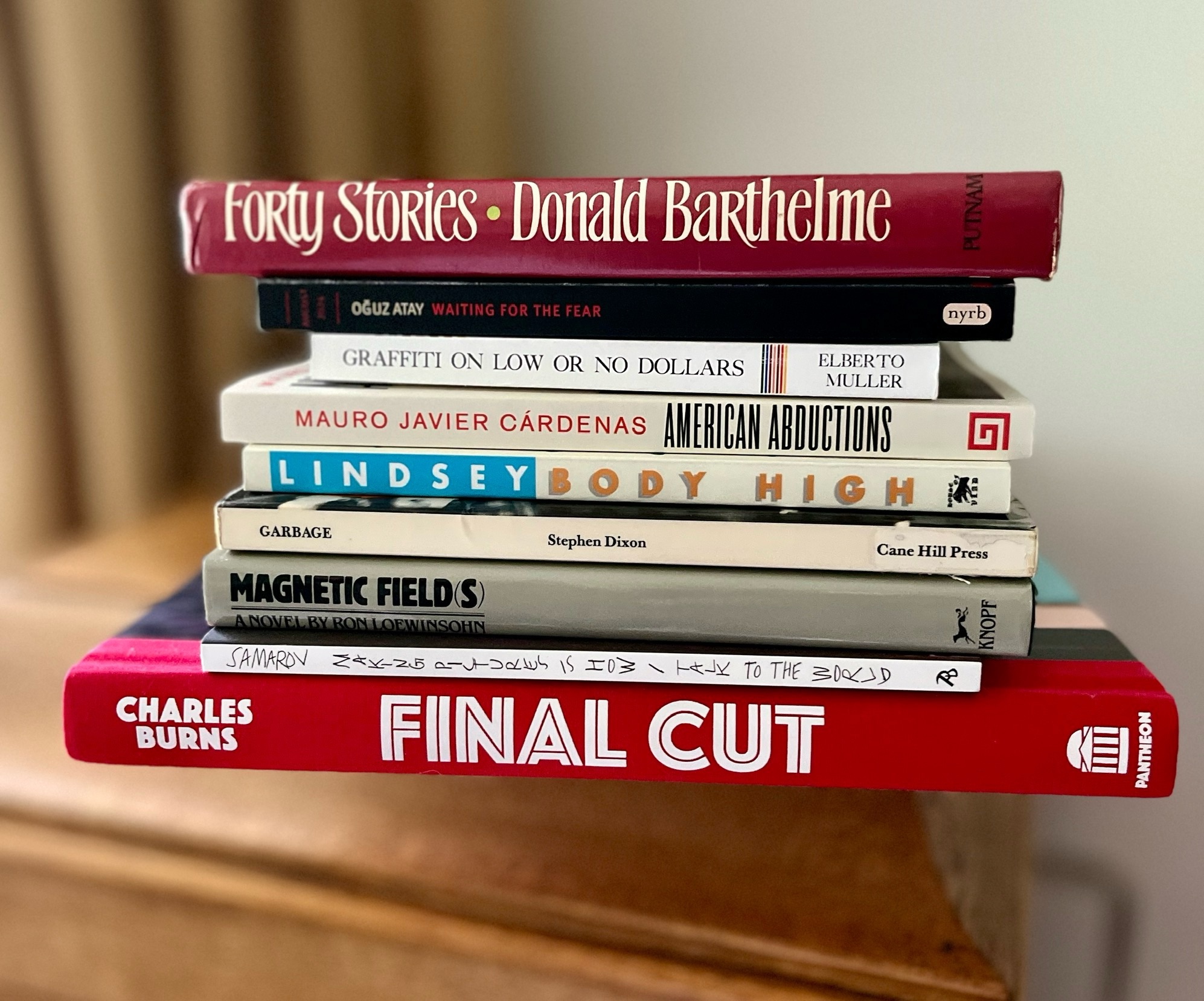
I thought I might try to knock out a review or a write-up of one of the many books I’ve finished that have stacked up as the summer has slowly transitioned to autumn. College classes have been canceled through to Tuesday. I have, ostensibly a “free” week; maybe some words, harder to cobble together for me these days, would come together, no? For the past few years I’ve focused more on reading literature with the attempt to suspend analysis in favor of, like, simply enjoying it. I realized I’d gotten into the habit of reading everything through the lens of this blog: What was I going to say about the book after reading it? I’ve been happier and read more sense freeing myself from the notion that I need to write about every fucking book I read. But the good books stack up (quite literally in a little place I have for such books); I find myself simply wanting to recommend, at some level, however facile, some of the stuff I’ve read. So forgive this lazy post, organized around a picture of a stack of books. From the top down:

Forty Stories, Donald Barthelme

A few years ago, I read Donald Barthelme’s collection Sixty Stories in reverse order. A few days ago, a commenter left me a short message on the final installment of that series of blogs: “Now do Forty Stories.” I think I have agreed–over the past week I’ve read stories forty through thirty-five in the collection. More to come.

Waiting for the Fear, Oğuz Atay; translation by Ralph Hubbell

A book of cramped, anxious stories. Atay, via Hubbell’s sticky translation, creates little worlds that seem a few reverberations off from reality. These are the kind of stories that one enjoys being allowed to leave, even if the protagonists are doomed to remain in the text (this is a compliment). Standouts include “Man in a White Overcoat,” “The Forgotten,” and “Letter to My Father.”

Graffiti on Low or No Dollars, Elberto Muller

Subtitled An Alternative Guide to Aesthetics and Grifting throughout the United States and Canada, Elberto Muller unfolds as a series of not-that-loosely connected vignettes, sketches, and fully-developed stories, each titled after the state or promise of their setting. The main character seems a loose approximation of Muller himself, a bohemian hobo hopping freights, scoring drugs, and working odd jobs—but mostly interacting with people. It kinda recalls Fuckhead at the end of Denis Johnson’s Jesus’ Son (a book Graffiti spiritually resembles) praising “All these weirdos, and me getting a little better every day right in the midst of them.” Muller’s storytelling chops are excellent—he’s economical, dry, sometimes sour, and most of all a gifted imagist.

American Abductions, Mauro Javier Cárdenas

If I were to tell you that Mauro Javier Cárdenas’s third novel is about Latin American families being separated by racist, government-mandated (and wholly fascist, really) mass deportations, you might think American Abductions is a dour, solemn read. And yes, Cárdenas conjures a horrifying dystopian surveillance in this novel, and yes, things are grim, but his labyrinthine layering of consciousnesses adds up to something more than just the novel’s horrific premise on its own. Like Bernhard, Krasznahorkao, and Sebald, Cárdenas uses the long sentence to great effect. Each chapter of American Abductions is a wieldy comma splice that terminates only when his chapter concludes—only each chapter sails into the next, or layers on it, really. It’s fugue-like, dreamlike, sometimes nightmarish. It’s also very funny. But most of all, it’s a fascinating exercise in consciousness and language—an attempt, perhaps, to borrow a phrase from one of its many characters, to make a grand “statement of missingnessness.”

Body High, Jon Lindsey

I liked Jon Lindsey’s debut Body High, a brief, even breezy drug novel that tries to do a bit too much too quickly, but is often very funny, gross, and abject. The narrator, who telegraphs his thoughts in short, clipped sentences (or fragments cobbled together) is a fuck-up whose main income derives from submitting to medical experiments. He dreams of scripting professional wrestling storylines though, perhaps one involving his almost-best friend/dealer/protector/enabler. When his underage-aunt shows up in his life, activating odd lusts, things get even more fucked up. Body High is at its best when it’s at its grimiest, and while it’s grimy, I wish it were grimier still.

Garbage, Stephen Dixon

I don’t know if Dixon’s Garbage is the best novel I’ve read so far this year, but it’s certainly the one that has most wrapped itself up in my brain pan, in my ear, throbbed a little behind my temple. The novel’s opening line sounds like an uninspired set up for a joke: “Two men come in and sit at the bar.” Everything that unfolds after is a brutal punchline, reminiscent of the Book of Job or pretty much any of Kafka’s major works. These two men come into Shaney’s bar—this is, or at least seems to be, NYC in the gritty seventies—and try to shake him down to switch up garbage collection services. A man of principle, Shaney rejects their “offer,” setting off an escalating nightmare, a world of shit, or, really, a world of garbage. I don’t think typing this description out does any justice to how engrossing and strange (and, strangely normalGarbage is. Dixon’s control of Shaney’s voice is precise and so utterly real that the effect is frankly cinematic, even though there are no spectacular pyrotechnics going on; hell, at times Dixon’s Shaney gives us only the barest visual details to a scene, and yet the book still throbs with uncanny lifeforce. I could’ve kept reading and reading and reading this short novel; it’s final line serves as the real ecstatic punchline. Fantastic stuff.

Magnetic Field(s), Ron Loewinsohn

I ate up Loewinshohn’s Magnetic Field(s) over a weekend. It’s a hypnotic triptych, a fugue, really, with phrases sliding across and through sections. We meet first a burglar breaking into a family’s home and learn that “Killing the animals was the hard”; then a composer, working with a filmmaker; then finally a novelist. Magnetic Field(s) posits crime and art as overlapping intimacies, and extends these intimacies through imagining another life as a taboo, too-intimate trespass.

Making Pictures Is How I Talk to the World, Dmitry Samarov

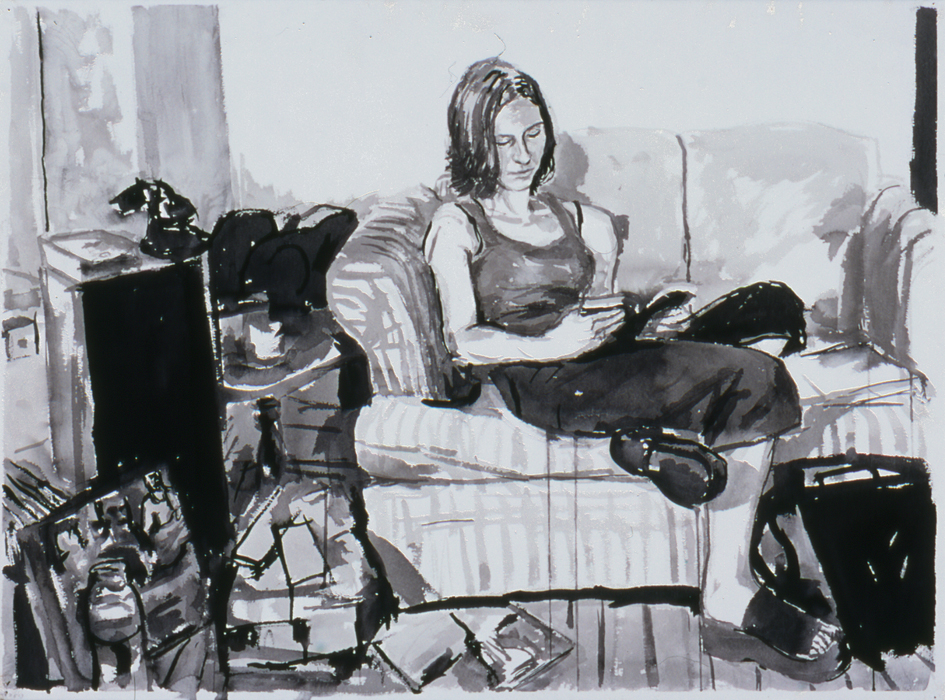
Making Pictures spans four decades of Samarov’s artistic career. Printed on high-quality color pages, the collection is thematically organized, showcasing Samarov’s different styles and genres. There are sketches, ink drawings, oils, charcoals, gouache, mixed media and more—but what most comes through is an intense narrativity. Samarov’s art is similar to his writing; there isn’t adornment so much as perspective. We get in Making Pictures a world of bars and coffee shops, cheap eateries and indie clubs. Samarov depicts his city Chicago with a thickness of life that is better seen than written about. Some of my favorite works include interiors of kitchens, portraits of women reading, and scribbly but energetic sketches of indie bands playing live. What I most appreciate about this collection though is that it showcases how outside of the so-called “art world” Samarov’s work is–and yet this is hardly the work of a so-called “outsider” artist. Samarov trained at the School of the Art Institute of Chicago, and yet through his career he has remained an independent, “not associated with an institution such as an art gallery, college, or museum,” as he writes in his book.

Beth, Dmitry Samarov, 2000

Final Cut, Charles Burns

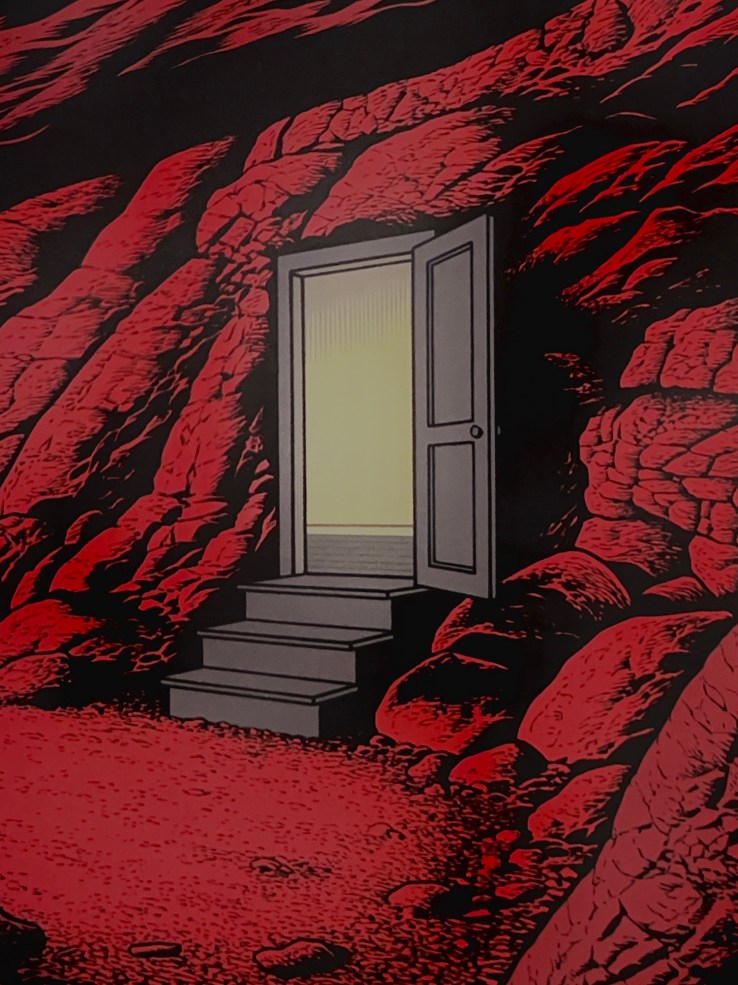
I don’t know anything about Charles Burns’s upbringing, his youth, his personal life, and I don’t mean to speculate. However, it’s impossible not to approach Final Cut without pointing out that for several decades he’s been telling the same story over and over again—a sensitive, odd, artistic boy who is out of place even among others out of place. This is in no way a complaint—he tells the story with difference each time. And with more coherence. Final Cut is beautiful and sad and also weird enough to fit in neatly to Burns’s oeuvre. But it’s also more mature, a mature reflection on youth really, intense, still, but without the claustrophobia of Black Hole or the mania of his Last Look trilogy. There’s something melancholy here. It’s fitting that Burns employs the heartbreaking 1971 film The Last Picture Show as a significant motif in Final Cut.

Image from Final Cut, Charles Burns, 2024

“Wife in Reverse,” a very short story by Stephen Dixon

“Wife in Reverse”

by

Stephen Dixon


 His wife dies, mouth slightly parted and one eye open. He knocks on his younger daughter’s bedroom door and says “You better come. Mom seems to be expiring.” His wife slips into a coma three days after she comes home and stays in it for eleven days. They have a little party second day she’s home: Nova Scotia salmon, chocolates, a risotto he made, brie cheese, strawberries, champagne. An ambulette brings his wife home. She says to him “Wheel me around the garden before I go to bed for the last time.” His wife refuses the feeding tube the doctors want to put in her and insists she wants to die at home. She says “I don’t want any more life support, medicines, fluid or food.” He calls 911 for the fourth time in two years and tells the dispatcher “My wife; I’m sure she has pneumonia again.” His wife has a trach put in. “When will it come out?” she says, and the doctor says “To be honest? Never.” “Your wife has a very bad case of pneumonia,” the doctor in ICU tells him and his daughters the first time, “and has a one to two percent chance of surviving.” His wife now uses a wheelchair. His wife now uses a motor cart. His wife now uses a walker with wheels. His wife now uses a walker. His wife has to use a cane. His wife’s diagnosed with MS. His wife has trouble walking. His wife gives birth to their second daughter. “This time you didn’t cry,” she says, and he says “I’m just as happy, though.” His wife says to him “Something seems wrong with my eyes.” His wife gives birth to their daughter. The obstetrician says “I’ve never seen a father cry in the birthing room.” The rabbi pronounces them husband and wife, and just before he kisses her, he bursts out crying. “Let’s get married,” he says to her, and she says “It’s all right with me,” and he says “It is?” and starts crying. “What a reaction,” she says, and he says “I’m so happy, so happy,” and she hugs him and says “So am I.” She calls and says “How are you? Do you want to meet and talk?” She drops him off in front of his building and says “It’s just not working.” They go to a restaurant on their first real date and he says “The reason I’m being so picky as to what to eat is that I’m a vegetarian, something I was a little reluctant to tell you so soon,” and she says “Why? It’s not peculiar. It just means we won’t share our entrees except for the vegetables.” He meets a woman at a party. They talk for a long time. She has to leave the party and go to a concert. He gets her phone number and says “I’ll call you,” and she says “I’d like that.” He says goodbye to her at the door and shakes her hand. After she leaves he thinks “That woman’s going to be my wife.”

Stephen Dixon on Thomas Bernhard

“The Plug,” by Stephen Dixon, was published in the winter 1997 issue of Rain Taxi.


I did a coupla readings for my last novel, Gould, and at one of them a guy in the audience said “Were you influenced by Thomas Bernhard?” and I said “Why, because of the long paragraphs? To tell you the truth, I know he has a great reputation but I started two Bernhard books and I didn’t think he did the long paragraph that well. They were repetitive, a bit formally and almost too rigidly written, and I often lost track of the story in them, and other things why I didn’t like them, although what, I forget.” “No,” he said, “or maybe that, but also because Gould is a character in one of his books too, The Loser. I just thought it was too much of a coincidence that you hadn’t read a lot of him and been influenced,” and I said “Gould? That guy’s name in his book is Gould? I thought I made up that forename,” and he said “Glenn Gould,” and I said “No, my character is Gould Bookbinder and he doesn’t play the piano though I think he does love Bach above all composers and especially the composition Gouldberg Variations,” and he said “That’s another thing. The first part of your novel is about variations of a single theme, abortions, right?–or that’s what you said,” and I said, “So, another coincidence. But you made me interested; I’ll read The Loser.” I didn’t, though, but a month later a colleague of mine asked if I’d ever read Bernhard’s The Loser and I said “Why, because of the long paragraphs, though he only seems to have one paragraph a book, and because of the name Gould, though I don’t know if you know–” and she said “I do: first name, not last name. But I was thinking you’d like him. The two of you do a lot of the same things. The urban settings, dark but comical nature of your characters, their dislike of so many things, though your narrators for the past ten years of your work have been fathers to the extreme as well as loyal husbands, while none of his main characters seem to have children and they never marry either or have sex, at least not in the books,” and I said “This is a double coincidence, your bringing up The Loser and someone at a recent reading bringing it up, or maybe ‘coincidence’ isn’t the right word. And sure, I understand it: Gould, the name, and my love for losers, and the long paragraph, so I’m going to read that book, I promise; the next book I start will be The Loser.” “What’re you reading now?” she said and I said “I forget; what am I reading now? It can’t be too interesting if I don’t know what it is. It isn’t interesting, in fact, so I’m going to buy a copy of his book today.” Usually I put things like this off, or just forget it, but this time I didn’t. I have to have a book to read and The Loser sounded like the one, but more out of curiosity, which isn’t a good reason for me to read a book, than because I was interested in it as literature. So I bought it that day, started it that night, and loved it. There’s my literary criticism. The single paragraph worked. So did Glenn Gould as a supporting character and Horowitz in the background. The book was funny and deep and crabby and dark and obsessive. He had his Gould and I had mine and the coincidence of the two of us using the same name, though his last but first and mine first but second, and intrigued, maybe for the same reason–I don’t know what his is but mine is that I can’t write anything anymore but in a single paragraph–by the long paragraph is, well . . . I lost my thought and apologize for the disarray. I liked it because it was intelligent, or should I say “I also liked it because,” and it was short, though took me a long time to finish, relatively speaking, since my eyes aren’t what they used to be and eyeglasses don’t do what they used to do for me and my body gets tireder faster than it used to and after a long day of work, and every day seems to be a long day of work, only a little of it my writing, I don’t have that much time to read the book, which is the only way I like to read: I want to read it, I want to read him. And after I read it I wanted to immediately read another Bernhard book, that’s the effect the first one had, so I got Woodcutters and read that and loved it and thought it was better than The Loser, funnier, crabbier, darker, more opinionated and artistic, he did things in this he didn’t in the other, trickier literary things: the guy sitting in the chair three quarters of the book, never getting out of it, just observing and thinking about what he observes, like someone out of Beckett’s novels but better, though Bernhard must have lifted it from Beckett, at least spiritually–do I know what I’m saying? Let me just say there was a very Beckettian feeling about Woodcutters. Anyway, after that one I immediately got another one, Yes, and didn’t much like it–it was older Bernhard, early Bernhard, it didn’t take the risks, it didn’t compel me to read, and it had paragraphs, I think, and I got The Lime Works and it was only so-so, and I thought “Have I read the very best of Bernhard or is it that his later works are better than his early ones?” and so got Old Masters, one of the last books of Bernhard, I think, and thought that the best one, again the man sitting in a chair, though it’s a couch in a museum, and it was even more vitriolic than Woodcutters, and next immediately read Concrete and thought that a very good one and I’m now reading Correction and liking it and I will probably read The Cheap-Eaters, without even thinking “early, late, middle Bernhard,” what do I care anymore? I just want to continue to read the guy, though a German professor at Hopkins where I teach told me there are more than twenty Bernhard novels, not all of them translated but all of them to be translated, and I told her maybe that’ll be too many for me to read, but you never know. I asked this woman “By the way, this Austrian writer Stifter, he mentions in Old Masters, he’s not a real person, is he?” and she said “Oh yes, very famous, a traditionalist, not too well known in America,” and I said “Amazing what Bernhard gets away with. Imagine an American writer working into his texts such excoriations of other writers, including contemporaries, which Bernhard does too. And knocking the Academy and prize givers, as Bernhard does in almost all his books: in America writers claw each other to get prizes and, you know, throw up on the hands that pin the medals on their chests and stuff the checks into their pockets. Some of his thoughts are a bit odd and wrongheaded if not occasionally loony,” I said, “but most I agree with. And after reading a lot of him, in addition to all the other similarities people have mentioned–well, really, just two people–and I don’t think the first ever read my work, just picked it up from the reading I gave and what was on the book jacket–is . . . oh, I forget what I was going to say.” I want to end this by saying I haven’t been so taken by one writer since I was in my mid-twenties and started reading everything Saul Bellow had written up till then. And in my early twenties, I read one Thomas Mann book after the other, probably not completing his entire oeuvre but getting close. And before that, when I was eighteen, I read everything of Dostoevski’s that had been translated. And I forgot Joyce and my mid-twenties when I read everything he wrote, though his corpus wasn’t by any means as large as Mann’s or Dostoevski’s. And one last note: Please don’t think I’m writing this as a plug for my own Gould. Or that what I just said in that last sentence is an additional plug. I hate writers who plug their books, who sort of work in a reference to their books, especially the new ones, whenever they can. I only brought up my book because it’s consequential to this inconsequential minor essay on Bernhard and that if I hadn’t written a book called Gould I probably wouldn’t have read The Loser and, of course, after that, another half-dozen Bernhard books. Did I use “inconsequential” right, then? Perhaps even to call this an essay is absurd, though to call it inconsequential and minor isn’t. But I hope I just did what I always like to do and that’s to belittle my own work and show myself as a writer who’s part bumbling semimoron. And also done what I’ve never done in print before, so far as I can remember, and my memory isn’t that good, and that is to plug the work of someone else and write even in the most exaggerated definition of the word an essay. “Exaggerated” isn’t the word I meant, I think, but I’m sure you know what I mean even in my probable misuse of it.

Mid-August riff; some books acquired, etc.

The last two weeks flew by. My kids went back to school this week; they are attending the same school for the first time since elementary school, high school,my own dear mother, that school, and I am relieved, if only temporarily from driving duties. We are making pizzas in an hour or two to celebrate the first Friday of their school year (we make pizzas every Friday as a nifty fridge clearing activity, but let’s not ruin the sparkle). My own semester starts the week after next and I realize that I need to do something more with my summers now that my children are so much older than they were when they were little children, when I was with them all summer, or if I wasn’t exactly right there with them I was hovering in the background.

I am on track to read fewer novels, or books, or whatever, than I read in July of this year. I finished Mauro Javier Cárdenas’s third novel American Abductions and liked it very much, or liked the experience or feeling of reading it, whatever that means, and I owe it a proper review. In July I read Katherine Dunn’s debut novel Attic and loved it. I couldn’t find her 1971 follow-up Truck in any of the used bookstores I frequent, so I ended up listening to it on audiobook. Maybe it was the narrator’s narration but I found it disappointing, but I still appreciate its grime and its abjection and its picaresque energy. I also checked out some Stephen Dixon e-books from my library; I read a handful of fucked up stories (a piece called “The Intruder” was especially weird) before digging into his 1988 novel Garbage. I read the first half of Garbage last night and I don’t even know how to describe it—it’s sort of like wandering upon some forgotten gritty 1970s American exploitation film made by an insane but focused auteur. But it’s also very normal in a way I will not explain. It’s uncanny.

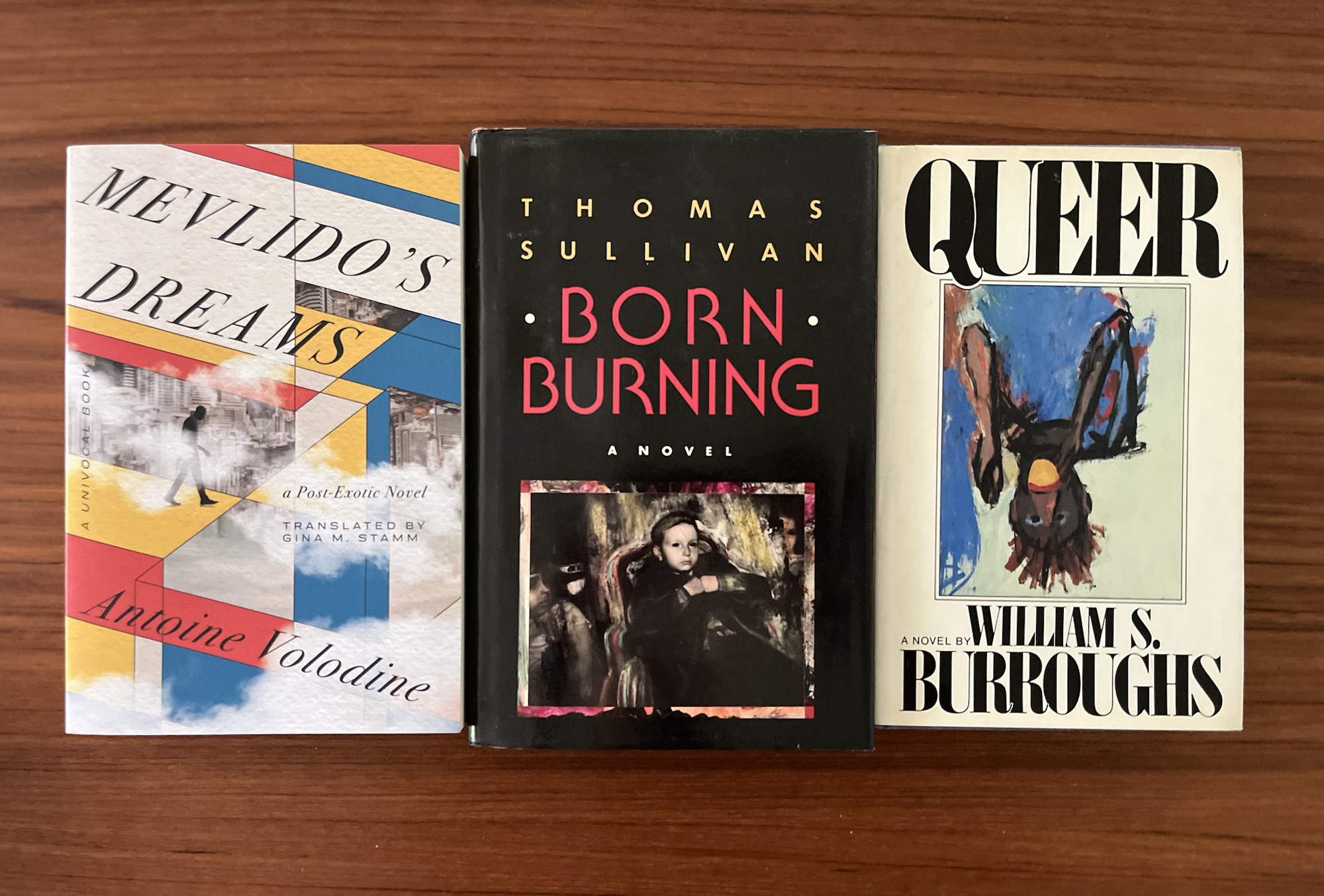
I purged about thirty paperbacks last week at my local used bookstore and ordered a copy of the latest Antoine Volodine novel, Gina M. Stamm’s translation of Mevlido’s Dreams. A recent reading of Volodine’s Radiant Terminus left me hungry for more of that sweet gross post-exotic flavor. I went to pick up the Volodine today and ended up with two hardbacks. I admit that the blurb on the back of Thomas Sullivan’s 1989 novel Born Burning sold me; it compared his previous novel to William Gaddis, John Barth, and Kurt Vonnegut. I also snapped up a first-edition hardback 1985 edition of William S. Burroughs’s novel Queer, which I fear was quite underpriced, although I don’t fear that too much. (All my sweet purged paperback credit is gone!)

I am ready for the summer to end.