Thomas Pynchon’s recipe for the first British pizza

“Lud wishes to know,” Whike relays at last, “Mr. Emerson’s Cousin’s Views, upon the Structure of the World.”
“A Spheroid, the last I heard of it, Sir.”
“Ahr Ahr ahr, ’ahr ahhrr!”
“ ’And I say, ’tis Flat,’” the Jesuit smoothly translates. “Why of course, Sir, flat as you like, flat as a Funnel-Cake, flat as a Pizza, for all that,— ”
“Apologies, Sir,—” Whike all Unctuosity, “the foreign Word again, was . . . ?”
“The apology is mine,— Pizza being a Delicacy of Cheese, Bread, and Fish ubiquitous in the region ’round Mount Vesuvius. . . . In my Distraction, I have reach’d for the Word as the over-wrought Child for its Doll.”
“You are from Italy, then, sir?” inquires Ma.
“In my Youth I pass’d some profitable months there, Madam.”
“Do you recall by chance how it is they cook this ‘Pizza’? My Lads and Lasses grow weary of the same Daily Gruel and Haggis, so a Mother is ever upon the Lurk for any new Receipt.”
“Why, of course. If there be a risen Loaf about . . . ?”
Mrs. Brain reaches ’neath the Bar and comes up with a Brown Batch-Loaf, rising since Morning, which she presents to “Cousin Ambrose,” who begins to punch it out flat upon the Counter-Top. Lud, fascinated, offers to assault the Dough himself, quickly slapping it into a very thin Disk of remarkable Circularity.
“Excellent, Sir,” Maire beams, “I don’t suppose anyone has a Tomato?”
“A what?”
“Saw one at Darlington Fair, once,” nods Mr.”“Brain.
“No good, in that case,— eaten by now.”
“The one I saw, they might not have wanted to eat . . . ?”
Dixon, rummaging in his Surveyor’s Kit, has come up with the Bottle of Ketjap, that he now takes with him ev’rywhere. “This do?”
“That was a Torpedo, Husband.”
“That Elecktrickal Fish? Oh . . . then this thing he’s making isn’t elecktrical?”
“Tho’ there ought to be Fish, such as those styl’d by the Neopolitans, Cicinielli. . . .”
“Will Anchovy do?” Mrs. Brain indicates a Cask of West Channel ’Chovies from Devon, pickl’d in Brine.
“Capital. And Cheese?”
“That would be what’s left of the Stilton, from the Ploughman’s Lunch.”
“Very promising indeed,” Maire wringing his Hands to conceal their trembling. “Well then, let us just . . .”
By the Time what is arguably the first British Pizza is ready to come out of the Baking-Oven beside the Hearth, the Road outside has gone quiet and the Moorland dark, several Rounds have come and pass’d, and Lud is beginning to show signs of Apprehension. “At least ’tis cloudy tonight, no Moonlight’ll be getting thro’,” his Mother whispers to Mr. Emerson.”

From Thomas Pynchon’s novel Mason & Dixon.

Books acquired, 13 Oct. 2023

I couldn’t pass on a used copy of the second edition of Steven Weisenburger’s A Gravity’s Rainbow Companion even though it ate up most of my trade credit. I used the first edition of the Companion when I reread Gravity’s Rainbow about eight years ago and then gave it to a friend I had been encouraging to read GR. He still hasn’t read it.

I also picked up a hardcover first edition of Cormac McCarthy’s The Road and a pristine 1946 hardback edition of Joyce’s Ulysses. I’ll probably trade in the Gabler edition of Ulysses I have, but I think I’m too sentimental to let go of the copy of The Road I read in the hospital over a few days when my daughter was born.

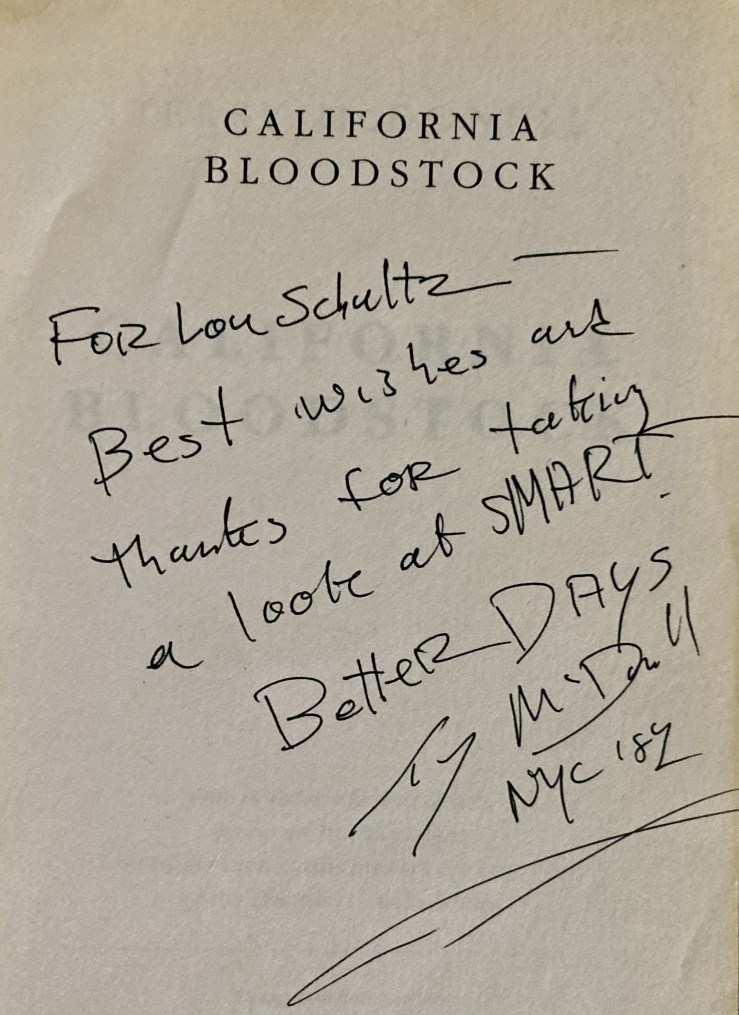
I’m a big fan of Vintage Contemporaries, but I’d never seen Terry McDonell’s California Bloodstock. I pulled it out because of its spine, and found the cover intriguing–it reminded me of these weird paintings that hang in a decrepit hotel in St. Augustine Beach that we stay at for a few nights every year. The blurb from H.S. Thompson didn’t hurt either.


I opened it to find that the novel is inscribed:

Anyone know Lou Schultz? Or what SMART might be?

(This is not a review of) The Dragon Waiting, John M. Ford’s lost classic of fantastical history

So what’s this book you liked so much?

It’s called The Dragon Waiting. It’s a 1983 novel by a guy named John M. Ford. It’s this erudite historical fantasy, or maybe fantastical history, that—

Wait, it’s called The Dragon Waiting? It’s like about dragons and shit? Dungeons and dragons?

There are dungeons, or really towers—the whole medieval motif of hostage-taking is part of the novel—but no, no dragons. Or, there is a dragon at the very end of the novel, but it’s essentially a shared illusion manifested by the dreams of an approaching army. The dragon manifests as this illusory spectacle, a spectacle based on lack and imagination—it’s kinda Lacanian, really, because—

Okay, so, is it a fantasy novel or not? I mean are there wizards and monsters and shit?

There are wizards. But really, they operate more like, I dunno, spies or chemists or thieves. One of the four main protagonists is a Welsh wizard named Hywel Peredur, and he isn’t like, doing sorcery so much as he’s trying to shape events by aligning personalities, throwing out political and personal gambits, heroic scheming, and—

Like Gandalf.

Yeah, like Gandalf I guess. Or Merlyn. But really, the stuff in The Dragon Waiting is like, reality-based, by which I mean history-based, or at least historical-fantasy-based.

So there aren’t any orcs or trolls or elves or whatever and the dragon is just a shared illusion? 

There are monstrous people. Oh, there are also vampires, but they’re not all bad.

So it’s a vampire novel? A horror novel?

No, not a horror novel, although it has some gothic tinges, and definitely not a “vampire novel,” whatever that is—although one of the four protagonists is afflicted with vampirism. He’s a German engineer named Gregory von Bayern who specializes in artillery.

So he’s a vampire who makes guns and bombs?

Kind of, but that makes it sound silly.

And so he kills people?

Yeah, but not to feed on them, and not like, in general. He’s one of the heroes of the story, enlisted by Hywel to—

Hywel is the Gandalf?

Not a great analog but sure, Hywel is your Gandalf. And he kinda puts together this squad whose long-term goals are never really stated clearly, but they are essentially forming a Western resistance to the Byzantine Empire.

The Byzantine Empire?

Yeah. So, in the alternate reality of The Dragon Waiting, the Byzantine Empire is the great unified force in the East. And because of this, Christianity never emerges as a major religion, so instead there’s this plurality of all kinds of Gods worshipped—Egyptian, Greek, Roman, and son on. And the sort of background action of the novel is Byzantium encroaching into Europe, threatening Italy, which is a bunch of disunified city states, so even if the Medici are powerful, they still have their own internal opponents, that’s one of the major themes of the novel—political infighting. We see the political scheming thing most strongly in the novel’s dominant plot, which is Hywel’s gang’s attempt to get Richard the Duke of Gloucester on the English throne.

Richard the Duke of Gloucester—that was a real guy, right?

Lots of the characters in The Dragon Waiting are real guys from history, yes.

So what do I know Richard the Duke of Gloucester from?

He was Richard the III of England.

The hunchback guy? The winter of our discontent guy? The guy who killed his nephews?

That’s how Shakespeare depicted him in the play, yes. But Ford’s novel takes a different approach. He’s very human, and he has flaws, but he’s not a Machiavellian child-killing prick.

Okay, so all of this is taking place in like Byzantium and Italy and England and like, when? When is Richard III? 1600 something?

No, not Byzantium—that Empire is trying to spread west. No, the action takes place in Western Europe—Wales, Italy, France, Switzerland, England, and so on. And the dates would cover a few decades, but a lot of the prime action is happening at the end of the fifteenth century. Richard III was coronated in the summer of 1483, if that helps. But because Christianity never really takes off, the whole AD thing never happens, so those numbers don’t really show up in the book.

This sounds really complicated. Do I need to know a lot of European history, world history to understand what’s happening?

Oh, I think even if you knew a lot of the historical background very well you’d have a hard time understanding what’s happening.

Great. So why are you into this dragon book?

I love how it’s written; I love its themes, its layering, its construction. It’s a dense book that feels light; it’s serious and erudite but also psychologically drawn. Ford eschews exposition. In fact, at times he even sets the reader up to look the wrong way. And this fits with a lot of the themes and motifs and bits of the novels—illusionists, forgers, secret agents, disguises, spies, thieves, and so on. So it’s not just happening in the plot; it’s also happening at the rhetorical level. Like, for example, okay, so we get this kind of overture in the first three chapters, which establish three of our four protagonists: Hywel the Welsh wizard, Dimitrios Ducas, an exiled Greek mercenary, and Cynthia Ricci, an Italian doctor initially in the service of the Medici. And Ford’s camera sits close to their perspective, we get into their heads, get to know them a bit. And then all of a sudden we get to the book’s second section, and all of the characters are in disguise in this remote mountain inn, way up in the snow, using false names. And Ford never shows his hand, we just have to figure out what happens, who the characters really are, and how they relate to each other. And he sort of wedges this neat little murder mystery in there (in the snow in a hotel no less—reminded me of Crane’s “The Blue Hotel” or Tarantino’s The Hateful Eight). And Ford does this again and again, but in new ways—misdirection, disguise, illusion. I ended up having to read each chapter twice.

I bet the vampire did the murder!

Okay.

But so like there are vampires in this book, but that’s not, like, a thing?

The novel treats vampirism as a disease, not as a supernatural thing, and like many diseases, there is folklore and superstition that develops around the disease, some in common with our own concept of “vampirism.” The vampires in The Dragon Waiting are sensitive to light and they do have to consume blood, but they aren’t necessarily immortal, and to a large extent, they are shunned and feared. Although some of them become powerful.

And the vampire Gregory is good?

I guess. The motivations for the four main characters aren’t necessarily good or evil, per se, although the four of them are generally sympathetic to decency, humanity, and compassion over violence and raw power. But ultimately, they seem mostly motivated by the strange friendships they forge with each other.

That sounds corny.

It’s not.

Ok. So you like the writing, but what about the subject matter? I mean, I didn’t really think you were into historical fantasy fiction? Does a body have to know a lot of European history to get into this? I tried to ask you earlier and you deflected.

I think I answered just fine: No, not really. There’s a lot of English history in there, and a lot of it will be familiar (but strangely so) if you know Shakespeare’s plays on the Plantagenet kings—a cycle that ends with Richard III, obviously.

Obviously.

I think Ford knows his history really, really well, but part of his rhetorical technique is withholding certain clues, baiting and switching, reshuffling the deck, moving the cups quickly in a shell game…the story is really about shifting identities, shifting names, shifting allegiances, and so on. I suppose it might be easy to compare it to George R.R. Martin’s A Song of Ice and Fire books, but, like better written, smarter, and trimmed of all the fat.

Rude.

That’s not what I meant. It’s sort of like Gene Wolfe’s New Sun novels. Although I’d really compare The Dragon Waiting to something like Thomas Pynchon’s Against the Day or V.—those are historical fantasies too—or fantastical histories?—encyclopedic ones that frequently defer meaning and stun or bewitch the reader. There’s like a specter there in the prose, pushing out an illusion that the reader has to chase—

The reader has to chase the dragon?

Shush.

So you’re saying this dragon book is Pynchonian?

No, no. But many things I like in Pynchon—the paranoia, the showing of the parts while withholding the revelation of the whole, the dazzling encyclopediaism—I find that in The Dragon Waiting too. Ford’s style also reminds me a bit of Cormac McCarthy, who’s so good at simply showing actions while refusing to tell the reader what they mean—either to the characters or to the narrator or whomever. Things just happen and the reader has to sort it out.

But won’t I get confused?

I was confused but not frustrated. I was confused, but then I’d reread the chapter and realize I had been looking in the wrong direction or following the wrong thread. Again, rhetorical misdirection doubles the novel’s themes of political/magical misdirection.

But the history might get me all confused.

Okay, so, the names can cause confusion. Pretty much every character has multiple names or titles, and they all use aliases as well. And lots of the historical background characters, particularly the English ones, have the same names. Lots of Richards and Elizabeths and Edwards and Henrys in here. Ford provides a little overture of historical personages, and Wikipedia is always there. Oh, and there’s this really cool site called Draco Concordans which is a series of annotations on the novel.

Wait, I have to read annotations on a website to follow this book? Is this fucking Finnegans Wake or something?

No, and I only found the site after I finished the book. I might have liked to have used it when I reread each chapter though. But I would definitely recommend reading it the first time cold. I think the pleasure in the book is looking back to realize where you lost the thread, where you were misdirected. I’m sure I’ll consult the Concordans when I read The Dragon Waiting again.

So you’ll read it again?

Oh yeah, definitely. Loved it.

That sounds like a recommendation then.

It is. I highly recommend it.

Gravity’s Rainbow is a picaresque, apocalyptic, absurdist novel that creates a complex mythology to describe our present predicament

L.E. Sissman’s contemporary review of Gravity’s Rainbow offers one of the better summaries I’ve ever read of Thomas Pynchon’s enormous novel:

Gravity’s Rainbow is a picaresque, apocalyptic, absurdist novel that creates a complex mythology to describe our present predicament. It is supposedly about a brief period in the decline of the West—fall, 1944, through fall, 1945. It is actually about our entire century, from the roots of the First World War through the final calamity, which keeps on threatening right up to press time. Beyond that, it is about the whole modern tendency of man to subordinate himself to the whims of the products of his intelligence, to the self-aggrandizing dictates of machines. It is also about the paranoia this subordination instills in men—a paranoia of which they are absolved as their persecution dreams come true and, ironically, destroy them.

Later in the review, Sissman, a poet, discusses Pynchon’s prose:

Pynchon’s talent is far greater than mere mimicry, though he is master of that. He is almost a mathematician of prose, who calculates the least and the greatest stress each word and line, each pun and ambiguity, can bear, and applies his knowledge accordingly and virtually without lapses, though he takes many scary, bracing linguistic risks. Thus his remarkably supple diction can first treat of a painful and delicate love scene and then roar, without pause, into the sounds and echoes of a drugged and drunken orgy.

Sissman’s review was published in a May 1973 issue of The New Yorker. I think the review would work as a strong introduction for anyone daunted by but interested in reading Gravity’s Rainbow. 

Portis’s Gringos, Essays on Pynchon, Elkin’s End (Books acquired, 29 Sept. 2023)

So two of the three books I picked up today I’d read before, but I couldn’t pass on the editions.

I read Stanley Elkin’s The Living End last summer, checking a digital version out from the library. I wanted something very short and funny at the time, and it worked wonders. I couldn’t pass up this Warner Books edition with design by Gene Light featuring art by Don Ivan Punchatz. I have a few other Elkins in this series and I adore them, even if my eyes are fading to the point that mass market paperbacks cause me to squint.

I also picked up another book I’ve already read, a book I already own a copy of—Charles Portis’s last novel Gringos. But I didn’t own a first edition with this fun, silly cover.

On the last day of 2020, the year I read Gringos, I wrote:

Gringos was the last of Portis’s five novels. I read the other four greedily last year, and pulled them all out when he passed away in February. I started in on Gringos, casually, then just kept reading. Sweet and cynical, spiked with strange heroism, strange grace, and very, very funny, Gringos might just be my favorite Portis novel. But I’d have to read them all again to figure that out.

I also picked up Mindful Pleasures: Essays on Thomas Pynchon, a 1976 collection that seems ahead of its time. From Scott Sanders’ essay “Pynchon’s Paranoid History”:

Steven Moore on the wild talents of Thomas Pynchon, William Gaddis, and the occultist Charles Fort

At Socrates on the Beach, there’s a nice long essay by critic Steven Moore that traces the occult influence of Charles Fort on Thomas Pynchon and William Gaddis.

From “Wild Talents: Pynchon, Gaddis, and Charles Fort“:

Pynchon and Gaddis are “wild talents” not in Fort’s original sense, but in their daring willingness to incorporate such exotic material into their novels, which previously had been confined to science fiction, fantasy, and occult novels. At any rate, it is an extraordinary coincidence that two of the greatest American novels of the 20th century evoke Charles Fort, of all people, despite what he thought of coincidences.

A review of Stone Junction, Jim Dodge’s alchemical pot-boiler

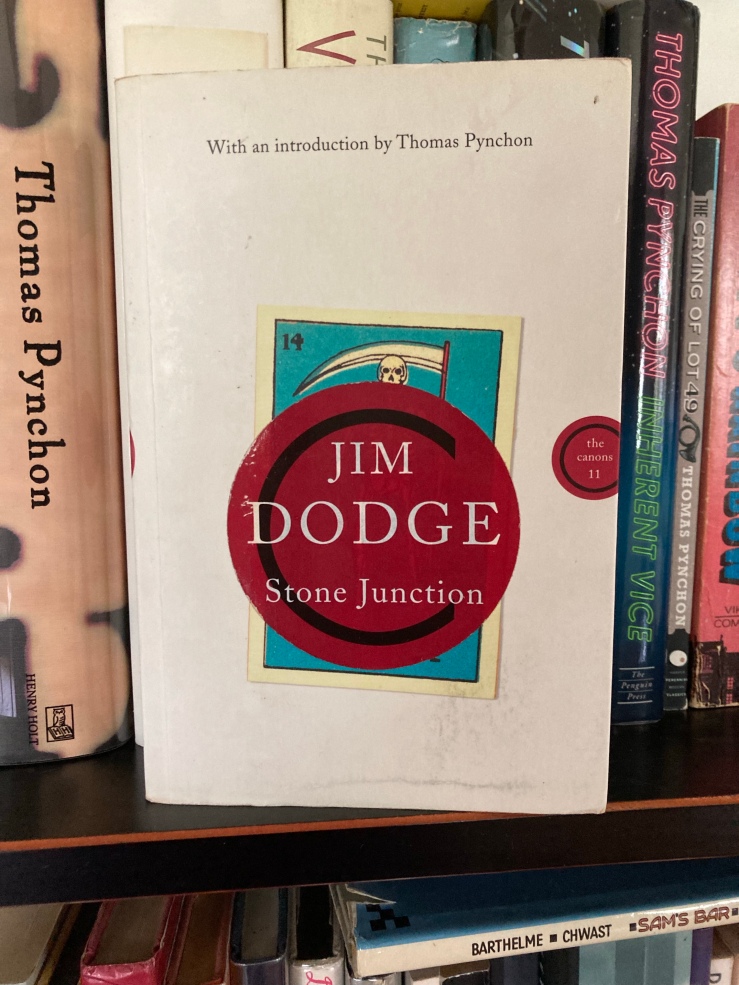
Jim Dodge’s 1990 novel Stone Junction tells the life story of Daniel Pearse, a young man of preternatural talents and sharp intelligence who trains under various tutors in a secret society, steals an enormous diamond, and eventually attains enlightened apotheosis. A lot of other stuff happens too.

Dodge subtitled his novel An Alchemical Pot-Boiler, a description that punctures any premature accusations of pretension, yet also calls attention to the novel’s arcane subject matter. The subtitle’s also a joke, of course—Dodge invites us to read his 500-pager as a kind of alchemist’s cauldron, a kitchen sink overloaded with spies and thieves, gamblers and quick change artists, holy fools and madmen. 

And Dodge, as promised, keeps his pot boiling. Stone Junction is a propulsive and engaging read largely because of the world he imagines for Daniel to grow up in. Stone Junction isn’t a magical realism act, but magic exists here. From a very young age, Daniel is initiated into a clandestine organization called AMO. Said aloud, as a young Daniel points out, the name “AMO” is suggestive of both “ammo” and the Latin verb amo, it’s really an acronym:

AMO is the acronym for Alliance of Magicians and Outlaws – or, as some members claim, Alchemists, Magicians, and Outlaws, which they contend was the original name. Another faction, small but vocal, insists AMO has always stood for Artists, Myth-singers, and Outriders. As you might sense, there is constant and long-standing contention about AMO’s origins and development

…AMO is a secret society – though more on the order of an open secret, in fact. Basically, AMO is a historical alliance of the mildly felonious, misfits, anarchists, shamans, earth mystics, gypsies, magicians, mad scientists, dreamers, and other socially marginal souls.

After the violent and mysterious death of his mother (and his own near-death), Daniel comes under the tutelage of those dreamers and socially-marginal souls. Extended episodes of Daniel’s working and growing under a new teacher make up the bulk of Stone Junction; these inventive and enjoyable sections are the finest parts of the book. Thomas Pynchon offers a nice catalog of Daniel’s various mentors in his introduction to the 1997 reprint of Stone Junction:

Wild Bill Weber teaches meditation, fishing, waiting. Mott Stocker teaches Dope, its production and enjoyment. Ace safecracker Willie Clinton (yep) instructs the boy in how to get past all kinds of locks and alarms, rendering him thus semi-permeable to certain protected parts of the world, setting him on his path to total dematerialization. For a while Daniel teams up with poker wizard Bad Bobby Sloane, roving the American highways in search of opportunities to risk capital in ways that cannot be officially controlled… The shape-shifting genius Jean Bluer teaches Daniel the arts of disguise… At last Daniel comes circling back to Volta…who teaches him the final secret of Invisibility. None of your secular Wellsian tricks with refractive indices and blood pigmentation here, but rather the time-honored arts of ceasing to be material.

It makes sense that Pynchon (who praises Stone Junction as “an outlaw epic for our own late era of corrupted romance and defective honor”) would stick on that big “I” Invisibility, always a byword in his own novels.

Dodge’s byword in Stone Junction is another i-word: imagination. Especially in its final third, Dodge’s novel, and its characters, repeat the importance of imaginative possibility, of imagining new realities, new states of being.

Volta is the dark sage magician guiding Daniel on his quest toward imagination. Or, rather, his quest to steal an enormous, perfectly-circular diamond from the U.S. government. He might throw Daniel into a den of lions, but our boy’s an escape artist. His last name, Pearse, among other transmutations (pierce, purse, pairs), suggests Percival, one of Arthur’s Knights of the Round Table. (Like Percival, Daniel is raised alone in hermetic seclusion by his solo mother.) The diamond is Daniel’s grail.

In her contemporary New York Times review of Stone Junction, Michele Slung pointed out the novel’s debt to Arthurian legends, among other sources, calling it “a post-psychedelic coming-of-age fable that’s part Thomas Pynchon, part Tolkien, part Richard Brautigan, a story that owes as much to The Once and Future King as it does to Huckleberry Finn.” Like Huck FinnStone Junction has a ramshackle, picaresque energy, but it nevertheless adheres to a plot, with the mystical diamond a MacGuffin for Daniel (among other thieves and spies) to quest after—once he’s matured and advanced in his outlaw skills, of course.

As I stated above, the strongest elements of Stone Junction revolve around Daniel’s adventures and training. (His time on the poker circuit with Bad Bobby Sloane is a particular highlight.) Dodge transmogrifies the raw material of American Weirdo Mythos into new inventions, zany recapitulations of occult outlaw fables.

Dodge’s prose style, while effective in its descriptions of characters, cannot quite approach the register of his imaginative inventory. The novel relies heavily on exposition, and while major characters like Volta and Bad Bobby Sloane speak with authentic and differentiated voices, a monolingual sameiness pervades too much of the prose. In its strongest moments, Stone Junction reads like a YA Pynchon novel; in its weakest moments, it reminded me of Tom Robbins.

The stronger moments prevail, however—Stone Junction is a fun, flighty, and at times unexpectedly heavy summer read. The novel might also be read in (stoned) conjunction with Pynchon’s 1990 twin Vineland. Both novels diagnose the fallout of the 1960s counterculture wave crashing against the Reagan eighties; both seem attempts to, at least in the world of letters, check the burgeoning nostalgic romanticization of that turbulent decade. Pynchon’s is the more flawed, sillier, and better-written effort; Dodge’s is likely his magnum opus.

If I’ve namechecked Pynchon too much in my review, forgive me: His name is on the cover of Jim Dodge’s novel, and his own (far more-detailed, far better-written) review precedes Jim Dodge’s novel, and his endorsement is frankly the reason I sought it out to begin with. I called Stone Junction “YA Pynchon” above, but I didn’t mean it as an insult—it’s YA in an older sense, in the sense of the novels handed me when I was young, hardly adult, novels that etched their own versions of reality onto our own banal reality; realities more real: Adventures of Huckleberry FinnThe OutsidersThe Once and Future KingThe Lord of the RingsHatchet… Stone Junction is about youth, but it’s also about maturation, and the ache and melancholy of aging out of the game, personified in the semi-tragic figure of Daniel’s would-be mentor, Volta.

I don’t think I would’ve appreciated the depth of Volta’s melancholy as a much younger person, which is the time I wished I had first read Stone Junction. I should’ve found the novel almost 30 years ago—let’s say the summer I stayed in my cousin’s old bedroom. I was fifteen or sixteen, and he, a decade older than me, was doing Adult Things. I listened to the tapes and records he had left in his high school bedroom, taking a few with me at the end of the summer. (Tripp, if you’re reading, I still have your cassette of New Order’s Low-Life in a box somewhere. Drive up sometime and we can search it out together.) I read almost all of his cheap paperbacks, and took as many as I thought I could reasonably get away with with me: Fear and Loathing, Cat’s CradleEven Cowgirls Get the Blues, both Miller Tropic novels, The Electric Kool-Aid Acid TestThe Dharma BumsDelta of VenusThe Beautiful and the Damned. That would’ve been the perfect summer for me to first read Stone Junction, but I didn’t read it then. I read it now. Let a younger person in your life steal it from you, sooner rather than later.

Three books (Books acquired, 8 June 2023)

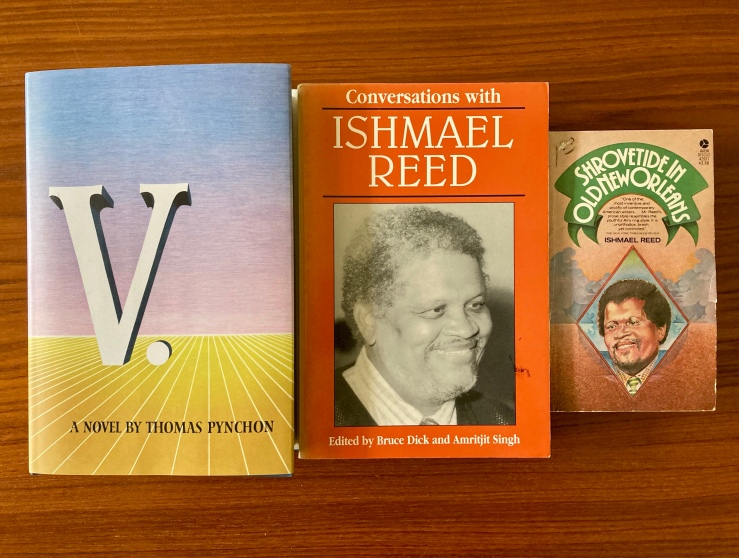
I got a facsimile hardback sixtieth anniversary edition of Thomas Pynchon’s novel V. for my birthday. I also picked up two Ishmael Reed books: Conversations with Ishmael Reed and an Avon Bard edition of Shrovetide in Old New Orleans. Before I even physically picked up these last two, I knew that they formerly belonged to a guy from Perry, Florida and that a stamp with his name and address would be on the inside of the cover or first page. I was correct in this intimation. I now have probably thirty to forty books once owned by this person. I wrote about some Reeds, formerly his, here.

Maybe I should compare my shelf with the checklist he made in the inside cover of Conversations with Ishmael Reed—


I am on kind of a Borges kick (Thomas Pynchon)

sq69phy

g7cznmh

More Thomas Pynchon letters here. Via Reddit user Forest Limit.

“Togetherness” — Thomas Pynchon

160N09658_9LTYB

(Click to enlarge.)

“Togetherness,” by Thomas Pynchon was published in the vol. 16, no. 12 issue of Aerospace Safety in December 1960. The byline reads “Thomas H. Pynchon” (for Huggles, presumably).

Full text of the article here (for completists only, of course).

Pynchon book titles embedded in other Pynchon books

IMG_5725

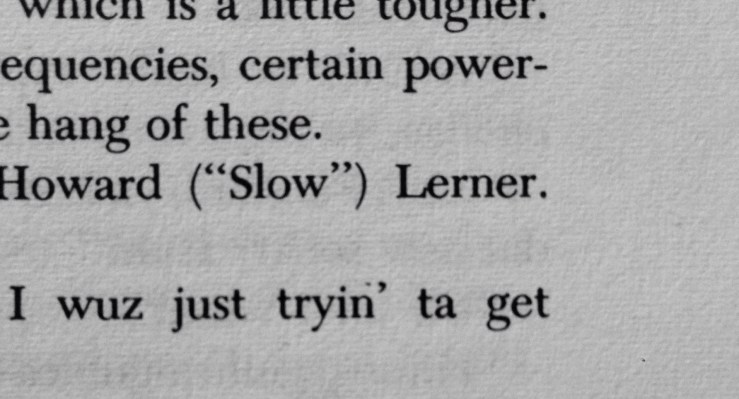
Slow Learner. From page 641 of Gravity’s Rainbow.

IMG_4503

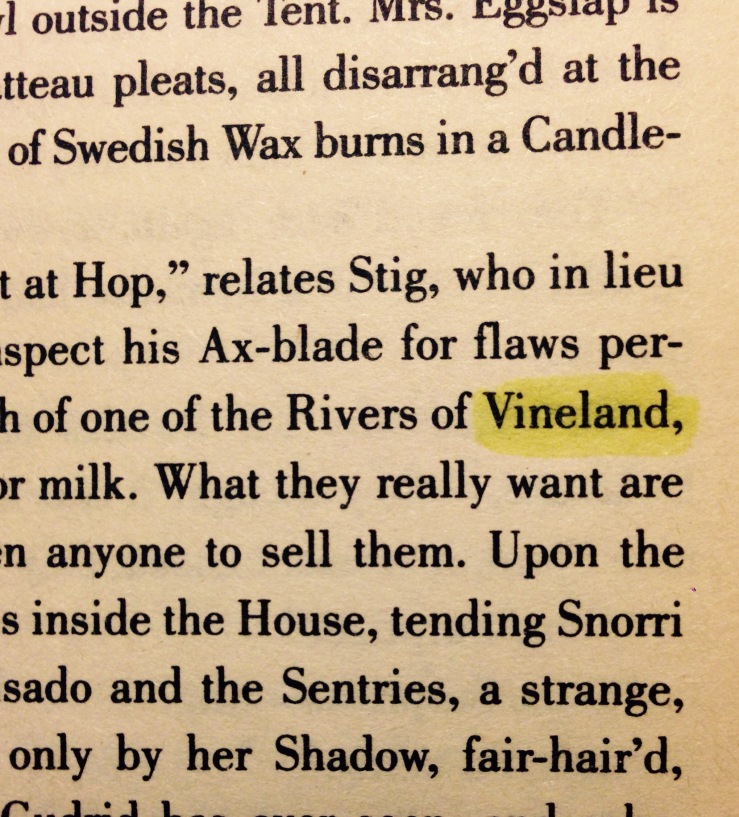
Vineland. From the beginning of ch. 66 of Mason & Dixon.

IMG_4191

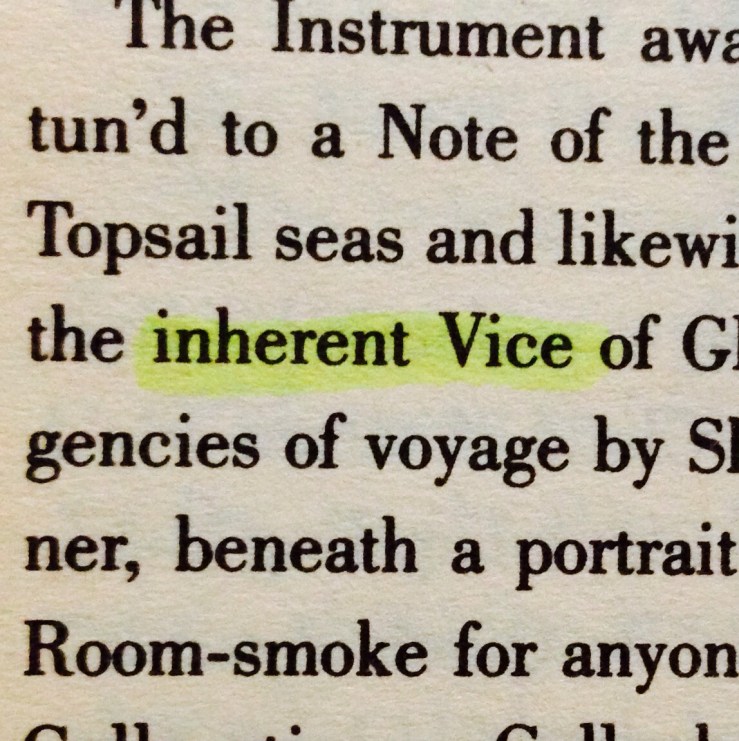
Inherent Vice. From page 272, chapter 27 of Mason & Dixon. 

img_9859

Against the Day. From page 125, chapter 13 of Mason & Dixon.

Way too cheap (From Thomas Pynchon’s Vineland)

“Whole problem ’th you folks’s generation,” Isaiah opined, “nothing personal, is you believed in your Revolution, put your lives right out there for it—but you sure didn’t understand much about the Tube. Minute the Tube got hold of you folks that was it, that whole alternative America, el deado meato, just like th’ Indians, sold it all to your real enemies, and even in 1970 dollars—it was way too cheap. . . .”

A critique (by Gen X punker Isaiah Two Four) of the Baby Boomers. From Thomas Pynchon’s 1990 novel Vineland.  The “Tube” is television, of course, but might be a placeholder for any passively-consumed entertainment.

Culte de la mayonnaise (Thomas Pynchon)

THE NEXT TIME he saw Pléiade Lafrisée was at a café-restaurant off the Place d’Armes. It would not occur to him until much later to wonder if she had arranged the encounter. She was in pale violet peau de soie, and a hat so beguiling that Kit was only momentarily surprised to find himself with an erection. It was still early in the study of these matters, only a few brave pioneers like the Baron von Krafft-Ebing had dared peep into the strange and weirdly twilit country of hat-fetishism—not that Kit noticed stuff like that ordinarily, but it happened actually to be a gray toque of draped velvet, trimmed with antique guipure, and a tall ostrich plume dyed the same shade of violet as her dress. . . .

“This? One finds them in every other midinette’s haunt, literally for sous.”

“Oh. I must’ve been staring. What happened to you the other night?”

“Come. You can buy me a Lambic.”

The place was like a museum of mayonnaise. This being just at the height of the culte de la mayonnaise then sweeping Belgium, oversize exhibits of the ovoöleaginous emulsion were to be encountered at every hand. Heaps of Mayonnaise Grenache, surrounded by plates of smoked turkey and tongue, glowed redly as if from within, while with less, if any, reference to actual food it might have been there to modify, mountains of Chantilly mayonnaise, swept upward in gravity-impervious peaks insubstantial as cloud, along with towering masses of green mayonnaise, basins of boiled mayonnaise, mayonnaise baked into soufflés, not to mention a number of not entirely successful mayonnaises, under some obscure attainder, or on occasion passing as something else, dominated every corner.

“How much do you know of La Mayonnaise?” she inquired.

He shrugged. “Maybe up to the part that goes ‘Aux armes, citoyens’—”

But she was frowning, earnest as he had seldom seen her. “La Mayonnaise,” Pléiade explained, “has its origins in the moral squalor of the court of Louis XV—here in Belgium the affinity should not be too surprising. The courts of Leopold and Louis are not that different except in time, and what is time? Both monumentally deluded men, maintaining their power through oppression of the innocent. One might usefully compare Cleo de Mérode and the marquise de Pompadour. Neuropathists would recognize in both kings a desire to construct a self-consistent world to live inside, which allows them to continue the great damage they are inflicting on the world the rest of us must live in.

“The sauce was invented as a new sensation for jaded palates at court by the duc de Richelieu, at first known as mahonnaise after Mahon, the chief port of Minorca, the scene of the due’s dubious ‘victory’ in 1756 over the illfated Admiral Byng. Basically Louis’s drug dealer and pimp, Richelieu, known for opium recipes to fit all occasions, is also credited with the introduction into France of the cantharides, or Spanish fly.” She gazed pointedly at Kit’s trousers. “What might this aphrodisiac have in common with the mayonnaise? That the beetles must be gathered and killed by exposing them to vinegar fumes suggests an emphasis on living or recently living creatures—the egg yolk perhaps regarded as a conscious entity—cooks will speak of whipping, beating, binding, penetration, submission, surrender. There is an undoubtedly Sadean aspect to the mayonnaise. No getting past that.”

Kit was a little confused by now. “It always struck me as kind of, I don’t know . . . bland?”

“Until you look within. Mustard, for example, mustard and cantharides, n’estce pas? Both arousing the blood. Blistering the skin. Mustard is the widelyknown key to resurrecting a failed mayonnaise, as is the cantharides to reviving broken desire.”

“You’ve been thinking about mayonnaise a lot, mademoiselle.”

“Meet me tonight,” a sudden fierce whisper, “out at the Mayonnaise Works, and you shall perhaps understand things it is given only to a few to know. There will be a carriage waiting.” She pressed his hand and was gone in a mist of vetiver, abruptly as the other evening.

A passage from Thomas Pynchon’s novel Against the Day; I don’t think you need any context to appreciate this passage.


Mail call | Thomas Pynchon

A great shout went up near the doorway, bodies flowed toward a fattish pale young man who’d appeared carrying a leather mailsack over his shoulder.

“Mail call,” people were yelling. Sure enough, it was, just like in the army. The fat kid, looking harassed, climbed up on the bar and started calling names and throwing envelopes into the crowd. Fallopian excused himself and joined the others.

Metzger had taken out a pair of glasses and was squinting through them at the kid on the bar. “He’s wearing a Yoyodyne badge. What do you make of that?”

“Some inter-office mail run,” Oedipa said.

“This time of night?”

“Maybe a late shift?” But Metzger only frowned. “Be back,” Oedipa shrugged, heading for the ladies’ room.

On the latrine wall, among lipsticked obscenities, she noticed the following message, neatly indited in engineering lettering:

“Interested in sophisticated fun? You, hubby, girl friends. The more the merrier. Get in touch with Kirby, through WASTE only. Box 7391. L. A.”

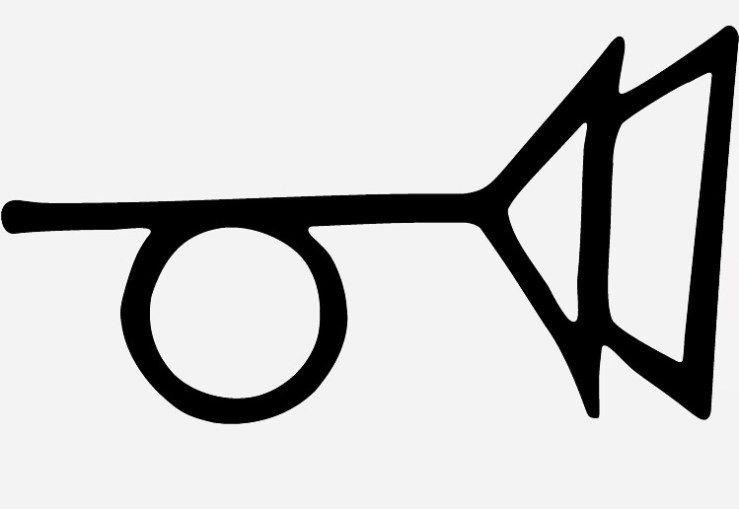
WASTE? Oedipa wondered. Beneath the notice, faintly in pencil, was a symbol she’d never seen before, a loop, triangle and trapezoid, thus:

img_5980

It might be something sexual, but she somehow doubted it. She found a pen in her purse and copied the address and symbol in her memo book, thinking: God, hieroglyphics. When she came out Fallopian was back, and had this funny look on his face.

“You weren’t supposed to see that,” he told them. He had an envelope. Oedipa could see, instead of a postage stamp, the handstruck initials PPS.

“Of course,” said Metzger. “Delivering the mail is a government monopoly. You would be opposed to that.”

Fallopian gave them a wry smile. “It’s not as rebellious as it looks. We use Yoyodyne’s inter-office delivery. On the sly. But it’s hard to find carriers, we have a big turnover. They’re run on a tight schedule, and they get nervous. Security people over at the plant know something’s up. They keep a sharp eye out. De Witt,” pointing at the fat mailman, who was being hauled, twitching, down off the bar and offered drinks he did not want, “he’s the most nervous one we’ve had all year.”

“How extensive is this?” asked Metzger.

“Only inside our San Narciso chapter. They’ve set up pilot projects similar to this in the Washington and I think Dallas chapters. But we’re the only one in California so far. A few of your more affluent type members do wrap their letters around bricks, and then the whole thing in brown paper, and send them Railway Express, but I don’t know . . .”

“A little like copping out,” Metzger sympathized.

“It’s the principle,” Fallopian agreed, sounding defensive. “To keep it up to some kind of a reasonable volume, each member has to send at least one letter a week through the Yoyodyne system. If you don’t, you get fined.” He opened his letter and showed Oedipa and Metzger.

Dear Mike, it said, how are you? Just thought I’d drop you a note. How’s your book coming? Guess that’s all for now. See you at The Scope.

That’s how it is,” Fallopian confessed bitterly, “most of the time.”

“What book did they mean?” asked Oedipa.

Turned out Fallopian was doing a history of private mail delivery in the U. S., attempting to link the Civil War to the postal reform movement that had begun around 1845. He found it beyond simple coincidence that in of all years 1861 the federal government should have set out on a vigorous suppression of those independent mail routes still surviving the various Acts of ’45, ’47, ’51 and ’55, Acts all designed to drive any private competition into financial ruin. He saw it all as a parable of power, its feeding, growth and systematic abuse, though he didn’t go into it that far with her, that particular night. All Oedipa would remember about him at first, in fact, were his slender build and neat Armenian nose, and a certain affinity of his eyes for green neon.

So began, for Oedipa, the languid, sinister blooming of The Tristero.


From The Crying of Lot 49 by Thomas Pynchon.

In which I read Playboy for the Thomas Pynchon article

A few years ago I posted a brief excerpt from Jules Siegel’s March 1977 Playboy profile “Who is Thomas Pynchon… And Why Did He Take Off With My Wife?” The excerpt came from an excerpt posted on the Pynchon-L forum, but most of the article had been removed at the (apparent) request by Siegel. A few people sent me the whole article though (thanks!) and I read it.

Pick Pynchon’s feet. Or don’t!

Jules Siegel was briefly a Cornell classmate of Pynchon’s in 1954, and they remained friends (in Siegel’s recollection) for at least two decades after. During this time, Siegel claims that Pynchon wrote him dozens of letters, which were ultimately sold at auction (along with much of Siegel’s property) to help pay for a hip replacement. Material from the letters soak into Siegel’s sketch of Pynchon’s progress, along with several stoned/drunken adventures that would not be out of place in V. or Mason & Dixon or Gravity’s Rainbow, or really, any person’s young life.

A competitive anxiety reverberates under the piece. “We were friends, maybe at some points best friends, very much alike in some important ways,” Siegel writes. “We were both writers,” he boldly writes. Siegel reminds us that “In Mortality and Mercy in Vienna, Pynchon’s first published short story, the protagonist is one Cleanth Siegel,” but protests he doesn’t see himself in that hero.

The competitive anxieties culminate in the big reveal that (spoiler!) Thomas Pynchon had an affair with Siegel’s second wife Chrissie. There’s probably a Freudian reading we can append to the details that Siegel offers about Pynchon’s sexual prowess: “He was a wonderful lover, sensitive and quick, with the ability to project a mood that turned the most ordinary surroundings into a scene out of a masterful film—the reeking industrial slum of Manhattan Beach would become as seen through the eye of Antonioni, for example.”

Or maybe these unsexy details are just a sign of Playboy’s editorial hand. Wedged gracelessly between ads for vibrators and nude greeting cards, Siegel’s lines often reek of 1970’s Playboy’s rhetorical house style, a kind of frank-but-(attempted)-sensual glossiness that contrasts heavily with Pynchon’s own sex writing. At times I found myself reading Siegel’s prose in one of Will Ferrell’s more pompous accents.

Even worse is the casual sexism of the piece—which again, may be attributable to Playboy’s editors. Siegel, on his first wife (sixteen when he married her): “She was so wonderful a lover, generous and easily aroused, but I was too callow then to appreciate her.” Of his second wife: “It is easy to underestimate her intelligence, but it is a mistake. She is obviously too pretty to be serious, conventional wisdom would have you believe.” Of one of Pynchon’s girlfriends: “Susan has red hair and is breathtakingly beautiful, with the voluptuous body of a showgirl. Like Chrissie, she is much brighter than she looks.”

More interesting, obviously, are the (supposedly) real-life details that inform Pynchon’s fiction. Siegel notes some of the contents of Pynchon’s Manhattan Beach apartment: “A built-in bookcase had rows of piggy banks on each shelf and there was a collection of books and magazines about pigs.” Pigs, of course, are a major motif of Gravity’s Rainbow. Another detail that seems to connect to GR: “On the desk, there was a rudimentary rocket made from one of those pencil-like erasers with coiled paper wrappers that you unzip to expose the rubber. It stood on a base twisted out of a paper clip.” Siegel lets us know that he knocked the rocket down. Pynchon puts it back together; Siegel knocks it down again.

(Parenthetically: Siegel’s evocation of Pynchon’s Manhattan Beach days fits neatly into my picture of Inherent Vice).

In accounting details of Pynchon’s alleged affair with his wife, Chrissie, Siegel shares the following:

Once, out on the freeway, she told him that we had all gone naked at the commune, he professed to find that incredible and dared her to take off her blouse right there. She did. A passing truck hooted its horn in lewd applause. He loved her Shirley Temple impersonations—On the Good Ship Lollipop sung and danced like a kid at a birthday party. They talked about running away together.

It is hardly possible here not to recall the episode early in Gravity’s Rainbow wherein Jessica Swanlake removes her blouse in the car on a dare from Roger Mexico. Is Siegel daring the reader to extrapolate further? Extrapolation, paranoid connections—isn’t this part of Pynchonian fun?

In that spirit, I’ll close with my favorite moment from the article.

“You know the W.A.S.T.E. horn in The Crying of Lot 49? The symbol of the secret message service? Every weirdo in the world is on my wave length. You cannot understand the kind of letters I get. Someone wrote to tell me that the very same horn was the symbol of a private mail system in medieval times. I checked it out at the library. It’s true. But I made it up myself before the book was ever published, before I ever got that letter.”

The lines are supposedly from Pynchon himself. Siegel even puts them in quotation marks—so they must be real, right?

[Ed. note: Biblioklept ran a version of this post in 2015. Enjoy Pynchon in Public Day tomorrow!]

Father Fairing’s Sewer Rat Parish | Thomas Pynchon

They were entering Fairing’s Parish, named after a priest who’d lived topside years ago. During the Depression of the ’30s, in an hour of apocalyptic well-being, he had decided that the rats were going to take over after New York died. Lasting eighteen hours a day, his beat had covered the breadlines and missions, where he gave comfort, stitched up raggedy souls. He foresaw nothing but a city of starved corpses, covering the sidewalks and the grass of the parks, lying belly-up in the fountains, hanging wrynecked from the streetlamps. The city—maybe America, his horizons didn’t extend that far—would belong to the rats before the year was out. This being the case, Father Fairing thought it best for the rats to be given a head start—which meant conversion to the Roman Church. One night early in Roosevelt’s first term, he climbed downstairs through the nearest manhole, bringing a Baltimore Catechism, his breviary and, for reasons nobody found out, a copy of Knight’s Modern Seamanship. The first thing he did, according to his journals (discovered months after he died) was to put an eternal blessing and a few exorcisms on all the water flowing through the sewers between Lexington and the East River and between Eighty-sixth and Seventy-ninth Streets. This was the area which became Fairing’s Parish. These benisons made sure of an adequate supply of holy water; also eliminated the trouble of individual baptisms when he had finally converted all the rats in the parish. Too, he expected other rats to hear what was going on under the upper East Side, and come likewise to be converted. Before long he would be spiritual leader of the inheritors of the earth. He considered it small enough sacrifice on their part to provide three of their own per day for physical sustenance, in return for the spiritual nourishment he was giving them.

Accordingly, he built himself a small shelter on one bank of the sewer. His cassock for a bed, his breviary for a pillow. Each morning he’d make a small fire from driftwood collected and set out to dry the night before. Nearby was a depression in the concrete which sat beneath a downspout for rainwater. Here he drank and washed. After a breakfast of roast rat (“The livers,” he wrote, “are particularly succulent”) he set about his first task: learning to communicate with the rats. Presumably he succeeded. An entry for 23 November 1934 says:

Ignatius is proving a very difficult student indeed. He quarreled with me today over the nature of indulgences. Bartholomew and Teresa supported him. I read them from with me today over the nature of indulgences. Bartholomew and Teresa supported him. I read them from the catechism: “The Church by means of indulgences remits the temporal punishment due to sin by applying to us from her spiritual treasury part of the infinite satisfaction of Jesus Christ and of the superabundant satisfaction of the Blessed Virgin Mary and of the saints.”

“And what,” inquired Ignatius, “is this superabundant satisfaction?”

Again I read: “That which they gained during their lifetime but did not need, and which the Church applies to their fellow members of the communion of saints.”

“Aha,” crowed Ignatius, “then I cannot see how this differs from Marxist communism, which you told us is Godless. To each according to his needs, from each according to his abilities.” I tried to explain that there were different sorts of communism: that the early Church, indeed, was based on a common charity and sharing of goods. Bartholomew chimed in at this point with the observation that perhaps this doctrine of a spiritual treasury arose from the economic and social conditions of the Church in her infancy. Teresa promptly accused Bartholomew of holding Marxist views himself, and a terrible fight broke out, in which poor Teresa had an eye scratched from the socket. To spare her further pain, I put her to sleep and made a delicious meal from her remains, shortly after sext. I have discovered the tails, if boiled long enough, are quite agreeable.

Evidently he converted at least one batch. There is no further mention in the journals of the skeptic Ignatius: perhaps he died in another fight, perhaps he left the community for the pagan reaches of Downtown. After the first conversion the entries begin to taper off: but all are optimistic, at times euphoric. They give a picture of the Parish as a little enclave of light in a howling Dark Age of ignorance and barbarity.

Rat meat didn’t agree with the Father, in the long run. Perhaps there was infection. Perhaps, too, the Marxist tendencies of his flock reminded him too much of what he had seen and heard above ground, on the breadlines, by sick and maternity beds, even in the confessional; and thus the cheerful heart reflected by his late entries was really only a necessary delusion to protect himself from the bleak truth that his pale and sinuous parishioners might turn out no better than the animals whose estate they were succeeding to. His last entry gives a hint of some such feeling:

When Augustine is mayor of the city (for he is a splendid fellow, and the others are devoted to him) will he, or his council, remember an old priest? Not with any sinecure or fat pension, but with true charity in their hearts? For though devotion to God is rewarded in Heaven and just as surely is not rewarded on this earth, some spiritual satisfaction, I trust, will be found in the New City whose foundations we lay here, in this Iona beneath the old foundations. If it cannot be, I shall nevertheless go to peace, at one with God. Of course that is the best reward. I have been the classical Old Priest—never particularly robust, never affluent—most of my life. Perhaps

The journal ends here. It is still preserved in an inaccessible region of the Vatican library, and in the minds of the few old-timers in the New York Sewer Department who got to see it when it was discovered. It lay on top of a brick, stone and stick cairn large enough to cover a human corpse, assembled in a stretch of 36-inch pipe near a frontier of the Parish. Next to it lay the breviary. There was no trace of the catechism or Knight’s Modern Seamanship.

“Maybe,” said Zeitsuss’s predecessor Manfred Katz after reading the journal, “maybe they are studying the best way to leave a sinking ship.”

The stories, by the time Profane heard them, were pretty much apocryphal and more fantasy than the record itself warranted. At no point in the twenty or so years the legend had been handed on did it occur to anyone to question the old priest’s sanity. It is this way with sewer stories. They just are. Truth or falsity don’t apply.

From Thomas Pynchon’s 1963 novel V.

img_2194

Gravity’s Rainbow annotations (so far)

img_4025

I’ll be adding to these and then doing more the next time (?!) I read Gravity’s Rainbow.*

Pages 82-83: The White Visitation, etc.

Page 103: Black Markets, King Kong, etc.

Pages 148-49: Preterite/Elect, Lurianic Kabbalah, Uncanny X-Men, etc.

Page 203: Rainbows, Fuck-yous, Plastic Man, etc.

Pages 204-05: Paper, mise en abyme, a silkenness of girls, etc.

Page 256: “Real America,” Hughes contra Whitman, BANZAI!, etc.

Pages 257-58: The War, nimbus clouds, Zoot Suit Riot!, etc.

Page 299: Tannhäuser, horny expectations, etc.

Page 364: Knights and fools, dendrites and axons, etc.

Pages 412-13:  Ouroboros, organic chemistry, tarot, etc.

Page 419: Innocence, experience, Wm Blake, Wagner’s Ring cycle, etc.

Page 539: Critical Mass, Weismann’s tarot reading, Rilke, hymns, etc.

[Ed. note–I published these links to my notes, riffs, and images connected to a re-reading of Gravity’s Rainbow back in November of 2016. Today marks the 50th anniversary of the publication of Pynchon’s great novel.]