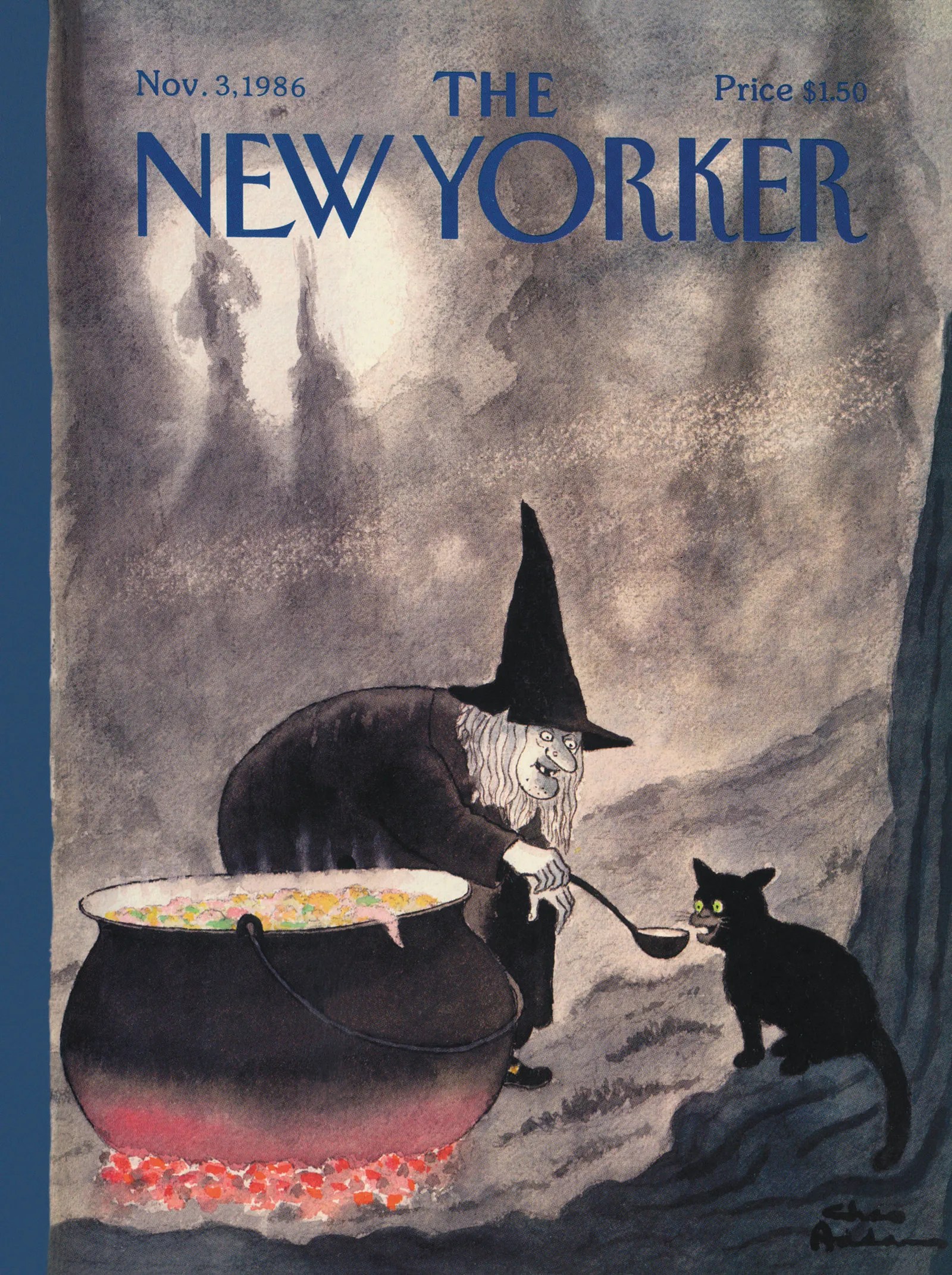
Halloween cover for The New Yorker, 3 Nov. 1986 by Charles Addams (1912-1988)
Halloween cover for The New Yorker, 3 Nov. 1986 by Charles Addams (1912-1988)
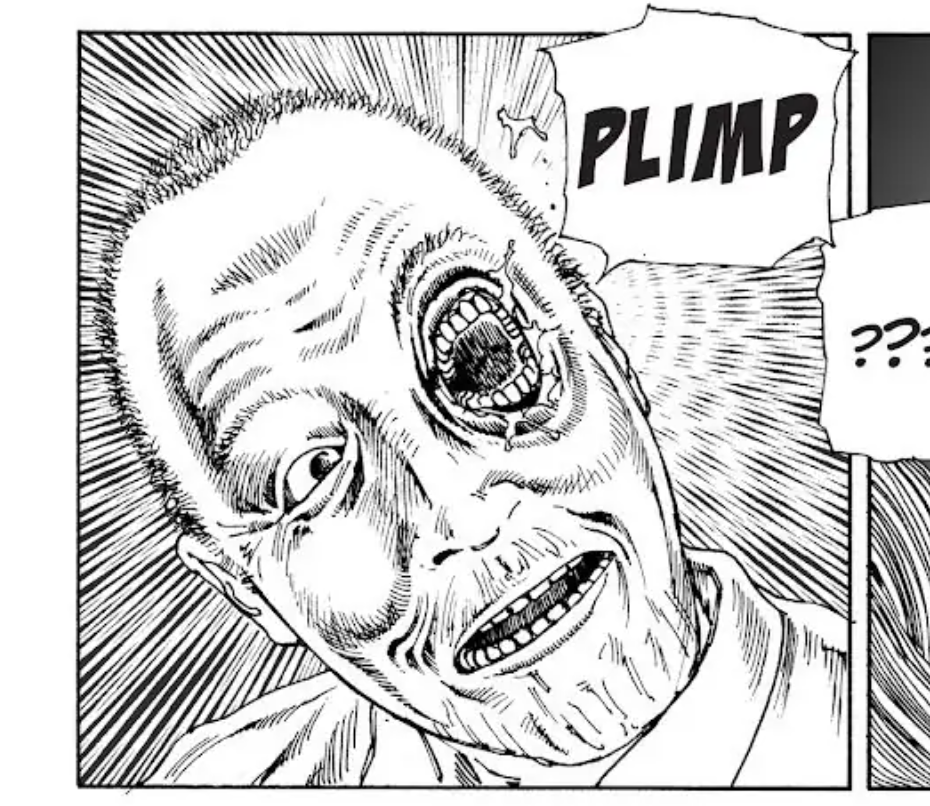
A panel from Dementia 21 (Vol. 1) by Shintaro Kago, (trans. Rachel Matt Thorne), 2018, Fantagraphics Books.
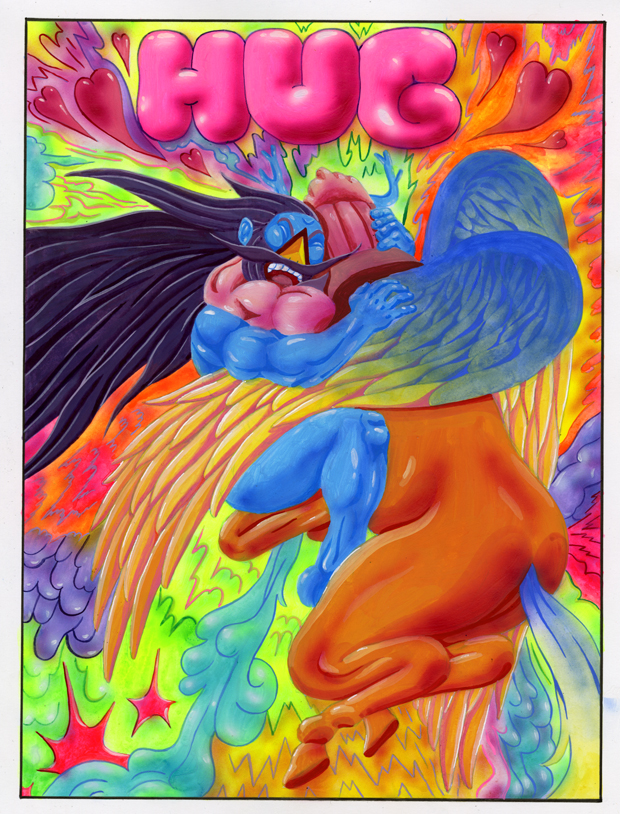
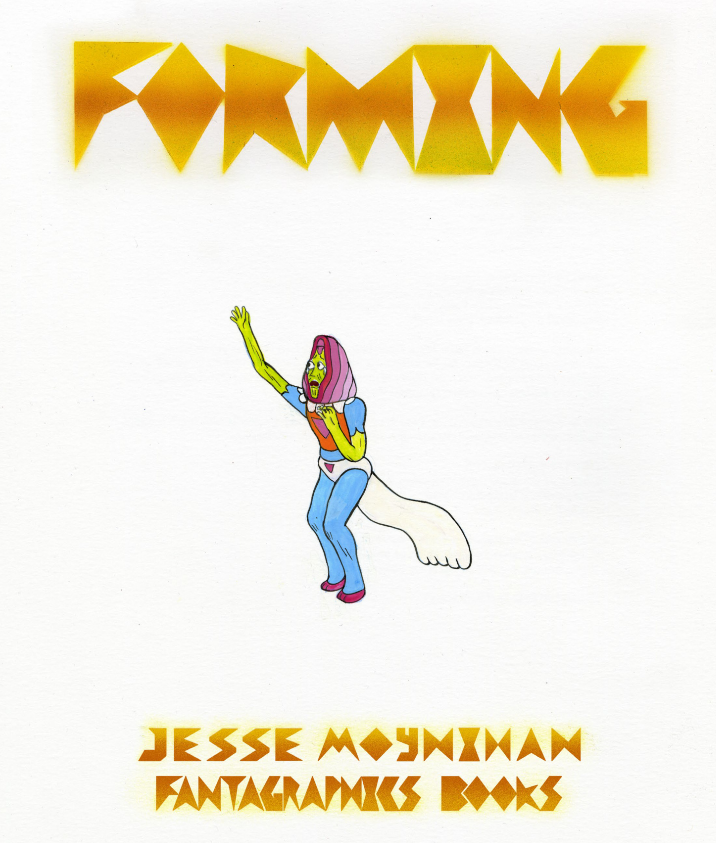
In Jesse Moynihan’s Forming, horny, neurotic, power-mad weirdos battle for supremacy, and in the process generate (and degenerate) the universe. Moynihan’s mutants can alter reality by force of will (and force of force) but they can barely manage their own appetites and grudges. It’s great fucking stuff.
Forming throws biblical genealogy, Greek succession myths, and Zoroastrian cosmology into a whirlpool of family disasters. We’ve got angels, aliens, and assassins. We’ve got giants, pissed-off proles, sudden whales and psychedelic geometric entities. We’ve got a cypher, a grinning black crescent in hot-pink boots named Nobody. Forming treats mythology as one enormous pulsing contradictory history, breaking familiar stories apart and rebuilding them as episodes in an ongoing struggle for power. The cosmic and the ridiculous are inseparable, and nobody, however exalted, is above the fray.
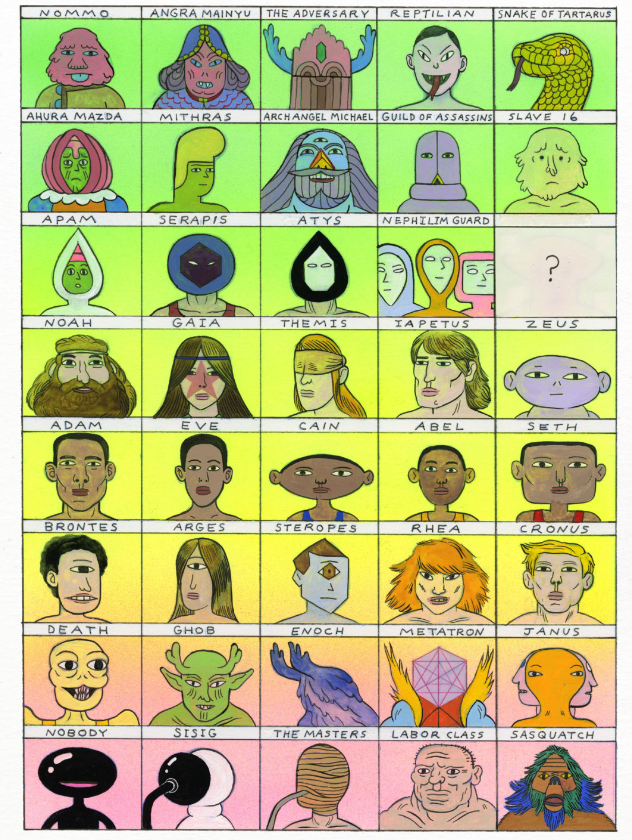
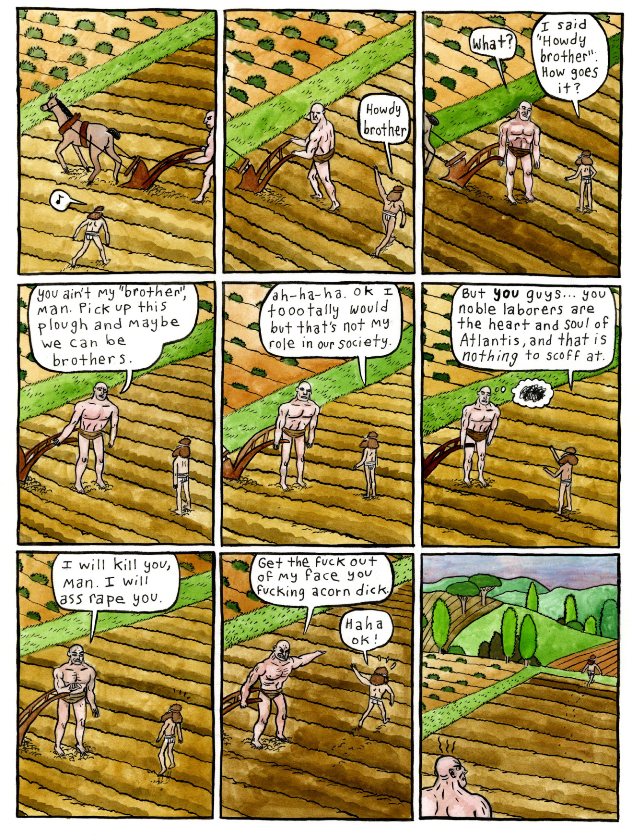
Moynihan’s epic begins in modest earnest ironic cartooning. Forming’s earliest pieces are one-pagers, little machines: setup, escalation, punchline. Consider this gag, in which Noah’s attempt at friendly solidarity swerves into class grievances and violent threats:
Elsewhere, Lucifer gets goosed by a ghost:
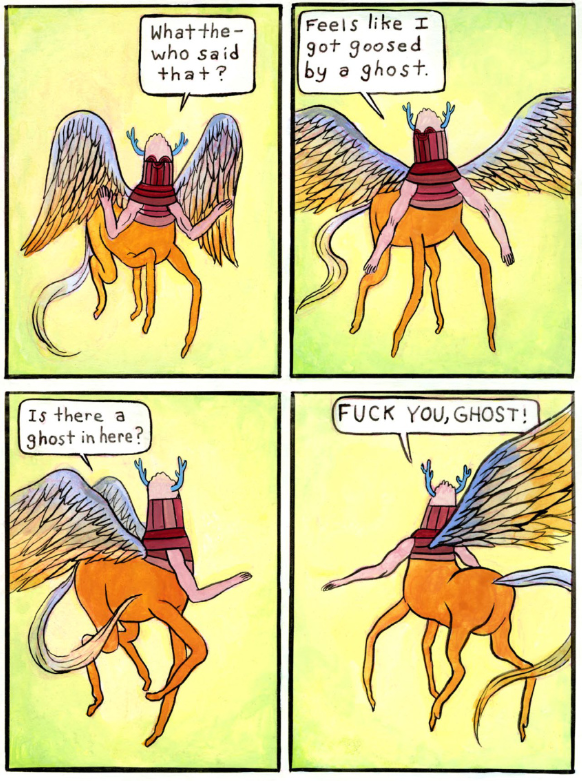
The jokes are more than tone-setting japes; they lead to worldbuilding. Atlantis emerges from labor dispute. Archangel Michael and Lucifer battle and banter in the metaphysical background. Insults, misunderstandings, and casual brutality establish cosmic hierarchies. Moynihan builds his epic sideways: setups produce universes; punchlines produce consequences.
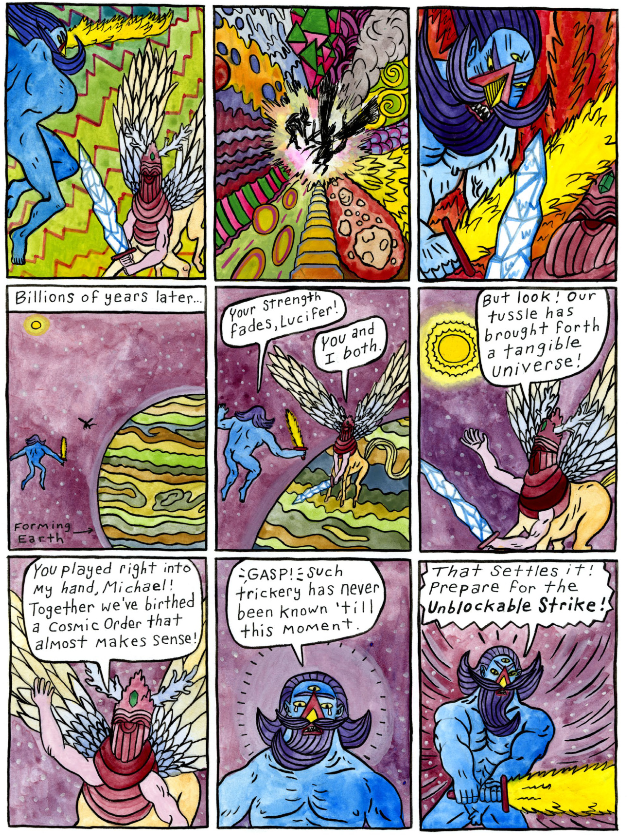
William Blake is a clear progenitor for Forming (both visually and schematically) — particularly the Blake of The Book of Urizen and The Four Zoas, where creation begins with division and cosmic history is a rough family album chronicling the gods’ goddamned damaged relations. Throughout Blake’s mythology, the elevation of a partial perspective into absolute truth produces division and conflict.
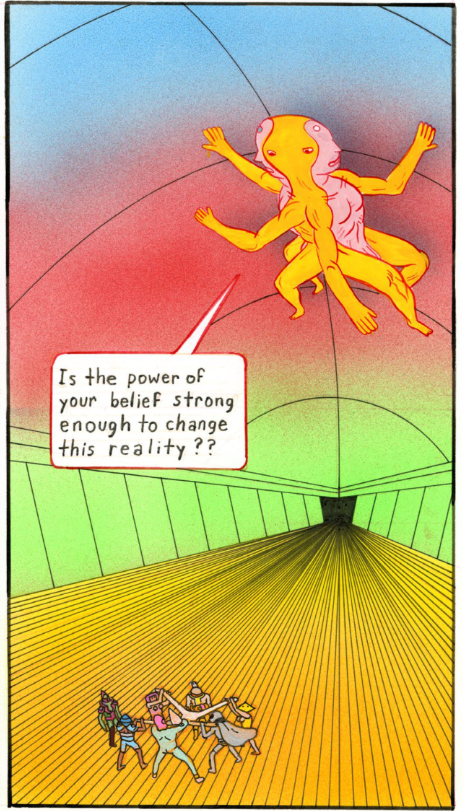
Moynihan pricks this predicament with a spur of emphatically comic physical life. His gods and demiurges can alter reality through force of will, yet remain tangled up in their rivalries, passions, and shortsighted ambitions. Janus asks a squad of assassins: “Is the power of your belief strong enough to change this reality?” — a Blakean speculation, a nod to imaginative power — but in Forming the answer to that question might play out with somegod getting their ass whooped. Metaphysics and slapstick run on the same aesthetic engine.
One of Forming’s central concerns is the uneasy relationship between (the pretense of) divine authority and the poet/artist who attempts to describe it. This conflict has another literary progenitor in John Milton and his epic Paradise Lost — the fall, the rebellion, divine providence, all that celestial jazz. Moynihan inserts Milton into a brief episode, late in Forming, where the blind poet wrestles with the influence of his own great precursor, Homer. Moynihan’s Milton appeals to God. He needs help in forming his depiction of Michael’s battle with Satan into “something truly badass.” What muse answers?
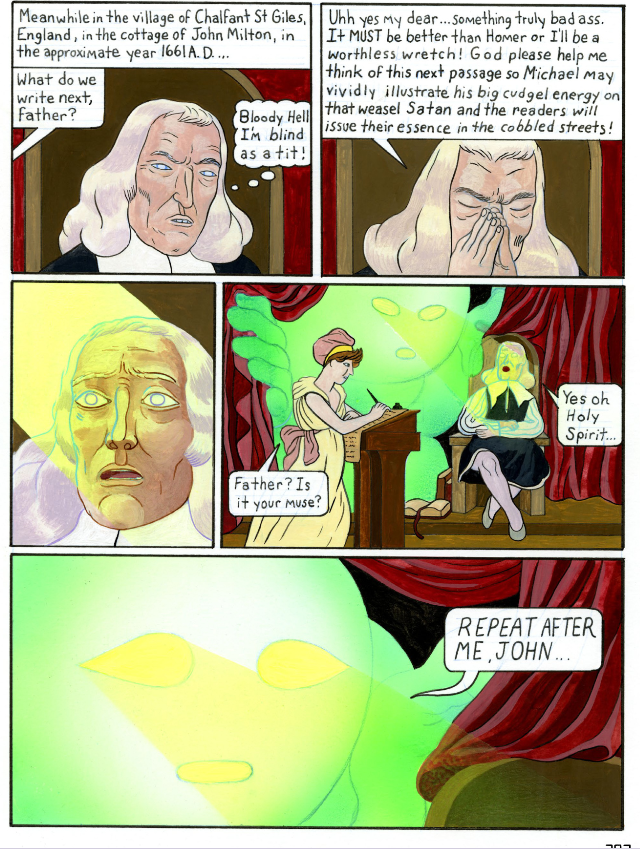
Milton thinks he’s writing the war in Heaven. The war in Heaven is apparently writing Milton. In Forming, the inspiriting Muse might be an assassin or secret agent, Origins Unknown. Is the poet’s aesthetic vision prompted by the metaphysical, psychological, biological? Does the poet invent his material, receive it, or get recruited into somebody else’s shenanigans?
Blake, of course, had his own complicated relationship with Milton. In Milton: A Poem, the precursor poet’s influence challenges Blake to confront and transform Milton’s theological and moral framework in favor of his own intuition and imagination. The anxiety of influence becomes a spiritual struggle: literary inheritance is something the younger poet must wrestle with rather than merely receive. Moynihan makes a comic variation on that struggle by putting Milton inside the very mythology he hopes to describe. The poet becomes another participant in the cosmic disorder, the poem its strange, self-creating artifact.
If Blake and Milton inform Forming’s theological and literary complications, Jack Kirby supplies much of the cosmic hardware. Kirby’s Fourth World comics, especially The New Gods, along with his later Marvel series The Eternals, chronicled divine genealogies and technological spectacle in a unique, Kirbyesque (forgive the tautology) visual language that other cartoonists continue to aspire to. Kirby’s gods wield weapons that look like they were designed in a mad god’s laboratory.
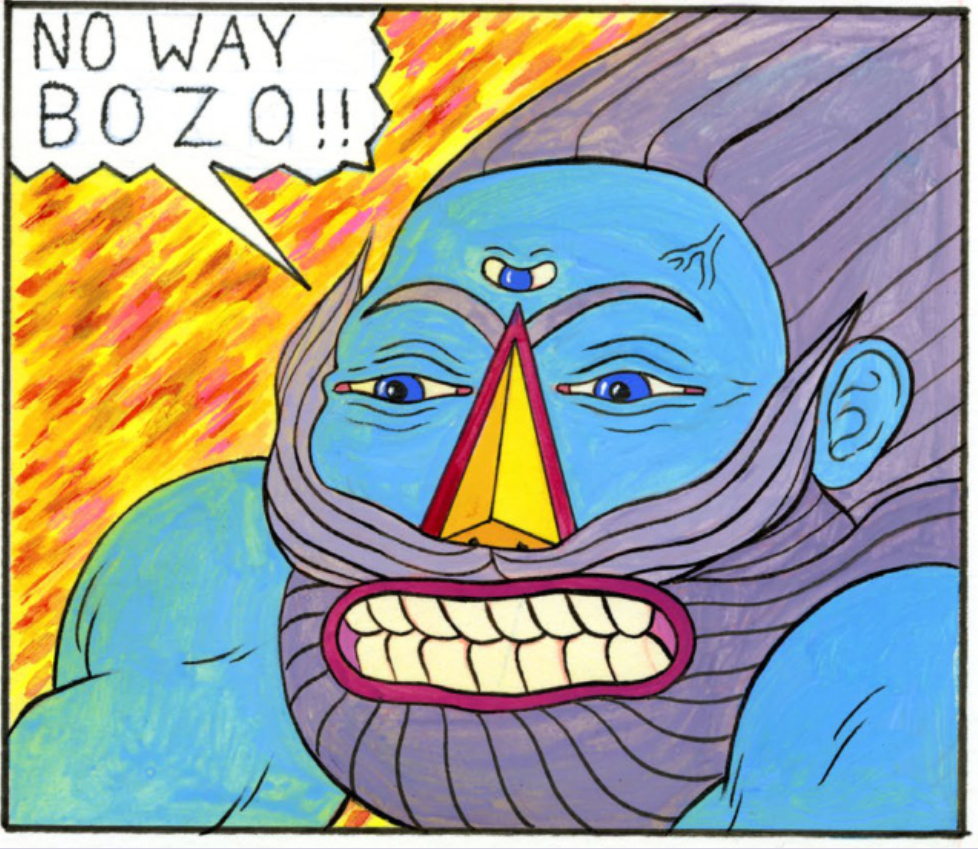
Forming draws on that Kirbyesque grandiosity but gives it a distinctly unruly cast. Its gods are similarly conceived as cosmic beings whose bodies, tools, and environments blur the line between divinity and machinery. Michael, Metatron, and Enoch manifest as components of a vast theological apparatus. Cosmic entities employ cool tech. But where Kirby’s monumental designs often project a sense of cosmic authority and immense structural order, Moynihan’s visual scale gestures towards slippery, fecund violent comedy and transcendent disorder. These gods are engineers, colonizers, bureaucrats, sneak thieves and warriors, dysfunctional relatives operating machinery far more sophisticated than they are. It’s all very sloppy, abject, gross. (That’s some of the highest praise I can heap.) And where Kirby’s legendary splash pages rumble like tectonic plates colliding, every punch and energy blast carrying the weight of a cosmic principle, Moynihan’s setpieces retain a playground-fight intensity that resonates with rude emotion. His combatants sound like children inventing special attacks in a backyard brawl. Celestial warfare gives us crystalline weapons and billions of years of history, the “Unblockable Strike” and “NO WAY BOZO!!” Who would not like to be there? To participate, even?
The fights are fucking awesome. Beams, blades, transformations, colossal bodies, and reality-altering attacks give physical form to the comic’s competing creation myths. There’s plenty of cool shit. Moynihan might spend pages on divine entities bickering or goofing around and then deliver a splash page of some impossible brute absolutely whaling on another impossible brute.
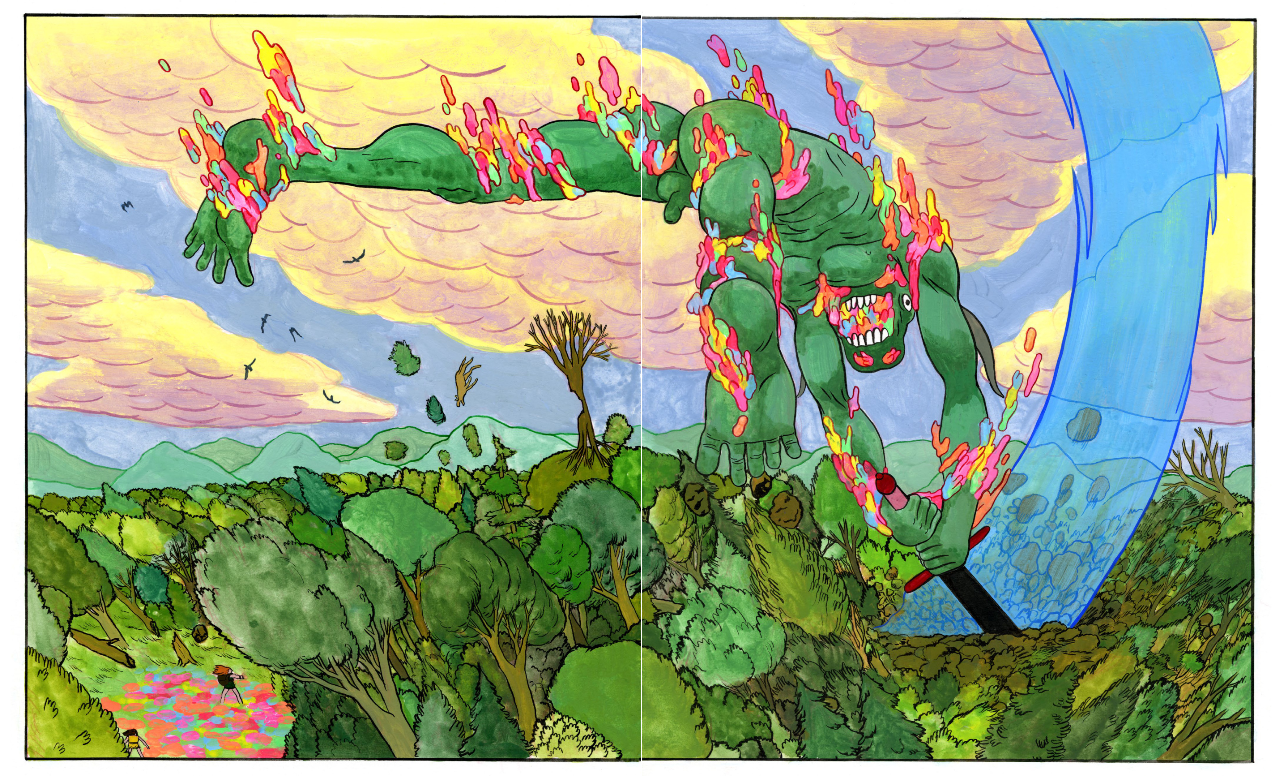
Forming’s grandiosity is inseparable from its ridiculousness. An ancient cosmic grievance might end with somebody getting the shit kicked out of them. Sooner or later, though, somebody has to ask whether all this spectacular violence means something or if it’s just like, fucking awesome to look at. Natch, that somebody is Nobody.
Nobody pops up with his sexy pink boots in Forming’s third act to offer metatextual commentary on how stories are made, marketed, and judged. He complains about every “rando dipstick” wanting to make “deep” art, scorns metaphor, and defends entertainment as a product designed to satisfy the broadest possible consumer base. Nommo, whose artistic vision has remade (literally reformed) the planet around them, responds by invoking the hoary old ideal of truth as the “true entertainment” worthy of the soul, higher than the gross marketplace. It’s an ideal that brings a third Dead English Poet to mind, our old dear John Keats, dead at 25, who nevertheless managed immortality with the zinger: “Beauty is truth, truth beauty,—that is all / Ye know on earth, and all ye need to know.” I’ve never known quite what to make of those lines. Keats, or Keats’s speaker, puts this pronouncement about beauty and truth in the urn’s mouth, which, like, an urn doesn’t fucking have, a mouth, then leaves us wondering who gets to speak for art and whether an artwork can settle its own meaning. That radical aesthetic uncertainty tingles throughout Forming (where an urn certainly could have a mouth, I suppose), staging a loose debate about art and entertainment inside a comic full of dirty jokes and spectacular fights.
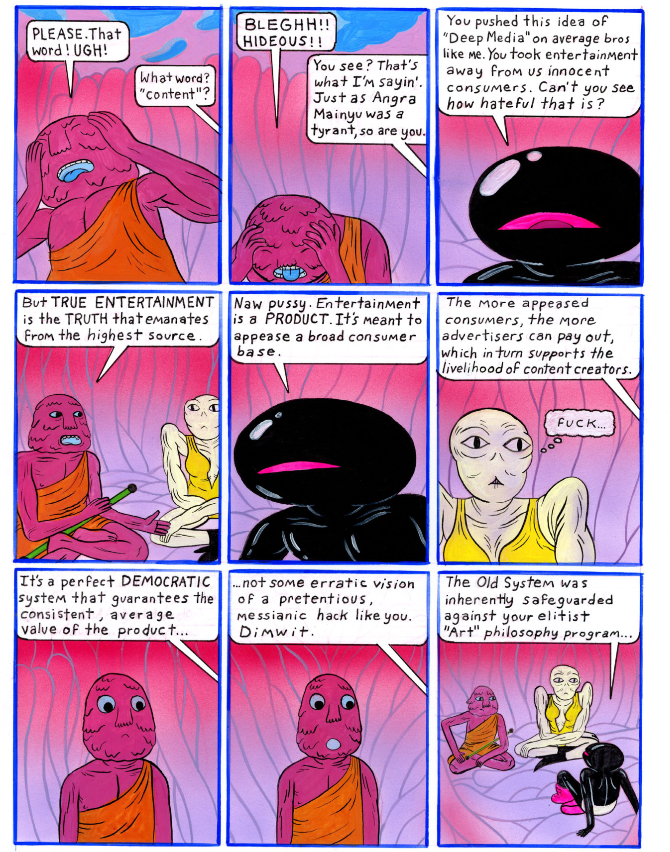
Neither position wins — the tension remains. Art might be slipped on like a fancy robe, a disguise for vanity, elitism, and self-coronation. Entertainment can become a product engineered to offend nobody while selling (out) everything. “Content” is both an economically accurate term and a little linguistic coffin into which the distinctions among art, entertainment, criticism, and advertising are tossed (but left unburied).
Moynihan gives himself plenty of room on both sides of the argument. Forming is full of metaphor, philosophy, theological speculation, colossal ambition, and authorial indulgence. It is also full of goofy monsters and obscene punchlines. It wants William Blake and “FUCK YOU GHOST!” It wants Miltonic prophecy and the awesome-shit spectacle of the Unblockable Strike. Its vulgarity is part and parcel of its take on creation, authority, and the desire to make something — art, entertainment, a really cool fucking comic — that other people will take seriously.
Here, Moynihan has something in common with Johnny Ryan and Benjamin Marra, cartoonists whose rough, vulgar surfaces refuse the tasteful separation of trash from art. Ryan’s comics run on unchecked appetite and endless bodily mutation; Marra pushes macho heroics past competence and into ritual. Moynihan is less relentlessly abrasive than Ryan and less committed to Marra’s deadpan masculine theater, but all three understand the expressive possibilities of crudity. An ugly body can puncture heroic pretensions, and an obscene joke can expose the absurdities hidden inside an exalted idea.
In Forming, that crudity brings the sacred insistently back to the body. Moynihan’s gods boast, reproduce, misunderstand instructions, hunger, shit, threaten strangers, and become trapped in forms they cannot control. For all their power, they remain subject to the vanity and confusion animating the comic’s smallest disputes. Even the most exalted being can wind up looking like an idiot. Or really fucking cool. Or really fucking cool and idiotic at the same time.
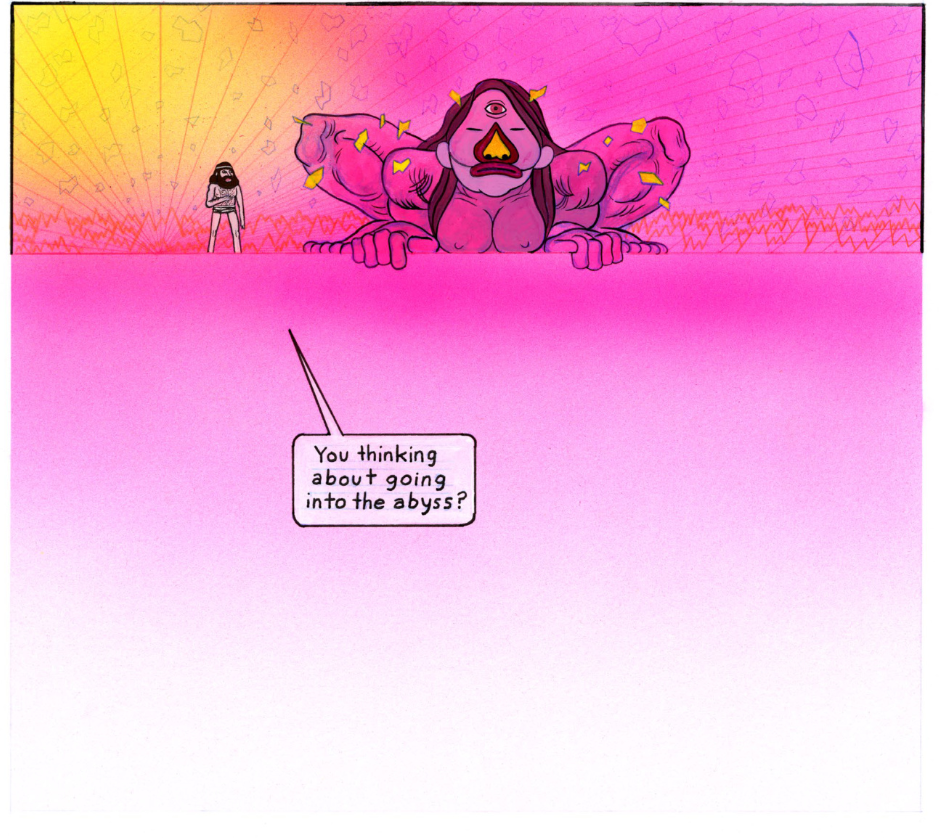
The comic’s shifting visual forms accommodate these sudden collapses of scale and dignity. Its pages move between compressed gag-strip grids and visionary spectacle, from cramped exchanges of insults to enormous abysses and burning colossi. Moynihan employs a nine-panel grid on most pages, establishing a rhythm of setup and punchline; his dramatic splash pages break out of that rhythm. Underground-comic crudity, psychedelic Hanna-Barbera, and Fletcher Hanks’s grotesque distortions haunt the visual mix, but by the book’s end Moynihan has pushed that unruliness toward something luminous and hallucinatory: the cosmic geometries of Kilian Eng, the psychedelic expansiveness of Moebius, even a Goethean drama of color and perception. The changes in scale become changes in visual logic, as the gag-strip machinery opens onto vast, unstable fields of color, form, and energy.
It all adds up to something genuinely and unexpectedly moving. Moynihan began Forming as a webcomic in 2009 and worked on it, intermittently and with increasing formal ambition, for seventeen years. Over that time, one gag opened onto another creation myth, one family grievance sparked another cosmic war, and each new generation inherited the wreckage of the last. The accumulation of jokes, betrayals, mutations, and apocalyptic battles gradually became an immense, deeply peculiar vision of creation, sustained by Moynihan’s willingness to keep expanding it without ever taming its absurdity.
Fantagraphics’ new complete edition gives that long undertaking an appropriately beautiful physical form. At 448 full-color pages, the hardcover is substantial without becoming unwieldy, handsomely printed and remarkably easy to read despite the density of Moynihan’s cosmology. The crisp reproduction and generous page size let the colors blaze, the crowded grids breathe, and the sudden splashes achieve their full scale. In this latest, perhaps final form, Forming is a masterful achievement.
Yet the book’s arrival at a finished form does not mean that its contradictions settle into place. There is something tender in the persistence with which Moynihan carries these oppositions and eruptions through cosmic violence, deranged theology, and dubious ambition. Forming ultimately suggests that these tensions might be carried forward only by passing into another form. The sacred and the stupid occupy the same panel, sometimes the same body. Creation is an ongoing accident, forever producing creatures who misunderstand the world, alter it, and occasionally reach for one another as everything comes apart in a ridiculous and tender gesture.
Beautiful, bewildering, hilarious, and unexpectedly affecting, Forming is very highly recommended.
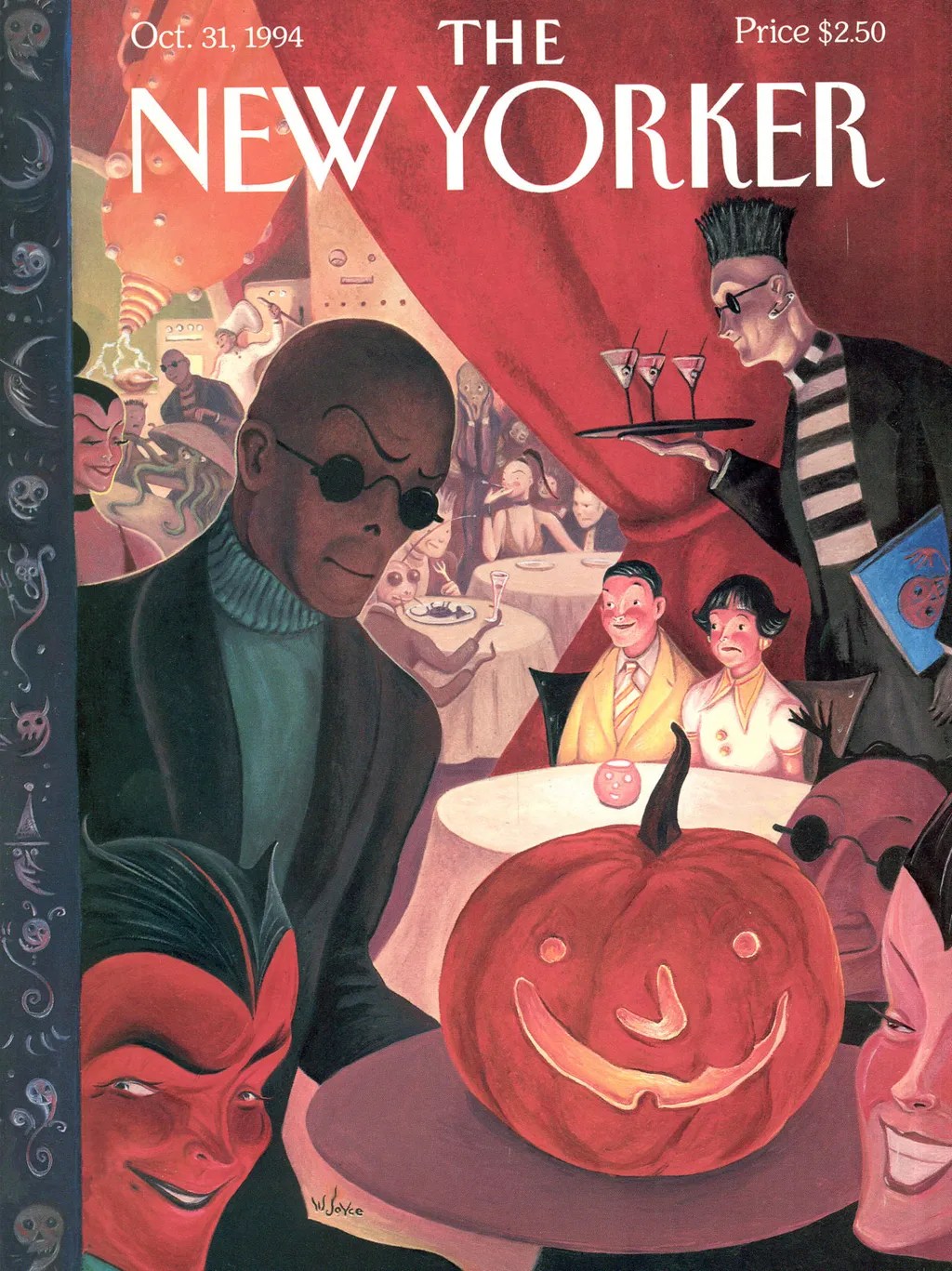
Halloween cover for The New Yorker, 31 Oct. 1994 by William Joyce (b. 1957)
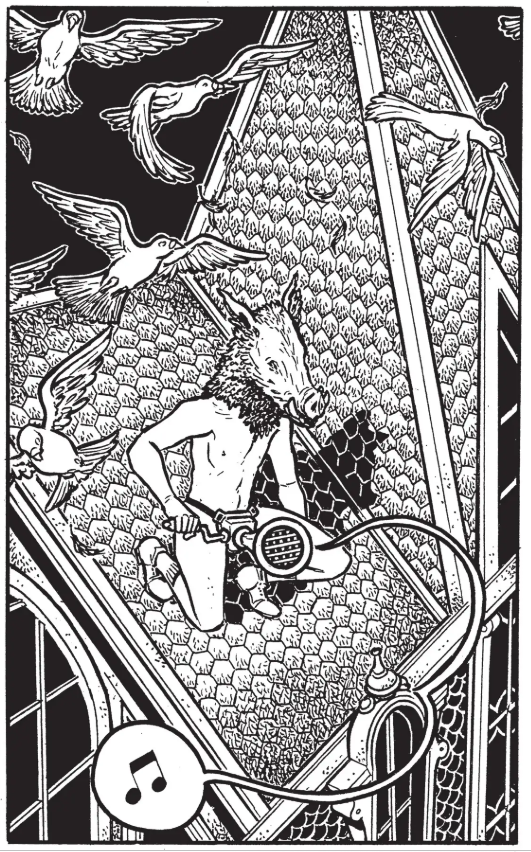
A panel from The Squirrel Machine by Hans Rickheit, 2013, Fantagraphics Books.
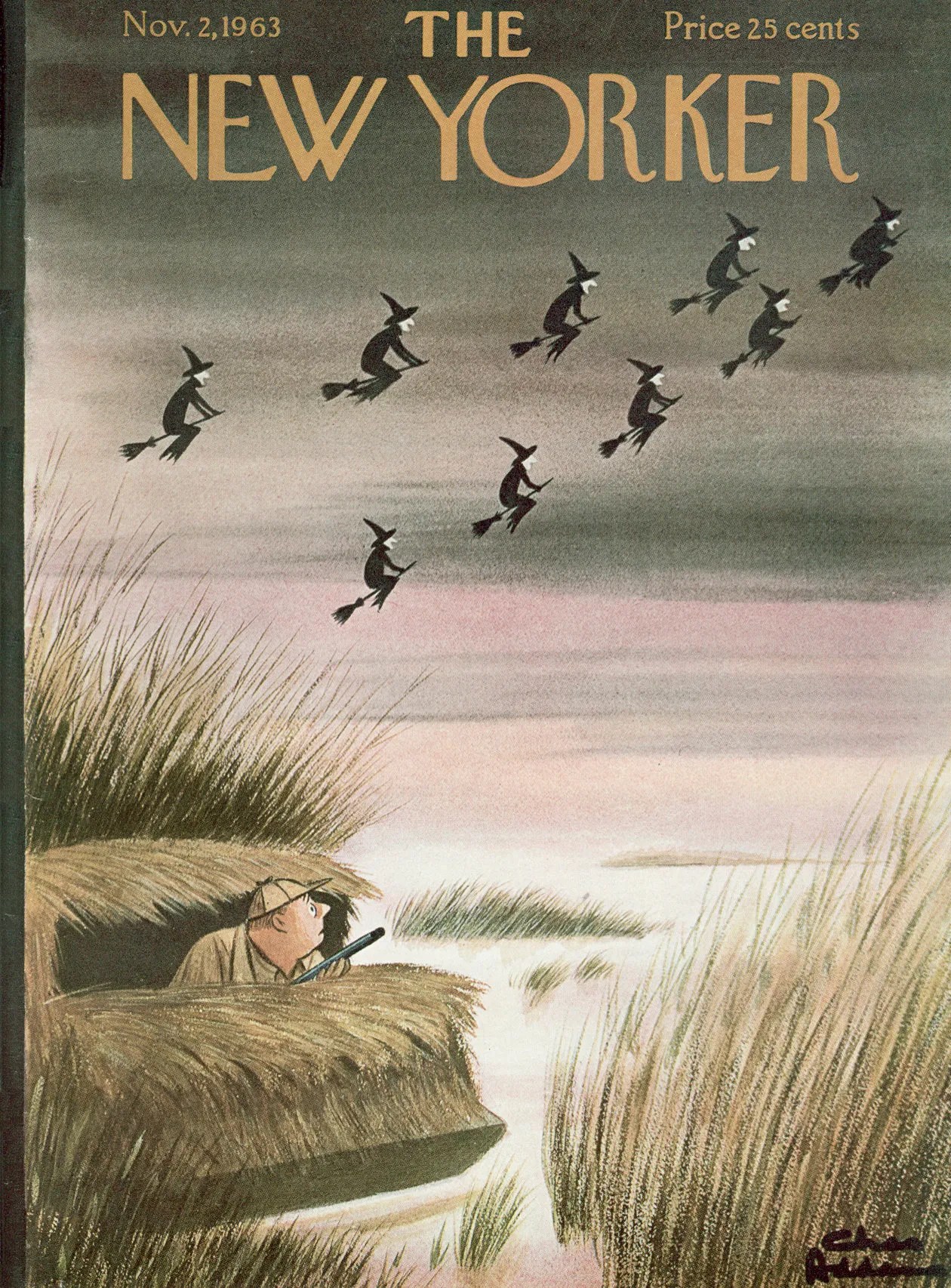
Halloween cover for The New Yorker, 2 Nov. 1963 by Charles Addams (1912-1988)
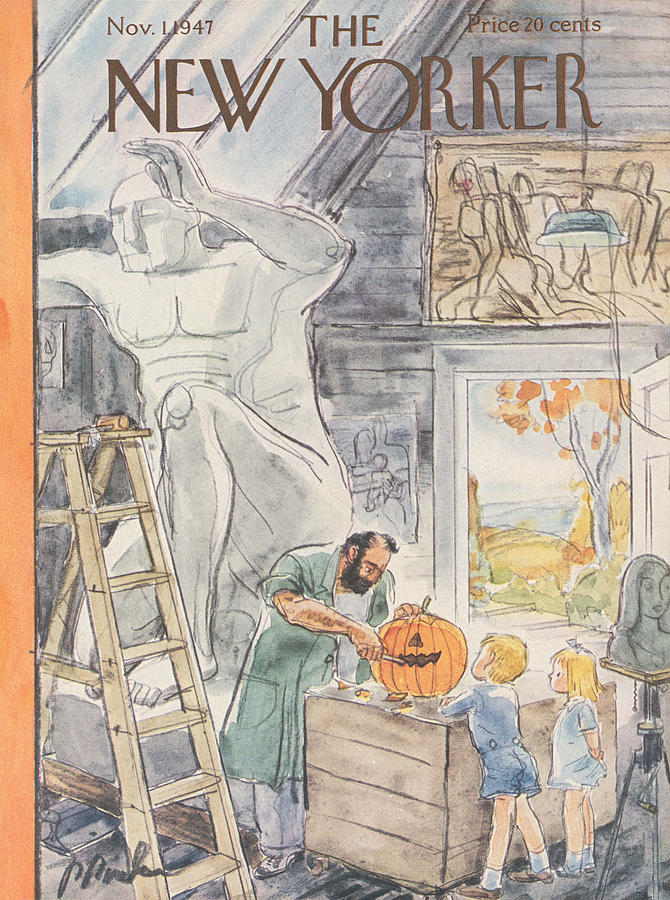
Halloween cover for The New Yorker, 1 Nov. 1947 by Perry Barlow (1892-1977)
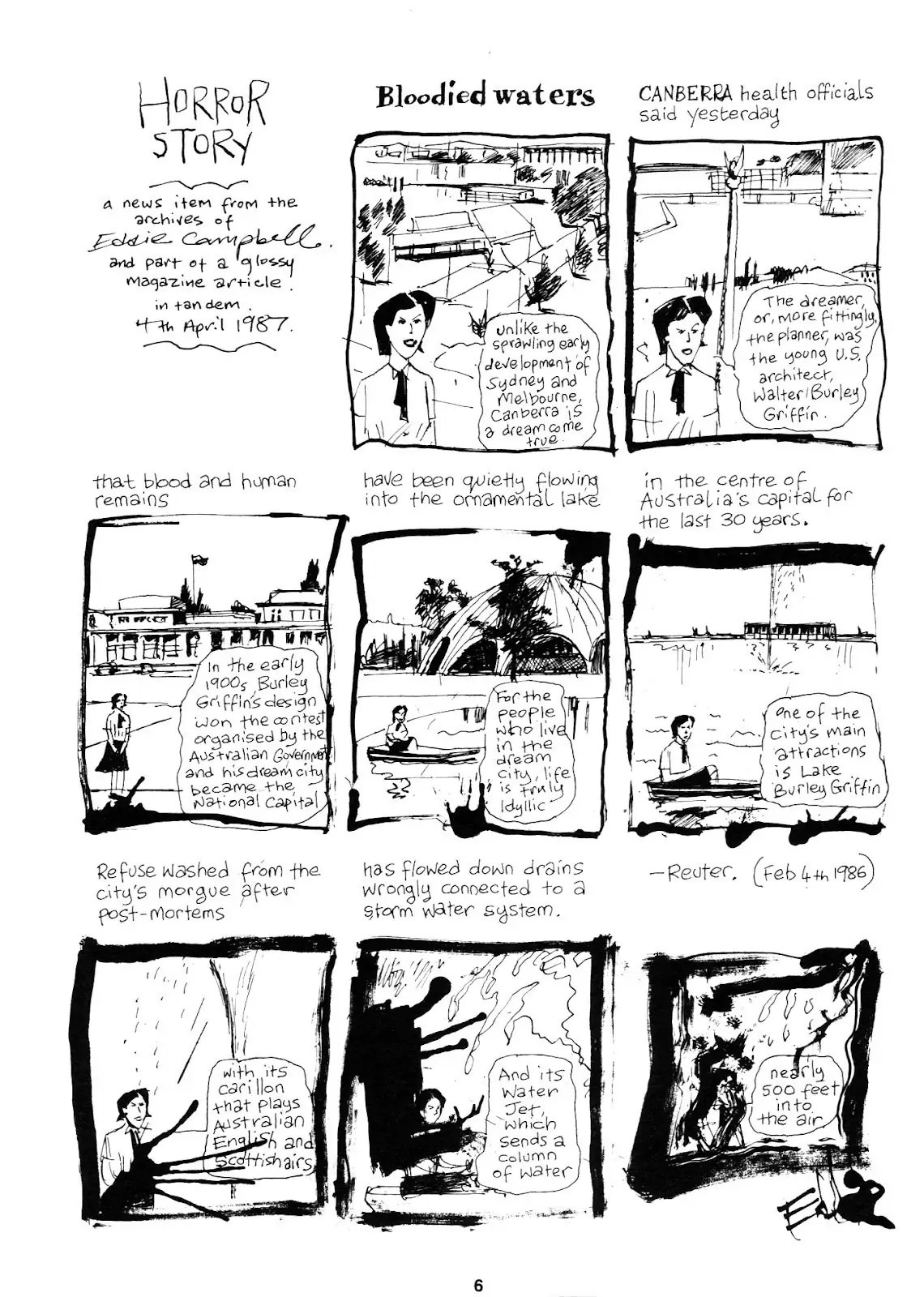
“Horror Story” by Eddie Campbell. Published in Taboo Especial, Spiderbaby Grafix & Publications, 1991.
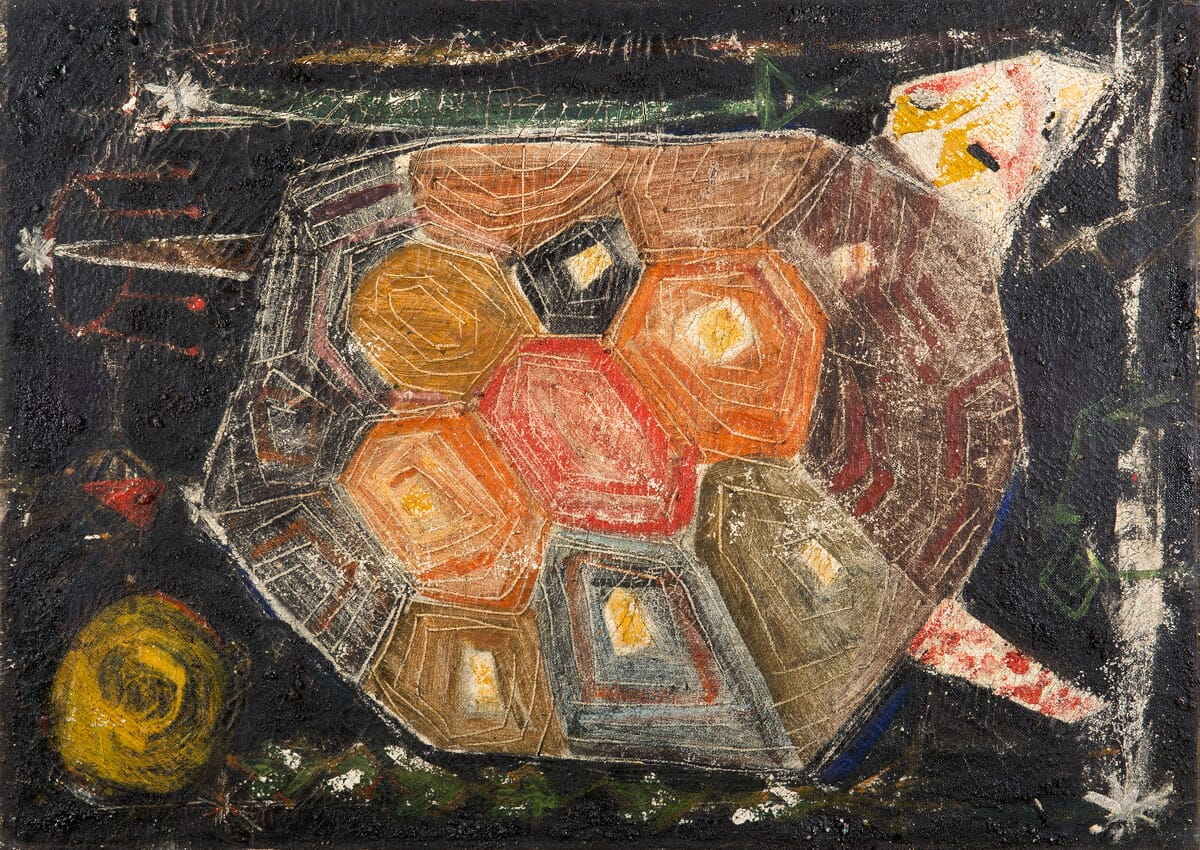
Tortuga, 1951 by Jacobo Borges (b. 1931)
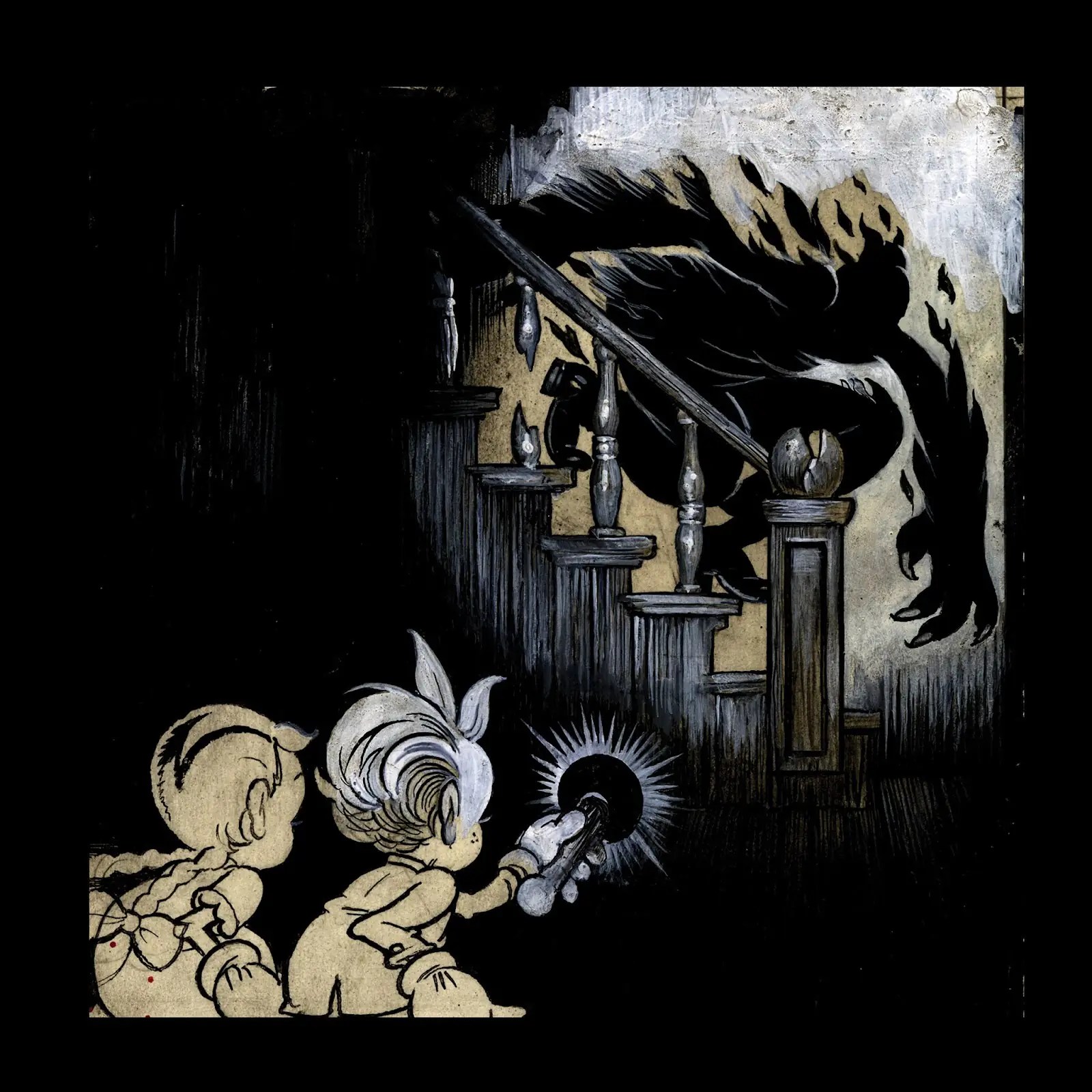
A panel from Pim & Francie: The Golden Bear Days by Al Columbia, Fantagraphics Books, 2009.
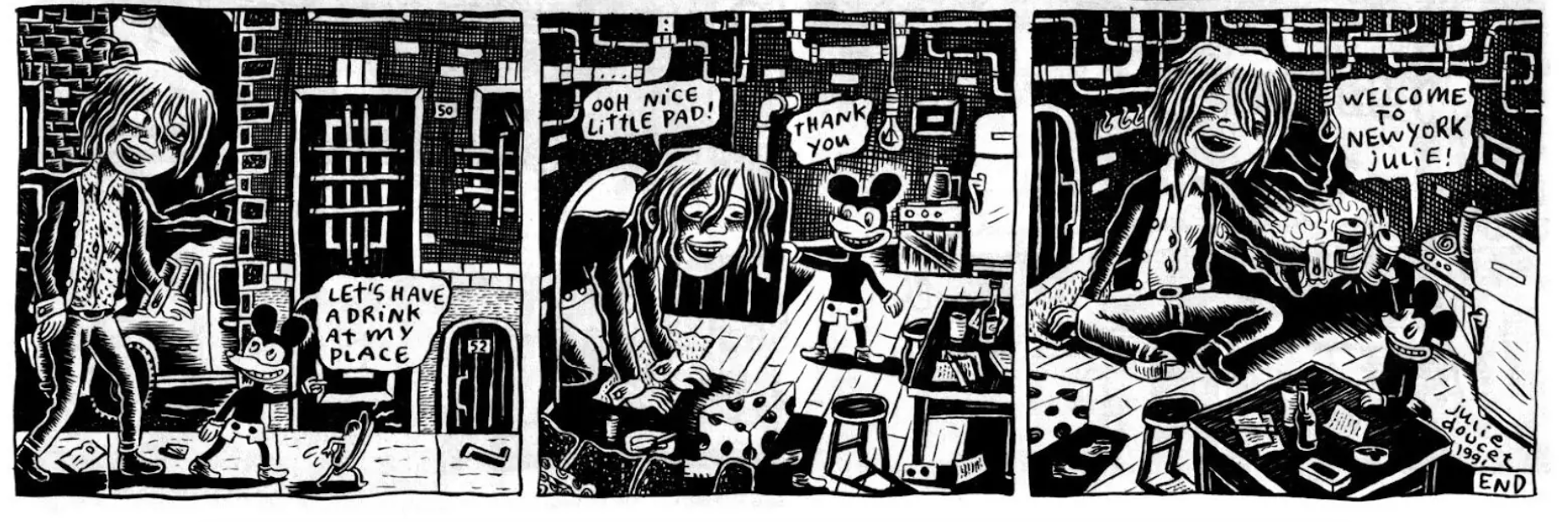
A few panels from “What an Interesting City!” by Julie Doucet. Published in Dirty Plotte #5, May 1992, Drawn & Quarterly.
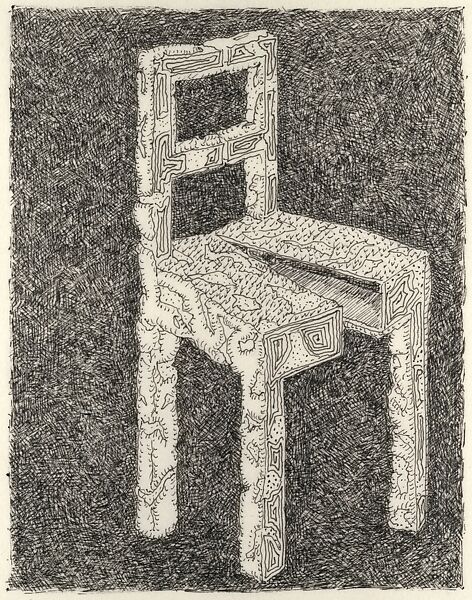
Untitled, 1970 by Lucas Samaras (1936–2024)
“The Raid”
by
John Steinbeck
I
It was dark in the little California town when the two men stepped from the lunch car and strode arrogantly through the back streets. The air was full of the sweet smell of fermenting fruit from the packing plants. High over the corners, blue arc lights swung in the wind and put moving shadows of telephone wires on the ground. The old wooden buildings were silent and resting. The dirty windows dismally reflected the street lights.
The two men were about the same size, but one was much older than the other. Their hair was cropped, they wore blue jeans. The older man had on a peajacket, while the younger wore a blue turtle-neck sweater. As they swung down the dark street, footsteps echoed back loudly from the wooden buildings. The younger man began to whistle Come to Me My Melancholy Baby. He stopped abruptly. “I wish that damn tune would get out of my head. It’s been going all day. It’s an old tune, too.”
His companion turned toward him. “You’re scared, Root. Tell the truth. You’re scared as hell.”
They were passing under one of the blue street lights. Root’s face put on its toughest look, the eyes squinted, the mouth went crooked and bitter. “No, I ain’t scared.” They were out of the light. His face relaxed again. “I wish I knew the ropes better. You been out before, Dick. You know what to expect. But I ain’t ever been out.”
“The way to learn is to do,” Dick quoted sententiously. “You never really learn nothing from books.”
They crossed a railroad track. A block tower up the line a little was starred with green lights. “It’s awful dark,” said Root. “I wonder if the moon will come up later. Usually does when it’s so dark. You going to make the first speech, Dick?”
“No, you make it. I had more experience than you. I’ll watch them while you talk and then I can smack them where I know they bite. Know what you’re going to say?”
“Sure I do. I got it all in my head, every word. I wrote it out and learned it. I heard guys tell how they got up and couldn’t think of a thing to say, and then all of a sudden they just started in like it was somebody else, and the words came out like water out of a hydrant. Big Mike Sheane said it was like that with him. But I wasn’t taking no chances, so I wrote it out.”
A train hooted mournfully, and in a moment it rounded a bend and pushed its terrible light down the track. The lighted coaches rattled past. Dick turned to watch it go by. “Not many people on that one,” he said with satisfaction. “Didn’t you say your old man worked on the railroad?”
Root tried to keep the bitterness out of his voice. “Sure, he works on the road. He’s a brakeman. He kicked me out when he found out what I was doing. He was scared he’d lose his job. He couldn’t see. I talked to him, but he just couldn’t see. He kicked me right out.” Root’s voice was lonely. Suddenly he realized how he had weakened and how he sounded homesick. “That’s the trouble with them,” he went on harshly. “They can’t see beyond their jobs. They can’t see what’s happening to them. They hang on to their chains.”
“Save it,” said Dick. “That’s good stuff. Is that part of your speech?”
“No, but I guess I’ll put it in if you say it’s good.”
The street lights were fewer now. A line of locust trees grew along the road, for the town was beginning to thin and the country took control. Along the unpaved road there were a few little houses with ill-kept gardens.
“Jesus! It’s dark,” Root said again. “I wonder if there’ll be any trouble. It’s a good night to get away if anything happens.”
Dick snorted into the collar of his peajacket. They walked along in silence for awhile.
“Do you think you’d try to get away, Dick?” Root asked.
“No, by God! It’s against orders. If anything happens we got to stick. You’re just a kid. I guess you’d run if I let you!”
Root blustered: “You think you’re hell on wheels just because you been out a few times. You’d think you was a hundred to hear you talk.”
“I’m dry behind the ears, anyway,” said Dick.
Root walked with his head down. He said softly, “Dick, are you sure you wouldn’t run? Are you sure you could just stand there and take it?”
“Of course I’m sure. I’ve done it before. It’s the orders, ain’t it? Why, it’s good publicity.” He peered through the darkness at Root. “What makes you ask, kid? You scared you’ll run? If you’re scared you got no business here.”
Root shivered. “Listen, Dick, you’re a good guy. You won’t tell nobody what I say, will you? I never been tried. How do I know what I’ll do if somebody smacks me in the face with a club? How can anybody tell what he’d do? I don’t think I’d run. I’d try not to run.”
“All right, kid. Let it go at that. But you try running, and I’ll turn your name in. We got no place for yellow bastards. You remember that, kid.”
“Oh, lay off that kid stuff. You’re running that in the ground.”
The locust trees grew closer together as they went. The wind rustled gently in the leaves. A dog growled in one of the yards as the men went by. A light fog began to drift down through the air, and the stars were swallowed in it. “You sure you got everything ready?” Dick asked. “Got the lamps? Got the lit’ature? I left all that to you.”
“I did it all this afternoon,” said Root. “I didn’t put the posters up yet, but I got them in a box out there.”
“Got oil in the lamps?”
“They had plenty in. Say, Dick, I guess some bastard has squealed, don’t you?”
“Sure. Somebody always squeals.”
“Well you didn’t hear nothing about no raid, did you?”
“How the hell would I hear. You think they’d come and tell me they was going to knock my can off? Get hold of yourself, Root. You got the pants scared off you. You’re going to make me nervous if you don’t cut it out.” Continue reading “Read “The Raid,” John Steinbeck’s story of labor and violence”
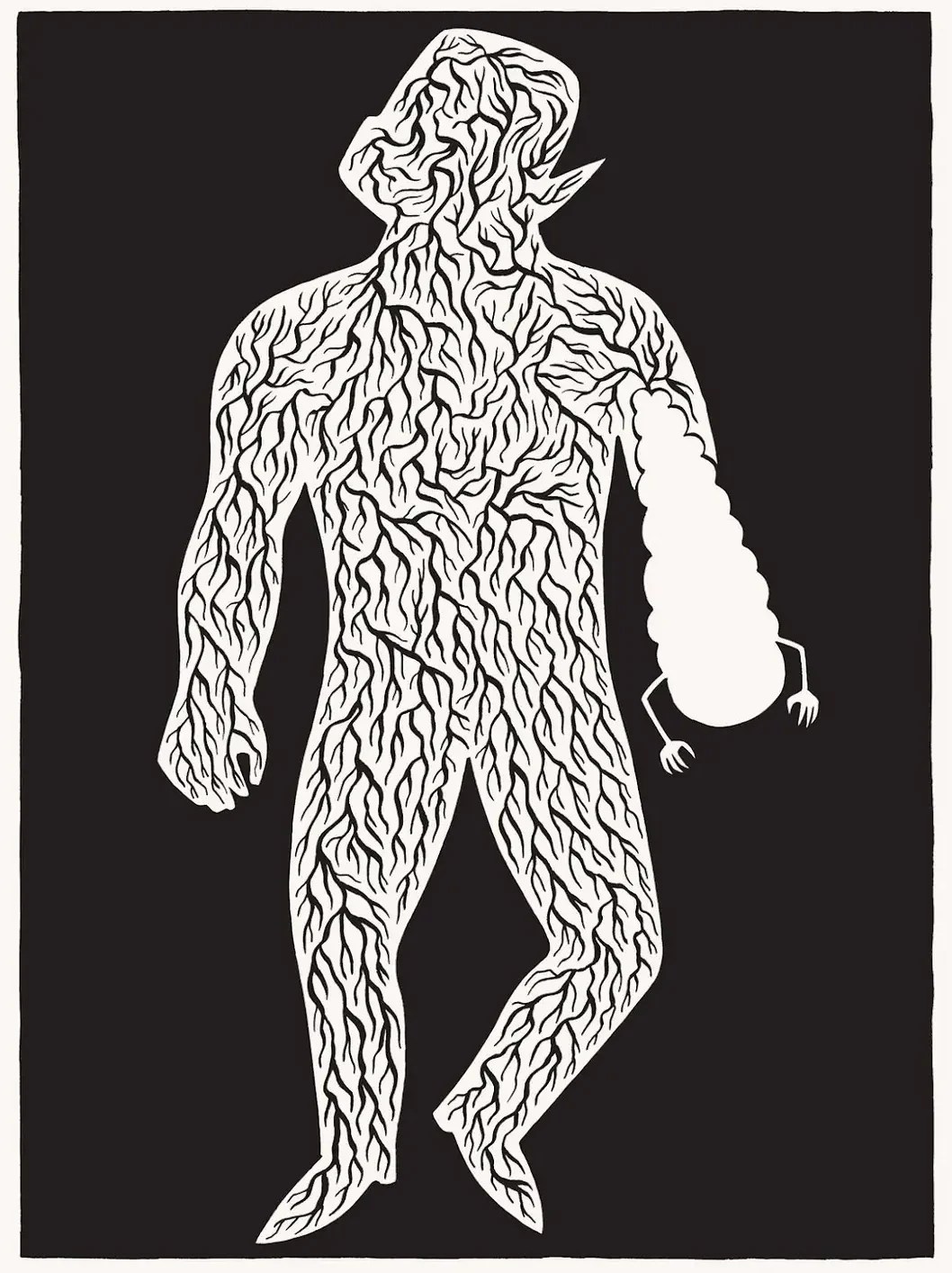
A page from Prison Pit, Book One by Johnny Ryan, 2009, Fantagraphics Books.
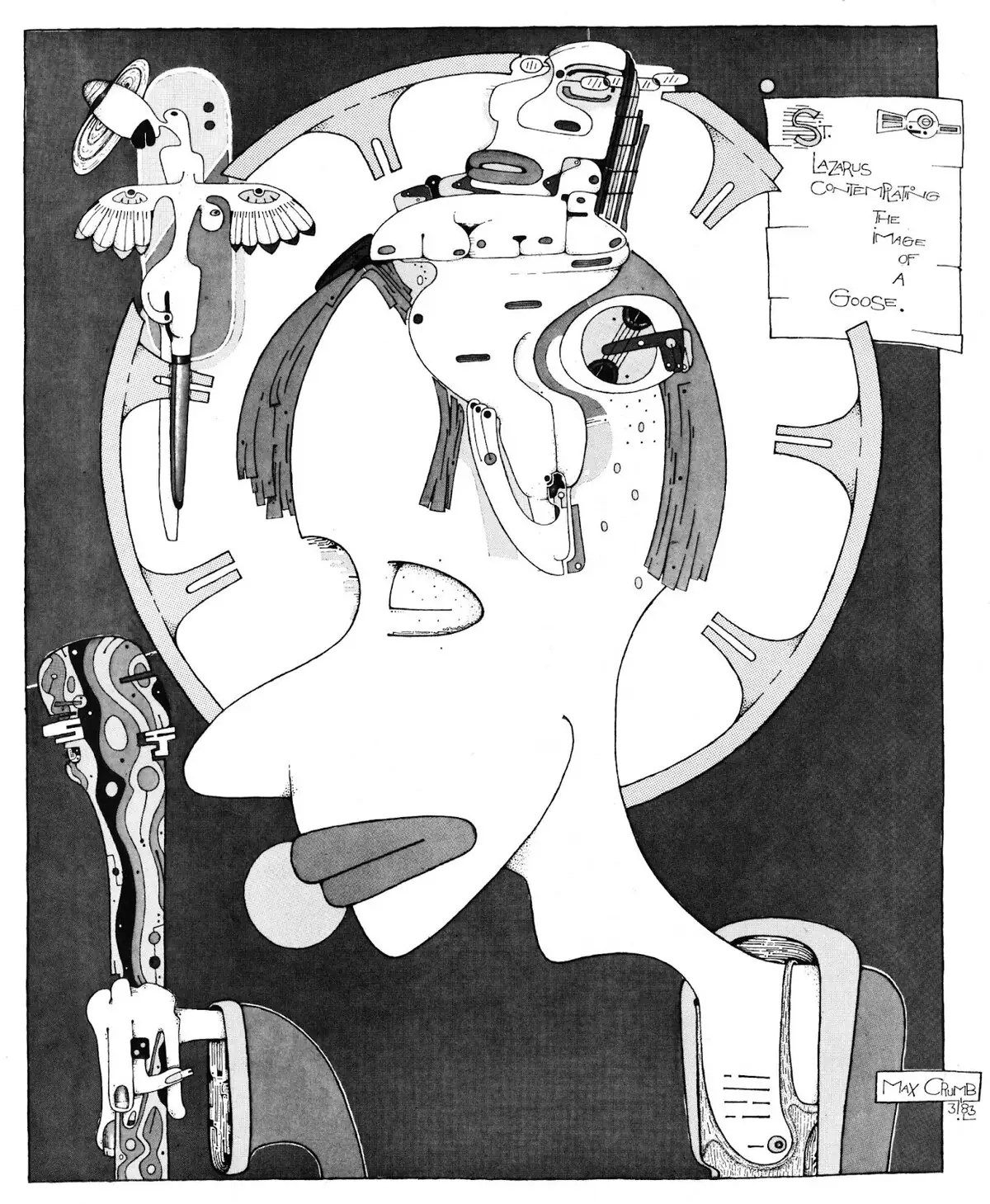
“St. Lazarus Contemplating the Image of a Goose” by Maxon Crumb. From Weirdo #9, January, 1983, Last Gasp.