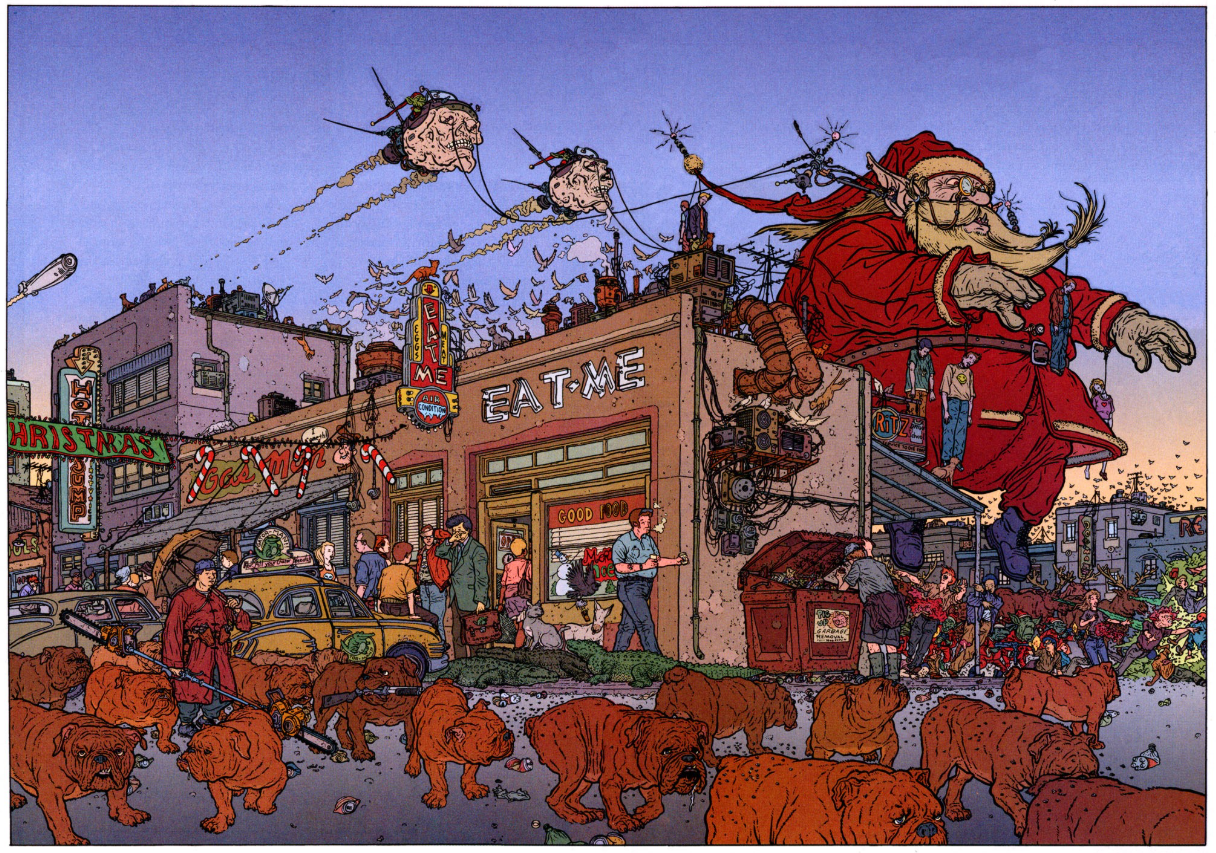
“Christmas” by Geof Darrow; colors by Dave Stewart. From the one-shot anthology Hellboy Christmas Special, 1997, Dark Horse Comics.

“Christmas” by Geof Darrow; colors by Dave Stewart. From the one-shot anthology Hellboy Christmas Special, 1997, Dark Horse Comics.
“Markheim”
by
Robert Louis Stevenson
“Yes,” said the dealer, “our windfalls are of various kinds. Some customers are ignorant, and then I touch a dividend on my superior knowledge. Some are dishonest,” and here he held up the candle, so that the light fell strongly on his visitor, “and in that case,” he continued, “I profit by my virtue.”
Markheim had but just entered from the daylight streets, and his eyes had not yet grown familiar with the mingled shine and darkness in the shop. At these pointed words, and before the near presence of the flame, he blinked painfully and looked aside.
The dealer chuckled. “You come to me on Christmas Day,” he resumed, “when you know that I am alone in my house, put up my shutters, and make a point of refusing business. Well, you will have to pay for that; you will have to pay for my loss of time, when I should be balancing my books; you will have to pay, besides, for a kind of manner that I remark in you to-day very strongly. I am the essence of discretion, and ask no awkward questions; but when a customer cannot look me in the eye, he has to pay for it.” The dealer once more chuckled; and then, changing to his usual business voice, though still with a note of irony, “You can give, as usual, a clear account of how you came into the possession of the object?” he continued. “Still your uncle’s cabinet? A remarkable collector, sir!”
And the little pale, round-shouldered dealer stood almost on tip- toe, looking over the top of his gold spectacles, and nodding his head with every mark of disbelief. Markheim returned his gaze with one of infinite pity, and a touch of horror.
Continue reading “Read “Markheim,” a dark Christmas tale by Robert Louis Stevenson”
2025 was in several ways one of the more fucked up and challenging years of my life. (This sentiment might be familiar to you and yours and many others.) But it was the year I finally learned to take a nap, thanks in part to an anecdote shared by the late novelist Philip Roth.
I have always been jealous of folks who can sleep on planes, in cars, on buses and far more jealous of people who can, like, choose to take a nap. I have envied people like my wife or my daughter or son or brother, who can just, like, conk out for twenty minutes and arise revived. It’s hard enough for me to fall asleep for six or seven or eight hours. As a child I remember reading that Napoleon Bonaparte was very good at taking cat naps, particularly before battles. I don’t know why but this factoid, true or false, made a huge impression on me as a kid. Napping has always seemed like a hidden key to focusing one’s energies.
I couldn’t nap but I was great at staying up for days at a time, particularly in my twenties. I also learned how to make my mind stop, to shut the whole thing down, but that wasn’t napping; it was passing out. None of this was or is healthy behavior.
Late last year a good friend of mine told me he’d picked up most of Philip Roth’s novels at an estate sale or a garage sale or some such. He’d been zipping through them and What do you think of Roth? he asked and I replied something like, I tried — it was Portnoy’s Complaint which I lifted from the Barnes & Noble when I was fifteen and then a few years later the first fifty pages of American Pastoral and all of The Human Stain and then giving up on The Plot Against America. And that was more or less it.
But maybe a year or two before this friend recommended my trying Roth, I’d read on the goddamned website Twitter an excerpt from a Philip Roth interview that stuck with me, primarily because of my desire to become a napper. It was a little screenshot, an excerpt from a 2013 puff piece with NPR celebrating Roth’s becoming an octogenarian. Here is the nap nugget:
Now that he’s not working every day, though, Roth says he’s savoring a gentler pleasure: naps. “Let me tell you about the nap,” he laughs. “It’s absolutely fantastic. When I was a kid, my father was always trying to tell me how to be a man, and he said to me, I was maybe 9, and he said to me, ‘Philip, whenever you take a nap, take your clothes off, put a blanket on you, and you’re going to sleep better.’ Well, as with everything, he was right. … Then the best part of it is that when you wake up, for the first 15 seconds, you have no idea where you are. You’re just alive. That’s all you know. And it’s bliss, it’s absolute bliss.”
My friend’s recommendation to return to Roth recalled this bit of advice and I started to practice it this year, now in my late forties. It has worked for me (or maybe my body has just gotten so old that all the cells and systems and such have agreed to allow consciousness to pause for twenty minutes on a Thursday afternoon). I think Roth’s dad’s advice works because it involves a commitment to the nap. Natural nappers like my lovely wife can shut it down on a couch with the second half of Gillian Armstrong’s 1994 adaptation of Little Women on the teevee, or drift off for a postprandial half-time siesta like an uncle after some ham and turkey and Pinot noir. Natural nappers are blessed; some of us have to work for it though.
I’ve added a few moves to Roth’s simple repertoire — shutting the door, closing the blinds, putting my phone in a different room. The hardest bit though, at first, was consciousness itself, some parcel of images and words and sounds intervening in blips in my mind’s eye when I tried to shut it all down. I remember as a kid being told to count sheep, or count numbers, to visualize the sheep or the numbers.
This bad count the sheep advice led me to realize that my mind stacks images on each other; or, not really stacks images so much as holds images — that when I’m not focused on external sensory input, like, when I’m supposed to be turning off, going to sleep, my mind’s eye (for lack of a better metaphor) has decided to rustle through my imagination and memory to layer visual (and to a much lesser extent, auditory) sensations in thick bundles. My trick this year has been to relax into the image bundle without attempting to make it cohere; I try to feel the blanket on my skin. I think I’ve gotten better at breathing, too.
I like napping. I have taken it up as a midlife hobby. It has made my life better in exactly the kind of way I had hoped it would — a small, minor, gift I thought would never be mine. Maybe I’ll even reach that bliss Roth mentions. But I’m fine without it.
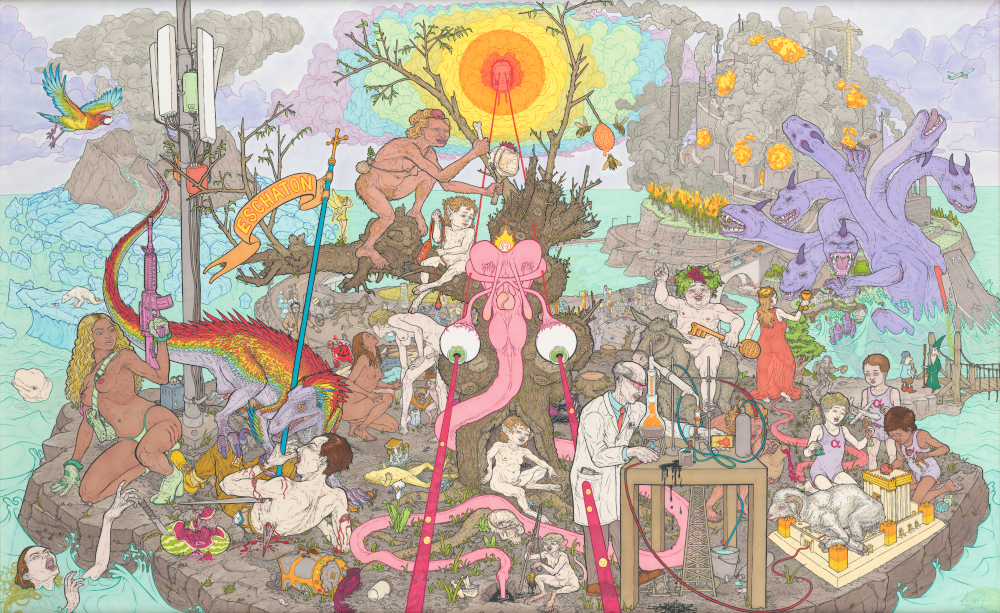
Discovery of Eschaton : Immanentize the Climate Change, 2020 by Mat Brown (b. 1980)
“Cretaceous bird, your giant claw no lime”
by
Edna St. Vincent Millay
from Epitaph for the Race of Man
Cretaceous bird, your giant claw no lime
From bark of holly bruised or mistletoe
Could have arrested, could have held you so
Through fifty million years of jostling time;
Yet cradled with you in the catholic slime
Of the young ocean’s tepid lapse and flow
Slumbered an agent, weak in embryo,
Should grip you straitly, in its sinewy prime.
What bright collision in the zodiac brews,
What mischief dimples at the planet’s core
For shark, for python, for the dove that coos
Under the leaves?—what frosty fate’s in store
For the warm blood of man,—man, out of ooze
But lately crawled, and climbing up the shore?
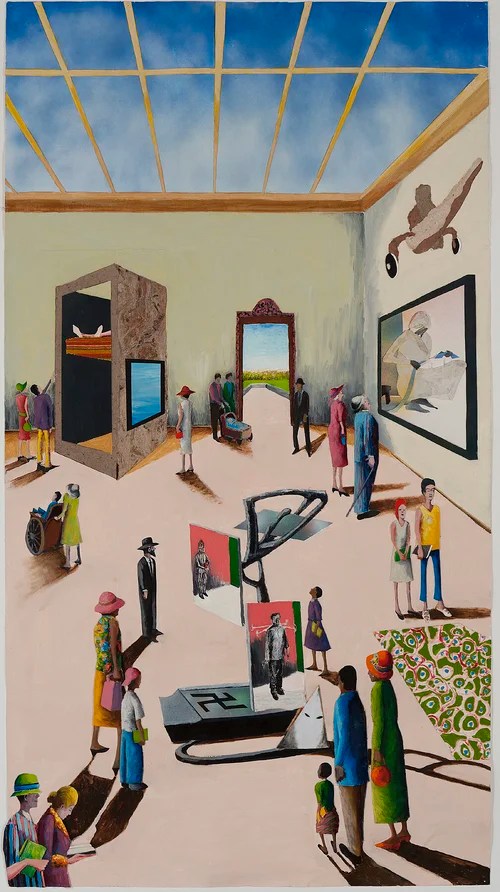
The Idea Museum, 2002 by Benny Andrews (1930-2006)
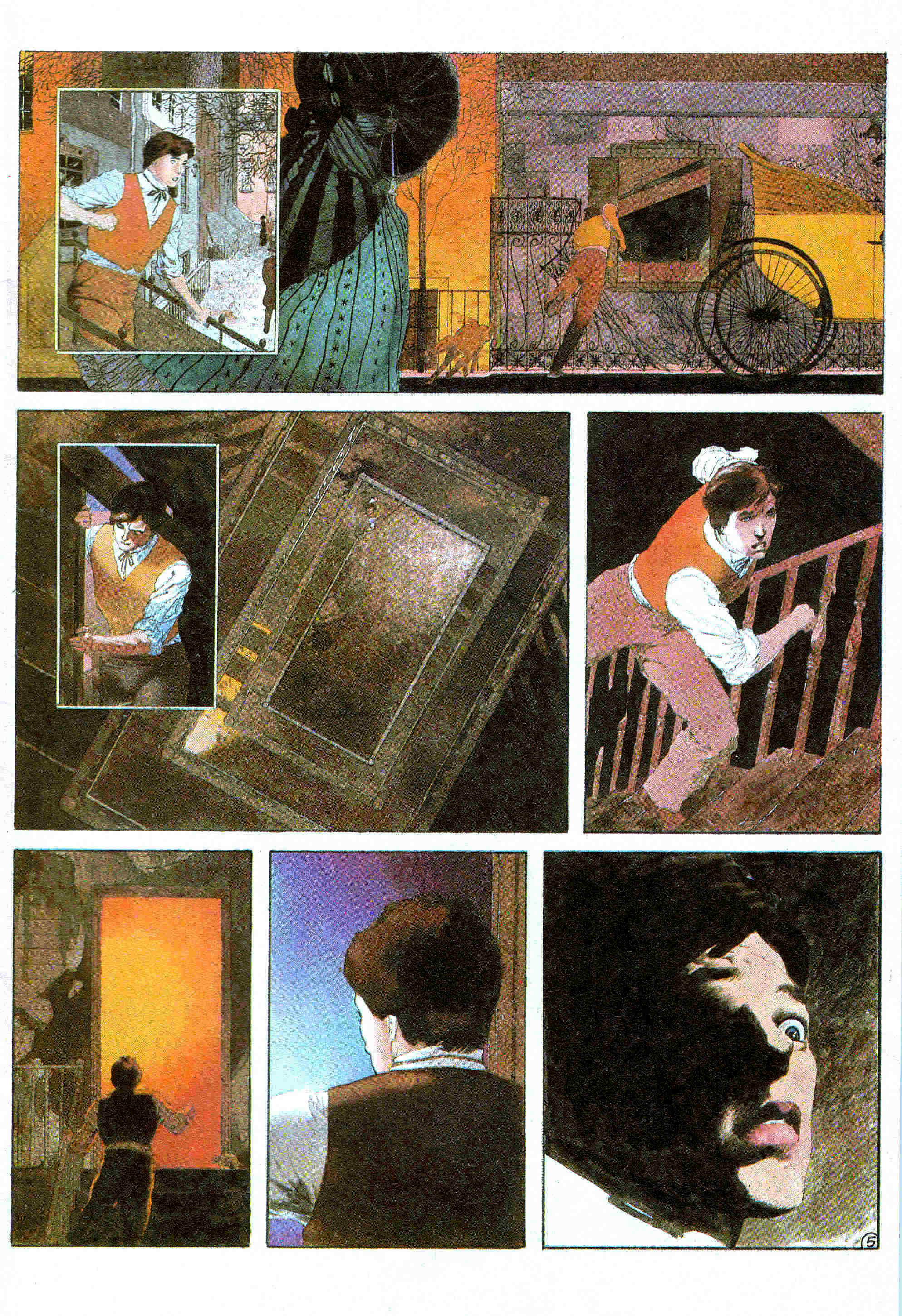
From “The Revenant” by Scott Hampton. Published in Tales of Terror #8, Sept. 1986, Eclipse Comics.

Let’s get the obvious out of the way first: The Pisstown Chaos is an improbably perfect and beautiful name for a novel. If you don’t like the title, The Pisstown Chaos isn’t for you. It is a foul, abject, hilarious, zany vaudeville act, a satire of post-apocalyptic literature, an extended riff on American hucksterism. It’s very funny and will make most readers queasy.
The author of The Pisstown Chaos is David Ohle. The novel was published in 2008; it is the second of three “sequels” to Ohle’s 1972 cult classic Motorman. You do not have to have read Motorman or The Age of Sinatra (2004) to “understand” The Pisstown Chaos. (But you’ll probably want to dig into those if you dig The Pisstown Chaos’s uh pungent urinous ammonia bouquet)
Moldenke, hero of Motorman, is a bit player in The Pisstown Chaos, a walk on, a song-and-dance man with no songs or dances. A storyteller. He’s a zombie, too — a “stinker” in the novel’s parlance — adorned in “black rags and a wide-brimmed white hat,” sporting “an inch-long tube of flesh protruding from just below his ear [which] had the general appearance and shape of an infant’s finger, but lacked a nail. In the end of the tube, a small hole leaked a clear, gelatinous fluid.”
Moldenke, we are to infer, is one of the “Victims of the Pisstown parasite…thought of as dead, but not enough to bury. Gray haggard, poorly dressed, they lay in gutters, sat rigidly on public benches, floated along canals and drank from rain-filled gutters.” He may or may not be centuries old.
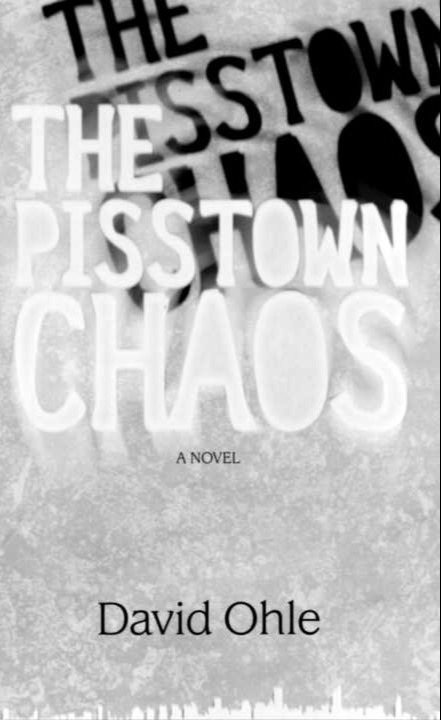
It’s not clear how far into the future we are in the Ohleverse (it doesn’t really matter). After “the Great Forgetting,” and multiple and ongoing Chaoses, the world has regressed, or progressed, or really mutated, into a dusty, wet, gross, nasty post-infrastructure reality. You might read The Pisstown Chaos as a slapstick zombie Western.
The Reverend Hooker presides over this wonderfully abject world. Hooker’s loose theocratic federation revolves elliptically around a “shifting” scheme. Nothing is permanent, everything is moving, plates spinning on poles. Folks receive their shifting papers and must relocate from, say, a cozy cottage to a prison camp. Or they might end up paired with a new concubine or some such.
That’s the fate of Mildred Balls, née Mildred Vink, who meets Jacob Balls on the road to Witchy Toe. The pair meet cute and get on famously. (And who wouldn’t; after all, suave Jacob Balls was the inventor of the “finely-grained, yellow-tinged powder” known as “Jake” — a kind of post-apocalyptic Bud Light.) Optimistic Jacob is optimistically optimistic of all the shifting, attesting his belief that “in any culture, when boredom and apathy take hold, the currency is debased and the decline is irreversible…What could be more of a tonic than a random redistribution of the populace?” Mildred is less convinced: “The whole scheme is idiotic.”
The Pisstown Chaos focuses on the Balls clan — primarily an older Mildred and her young adult grandkids, Roe and Ophelia. There are stinkers and imps, shifting folk consuming urpflanz, willy, and Jake on their way via Q-ped to Indian Apple or Bum Bay. Reverend Hooker is always lurking in the margins, too, before taking over the narrative’s final pages in a mock apotheosis that brought a stupid smile to my face.
Ohle’s narrative isn’t exactly a picaresque, but it runs on the same energy. Each chapter opens with a series of frank excerpts from the Pisstown rag, the City Moon. Here’s one update of news you need:
A fondness for pickled lips has led to the arrest of a Kootie Fiyo, a stinker known to be a trader in tooth gold and a vicious biter. Fiyo was just leaving the impeteria in South Pisstown when two Guards entered. The proprietor said, “That stink can eat more imp lips than I can heap in front of him. “
The City Moon is not just a source for the goods on a stinker’s glimpse of pickled imps’ lips, but also a gloss on the undead (or un-undead’s) physiology:
What then is a final-stage stinker’s life like? It has been described by scientists as showing a poverty of sensation and a low body temperature. In their nostrils is the persistent odor of urpmilk. The membrane which lines their mouth is extremely tough and is covered with thick scales. They like to touch fur and drink their own urine. Because they have been known to go without food for as long as eighteen years, we can assume that their sense of time passing is also very different from our own.
The Stinker Problem is likely the signature event of whatever century we are in. There’s probably an icky metaphor or allegory somewhere in there, but I find myself disinterested in that end of the novel. But still: Consider Mildred–who wants to find a “cure” for stinkerism–in charge of a crew of stinkers who, after their daily labors, commit “to walking in circles and searching the ground.” But these are not geologists peering into the navel of the world: “‘No, Miss,’ Spanish Johnny said, ‘We like to get dizzy and faint. It’s the way we have fun.'” We’ve all been there.
Mildred’s granddaughter Ophelia commands much of the narrative, shifting about her stations in life. Her domestic comedy with servants Red and Peters is a class-conscious comic delight. Our Miss Madame goes through a series of abject slapstick routines with the Help (including an enema gag that uh, gag me yeah). Here’s a foul episode in the life of Ophelia Balls:
She walked carefully from slippery stone to slippery stone until she got to the potting shed, then blew out the candle. She tried the door and found it locked. Wiping the dirty door-glass, she looked in at Peters, lying on the peat pile with his pants pulled down, fanning his rear with a handful of straw. Red, sitting beside him in Mildred Balls’s underwear, combed Peters’s coarse hair with a tortoise-shell comb. Peters’s cheeks were flushed, his eyes half-closed. When Ophelia entered, the scene seemed all the more lurid for the dim lantern and its flicker.
“I hope you don’t take any offense,” Red said, “but I’ve just mated with Peters here.”
Peters sat up. “I was quietly potting geraniums when that idiot stepped out of a dark corner and made advances, clumsy, lewd advances, with his big willy sticking out. I tried, but I couldn’t resist him.”
“Is that true, Red, that he put up resistance?”
“He lies like a rug. He clearly indicated he wanted me to sex him good and sex him hard.”
Ophelia saw the pointlessness of going any further with the inquiry. “All is forgiven. Let’s move past this.”
“I’ll serve the swan,” Red said.
If I’ll serve the swan isn’t your kinda punchline, The Pisstown Chaos ain’t your cup of Jake. It’s a rich, smelly, gross novel, fun, funny, fueled with 19th-century inventions viewed through piss-colored glasses, aimed at the apocalyptic future. It’s smoked imp-meat served with urpsmoke, a vaudeville buzz against the zombies in the gutter. When I was a kid we held our breath when we passed cemeteries. There are other ceremonies, other totems, but warding off the dead remains a concern.
I have neglected the Balls scion, young Roe, who eventually finds himself attending the Reverend Hooker. Late in the novel, Roe Balls prepares an enema for the theocrat; Hooker then delivers a sermon:
“I’ll warm up the bathroom right away, sir, and get the enema bag ready.”
Once Roe had firmly inserted the hose, the Reverend sat on the pot and closed his eyes. “There, that’s it, Roe. It’s in well enough.”
“Shall I leave you alone now, sir?”
“No. Don’t leave. Let me sermonize a little. I’ll tell you a story, a story with a lesson. In the days when all men were good, they had miraculous power. Lions, mountains, whales, jellyfish, hagfish, birds, rocks, clouds, seas, moved quietly from place to place, just as men ordered them at their whim and fancy. But the human race at last lost its miraculous powers through the laziness of a single man. He was a woodman in the Fertile Crescent. One morning he went into the forest to cut firewood for his master’s hearth. He sawed and split all day, until he had a considerable stack of hickory and oak. Then he stood before the pile and said, ‘Now, march off home!’ The great bundle of wood at once got up and began to walk, and the woodman tramped on behind it. But he was a very lazy man. Now, why shouldn’t I ride instead of galloping along this dusty road, he said to himself, and jumped up on the bundle of wood as it was walking in front of him and sat down on top of it. As soon as he did, the wood refused to go. The woodman got angry and began to strike it fiercely with his axe, all in vain. Still the wood refused to go. And from that time the human race had lost its power.”
“That certainly explains everything I’ve ever wondered about, sir.”
“You may clean me now.”
“Yes, sir.”
The punchlines accumulate after the Rev. Hooker’s fable — young Roe’s deadpan line “That certainly explains everything I’ve ever wondered about, sir” made me laugh aloud when I read it, and the following asswipe line is too much — but I think we have here in the fable a key to the novel. Not the key, but a key.
In the Rev’s woodman’s fable, humans once wielded Promethean power over the world. But that power’s contingent; it exists only when humans move with the world, attentive to its rhythms and limits. When the woodman attempts to ride the wood and make it a convenience instead of walking alongside it, cooperation collapses. S’all she wrote.
Ohle’s chaotic, grotesque world echoes his some-time collaborator William Burroughs’ alien abjection. It will also be comfortingly/nauseatingly familiar (familiar?!) with anyone who digs David Cronenberg’s corporeal horrors. The Pisstown Chronicles will also appeal to weirdos who dig the abject fictions of Vladmir Sorokin, José Donoso, and Antoine Volodine.
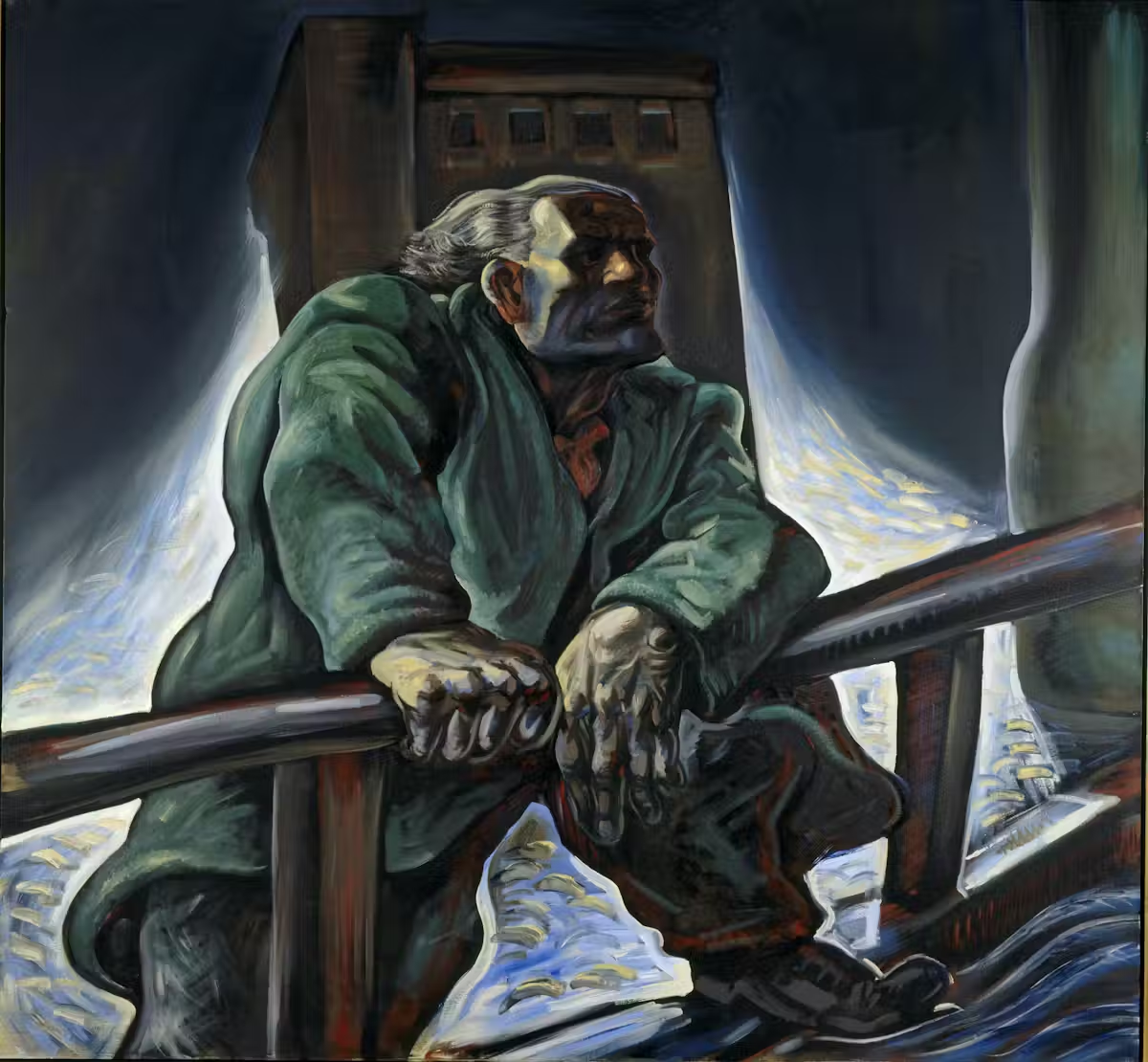
The Heroic Dosser, 1987 by Peter Howson (b. 1958)

I dug/was perplexed by Gerhard Rühm’s Cake and Prostheses a few years ago, so when I got my soft pink hands on The Folded Clock, (translated like C & P by Alexander Booth), I was intrigued. Publisher Twisted Spoon describes The Folded Clock as a collection of “number poems, comprising typewriter ideograms, typed concrete poetry, collages of everyday paper ephemera and scraps, and a wide variety of literary forms where the visual pattern created on the page underpins the thematic meaning.”

Rühm seems to identify Kurt Schwitters as his artistic precursor, or an artistic precursor. Like Cake and Prostheses, the pieces in The Folded Clock defy easy categorization — Is it a script or a poem or art? is probably the wrong question.
Passing eyes over the text is probably not the way to go; Rühm’s asking you to engage. As Joseph Schreiber puts it in his review at Rough Ghosts, you might follow Rühm’s directions and “allow yourself to read aloud and, there are you are, from the very beginning, not simply reading but actively engaging with the poem.”

I don’t really like numbers that much, at least not in a mob, a gang, a swarm. I tried and didn’t work out. Not just with this book but in general. I can’t count sheep, I guess.
I had a better time with Rühm’s forays into music and letters and collages; I enjoyed whatever psychotic version of minesweeper or Sudoku this piece is:

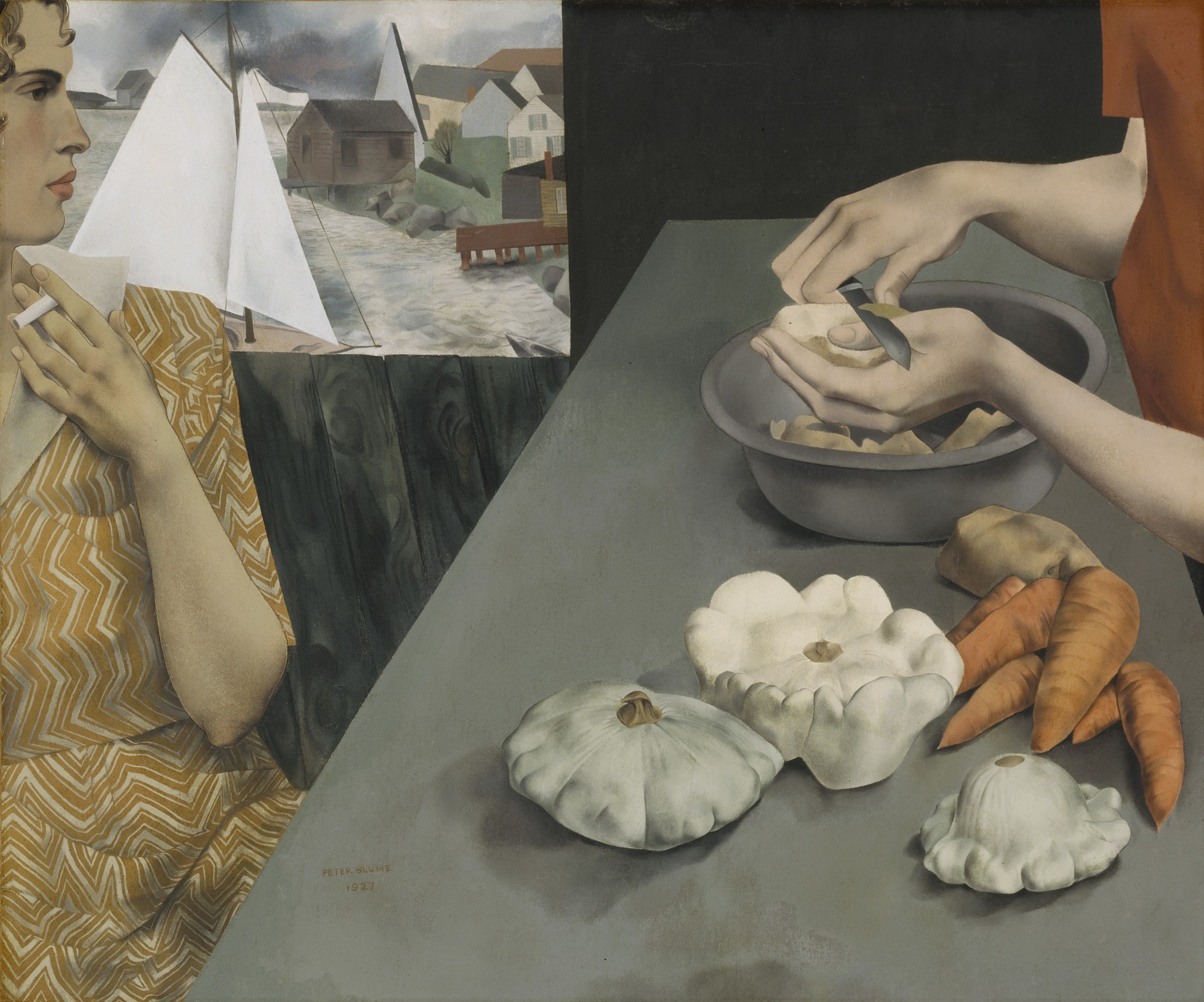
Vegetable Dinner, 1927 by Peter Blume (1906–1992)

Inge in Bed, 1965 by Alasdair Gray (1935-2019)
“The Sausage Cellar”
by
Henri Michaux
translated by David Ball
from Life in the Folds
I love to knead.
I get hold of a field marshal and grind him up so fine that he loses half his senses, he loses his nose that he thought really had flair and even his hand that he can’t raise to his cap any more even if a whole army saluted him.
Yes, through a series of grindings, I reduce him, I reduce him—a sausage unable to do anything from now on.
And I don’t limit myself to field marshals. In my cellar I have lots of sausages that were once important people supposedly out of my reach.
But my infallible instinct for jubilation triumphed over these obstacles.
If they act up after that, it’s really no fault of mine. They could not have been mixed and ground any more than they were. I’ve been told that some of them are still moving about. It’s printed in the papers. Is this real? How could it be? They’re rolled up. The rest is the tail end of a phenomenon, the kind that one might encounter in nature, a sort of mystery comparable to reflections and exhalations whose importance should not be exaggerated. No, absolutely not.
In my cellar they lie, in deep silence.
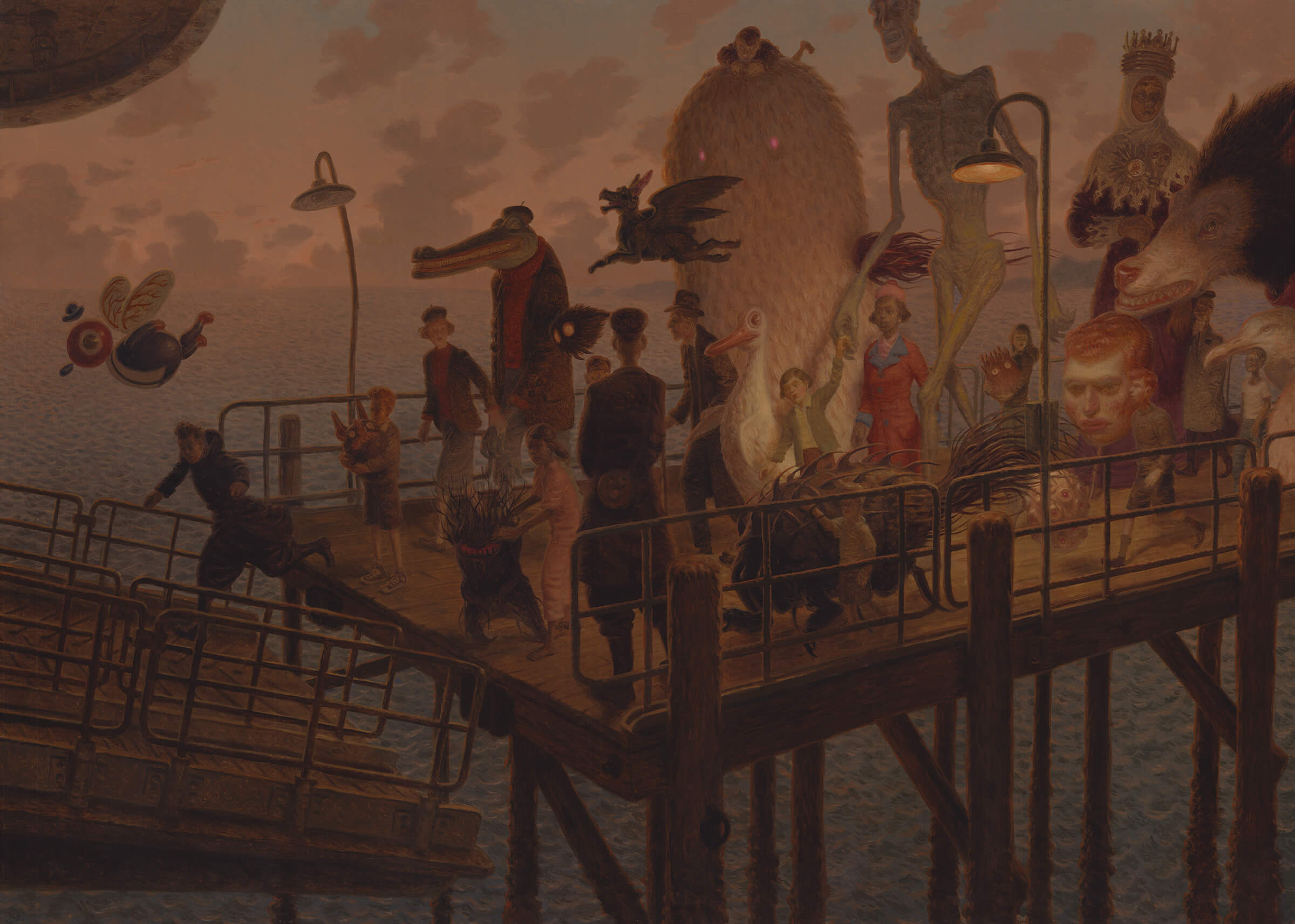
You Bring Your Tulpas When You Go (The Tenement Fire), 2021 by Peter Ferguson (b. 1968)

From “Armed Love” by Jay Kinney and Ned Sonntag. Published in Young Lust #2, 1971, The Print Mint.
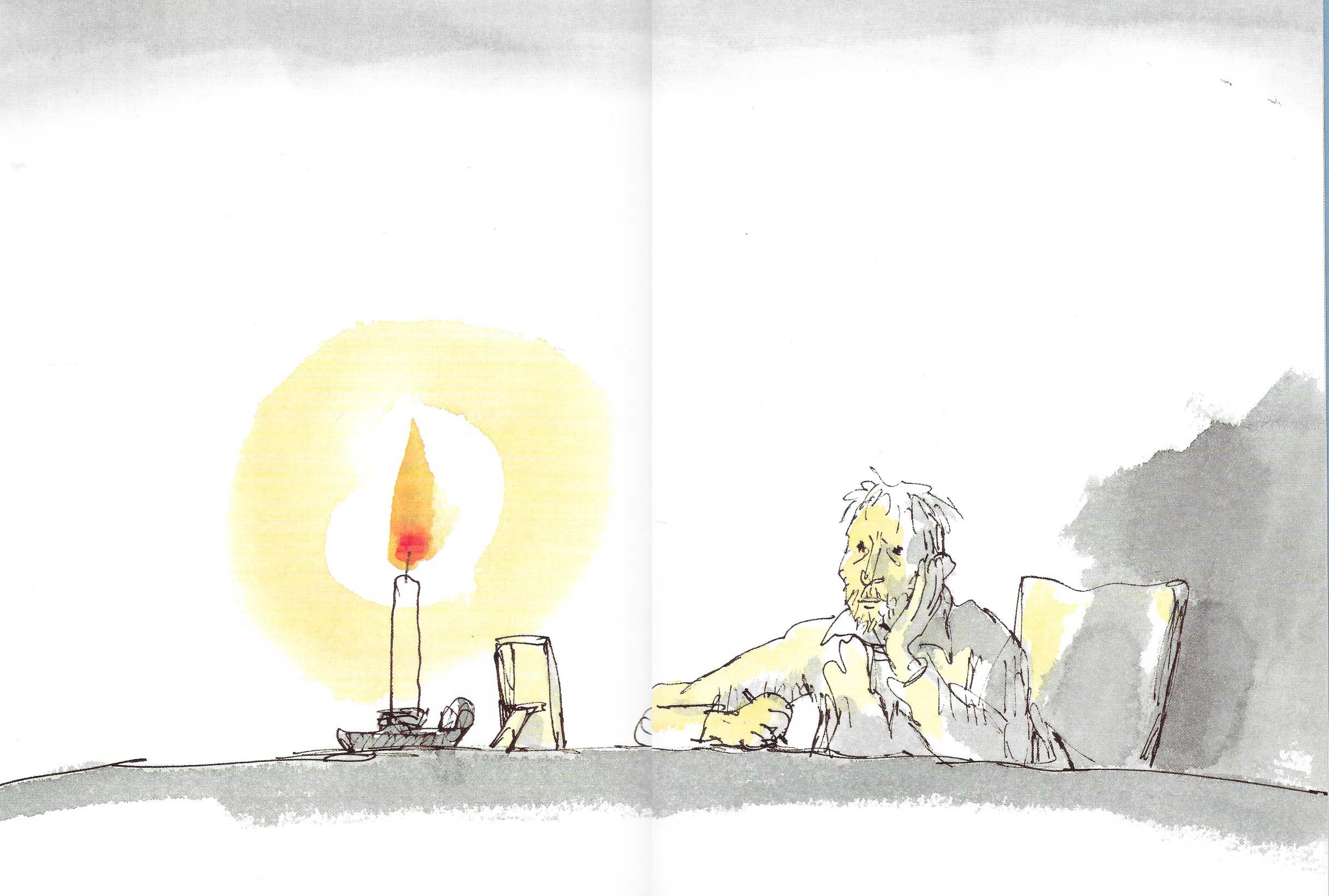
Illustration to Michael Rosen’s Sad Book, 2004 by Quentin Blake (b. 1932)

 Biblioklept