Heroes of 2010 — Beach House

“A Christmas Card” by Etgar Keret

“A Christmas Card” by Etgar Keret, via the good people at Electric Literature

Hemorrhoid

This is the story of a man who suffered from a hemorrhoid. Not a lot of hemorrhoids. A single, solitary one. This hemorrhoid started out small and annoying, but very soon it became medium-sized and irritating, and in less than two months it became big and really painful. The man continued to live his life as usual: he worked long hours every day, took time off on weekends and fucked on the side whenever he had the chance. But this hemorrhoid, which was clinging to a vein, kept reminding him at every long meeting or painful BM that to live is to suffer, to live is to sweat, to live is an ache you can’t fucking forget . And so, before every important decision the man would listen to his hemorrhoid the way others listen to their conscience. And the hemorrhoid, like any hemorrhoid, would give the man some asshole advice. Advice on whom to fire, advice on aiming higher, advice to pick a fight and with whom he should conspire. And it worked. With every passing day, the man became more and more successful. The earnings of the company he headed kept growing, and so did the hemorrhoid. It reached a point where the hemorrhoid outgrew the man. And even then, it didn’t stop. Until eventually it was the hemorrhoid that was Chairman of the Board. And sometimes, when the hemorrhoid took its seat on the chair in the board room, it found the man underneath a little irritating.

This is the story of a hemorrhoid that suffered from a man. The hemorrhoid continued to live its life as usual: it worked long hours every day, took time off on weekends and fucked on the side whenever it had the chance. But this man, who was clinging to a vein, kept reminding him at every long meeting or painful BM that to live is to yearn, to live is to burn, to live is to fucking screw up and wait for fate to turn. And the hemorrhoid would listen to the man the way people listen to their stomach when it rumbles and asks for food – passively but acceptingly. And thanks to this man, the hemorrhoid tried to believe it could live and let live, it could learn to forgive. It could conquer its urge to look down on others. And even when it swore, it didn’t mention people’s mothers. And so, thanks to the irritating little man under him, everyone came to value the hemorrhoid: hemorrhoids, people, and of course, the company’s satisfied shareholders all around the world.

The Adventures of Tintin, Vol. 3 — Hergé

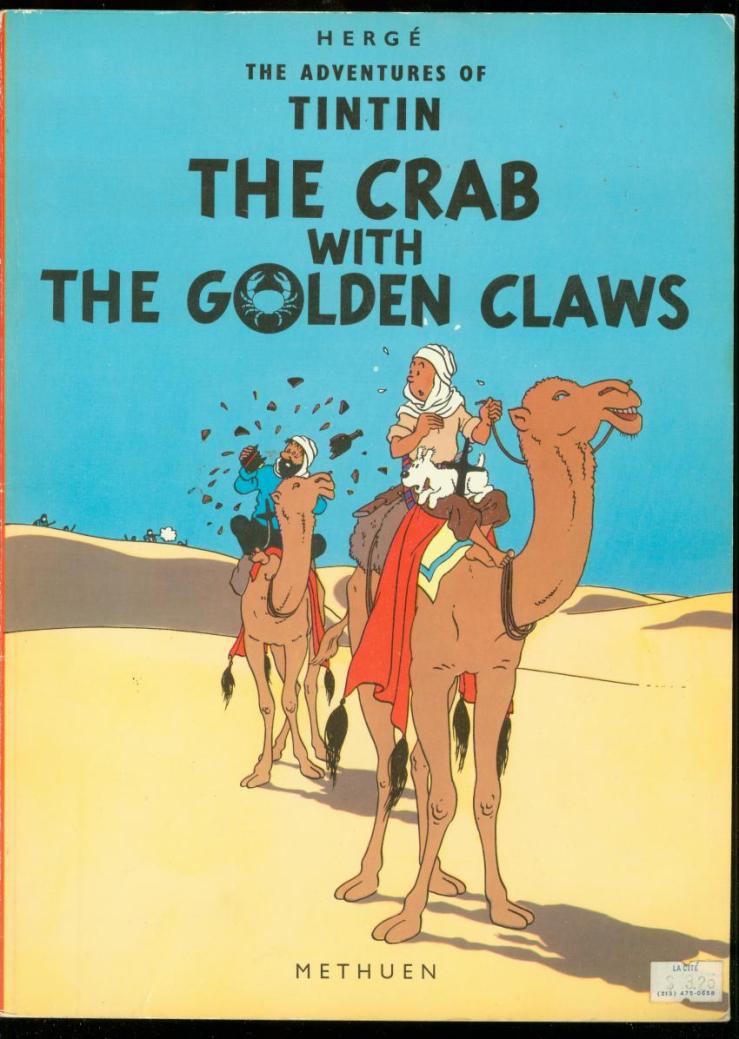
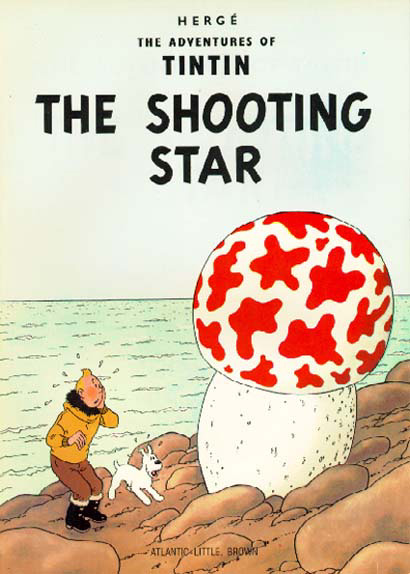
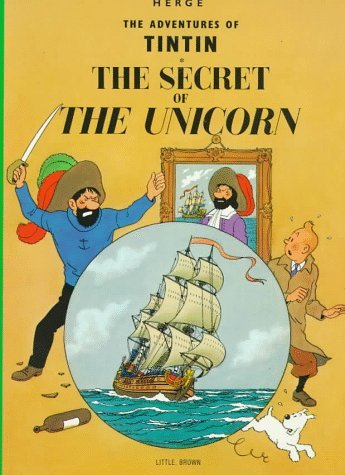
I’ve long been interested in Hergé’s Belgian comic series Tintin, which chronicles the adventures of Tintin, boy reporter, and his faithful dog Snowy. When a batch of hardback three-in-one editions showed up at my favorite used book store I picked up Vol. 3, which collects The Crab with the Golden Claws, The Shooting Star, and The Secret of the Unicorn. I read The Crab with the Golden Claws in one pleasant sitting that night and finished the other two adventures in similar fashion. Then I went back to the bookshop and picked up the other four three-in-one editions they had in stock.

It’s hard to divide the tales, which are all fun adventures in the high style of boy-adventuring, but I think Crab was my favorite of the three. It involves a drug smuggling ring and a trip to the Sahara desert. It also introduces Captain Haddock, an alcoholic lummox who tips into a verbose stream of insults whenever he’s in a rage (he merely stutters when in his cups). Haddock is Tintin’s unlikely (but totally likely) sidekick in the other tales in the volume, and he shows up in the other books I bought as well. The Shooting Star is a bit more sporadic in its plot–it begins with the end of the world (by asteroid!) and when that doesn’t pan out, moves into an ocean race to recover a meteorite. Unicorn also boasts a nautical theme; Tintin finds part of a treasure map in a model ship and fights against antique-collecting brothers to recover the booty (Keno Bros. beware). These adventure stories share more in common with Indiana Jones and Edgar Rice Burroughs than Marvel or DC comics; there’s a prevalent sense of danger, fun, and mystery that underscores the series.

Hergé’s clean, efficient style evokes beautiful and strange worlds. His economy of storytelling is simply brilliant; he knows how to connote his characters’ movements–including some sweaty action sequences–and he also knows how to move the plot forward without resorting to talking heads (although you will find the occasional expository-friendly radio broadcast pop up in a Tintin comic). It’s when Hergé drops a luscious market scene or a crowded basement-dungeon larded with antiquities that the art in Tintin shines. Hergé’s great talent is to evoke a startling sense of place for each setting in his comics, a fully-realized set that creates a sort of visual (and emotional) baseline for the reader. This allows for the cleaner, crisper panels to relay action without clutter. Hergé’s knack for storytelling cannot be underestimated either. He blends high adventure with slapstick and verbal comedy, much of it courtesy Tintin’s foils: the Thompsons, bungling detectives, precisely, who provide Tintin with many of his cases; Haddock; and Snowy, of course.

If you know a bit about Hergé’s Tintin series, you may know that its depiction of non-white and non-European characters has come under attack in recent years; Tintin in the Congo has been singled out in particular. I haven’t read Congo, but Crab’s representation of  Arabs (and Asians) is riddled with all kinds of wrong–at least when viewed from a PC postmodern post-colonialist post-whatever perspective. Hergé’s comics reveal at times a particularly suspect Western European ideology, one that privileges white male authority in the form of white male adventure. We can see the same colonialism and Orientalism at work decades later in the Indiana Jones movies (particularly Temple of Doom). This comparison is not meant to indict Indy (or Spielberg, rather) or excuse Tintin (and Hergé); instead, I’m merely pointing out that adventure tales that feature white heroes exploring–and dominating–the Other are hardly new; nor have they disappeared. The big mistake would be not to read Hergé’s work for fear of tripping over politically-correct mores. Banning a book is never a smart practice.

Far better is Charles Burns’s recent Tintin revisionism in X’ed Out: he moves his inverted hero Nitnit to a bizarro world version of the Saharan market, a place teeming with strangeness that is also largely indebted to William Burroughs’s Interzone. The inversion reverses Tintin’s a priori white male domination into an equally fantastic (but far more horrific) vision of confrontation with radical Otherness. Shit gets weird (as alien encounters should). Nitnit is not in control, not the master of this domain, which is plainly not his. Burns’s Tintin revision saliently calls attention to the ways that the best in art might be transformed and reinterpreted. It points toward the subconscious inheritance intrinsic to art.

But back to the book I am ostensibly reviewing. The Adventures of Tintin, Vol 3 seems to me as good a place as any to start with Tintin, and those interested should dig in. These three-in-one editions are smaller than the traditional oversized format, but you can compensate by holding the book closer to your face (ah, intimacy). Lovely stuff.

Heroes of 2010 — Kelly MacDonald

Do you remember that episode of Boardwalk Empire where Kelly MacDonald’s character Margaret Schroeder has to go undress for Nucky’s spoiled rotten immature mistress Lucy Danzinger? And then she tells that story about a rooster whose parlor tricks result in diminishing returns? And then she decides not to model the underwear for Lucy but instead tells her something like, “Maybe your cunny isn’t quite draw you think it is.” Damn! Zing! Pow!  Schroeder rules. And of course, MacDonald has ruled our hearts since Trainspotting. Oh, here’s a cam version of that scene–

David Foster Wallace Describes Poststructuralism

Thumbed through my copy of A Supposedly Fun Thing I’ll Never Do Again yesterday and ended up re-reading David Foster Wallace’s essay “Greatly Exaggerated,” ostensibly a review of H.L. Hix’s book Morte d’Author: An Autopsy, considers the literary fall-out after Roland Barthes declared the “death of the author.” Anyway, I thought Wallace’s description of poststructuralism was worth sharing–

The deconstructionists (“deconstructionist” and “poststructuralist” mean the same thing, by the way: “poststructuralist” is what you call a deconstructionist who doesn’t want to be called a deconstructionist) . . . see the debate over the ownership of meaning as a skirmish in a larger war in Western philosophy over the idea that presence and unity are ontologically prior to expression. There’s been this longstanding deluded presumption, they think, that if there is an utterance then there must exist a unified, efficacious presence that causes and owns that utterance. The poststructuralists attack what they see as a post-Platonic prejudice in favor of presence over absence and speech over writing. We tend to trust speech over writing because of the immediacy of the speaker: he’s right there, and we can grab him by the lapels and look into his face and figure out just exactly what one single thing he means. But the reason why poststructuralists are in the literary theory business at all is that they see writing, not speech, as more faithful to the metaphysics of true expression. For Barthes, Derrida, and Foucault, writing is a better animal than speech because it is iterable; it is iterable because it is abstract; and it is abstract because it is a function not of presence but of absence: the reader’s absent when the writer’s writing, and the writer’s absent when the reader’s reading.

For a deconstructionist, then, a writer’s circumstances and intentions are indeed a part of the “context” of a text, but context imposes no real cinctures on the text’s meaning, because meaning in language requires a cultivation of absence rather than presence, involves not the imposition but the erasure of consciousness. This is so because these guys–Derrida following Heidegger and Barthes Mallarme and Foucault God knows who–see literary language as a not a tool but an environment. A writer does not wield language; he is subsumed in it. Language speaks us; writing writes; etc.

Our Favorite Book Covers of 2010

We know you’re not supposed to judge a book by its cover and blah blah blah, but really, c’mon, aesthetic sensibilities go a long way. Here are a some of our favorite covers for books published in 2010.

Has Melville House made a book that’s not really really good looking? This NY indie not only put out some of our favorite reading of 2010, they also put out some of the best designed books of the year. Books like Jean-Christophe Valtat’s Aurorarama and Mahendra Singh and Lewis Carroll’s The Hunting Carroll evince a diverse aesthetic range unified by simple and attractive designs. We absolutely love the cover for Tao Lin’s Richard Yates; the visual non sequitur dovetails nicely with the book’s arbitrary name.

In fact, it’s a trio of forthcoming books from Melville House that prompted this post. In January, they’ll release the first in a series of books by Nobel winning German author Heinrich Böll. The first three books, which arrived at Biblioklept World Headquarters yesterday, are beautiful, simple, and elegant.

We’ve started The Clown; a review of the book’s guts forthcoming. Another book with a cool cover that we haven’t read yet is Adam Ross’s Mr. Peanut. We know someone on Twitter pointed out that skulls are the smiley faces of this decade but we can’t remember who gets credit, so let’s just pretend you heard that witticism here first.


We haven’t read Adam Levin’s mammoth début The Instructions yet, but a copy arrived today, and man is it beautiful. McSweeney’s knows how to do a hardback right–why encumber a book with a dusty dust jacket that’s going to get in the reader’s way when some gold embossing will do much nicer? Our copy is white but we couldn’t find an image of a white one on the internet, so here’s a blue one because Jesus Christ we’re not about to start photographing books now, are we?

We like both covers for Tom McCarthy’s C, but maybe we’re biased here because we loved the book so much.

We also love the cover of Charles Burns’s X’ed Out.

Picador’s British edition of Roberto Bolaño’s Nazi Literature in the Americas is somehow playful and deadly serious at the same time (just like the book).

Another one on the posthumous tip: We’re not big into tattoos but we can’t help digging this cover for David Foster Wallace’s The Broom of the System.

Heroes of 2010 — MGMT

Amy Hempel on Gordon Lish and Barry Hannah

Amy Hempel talks Gordon Lish and Barry Hannah (among other things) in a new interview with Vice. A taste–

Do you think about readers when you’re writing? Do you personify them?
I do. I always have, and it’s always been a handful of other writers. Sometimes it has changed, but yes, I really do think of a few actual people. It makes it a little bit easier since I know them, and I know that, well, if this person will find it funny, then I’ve succeeded, or some such thing. It makes it more like trading confidences. I think it’s daunting to think of writing for one’s readers, whoever they may be, so I bring it down to something manageable—a few people whose standards I know and whose work I very much admire—and that makes it more like, almost, a letter to the person. That helps me set the course.

So do you think like, “I’m going to change this here. I’m sure Gordon Lish would love it”?
[laughs] Well, I often have in mind Barry Hannah, and in fact when you phoned me just now, I was working on some remarks I’m going to make at a sort of memorial tribute to Barry, who died last March. This is something that will be held just outside Boston, two nights from now. A bunch of writers who adored him, just paying tribute to him. Barry Hannah was always on my list of people I knew, writers I admired immensely, and just thinking, you know, Barry Hannah might read this, it seemed to focus me when I was writing.

Writing is an extremely solitary activity, but at the same time it’s also very intense. One analogy that I always think of is swimming—it’s something that you do on your own, and the only standard of success you have is your last lap.
I agree 100 percent. And yet there are writers who hold themselves up and compare themselves to other writers. I think that’s useless. As you say, you’re only trying to beat your own best time. That’s the only relevant competition as far as I’m concerned.

Is your past with Lish something that still has an influence on you?
You know, it was a long time ago. I was a student of his at Columbia and then privately and then his author back in the early 80s. I did two books with him. Working with him was a crucial formative experience, but it was a long time ago. There are other writers who have sort of stepped in. Interestingly, Barry Hannah was one and Mary Robison is another, and they are both his authors, too, and were at the time that I was being published by him. So, yes, [Lish] had a terrific impact on my writing very early on. I don’t think he’s writing any more, but he’s still present among writers who really do care about writing at the sentence level. His impact there has certainly endured.

What about the so-called golden age of American short stories? I don’t really know if it’s accurate, or even intelligent, to define it that way.
Well, I think it was a phenomenon in publishing, with a lot of critics rightly going to Raymond Carver—who was also Gordon’s author—and people like Mary Robison. You know—some of the story writers who really, really opened things up again for stories as a commercially viable kind of writing as well as something that was important to a lot of readers.

Granddad’s Eggnog

Hopefully everyone is happy and with loved ones and friends during these holidays–and what better way to show love and fellowship than sharing a draught of delicious eggnog (alternately, the sad and solitary can drown their lonely sorrows in this high-alcohol, high-calorie treat). This is an old recipe; I remember my cousin and I stealing sips of this nog during my grandparents’ Christmas parties.

You will need:

A bottle of fine bourbon

A bottle of fine rum

A liqueur of your choice (this is optional; coffee, cream, or amaretto all add a nice touch)

A gallon of vanilla ice cream (substitute frozen yoghurt if you’re concerned about calories)

A carton of store-bought eggnog (alternately, you can make your own eggnog from eggs, milk, and sugar, although it’s a genuine pain in the ass and no one will ever know the difference, unless you go around pointing it out to them, which will make you look like an asshole, and you don’t want to look like an asshole, do you?)

Nutmeg, cinnamon, mace, clove (Use whole spices! Any of your favorite holiday spices will do, but I consider these four essential)

To make a one gallon pitcher of eggnog:

Put about 6 cups of ice cream in the pitcher. Add some cinnamon sticks and cloves; grate some nutmeg and mace into the pitcher. Add 4 cups of the store-bought eggnog, stir mixture. Add about 3 and 1/2 cups of bourbon, 1 1/2 cups of rum, and liqueur (about 1/2 a cup will do) to taste; add more spices. Stir vigorously; cover and allow to set in the freezer for at least 12 hours before serving. Stir vigorously before serving.

To make your guests happy, I suggest serving the nog with both liquor and ice cream at hand; this way those inclined may add either as their taste dictates. (Note for heavy drinkers: if your intention is to get smashed, stop drinking the eggnog after two cups and begin drinking the bourbon straight! The high levels of cream and sugar in this nog will almost guarantee a hangover–don’t overdo it!)


“Christmas Trees” — Robert Frost

“Christmas Trees” by Robert Frost–

A Christmas Circular Letter

The city had withdrawn into itself
And left at last the country to the country;
When between whirls of snow not come to lie
And whirls of foliage not yet laid, there drove
A stranger to our yard, who looked the city,
Yet did in country fashion in that there
He sat and waited till he drew us out
A-buttoning coats to ask him who he was.
He proved to be the city come again
To look for something it had left behind
And could not do without and keep its Christmas.
He asked if I would sell my Christmas trees;
My woods—the young fir balsams like a place
Where houses all are churches and have spires.
I hadn’t thought of them as Christmas Trees.
I doubt if I was tempted for a moment
To sell them off their feet to go in cars
And leave the slope behind the house all bare,
Where the sun shines now no warmer than the moon.
I’d hate to have them know it if I was.
Yet more I’d hate to hold my trees except
As others hold theirs or refuse for them,
Beyond the time of profitable growth,
The trial by market everything must come to.
I dallied so much with the thought of selling.
Then whether from mistaken courtesy
And fear of seeming short of speech, or whether
From hope of hearing good of what was mine,
I said, “There aren’t enough to be worth while.”
“I could soon tell how many they would cut,
You let me look them over.”

“You could look.
But don’t expect I’m going to let you have them.”
Pasture they spring in, some in clumps too close
That lop each other of boughs, but not a few
Quite solitary and having equal boughs
All round and round. The latter he nodded “Yes” to,
Or paused to say beneath some lovelier one,
With a buyer’s moderation, “That would do.”
I thought so too, but wasn’t there to say so.
We climbed the pasture on the south, crossed over,
And came down on the north.
He said, “A thousand.”

“A thousand Christmas trees!—at what apiece?”

He felt some need of softening that to me:
“A thousand trees would come to thirty dollars.”

Then I was certain I had never meant
To let him have them. Never show surprise!
But thirty dollars seemed so small beside
The extent of pasture I should strip, three cents
(For that was all they figured out apiece),
Three cents so small beside the dollar friends
I should be writing to within the hour
Would pay in cities for good trees like those,
Regular vestry-trees whole Sunday Schools
Could hang enough on to pick off enough.
A thousand Christmas trees I didn’t know I had!
Worth three cents more to give away than sell,
As may be shown by a simple calculation.
Too bad I couldn’t lay one in a letter.
I can’t help wishing I could send you one,
In wishing you herewith a Merry Christmas.


Heroes of 2010 — Bill Murray

Sure, Bill Murray didn’t make a movie this year (not a big one anyway), and sure, he’s a hero any year, but we loved his interview with GQ this summer. From the interview–

Okay. Well, how about Garfield? Can you explain that to me? Did you just do it for the dough?

No! I didn’t make that for the dough! Well, not completely. I thought it would be kind of fun, because doing a voice is challenging, and I’d never done that. Plus, I looked at the script, and it said, “So-and-so and Joel Coen.” And I thought: Christ, well, I love those Coens! They’re funny. So I sorta read a few pages of it and thought, Yeah, I’d like to do that. I had these agents at the time, and I said, “What do they give you to do one of these things?” And they said, “Oh, they give you $50,000.” So I said, “Okay, well, I don’t even leave the fuckin’ driveway for that kind of money.”

Bill Murray also did this in 2010–

Euphemania — Ralph Keyes


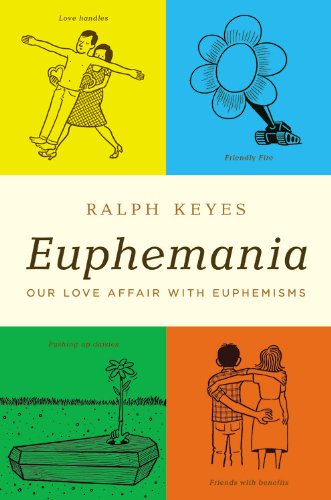
In his new book Euphemania, a cultural history of euphemisms, Ralph Keyes takes a frank and often bawdy look at why we use euphemisms in social and political discourse, even when such evasions can degrade communication. “We all rely on euphemisms to tiptoe around what makes us uneasy, and have done so for most of recorded history,” writes Keyes, adding that “Euphemisms are a function of their times.” As such, Euphemania surveys different euphemisms throughout different cultures and times, from ancient Greece to the Roman republic, to Shakespeare’s England and the Victorian era (a treasure trove of euphemisms), to our modern age–which Keyes argues is not nearly as frank and open as we might like to think; indeed, one of his most intriguing arguments points out that modern discourse has simply opened up more topics to euphemism, including medicine, politics, and advertising.

Keyes doesn’t intend his book to be a straightforward history or dictionary of euphemisms; rather, he writes “it’s a consideration of the ways euphemisms enter our conversations and how they reflect their time and place. Euphemizing most often results from an excess of politeness and prudery, but it can also demonstrate creativity and high good humor.” Although Keyes always has a keen eye on the prudish mores of which ever age he’s discussing, he balances this analysis with plenty of humorous examples. His tone is fun and earthy, drawing examples from literature, film, TV, advertising, and political rhetoric. Between discussions of the Bowdlerization of Shakespeare, W.C. Fields’s difficulties with censors, or dialog from The Wire, Keyes also holds forth on the strange etymologies of our words. The root of the word bear (the mammal, not the verb) simply means “brown” or “the brown one” — the word bear is an unexpected euphemism, a refusal to name a lethal wild animal. Such examples can often magnify one’s awareness of how indebted our language is to euphemisms. Even when we reach for one of those Latinate technical words, we’ve really just picked up another culture’s euphemism. Our medical standby penis, for example, comes from the Latin word for “tail.” Vagina was a Roman synonym too–it means “sheath” or “scabbard.”

Euphemania is best when Keyes is riffing on naughty bits like these–or sex, or excretions, or violence, or all those things we’d like to otherwise gloss over. Most readers will likely gravitate to chapters like “Anatomy Class” or “Speaking of Sex.” Although Keyes is never dull (if anything, he’s at times too effervescent), his book is less convincing when discussing why we use euphemisms, simply because, at least to this reader, the answers are so obvious–euphemisms are part of the intrinsic codes of our culture. They make it easier to discuss unpleasant things; they build a sense of shared knowledge; they alleviate anxieties of race, place, and gender. At the same time, the cost of euphemisms–particularly in contemporary political discourse–can be astounding, leading to the evasion or outright denial of dramatic problems. Keyes doesn’t offer a pat solution to this problem, which is really better, if one thinks about it, because after all, wouldn’t an overly simplified, self-satisfied answer be just another dodge, another evasion, another euphemism? Good stuff.

Euphemania is new in hardback from Hatchette/Little, Brown and Company.

Heroes of 2010 — David Mitchell

Vice Interviews Sam Lipsyte

Vice interviews Sam Lipsyte–good stuff. From the interview, here’s Lipsyte on writing comedy–

The page is very different than what a stand-up comic does. A comedian has a physical body—gestures, vocal intonations, double takes—whatever they’re going to do to bring across the comedy. They can make a phrase funny just by the way they say it. Authors don’t have any of those tools at our disposal, so we have to find lingual ways to do it. So much of it is how you build to something, how wide you make a loop of description before you veer off and land somewhere totally unrelated. You have to learn how that rhythm works in prose. It has to be something you feel.

I don’t want it to be too jokey, I don’t want it to be making claims for itself as funny, but then you must laugh because it is a funny moment. I pursue… something strange, usually, in every paragraph. It may be funny, or it may be something I don’t think is that funny. I’ve had people come up to me and say, “That was so funny!” and I think, “Dude, that’s the most devastating moment in the book.” I’ve realized that it’s both. In my work the funniest thing is usually the most devastating thing, and that’s where they play with each other.

“The Savior must have been a docile Gentleman” — Emily Dickinson

Emily Dickinson’s nativity poem, “The Savior must have been a docile Gentleman”–

The Savior must have been
A docile Gentleman—
To come so far so cold a Day
For little Fellowmen—

The Road to Bethlehem
Since He and I were Boys
Was leveled, but for that ‘twould be
A rugged Billion Miles—

James Joyce’s Death Mask

Heroes of 2010 — Neko Case