Lucifer Son of the Morning, I’m Gonna Chase You Out of Earth — Van Arno

Check out more of Van Arno’s amazing series of oil paintings, The Minstrel Cycle. Artist’s statement about Lucifer Son of the Morning, I’m Gonna Chase You Out of Earth: 

Jay-Z’s ‘Lucifer’ sampled the Max Romeo song ‘Chase The Devil,’  but didn’t include the full chorus, ‘I gonna put on an iron shirt, and chase Satan out of earth… I gonna send him to outer space, to find another race.’ The armor, and futility of the mission brings to mind Don Quixote, who mistakes a windmill for a giant, much as our heroine mistakes the evil in her own nature for a space traveling monster.

Margaret Atwood Talks About Twitter (Video)

David Markson: “Originally I Was Calling It Wittgenstein’s Niece”

More from David Markson’s interview at the Dalkey Archive:

DM: Originally I was calling it “Wittgenstein’s Niece.” Never knowing, of course, that Thomas Bernhard would eventually publish something called “Wittgenstein’s Nephew.” But even before I submitted it I knew I’d have enough trouble finding a publisher as was—hardly the amount I did have, but some—and so not wanting to compound the difficulty I changed it to “Keeper of the Ghosts.” Which is something I swiped from Lowry, by the way, from a character named Ghostkeeper. But once the manuscript wound up in the hands of a small press that wasn’t going to be worried about recognition value in Downers Grove, Illinois, or among the knuckleheads at a sales conference, I went back to Wittgenstein. “Mistress” had been on the same scratch sheet with “Niece,” and I decided I liked it better by then.

JT: And meaning basically that your heroine is mistress to Wittgenstein’s thought?

DM: Well, along with several other people’s yes. But as I started to say a few minutes ago, the Wittgenstein is frequently most obvious in the very way she questions so many of her own “propositions,” as it were.

The Last Supper — Joe Simon

“I Suppose You Become Addicted to a Certain Kind of Writing” — David Markson on Lowry, Joyce, and Gaddis

David Markson talked with Joseph Tabbi about (among many other things) his friendship with Malcolm Lowry, his love for William Gaddis’s The Recognitions, and how James Joyce teaches us to read. Read the entire interview at the Dalkey Archive:

JT: You mention your critical study of “Volcano.” But you did a master’s thesis on it at Columbia much earlier?

DM: While we were in touch, but before I’d actually met him, yes. In 1951.

JT: Which means it was only four years after the novel had been published. Isn’t that rare, an academic paper on an entirely “new” writer with no body of criticism to verify his status?

DM: As a matter of fact I had to wander around the English department knocking on doors looking for someone to approve the project. I remember Lionel Trilling’s dismissal in particular: “What is all this drunkenness all about?” My whole object was to explain just that, obviously, but I decided to find less of a current to buck. Finally William York Tindall gave me a go-ahead.

JT: That brings up a question of a different sort, however. “Volcano” is scarcely your everyday traditional novel. What sort of training or background did you have that let you feel able to confront the challenge of interpreting something that difficult?

DM: To tell the truth, I’m not sure if I had any real idea what I was getting into, or if any of us do, the first time we’re seduced by a book of that sort. Though Joyce certainly teaches us, for starters. By which I mean that we all learn quickly with “Ulysses” that we cannot simply read the novel itself but have to lean on some of the critical crutches.

JT: But you had no crutches at all?

DM: Oh, well, but there are always clues in the text itself—this reference to that which leads to patterns you begin to trace out. On one level I impressed the hell out of myself, surprised at what I did know. And evidently I impressed a few other creatures as well, since I kept hearing that the thesis was being stolen from by students all over the place. The again when I sat down years later to turn that early stuff into a full length book I was almost embarrassed at how little I’d seen after all.

JT: Not long after that original Lowry thesis you were proselytizing fairly extensively for “The Recognitions” too?

DM: I suppose you become addicted to a certain kind of writing. There’s little enough of it extant, God knows. I’m not sure how much actual “proselytizing” I did for Gaddis, however. Except of course for practically button-holing friends on street corners.

JT: But I understand you were very directly responsible for the first reissue of the book, also?

DM: Evidently I was. It’s a funny story, actually. I was living in Mexico, and someone—well, old Aiken, in fact—gave my address to Aaron Asher, who was the editor of Meridian Books at the time. I picked him and his wife Linda up at their hotel and brought them out to where Elaine and I were living—outside Mexico City—for dinner and then spent approximately three solid hours talking nonstop about Gaddis. Finally Aaron threw up his hands in despair, telling me, “Please, please, I promise I’ll read the darned thing as soon as I get home! But now tell us something about where to go and what to see in Mexico, for heaven’s sake!”

JT: And then he did publish it. Did Gaddis himself know about the impetus?

DM: That’s fairly funny too, as it happens. “The Recognitions” came out in 1955. I’d read it twice when it did, and then wrote Gaddis a letter. It’s perhaps the only other letter I’ve written to an author I didn’t know, but it was completely different from the one I wrote to Lowry. In this case I’d just been infuriated by the rotten reviews and simply wanted to tell the man the hell with them all, that there were some few of us out there who did see what he’s accomplished. I didn’t get an answer, though I eventually heard secondhand that Gaddis had been too depressed at the time to send one. Or that he’d ultimately decided it was too late. But then sometime in 1961, not long after the Asher incident, I did hear. Six years after the fact, this was, a long letter beginning with something like, “Dear David Markson, if I can presume to answer yours of June whatever, 1955!” Which went on to say that Asher was in fact about to do a first reprint.

John Cage’s Variations VII (1966)

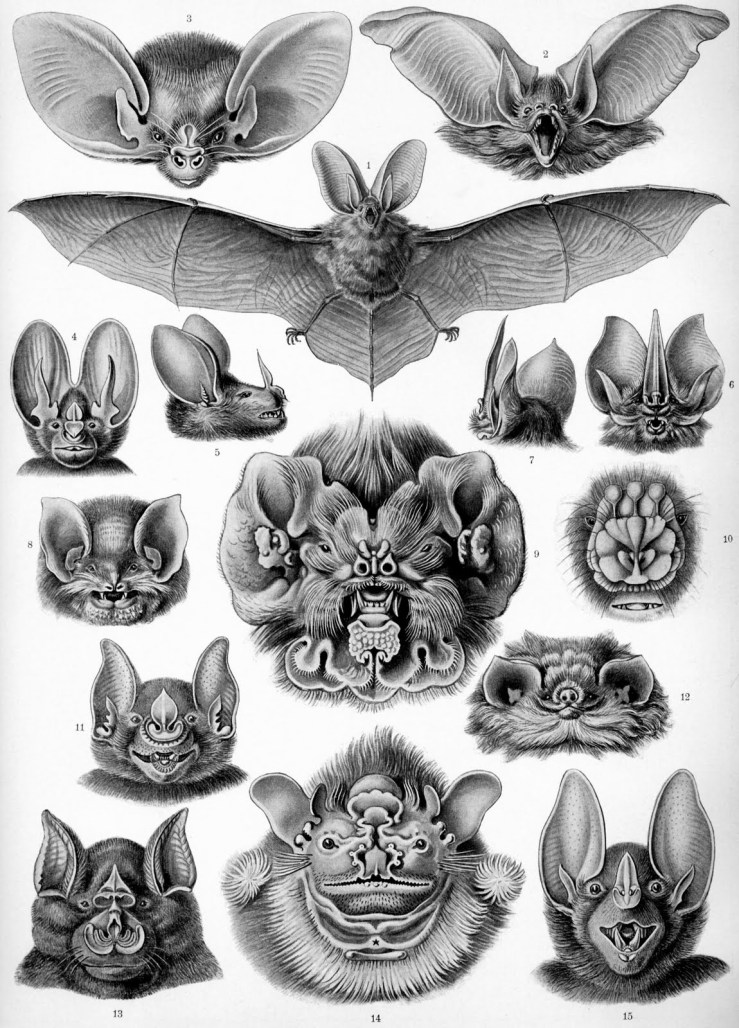
Chiroptera — Ernst Haeckel

“Strawberry Soda” (The Wire)

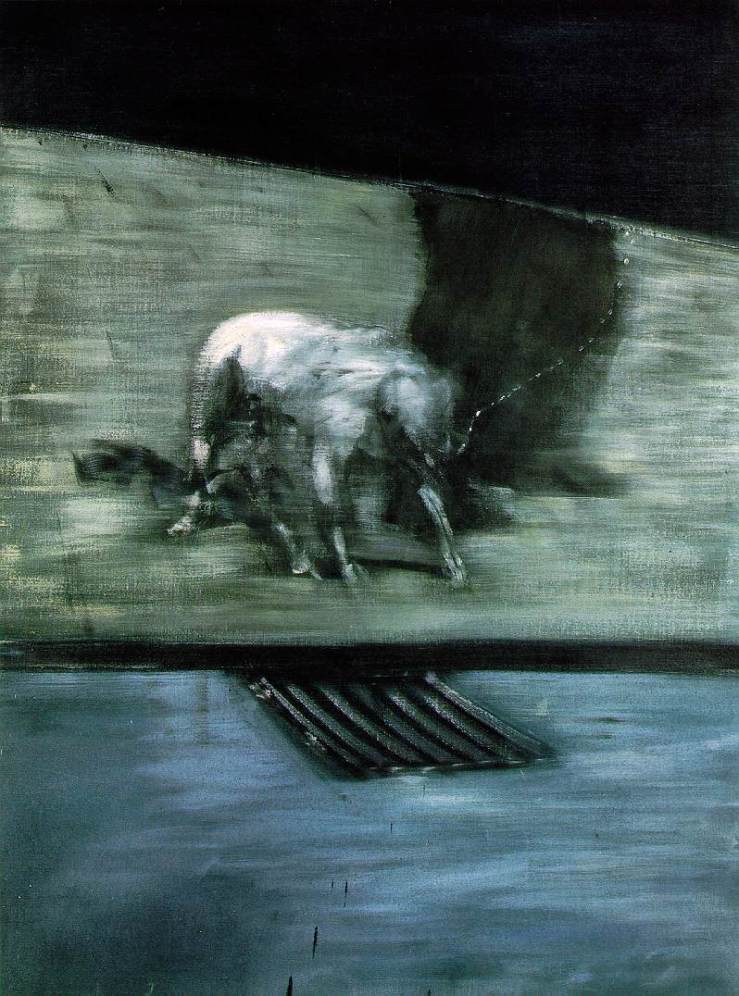
Man with Dog — Francis Bacon

“Dizzy Dizzy” — Can

Book Shelves #2, 1.08.2012

. . . it’s not too difficult, very obviously, to keep ten or twenty or let’s say even a hundred books; but once you start to have 361, or a thousand, or three thousand, and especially when the total starts to increase every day or thereabouts, the problem arises, first of all of arranging all these books somewhere and then of being able to lay your hand on them one day when, for whatever reason, you either  want or need to read them at last or even to reread them.

Thus the problem of a library is twofold: a problem of space, first of all, then a problem of order.

—Georges Perec, from “Brief Notes on the Art and Manner of Arranging One’s Books” (1978)

Book shelves series #2, second Sunday of 2012. Master bedroom: Corner piece bookshelf in the southwest corner; two tiers + top shelf.

I didn’t take a picture of the entire bookshelf, a humble little two-tier piece that abuts the corner of any room with corners. Actually, I did take a picture—a few—but they just looked awful. Like I said in the first installment of this series, it’s not my goal to present aesthetically pleasing portraits of bookshelves.

This corner bookshelf was my grandmother’s and I’ve had it for at least 10 years. The top shelf holds five books that rest there for entirely aesthetic purposes; looking at them now I realize that, with the exception of the Audubon volume in the middle and the Lewis Carroll on the end, I’ve never even bothered to flick through them. They look strange photographed here without the framed photographs, plants, and tchotchkes that attend most shelves in the house:

20120107-141429.jpg

At one point, this entire piece of furniture was double shelved (is this a term? Do you know what I mean here?) with cheap mass market paperbacks, the kind of books that I bought and received for years. I rarely buy mass markets anymore; nor do I like hardbacks. I’m a trade paperback man. Still, some of the sci-fi/dystopian lit here was fundamental to my early reading habits, to the point where I even pick up newer volumes (like Philip Pullman’s books) in mass market paperback.

We also see here the first of many cameras scattered throughout the books in this house. This particular Polaroid is likely the least antiquated; I think it’s from 1999 or 2000. I took all these photos with an iPhone:

20120107-141441.jpg

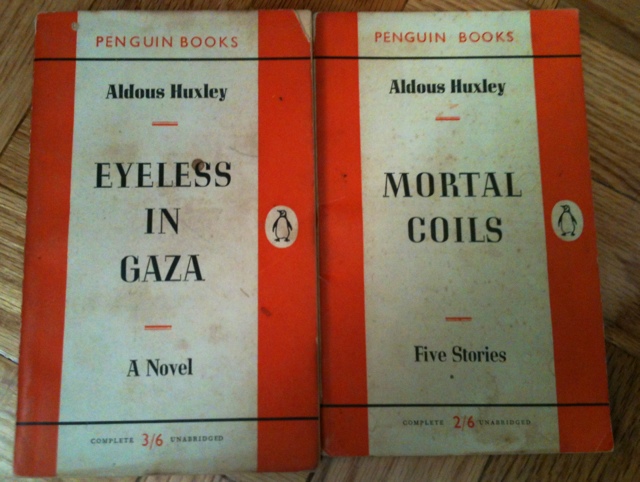
The shot is blurry, so you might not make out the cracked spines, but there are many Huxley books there (although it occurs to me now how odd it is that only one Vonnegut volume is there, when I know that I have so many more somewhere). Two noteworthy Huxleys:

20120107-141453.jpg

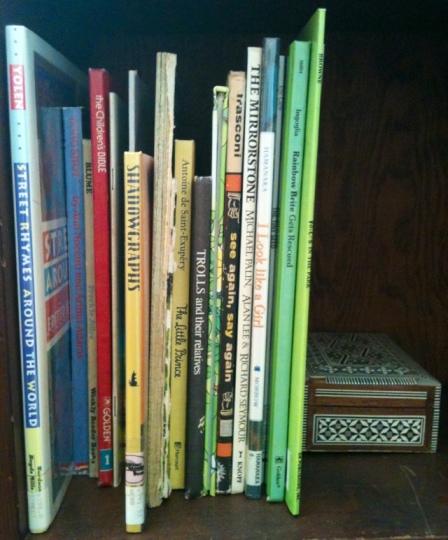
We have children. There are children’s books everywhere in the house, organized in no particular fashion. The drawing and painting books belonged to my grandmother, who was an amateur painter. I am fairly familiar with these books.

20120107-141500.jpg

More kids books. They were probably stuffed here after piling up on the floor one night. The box is full of homemade dice and preserved insects:

20120107-141508.jpg

And more mass markets—sci-fi and fantasy. Many of these were, uh, “borrowed” and never returned, either from a school that I used to work for (The Left Hand of Darkness; Alas Babylon, the aforementioned Pullman volumes), or from dear friends (I’m looking at you, William Gibson books). There are probably 50 more books like this in a secret stash in the back of the house, out of sight:

20120107-141519.jpg

The Lord of the Rings trilogy is an early paperback edition, sporting Tolkien’s original illustrations. My aunt gave me these. I’ve probably read The Lord of the Rings more than any other book, and I’m almost certain that I’ve owned it in more editions than any other book:

20120107-141526.jpg

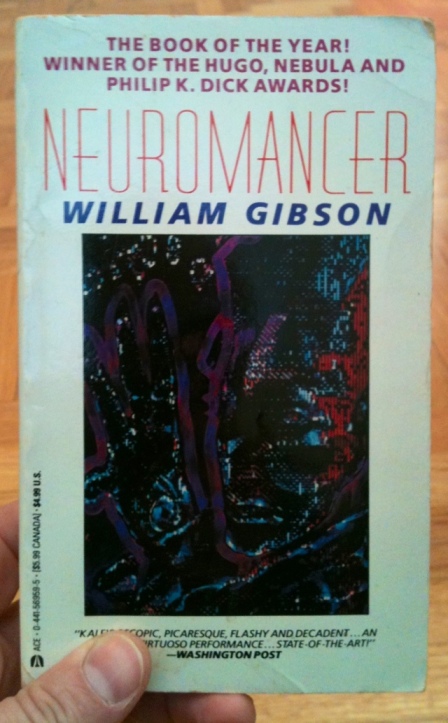
 A dear friend lent me Gibson’s Neuromancer years ago; I know Gibson’s other early books (the first two trilogies) must be somewhere around the house, unless I passed them on, but I’ve always been fond of this book, which taught me how to read in some ways:

20120107-141534.jpg

So we’ve made it out of my bedroom—I chose not to take a picture of my wife’s night stand, for her privacy, I suppose, although she might not have cared. (She doesn’t read this blog and is likely unaware of this weird project). There was a Hayao Miyazaki adaptation she was reading to our daughter there, and Hemingway’s novel The Garden of Eden, which I think she finished just the other night.

Book Acquired, 1.06.2012 — H.G. Adler’s Panorama, A Lost Modernist Classic

20120107-110240.jpg

Like Kafka, H.G. Adler was a German-speaking Jewish writer from Prague. About a year ago, Adler’s Panorama was released for the first time in in English (by Peter Filkins); The book is now available in trade paperback (Random House). Adler survived the Holocaust, forced first into Theresienstadt and then Auschwitz, where his wife and mother were murdered in the gas chambers. Panorama is an autobiographical bildungsroman, with its hero, young Josef Kramer, standing in for Adler. While the book clearly works its way into grim territory, the beginning is bucolic and sweet and strange, an account of young Josef at home with his family. There’s a cinematic scope to Adler’s prose – Panorama is a Modernist work, one where the narrative freely dips into its protagonist’s mind. By the bye, W.G. Sebald references Adler in Austerlitz, a book that tries to measure the continental memory of the Holocaust.

“Being Dead While You’re Alive — That’s Real Death” — Henry Miller & Anaïs Nin on Death and Dreams

Michel Houellebecq, Curmudgeonly Pain in the Ass

From Michel Houellebecq’s 2010 Paris Review interview:

INTERVIEWER

You’ve said that you are “an old Calvinist pain-in-the-ass.” What do you mean?

HOUELLEBECQ

I tend to think that good and evil exist and that the quantity in each of us is unchangeable. The moral character of people is set, fixed until death. This resembles the Calvinist notion of predestination, in which people are born saved or damned, without being able to do a thing about it. And I am a curmudgeonly pain in the ass because I refuse to diverge from the scientific method or to believe there is a truth beyond science.

Horse Movies Suck

So I hadn’t really put all the pieces together on this one until I found this wonderful article about Steven Spielberg’s stupid-looking new movie War Horse, basically paring the whole thing down as a gay metaphor. Hearing this Oscar-bait, bullshit family film cut down to size was bizarrely satisfying for me but I couldn’t understand why at first.

Or furthermore, why had I been so 100% dismissive of this entire movie from the moment I heard it announced like two whole years ago?

I mean Spielberg is undeniably a master filmmaker and is certainly responsible for two or three of the best American films ever made (The Terminal and Amistad obviously . . . oh, wait, I meant Indiana Jones and the Kingdom of The Crystal Skull and Jurassic Park: The Lost World . . . shit . . . I mean A.I. . . . oh never mind). And it’s not like this movie features dead-eyed, gross looking, CG-inflated cartoon characters, so what was driving my antipathy?

Then of course it hit me: Horse Movies suck.

Pretty much all of them. Horse Movies is maybe the worst genre in cinema history, with the possible exception of Poker Movies (but I’m still unpacking this, so I can get back to that). Why do I even know this though? How many Horse Movies can I even name?

Not that many: Black Stallion, Black Beauty, National Velvet (that was about horses right?), Seabiscuit, Secretariat, Wild Hearts Can’t Be Broken. And have I even seen any of these movies? Certainly not the two newer titles on that list, (those of the sub-subgenre: “Celebrity Horse Movie”) and I did somehow watch Wild Hearts Etc. with my wife at some point last year (it was an identical experience to my memory of watching it with my sister years prior; both times I’m pretty sure I was asked to leave the room by the end).

So what of the three old ones: Two Blacks and a Velvet? I have no idea what these movies are about, except that of course I do: they are about beautiful, powerful horses and the presumably young people who share a wordless bond with them. It is passionate. It is real. It is love. Pure and simple. I know this because all horse movies are about the same damn thing and also because I have some strange, unspeakable back-of-my-mind notion that somewhere in my childhood I was subject to abuses, of a cinematic kind, but apparently no less haunting, made to watch an endless stream of Horse Movies made for The Whole Family, because like every family in the suburban south mine loved horses.

Wait, no we didn’t. My Grandpa had been thrown from one as a child and suffers to this day from a fear of them that was passed down to me as a kind of darkly cautionary tale. “Don’t ever ride a horse,” he would tell me while I watched him fashion wooden swords for me out of scrap-wood from his garage workshop. As far as I know I have no memories of my father or mother riding or showing any interest in horses. So why of all movies did we gather around to watch Black Beauty on a Sunday night?

I have no idea.

All I do know is that I hated every minute of every one of those films. It isn’t something I think about very often, but reading that article sent me on quite a trip through the past. A past full of boring shitty memories of watching shitty Horse Movies.

War Horse looks like something I would have to watch with a babysitter when my parents had a party to go to or something. One of those times when they rent a movie for you as a surprise and you have that moment where maybe they are going to tell you it’s Bill & Ted’s Bogus Journey and then: nope, surprise War Horse. Have fun.

I should stop beating up on that movie though; it’s kind of unfair, especially since I haven’t seen it. I think I should attempt to focus instead on understanding why I hated/hate the Horse Movie genre. Obviously it all comes down to: taste in genre in any medium is so totally subjective it’s almost not worth attempting to understand or explain. Why some people have an endless appetite for reggae music and zombie movies is completely beyond me and obviously plenty of people would be equally baffled by my general enjoyment of free jazz and Space Horror (the genre of horror films that are all set in space, e.g. Leprechaun in Space and Event Horizon). So for me to say that all Horse Movies are in some ways the same is both obvious and redundant; of course they are, that’s what makes it a genre. All Boxing Movies are the same too, but I thought last year’s film The Fighter was totally amazing. So I will concede that there are people out there who just love all these Horse Movies that parents around world seem to jam down their kids throats year-after-year. These people want more more more. More horses! More shots of humans hugging horses and crying! I can only speculate what’s behind this reaction; if my own natural disinclination to theses films springs at least partly from an inherited fear of horses, then I must assume the opposite factor is at work in the hearts and minds of Horse Movie Lovers. These are people with a natural love of horses or people who perhaps have known the love of a good horse. (No laughing at that please. I am going to talk about Zoo later, but for now I still mean Innocent Love of horses).

So yeah, if you grew up around horses, or had your own horse, then I would bet that you get more out of Horse Movies than I do. If you’ve experienced this apparently near-mystical horse-human connection, then you are understandably going to be more affected by watching people like Tobey Maguire pretend to be having it as well. But as film genres go, some things are just more cinematic than others, and in my own subjective opinion certain things kind of automatically make for less engaging films. This is where the comparison to Poker Movies comes back. Poker Movies are really really really really really really really awful. Because poker itself is the most boring thing in the world to watch, unless of course you’re just WAY into poker, and if you are, you can spend hours watching those terrible celebrity poker tournaments because you can mentally project yourself into the game and sort of “play along” with them. Now, in most poker movies there is no actual poker going on, so the best you can hope for is that people who are way into poker will be entertained by just hearing their stupid familiar expressions — “Oh shit, he got two kings on the river” or whatever. Those of us who hate poker will be doubly bored because we have no intrinsic interest in the game, and we hate the terminology, (oh and you know that whole Poker Face thing? You know how in order to be good at poker you should be as blank and emotionless as possible? Yeah, you get it, watching actors act like they are playing poker means watching really expressive people NOT express anything for two hours).

So I’m taking the long way around here, but I think I just convinced myself that the Poker Movie is indeed The Worst Genre. Because while Poker and Love of Horses are both things that are totally un-cinematic, and interest in them in a movie is disproportionately dependent on the audience’s previous knowledge and/or experience (more so than say, boxing. It’s two dudes punching, easy to follow and grasp), at least Horse Movies have horses in them. Does it sound like I’m contradicting myself? See there are plenty of great, awesome, powerful, exciting movies that have horses in them, look at all Westerns, hell even Melancholia had some awesome horse sequences. Horses are beautiful animals and they look amazing up on the big screen, especially in slow motion. And horses as photographic subjects are wonderfully compelling, so it’s a very weird irony that movies featuring horses are great, but movies about horses bore me to tears.

Still: Someone should make a movie about a bunch of horses playing poker in slow motion. That would be the apex of both these genres. Throw some William Basinski music down for the score and I’d watch that all day long.

Hmm. I kind of feel like I completed my thought there, but I promised earlier to talk about Zoo, which is the notably huge exception to everything I have just said.  Zoo is the movie about the guys who have sex with horses and one of the guys dies because the horse-sex kills him. I wholly adore this movie and have watched it several times.

(And no, in case you are wondering there is not a bunch of graphic horse sex in the film; it’s a documentary made of voiceovers and sort of “unsolved mysteries style” re-enactments, none of which involve actual horse sex, with the exception of maybe two or three seconds of actual footage that appears very small in the frame, on a television set being watched by characters in the shot).

Why do I like this movie so much when I can’t stand all the other ones I mentioned? I think partly because it is more real and because it’s not a movie for kids, and also because it combines (an even more baffling) Love of Horses (these guys know the love of a good horse, right?) with my naturally felt fear of them. I think all of the kids movies about horses all feel like bullshit to me because they very obviously and rightly leave out all of the weird shit humans have going on with these animals. I mean, the sort of Freudian thing about little girls and horses is silly and cliché as any tired old “What does a cigar look like?” jokes your dad could come up with. We all know that there can be this weird sexual component to our interaction with horses, and if you’re at all like me you look at these things and see Giant Dangerous Animals, just as much as beautiful graceful creatures. So Zoo seems really vital to me as one of the only movies to really capitalize on all of that stuff, (I realize now that I have never seen Equus, doesn’t that have dark, sexual, horse stuff too?). And add all of this to the fact that Zoo is an exceptional story and a true story, so it’s that much more interesting. By exceptional I mean that it is precisely not the story of a normal kid who discovers a passionate connection with an animal. No, it’s the story about a group of guys who have sex with horses, and beyond that it focuses on the guy who died from it. So he’s a unique member of a unique group and this factor makes it interesting.

As a kid one is supposed to watch those horse movies and project one’s self into them, have a vicarious relationship with the black stallion for two hours, but because I was never all that interested in horses it didn’t work for me. I’m not looking to project myself into the story; Zoo works for me because the characters couldn’t be more different from me.

The true story aspect makes a difference too; take for instance The Horse Whisperer vs. Buck, (both terrible titles btw). I couldn’t be less interested in the Redford film, but the doc looked pretty fascinating. So I guess that’s the takeaway: When it comes to horses go documentary over narrative.

“Nothing but Misery, Nothing but Monsters” — Henry Miller Walks Around New York, Talking About His Childhood

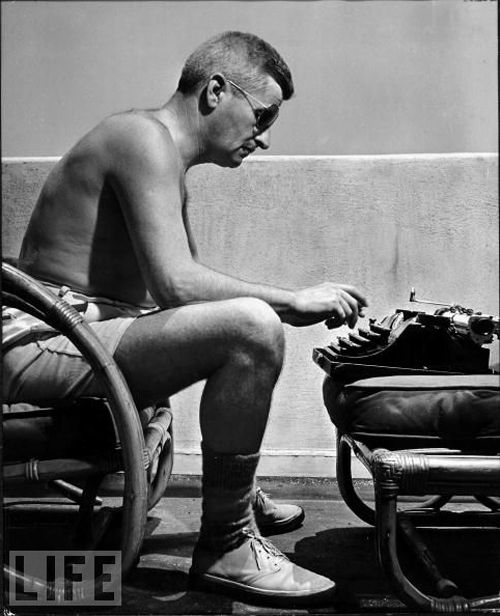
Topless Faulkner, Part II

(See also).