“People Got A Lotta Nerve” — Neko Case

Charles Dickens’s Traveling Cutlery Kit

(Via the Library of Congress).

“Intercourse with Resuscitated Wife” — Ben Marcus

Intercourse with resuscitated wife for particular number of days, superstitious act designed to insure safe operation of household machinery. Electricity mourns the absence of the energy from (wife) within the household’s walls by stalling its flow to the outlets. As such, an improvised friction need to take the place of electricity, to goad the natural currents back to their proper levels. This is achieved with the dead wife. She must be found, revived, and then penetrated until heat fills the room, until the toaster is shooting bread onto the floor, until she is smiling beneath you with black teeth and grabbing your bottom. Then the vacuum rides by and no one is pushing it, it is on full steam. Days flip past in chunks of fake light, and the intercourse is placed in the back of the mind. But it is always there, that moving into a static-ridden corpse that once spoke familiar messages in the morning when the sun was new.

― From Ben Marcus’s collection The Age of Wire and String

The Word of the Day Is “Doh”

Your word for today is: doh, int.

doh, int.
Pronunciation: Brit. /dəʊ/,  U.S. /doʊ/
Forms:  19– d’oh,   19– doh,   19– dooh.
Etymology:Imitative. Compare oh int.duh int.

Popularized by the American actor Dan Castellaneta who provides the voice for the character Homer Simpson in the U.S. cartoon series The Simpsons. The quotation below is his own description of its origin:

1998 Daily Variety (Nexis) 28 Apr., The D’oh came from character actor James Finlayson’s “Do-o-o-o” in Laurel & Hardy pictures. You can tell it was intended as a euphemism for “Damn”. I just speeded it up.

Although the word appears (in the form D’oh) in numerous publications based on The Simpsons, the scripts themselves simply specify annoyed grunt (as did the very earliest). Unofficial transcripts of the programme suggest the first spoken use was in a short episode, Punching Bag, broadcast on 27 Nov. 1988 as part of The Tracey Ullman Show. Its earliest occurrence in the full-length series was in the first episode Simpsons roasting on an Open Fire, broadcast on 17 Dec. 1989.

colloq.

  Expressing frustration at the realization that things have turned out badly or not as planned, or that one has just said or done something foolish. Also (usu. mildly derogatory): implying that another person has said or done something foolish (cf. duh int.).

1945  T. Kavanagh It’s That Man Again (B.B.C. radio script) 8th Ser. No. 166, Tom: Yes, out of the nest–Diana: What nest? Tom: In those whiskers–Diana: Dooh! Its [sic] no good talking to you.
1945  T. Kavanagh It’s That Man Again (B.B.C. radio script) 8th Ser. No. 167, Diana: The man I marry must be affectionate and call me ‘Dear’–Tom: Oh you’re going to be a stag’s wife–Diana: Doh!Tom: Same thing.
1952  A. Buckeridge Jennings & Darbishire xii. 183 ‘Doh!’ An anguished gasp of exasperation rang out loud and clear as Mr Wilkins found his voice again.
1989 Beano 11 Feb. 23  (caption) [Speaker is a man who is knocked against a bus stop.] Doh!
1991 Chicago Tribune (Nexis) 15 Nov. (Friday section) Pg-h, ‘The movie had one good point: It wasn’t the worst movie I’ve ever seen.’ ‘It was the worst movie I’ve ever seen.’ ‘Doh!’
1993 HP Professional (Nexis) July 28 Along their long path ISO sort of missed local area networks and network management, which gave the market over to TCP/IP and related technologies. As Homer Simpson would say: ‘Doh!’
1996  A. Fein et al.  Simpsons Comics strike Back! 14/2 ‘Look out, you dern fool! You’re gonna cut off your…’ ‘D’oh!!!’
1998  N. Jones Hollyoaks (Mersey TV transmission script) Episode 256. 44 Cindy: What are we doing here, anyway? PaulDoh! Use your head, eh?
–From today’s OED “Word of the Day” email.

Message from the Sea — John Everett Millais

Jim Henson, Apocalypse Style (The Garden of Muppetly Delights — Hilary White)

(More/via; White’s site).

Bloodstained Book Acquired, 4.16.2012

20120418-144945.jpg

Okay. There aren’t really bloodstains on Catriona McPherson’s mystery Dandy Gilver and the Proper Treatment of Bloodstains—but I’m a sucker for alliteration (and you clicked on the link, didn’t you?).  From The Independent’s review:

. . . Catriona McPherson’s novel . . . appears to be firmly in the cosy camp – but is it? The Dandy Gilver series demonstrates the author’s faultless assimilation of this idiom. A genteel note is sounded throughout, with the middle-class Dandy, an amateur female sleuth in the 1920s, solving knotty mysteries. But there’s a subtle detonation of the cosy genre, as the books soothe the reader while clandestinely taking on more serious concerns.

Subtle detonation? I don’t know enough about the genre to assess such claims. Good cover though. Bloodstains is new in the US from Minotaur.

Russian Beauty in a Landscape — Wassily Kandinsky

Books Acquired, 4.10.2012

20120417-145226.jpg

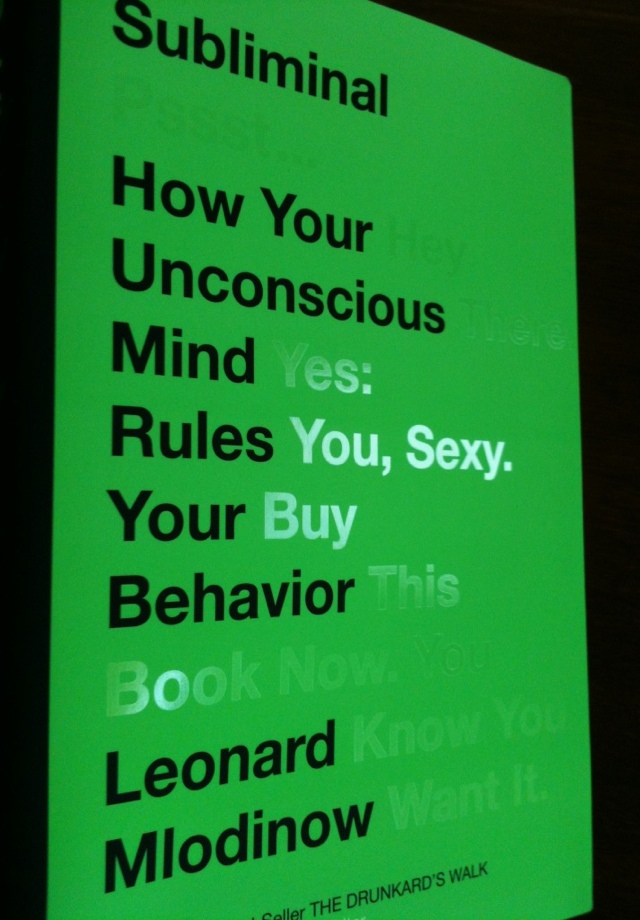
Subliminal by Leonard Mldodinow is new from Random House. Their description:

Leonard Mlodinow, the best-selling author of The Drunkard’s Walk and coauthor of The Grand Design (with Stephen Hawking), gives us a startling and eye-opening examination of how the unconscious mind shapes our experience of the world and how, for instance, we often misperceive our relationships with family, friends, and business associates, misunderstand the reasons for our investment decisions, and misremember important events.

Your preference in politicians, the amount you tip your waiter—all judgments and perceptions reflect the workings of our mind on two levels: the conscious, of which we are aware, and the unconscious, which is hidden from us. The latter has long been the subject of speculation, but over the past two decades researchers have developed remarkable new tools for probing the hidden, or subliminal, workings of the mind. The result of this explosion of research is a new science of the unconscious and a sea change in our understanding of how the subliminal mind affects the way we live.

Employing his trademark wit and lucid, accessible explanations of the most obscure scientific subjects, Leonard Mlodinow takes us on a tour of this research, unraveling the complexities of the subliminal self and increasing our understanding of how the human mind works and how we interact with friends, strangers, spouses, and coworkers. In the process he changes our view of ourselves and the world around us.

Read a profile of Mlodinow at The Los Angeles Times (dude used to work on MacGyver, so . . .)

20120417-145237.jpg

Also new from Random House is Against Wind and Tide, a collection of letters, journals, and other documents by Anne Morrow Lindbergh. Jacket copy:

Why, as an eager and talented writer, has Anne Morrow Lindbergh published so relatively little in forty years of marriage?” asked reviewer John Barkham in 1970. “After a promising start with those first books on flying, she tapered off into long silences broken by an infrequent volume of verse or prose.”  Many years later, Lindbergh replied with a quote from Harriet Beecher Stowe, who claimed that writing, for a wife and mother, is “rowing against wind and tide.”

In this sixth and final collection of Lindbergh’s diaries and letters, taking us from 1947 to 1986, we mark her progress as she navigated a remarkable life and a remarkable century with enthusiasm and delight, humor and wit, sorrow and bewilderment, but above all devoted to finding the essential truth in life’s experiences through a hard-won spirituality and a passion for literature.

Between the inevitable squalls of life with her beloved but elusive husband, the aviator Charles A. Lindbergh, she shepherded their five children through whooping cough, horned toads, fiancés, the Vietnam War, and their own personal tragedies.  She researched and wrote many books and articles on issues ranging from the condition of Europe after World War II to the meaning of marriage to the launch of Apollo 8.  She published one of the most beloved books of inspiration of all time, Gift from the Sea. She left penetrating accounts of meetings with such luminaries as John and Jacqueline Kennedy, Thornton Wilder, Enrico Fermi, Leland and Slim Hayward, and the Frank Lloyd Wrights. And she found time to compose extraordinarily insightful and moving letters of consolation to friends and to others whose losses touched her deeply.

More than any previous books by or about Anne Morrow Lindbergh, Against Wind and Tide makes us privy to the demons that plagued this fairy-tale bride, and introduces us to some of the people—men as well as women—who provided solace as she braved the tides of time and aging, war and politics, birth and death. Here is an eloquent and often startling collection of writings from one of the most admired women of our time.

“Smile” (O Lucky Man!)

“Authenticity’s Wiped Out” — A Passage from William Gaddis’s Last Novel, Agapē Agape

William Gaddis’s last novel Agapē Agape is a bitter, funny rant, a monologic stream-of-consciousness that, through its extreme powers of synthesis, spills over into heteroglossic eruptions, a carnival of erudite voices. Driven by terrible physical pain, hints of madness, and, most of all, the need to “explain all this” before he dies, the voice of the novel (surely Gaddis himself) channels cultural historian Johan Huizinga and philosopher Walter Benjamin into a conversation about the conflict of art and commerce set against the backdrop of the rise of mass culture:

. . . falls right into line doesn’t it, collapse of authenticity collapse of religion collapse of values what Huizinga called one of the most important phases in the history of civilization, and Walter Benjamin picks it up in his Art in the Age of Mechanical Reproduction in this heap somewhere, the authentic work of art is based in ritual he says, and wait Mr. Benjamin, got to get in there the romantic mid-eighteenth century aesthetic pleasure in the worship of art was the privilege of the few. I was saying, Mr. Huizinga, that the authentic work of art had its base in ritual, and mass reproduction freed it from this parasitical dependence. Ah, quite so Mr. Benjamin quite so, turn of the century religion was losing its steam and art came in as its substitute would you say? Absolutely Mr. Huizinga, and I’d add that this massive technical reproduction of works of art could be manipulated, changed the way the masses looked at art and manipulated them. Inadvertently Mr. Benjamin you might say that art now became public property, for the simply educated Mona Lisa and the Last Supper became calendar art to hang over the kitchen sink. Absolutely Mr. Huizinga, Paul Valery saw it coming, visual and auditory images brought into homes from far away like water gas and electricity and finally, God help us all, the television. Positively Mr. Benjamin, with mechanization, advertising artworks made directly for a market what America’s all about. Always has been, Mr. Huizinga. Always has been, Mr. Benjamin. Everything becomes an item of commerce and the market names the price. And the price becomes the criterion for everything. Absolutely Mr. Huizinga! Authenticity’s wiped out when the uniqueness of every reality is overcome by the acceptance of its reproduction, so art is designed for its reproducibility. Give them the choice, Mr. Benjamin, and the mass will always choose the fake. Choose the fake, Mr. Huizinga! Authenticity’s wiped out, it’s wiped out Mr. Benjamin. Wiped out, Mr. Huizinga. Choose the fake, Mr. Benjamin. Absolutely, Mr. Huizinga! Positively Mr. Benjamowww! Good God! a way to find a sharp pencil just sit still avoid stress stop singing what, anybody heard me they’d think I was losing my, that I’d lost it yes maybe I have . . .

A Pictorial Chart of English Literature

(Via the Library of Congress).

Book Acquired, 4.14.2012

20120417-113551.jpg

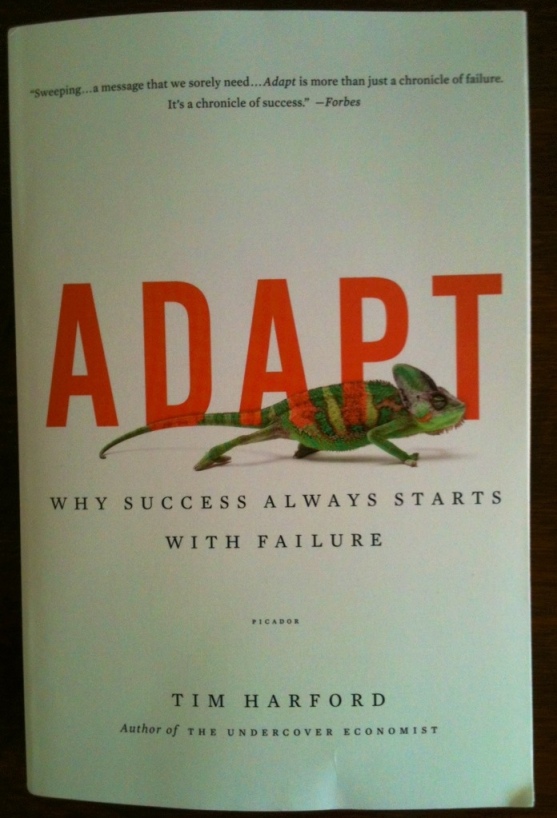
Adapt by Tim Harford. New from Picador. Their description:

In this groundbreaking book, Tim Harford, the Undercover Economist, shows us a new and inspiring approach to solving the most pressing problems in our lives. When faced with complex situations, we have all become accustomed to looking to our leaders to set out a plan of action and blaze a path to success. Harford argues that today’s challenges simply cannot be tackled with ready-made solutions and expert opinion; the world has become far too unpredictable and profoundly complex. Instead, we must adapt.

Deftly weaving together psychology, evolutionary biology, anthropology, physics, and economics, along with the compelling story of hard-won lessons learned in the field, Harford makes a passionate case for the importance of adaptive trial and error in tackling issues such as climate change, poverty, and financial crises—as well as in fostering innovation and creativity in our business and personal lives.

Taking us from corporate boardrooms to the deserts of Iraq, Adapt clearly explains the necessary ingredients for turning failure into success. It is a breakthrough handbook for surviving—and prospering— in our complex and ever-shifting world.

“Mount Hood” (Live) — Hauschka

“A Wounded Deer—leaps highest— ” — Emily Dickinson

A poem by Emily Dickinson:

A Wounded Deer—leaps highest—
I’ve heard the Hunter tell—
‘Tis but the Ecstasy of death
And then the Brake is still!

The Smitten Rock that gushes!
The trampled Steel that springs!
A Cheek is always redder
Just where the Hectic stings!

Mirth is the Mail of Anguish
In which it Cautious Arm,
Lest anybody spy the blood
And “you’re hurt” exclaim!

The Head Drifts Toward the Bottom (Fletcher Hanks)

(More/via).

“A Snake Is Afraid of a Man That Is Naked,” and Other Great Occult Tips on Animals (Heinrich Cornelius Agrippa von Nettesheim)

From Heinrich Cornelius Agrippa von Nettesheim’s Three Books of Occult Philosophy or Magic, (1533)

The bird called bustard flies away at the sight of a horse, and a hart runs away at the sight of a ram, as also of a viper.

An elephant trembles at the hearing of the grunting of a hog, so doth a lion at the sight of a cock; and panthers will not touch them that are anointed all over with the broth of a hen, especially if garlic hath been boiled in it.

There is also enmity betwixt foxes and swans, bulls and jackdaws.

Amongst birds, also, some are at perpetual strife one with another, as also with other animals, as jackdaws and owls, the kite and crows, the turtle and ring-tail, egepis and eagles, harts and dragons.

Also amongst water animals there is enmity, as betwixt dolphins and whirlpools, mullets and pikes, lampreys and congers.

Also the fish called pourcontrel makes the lobster so much afraid that the lobster, seeing the other but near him, is struck dead.

The lobster and conger tear one the other.

The civet cat is said to stand so in awe of the panther that he hath no power to resist him or touch his skin; and they say that if the skins of both of them be hanged up one against the other, the hairs of the panther’s skin fall off.

And Orus Apollo saith in his hieroglyphics, if any one be girt about with the skin of the civet cat that he may pass safely through the middle of his enemies and not at all be afraid.

Also the lamb is very much afraid of the wolf and flies from him. And they say that if the tail or skin or head of a wolf be hanged upon the sheep-coate the sheep are much troubled and cannot eat their meat for fear.

And Pliny makes mention of a bird, called marlin, that breaks crows’ eggs, whose young are so annoyed by the fox that she also will pinch and pull the fox’s whelps, and the fox herself also; which when the crows see, they help the fox against her, as against a common enemy.

The little bird called a linnet, living in thistles, hates asses, because they eat the flowers of thistles.

Also there is such a bitter enmity betwixt the little bird called esalon and the ass that their blood will not mix together, and that at the braying of the ass both the eggs and young of the esalon perish.

There is also such a disagreement betwixt the olive-tree and a wanton, that if she plant it, it will either be always unfruitful or altogether wither.

A lion fears nothing so much as fired torches, and will be tamed by nothing so much as by these; and the wolf fears neither sword nor spear, but a stone—by the throwing of which, a wound being made, worms breed in the wolf.

A horse fears a camel so that he cannot endure to see so much as his picture.

An elephant, when he rageth, is quieted by seeing of a cock.

A snake is afraid of a man that is naked, but pursues a man that is clothed.

A mad bull is tamed by being tied to a fig-tree.

(NB: I took the editorial liberty of turning Agrippa’s marvelous paragraphs into a list, which I think reads a bit better, or at least more absurdly).