Bill Plympton’s Simpsons Couch Gag

Keith Miller’s The Book on Fire, A Tale of Biblioklepts, Bibliophiles, and Bibliomania

Balthazar, the hero of Keith Miller’s agile and trippy novel The Book on Fire, is a biblioklept. He comes to Alexandria to rob the famous library, a cavernous, labyrinthine complex that still exists–under heavy guard—in Miller’s mystical version of that ancient Egyptian city. Miller’s Alexandria is a byzantine maze, humming with a turn-of-the-century buzz, a kaleidoscope world that strongly reminded me of the strange cityscapes of William Gibson or William Burroughs. Here, Balthazar describes his attraction to Alexandria:

This is the city of books, where children are admonished if they don’t bring a book to the breakfast table, where they’re ordered by their mothers to drop their books and go play on the street, where bedtime tales sometimes continue, chapter after chapter, till well after midnight, parents pinching their children to keep them awake. This is a city where men beat their wives with books, the women shielding their heads with books. A city of book-whores, who fuck for books, and their bibliogiglios. A city of book-beggars, who spit on your money, gesturing with their stumps to the paperback in your hand.

What a town for a book thief! Balthazar plans to rob the Library of Alexandria, but he spends his early months stealing rare books from private homes. Soon, he’s trailed by Zeinab, a book prostitute who burns each volume she’s paid with. After a sexual interlude (“like fucking a wounded ferret,” Balthazar tells us), Zeinab introduces our hero to a guild of thieves and helps guide him through Alexandria’s frenetic underworld. In time, Balthazar breaches the forbidden, intoxicating library:

I read impossibly gorgeous scripts. Scripts in which each hieroglyph filled a page and took a day to write, but could express an entire philosophy. Scripts in which each letter stood for a notion, so the writing dictated thought patterns rather than words. Scripts that had no meaning at all, or that started out meaningfully but then, as the author was caught up in the physical act of writing, became relationships of lines and shapes on paper, beautiful and abstract. Private scripts, the authors long dead, so the script stood isolated, unreadable precious nonetheless. Rainforest scripts of samara and turaco crest. Marine scripts of shark tooth and sand dollar. I passed through rooms of books the size of doors, each cover the death of an eland, and rooms of books dainty as ladybirds. Books written on communion wafers, grains of rice, sheets of ice.

For Balthazar, books are a drug, and the Library of Alexandria is the heady nexus point for his addiction. No wonder then that he becomes obsessed with the young librarian Shireen, whom he plots to free (or perhaps steal) from the library—a plan that comes into conflict with Zeinab’s own designs. And while The Book of Fire does have the strong, page turning plot of a thriller, that plot exists mostly as the bones for Miller to hang rapturous descriptions of reading and books and, best of all, his strange Alexandria, a city of marvels. Good stuff.

“Hitler and Nietzsche” — Ricky Gervais

People in the Sun — Edward Hopper

“Well, the evening began at the Gentleman’s club, where we were discussing Wittgenstein over a game of backgammon”

Book Shelves #16, 4.15.2012

20120415-113741.jpg

Book shelves series #16, sixteenth Sunday of 2012.

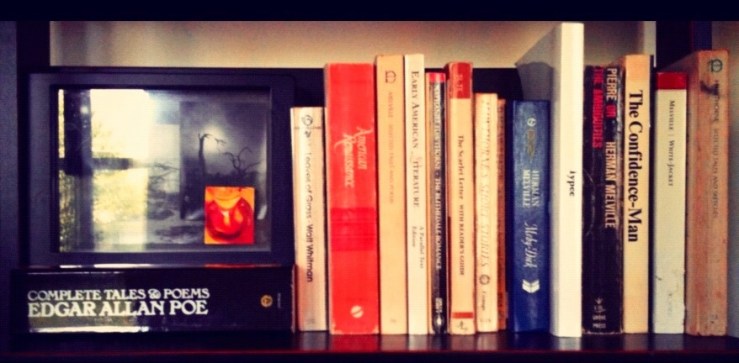
It’s hard to photograph books, and using an iPhone 3gs probably doesn’t help. Lots of glare. Anyway: This shelf houses mostly Melville, with some Hawthorne, Poe, and Whitman, as well as some critical works on the American Renaissance movement. (Henry James and F.O. Matthiessen). I have other versions of a lot of these books, including a fraternal twin in my office, a bit bulkier (Emerson, Dickinson, Thoreau, etc.), although these days I’m apt to go to the Kindle for American Renaissance stuff. Here’s a better angle, perhaps:

20120415-113756.jpg

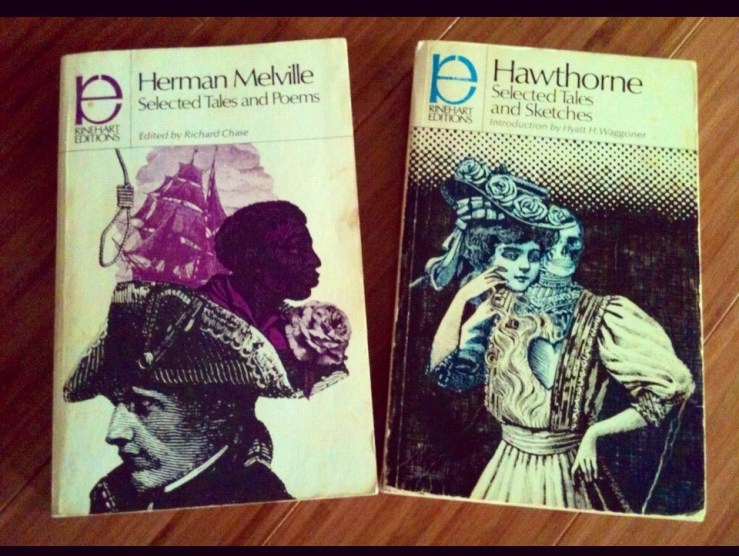
The version of Typee is bizarre: no colophon, no publisher info, just text. I love these midcentury Rinehart Editions of Hathorne and Melville stuff:

20120415-113807.jpg

“Rhetoric” — A Page from James Joyce’s Notebooks

This page is from a notebook that contains some of Joyce’s preparatory notes for Ulysses—there are notes for characters (“Stephen,” “Simon,” “Leopold,” etc.) as well as lists (“Books,” “Recipes”) and general ideas (“Theosophy”). This particular page, “Rhetoric,” seems to be part of the material that went into the “Aeolus” chapter of Ulysses, which plays with the windiness of rhetorical figures. From the National Library of Ireland, via UbuWeb.

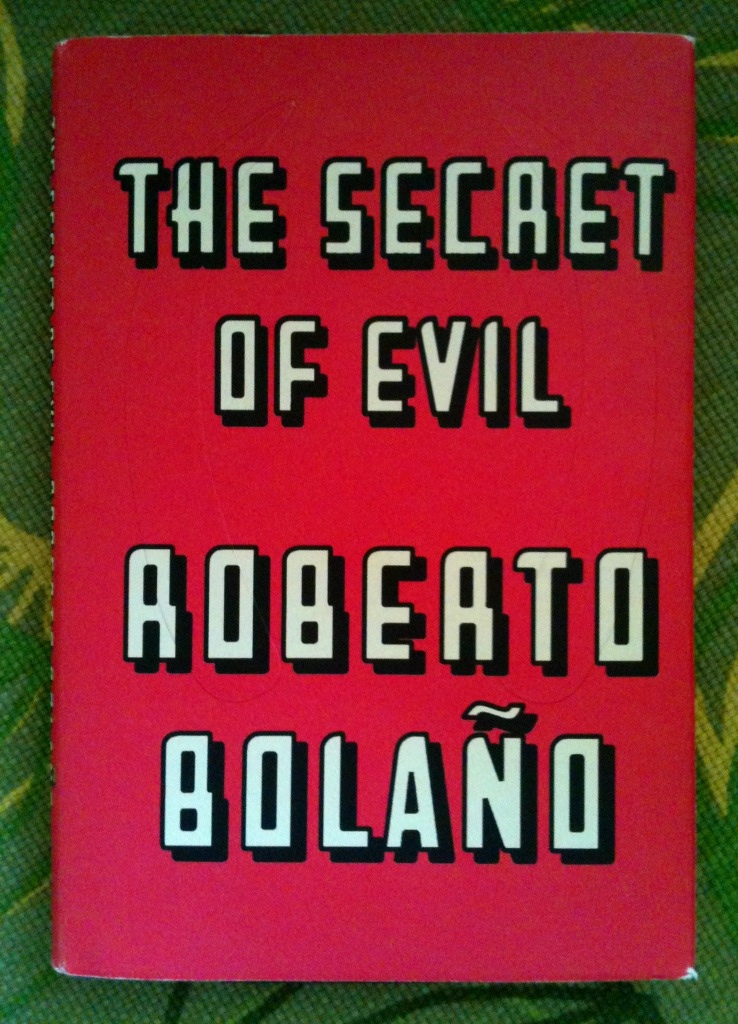
Roberto Bolaño’s The Secret of Evil (Book Acquired, 4.09.2012)

20120414-140951.jpg

How you react to a “new” book by Roberto Bolaño at this point is probably dependent on how much you love or loathe his work—although I imagine those indifferent to or unfamiliar with his writing might be unduly put off by this point at the volume of material that this writer drops posthumously [insert Tupac joke here].

I’m a fan though, so I’m excited about The Secret of Evil, even if the material collected here is in part unfinished . . . although, as Ignacio Echevarria points out in his introduction, all of Bolaño’s “narratives, not just The Secret of Evil, seem to be governed by a poetics of inconclusiveness.” A few of the pieces in Evil have already been excerpted, and I read a few this weekend (who can resist a Bolaño text called “Crimes”?), and while some pieces here are sketchier than others, there’s that preponderance of life force that we expect from late period Bolaño, from a man who seemed to pour what was left of himself into his words and sentences.

From publisher New Directions’ website:

Opening this book is like being granted access to the Chilean master’s personal files. Included in this one-of-a-kind collection is everything Roberto Bolaño was working on just before his death in 2003, and everything that he wanted to share with his readers. Fans of his writing will find familiar characters in new settings, and entirely new stories and styles, too.

A North American journalist in Paris is woken at 4 a.m. by a mysterious caller with urgent information. Daniela de Montecristo (familiar to readers of Nazi Literature in the Americas and 2666) recounts the loss of her virginity. Arturo Belano returns to Mexico City and meets the last disciples of Ulises Lima, who play in a band called The Asshole of Morelos. Belano’s son Gerónimo disappears in Berlin during the Days of Chaos in 2005. Memories of a return to the native land; Argentine writers as gangsters; zombie schlock as allegory…and much more.

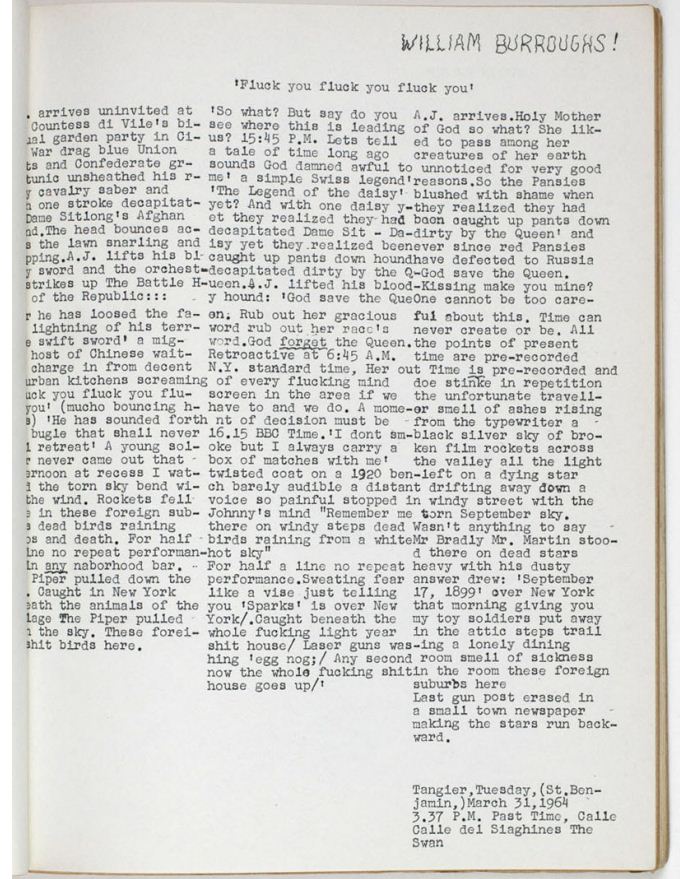
“Fluck you fluck you fluck you” — Tangier Transmission from William Burroughs, 1964

From Number 5, Vol. 7 of Fuck You, (1964) a mimeograph magazine from editor Ed Sanders. The magazine featured Allen Ginsberg, Tuli Kupferberg, Frank O’Hara and more. There’s a fantastic visual archive of Fuck You at Reality Studio, which is where I got this Burroughs layout.

“Mediæval mythology, rich and gorgeous, is a compound like Corinthian brass”

Mediæval mythology, rich and gorgeous, is a compound like Corinthian brass, into which many pure ores have been fused, or it is a full turbid river drawn from numerous feeders, which had their sources in remote climes. It is a blending of primæval Keltic, Teutonic, Scandinavian, Italic, and Arab traditions, each adding a beauty, each yielding a charm, bat each accretion rendering the analysis more difficult. Pacciuchelli says:–“The Anio flows into the Tiber; pure as crystal it meets the tawny stream, and is lost in it, so that there is no more Anio, but the united stream is all Tiber.” So is it with each tributary to the tide of mediæval mythology. The moment it has blended its waters with the great and onward rolling flood, it is impossible to detect it with certainty; it has swollen the stream, but has lost its own identity. If we would analyse a particular myth, we must not go at once to the body of mediæval superstition, but strike at one of the tributaries before its absorption.

From Sabine Baring-Gould’s marvelous volume The Book of Were-Wolves (1865).

David Lynch Talks (in Vague, Elusive Terms) About the Meaning of Mulholland Drive

“It Sounds Like the Title of a David Lynch Film” — A Passage from Roberto Bolaño’s 2666

A passage from Roberto Bolaño’s opus 2666

The card for the Santa Teresa cybercafe was a deep red, so red that it was hard to read what was printed on it. On the back, in a lighter red, was a map that showed exactly where the cafe was located. He asked the receptionist to translate the name of the place. The clerk laughed and said it was called Fire, Walk With Me.

“It sounds like the title of a David Lynch film,” said Fate.

The clerk shrugged and said that all of Mexico was a collage of diverse and wide-ranging homages.

“Every single thing in this country is an homage to everything in the world, even the things that haven’t happened yet,” he said.

After he told Fate how to get to the cybercafe, they talked for a while about Lynch’s films. The clerk had seen all of them. Fate had seen only three or four. According to the clerk, Lynch’s greatest achievement was the TV series Twin Peaks. Fate liked The Elephant Man best, maybe because he’d often felt like the elephant man himself, wanting to be like other people but at the same time knowing he was different. When the clerk asked him whether he’d heard that Michael Jackson had bought or tried to buy the skeleton of the elephant man, Fate shrugged and said that Michael Jackson was sick. I don’t think so, said the clerk, watching something presumably important that was happening on TV just then.

“In my opinion,” he said with his eyes fixed on the TV Fate couldn’t see, “Michael knows things the rest of us don’t.”

“We all know things we think nobody else knows,” said Fate.

David Lynch’s 10 Clues to Unlocking Mulholland Drive

From an insert in the 2002 DVD release of David Lynch’s Mullholland Drive:

David Lynch’s 10 Clues to Unlocking This Thriller
1. Pay particular attention in the beginning of the film: at least two clues are revealed before the credits.
2. Notice appearances of the red lampshade.
3. Can you hear the title of the film that Adam Kesher is auditioning actresses for? Is it mentioned again?
4. An accident is a terrible event… notice the location of the accident.
5. Who gives a key, and why?
6. Notice the robe, the ashtray, the coffee cup.
7. What is felt, realized and gathered at the club Silencio?
8. Did talent alone help Camilla?
9. Note the occurrences surrounding the man behind Winkies.
10. Where is Aunt Ruth?

“Self Defense” — Nietzsche

104 Self Defence.—If self defence is in general held a valid justification, then nearly every manifestation of so called immoral egoism must be justified, too. Pain is inflicted, robbery or killing done in order to maintain life or to protect oneself and ward off harm. A man lies when cunning and delusion are valid means of self preservation. To injure intentionally when our safety and our existence are involved, or the continuance of our well being, is conceded to be moral. The state itself injures from this motive when it hangs criminals. In unintentional injury the immoral, of course, can not be present, as accident alone is involved. But is there any sort of intentional injury in which our existence and the maintenance of our well being be not involved? Is there such a thing as injuring from absolute badness, for example, in the case of cruelty? If a man does not know what pain an act occasions, that act is not one of wickedness. Thus the child is not bad to the animal, not evil. It disturbs and rends it as if it were one of its playthings. Does a man ever fully know how much pain an act may cause another? As far as our nervous system extends, we shield ourselves from pain. If it extended further, that is, to our fellow men, we would never cause anyone else any pain (except in such cases as we cause it to ourselves, when we cut ourselves, surgically, to heal our ills, or strive and trouble ourselves to gain health). We conclude from analogy that something pains somebody and can in consequence, through recollection and the power of imagination, feel pain also. But what a difference there always is between the tooth ache and the pain (sympathy) that the spectacle of tooth ache occasions! Therefore when injury is inflicted from so called badness the degree of pain thereby experienced is always unknown to us: in so far, however, as pleasure is felt in the act (a sense of one’s own power, of one’s own excitation) the act is committed to maintain the well being of the individual and hence comes under the purview of self defence and lying for self preservation. Without pleasure, there is no life; the struggle for pleasure is the struggle for life. Whether the individual shall carry on this struggle in such a way that he be called good or in such a way that he be called bad is something that the standard and the capacity of his own intellect must determine for him.

From Human, All Too Human by Friedrich Nietzsche

Trench Warfare (Paths of Glory)

“I Felt an Irresistible Repulsion and Tedium” — Tolstoy Disses Shakespeare

From the beginning of Leo Tolsoy’s attack on William  ShakespeareA Critical Essay on Shakespeare:

I remember the astonishment I felt when I first read Shakespeare. I expected to receive a powerful esthetic pleasure, but having read, one after the other, works regarded as his best: “King Lear,” “Romeo and Juliet,” “Hamlet” and “Macbeth,” not only did I feel no delight, but I felt an irresistible repulsion and tedium, and doubted as to whether I was senseless in feeling works regarded as the summit of perfection by the whole of the civilized world to be trivial and positively bad, or whether the significance which this civilized world attributes to the works of Shakespeare was itself senseless. My consternation was increased by the fact that I always keenly felt the beauties of poetry in every form; then why should artistic works recognized by the whole world as those of a genius,—the works of Shakespeare,—not only fail to please me, but be disagreeable to me?

For a long time I could not believe in myself, and during fifty years, in order to test myself, I several times recommenced reading Shakespeare in every possible form, in Russian, in English, in German and in Schlegel’s translation, as I was advised. Several times I read the dramas and the comedies and historical plays, and I invariably underwent the same feelings: repulsion, weariness, and bewilderment. At the present time, before writing this preface, being desirous once more to test myself, I have, as an old man of seventy-five, again read the whole of Shakespeare, including the historical plays, the “Henrys,” “Troilus and Cressida,” the “Tempest,” “Cymbeline,” and I have felt, with even greater force, the same feelings,—this time, however, not of bewilderment, but of firm, indubitable conviction that the unquestionable glory of a great genius which Shakespeare enjoys, and which compels writers of our time to imitate him and readers and spectators to discover in him non-existent merits,—thereby distorting their esthetic and ethical understanding,—is a great evil, as is every untruth.

Tolstoy spends most of the rest of the (long) essay showing why he believes King Lear a terrible piece of literature. His rubric is of course terribly subjective, aesthetic, and perhaps ultimately rooted in his own literary mission of realism and social reform—but what I find most remarkable is that, despite all his claims to have read and reread Shakespeare (in English, Russian and German!) he never mentions actually watching a performance of the play.

I read Tolstoy’s gripes last night and felt the need (why?!) to reply, but found this morning that George Orwell already did so. From  Orwell’s rebuttal to Tolstoy, “Lear, Tolstoy and the Fool“:

Artistic theories such as Tolstoy’s are quite worthless, because they not only start out with arbitrary assumptions, but depend on vague terms (‘sincere’, ‘important’ and so forth) which can be interpreted in any way one chooses. Properly speaking one cannot answer Tolstoy’s attack. The interesting question is: why did he make it? But it should be noticed in passing that he uses many weak or dishonest arguments. Some of them are worth pointing out, not because they invalidate his main charge but because they are, so to speak, evidence of malice. . . .

There is no argument by which one can defend a poem. It defends itself by surviving, or it is indefensible. And if this test is valid, I think the verdict in Shakespeare’s case must be “not guilty”. Like every other writer, Shakespeare will be forgotten sooner or later, but it is unlikely that a heavier indictment will ever be brought against him. Tolstoy was perhaps the most admired literary man of his age, and he was certainly not its least able pamphleteer. He turned all his powers of denunciation against Shakespeare, like all the guns of a battleship roaring simultaneously. And with what result? Forty years later Shakespeare is still there completely unaffected, and of the attempt to demolish him nothing remains except the yellowing pages of a pamphlet which hardly anyone has read, and which would be forgotten altogether if Tolstoy had not also been the author of WAR AND PEACE and ANNA KARENINA.

For Want of Sleep — Emma Bennett

(Via/more).