1. Ah, 1985. I was just a kid. A young kid. And my folks took me to see Walter Murch’s Return to Oz, an unofficial sequel to The Wizard of Oz.
Return to Ozis a film so bleak and dark and bizarre that its imagery still lives in the nooks of my nightmares.
2. Not that I didn’t enjoyReturn to Oz—to be clear, I did. But it horrified me in ways that surpassed the deep horror I’d experienced viewing the 1939 film The Wizard of Oz.
3. (The green Wicked Witch cackling “I’ll get you my pretty” in The Wizard of Oz being something of a founding moment of horrific horror, a horror amplified by my mother’s tendency to act out the line at weird moments as she tickled me or chased me or picked me up from school).
4. But Return to Oz: this movie is dark. It’s fucked up.
Dorothy gets institutionalized and treated with electroshock therapy. Then she goes to Oz, where she’s pursued by Wheelers, these things that roll around on rollerskate hands and feet, which, you know, should be whimsical, but are instead horrific. Then there’s this cabinet of detached heads, which could have been handled playfully, but no, instead it’s like something out of Hieronymus Bosch. Even Dorothy’s friends are these weird, off-putting versions that don’t match up to the original trio of Scarecrow, Tinman, and Lion. Instead we get Tik-Tok, an android who looks like a swollen pot-bellied C3PO, and Jack Pumpkinhead, a guy with a pumpkin for a head. These friends don’t look human at all (because they aren’t). There’s a quest; they cross a desert; they save the day, etc.
It ends with Dorothy returned, not exactly safely, to aunt and uncle.
5. So Disney made another unofficial sequel, Oz the Great and Powerful, this time from director Sam Raimi (Return’s Murch never directed another film, by the way). Despite his franchise work on the first trilogy of Spider-Man films, Raimi is an auteur who gave us cult classics like Darkman and the Evil Dead trilogy. I loved his last film Drag Me to Hell, which mixed humor with noir and genuine horror.
6. Oz the Great and Powerful is of course doomed, no matter how much money it makes. It’s doomed in the way that The Two Jakes was doomed, or Godfather III was doomed, or Citizen Kane 2: Electric Boogaloo was doomed: There’s no way that it can surpass, let alone stand up next to, the strength of the prototype.
7. Still, I think that if Raimi has brought enough of his own weirdness to the film, we might get a fascinating artifact. My real hope is that there will be a strong streak of Evil Dead 2 in Raimi’s Disney, a streak of bizarre dark weirdness to baffle and disturb a new generation. Hell, maybe I’ll take my kids.
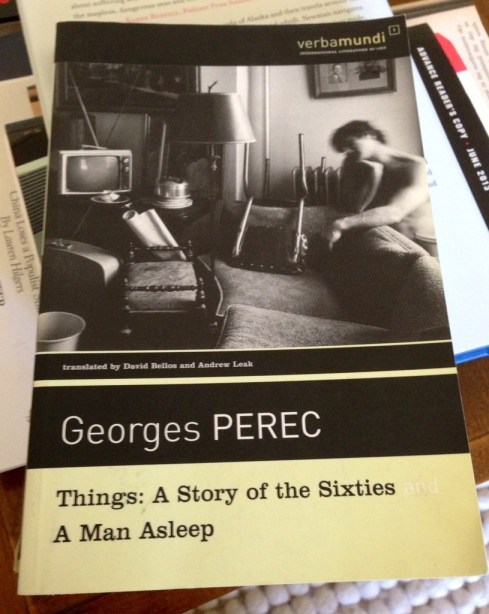
I picked up Georges Perec’s twofer Things and A Man Asleep last Friday at the used bookstore. I was there looking for something else. The Perec was not even shelved under “P.” I found it laid on a table. The good people at Melville House also sent me a copy of Perec’s La Boutique Obscure last week, which I do not photograph here because it is an ebook. I read a big chunk of Obscure this week and will do some kind of write-up sometime soon, but here’s David Auerbach’s review at the LA Review of Books in the meantime.
Passing a summer several years since at Edgartown, on the island of Martha’s Vineyard, I became acquainted with a certain carver of tombstones who had travelled and voyaged thither from the interior of Massachusetts in search of professional employment. The speculation had turned out so successful that my friend expected to transmute slate and marble into silver and gold to the amount of at least a thousand dollars during the few months of his sojourn at Nantucket and the Vineyard. The secluded life and the simple and primitive spirit which still characterizes the inhabitants of those islands, especially of Martha’s Vineyard, insure their dead friends a longer and dearer remembrance than the daily novelty and revolving bustle of the world can elsewhere afford to beings of the past. Yet, while every family is anxious to erect a memorial to its departed members, the untainted breath of Ocean bestows such health and length of days upon the people of the isles as would cause a melancholy dearth of business to a resident artist in that line. His own monument, recording his decease by starvation, would probably be an early specimen of his skill. Gravestones, therefore, have generally been an article of imported merchandise.
In my walks through the burial-ground of Edgartown—where the dead have lain so long that the soil, once enriched by their decay, has returned to its original barrenness—in that ancient burial-ground I noticed much variety of monumental sculpture. The elder stones, dated a century back or more, have borders elaborately carved with flowers and are adorned with a multiplicity of death’s-heads, crossbones, scythes, hour-glasses, and other lugubrious emblems of mortality, with here and there a winged cherub to direct the mourner’s spirit upward. These productions of Gothic taste must have been quite beyond the colonial skill of the day, and were probably carved in London and brought across the ocean to commemorate the defunct worthies of this lonely isle. The more recent monuments are mere slabs of slate in the ordinary style, without any superfluous flourishes to set off the bald inscriptions. But others—and those far the most impressive both to my taste and feelings—were roughly hewn from the gray rocks of the island, evidently by the unskilled hands of surviving friends and relatives. On some there were merely the initials of a name; some were inscribed with misspelt prose or rhyme, in deep letters which the moss and wintry rain of many years had not been able to obliterate. These, these were graves where loved ones slept. It is an old theme of satire, the falsehood and vanity of monumental eulogies; but when affection and sorrow grave the letters with their own painful labor, then we may be sure that they copy from the record on their hearts. Continue reading ““Chippings with a Chisel” — Nathaniel Hawthorne”→


 Biblioklept