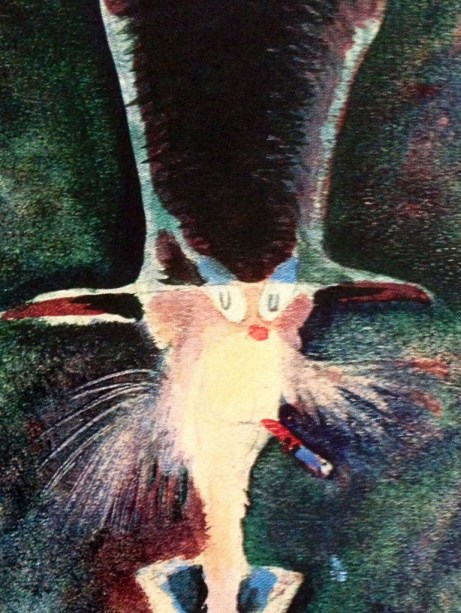
The Goblin — William Blake

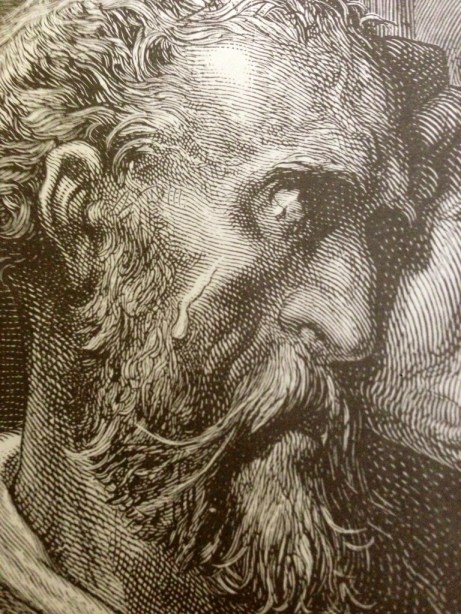
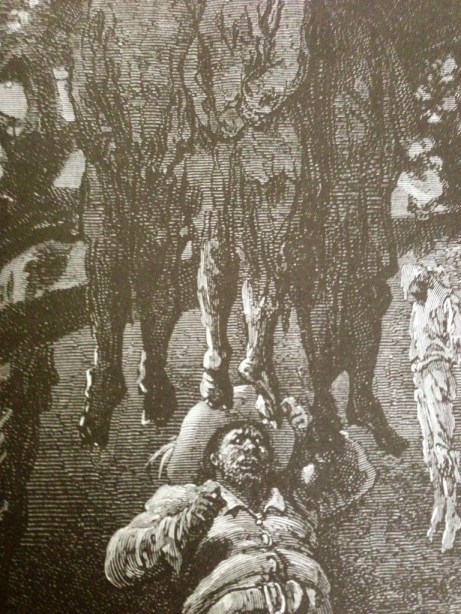
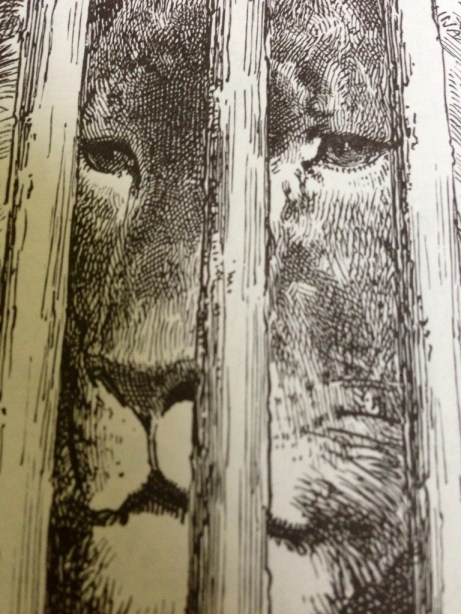
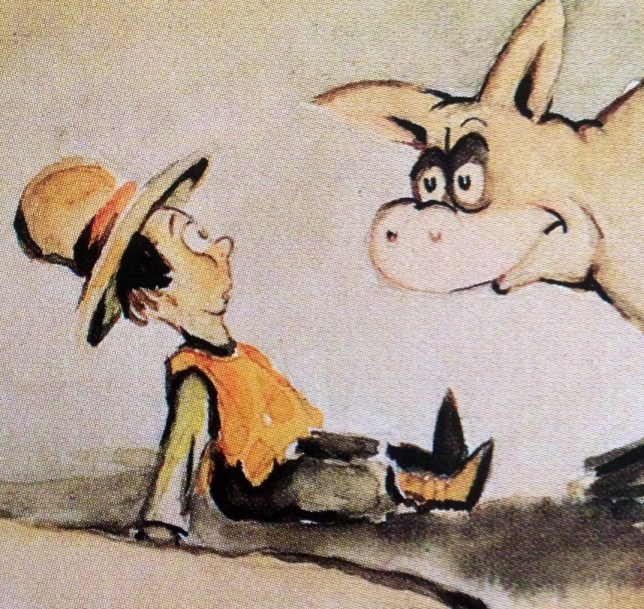
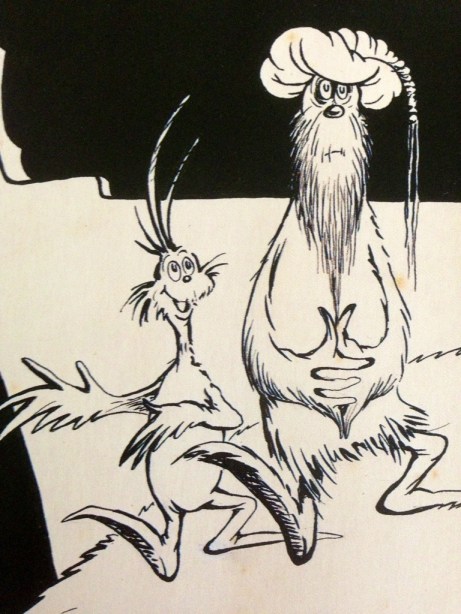
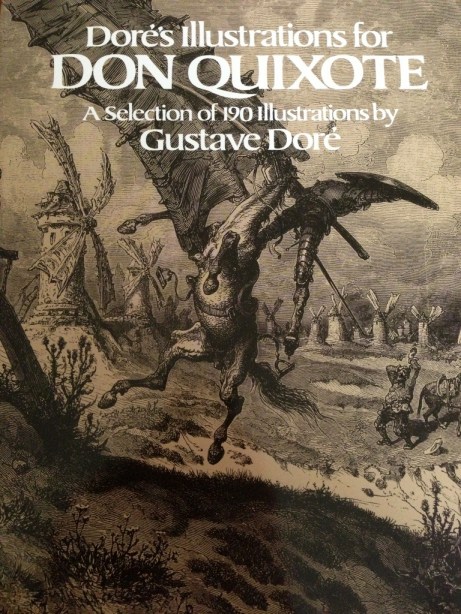
Gustave Doré / Dr. Seuss (Books Acquired, 4.16.2013)

20130420-153946.jpg

20130420-153951.jpg

20130420-153956.jpg

20130420-154002.jpg

20130420-154007.jpg

20130420-154012.jpg

20130420-154018.jpg

20130420-154026.jpg

20130420-154033.jpg


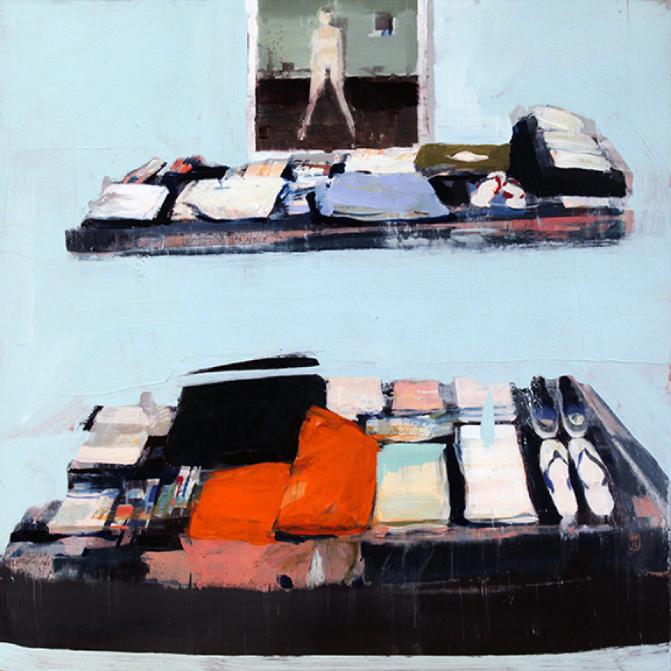
Issued Items — Alex Kanevsky

issueditemswithaa

(More/via).

“The Hounds of Fate” — Saki

“The Hounds of Fate” — Saki

In the fading light of a close dull autumn afternoon Martin Stoner plodded his way along muddy lanes and rut-seamed cart tracks that led he knew not exactly whither. Somewhere in front of him, he fancied, lay the sea, and towards the sea his footsteps seemed persistently turning; why he was struggling wearily forward to that goal he could scarcely have explained, unless he was possessed by the same instinct that turns a hard-pressed stag cliffward in its last extremity. In his case the hounds of Fate were certainly pressing him with unrelenting insistence; hunger, fatigue, and despairing hopelessness had numbed his brain, and he could scarcely summon sufficient energy to wonder what underlying impulse was driving him onward. Stoner was one of those unfortunate individuals who seem to have tried everything; a natural slothfulness and improvidence had always intervened to blight any chance of even moderate success, and now he was at the end of his tether, and there was nothing more to try. Desperation had not awakened in him any dormant reserve of energy; on the contrary, a mental torpor grew up round the crisis of his fortunes. With the clothes he stood up in, a halfpenny in his pocket, and no single friend or acquaintance to turn to, with no prospect either of a bed for the night or a meal for the morrow, Martin Stoner trudged stolidly forward, between moist hedgerows and beneath dripping trees, his mind almost a blank, except that he was subconsciously aware that somewhere in front of him lay the sea. Another consciousness obtruded itself now and then—the knowledge that he was miserably hungry. Presently he came to a halt by an open gateway that led into a spacious and rather neglected farm-garden; there was little sign of life about, and the farm-house at the further end of the garden looked chill and inhospitable. A drizzling rain, however, was setting in, and Stoner thought that here perhaps he might obtain a few minutes’ shelter and buy a glass of milk with his last remaining coin. He turned slowly and wearily into the garden and followed a narrow, flagged path up to a side door. Before he had time to knock the door opened and a bent, withered-looking old man stood aside in the doorway as though to let him pass in.

“Could I come in out of the rain?” Stoner began, but the old man interrupted him.

“Come in, Master Tom. I knew you would come back one of these days.”

Stoner lurched across the threshold and stood staring uncomprehendingly at the other. Continue reading ““The Hounds of Fate” — Saki”

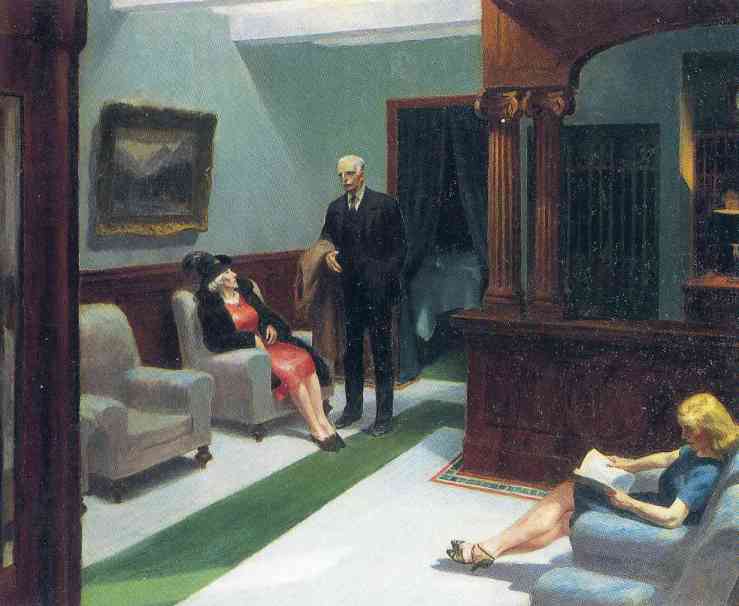
Hotel Lobby — Edward Hopper

hotel-lobby

The Mysterious Geographic Explorations of Jasper Morello

“One must refute the author and vindicate oneself” (Sigizmund Krzhizhanovsky)

And an invented person makes the greatest impression, naturally, on the seemingly not-invented, real person who, upon finding his reflection in a book, feels replaced and redoubled. This person cannot forgive his feeling of double insult: here I, a real, not-invented person, shall go to my grave and nothingness in ten or twenty years, whereas this fabricated, not-real “almost I” shall go on living and living as though it were the most natural thing in the world; more unforgivable still is the awareness that someone, some author, made you up like an arithmetic problem, what’s more he figured you out, arrived at an answer over which you struggled your entire life in vain, he divined your existence without ever having met you, he penned his way into your innermost thoughts, which you tried so hard to hide from yourself. One must refute the author and vindicate oneself. At once!

From Sigizmund Krzhizhanovsky’s short story “Someone Else’s Theme,” collected in NYRB’s Memories of the Future.

Cosmic Energy — Remedios Varo

“How Can I Love You If You Won’t Lie Down?” — Silver Jews

Six (More) Stoner Novels (And a Bonus Short Story)

A few years ago, to celebrate 4/20, Sam Munson at the Daily Beast wrote an article praising “The Best Stoner Novels.” Not a bad list—Wonder Boys, sure, Invisible Man, a bit of a stretch, The Savage Detectives, a very big stretch, but sure, why not. Anyway, six more stoner novels (not that we advocate the smoking of the weed)—

Junkie, William Burroughs

Burroughs’s (surprisingly lucid) early novel Junkie may take its name from heroin, but it’s full of weed smoking. Lesson: weed smoking leads to heroin. And the inevitable search for yage.

Inherent Vice, Thomas Pynchon

Doc Sportello, the wonky PI at the off-center of Pynchon’s California noir, is always in the process of lighting another joint, if not burning his fingers on the edges of a roach. A fuzzy mystery with smoky corners.

Infinite Jest, David Foster Wallace

Hal Incandenza, protagonist of Wallace’s opus, spends much of his time hiding in the tunnels of Enfield Tennis Academy, feeding his bizarre marijuana addiction, which is, in many ways, more of an addiction to a secret ritual than to a substance. Hal’s hardly the only character in IJ who likes his Mary Jane; there’s a difficult section near the novel’s beginning that features a minor character preparing to go on a major weed binge. His pre-smoking anxiety works as a challenge to any reader seeking to enter the world of Infinite Jest.

The Lord of the Rings, J.R.R. Tolkien

I’m pretty sure “pipe-weed” isn’t tobacco.

Chronic City, Jonathan Lethem

I kind of hated Chronic City, a novel where characters seem to light up joints on every other page. It seems to have been written in an ambling, rambling fog, absent of any sense of immediacy, urgency, or, uh, plot. Bloodless stuff, but, again, very smoky.

Stoner, John Williams

Okay. Stoner has nothing to do with marijuana. But, hey, it’s called Stoner, right?

Bonus short story: Raymond Carver’s “Cathedral”

Carver’s classic story features a myopic narrator who comes up against his own shortcomings when he meets an old friend of his wife, a blind man who ironically sees deeper than he does. After drinking too much booze, they spark up, share a doob, and take in a documentary about European cathedrals. Great stuff.

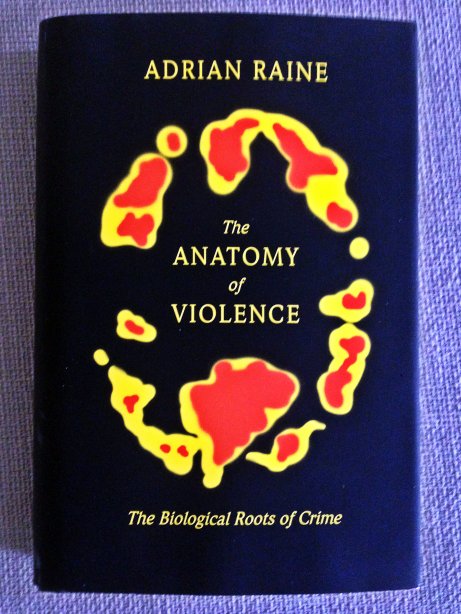
The Anatomy of Violence (Book Acquired, Some Time Last Week)

IMG_5191

Adrian Raine’s The Anatomy of ViolencePublisher Random House’s blurb:

Why do some innocent kids grow up to become cold-blooded serial killers? Is bad biology partly to blame? For more than three decades Adrian Raine has been researching the biological roots of violence and establishing neurocriminology, a new field that applies neuroscience techniques to investigate the causes and cures of crime. In The Anatomy of Violence, Raine dissects the criminal mind with a fascinating, readable, and far-reaching scientific journey into the body of evidence that reveals the brain to be a key culprit in crime causation.Raine documents from genetic research that the seeds of sin are sown early in life, giving rise to abnormal physiological functioning that cultivates crime. Drawing on classical case studies of well-known killers in history—including Richard Speck, Ted Kaczynski, and Henry Lee Lucas—Raine illustrates how impairments to brain areas controlling our ability to experience fear, make good decisions, and feel guilt predispose us to violence. He contends that killers can actually be coldhearted: something as simple as a low resting heart rate can give rise to violence. But arguing that biology is not destiny, he also sketches out provocative new biosocial treatment approaches that can change the brain and prevent violence.

Finally, Raine tackles the thorny legal and ethical dilemmas posed by his research, visualizing a futuristic brave new world where our increasing ability to identify violent offenders early in life might shape crime-prevention policies, for good and bad. Will we sacrifice our notions of privacy and civil rights to identify children as potential killers in the hopes of helping both offenders and victims? How should we punish individuals with little to no control over their violent behavior? And should parenting require a license? The Anatomy of Violence offers a revolutionary appraisal of our understanding of criminal offending, while also raising provocative questions that challenge our core human values of free will, responsibility, and punishment.

Weed Burner — Vincent van Gogh

Moon Weed

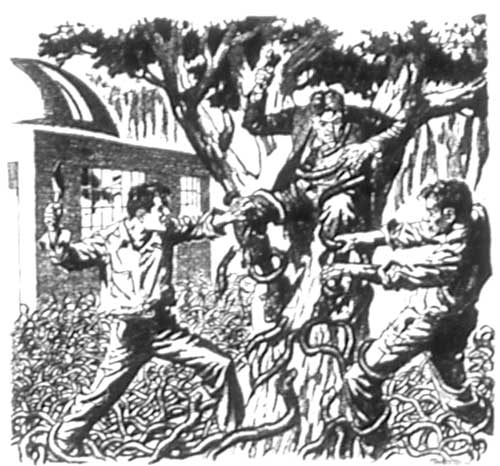
“The Moon Weed” by Harl Vincent

Bart hacked and hacked at the rubbery growth.


Hobart Madison pursed his lips in a whistle of incredulous surprise as he regarded the object that lay in the palm of his hand. An ordinary pebble, it seemed to be, but a pebble in which a strange fire smouldered and showed itself here and there through the dull surface.

“Would you mind repeating what you just said, Van?” he asked.

“You heard me the first time. I say that that’s a diamond and that it came from the moon.” Carl Vanderventer glared at his friend in resentment of his doubting tone.

“Mean to tell me you’ve been there? To the moon?”

“Certainly not. I’m not a Jules Verne adventurer. But I’m telling you that stone is a diamond of the first water and that it came from the moon. Weighs over a hundred carats, too. You can have it appraised yourself if you think I’m kidding you.”

Bart Madison laughed. “Don’t get sore, Van,” he said. “I’m not doubting your word. But Lord, man—the thing’s so incredible! It takes a little time to soak in. And you say there are more?”

“Sure. This one’s the largest of five I’ve found so far. And there’s other stuff, too. Wait till you see. Fossils, beetles and things. I tell you, Bart, the moon was inhabited at one time. I’ve the evidence and I want you to be the first to see it.” The eyes of the young scientist shone with excitement as he saw that his friend was roused to intense interest.

“So that’s what all your experimenting has been aimed at. No wonder it cost so much.”

“Yes, and you’ve been a brick for financing me. Never asked a question, either. But Bart, it’ll all come back to you now. Know how much that stone’s worth?”

“Plenty, I guess. But, forget about the financing and all that. Where’s this laboratory of yours?” Madison had pushed his chair back from his desk and was reaching for his hat.

“Over in the Ramapo Mountains, not far from Tuxedo. I’ll have you there in two hours. Sure you can spare the time to go out there now?” Vanderventer was enthusiastically eager.

“Spare the time? You just try and keep me from going!”

Neither of them noticed the sinister figure that lurked outside the door which led into the adjoining office. They chattered excitedly as they passed into the outer hall and made for the elevator.

(Read the rest of “The Moon Weed,” originally published in Astounding Stories, August, 1931)

Turin Spring — Giorgio de Chirico

Even Dwarfs Started Small — Werner Herzog (Full Film)

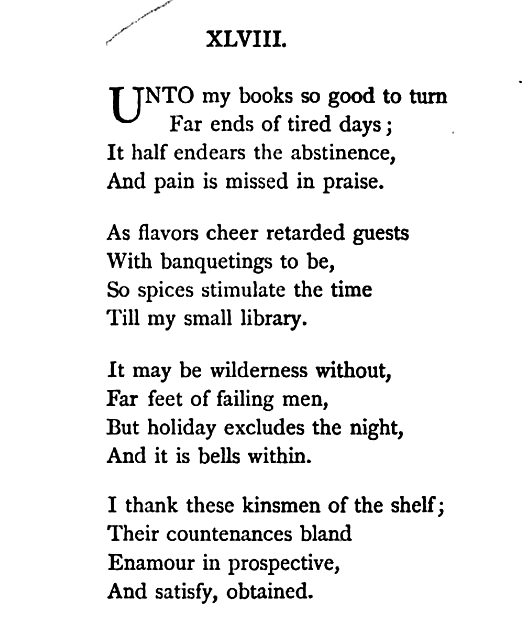
“Unto my books so good to turn” — Emily Dickinson

Capture

Spiegel im Spiegel — Vincent Desiderio

Desiderio_Spiegel_im_Spiegel

(More/via).