“Whenever I look at people, I look at unhappy people,” the prince said. “They are people who carry their torment into the streets and thus make the world a comedy, which is of course laughable. In this comedy they all suffer from tumors both mental and physical; they take pleasure in their fatal illness. When they hear its name, no matter whether the scene is London, Brussels, or Styria, they are frightened, but they try not to show their fright. All these people conceal the actual play within the comedy that this world is. Whenever they feel themselves unobserved, they run away from themselves toward themselves. Grotesque. But we do not even see the most ridiculous side of it because the most ridiculous side is always the reverse side. God sometimes speaks to them, but he uses the same vulgar words as they themselves, the same clumsy phrases. Whether a person has a gigantic factory or a gigantic farm or an equally gigantic sentence of Pascal’s in his head, is all the same,” the prince said. “It is poverty that makes people the same; at the human core, even the greatest wealth is poverty. In men’s minds and bodies poverty is always simultaneously a poverty of the body and a poverty of the mind, which necessarily makes them sick and drives them mad. Listen to me, Doctor, all my life I have seen nothing but sick people and madmen. Wherever I look, the worn and the dying look back at me. All the billions of the human race spread over the five continents are nothing but one vast community of the dying. Comedy!” the prince said. “Every person I see and everyone I hear anything about, no matter what it is, prove to me the absolute obtuseness of this whole human race and that this whole human race and all of nature are a fraud. Comedy. The world actually is, as has so often been said, a stage on which roles are forever being rehearsed. Wherever we look it is a perpetual learning to speak and learning to walk and learning to think and learning by heart, learning to cheat, learning to die, learning to be dead. This is what takes up all our time. Men are nothing but actors putting on a show all too familiar to us. Learners of roles,” the prince said. “Each of us is forever learning one (his) or several or all imaginable roles, without knowing why he is learning them (or for whom). This stage is an unending torment and no one feels that the events on it are a pleasure. But everything that happens on this stage happens naturally. A critic to explain the play is constantly being sought. When the curtain rises, everything is over.” Life, he went on, changing his image, was a school in which death was being taught. It was filled with millions and billions of pupils and teachers. The world was the school of death. “First the world is the elementary school of death, then the secondary school of death, then, for the very few, the university of death,” the prince said. People alternate as teachers or pupils in these schools. “The only attainable goal of study is death,” he said.
DEALING WITH THE ETYMOLOGY OF COFFEE — from William H. Ukers’s All About Coffee (1922)
Origin and translation of the word from the Arabian into various languages—Views of many writers
THE history of the word coffee involves several phonetic difficulties. The European languages got the name of the beverage about 1600 from the original Arabic qahwah, not directly, but through its Turkish form, kahveh. This was the name, not of the plant, but the beverage made from its infusion, being originally one of the names employed for wine in Arabic.
Sir James Murray, in the New English Dictionary, says that some have conjectured that the word is a foreign, perhaps African, word disguised, and have thought it connected with the name Kaffa, a town in Shoa, southwest Abyssinia, reputed native place of the coffee plant, but that of this there is no evidence, and the name qahwah is not given to the berry or plant, which is called bunn, the native name in Shoa being būn.
Contributing to a symposium on the etymology of the word coffee in Notes and Queries, 1909, James Platt, Jr., said:
The Turkish form might have been written kahvé, as its final h was never sounded at any time. Sir James Murray draws attention to the existence of two European types, one like the Frenchcafé, Italian caffè, the other like the English coffee, Dutch koffie. He explains the vowel o in the second series as apparently representing au, from Turkish ahv. This seems unsupported by evidence, and the v is already represented by the ff, so on Sir James’s assumption coffee must stand for kahv-ve, which is unlikely. The change from a to o, in my opinion, is better accounted for as an imperfect appreciation. The exact sound of ă in Arabic and other Oriental languages is that of the English short u, as in “cuff.” This sound, so easy to us, is a great stumbling-block to other nations. I judge that Dutch koffie and kindred forms are imperfect attempts at the notation of a vowel which the writers could not grasp. It is clear that the French type is more correct. The Germans have corrected their koffee, which they may have got from the Dutch, into kaffee. The Scandinavian languages have adopted the French form. Many must wonder how the hv of the original so persistently becomes ff in the European equivalents. Sir James Murray makes no attempt to solve this problem.
Virendranath Chattopádhyáya, who also contributed to the Notes and Queries symposium, argued that the hw of the Arabic qahwah becomes sometimes ff and sometimes only f or v in European translations because some languages, such as English, have strong syllabic accents (stresses), while others, as French, have none. Again, he points out that the surd aspirate h is heard in some languages, but is hardly audible in others. Most Europeans tend to leave it out altogether.
Col. W.F. Prideaux, another contributor, argued that the European languages got one form of the word coffee directly from the Arabic qahwah, and quoted from Hobson-Jobson in support of this:
Chaoua in 1598, Cahoa in 1610, Cahue in 1615; while Sir Thomas Herbert (1638) expressly states that “they drink (in Persia) … above all the rest, Coho or Copha: by Turk and Arab calledCaphe and Cahua.” Here the Persian, Turkish, and Arabic pronunciations are clearly differentiated. Continue reading “Coffee Etymology”→
IT WAS MIDAPRIL, Carnevale had been over for weeks, and Lent was coming to a close, skies too drawn and pallid to weep for the fate of the cyclic Christ, the city having slowly regained a maskless condition, with a strange dull shine on the paving of the Piazza, less a reflection of the sky than a soft glow from regions below. But the silent communion of masks was not quite done here.
On one of the outer islands in the Lagoon, which had belonged to the Spongiatosta family for centuries, over an hour away even by motor craft, stood a slowly drowning palazzo. Here at midnight between Holy Saturday and Easter Sunday began the secret counter-Carnevale known as Carnesalve, not a farewell but an enthusiastic welcome to flesh in all its promise. As object of desire, as food, as temple, as gateway to conditions beyond immediate knowledge.
With no interference from authority, church or civic, all this bounded world here succumbed to a masked imperative, all hold on verbatim identities loosening until lost altogether in the delirium. Eventually, after a day or two, there would emerge the certainty that there had always existed separately a world in which masks were the real, everyday faces, faces with their own rules of expression, which knew and understand one another—a secret life of Masks. It was not quite the same as during Carnevale, when civilians were allowed to pretend to be members of the Maskworld, to borrow some of that hieratic distance, that deeper intimacy with the unexpressed dreams of Masks. At Carnevale, masks had suggested a privileged indifference to the world of flesh, which one was after all bidding farewell to. But here at Carnesalve, as in espionage, or some revolutionary project, the Mask’s desire was to be invisible, unthreatening, transparent yet mercilessly deceptive, as beneath its dark authority danger ruled and all was transgressed.
1. Okay—I know it’s been like forever since I riffed on Thomas Pynchon’s novel Against the Day (here, “forever” = a few weeks), but I took a week off from the novel, which turned into two weeks, which is a bad habit, yes, but here we are, and I’m nearing the end of the shaggy beast. I don’t think Pynchon is going to tie all the loose threads into some perfect picture for me, but I don’t think I’d want that anyway.
2. Where I am in the book: Cyprian, Cyprian, Cyprian. The beginning of The Great War. Just waaaaaay too much going on to even bother to begin to try to summarize.
3. Cyprian is surely the most fascinating character of Against the Day, but his somewhat late arrival in the text feels, I don’t know, lumpy or something. Something about reading such a long book—we make a kind of investment in certain plots, figures, characters, and Pynchon here sort of moves them into the background, or disappears them completely, for long, long stretches. I’m thinking about The Chums of Chance in particular, but also Lew Basnight, the Tunguska event, the Vibes vs. the Traverses, etc. Thematically it’s all there, but this stretch with Cyprian’s dark adventures, while fantastic, also feels almost like a novella shoehorned into the final chapters of an epic. This is not a complaint.
4. I’ve shared a few citations from Against the Day since my last riff, but the one above (my Kindle tells me its at the 82% mark, if that means anything to you) seems to resonate with what I take to be the major themes and motifs of the novel.
I’m thinking specifically of the final line: “But here at Carnesalve, as in espionage, or some revolutionary project, the Mask’s desire was to be invisible, unthreatening, transparent yet mercilessly deceptive, as beneath its dark authority danger ruled and all was transgressed.”
Invisible is obviously a key word in Against the Day, and the novel turns on concepts of doubling, masking, transgression, themes that the Carnevale-Carnesalve disjunction highlights (flesh vs. spirit, visible vs. invisible, etc.).
5. Actually, now that I think about it, Cyprian probably most embodies, or, rather, embodies most complexly, Pynchon’s themes of doubling, masking, and transgression. He’s his own doppelganger. (Even the name suggest a kind of bilocation — Cyprus, that ancient crossroads of East and West).
6. And —
The Carnesalve chapter culminates in a truly salacious sex scene, an S&M-fueled ménage à trois that somehow simultaneously punctures the novels structure of doubling (cause, uh, a three-way) at the same time it reinforces it (Cyprian as self-double). I’m not sure if any of this that I’m saying makes any sense at all.
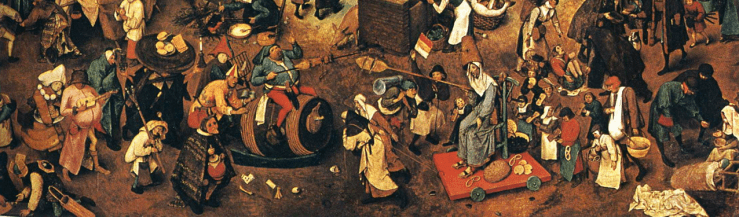
7. The image at the top of this riff is a detail from The Fight Between Carnival and Lent by Pieter Bruegel.
A blind man on a dark night carried a torch, in order that people might see him, and not run against him, and direct him how to avoid dangers.
To picture a child’s (one of four or five years old) reminiscences at sunset of a long summer’s day,–his first awakening, his studies, his sports, his little fits of passion, perhaps a whipping, etc.
The blind man’s walk.
To picture a virtuous family, the different members examples of virtuous dispositions in their way; then introduce a vicious person, and trace out the relations that arise between him and them, and the manner in which all are affected.
A man to flatter himself with the idea that he would not be guilty of some certain wickedness,–as, for instance, to yield to the personal temptations of the Devil,–yet to find, ultimately, that he was at that very time committing that same wickedness.
What would a man do, if he were compelled to live always in the sultry heat of society, and could never bathe himself in cool solitude?
House
Two floors
Down is stove
Down is bath kitchen music
Down is stove and the stack of logs
Up is bed and the climate the tropical
Down is desk next to stove
Around and around floors windows uncurtained
Outside is snow
Unmarked northern profound white snow
Up small woman alone
Icicles
Naked
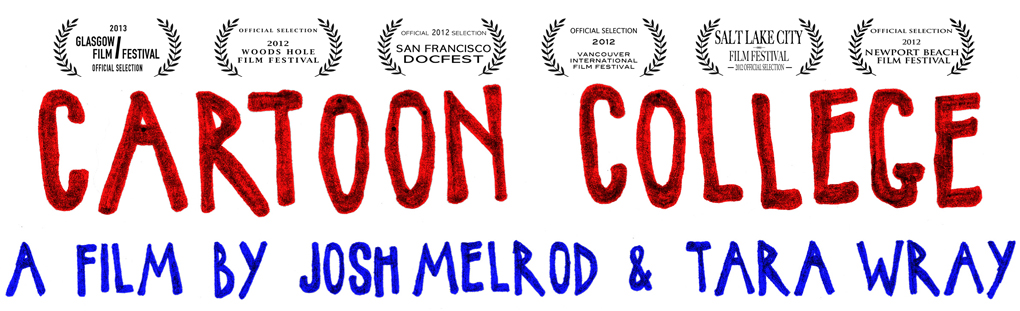
When I first read the press materials for Josh Melrod and Tara Wray’s documentary Cartoon College, I’ll admit that I was mostly interested in the prospect of seeing comix legends like Art Spiegelman, Charles Burns, Lynda Barry, Chris Ware, Scott McCloud, and Stephen Bissette discuss their craft. What Melrod and Wray deliver though is much more—an intimate and often very moving look at the lives of the young artists who attend the prestigious Center for Cartoon Studies. This is a film about passion, drive, commitment, and what it means to be an outsider.
In my review, I wrote: “Cartoon College offers an intriguing story about real people trying to do something that they love, and I enjoyed that. This is a film about the impetus, motivation, and hard, hard work that goes into the creative process. Great stuff.”
Josh was kind enough to talk to me about making the film over a series of emails.
Biblioklept: How did you begin the documentary Cartoon College? How did the project come about?
Josh Melrod: In 2006 my wife, then my girlfriend, Tara Wray, had just finished her first movie, Manhattan, Kansas, and was looking for her next project. She’s a huge fan of Chris Ware and she read an article about how he’d been a visiting lecturer at CCS, which had just opened a year earlier, and that was enough to get her thinking about a cartoon school documentary. She asked me if I’d consider moving to Vermont for a year–we were living in New York, and had been for a while–and I said ok. Then we had to convince James Sturm and Michelle Ollie, who founded the school, to let us film, which took several months of emails and a couple of face-to-face meetings and a trip or two to White River Junction. Once they gave us the green light we basically packed up and moved to Vermont. That was in August of 2007, and we’ve been here ever since.
Biblioklept: So you guys were shooting for like, three years? When you started did you have an idea of the kind of story you wanted to tell in Cartoon College?
JM: Our original conceit for the movie was a year in the life of a cartoon school. It was supposed to be more about the institution and how it was helping to revitalize White River Junction, which had been a town in decline for about a century. So we shot for the 2007-2008 academic year and then started working with an editor in New York that summer. It took about six months to get a rough cut put together, but when all was said and done we weren’t happy with what we had. Part of it was that the story of the school’s impact on the town didn’t quite come together–it was an arc that was unfolding too slowly to really be seen during the year we’d been filming. But we also realized that what really interested us, much more than the school itself, was documenting the creative lives of the students and witnessing these aspiring artists at a very pivotal time in their careers. We basically scrapped the rough cut, which was a pretty difficult decision, and went back to film for what turned out to be another year-and-a-half.
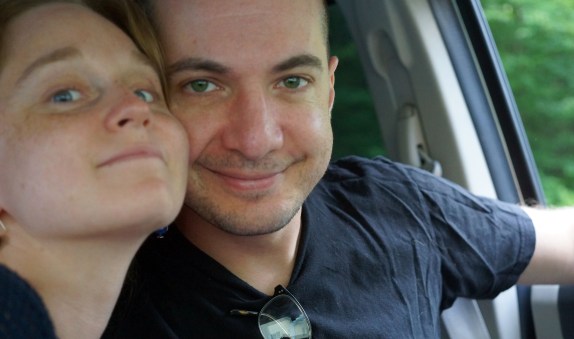
The filmmakers, Tara Wray and Josh Melrod
Biblioklept: Some of the students, like Blair Sterett and Jen Vaughn, for example, are on screen a lot more than others. Was this because they were more open to the cameras? Were there students who were reticent to talk to you?
JM: Jen is kind of a natural in front of the camera, so in a sense she was more open than some of the others. But there were only a very small handful of people during the entire production who told us they really didn’t want to be filmed. A lot of the cartoonists we spoke with are fairly introverted, and quite a few, both the younger and the more experienced artists, discussed how they express themselves best through their comics, but it doesn’t take too long for most people to begin to forget the camera is there.
Biblioklept: I like that the film is really about the career of cartooning, and that the film focuses on the arcs of these aspiring cartoonists. You’ve got all these great interviews with people like Chris Ware and Art Spiegelman and Charles Burns, but their comments ultimately work to illuminate or enrich, through their perspectives, what the students are going through. It seems like there’s a lot of restraint and wise editing on your end here. Can you talk about how you put the film together? I’m curious how intuitive the process of forming the narrative was . . .
JM: By the time we finished shooting we had something like 150 hours of footage. I don’t remember how it all broke down, but maybe forty percent was interviews. There was a lot to go through. But it was pretty clear what the character arcs were for Blair and Al and Jen. Actually, it’s kind of hard for me to remember the process in any great detail. I was just starting to work on the rough cut when Tara and I had our twins, so for the first six months of the edit I was working from around ten at night until six a.m., stopping every couple of hours to help with feedings and changing diapers, and getting a few hours of sleep here and there during the day. It’s all very blurry, and sort of miraculous that I finished the rough cut at all. My method of working was to cut the footage down from 150 hours to just 10, which is a manageable amount of material, and from there put together an assembly that had the basic structure of a movie, and then loosely refine that into a two-hour rough cut. Then I went to New York to work with another editor, Chris Branca, who came in with a ton of great ideas and further refined the story. As for the interviews serving to illuminate what the students were going through, that was pretty organic. The challenges that a person faces when they decide to become an artist are fairly universal–the self-doubt, managing your time, coming to terms with your own limitations, figuring how to make a living, etc.–so the experiences shared by the established artists were in-line with what we documented from the students.
Biblioklept: You brought up that Tara’s interest in Ware’s work kind of sparked the genesis of the documentary. Were you a fan of comics too? How much did you know about the cartooning world going into the filming process?
JM: As a kid I loved Calvin and Hobbes and Bloom County/Outland and The Far Side, but those all ended when I was in high school and I pretty much stopped reading comics at that point. Then, after Tara and I moved in together, I’d pick up some of the books she’d leave around the apartment–like Jimmy Corrigan and Hate, I remember in particular–but I knew virtually nothing about the cartooning world when we started the movie.
Biblioklept: Have you become a fan since then?
JM: I love comics, but I’m a very casual fan. I still gravitate towards non-graphic novels, and I’m not quite sure why that is. Comics certainly demand more attention from the reader, if the reader we’re talking about is me–the interplay between the pictures and the text require a level of focus that isn’t needed when you’re just reading words, although I’m not sure I ever noticed that when I was a kid–and so maybe it’s that I don’t always have the mental energy to pick up a heavy graphic novel. I am really interested in reading comics from the people in the movie–CCS graduates are doing just incredible work and a lot of the former students we followed are starting to put out books now. Katherine Roy just illustrated a book and has a couple of others coming out soon; Jen Vaughn released a book last week; Josh Rosen is going to start serializing the project he was working on while we were filming; Joe Lambert, who we interviewed but didn’t appear in the movie, although he designed the poster, made a book about Annie Sullivan and Helen Keller that’s just incredible.
Biblioklept: What kind of movie would you like to do next?
JM: I’m working on a short, a fiction movie, with a couple of guys who used to edit a literary magazine with me. It was called theLand-Grant College Review and we published for five or six years starting in about 2002. We wanted to work on something new, and I’m really interested in doing a narrative, and they’d been thinking of doing a screenplay, so that’s what we decided to do. We’re still writing, but we have some good advisers on board and the plan is to shoot next summer. And I’m in the development phase on a pair of new docs. They’re both about personalities, as opposed to being issue-based, which is a common denominator. One follows a semi-famous performer and the other involves a family on its summer vacation. It’s still pretty early to talk confidently about any of this stuff. I just have to keep plugging away and see what happens, but these are the projects I’d like to do next.
Biblioklept: The docs sound intriguing. I spent some time in the Land-Grant College Review archive just now—what a great collection of authors. Your little microfiction there is a good creepy laugh. What are you reading now?
JM: Thanks! We had a short but good run, and got to publish a lot of great writers. One of my most prized possessions is a postcard that David Foster Wallace sent me–in response to a letter I’d written asking him to send us a story–saying that he’s “just working on stuff that isn’t suitable for publication any place.”
As for what I’m reading, I just started [Erik Larson’s] The Devil In The White City, which I’d been hesitant to open for a few years since I do a lot of reading before bed and I thought it would mess with my sleep. So far so good.
Biblioklept: Have you ever stolen a book?
JM: No, never stolen a book, but I have gone a long time without paying for a book. A lot of the books on my shelf I picked out of piles left on the curb or at the recycling center near where we live now. Sometimes I like to let the universe decide what I read depending on what I find in front of me, which is how I got to read The Universe And Dr. Einstein, a lay readers guide to general relativity that I still managed not to understand.






 Biblioklept