Read My Interview with S.D. Chrostowska at 3:AM Magazine

I interviewed S.D. Chrostowska for 3:AM Magazine. I reviewed Chrostowska’s novel Permission here.

3:AM also features a new piece of short fiction from Chrostowska, “How to Avoid the Cardinal Sins /A Nominalistic Pamphlet/“.

From the interview:


3:AM: How did Permission begin? Did it begin as a novel? As something else?

S D Chrostowska: It began with the first message, and ended with the last. It was principally a literary effort subordinated to communication. To me this remains a crucial difference, itsdifferentia specifica. The origin of the now-book Permission was in an illegitimate literary dimension outside the frame of book authorship. You have to understand that, though I had chosen my reader, this reader could not know what if anything would become of the writing that came their way. Naturally I wonder whether and how it changes things for readers today, who approach them as a bound book, to know that the letters, just as they are, were once for real.

3:AM: Why write the letters under a pseudonym? How did you arrive at “Fearn Wren”?

SDC: For the sake of ambiguity. Knowing too much, or for that matter anything, about the artist-producer prejudices us about their work. The prejudice is not just personal or social but also simply contextual. It is all but unavoidable in visual and performing artworks requiring direct human contact, where other people are involved from the start rather than just on the receiving end. Sitting for a portrait or mounting a play depends on direct interaction. But we have already chosen the photographer based on their reputation. And we know something about the director before we get involved in their production or, if we happen to be directors, select actors based on their training or past work.

But writing, usually done at some distance from readers, can minimize our reader’s prejudices—at least until the finished work is judged, and the reviews and exposés come out. One way it can do this is by appearing anonymously or pseudonymously. Such publishing has a long history. As, one should add, does letter-writing under a pseudonym. Permission’s first reader would have had no context to go on.

Being read as an unknown author, not part of the literary scene, mimics that condition somewhat. But almost everyone nowadays can be googled, which is to say traced. I imagine that many people who would pick up a book like mine would be curious in this way.

I’m not sure how I settled on this particular pen-name. I do like ferns and wrens, their behaviors and the myths around them.

Bonus:

So, my signature interview question — “Have you ever stolen a book?” — had to be cut because it was just kind of confusing on 3:AM, but I couldn’t not ask it, so:

3:AM: Have you ever stolen a book?

SDC: Of course. 


Morning, Going to Work — Vincent van Gogh

“A Visit to Walt Whitman”

“A Visit to Walt Whitman”

From James Huneker’s Ivory Apes and Peacocks

My edition of Walt Whitman’s Leaves of Grass is dated 1867, the third, if I am not mistaken, the first appearing in 1855. Inside is pasted a card upon which is written in large, clumsy letters: “Walt Whitman, Camden, New Jersey, July, 1877.” I value this autograph, because Walt gave it to me; rather I paid him for it, the proceeds, two dollars (I think that was the amount), going to some asylum in Camden. In addition, the “good grey poet” was kind enough to add a woodcut of himself as he appeared in the 1855 volume, “hankering, gross, mystical, nude,” and another of his old mother, with her shrewd, kindly face. Walt is in his shirt-sleeves, a hand on his hip, the other in his pocket, his neck bare, the pose that of a nonchalant workman—though in actual practice he was always opposed to work of any sort; on his head is a slouch-hat, and you recall his line: “I wear my hat as I please, indoors or out.” The picture is characteristic, even to the sensual mouth and Bowery-boy pose. You almost hear him say: “I find no sweeter fat than sticks to my own bones.” Altogether a different man from the later bard, the heroic apparition of Broadway, Pennsylvania Avenue, and Chestnut Street. I had convalesced from a severe attack of Edgar Allan Poe only to fall desperately ill with Whitmania. Youth is ever in revolt, age alone brings resignation. My favourite reading was Shelley, my composer among composers, Wagner. Chopin came later. This was in 1876, when the Bayreuth apotheosis made Wagner’s name familiar to us, especially in Philadelphia, where his empty, sonorous Centennial March was first played by Theodore Thomas at the Exposition. The reading of a magazine article by Moncure D. Conway caused me to buy a copy, at an extravagant price for my purse, of The Leaves of Grass, and so uncritical was I that I wrote a parallel between Wagner and Whitman; between the most consciously artistic of men and the wildest among improvisators. But then it seemed to me that both had thrown off the “shackles of convention.” (What prison-like similes we are given to in the heady, generous impulses of green adolescence.) I was a boy, and seeing Walt on Market Street, as he came from the Camden Ferry, I resolved to visit him. It was some time after the Fourth of July, 1877, and I soon found his little house on Mickle Street. A policeman at the ferry-house directed me. I confess I was scared after I had given the bell one of those pulls that we tremblingly essay at a dentist’s door. To my amazement the old man soon stood before me, and cordially bade me enter. Continue reading ““A Visit to Walt Whitman””

The Temptation of St. Anthony — January Wellens de Cock

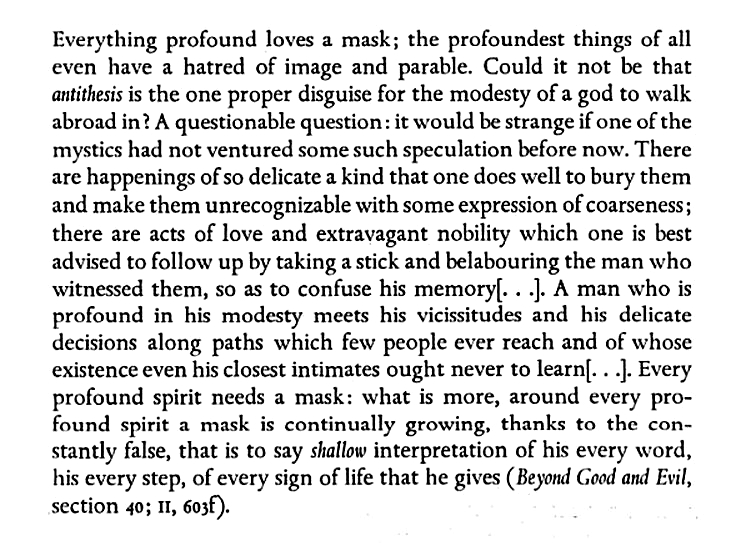
“Everything profound loves a mask” (Nietzsche)

profound

Two Comedians — Edward Hopper

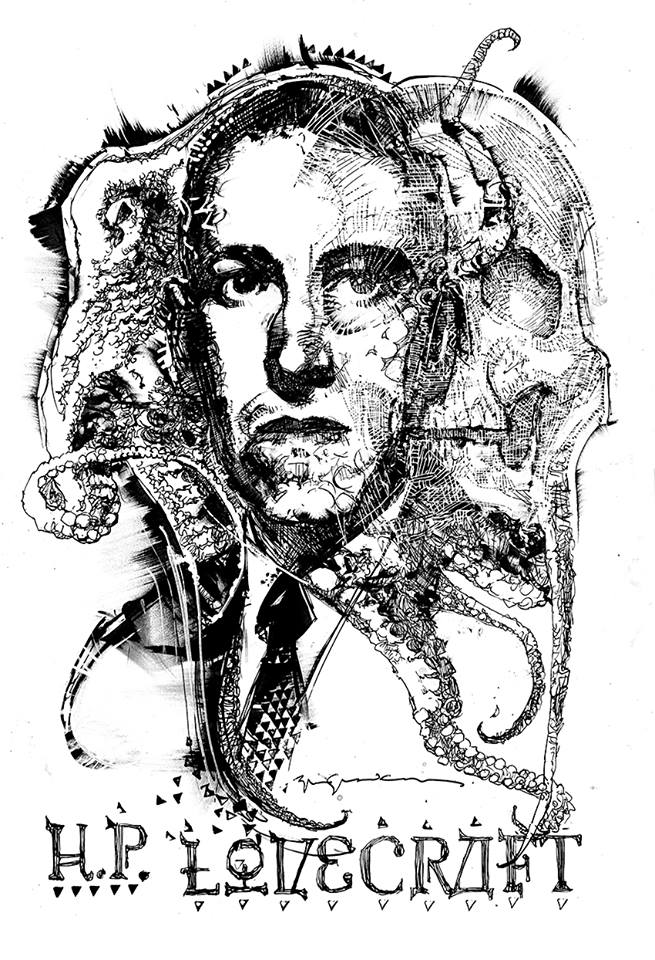
H.P. Lovecraft — Bill Sienkiewicz

lovecraft

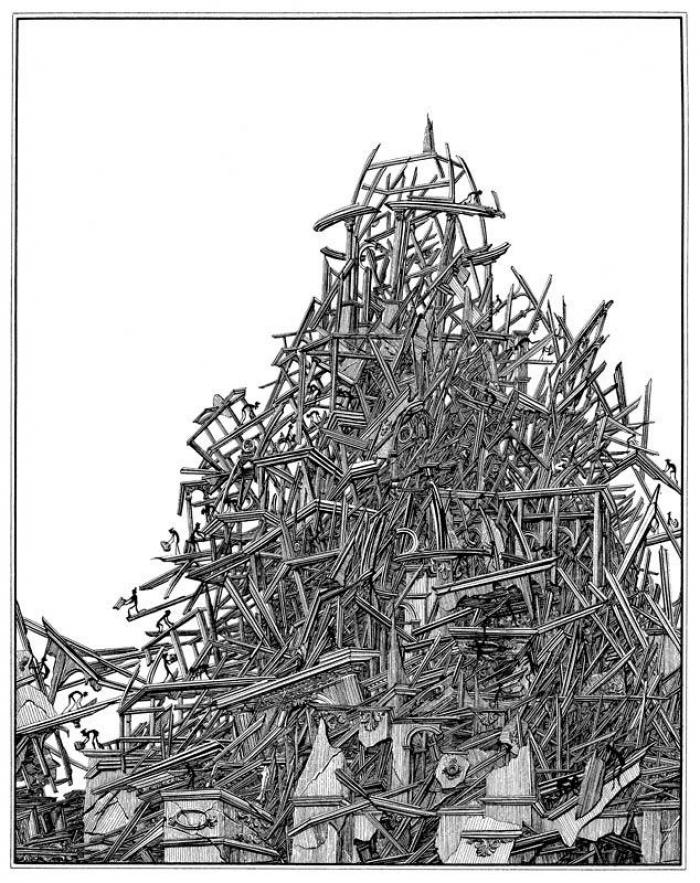
Chaos as Order — Hans-Georg Rauch

49

Ennio Morricone Disucsses Scoring Petri’s Investigation of a Citizen Above Suspicion

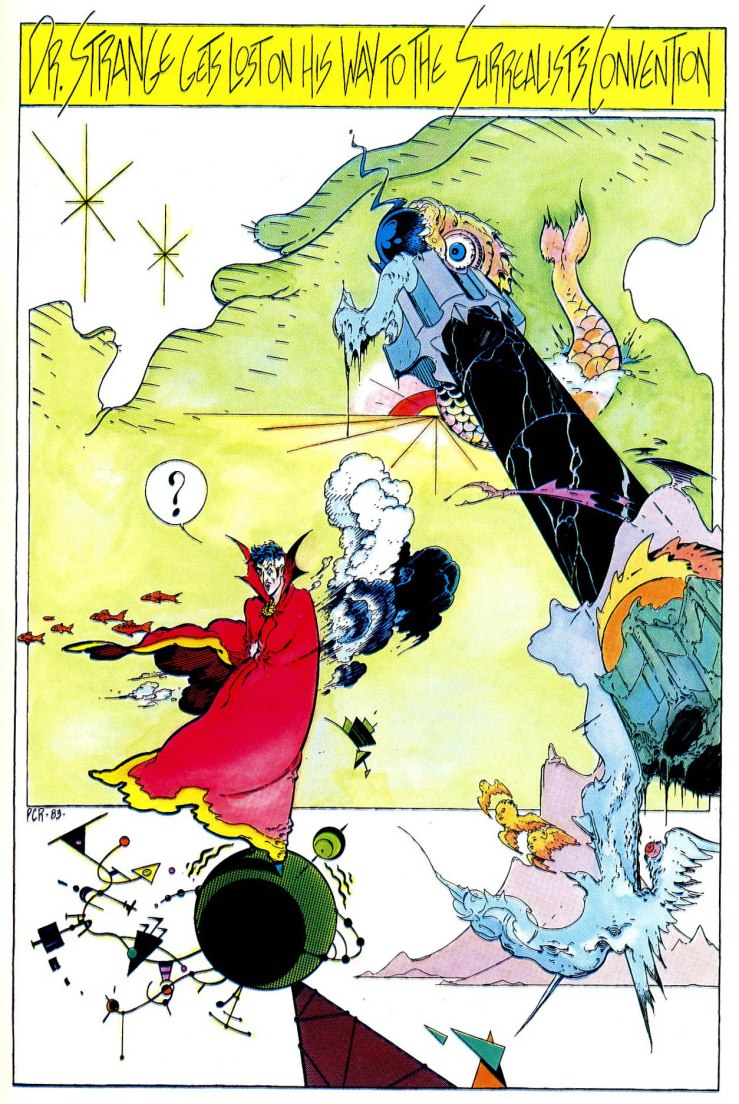
Dr. Strange Gets Lost on His Way to the Surrealist’s Convention — P. Craig Russell

russell strange

“Egotism; Or, The Bosom Serpent” — Nathaniel Hawthorne

 “Egotism; Or, The Bosom Serpent” — Nathaniel Hawthorne

“Here he comes!” shouted the boys along the street. “Here comes the man with a snake in his bosom!”

This outcry, saluting Herkimer’s ears as he was about to enter the iron gate of the Elliston mansion, made him pause. It was not without a shudder that he found himself on the point of meeting his former acquaintance, whom he had known in the glory of youth, and whom now after an interval of five years, he was to find the victim either of a diseased fancy or a horrible physical misfortune.

“A snake in his bosom!” repeated the young sculptor to himself. “It must be he. No second man on earth has such a bosom friend. And now, my poor Rosina, Heaven grant me wisdom to discharge my errand aright! Woman’s faith must be strong indeed since thine has not yet failed.”

Thus musing, he took his stand at the entrance of the gate and waited until the personage so singularly announced should make his appearance. After an instant or two he beheld the figure of a lean man, of unwholesome look, with glittering eyes and long black hair, who seemed to imitate the motion of a snake; for, instead of walking straight forward with open front, he undulated along the pavement in a curved line. It may be too fanciful to say that something, either in his moral or material aspect, suggested the idea that a miracle had been wrought by transforming a serpent into a man, but so imperfectly that the snaky nature was yet hidden, and scarcely hidden, under the mere outward guise of humanity. Herkimer remarked that his complexion had a greenish tinge over its sickly white, reminding him of a species of marble out of which he had once wrought a head of Envy, with her snaky locks.

The wretched being approached the gate, but, instead of entering, stopped short and fixed the glitter of his eye full upon the compassionate yet steady countenance of the sculptor.

“It gnaws me! It gnaws me!” he exclaimed.

And then there was an audible hiss, but whether it came from the apparent lunatic’s own lips, or was the real hiss of a serpent, might admit of a discussion. At all events, it made Herkimer shudder to his heart’s core.

“Do you know me, George Herkimer?” asked the snake-possessed.

Herkimer did know him; but it demanded all the intimate and practical acquaintance with the human face, acquired by modelling actual likenesses in clay, to recognize the features of Roderick Elliston in the visage that now met the sculptor’s gaze. Yet it was he. It added nothing to the wonder to reflect that the once brilliant young man had undergone this odious and fearful change during the no more than five brief years of Herkimer’s abode at Florence. The possibility of such a transformation being granted, it was as easy to conceive it effected in a moment as in an age. Inexpressibly shocked and startled, it was still the keenest pang when Herkimer remembered that the fate of his cousin Rosina, the ideal of gentle womanhood, was indissolubly interwoven with that of a being whom Providence seemed to have unhumanized. Continue reading ““Egotism; Or, The Bosom Serpent” — Nathaniel Hawthorne”

The Tome — Kama and Seele

cowboy-henk-513082013_0000

Watch Salesman, a 1969 Documentary About Traveling Bible Salesmen by the Maysles Brothers and Charlotte Zwerin

The Distributor of Crowns — Odilon Redon

“First he slew a snowshoe rabbit cleaving it in twain with a single blow and then he slew a spiny anteater” (Donald Barthelme)

They found the Dead Father standing in a wood, slaying. First he slew a snowshoe rabbit cleaving it in twain with a single blow and then he slew a spiny anteater and then he slew two rusty numbats and then whirling the great blade round and round his head he slew a wallaby and a lemur and a trio of ouakaris and a spider monkey and a common squid. Then moving up and down the green path in his rage he dispatched a macaque and a gibbon and fourscore innocent chinchillas who had been standing idly by watching the great slaughter. Then he rested standing with the point of his sword stuck in the earth and his two hands folded upon the hilt. Then he again as if taken by a fit set about the bloody work slaying a prairie dog and a beaver and a gopher and a dingo and a honey badger and an otter and a house cat and a tapir and a piglet. Then his anger grew and he called for a brand of even greater weight and length which was brought him by a metaphorically present gillie and seizing it with his two fine-formed and noble hands he raised it above his head, and every living thing within his reach trembled and every dead thing within his reach remembered how it got that way, and the very trees of the wood did seem to shrink and step away. Then the Dead Father slew a warthog and a spotted fawn and a trusting sheep and a young goat and a marmoset and two greyhounds and a draghound. Then, kicking viciously with his noble and shapely foot at the piles of the slain, raw and sticky corpses drenching the earth in blood on every side, he cleared a path to a group of staring pelicans slicing the soft white thin necks of them from the bodies in the wink of an eye. Then he slew a cassowary and a flamingo and a grebe and a heron and a bittern and a pair of ducks and a shouting peacock and a dancing crane and a bustard and a lily-trotter and, wiping the sacred sweat from his brow with one ermine-trimmed sleeve, slew a wood pigeon and a cockatoo and a tawny owl and a snowy owl and a magpie and three jackdaws and a crow and a jay and a dove. Then he called for wine. A silver flagon was brought him and he downed the whole of it in one draught looking the while out of the corner of his ruby eye at a small iguana melted in terror against the limb of a tree. Then he tossed the silver flagon into the arms of a supposititious cupbearer sousing the cupbearer’s hypothetical white tunic with the red of the (possible) wine and split the iguana into two halves with the point of his sword as easily as one skilled in the mystery fillets a fish. Then the Dead Father resumed his sword work in earnest slaying diverse small animals of every kind, so that the heaps mounted steaming to the right and to the left of him with each passionate step. A toad escaped.

From Donald Barthelme’s novel The Dead Father.

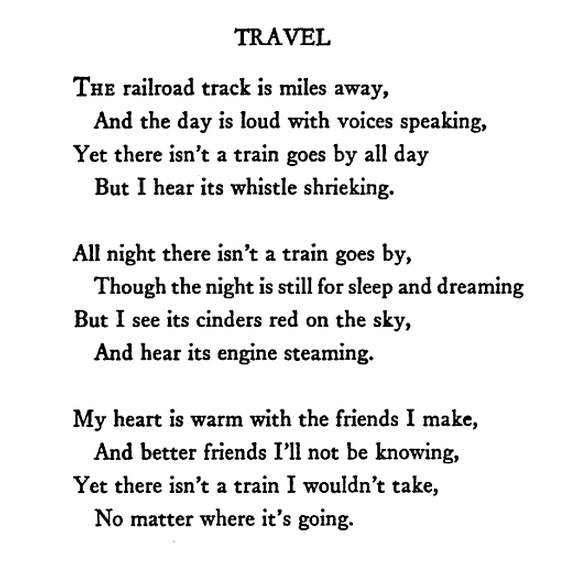
“Travel” — Edna St. Vincent Millay

travel