“Two Gallants” — James Joyce

“Two Gallants” by James Joyce

The grey warm evening of August had descended upon the city and a mild warm air, a memory of summer, circulated in the streets. The streets, shuttered for the repose of Sunday, swarmed with a gaily coloured crowd. Like illumined pearls the lamps shone from the summits of their tall poles upon the living texture below which, changing shape and hue unceasingly, sent up into the warm grey evening air an unchanging unceasing murmur.

Two young men came down the hill of Rutland Square. One of them was just bringing a long monologue to a close. The other, who walked on the verge of the path and was at times obliged to step on to the road, owing to his companion’s rudeness, wore an amused listening face. He was squat and ruddy. A yachting cap was shoved far back from his forehead and the narrative to which he listened made constant waves of expression break forth over his face from the corners of his nose and eyes and mouth. Little jets of wheezing laughter followed one another out of his convulsed body. His eyes, twinkling with cunning enjoyment, glanced at every moment towards his companion’s face. Once or twice he rearranged the light waterproof which he had slung over one shoulder in toreador fashion. His breeches, his white rubber shoes and his jauntily slung waterproof expressed youth. But his figure fell into rotundity at the waist, his hair was scant and grey and his face, when the waves of expression had passed over it, had a ravaged look.

When he was quite sure that the narrative had ended he laughed noiselessly for fully half a minute. Then he said:

“Well!… That takes the biscuit!”

His voice seemed winnowed of vigour; and to enforce his words he added with humour:

“That takes the solitary, unique, and, if I may so call it, recherche biscuit!” Continue reading ““Two Gallants” — James Joyce”

The Physician — Gerrit Dou

the-physician-1653-1

Kon Ichikawa’s The Burmese Harp (Full Film with English Subtitles)

Forever Still (Short Film) — Beach House

“To produce a mighty book, you must choose a mighty theme” (Moby-Dick)

One often hears of writers that rise and swell with their subject, though it may seem but an ordinary one. How, then, with me, writing of this Leviathan? Unconsciously my chirography expands into placard capitals. Give me a condor’s quill! Give me Vesuvius’ crater for an inkstand! Friends, hold my arms! For in the mere act of penning my thoughts of this Leviathan, they weary me, and make me faint with their outreaching comprehensiveness of sweep, as if to include the whole circle of the sciences, and all the generations of whales, and men, and mastodons, past, present, and to come, with all the revolving panoramas of empire on earth, and throughout the whole universe, not excluding its suburbs. Such, and so magnifying, is the virtue of a large and liberal theme! We expand to its bulk. To produce a mighty book, you must choose a mighty theme. No great and enduring volume can ever be written on the flea, though many there be who have tried it.

From “The Fossil Whale,” Chapter 104 of Melville’s Moby-Dick.


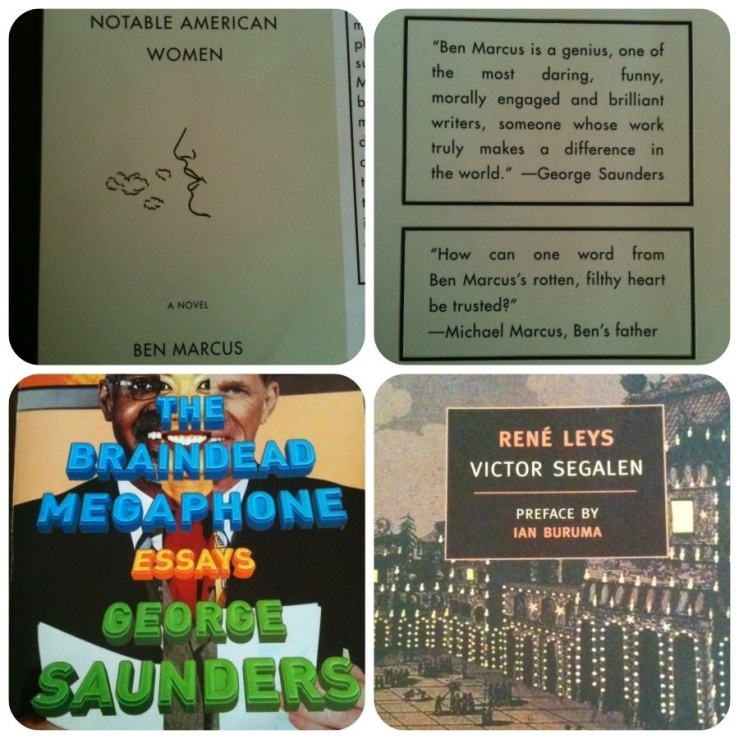
Ben Marcus/Victor Segalen/George Saunders (Books Acquired, 2.01.2013)

20130203-165505.jpg

I went to the bookstore on Friday afternoon to drop off some trade-ins and order a few books for my wife and kids for Valentine’s Day. I had no intention of buying anything, but a bit of random browsing led to me leaving with Ben Marcus’s collection Notable American Women (how could I resist that blurb?), a collection of George Saunders essays, and René Leys by Victor Segalen—the NYRB edition stuck out, and then the blurb sold me on this tale of a Westerner trying to access the Forbidden City of imperial China.

I’m reading Ben Marcus’s The Flame Alphabet right now, along with some short stories by Yoko Ogawa, as well as Lars Iyer’s latest, Exodus; I’m pretty sure René Leys is on deck after one of those.


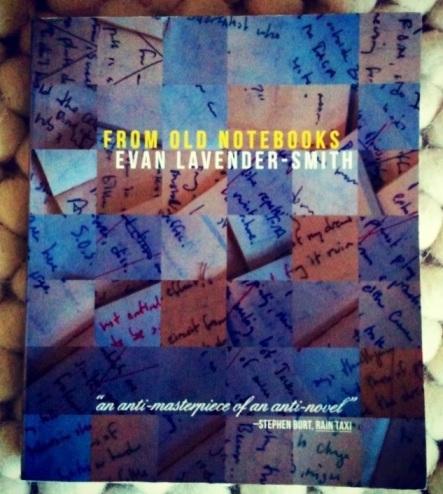
I Anti-Review Evan Lavender-Smith’s Anti-Novel, From Old Notebooks

20130202-121935.jpg

The style of this review is probably a bad idea.

In fact, it’s such a bad idea that it’s probable someone has already done it. Or considered doing it but had the good sense to refrain.

From Old Notebooks as the presentation of a subject through his daily jotting downs.

To clarify: All block quotes—like the one above—belong to Evan Lavender-Smith’s From Old Notebooks.

Which I read twice last month.

And am writing about here.

From Old Notebooks: A Novel: An Essay.

From Old Notebooks: An Essay: A Novel.

From Old Notebooks blazons its anxiety of influence: Ulysses, Infinite Jest, Nietzsche, Wittgenstein. Shakespeare.

Joycespeare.

References, critiques, ideas about Joyce, DFW, Wittgenstein, Nietzsche repeatedly evince in From Old Notebooks—and yet David Markson, whose format E L-S so clearly borrows, is evoked only thrice—and not until page 74 (this in a book of 201 pages):

I count David Markson’s literary-anecdote books among the few things I want to read over and over again, yet I have no idea whether they are actually any good. They’re like porn for English majors.

And then again on page 104:

If David Markson hadn’t written his literary-anecdote novels, would I have ever thought to consider F.O.N. a novel? Would I have ever thought to write such a book?

(I should point out that the page numbers I cite are from Dzanc Book’s first edition of From Old Notebooks; Dzanc’s 2012 printing puts the book back in print).

Like Markson’s anti-novels (Reader’s Block, This Is Not a Novel, Vanishing Point, The Last Novel), E L-S’s F.O.N. is constantly describing itself.

There may be some question as to F.O.N.’s status as fiction, poetry, philosophy, nonfiction, etc., but hopefully there will be no question about its status as a book.

Is E L-S’s book postmodern? Post-postmodern?

Perhaps there is nothing quintessentially postmodern about the self-reflexivity, fragmentation and pastiche of F.O.N., if only because all of it follows from form.

From Old Notebooks as a document constantly performing its self-critique:

If there were a Viking Portable Lavender-Smith containing an abridgment of F.O.N., I would be very interested to read it, because there’s no reason that the total value of the book wouldn’t be gained, through editorial happenstance, with much greater efficiency.

From Old Notebooks as a document of authorial anxiety.

A reader could make a case that there are a number of elided texts within or suggested by From Old Notebooks, including the one that gives the author the authority to write such a book.

F.O.N. is also a generative text, bustling with ideas for short stories, novels, plays, films, pamphlets, somethings—it is E L-S’s notebook after all (maybe). Just one very short example—

Novel about a haunted cryonics storage facility.

F.O.N.’s story ideas reminded me of my favorite Fitzgerald text, his Notebooks.

Reading From Old Notebooks is a pleasurable experience.

Personal anecdote on the reading experience:

Reading the book in my living room, my daughter and wife enter and begin doing some kind of mother-daughter yoga. My wife asks if they are distracting me from reading. I suggest that the book doesn’t work that way. The book performs its own discursions.

I shared the tiniest morsel here of my family; E L-S shares everything about his family in F.O.N.:

I know that the reconciliation of my writing life and my family life is one of the things that F.O.N. is finally about, but I can’t actually see it in the book; I don’t imagine I could point to an entry and say, Here is an example of that.

It would be impossible for me not to relate to the character of the author or novelist or narrator of F.O.N. (let me call him E L-S as a simple placeholder): We’re about the same age, we both have a son and a daughter (again of similar ages); we both teach composition. Similar literary obsessions. Etc. After reading through F.O.N. the first time I realized how weird it was that I didn’t feel contempt and jealousy for what E L-S pulls off in F.O.N.—that I didn’t hate him for it. That I felt proud of him (why?) and liked him.

There are moments where our obsessions diverge; the E L-S of F.O.N. is preoccupied with death to an extent that I simply don’t connect to. He:

1) Think always about sex. 2) Have a family. 3) Think always about death.

I:

1) Think always about sex. 2) Have a family. 3) Think always about sex.

But generally I get and feel and empathize with his descriptions of his son and daughter and wife.

And his work. Big time:

Getting up the motivation to grade student essays is like trying to pass a piece of shit through the eye of a needle.

Or

I have perfected my lecture after giving it for the third time, but my fourth class never gets to realize it because my voice is hoarse and I’m so tired from giving the same lecture four times in one day, so their experience of my perfect lecture at 8-9:40 PM is of approximately equal value to that of my students receiving my imperfect lecture at 8-9:40 AM, as well as my students at 2:30-3:55 and 5:30-7:10—and it all evens out to uniform mediocrity in the end.

The novel is not jaded or cynical or death-obsessed though (except when it is).

What E L-S is trying to do is to remove as much of the barrier between author and reader as possible:

Contemporary authors who construct a thick barrier between themselves and their readers such that authorial vulnerability is revealed negatively, i.e., via the construction of the barrier.

Perhaps my suggestion that E L-S tries to remove the barrier is wrong. Maybe instead: E L-S’s F.O.N. maps the barrier, points to the barrier’s structure, does not try to deny the barrier, but also tries to usher readers over it, under it, through its gaps—-and in this way channels a visceral reality that so much of contemporary fiction fails to achieve.

I really, really liked this book and will read it again.


I Don’t Like to Look at Him, Jack — Walton Ford

PK_15822_burke_img4

(More/via)

“A Visit of Charity” — Eudora Welty

“A Visit of Charity” by Eudora Welty

It was mid-morning—a very cold, bright day. Holding a potted plant before her, a girl of fourteen jumped off the bus in front of the Old Ladies’ Home, on the outskirts of town. She wore a red coat, and her straight yellow hair was hanging down loose from the pointed white cap all the little girls were wearing that year. She stopped for a moment beside one of the prickly dark shrubs with which the city had beautified the Home, and then proceeded slowly toward the building, which was of whitewashed brick and reflected the winter sunlight like a block of ice. As she walked vaguely up the steps she shifted the small pot from hand to hand; then she had to set it down and remove her mittens before she could open the heavy door.

“I’m a Campfire Girl…I have to pay a visit to sold old lady,” she told the nurse at the desk. This was a woman in a white uniform who looked as if she were cold; she had close-cut hair which stood up on the very top of her head exactly like a sea wave. Marian, the little girl, did not tell her that this visit would give her a minimum of only three points in her score.

“Acquainted with any of our residents?” asked the nurse. She lifted one eyebrow and spoke like a man.

“With any old ladies? No—but—that is, any of them will do,” Marian stammered. With her free hand she pushed her hair behind her ears, as she did when it was time to study Science.

The nurse shrugged and rose. “You have a nice multiflora cineraria there,” she remarked as she walked ahead down the hall of closed doors to pick out an old lady.

There was loose, bulging linoleum on the floor. Marian felt as if she were walking on the waves, but the nurse paid no attention to it. There was a smell in the hall like the interior of a clock. Everything was silent until, behind one of the doors, an old lady of some kind cleared her throat like a sheep bleating. This decided the nurse. Stopping in her tracks, she first extended her arm, bent her elbow, and leaned forward from the hips, all to examine the watched strapped to her wrist; then she gave a loud double-rap on the door.

“There are two in each room,” the nurse remarked over her shoulder.

“Two what?” asked Marian without thinking. The sound like a sheep’s bleating almost made her turn around and run back. Continue reading ““A Visit of Charity” — Eudora Welty”

Reading Man — Ferdinand Hodler

reading-man

Self Portrait as Thing in the Forest — Julie Heffernan

00973

(More/via).

Gertrude Stein on Football

In a 1934 radio interview, Gertrude Stein talks American football:

INTERVIEWER: You saw the Yale-Dartmouth game a week ago Saturday didn’t you? Did you understand that in the American way or the football way or how?

STEIN: IN the American way. The thing that interested me was that the Modern American in his movements and his actions in a football game so resembled the red Indian dance and it proves that the physical country that made the one made the other and that the red Indian is still with us. They just put their heads down solemnly together and then double over, while on the sidelines the substitutes move in a jiggly way just like Indians. Then they all get down on all fours just like Indians.

INTERVIEWER: But those jiggles are just warming-up exercises.

STEIN: It doesn’t make any difference what they are doing it for, they are just doing it, like the way the Indian jiggles in the Indian dance and then there is that little brown ball they all bend down and worship.

INTERVIEWER: But the ideas in that is to get the ball across the goal line.

STEIN: But don’t you suppose I know that, and don’t you suppose the Indians had just as much reason and enjoyed their dancing just as much?

“You Made Me Realise” — My Bloody Valentine

The Football Hero — Norman Rockwell

“In Football Season” — John Updike

“In Football Season” by John Updike

            Do you remember a fragrance girls acquire in autumn? As you walk beside them after school, they tighten their arms about their books bend their heads forward to give a more flattering attention to you words, and in the little intimate area thus formed, carved into the clear; by an implicit crescent, there is a complex fragrance woven of tobacco, powder, lipstick, rinsed hair, and that perhaps imaginary and certainly elusive scent that wool, whether in the lapels of a jacket or the nap of a j sweater, seems to yield when the cloudless fall sky like the blue bell of I a vacuum lifts toward itself the glad exhalations of all things. This fra­grance, so faint and flirtatious on those afternoon walks through the dry leaves, would be banked a thousand-fold on the dark slope of the stadium when, Friday nights, we played football in the city.

“We”—we the school. A suburban school, we rented for some of our home games the stadium of a college in the city of Alton three miles away. My father, a teacher, was active in the Olinger High athletic department, and I, waiting for him beside half-open doors of varnished wood and frosted glass, overheard arguments and felt the wind of the worries that accompanied this bold and at that time unprecedented deci­sion. Later, many of the other county high schools followed our lead; for the decision was vindicated. The stadium each Friday night when we played was filled. Not only students and parents came but spectators unconnected with either school, and the money left over when the sta­dium rent was paid supported our entire athletic program. I remember the smell of the grass crushed by footsteps behind the end zones. The smell was more vivid than that of a meadow, and in the blue electric glare the green vibrated as if excited, like a child, by being allowed up late. I remember my father taking tickets at the far corner of the wall, wedged into a tiny wooden booth that made him seem somewhat magical, like a troll.

And of course I remember the way we, the students, with all of our jealousies and antipathies and deformities, would be—beauty and boob, sexpot and grind—crushed together like flowers pressed to yield to the black sky a concentrated homage, an incense, of cosmetics, cigarette smoke, warmed wool, hot dogs, and the tang, both animal and metallic, of clean hair. In a hoarse olfactory shout, these odors ascended. A dense haze gathered along the ceiling of brightness at the upper limit of the arc lights, whose glare blotted out the stars and made the sky seem romanti­cally void and intimately near, like the death that now and then stooped and plucked one of us out of a crumpled automobile. If we went to the back row and stood on the bench there, we could look over the stone lip of the stadium down into the houses of the city, and feel the cold Novem­ber air like the black presence of the ocean beyond the rail of a ship; and when we left after the game and from the hushed residential streets of this part of the city saw behind us a great vessel steaming with light, the arches of the colonnades blazing like portholes, the stadium seemed a great ship sinking and we the survivors of a celebrated disaster. Continue reading ““In Football Season” — John Updike”

St. Jacob and The Magician — Hieronymous Bosch

st-jacob-and-the-magician

Night Fishing — Peter Doig

night-fishing-1993