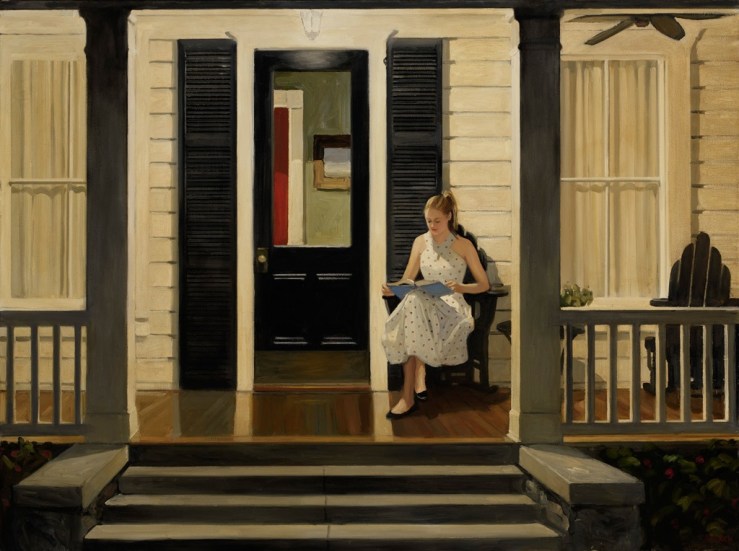
Summer Porch — Sally Storch

SS-web.22

“All art constantly aspires towards the condition of music”

“How I classify” — Georges Perec

20140721-162336-59016551.jpg

From Georges Perec’s “Reading: A Socio-Physiological Outline.” Collected in Species of Spaces and Other Pieces.

The Traveller — Jeffrey Smart

“A Crossbreed” — Franz Kafka

“A Crossbreed”

by

Franz Kafka


I have a curious animal, half kitten, half lamb. It is a legacy from my father. But it only developed in my time; formerly it was far more lamb than kitten. Now it is both in about equal parts. From the cat it takes its head and claws, from the lamb its size and shape; from both its eyes, which are wild and flickering, its hair, which is soft, lying close to its body, its movements, which partake both of skipping and slinking. Lying on the window sill in the sun it curls up in a ball and purrs; out in the meadow it rushes about like mad and is scarcely to be caught. It flees from cats and makes to attack lambs. On moonlight nights its favorite promenade is along the eaves. It cannot mew and it loathes rats. Beside the hen coop it can lie for hours in ambush, but it has never yet seized an opportunity for murder.

I feed it on milk; that seems to suit it best. In long draughts it sucks the milk in through its fanglike teeth. Naturally it is a great source of entertainment for children. Sunday morning is the visiting hour. I sit with the little beast on my knees, and the children of the whole neighborhood stand around me.

Then the strangest questions are asked, which no human being could answer: Why there is only one such animal, why I rather than anybody else should own it, whether there was ever an animal like it before and what would happen if it died, whether it feels lonely, why it has no children, what it is called, etc.

I never trouble to answer, but confine myself without further explanation to exhibiting my possession. Sometimes the children bring cats with them; once they actually brought two lambs. But against all their hopes there was no scene of recognition. The animals gazed calmly at each other with their animal eyes, and obviously accepted their reciprocal existence as a divine fact.

Sitting on my knees, the beast knows neither fear nor lust of pursuit. Pressed against me it is happiest. It remains faithful to the family that brought it up. In that there is certainly no extraordinary mark of fidelity, but merely the true instinct of an animal which, though it has countless step-relations in the world, has perhaps not a single blood relation, and to which consequently the protection it has found with us is sacred.

Sometimes I cannot help laughing when it sniffs around me and winds itself between my legs and simply will not be parted from me. Not content with being lamb and cat, it almost insists on being a dog as well. Once when, as may happen to anyone, I could see no way out of my business problems and all that they involved, and was ready to let everything go, and in this mood was lying in my rocking chair in my room, the beast on my knees, I happened to glance down and saw tears dropping from its huge whiskers. Were they mine, or were they the animal’s? Had this cat, along with the soul of a lamb, the ambitions of a human being? I did not inherit much from my father, but this legacy is quite remarkable.

It has the restlessness of both beasts, that of the cat and that of the lamb, diverse as they are. For that reason its skin feels too tight for it. Sometimes it jumps up on the armchair beside me, plants its front legs on my shoulder, and put its muzzle to my ear. It is as if it were saying something to me, and as a matter of fact it turns its head afterwards and gazes in my face to see the impression its communication has made. And to oblige it I behave as if I had understood, and nod. Then it jumps to the floor and dances about with joy.

Perhaps the knife of the butcher would be a release for this animal; but as it is a legacy I must deny it that. So it must wait until the breath voluntarily leaves its body, even though it sometimes gazes at me with a look of human understanding, challenging me to do the thing of which both of us are thinking.

Translated by Willa and Edwin Muir.

Reading The Secret of the Hive — Charles Burns

hive

My God, My God, Why Hast Thou Forsaken Me? — Shinji Aoyama (Full Film)

Trompe l’oeil: A Cabinet in the Artist’s Studio — Cornelis Norbertus Gysbrechts

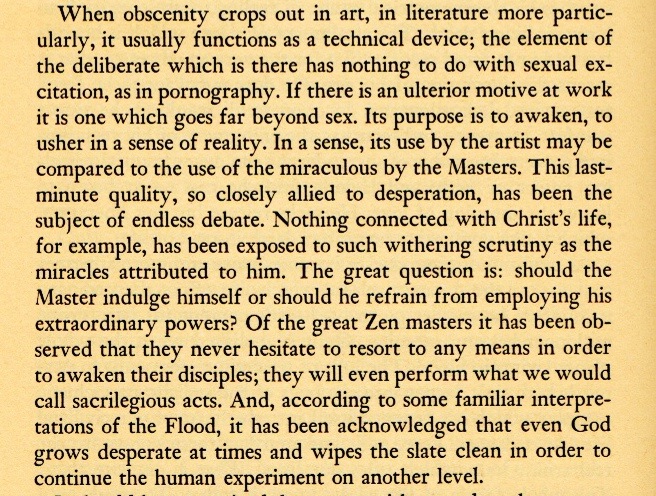
Obscenity as a technical device (Henry Miller)

20140721-162338-59018771.jpg

From “Obscenity and the Law of Reflection,” collected in Henry Miller on Writing.

World Destroyed by Water — Gustave Doré

Four Notes from Nathaniel Hawthorne’s Note-Books

  1. Punishment of a miser,–to pay the drafts of his heir in his tomb.
  2. A series of strange, mysterious, dreadful events to occur, wholly destructive of a person’s happiness. He to impute them to various persons and causes, but ultimately finds that he is himself the sole agent. Moral, that our welfare depends on ourselves.
  3. The strange incident in the court of Charles IX. of France: he and five other maskers being attired in coats of linen covered with pitch and bestuck with flax to represent hairy savages. They entered the hall dancing, the five being fastened together, and the king in front. By accident the five were set on fire with a torch. Two were burned to death on the spot, two afterwards died; one fled to the buttery, and jumped into a vessel of water. It might be represented as the fate of a squad of dissolute men.
  4. A perception, for a moment, of one’s eventual and moral self, as if it were another person,–the observant faculty being separated, and looking intently at the qualities of the character. There is a surprise when this happens,–this getting out of one’s self,–and then the observer sees how queer a fellow he is.

From Nathaniel Hawthorne’s American Note-Books.

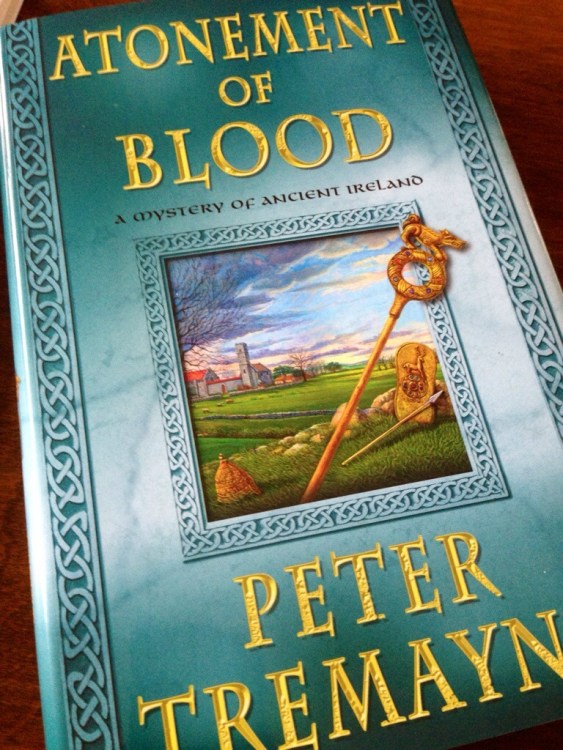
Atonement of Blood (Book Acquired, Sometime in Early July, 2014)

20140707-150321-54201189.jpg

Atonement of Blood is historical mystery fiction by Peter Tremayne. Publisher’s blurb:

Winter, 670 AD. King Colgú has invited the leading nobles and chieftains of his kingdom to a feast day. Fidelma and her companion Eadulf are finally home for an extended stay, and have promised their son, Alchú, that they’ll be able to spend some time together after months of being on the road, investigating crimes. Fidelma and Eadulf are enjoying the feast when it is interrupted by the entrance of a religieux, who claims he has an important message for the King. He approaches the throne and shouts ‘Remember Liamuin!’ and then stabs King Colgú. The assassin is slain, but does enough damage to take out Colgú’s bodyguard, and to put the king himself on the verge of death.

As King Colgú lies in recovery, Fidelma, Eadulf, and bodyguard Gormán are tasked with discovering who is behind the assassination attempt, and who Liamuin is. They must journey into the territory of their arch-enemies, the Uí Fidgente, to uncover the secrets in the Abbey of Mungairit, and then venture into the threatening mountain territory ruled by a godless tyrant. Danger and violence are their constant companions until the final devastating revelation.

Night Stories — Sally Storch

storch

“Wrong Note” — Thomas Bernhard

20140721-162337-59017776.jpg

Two Rats — Vincent van Gogh

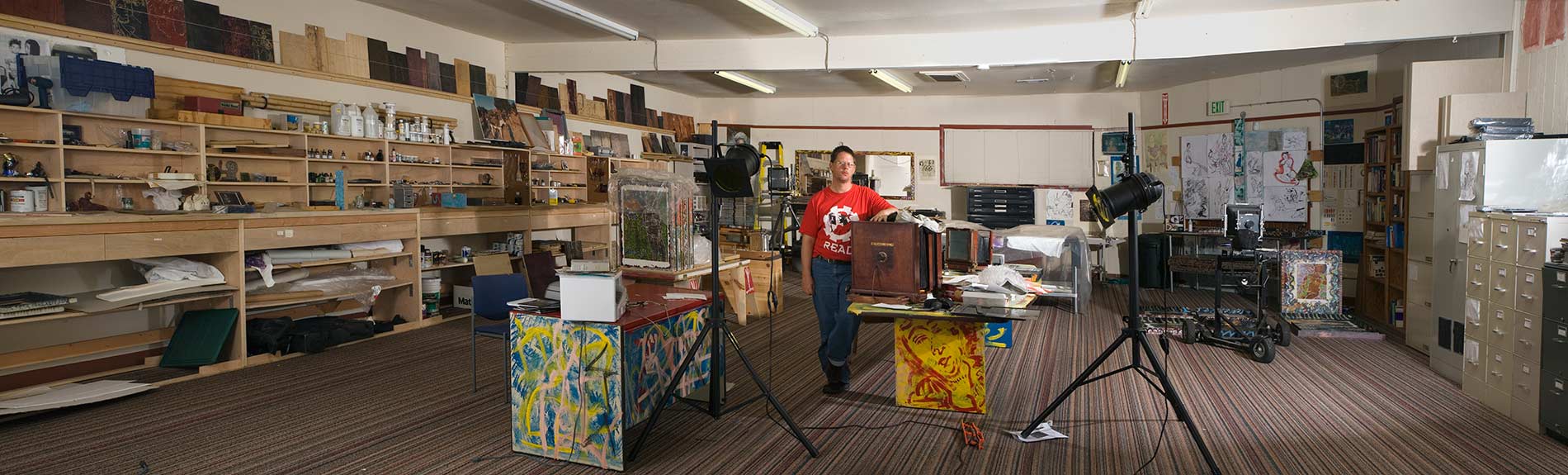
Vollmann in His Studio


There’s a great big fat long profile of William T. Vollmann by Tom Bissell at The New Republic—it’s one of the better pieces I’ve read on an author who is more widely read about than, you know, read.

From the profile, details of a visit to Vollmann’s studio:

Half of Vollmann’s studio felt like a proper gallery, with finished pieces handsomely framed and displayed. The other half was split into what looked like a used bookstore on one side and a struggling industrial arts business on the other. I imagined Vollmann had a gallery somewhere that showed his stuff, yes? Actually, no. “I’ve had a couple of photographer friends who have shows,” Vollmann said. “Every time, they always end up impoverished.” He employs “a couple dealers” who sell his work to various institutions, but he considers his studio a “perpetual gallery.” Vollmann gets additional income from Ohio State, which has been buying Vollmann’s work and manuscripts for several years. Vollmann has no idea why Ohio State has shown such interest in his work, but he’s grateful to the institution, which has been paying the mortgage on his studio for the last decade.

He began our tour proper while a dinging train from the city’s light-rail line rumbled by, just feet from his curtained windows. Woodcuts, watercolors, ink sketches, silver-gelatin black-and-white photographs, portraits. “Gum-printing is a nineteenth-century technique,” he told me. “It’s the most permanent coloring process. But it’s slow, and toxic. … I also have this device here, which is based in dental technology. … It’s like a non-vibrating, very high-speed Dremel tool. … This was originally drawn with pen and ink, and then I had a magnesium block made with a photo resist.” Some of the pieces he showed me were complete; most were not. He estimated that he has “dozens and dozens” of pieces going at any one time.

Vollmann’s most important artistic influences are Gauguin and what he described as the “power colors” of Native American art. His other inescapable influence is the female body. The majority of Vollmann’s visual art centers upon women generally and geishas, sex workers, and those he calls “goddesses” specifically. Usually they are nude. From where I was standing I counted at least two dozen vaginas, their fleshy machinery painstakingly drawn and then painted over with a delicate red slash. Vollmann uses live models, so every vagina within sight is currently out there right now, wandering the world.

A New Yorker Short Fiction Reading List


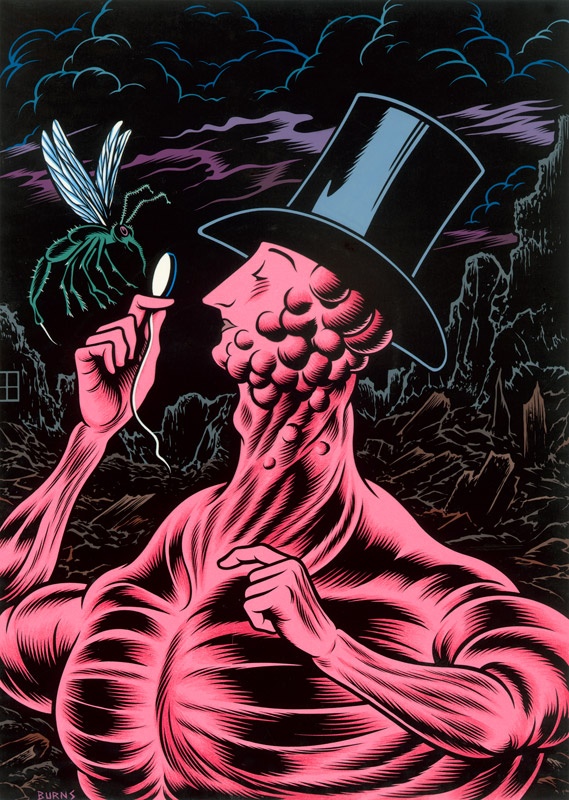
Mutant Eustace Tilley (The New Yorker's Mascot) by Charles Burns
Mutant Eustace Tilley (The New Yorker’s Mascot) by Charles Burns

As you, savvy reader, are undoubtedly already aware, The New Yorker has opened up some of its archive for the rest of the summer (to show off its website redesign, I guess).

Here’s a reading list of short fiction from the archives (admittedly, some of the stuff I wanted to put on here is still behind a paywall).

Some of the stories on the list are classics, some are pieces I’ve shared on this blog before, some are excerpts from longer works, and a few are stories I have yet to read myself.

“The Daughters of the Moon” by Italo Calvino

“Backbone” by David Foster Wallace

“1966” by Denis Johnson

“My Father Addresses Me on the Facts of Old Age” by Grace Paley

“The Insufferable Gaucho” by Roberto Bolaño

“Victory Lap” by George Saunders

“Leopard” by Wells Tower

“Gorse Is Not People” by Janet Frame

“Rough Deeds” by Annie Proulx