The Unmade Bed — Adolph von Menzel

Paul Thomas Anderson’s Inherent Vice Screenplay

Capture


You can (legally) download Paul Thomas Anderson’s screenplay for his adaptation of Thomas Pynchon’s Inherent Vice(Via, via, via).

There is no avoiding time (Pynchon’s Inherent Vice)

Sauncho was giving a kind of courtroom summary, as if he’d just been handling a case. “. . . yet there is no avoiding time, the sea of time, the sea of memory and forgetfulness, the years of promise, gone and unrecoverable, of the land almost allowed to claim its better destiny, only to have the claim jumped by evildoers known all too well, and taken instead and held hostage to the future we must live in now forever. May we trust that this blessed ship is bound for some better shore, some undrowned Lemuria, risen and redeemed, where the American fate, mercifully, failed to transpire . . .”

From Thomas Pynchon’s Inherent Vice. The passage, near the end of the novel, acts as a summary—or rather one of several summaries—to Inherent Vice’s shaggy plot. The blessed ship is The Golden Fang, aka Preserved. I’ve been sketching out a riff on Inherent Vice the novel, Inherent Vice the film, and The Crying of Lot 49. (This passage also kinda sorta summarizes The Crying of Lot 49. And Mason & Dixon).

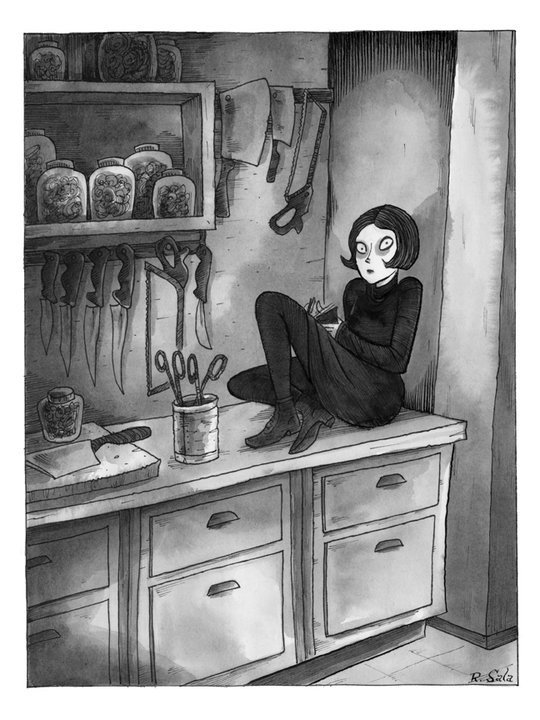
Girl Reading — Richard Sala

tumblr_njw104ES9h1r16qfco1_540

Because It’s So Damn Cold, Donald Barthelme’s Recipes for Fine Homemade Oxtail Soup and Fine Homemade Leek Soup

In his introduction to The Teachings of Don B, Thomas Pynchon praises Donald Barthelme’s soups:

Those recipes. That oxtail soup mix. That “burgoo,” with the frozen ducks in it? A notable moment in chef psychopathology, to be sure — yet such is Barthelme’s genius that even the most porkophobic or duck-intolerant among us is drooling, unashamed, by recipe’s end.

I don’t own The Teachings of Don B, but Pynchon’s description (which I found while looking for something entirely different) piqued my interest (first and foremost: was the recipe even a real thing?). Anyway: Via Maude Newton, via Overnight to Many Distant Cities, and then an additional Google search to The Purest of Treats:

FINE HOMEMADE OXTAIL SOUP

Take Knorr Oxtail Soupmix, decant into same any leftover meat (sliced or diced) from the old refrigerator. Follow above strategies to the letter. The result will make you happy. Knorr’s Oxtail is also good as a basic gravy maker and constituent of a fine fake cassoulet about which we can talk at another time. Knorr is a very good Swiss outfit whose products can be found in both major and minor cities. The point here is not to be afraid of the potential soup but to approach it with the attitude that you know what’s best for it. And you do. The rawness of the vegetables refreshes the civilization of the Soupmixes. And there are opportunities for mercy–if your ox does not wish to part with his tail, for example, to dress up your fine Oxtail Soup, you can use commercial products from our great American supermarkets, which will be almost as good.

And if you’re into Lenten observation:

FINE HOMEMADE LEEK SOUP

Take one package Knorr Leek Soupmix. Prepare as directed. Take two live leeks. Chop leeks into quarter-inch rounds. Throw into Soupmix. Throw in ½ cup Tribuno Dry Vermouth. Throw in chopped parsley. Throw in some amount of salt and a heavy bit of freshly ground pepper. Eat with good-quality French bread, dipped repeatedly in soup.

(See also: Gordon Lish’s recipe for chicken soup).

How to represent Night (Leonardo da Vinci)

That which is entirely devoid of light is all darkness; as the night is like this and you wish to represent a night subject, represent a great fire, so that the object which is nearest to the fire may be tinged with its colour, since the object which is nearest the fire will participate most in its nature. And as you will make the fire red, all the objects which it illumines must be red also, and those which are farther off from the fire will be dyed to a greater extent by the dark colour of night. The figures which are between you and the fire appear dark from the obscurity of the night, not from the glow of the firelight, and those which are at the side are half dark and half ruddy, and those which are visible beyond the edge of the flames will be altogether lighted up by the red glow against a black background. As to their action, make those which are near shield themselves with their hands and cloaks against the intense heat with averted faces as though about to flee; with regard to those who are farther off, represent them chiefly in the act of raising their hands to their eyes, dazzled by the intense glare.

From Baring’s translation of Leonardo’s notebooks.

Wunderkammer — Santiago Caruso

WUNDERKAMMER

The Hook and the Haymaker (Book acquired, 2.12.2015)

IMG_5102

Jared Yates Sexton’s The Hook and the Haymaker is new from Split Lip Press. Dug his last joint, An End to All Things and looking forward to getting into this one. Blurb from his site:

In 2012 Atticus Books released An End To All Things, Jared Yates Sexton’s acclaimed debut collection of stories. Called “invigorating” and “shades of Barry Hannah, Raymond Carver, and Breece D’J Pancake,” it was lauded byThe Portland Book Review as “the beginning of a long literary career.” Here, his next installment of stories, The Hook and The Haymaker, twenty-three award-winning pieces that have appeared in The Southern Humanities Review, Night Train, Verdad, PANK, Midwestern Gothic, among other prominent magazines and publications from around the country.

This book picks up right where Sexton’s debut left off with hard-hitting, gritty glimpses into an America that too-often goes unseen. Set in sweat-saturated sparring rings, the backrooms of gas station speakeasies, and the kitchens of the houses down the street, witness here the untold tales of the losers and the should’ve-beens, the dreamers and the hustlers, all of them just spoiling for their turn at glory or the inevitable one-two punch that puts them down for good.

Eva Cristina — Ernst Fuchs

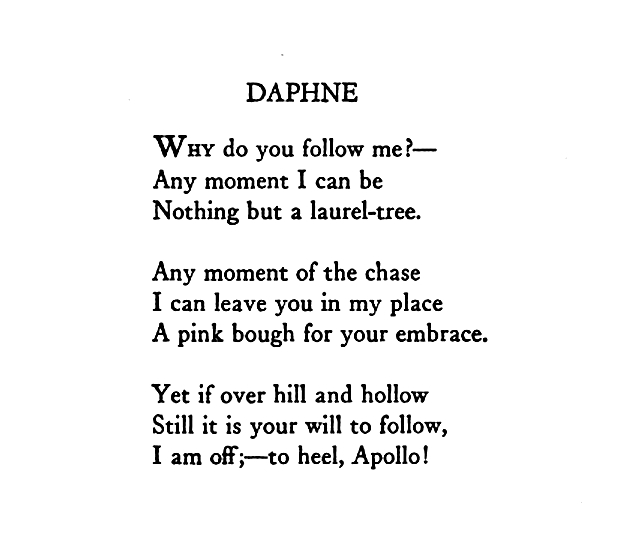
“Daphne” — Edna St. Vincent Millay

daphne

“All art constantly aspires towards the condition of la la la”

Dream — Claude Verlinde

claudeverlinde_100

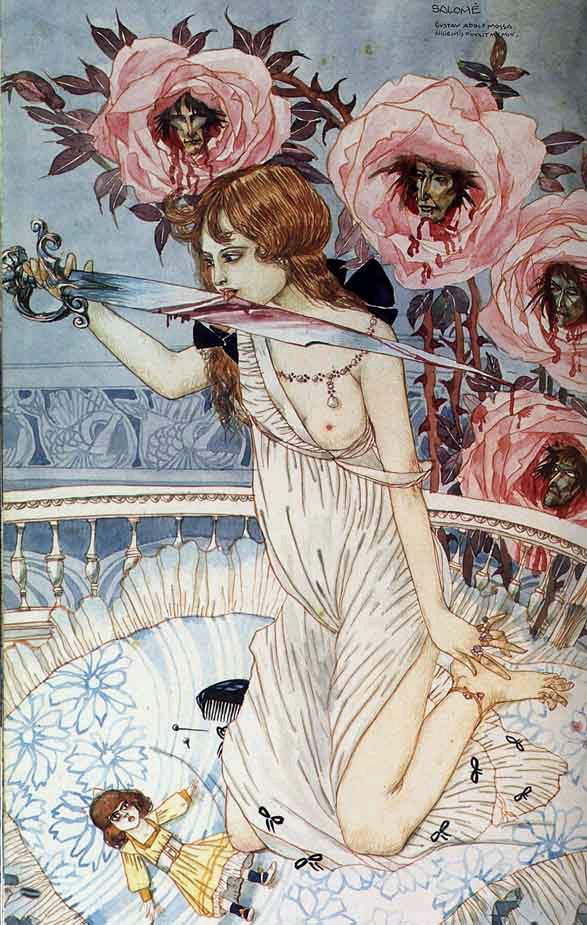
Salome — Gustav-Adolf Mossa

tumblr_ltsgw5EyQW1qarjnpo1_1280

An Interview with Christopher K. Coffman and Daniel Lukes, Editors of William T. Vollmann: A Critical Companion (Part I)

William T. Vollmann: A Critical Companion, new from University of Delaware Press, collects academic essays and memoir-vignettes by a range of critics and authors to make the case that Vollmann is, as the blurb claims, the “most ambitious, productive, and important living author in the US.” I interviewed the book’s editors, Christopher K. Coffman and Daniel Lukes, over a series of emails.

If you live in NYC (or feel like traveling), you can check out the book launch for William T. Vollmann: A Critical Companion this weekend, hosted by Coffman and Lukes (4:30pm at the 11th Street Bar).

This is the first part of a two-part interview.

IMG_5107

Biblioklept: How did William T. Vollmann: A Critical Companion come about?

Daniel Lukes: The starting point would be the MLA panel I put together in January 2011, called “William T. Vollmann: Methodologies and Morals.” Chris’s was the first abstract I received and I remember being impressed with its confidence of vision. Michael Hemmingson also gave a paper, and Larry McCaffery was kind enough to act as respondent. Joshua Jensen was also a panelist. I kept in touch with Chris and we very soon decided that there was a hole in the market, so to speak, so we put out a call for papers and took it from there.

One of my favorite things about putting together this book has been connecting with – and being exposed to – such a range of perspectives on Vollmann: people seem to come at him from – and find in his works – so many different angles. It’s bewildering and thrilling to talk about the same author with someone and not quite believe you are doing so. And I think this started for me, in a way, at least as far as this book is concerned, with reading Chris’ MLA abstract.

Biblioklept: I first heard about Vollmann in connection to David Foster Wallace (Wallace namechecks him in his essay “A Supposedly Fun Thing I’ll Never Do Again”). A friend “loaned” me his copy of The Ice-Shirt and I never gave it back. When was the first time you read Vollmann?

Christopher K. Coffman: I first encountered William T. Vollmann’s work about ten years ago. At the time, I had just finished grad school, and as my dissertation work had been focused on aspects of modern and contemporary poetry, I had let my attention to contemporary prose slip a bit. When I realized this had happened, I starting reading a lot of recent fiction. Of course David Foster Wallace’s books were part of this effort, and I, like so many others, really developed a love for Infinite Jest and some of the stories in Girl with Curious Hair. My memory’s a bit fuzzy on the timeline, but my best guess, given what I know I was reading and thinking about at the time, is that in my reading around DFW I discovered the Summer 1993 issue of The Review of Contemporary Fiction with which Larry McCaffery had been involved, and that the interview with DFW in that issue–along with the WTV materials themselves–woke me up to WTV and his work. I can’t say enough about how important Larry’s championing of WTV has been, and continues to be. Of course, one could say that about his support for so many of the interesting things that have happened in fiction during the past three or four decades. His interviews, his editorial work, the part he played with the Fiction Collective …. the list of the ways that he identifies and promotes some of the best work out there could go on for a while, and no one else that I know of has done it as well as Larry has for as long as he has. Anyway, as I was pretty much broke at the time, my reading choices were governed in large part by what I could find at libraries or local used bookstores, and The Ice-Shirt was the first volume I came across in one of these venues. I was already a huge fan of The Sot-Weed Factor and Mason & Dixon, and the entire Seven Dreams project very much struck me as a next step forward along the trajectory those books described. As a consequence, I immediately started tracking down and reading not only the rest of the Dreams, but also everything else I could find by WTV.

What about The Ice-Shirt that really won me over, aside from my impression that this was another brilliant reinterpretation of the historical novel, is that WTV was clearly bringing together and pushing to their limits some of my favorite characteristics of post-1945 American fiction (structural hijinks of a sort familiar from works by figures like Barth and Barthelme, a fearlessness in terms of subject matter and the occasional emergence of a vatic tone that reminded me of Burroughs, an autofictional element of the sort you see in Hunter S. Thompson). Furthermore, as a literary critic, I was really intrigued by two additional aspects of the text: the degree to which The Ice-Shirt foregrounds the many ways that it is itself an extended interpretation of earlier texts (the sagas on which he draws for many of the novel’s characters and much of its action), and the inclusion of extensive paratexts–the notes, glossaries, timelines, and so forth. In short, this seemed like a book that united my favorite characteristics of contemporary literary fiction with a dedication to the sort of work that I, as a scholar, spend a lot of my time doing. How could I resist? It took my readings of a few more of WTV’s books for me to be able to recognize what I would argue are his other most significant characteristics: his global scope and his deep moral vision.

As for your also having begun reading WTV with The Ice-Shirt: It’s an interesting coincidence to me that we both started with that book. I have always assumed that most people start into WTV via either the prostitute writings (which have a sort of underground cachet by virtue of subject matter) or Europe Central (which is of course the book that got the most mainstream attention), but here we both are with The Ice-Shirt. WTV has indicated he sees it as under-realized in certain ways, but I am still quite fond of it, even in comparison to some of the later books. Continue reading “An Interview with Christopher K. Coffman and Daniel Lukes, Editors of William T. Vollmann: A Critical Companion (Part I)”

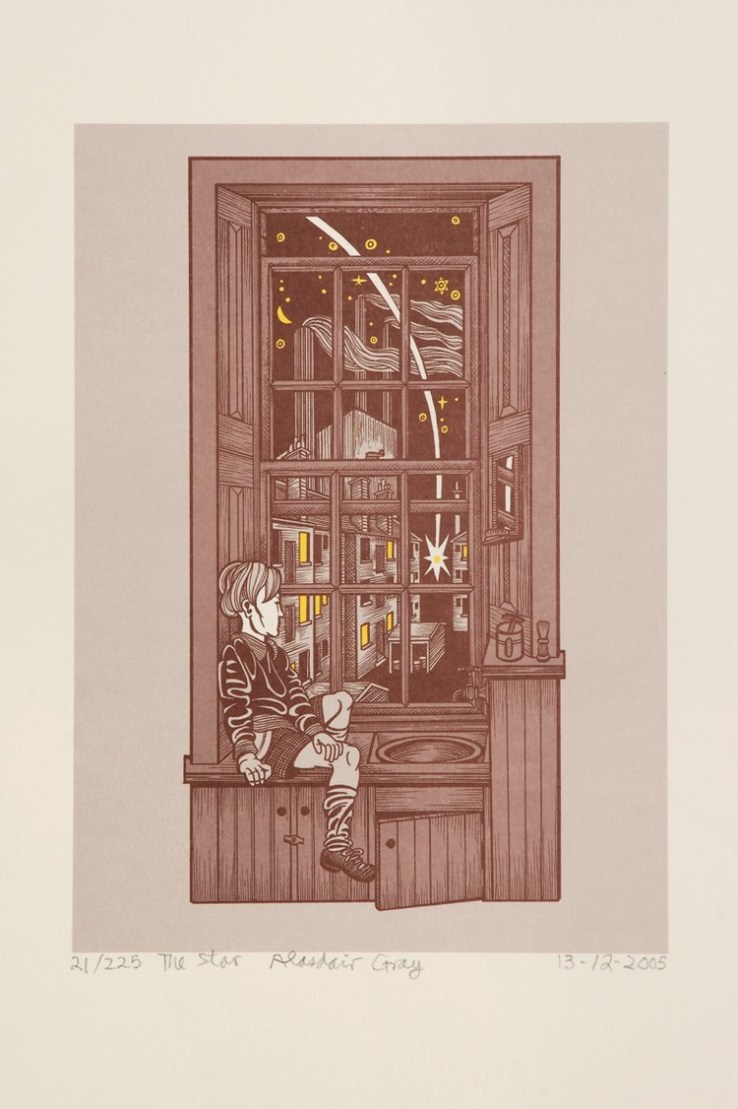
The Star — Alasdair Gray

3914-graya052094-alasdair-gray-the-star-2005

The Star is one of several pieces of art by Alasdair Gray that accompany Rodge Glass’s review of the Scottish novelist’s collection of non-fiction pieces, Of Me & Others. The first paragraph of Glass’s piece:

At the time I finished my biography of the polymath Alasdair Gray, in 2008, my subject was at a curious juncture. Though an artist for six decades, he remained a footnote in his country’s art world. Though the author of the most celebrated Scottish novel in the last hundred years, Lanark, and several others which altered the literary landscape of his home city, Glasgow, beyond recognition (Poor Things, 1982, Janine, Unlikely Stories, Mostly) he was dependent on a small Royal Literary Fund grant and regular scraps from various overdue projects for his living. (Gray is, was, and always will be a Republican. He once turned down a knighthood.) 2007 saw the publication of what he called “my final novel,” labeled as such because he’d quite simply run out of old unpublished manuscripts to pilfer ideas from. The spares drawer was now empty. Meanwhile, no matter how many times he reminded folks that he had stolen it from the Canadian poet Dennis Lee, he was still always credited with the only quote outside the still-new Scottish Parliament building: Work as if you live in the early days of a better nation. In his old age, there was talk of him becoming that most disgraceful of things—an uncontroversial “national treasure,” awaiting death, then platitudes from the great and the good, and then probably—the horror!—a statue. All this was an ominous sign for an artist who had always defined himself in opposition to political power.

Renoir at Work

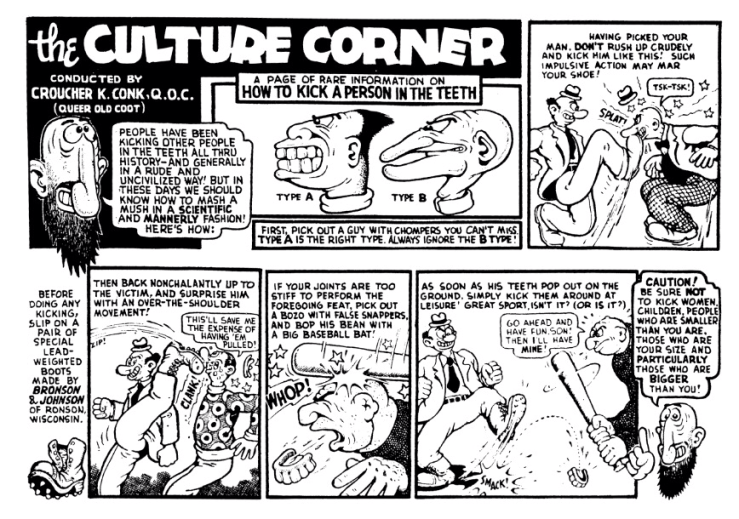
How to Kick a Person in the Teeth — Basil Wolverton

IMG_0177