Battle of the Gods That Have Been Transformed — Ernst Fuchs

Bob Rafelson and Jack Nicholson on the diner scene in Five Easy Pieces

Still Life with a Wine Cooler — Frans Snyders

New Evan Lavender-Smith short story, “For This Relief, Much Thanks”

At The Offing, read “For This Relief, Much Thanks,” a new story by Evan Lavender-Smith. First two paragraphs:

Worried, even certain, will die on upcoming Peru trip — card-carrying hypochondriac — so jotting down some instructions for you. Here goes.

First thing, ms. on ugly brown reclining chair in study, containing, near end, these very instructions — card-carrying metafictionist — requires thorough proofreading before sending out. Aim high initially, as I am of opinion this one may deserve proper publication by proper house, proper distribution to brick-and-mortars, etc., unlike first two. Hopeful royalties, if any, suffice to cover boy’s dental care in upcoming years. Good boy, as you know, deserving of straight teeth. Maybe royalties enough to cover Little League uniforms/dues, though doubtful. Sorry couldn’t afford term life with smoking, unemployment, etc. Baseball equipment stuff way cheaper on Amazon. Try to find ways to make it work. Boy already knows how to be broke. Dentist is one next to Pro’s Ranch, only Spanish spoken there so have him keep moving ahead on his Duolingo app.

Read the rest of Evan Lavender-Smith’s story “For This Relief, Much Thanks.”

If it is not known how and when a man dies, it makes a ghost of him for many years thereafter (Nathaniel Hawthorne)

June 30th.–If it is not known how and when a man dies, it makes a ghost of him for many years thereafter, perhaps for centuries. King Arthur is an example; also the Emperor Frederick, and other famous men, who were thought to be alive ages after their disappearance. So with private individuals. I had an uncle John, who went a voyage to sea about the beginning of the War of 1812, and has never returned to this hour. But as long as his mother lived, as many as twenty years, she never gave up the hope of his return, and was constantly hearing stories of persons whose description answered to his. Some people actually affirmed that they had seen him in various parts of the world. Thus, so far as her belief was concerned, he still walked the earth. And even to this day I never see his name, which is no very uncommon one, without thinking that this may be the lost uncle.

Thus, too, the French Dauphin still exists, or a kind of ghost of him; the three Tells, too, in the cavern of Uri.

—Nathaniel Hawthorne’s journal entry of June 30th, 1854; collected in Passages from the English Note-Books.

“The Surprises of the Superhuman” — Wallace Stevens

Screenshot 2015-06-29 at 8.49.35 PM

The Vision — Sigmund Walter Hampel

tumblr_kvfhp4rxC81qzw5wjo1_1280

Interior with Girl Reading — Peter Ilsted

c4422_1

Barthelme has managed to place himself in the center of modern consciousness (William H. Gass)

Barthelme has managed to place himself in the center of modern consciousness. Nothing surrealist about him, his dislocations are real, his material quite actual. Radio, television, movies, newspapers, books, magazines, social talk: these supply us with our experience. Rarely do we see trees, go meadowing, or capture crickets in a box. The aim of every media, we are nothing but the little darkening hatch they trace when, narrowly, they cross. Computers begin by discriminating only when they’re told to. Are they ahead that much? since that’s the way we end. At home I rest from throwing pots according to instructions by dipping in some history of the Trojan war; the fete of Vietnam is celebrated on the telly; my daughter’s radio is playing rock—perhaps it’s used cars or Stravinsky; my wife is telling me she loves me, is performing sexercises with a yogi Monday, has accepted a proposal to be photoed without clothing and now wonders if the draft will affect the teaching of freshman chemistry. Put end to end like words, my consciousness is a shitty run of category errors and non sequiturs. Putting end to end and next to next is Barthelme’s method, and in Barthelme, blessed method is everything.

From William H. Gass’s 1968 essay “The Leading edge of the Trash Phenomenon,” an ostensible review of Donald Barthelme’s collection Unspeakable Practices, Unnatural Acts.

Portrait of Gertrude Stein — Felix Vallotton

1.3

“The Golden Poppy,” an essay by Jack London

“The Golden Poppy”

by

Jack London

I have a poppy field.  That is, by the grace of God and the good-nature of editors, I am enabled to place each month divers gold pieces into a clerical gentleman’s hands, and in return for said gold pieces I am each month reinvested with certain proprietary-rights in a poppy field.  This field blazes on the rim of the Piedmont Hills.  Beneath lies all the world.  In the distance, across the silver sweep of bay, San Francisco smokes on her many hills like a second Rome.  Not far away, Mount Tamalpais thrusts a rugged shoulder into the sky; and midway between is the Golden Gate, where sea mists love to linger.  From the poppy field we often see the shimmering blue of the Pacific beyond, and the busy ships that go for ever out and in.

“We shall have great joy in our poppy field,” said Bess.  “Yes,” said I; “how the poor city folk will envy when they come to see us, and how we will make all well again when we send them off with great golden armfuls!”

“But those things will have to come down,” I added, pointing to numerous obtrusive notices (relics of the last tenant) displayed conspicuously along the boundaries, and bearing, each and all, this legend:

Private GroundsNo Trespassing.”

“Why should we refuse the poor city folk a ramble over our field, because, forsooth, they have not the advantage of our acquaintance?”

“How I abhor such things,” said Bess; “the arrogant symbols of power.”

“They disgrace human nature,” said I.

“They shame the generous landscape,” she said, “and they are abominable.”

“Piggish!” quoth I, hotly.  “Down with them!” Continue reading ““The Golden Poppy,” an essay by Jack London”

Angel of Splendors — Jean Delville

jd6

Phil Spector talks about “Be My Baby,” Scorsese’s Mean Streets, Brian Wilson, etc.

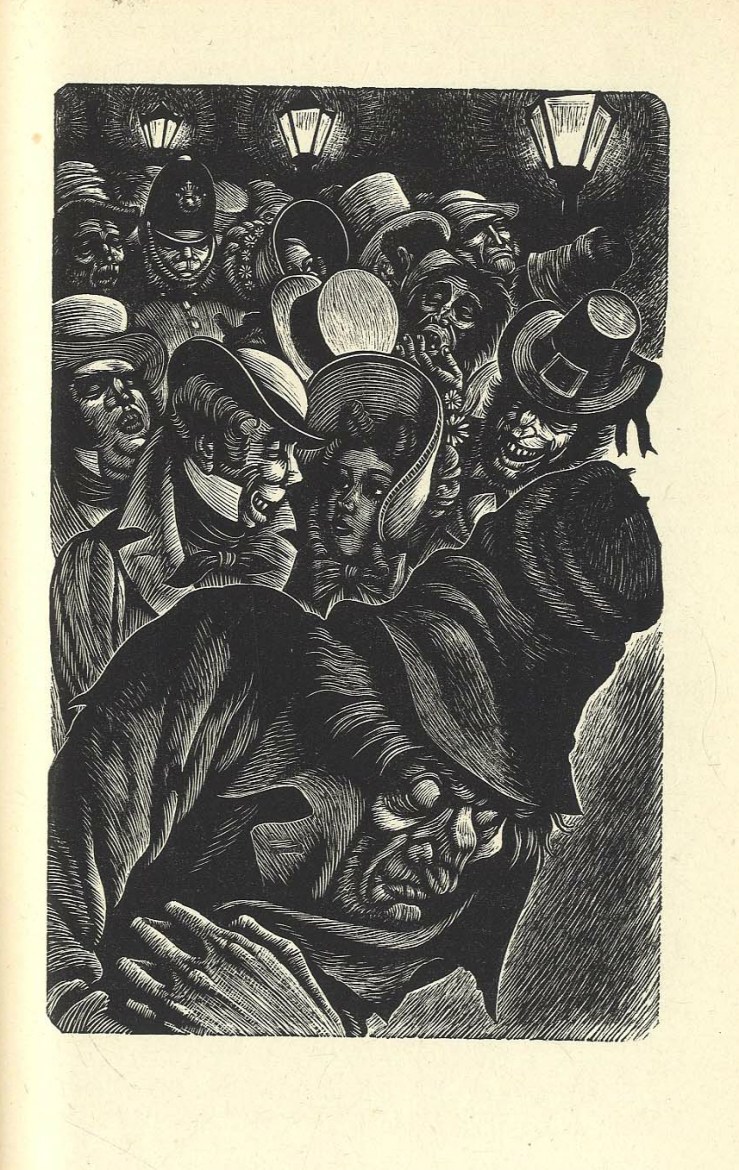
Illustration for Edgar Allan Poe’s story “The Man of the Crowd” — Fritz Eichenberg

SH925

Wonderful Fritz Eichenberg illustration to one of my favorite Poe stories, “The Man of the Crowd,”. Via a gorgeous gallery at Full Table.

The Bus — Paul Kirchner

dYdxq6N - Imgur

Odalisque — Georgy Kurasov

Georgy Kurasov Odalesque 32 x 40

And seems a moving land and at his gills Draws in, and at his trunk spouts out, a sea — Gustave Dore