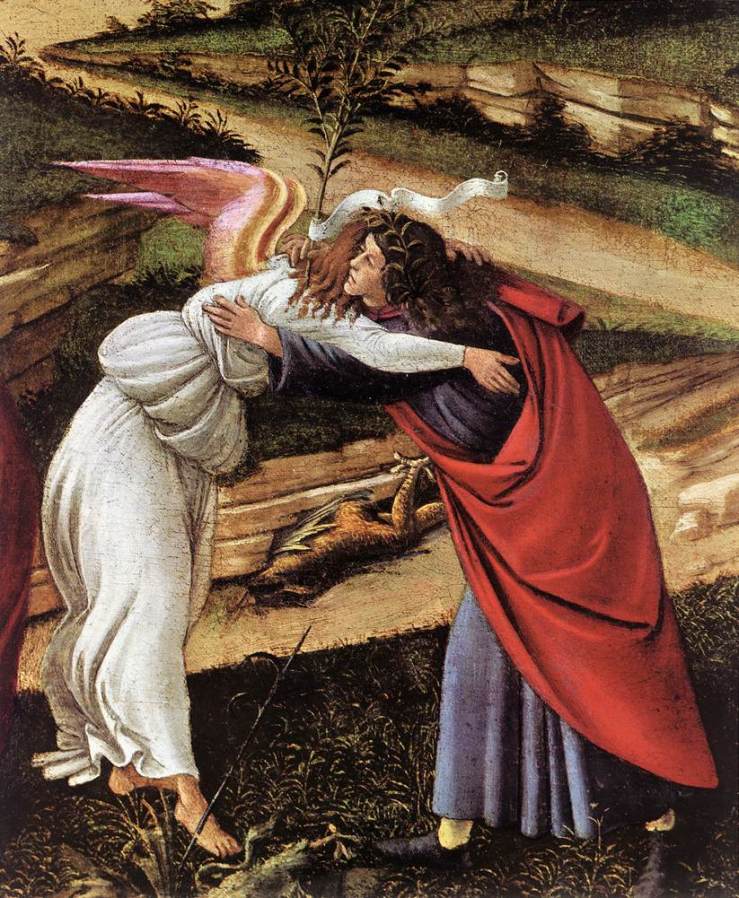
The Mystical Nativity (Detail) — Sandro Botticelli

131nativi

Thirty-point riff on Star Wars: The Force Awakens

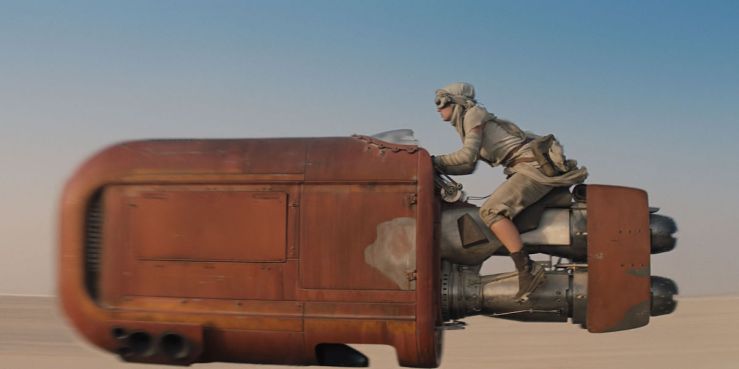
Rey-Star-Wars-Episode-7-Force-Awakens

  1. Star Wars: The Force Awakens is a fun entertainment that achieves its goals, one of which is not to transcend the confines of its brand-mythos.
  2. SW: TFA takes Star Wars itself (as brand-mythos) as its central subject. The film is “about” Star Wars.
  3. To this end, SW: TFA is basically a remake of A New Hope. My saying this is not insightful and cannot be insightful.
  4. In the first Star Wars film, A New Hope (aka Episode IV, aka simply Star Wars), George Lucas synthesized Flash Gordon and Kurosawa, Joseph Campbell and WWII serials into a cultural product that was simultaneously new and old, hokey and profound, campy and heroic.
  5. SW: TFA is not a synthesis (and does not seek to be a synthesis); rather it is a transcription, repetition, and  replication of the previous Star Wars films—particularly the so-called “original trilogy” (Episodes IV, V, and VI).
  6. Hence, SW: TFA often feels like a greatest hits collection, its sequences and visuals (engaging and visually spectacular) cribbed from the previous films. I could spend the rest of the riff outlining the correspondences—major and minor—but why? The correspondences are intentionally obvious to anyone who has seen the film; furthermore, they are not allusions, but the formal structure of the film.
  7. And this formal technique, this replication—it’s all very enjoyable and often warm and unexpectedly humorous and at times awfully sad even.
  8. And I liked the new characters very much, which I was of course supposed to. They are all in some ways replications of previously existing characters, just as the set pieces and sequences they act in/out/upon are replications.
  9. Let’s consider Rey, the heroine of The Force Awakens really quickly: She is, in some ways, a synthesis, but only a synthesis of the principals of the Star Wars brand-mythos: She is at once Han, Luke, and Leia: A figuration in the foreground: A childhood fantasy.
  10. A childhood fantasy: Watching SW: TFA feels like watching a Star Wars film—which is the film’s intention, obviously.
  11. But not obviously and really quickly and not a gripe: Isn’t there a part of us, by which us I mean me, that wants something more than the feeling of (the feeling of) a Star Wars film? That wants something transcendent—something beyond that which we have felt and can name? Something that we don’t know that we want because we haven’t felt it before?
  12. Re: Point 11: I already made an (awfully) oblique argument at some length almost three years ago about franchise films in general and Star Wars films in particular, arguing (maybe arguing) for, say, Wong Kar Wai to direct the next Star Wars film.
  13. In that riff I wrote that, “J.J. Abrams is a safe bet. I can more or less already imagine the movie he’ll make.” That prediction was incorrect only in that I enjoyed the product that he made more than I thought I would. That prediction was wholly correct in that I could imagine the product Abrams made. It was easy to imagine. I’d already seen the film dozens of times before he even made it.
  14. So, to return to point 11, the “not a gripe” point: Is the argument then that film as an art form allows us (the illusion of) a transcendent perspective? That film at its best, at its strongest and strangest, offers us a new way of seeing?
  15. (Yes).
  16. The Force Awakens is strong but not strange. Its major advancement (by which I mean break from previous films) evinces in its casting choices—but these reflect the progress of our own era, not the brand-mythos of Star Wars itself, which was of course always diverse.
  17. The Force Awakens is fun. Entertaining. Like I wrote in point 1.
  18. And, to repeat point 2 after repeating point 1: SW: TFA is “about” Star Wars.
  19. So what do I mean by this? Consider for a minute what the other Star Wars films are “about.”
  20. A New Hope is about escape and rescue, both in the literal, romantic, and metatextual sense.
  21. The Empire Strikes Back is about Oedipal anxieties and Oedipal violence, family entanglements, friendships and loyalties.
  22. Return of the Jedi is about restoration and redemption, a film about the genius of ecology over mechanization.
  23. And while the (so-called) prequels are generally reviled, I like them: They are “about” something.
  24. For example, Revenge of the Sith is about democracy and fascism, community and ego—and more of that Oedipal violence.
  25. Indeed the entire series is Oedipally structured—which The Force Awakens replicates and continues.
  26. Yet Abrams’s reverence for Star Wars bears no clear trace (at least on my first viewing) of Oedipal anxiety towards Lucas. No attempt to transcend or surpass—as such a move would entail a kind of critical (if metaphorical) violence directed at Lucas’s vision. (Notably, many of the criticisms of the so-called prequels rest on the way those films look beyond their predecessors (in a way that Abrams’s film doesn’t)).
  27. “In order to criticize a movie, you have to make another movie,” said Jean-Luc Goddard.
  28. And Harold Bloom: “Every poem is a misinterpretation of a parent poem. A poem is not an overcoming of anxiety, but is that anxiety…There are no interpretations but only misinterpretations, and so all criticism is prose poetry.”
  29. Abrams’s goal was not to criticize Star Wars or poetically engage it; his goal was to praise it—to praise it as stasis, to replicate its comforts, to avow and vindicate its forms and tropes. And he succeeded.
  30. And of course the biggest success of the film: I want to watch it again.

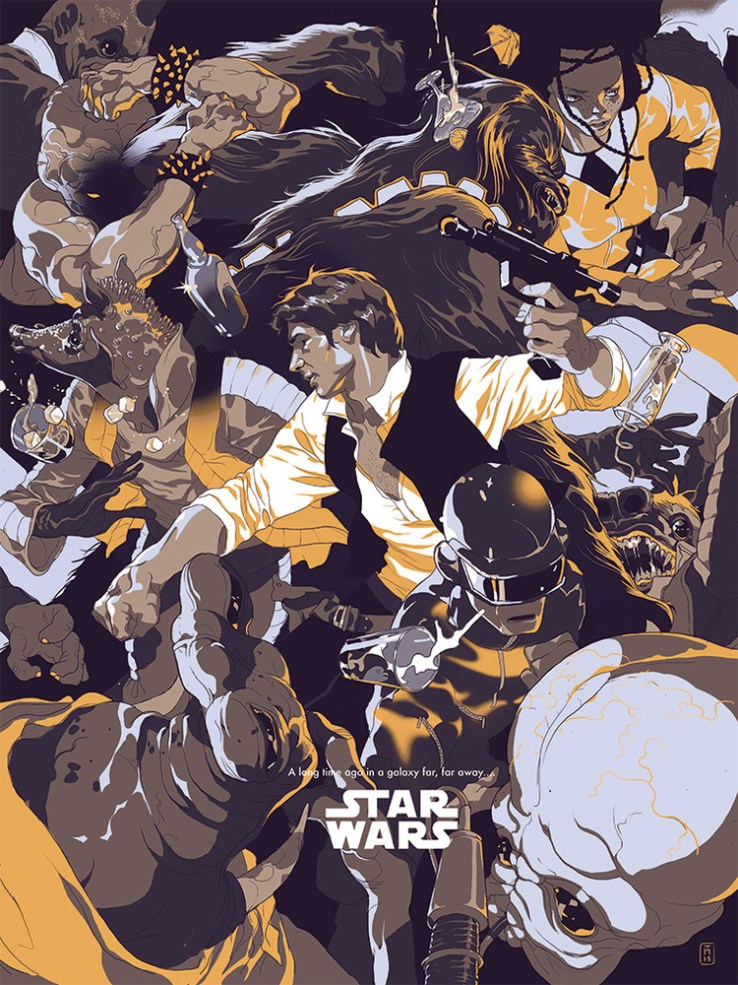
Goldie Han, a Star Wars illustration by Tomer Hanuka

Goldie_Han_72

If civilization has an opposite, it is war (Ursula K. Le Guin)

Tibe spoke on the radio a good deal. Estraven when in power had never done so, and it was not in the Karhidish vein: their government was not a public performance, normally; it was covert and indirect. Tibe, however, orated. Hearing his voice on the air I saw again the long-toothed smile and the face masked with a net of fine wrinkles. His speeches were long and loud: praises of Karhide, disparagements of Orgoreyn vilifications of “disloyal factions,” discussions of the “integrity of the Kingdom’s borders,” lectures in history and ethics and economics, all in a ranting, canting, emotional tone that went shrill with vituperation or adulation. He talked much about pride of country and love of the parentland, but little about shifgrethor, personal pride or prestige. Had Karhide lost so much prestige in the Sinoth Valley business that the subject could not be brought up? No; for he often talked about the Sinoth Valley. I decided that he was deliberately avoiding talk of shifgrethor because he wished to rouse emotions of a more elemental, uncontrollable kind. He wanted to stir up something which the whole shifgrethor-pattern was a refinement upon, a sublimation of. He wanted his hearers to be frightened and angry. His themes were not pride and love at all, though he used the words perpetually; as he used them they meant self-praise and hate. He talked a great deal about Truth also, for he was, he said, “cutting down beneath the veneer of civilization.”

It is a durable, ubiquitous, specious metaphor, that one about veneer (or paint, or pliofilm, or whatever) hiding the nobler reality beneath. It can conceal a dozen fallacies at once. One of the most dangerous is the implication that civilization, being artificial, is unnatural: that it is the opposite of primitiveness… Of course there is no veneer, the process is one of growth, and primitiveness and civilization are degrees of the same thing. If civilization has an opposite, it is war. Of those two things, you have either one, or the other. Not both. It seemed to me as I listened to Tibe’s dull fierce speeches that what he sought to do by fear and by persuasion was to force his people to change a choice they had made before their history began, the choice between those opposites.

From Ursula Le Guin’s 1969 novel The Left Hand of Darkness. The bold emphases are mine—mea culpa, I couldn’t help it.
Frankie Styne and the Silver Man (Book acquired, 12.09.2015)

img_1013

Kathy Page’s 1992 novel Frankie Styne and the Silver Man is getting a North American debut thanks to publisher Biblioasis. Blurb from the author’s website:

Frankie Styne, the successful author of a series of gruesome killer novels,  has lived  at 125 Onley Street for many years. Meticulous and obsessive, he lives a life of isolation, managing to keep both future and past at bay.

Next door, live Liz Meredith and her new baby, Jim. Liz has been told by her social worker Mrs Purvis that Jim has a rare disorder, and will never be like other children. But Mrs Purvis can’t see, as Liz can, that Jim already knows things no ordinary person could. Besides, Liz doesn’t want any help from the social services or from Tom and Alice, the couple at number 129. She wants to be left in peace so that she can imagine her way out of how things are.

When Frank’s solitary anonymity is threatened, he hatches a real-life plot which, as he begins to enact it, unexpectedly changes not only his own life, but also those of Liz and Jim. Sifting through our collective nightmares, Kathy Page has written a novel that is powerful, humorous, tragic and thoroughly surprising.

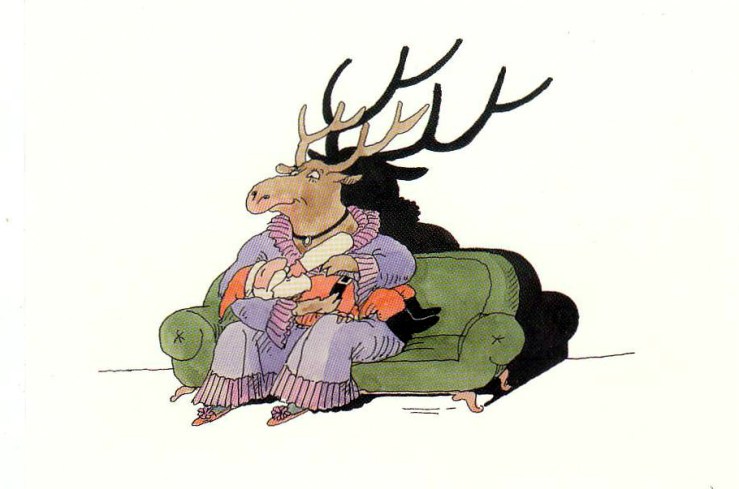
A Christmas card by Tomi Ungerer

tomi ungerer

A Mason & Dixon Christmastide (Thomas Pynchon)

They discharge the Hands and leave off for the Winter. At Christmastide, the Tavern down the Road from Harlands’ opens its doors, and soon ev’ryone has come inside. Candles beam ev’rywhere. The Surveyors, knowing this year they’ll soon again be heading off in different Directions into America, stand nodding at each other across a Punch-bowl as big as a Bathing-Tub. The Punch is a secret Receipt of the Landlord, including but not limited to peach brandy, locally distill’d Whiskey, and milk. A raft of long Icicles broken from the Eaves floats upon the pale contents of the great rustick Monteith. Everyone’s been exchanging gifts. Somewhere in the coming and going one of the Children is learning to play a metal whistle. Best gowns rustle along the board walls. Adults hold Babies aloft, exclaiming, “The little Sausage!” and pretending to eat them. There are popp’d Corn, green Tomato Mince Pies, pickl’d Oysters, Chestnut Soup, and Kidney Pudding. Mason gives Dixon a Hat, with a metallick Aqua Feather, which Dixon is wearing. Dixon gives Mason a Claret Jug of silver, crafted in Philadelphia. There are Conestoga Cigars for Mr. Harland and a Length of contraband Osnabrigs for Mrs. H. The Children get Sweets from a Philadelphia English-shop, both adults being drawn into prolong’d Negotiations with their Juniors, as to who shall have which of. Mrs. Harland comes over to embrace both Surveyors at once. “Thanks for simmering down this Year. I know it ain’t easy.”
“What a year, Lass,” sighs Dixon.
“Poh. Like eating a Bun,” declares Mason.”

The last paragraphs of Ch. 52 of Thomas Pynchon’s novel Mason & Dixon.

Three Books

img_1191

Homesick: New & Selected Stories by Lucia Berlin. Lovely Black Sparrow trade edition, 1990; design by Barbara Martin. An amazing book, a revelation to me. I picked it up looking for the posthumous collection A Manual for Cleaning Women (that track is collected here) based on, well, the hype. But the hype was more than right, and I feel simultaneously abashed that I didn’t know Berlin before and grateful to know her writing now.

img_1190

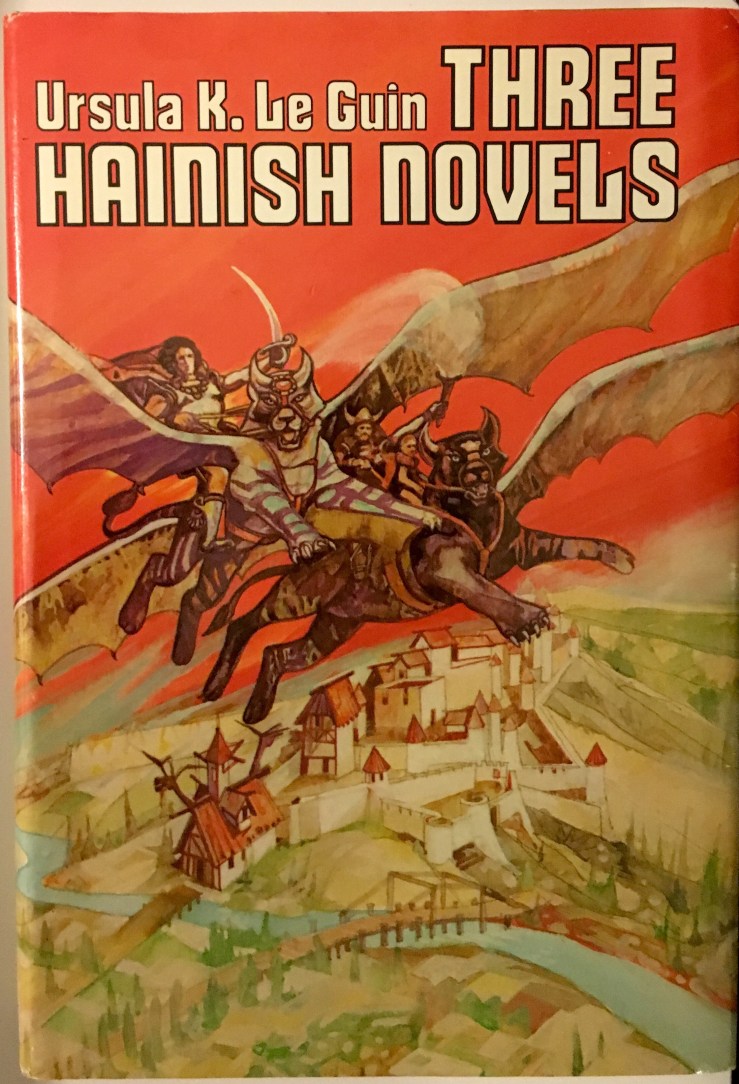
Three Hainish Novels by Ursula K. Le Guin. An omnibus collecting Rocannon’s WorldPlanet of Exile, and City of Illusions. 1967 hardcover by Nelson Doubleday. Jacket design by John Lisco; cover illustration by Jack Woolhiser. I finished City of Illusions this weekend—probably the most accomplished of her earliest (non-)trilogy, synthesizing high adventure into a philosophical exploration of truth and lie. A reread of The Left Hand of Darkness is next.img_1187

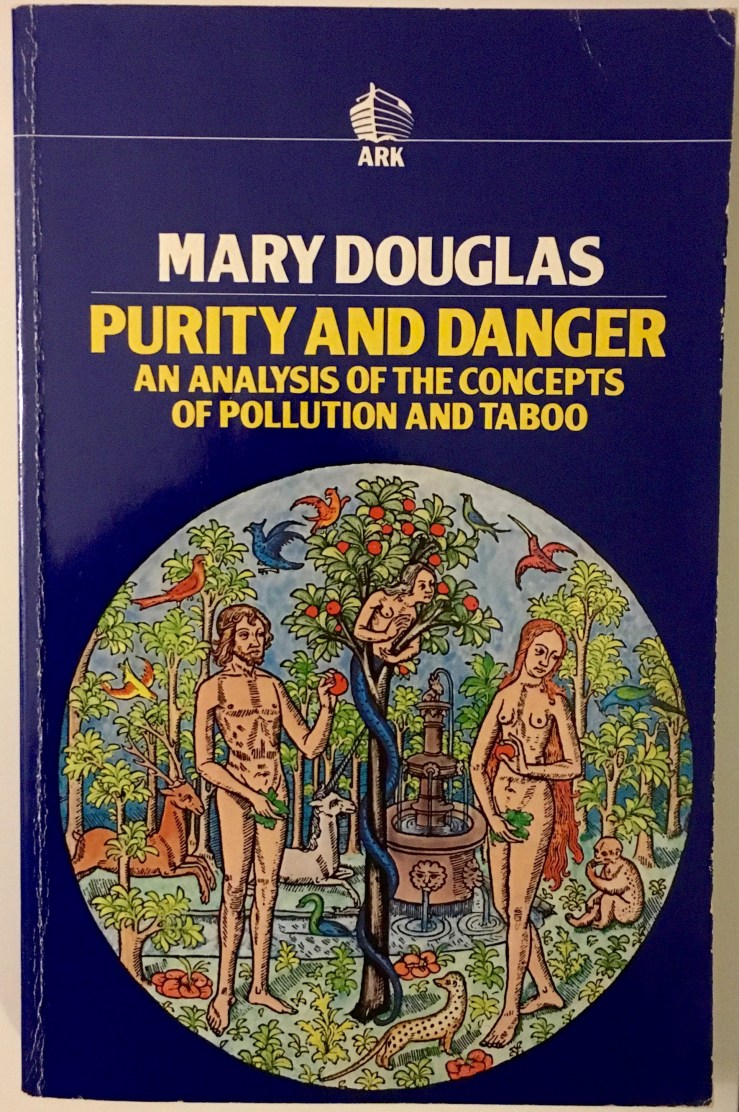
Purity and Danger by Mary Douglas. 1988 trade paperback by ARK. No designer or cover artist credited. I dug this out at some point in my big Le Guin read/re-read, and it’s been hanging around since. Can’t remember why.

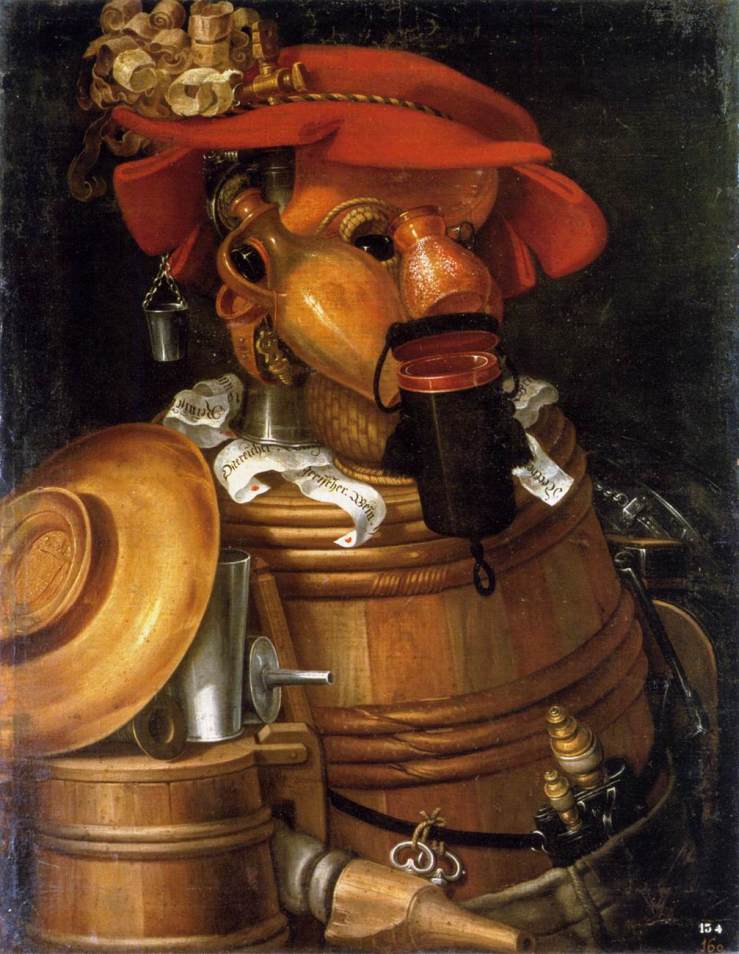
The Waiter — Giuseppe Arcimboldo

4waiter

William S. Burroughs and his friends

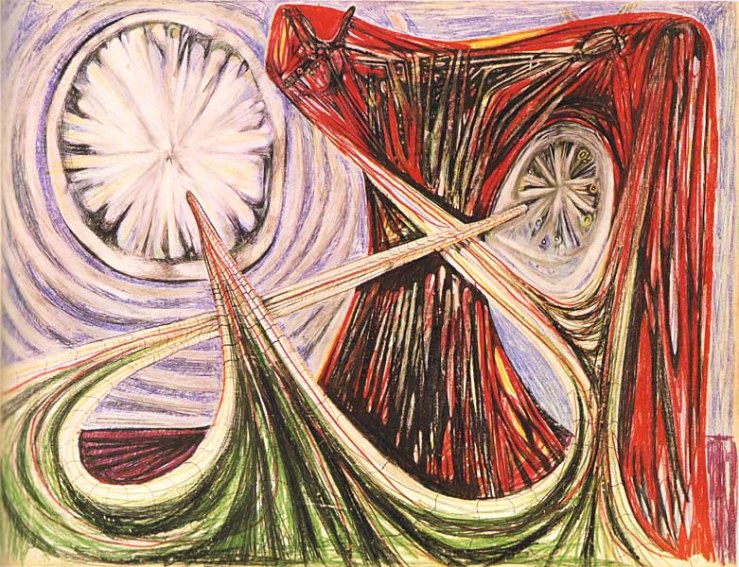
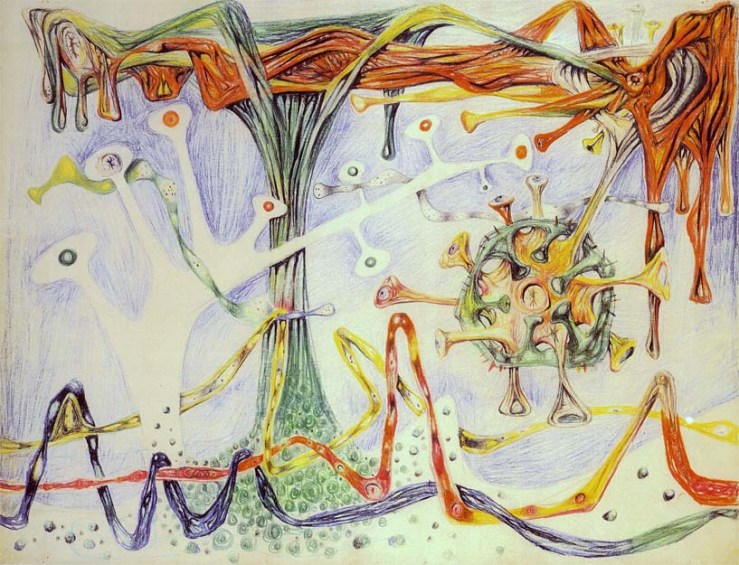
Morphology — Roberto Matta

morphology-1937

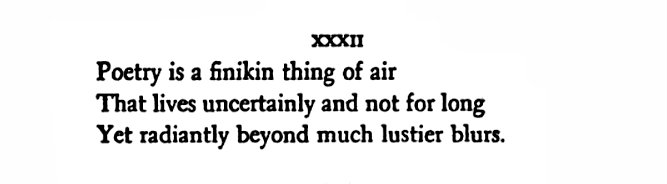
Finikin thing of air (Wallace Stevens)

finikin

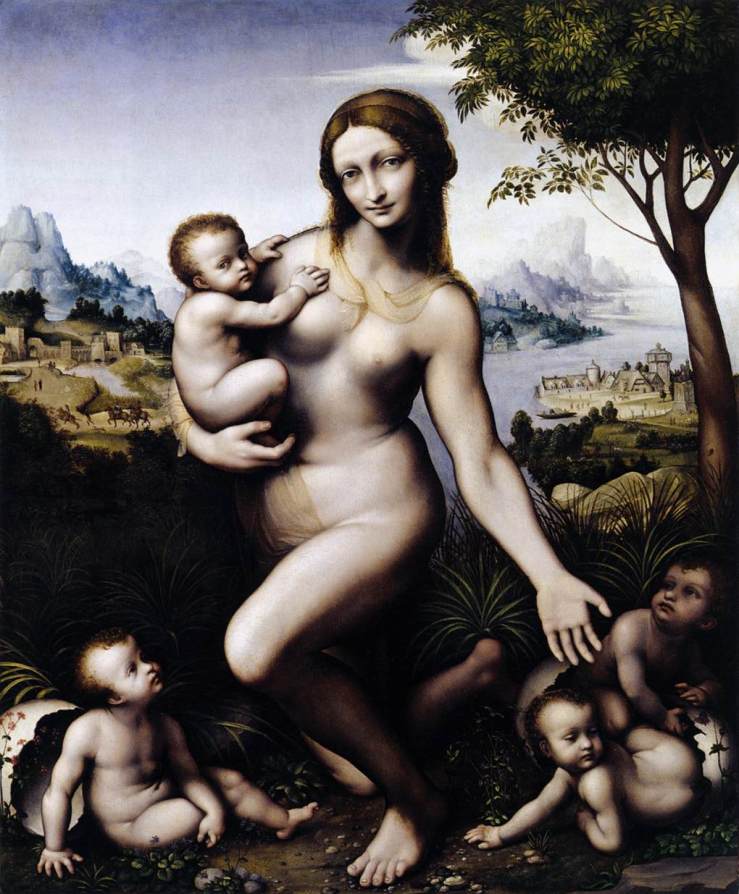
Leda and Her Children — Giampietrino

leda

I find it difficult to believe in Father Christmas (A.A. Milne)

“A Doubtful Character”

by

A.A. Milne


I find it difficult to believe in Father Christmas. If he is the jolly old gentleman he is always said to be, why doesn’t he behave as such? How is it that the presents go so often to the wrong people?

This is no personal complaint; I speak for the world. The rich people get the rich presents, and the poor people get the poor ones. That may not be the fault of Father Christmas; he may be under contract for a billion years to deliver all presents just as they are addressed; but how can he go on smiling? He must long to alter all that. There is Miss Priscilla A—— who gets five guineas worth of the best every year from Mr. Cyril B—— who hopes to be her heir. Mustn’t that make Father Christmas mad? Yet he goes down the chimney with it just the same. When his contract is over, and he has a free hand, he’ll arrange something about THAT, I’m sure. If he is the jolly old gentleman of the pictures his sense of humour must trouble him. He must be itching to have jokes with the parcels. “Only just this once,” he would plead. “Let me give Mrs. Brown the safety-razor, and Mr. Brown the night-dress case; I swear I won’t touch any of the others.” Of course that wouldn’t be a very subtle joke; but jolly old gentlemen with white beards aren’t very subtle in their humour. They lean to the broader effects—the practical joke and the pun. I can imagine Father Christmas making his annual pun on the word “reindeer,” and the eldest reindeer making a feeble attempt to smile. The younger ones wouldn’t so much as try. Yet he would make it so gaily that you would love him even if you couldn’t laugh. Continue reading “I find it difficult to believe in Father Christmas (A.A. Milne)”