Watch Guilty as Charged, a documentary about Harry Crews

Lady Butts — Hans Holbein the Younger

Nathaniel Hawthorne’s journal entry, June 6th, 1844

Concord, June 6th.–. . . Mr. F—- arrived yesterday, and appeared to be in most excellent health, and as happy as the sunshine. About the first thing he did was to wash the dishes; and he is really indefatigable in the kitchen, so that I am quite a gentleman of leisure. Previous to his arrival, I had kindled no fire for four entire days, and had lived all that time on the corned beef, except one day, when Ellery and I went down the river on a fishing excursion. Yesterday, we boiled some lamb, which we shall have cold for dinner to-day. This morning, Mr. F—- fried a sumptuous dish of eels for breakfast. Mrs. P. —- continues to be the instrument of Providence, and yesterday sent us a very nice plum-pudding.

I have told Mr. F—- that I shall be engaged in the forenoons, and he is to manage his own occupations and amusements during that time, . . .

Leo, I regret to say, has fallen under suspicion of a very great crime,–nothing less than murder,–a fowl crime it may well be called, for it is the slaughter of one of Mr. Hayward’s hens. He has been seen to chase the hens, several times, and the other day one of them was found dead. Possibly he may be innocent, and, as there is nothing but circumstantial evidence, it must be left with his own conscience.

Meantime, Mr. Hayward, or somebody else, seems to have given him such a whipping that he is absolutely stiff, and walks about like a rheumatic old gentleman. I am afraid, too, that he is an incorrigible thief. Ellery says he has seen him coming up the avenue with a calf’s whole head in his mouth. How he came by it is best known to Leo himself. If he were a dog of fair character, it would be no more than charity to conclude that he had either bought it, or had it given to him; but with the other charges against him, it inclines me to great distrust of his moral principles. Be that as it may, he managed his stock of provisions very thriftily, burying it in the earth, and eating a portion of it whenever he felt an appetite. If he insists upon living by highway robbery, it would be well to make him share his booty with us. . . .

From Nathaniel Hawthorne’s American Note-Books.

Crumbling — Chris Ware

chris_ware_building_stories_two

“All art constantly aspires towards the condition of music”

Lydia Davis on using found materials in her stories

INTERVIEWER

More and more you seem to use found materials in your stories.

DAVIS

Back in the early eighties, I realized that you could write a story that was really just a narration of something that had happened to you, and change it slightly, without having really to fictionalize it. In a way, that’s found ­material. I think it’s hard to draw the line and say that something isn’t found material. Because if a friend of mine tells me a story or a dream, I guess that’s found material. If I get an e-mail that lends itself to a good story, that’s found material. But then if I notice the cornmeal making little condensations, is that found material? It’s my own, I’m not using text, but I am using a situation that exists. I’m not making it up. I find what happens in reality very interesting and I don’t find a great need to make up things, but I do like retelling stories that are told to me.

INTERVIEWER

The last time I was here you mentioned that you jot things down on scraps of paper. What happens to those scraps?

DAVIS

They pile up in my study. And then I use them. Sometimes when I’m just sort of tidying up, I go through them and type them onto the computer and then either do something with them right away or else I just leave them there for later. When I travel, I carry around a notebook with me. I use notebooks a lot because my brain tends to live in the moment. I’m always afraid of forgetting something.

From the Spring 2015 issue of Paris Review. Lydia Davis’s full interview is now online. She discusses her fiction and translation, recalls taking Grace Paley’s writing class when she was 19, and trying to run away from school after reading Walden.

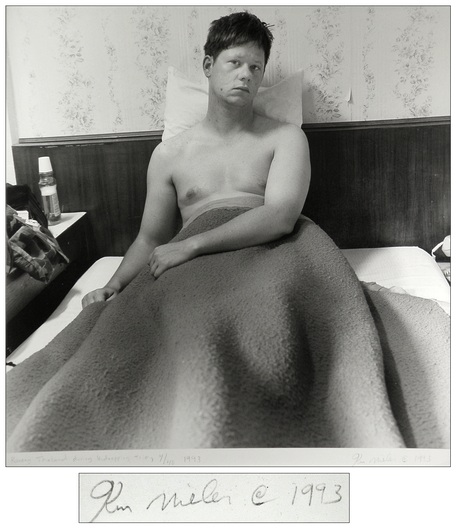
Topless William T. Vollmann

029367

William T. Vollmann photographed by Ken Miller during the, uh, adventures chronicled in Butterfly Stories. (Photo via).

Coffee and Donut — Ralph Goings

coffee-and-donut-2005

School’s Out

“Love is not all” — Edna St. Vincent Millay

Screenshot 2015-05-04 at 7.33.58 PM

An Interview with Christopher K. Coffman and Daniel Lukes, Editors of William T. Vollmann: A Critical Companion (Part 2)

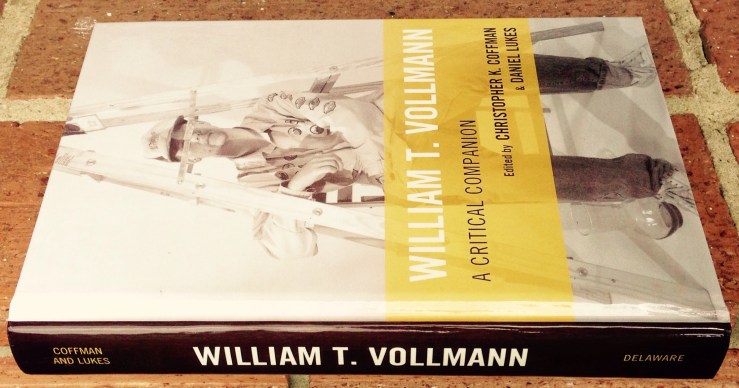
William T. Vollmann: A Critical Companion, newish from University of Delaware Press, collects academic essays and memoir-vignettes by a range of critics and authors to make the case that Vollmann is, as the blurb claims, the “most ambitious, productive, and important living author in the US.” I interviewed the book’s editors, Christopher K. Coffman and Daniel Lukes, over a series of emails in a two-part interview. You can read the first part here. A few days after the first part of the interview posted, Lukes and Coffman hosted a book launch party in NYC for WTV: ACC; the pics in this interview are from that event (check out the Facebook page for more, including Jonathan Franzen reading from his piece on Vollmann).
IMG_6524


Biblioklept: Let’s talk about the formal elements of William T. Vollmann: A Critical Companion. The collection seems to balance essays of a more academic flavor with memoir-vignettes, personal accounts, and riffs.

Christopher K. Coffman: We decided early on to intersperse among the academic essays pieces by non-scholars, or by scholars writing in a non-scholarly mode. The goal here was at least two-fold. We wanted to offer something a bit more accessible to WTV readers who were not in academia (although I think the average WTV fan can follow scholarly arguments as well as many of us in academia can). Also, we realized that some people with a privileged view on WTV’s work–such as those of WTV’s book designers who contributed (Bolte and Speaker Austin)–could add something of interest and great value to audiences in and out of academia, and we wanted to make space for that. I would have to look back through the e-mail log to be sure, but I think Daniel first came up with the idea of soliciting shorter pieces from non-scholars, and that I then conceived the structural component. I am a huge fan of Hemingway’s In Our Time, and the contrapuntal play between the stories and the very short inter-chapters in that book served for me as a paradigm of what Daniel and I have tried to do in this regard. Of course, as soon as we brought up the example of Hemingway, we recalled that WTV does something similar in Thirteen Stories and Thirteen Epitaphs, so he beat us to the punch even there. At any rate, my hope is that our readers find in the short chapterlets material that serves as a response to or as an extension of ideas presented in the more properly scholarly readings that surround those shorter pieces.

The second question of arrangement was the placement of essays and interchapters, and we here grouped according to subject matter as well as we could, without merely replicating what McCaffery and Hemmingson had done for Expelled from Eden. We also, obviously, made space for both Larry and Michael as the authors of the Preface and Afterword. Our intention there, insofar as I can speak for both of us, is to make it clear that we are trying to situate our contribution to scholarship on WTV in relation to the work that Larry and Michael have already done. Finally, I wrote the Introduction not only because one of us had to, but also because Daniel was spoken for in the sense that he already had material that formed the basis for the really great chapter that he contributed. Also, I found the chance to frame the book’s material via an introduction that dealt with WTV’s place in the landscape of post-1945 American fiction appealing. That said, while the introduction bears my byline, my ongoing conversation with Daniel during the past few years shaped my thinking about WTV as much as any original ideas of my own, so he deserves a lot of credit for the introduction as well.

Daniel Lukes: I’ve been going back over the timeline to see if Samuel Cohen and Lee Konstantinou’s edited volume The Legacy of David Foster Wallace, which also features some shorter pieces, was an influence on that, but it looks like we took our approach independently. Though I will say their book did serve as a model in some ways of what ours could be. Dealing with the “non-scholarly” pieces has been for me one of the most exciting parts of putting this book together (the distinction between “scholarlies” and “non-scholarlies” itself being one of the various amusing frameworks that Chris and I have been carrying around throughout the process). From the beginning I thought it would be very helpful to have some of Vollmann’s literary peers chime in: you just don’t hear too much from them about him. So we reached out to writers we thought might be Vollmann readers: some just weren’t (I’d love to know if Cormac McCarthy reads Vollmann: the letter I mailed to a presumed representative of his returned unopened). Some were Vollmann fans/friends, but couldn’t make it for another reason; when Jonathan Franzen came through and expressed his enthusiasm for the project and willingness to contribute a piece, I felt some relief. And James Franco was a pleasure to work with. That said I think the primary value of the non-scholarlies is in the insights they offer into Vollmann’s world and writing practices, from those who have worked closely with him, in particular Carla Bolte, Mary Austin Speaker, and Mariya Gusev’s excellent and vivid pieces. Continue reading “An Interview with Christopher K. Coffman and Daniel Lukes, Editors of William T. Vollmann: A Critical Companion (Part 2)”

Read “Gandalf Goes West,” a short story by Chris Power

“Gandalf Goes West”

by

Chris Power


HAL STANDS IN FRONT OF THE SCREEN. On the screen the words GANDALF GOES EAST.


GO EAST, types Hal.


The cursor flashes.


BILBO GOES EAST, the screen says.


The cursor flashes.


Another line of text appears: GANDALF GOES WEST, it says.


Hal clenches his hands once, twice. He cannot progress in the game without Gandalf. GO WEST, he types.


The cursor flashes.


BILBO GOES WEST, the screen says.


Ben comes into the room and walks over to Hal. He reads the words on the screen from top to bottom:


GANDALF GOES EAST


GO EAST


BILBO GOES EAST


GANDALF GOES WEST


GO WEST


BILBO GOES WEST


GANDALF GOES EAST


Hal turns to Ben. How are you? Hal says.


Ben stares at the screen.


Stay, says Ben.

Read the rest of Chris Power’s short story “Gandalf Goes West” at The White Review.

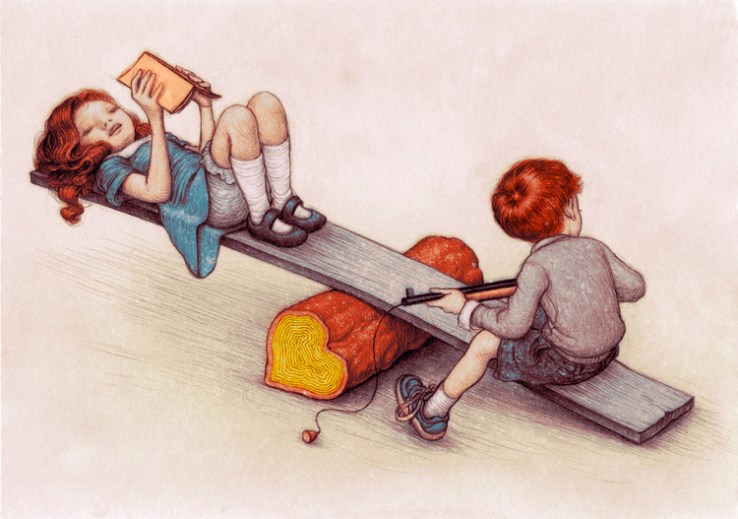
See-Saw — James Jean

seesaw-web

No Zen-type One, always rather Two (Infinite Jest)

How many sub-rosa twins are there, out there, really? What if heredity, instead of linear, is branching? What if it’s not arousal that’s so finitely circumscribed? What if in fact there were ever only like two really distinct individual people walking around back there in history’s mist? That all difference descends from this difference? The whole and the partial. The damaged and the intact. The deformed and the paralyzingly beautiful. The insane and the attendant. The hidden and the blindingly open. The performer and the audience. No Zen-type One, always rather Two, one upside-down in a convex lens.

A passage from David Foster Wallace’s novel Infinite Jest. Thoughts are Joelle Van Dyne’s for those keeping score. The riff reminds me of all the binaries in Gravity’s Rainbow, but maybe only because I just read Gravity’s Rainbow.

Antaeus Setting Down Dante and Virgil in the Last Circle of Hell — William Blake

514484