Read an excerpt of Alejandro Jodorowsky’s psychomagical memoir at BOMB Magazine

BOMB has published an excerpt from filmmaker Alejandro Jodorowsky’s new memoir Where the Bird Sings Best. An excerpt of the excerpt:

In those good old days, Salvador Arcavi, the first of a long series of Salvadors—traditionally all his descendants had the same name—though respectful of the Holy Book, decided he was not to going to be a prisoner to its letters. Following the prophecy Jacob made to his son (“Your hand will be on the neck of your enemy. Your father’s sons will bow down to you. Judah is a young lion.”), he became a lion tamer. His way to draw nearer to God was to study those beasts and to live an itinerant life, giving performances in which his union with his animals surpassed the limits of reality and reached the miraculous. The lions jumped through flaming hoops, balanced on the tight rope, danced on their hind legs, climbed up on one another to form a pyramid, spelled out the name of a spectator by choosing wooden letters, and, the greatest test, accepted within their jaws without hurting it the head of the tamer, then dragged him through the sawdust to draw a six-pointed star.

My ancestor had a simple method for making the beasts love him: he never forced them to do anything, and he made their training into a game. Whenever they wanted to eat, he fed them, and if they decided not to eat, he did not insist. If they wanted to sleep, he let them, and if they were rutting, he let them fornicate without distraction. He adopted the rhythm of the animals with care and tenderness. He let his hair grow into a mane, he ate raw meat, and he slept naked in the cage embracing his lions.

The Green Stocking — Egon Schiele

Even more beautiful emotions (Kafka’s diary entry, 27 March 1912)

27. March. Monday, on the street. The boy who with several others, threw a large ball at a servant girl walking defencelessly in front of them; just as the ball was flying at the girls’ behind I grabbed him by the throat, choked him in a fury, thrust him aside, and swore. Then walked on and didn’t even look at the girl. One quite forgets one’s earthly existence because one is so entirely full of fury is permitted to believe that, given the opportunity, one would in the same way fill oneself with even more beautiful emotions.

Franz Kafka’s diary entry, 27 March 1912. Translation by Joseph Kresh.

The Abduction of Ganymede — Rembrandt

“Rain” — Roberto Bolaño

Watch Hokusai, a short film on the artist’s life by Hiroshi Teshigahara

Africa 39, a compilation of new African writing, and Franzen’s Kraus Project (Books acquired, 3.04.2015)

IMG_5182

Got these as desk copies (as opposed to review copies) a few weeks ago. I’ve been picking through Africa 39 more or less at random, in between stretches of Gravity’s Rainbow. Hit or miss so far, as these affairs so often are. Here’s Margaret Busby, one of the panelists who helped compile the book (from The Guardian):

Africa39 is not an exercise constrained by labels, fashion and preconceived rules about genres, nor by what constitutes African writing. Twenty countries are represented by work created in a variety of African and European languages – Kiswahili, Igbo and Lingala as well as English, French, Spanish and Portuguese. Understandably, with the continuing debate about the validity of the “African writer” category, there are those who feel uncomfortable about participating in this venture (indeed, some have chosen to opt out).

Speaking of Gravity’s Rainbow (sort of), it shows up in Jonathan Franzen’s “translation” of Karl Kraus’s essays. I shouldn’t put translation in those suspicious quotation marks; he does translate—but the book he really wants to write is a memoir in footnotes. Maybe you read the excerpt Harper’s published a few years ago?

Michael Hoffman’s long review at NYRB is good. From that piece:

In the same hands done differently, The Kraus Project could have made an entertainment, an intellectual comedy, a bildungsroman about a clever and ambitious young man on a Fulbright in Germany for a couple of years in the early 1980s. The loneliness of abroad would have come into it, separation from a difficult unbookish family in the Midwest and a bookish difficult fiancée at Columbia; the poststructuralist intellectual fashions of the time; a little local color to evoke the bizarrely wonderful extraterritorial and microideological West Berlin of the cold war; what it felt like to be an American in Germany at the time of the Cruises and Pershings and the SS-20s (what price Germany then, not Austria, as what Kraus called a laboratory for destroying the world?); the overbearing influence of the one novel our hero packed in his suitcase full of French theory—it was Gravity’s Rainbow—and the dual terror exerted on him by Pynchon on the one hand and Harold Bloom on the other.

Such a book would somehow have delivered us to the improbable but finally inescapable conclusion that our young American could find no more apt or fruitful literary father for himself than “the angry, apocalyptic, and arguably megalomaniacal Karl Kraus.” The old curmudgeon took care to express his nolo in advance thus: “Many share my views with me. But I don’t share them with them.” As it happened, he also disdained fiction: not an ideal adopted father.

This rich web of circumstance is all present here (Franzen seems to remember everything, or at least to have kept records of everything), but it is packed away in the garrulous and seedy autobiographical footnotes, often going over many pages. Probably the main life of the book is in these. But there is something earnest and faithful and inflexible in Franzen that won’t let him turn away and ironize his former self—“my feeling [is] that I’m still the same person I was at twenty-two.”

… The entire unstable ensemble has something of the rackety allure of the Bremen Town Musicians, or, if you prefer, a new supergroup: the assiduous, dependable Paul Reitter holding things together on bass, the restrained Daniel Kehlmann good for the occasional off-beat tambourine flick (“But Heine is still wonderful, too”), and Franzen riffing and wailing away on free-form lead and clamorous vocals. The Kraus Project really is one of a kind—a strange, space-bending, Cubist, not un-simpatico book.

Read Kobo Abe’s short story “The Magic Chalk”

“The Magic Chalk”

by

Kobo Abe

Next door to the toilet of an apartment building on the edge of the city, in a room soggy with roof leaks and cooking vapors, lived a poor artist named Argon.

The small room, nine feet square, appeared to be larger than it was because it contained nothing but a single chair set against the wall. His desk, shelves, paint box, even his easel had been sold for bread. Now only the chair and Argon were left. But how long would these two remain?


Dinnertime drew near. “How sensitive my nose has become!” Argon thought. He was able to distinguish the colors and proximity of the complex aromas entering his room. Frying port at the butcher’s along the streetcar line: yellow ocher. A southerly wind drifting by the front of the fruit stand: emerald green. Wafting from the bakery: stimulating chrome yellow. And the fish the housewife below was broiling, probably mackerel: sad cerulean blue.


This fact is, Argon hadn’t eaten anything all day. With a pale face, a wrinkled brow, an Adam’s apple that rose and fell, a hunched back, a sunken abdomen, and trembling knees, Argon thrust both hands into his pocket and yawned three times in succession.


His fingers found a stick in his pocket.


“Hey, what’s this? Red chalk. Don’t remember it being there.”


Playing with the chalk between his fingers, he produced another yawn.


“Aah, I need something to eat.”


Without realizing it, Argon began scribbling on the wall with the chalk. First, an apple. One that looked big enough to be a meal in itself. He drew a paring knife beside it so that he could eat it right away. Next, swallowing hard as baking smells curled through the hallway and window to permeate his room, he drew bread. Jam-filled bread the size of a baseball glove. Butter-filled rolls. a loaf as large as a person’s head. He envisioned glossy browned spots on the bread. Delicious-looking cracks, dough bursting through the surface, the intoxicating aroma of yeast. Beside the bread, then, a stick of butter a large a a brick. He thought of drawing some coffee. Freshly brewed, steaming coffee. In a large jug-like cup. On a saucer, three matchbox-size sugar cubes.


“Damn it!” He ground his teeth and buried his face in his hands. “I’ve got to eat!”


Gradually, his consciousness sank into darkness. Beyond the windowpane was a bread and pastry jungle, a mountain of canned goods, a sea of milk, a beach of sugar, a beef and cheese orchard— he scampered about until, fatigued, he fell asleep. Continue reading “Read Kobo Abe’s short story “The Magic Chalk””

Girl with White Veil — Nicolae Grigorescu

Žižek riffs on Spike Jonze’s film Her, Lacan, sex, a Taco Bell ad, The Lady Eve, and so on and so on

When the Last Chandelier Falls — Jake Wood-Evans

5ed9c0_f76380c9a6564b5db0c28d4b1c298452

Selections from One-Star Amazon Reviews of Flannery O’Connor’s Short Story Collections and Novels

[Editorial note: The following citations come from one-star Amazon reviews of various Flannery O’Connor short story collections and novels. To be clear, I’m a big O’Connor fanI’ve preserved the reviewers’ own styles of punctuation and spelling. More one-star Amazon reviews.].

I wanted to burn it.

I like happy endings.

100 per cent not for me.

I did not finish the book.

This story was agonizing.

I do not like the words used.

To me it was very depressing.

I really, truly hated this book.

The plot was as much a mystery.

They barely even seemed human.

I would not recommend this to anyone.

I had to force myself to finish this book.

I didn’t understand the characters at all.

Not only that, but I really didn’t like them either.

I would never have guessed that the author was female.

I didn’t understand, and I’m fairly certain that I never will.

I think this is the only book I’ve ever felt that I really hated.

One finds it impossible to symapthize or identify with them.

O;Connor is a gifted writer. However this book is dark in tone.

This story just stopped, no solutions to the problems involved.

I think it was a failing of the author to make the character believable.

After reading this book I really need some sunshine and happy voices.

Perhaps most disurbing is the brutal portrayal of violence against children.

Flannery O’Connor is the most depressing writer I have ever had the misfortune to read.

I can’t understand an author who could treat her characters with such callous disregard!

There is little here that resonates with my life’s experiences or my understanding of them.

I would not read this book again without a gun to my head, and I regret ever having picked it up. Continue reading “Selections from One-Star Amazon Reviews of Flannery O’Connor’s Short Story Collections and Novels”

The Woman with the Arrow — Rembrandt

“Maybe” — Langston Hughes

m

Paradise, Adam and Eve — Marcel Duchamp

Read Ursula K. Le Guin’s short story “The Stars Below”

“The Stars Below”

by

Ursula K. Le Guin

The wooden house and outbuildings caught fire fast, blazed up, burned down, but the dome, built of lathe and plaster above a drum of brick, would not burn. What they did at last was heap up the wreckage of the telescopes, the instruments, the books and charts and drawings, in the middle of the floor under the dome, pour oil on the heap, and set fire to that. The flames spread to the wooden beams of the big telescope frame and to the clockwork mechanisms. Villagers watching from the foot of the hill saw the dome, whitish against the green evening sky, shudder and turn, first in one direction then in the other, while a black and yellow smoke full of sparks gushed from the oblong slit: an ugly and uncanny thing to see.

It was getting dark, stars were showing in the east. Orders were shouted. The soldiers came down the road in single file, dark men in dark harness, silent.

The villagers at the foot of the hill stayed on after the soldiers had gone. In a life without change or breadth, a fire is as good as a festival. They did not climb the hill, and as the night grew full dark they drew closer together. After a while they began to go back to their villages. Some looked back over their shoulders at the hill, where nothing moved. The stars turned slowly behind the black beehive of the dome, but it did not turn to follow them.

About an hour before daybreak a man rode up the steep zigzag, dismounted by the ruins of the workshops, and approached the dome on foot. The door had been smashed in. Through it, a reddish haze of light was visible, very dim, coming from a massive support-beam that had fallen and had smoldered all night inward to its core. A hanging, sour smoke thickened the air inside the dome. A tall figure moved there and its shadow moved with it, cast upward on the murk. Sometimes it stooped, or stopped, then blundered slowly on.

The man at the door said: “Guennar! Master Guennar!”

The man in the dome stopped still, looking towards the door. He had just picked up something from the mess of wreckage and half-burnt stuff on the floor. He put this object mechanically into his coat pocket, still peering at the door. He came towards it. His eyes were red and swollen almost shut, he breathed harshly in gasps, his hair and clothes were scorched and smeared with black ash.

“Where were you?”

The man in the dome pointed vaguely at the ground. Continue reading “Read Ursula K. Le Guin’s short story “The Stars Below””

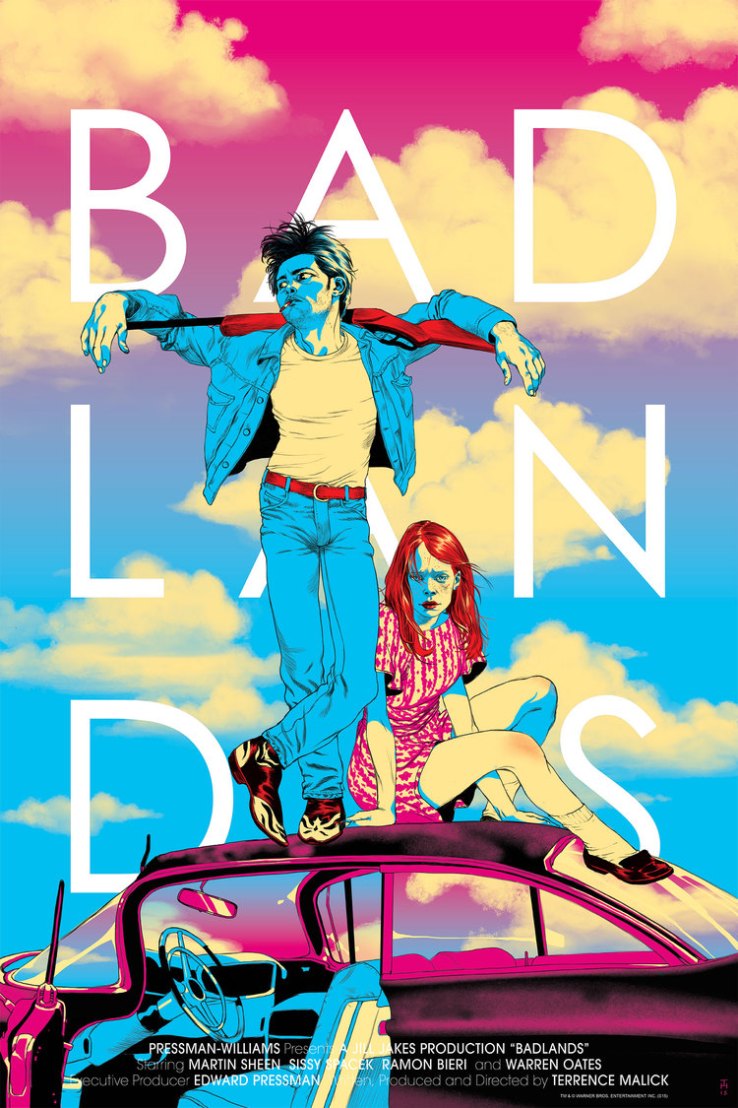
Film Poster for Terrence Malick’s Badlands — Tomer Hanuka

badlands_blue_72