Read Philip K. Dick’s early short story “Piper in the Woods”

“WELL, Corporal Westerburg,” Doctor Henry Harris said gently, “just why do you think you’re a plant?”

As he spoke, Harris glanced down again at the card on his desk. It was from the Base Commander himself, made out in Cox’s heavy scrawl: Doc, this is the lad I told you about. Talk to him and try to find out how he got this delusion. He’s from the new Garrison, the new check-station on Asteroid Y-3, and we don’t want anything to go wrong there. Especially a silly damn thing like this!

Harris pushed the card aside and stared back up at the youth across the desk from him. The young man seemed ill at ease and appeared to be avoiding answering the question Harris had put to him. Harris frowned. Westerburg was a good-looking chap, actually handsome in his Patrol uniform, a shock of blond hair over one eye. He was tall, almost six feet, a fine healthy lad, just two years out of Training, according to the card. Born in Detroit. Had measles when he was nine. Interested in jet engines, tennis, and girls. Twenty-six years old.

“Well, Corporal Westerburg,” Doctor Harris said again. “Why do you think you’re a plant?”

The Corporal looked up shyly. He cleared his throat. “Sir, I am a plant, I don’t just think so. I’ve been a plant for several days, now.”

“I see.” The Doctor nodded. “You mean that you weren’t always a plant?”

“No, sir. I just became a plant recently.”

“And what were you before you became a plant?”

“Well, sir, I was just like the rest of you.”

There was silence. Doctor Harris took up his pen and scratched a few lines, but nothing of importance came. A plant? And such a healthy-looking lad! Harris removed his steel-rimmed glasses and polished them with his handkerchief. He put them on again and leaned back in his chair. “Care for a cigarette, Corporal?”

“No, sir.”

The Doctor lit one himself, resting his arm on the edge of the chair. “Corporal, you must realize that there are very few men who become plants, especially on such short notice. I have to admit you are the first person who has ever told me such a thing.”

“Yes, sir, I realize it’s quite rare.”

“You can understand why I’m interested, then. When you say you’re a plant, you mean you’re not capable of mobility? Or do you mean you’re a vegetable, as opposed to an animal? Or just what?”

The Corporal looked away. “I can’t tell you any more,” he murmured. “I’m sorry, sir.”

“Well, would you mind telling me how you became a plant?”

Corporal Westerburg hesitated. He stared down at the floor, then out the window at the spaceport, then at a fly on the desk. At last he stood up, getting slowly to his feet. “I can’t even tell you that, sir,” he said.

“You can’t? Why not?”

“Because—because I promised not to.”

Read the rest of “Piper in the Woods” by Philip K. Dick at Gutenberg. (And consider donating a buck or five or ten or more while you’re there).
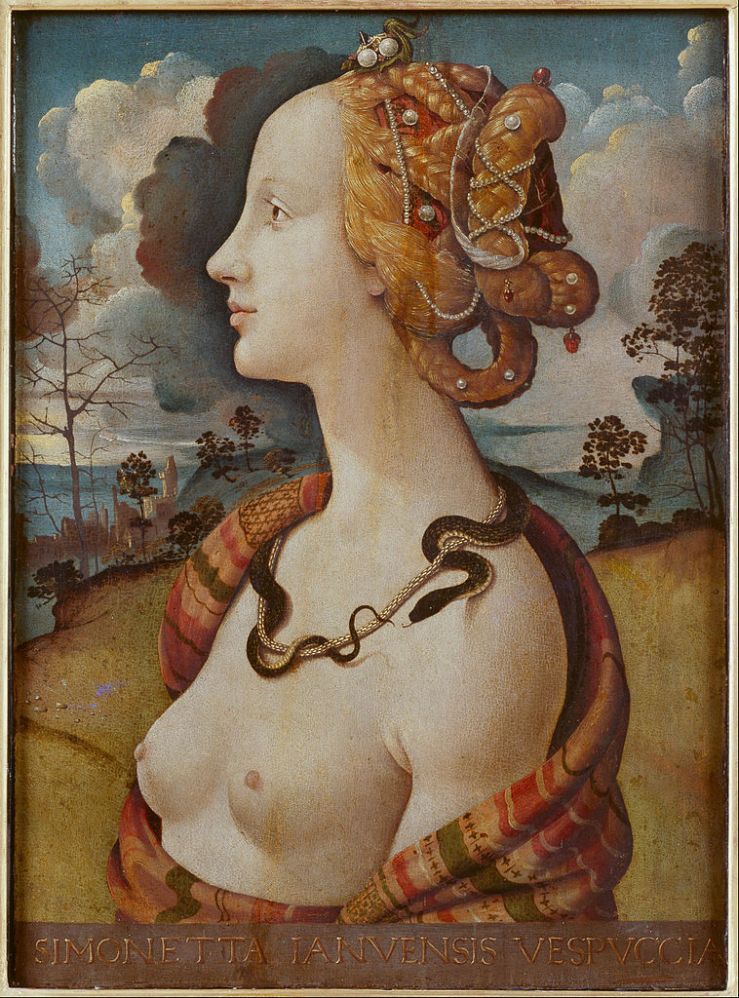
Portrait of Simonetta Vespucci as Cleopatra — Piero di Cosimo

portrait-of-simonetta-vespucci-as-cleopatra-1490

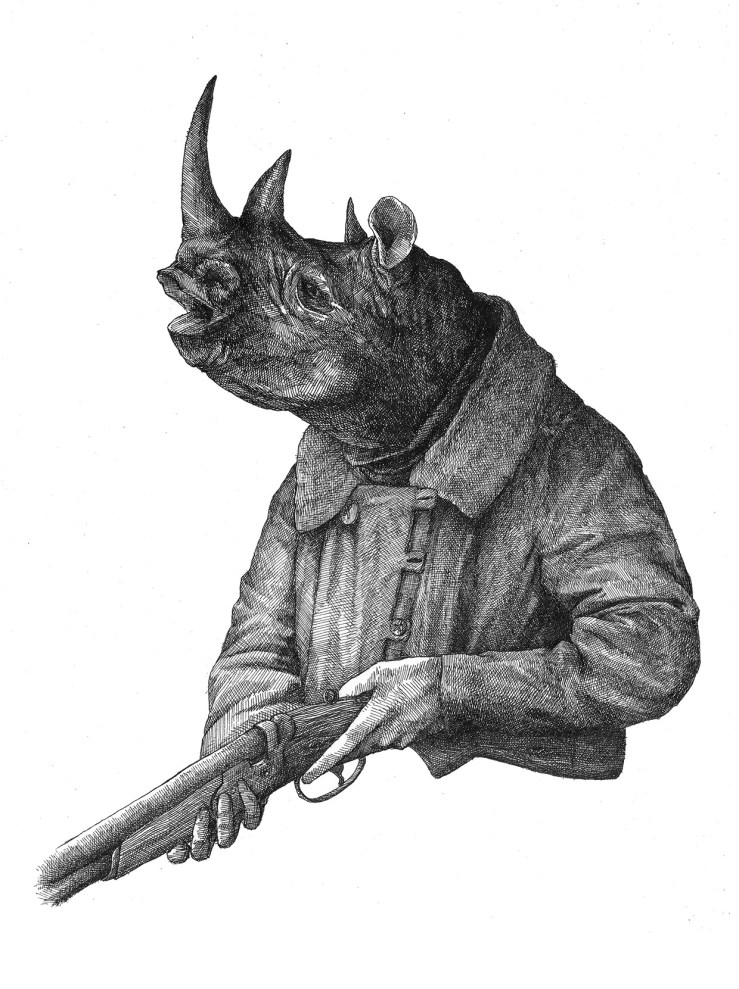
Fable II — Theo Jan

09ce5630683741.562e8af5bdb92

Woman with a Cat — Francesco Bacchiacca

womancat

“The pedigree of honey” — Emily Dickinson

honey

“Yonder Blue” — Tortoise

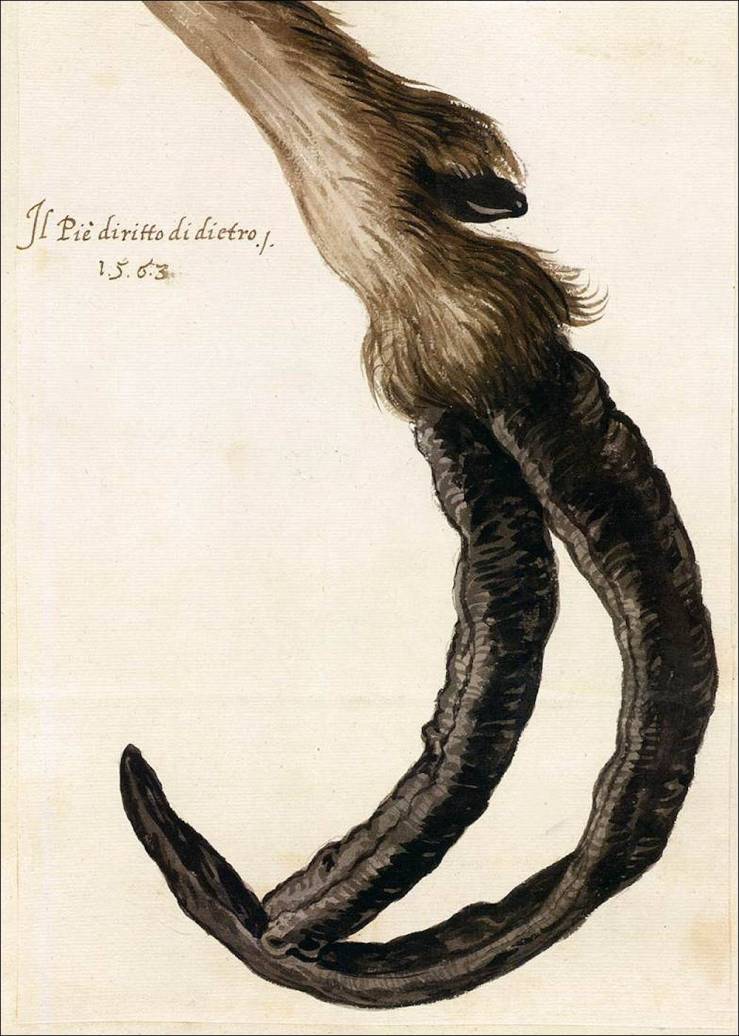
Study of Goat’s Deformed Hoof — Giuseppe Arcimboldo

65-1563-c2b7-giuseppe-arcimboldi-c2b7-study-of-a-goats-deformed-hoof

They Like to Dress — Leonor Fini

Leonor Fini-They Like to Dress-1948

“Blue and Green” — Virginia Woolf

“Blue and Green”

by

Virginia Woolf

from Monday or Tuesday


GREEN

The pointed fingers of glass hang downwards. The light slides down the glass, and drops a pool of green. All day long the ten fingers of the lustre drop green upon the marble. The feathers of parakeets—their harsh cries—sharp blades of palm trees—green, too; green needles glittering in the sun. But the hard glass drips on to the marble; the pools hover above the dessert sand; the camels lurch through them; the pools settle on the marble; rushes edge them; weeds clog them; here and there a white blossom; the frog flops over; at night the stars are set there unbroken. Evening comes, and the shadow sweeps the green over the mantelpiece; the ruffled surface of ocean. No ships come; the aimless waves sway beneath the empty sky. It’s night; the needles drip blots of blue. The green’s out.


BLUE

The snub-nosed monster rises to the surface and spouts through his blunt nostrils two columns of water, which, fiery-white in the centre, spray off into a fringe of blue beads. Strokes of blue line the black tarpaulin of his hide. Slushing the water through mouth and nostrils he sings, heavy with water, and the blue closes over him dowsing the polished pebbles of his eyes. Thrown upon the beach he lies, blunt, obtuse, shedding dry blue scales. Their metallic blue stains the rusty iron on the beach. Blue are the ribs of the wrecked rowing boat. A wave rolls beneath the blue bells. But the cathedral’s different, cold, incense laden, faint blue with the veils of madonnas.

Sleeping Groom and Sorceress — Hans Baldung

sleeping-groom-and-sorceress-1544

Three Books

img_1392

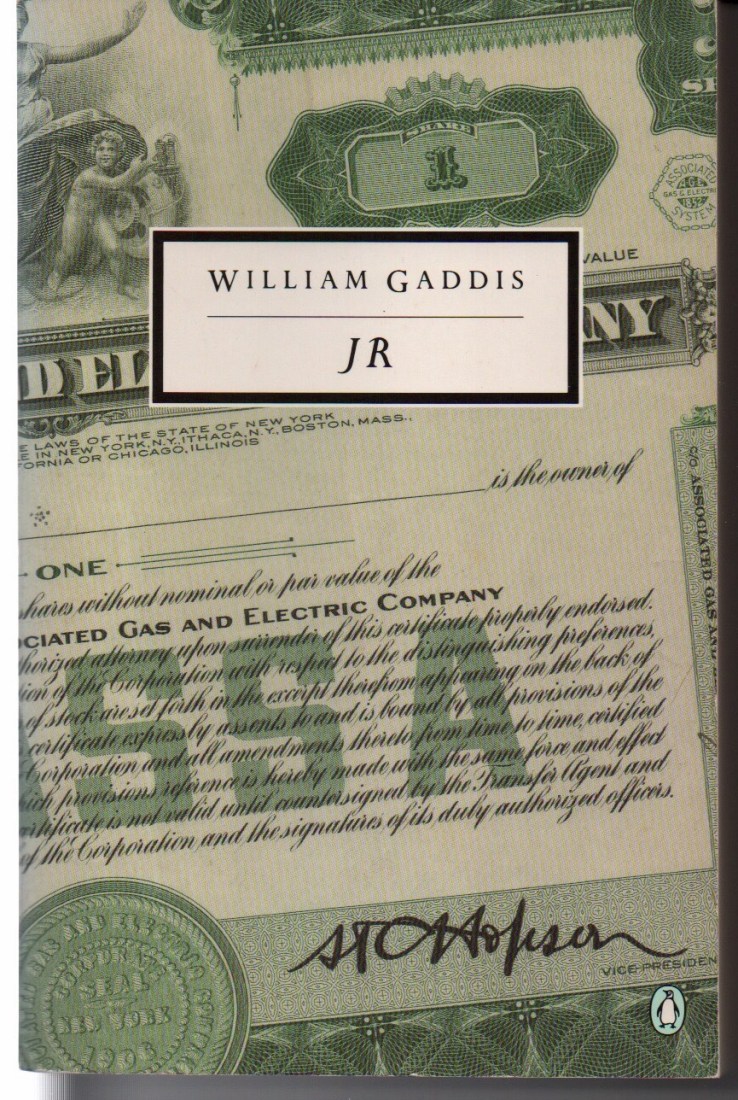
J R by William Gaddis. 1993 trade paperback edition by Penguin. Cover art is a detail of an Associated Gas and Electric Company stock certificate “Courtesy of William Gaddis.” No designer credited.

img_1391

Infinite Jest by David Foster Wallace. 1997 first paperback printing edition by Abacus (Great Britain). No designer credited.

img_1394

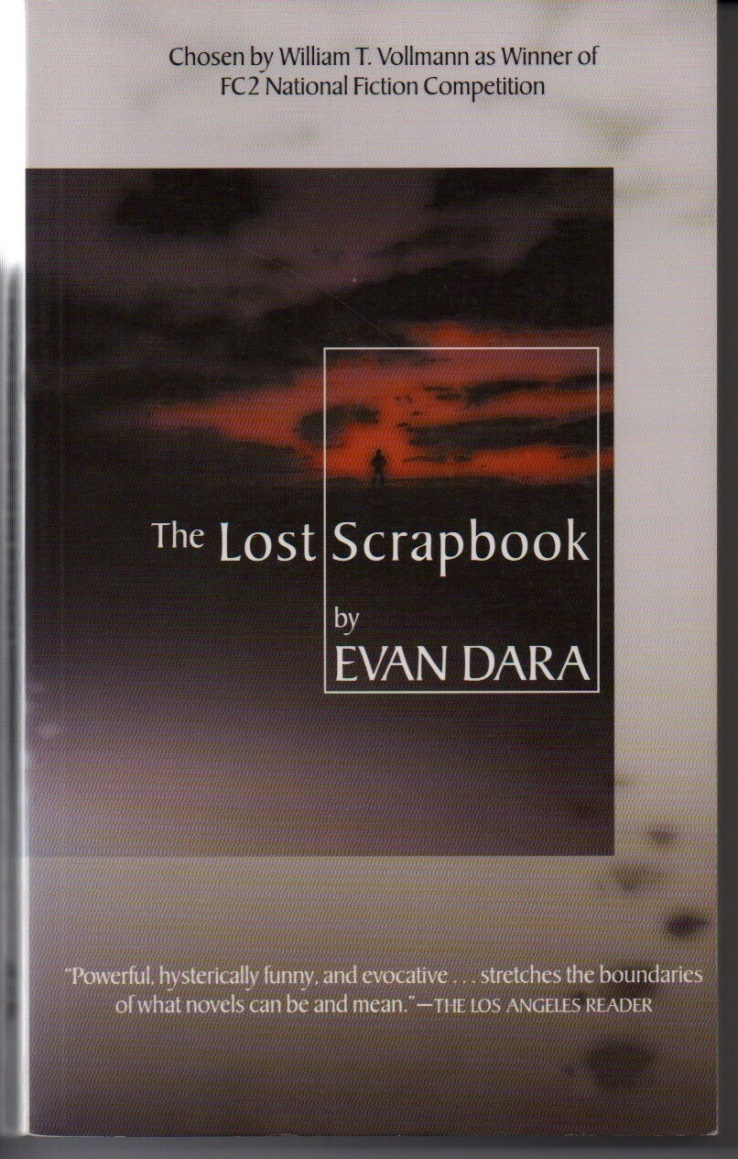
The Lost Scrapbook by Evan Dara. First paperback printing by Aurora, 1998. Cover design by Todd Michael Bushman.

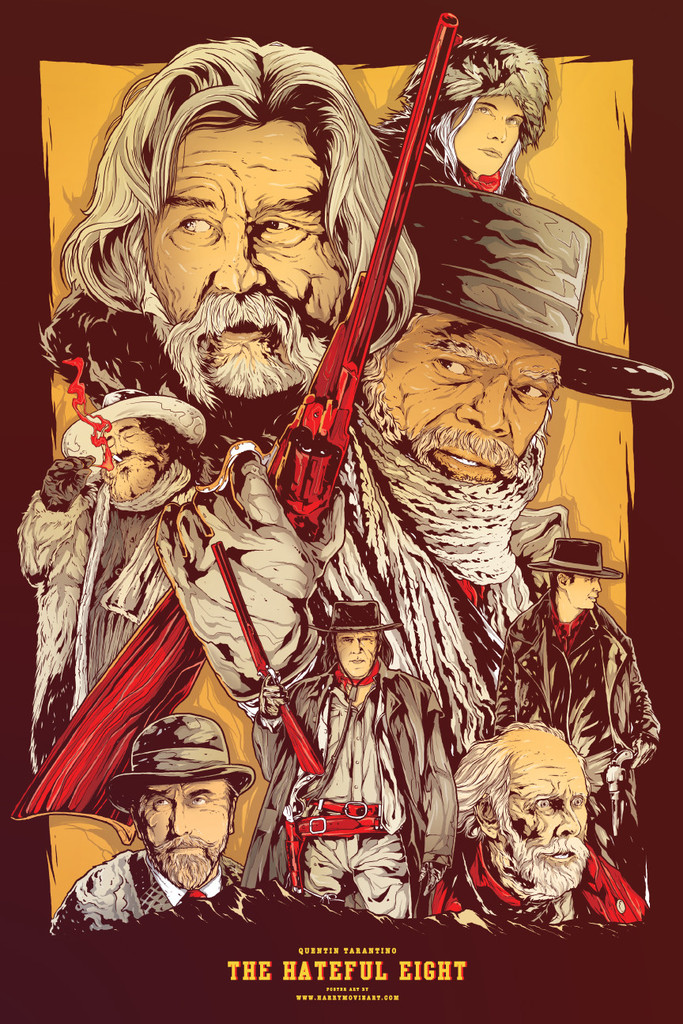
Does anything good happen in The Hateful Eight?

Hateful-eight-12x18_1024x1024

I don’t like films where nothing good happens, my wife told me years ago. I can’t remember the film that occasioned this remark, and I don’t find myself beholden to her rubric, but I still find myself applying it to films now and then. Especially after watching Quentin Tarantino’s The Hateful Eight.

Does anything good happen in The Hateful Eight?

(This is not the right question to ask about a film, but—).

This question isn’t the same as, say, Is any part of The Hateful Eight good?—because so many of the elements are good—excellent even—Ennio Morricone’s score, Robert Richardson’s cinematography, Yohei Taneda’s set design.

And the acting is great, or sorta great, or it’s hard to tell, maybe. Let’s say the performances are great. I mean, it’s Tarantino, so the acting is always at least one level removed from reality—even in Sam Jackson, the realest dude, the dude who carries the film as former Union officer, Major Marquis Warren. Sam Jackson is Tarantino’s main man, his star of hyperreality, and his performance is electric here.

But for hyperreality, it’s Jennifer Jason Leigh who stands out in The Hateful Eight. Her portrayal of prisoner Daisy Domergue is refined Looney Tunes slapstick. Cartoon soul. Watching Walton Goggins (vile racist ex-Confederate marauder Chris Mannix) or Kurt Russell (bounty hunter John Ruth)—both of whom get lots and lots of lines and screen time—one can’t help but realize one is seeing an actor acting—or, more Tarantinoesque—a character acting.

But Jennifer Jason Leigh, remanded to a punching bag for much of the film—or even stranger, a chained work-wife to Kurt Russell’s John Wayne parody (via Kurt Russell’s John Wayne parody as Jack Burton in Big Trouble in Little Trouble)—JJL imbues her Daisy Domergue with a wily pathos that surpasses both the script she’s made to read and her Seussian name.

Not that JJL’s Daisy Domergue’s isn’t vile, nasty, deeply racist, and hateful…but her hatefulness points towards something, I dunno, complex. Real. True. (I should mention now Laura Bogart’s essay “Hipster Misogyny: The Betrayal of The Hateful Eight,” which I think offers an intriguing read on the film. Bogart seems to argue that JJL’s DD is not complex enough, or not given enough complexity, which, hey, okay, fair enough—but I think also that Bogart was disturbed by the film’s conclusion—which I was too, disturbed). 

But: Does anything good happen in The Hateful Eight?

What do I mean here by good? Should I just admit I don’t know “good,” but rather feel “good”? Okay. I don’t know good through definition, but rather by example. Fuzzy precis. Good: Perhaps a moment of redemption, but like, say, an earned one, a real one, one not forced through a Hollywood formula. Good might be kernel of hope—a real moment of hope, not just an up established for a foreshadowed down. Or maybe by good I just mean something aesthetically true.

Tarantino’s best films—the Kill Bill films, Pulp FictionJackie Brown, and Reservoir Dogs—point to something good in their conclusions—and by conclusions I mean both literal endings and thesis statements. I’m not sure if I find this same “goodness” evident in the conclusion of The Hateful Eight, or, if it is there, it’s awfully ambiguous.

The conclusion of The Hateful Eight is the not-exact opposite of the end of my favorite Tarantino conclusion, the end of Kill Bill 2:

img_0370

And The Hateful Eight’s conclusion is the not-exact opposite of the ending of Jackie Brown’s bittersweet take on redemption, loss, and escape—American lives that earn second acts.

And The Hateful Eight’s conclusion is the not-exact opposite of the ending Pulp Fiction, a film that resurrects Vincent Vega and sees Sam Jackson’s Jules Winnfield suspend wrathful violence and judgment on Tim Roth’s Ringo (or Pumpkin. Or whatever his name was).

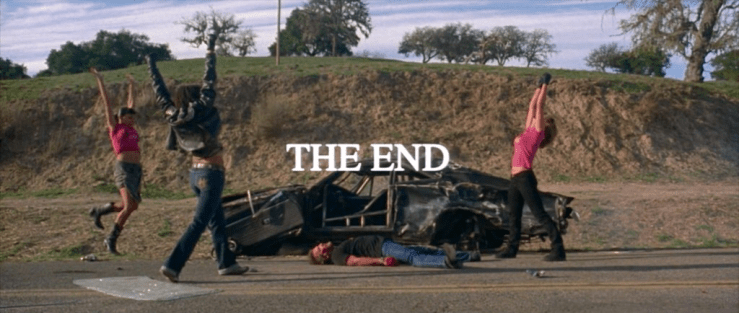
And what about those films that didn’t make my silly little list of “Best Tarantino” — Inglorious Basterds (which is one of my faves, actually, just to watch for like, pure entertainment), Django Unchained, and Death Proof (which actually belongs on that best-of list, maybe, or at least the final sequence)? Shoshanna Dreyfus using film as weapon to end the Nazis? Django’s righteous rampage against slavery? Or the ecstatic violence of “the girls” destroying serial killer Stuntman Mike?

img_0372

What most of QT’s conclusions share in common is that they somehow mediate the relationship between revenge and justice, and do so in a way that’s aesthetically convincing. The Hateful Eight also seeks to be a film about the relationship between revenge and justice. Its final moments attempt to aesthetically recapitulate much of American history into a morbid sequence of violence.

[Fair warning: There’s a discussion of the conclusion of The Hateful Eight coming up, including what some folks might call spoilers].

Continue reading “Does anything good happen in The Hateful Eight?”

A New York Blizzard — Childe Hassam

a-new-york-blizzard

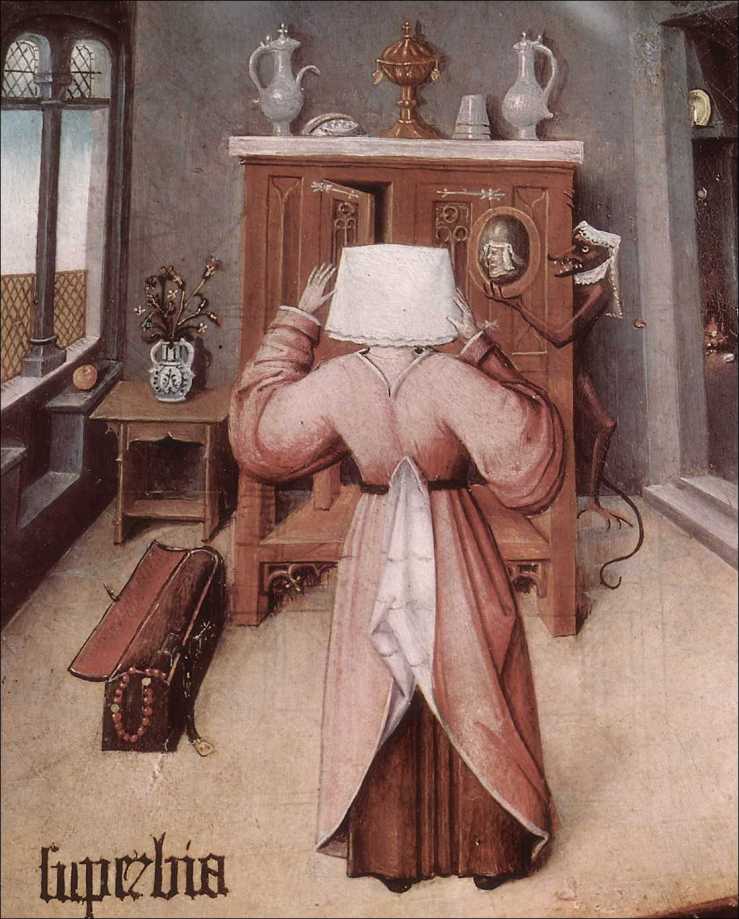
Pride — Hieronymus Bosch

1480-1520-c2b7-hieronymus-bosch-c2b7-superbia

“When Thy Song Flows Through Me” — Bonnie ‘Prince’ Billy

The Bridge — Mike Davis

the bridge

Funtime