With a wildly excited Bendicò bounding ahead of him he went down the short flight of steps into the garden. Enclosed between three walls and a side of the house, its seclusion gave it the air of a cemetery, accentuated by the parallel little mounds bounding the irrigation canals and looking like the graves of very tall, very thin giants. Plants were growing in thick disorder on the reddish clay, flowers sprouted in all directions, and the myrtle hedges seemed put there to prevent movement rather than guide it. At the end a statue of Flora speckled with yellow-black lichen exhibited her centuries-old charms with an air of resignation; on each side were benches holding quilted cushions, also of gray marble; and in a corner the gold of an acacia tree introduced a sudden note of gaiety. Every sod seemed to, exude a yearning for beauty soon muted by languor.
But the garden, hemmed and almost squashed between these barriers, was exhaling scents that were cloying, fleshy, and slightly putrid, like the aromatic liquids distilled from the relics of certain saints; the carnations superimposed their pungence on the formal fragrance of roses and the oily emanations of magnolias drooping in corners; and somewhere beneath it all was a faint smell of mint mingling with a nursery whiff of acacia and the jammy one of myrtle; from a grove beyond the wall came an erotic waft of early orange blossom.
It was a garden for the blind: a constant offense to the eyes, a pleasure strong if somewhat crude to the nose. The Paul Neyron roses, whose cuttings he had himself bought in Paris, had degenerated; first stimulated and then enfeebled by the strong if languid pull of Sicilian earth, burned by apocalyptic Julies, they had changed into things like flesh-colored cabbages, obscene and distilling a dense, almost indecent, scent which no French horticulturist would have dared hope for. The Prince put one under his nose and seemed to be sniffing the thigh of a dancer from the Opera. Bendicò, to whom it was also proffered, drew back in disgust and hurried off in search of healthier sensations amid dead lizards and manure.
But the heavy scents of the garden brought on a gloomy train of thought for the Prince: “It smells all right here now; but a month ago… ”
He remembered the nausea diffused throughout the entire villa by certain sweetish odors before their cause was traced: the corpse of a young soldier of the Fifth Regiment of Sharpshooters who had been wounded in the skirmish with the rebels at San Lorenzo and come up there to die, all alone, under a lemon tree. They had found him lying face downward in the thick clover, his face covered in blood and vomit, his nails dug into the soil, crawling with ants; a pile of purplish intestines had formed a puddle under his bandoleer. Russo, the agent, had discovered this object, turned it over, covered its face with his red kerchief, thrust the guts back into the gaping stomach with some twigs, and then covered the wound with the blue flaps of the cloak; spitting continuously with disgust, meanwhile, not right on, but very near the body. And all this with meticulous care. “Those swine stink even when they’re dead.” It had been the only epitaph to that derelict death.
After other soldiers, looking bemused, had taken the body away (and yes, dragged it along by the shoulders to the cart so that the puppet’s stuffing fell out again), a De Profundis for the soul of the unknown youth was added to the evening Rosary; and now that the conscience of the ladies in the house seemed placated, the subject was never mentioned again.
The Prince went and scratched a little lichen off the feet of the Flora and then began to stroll up and down; the lowering sun threw an immense shadow of him over the gravelike flower beds.
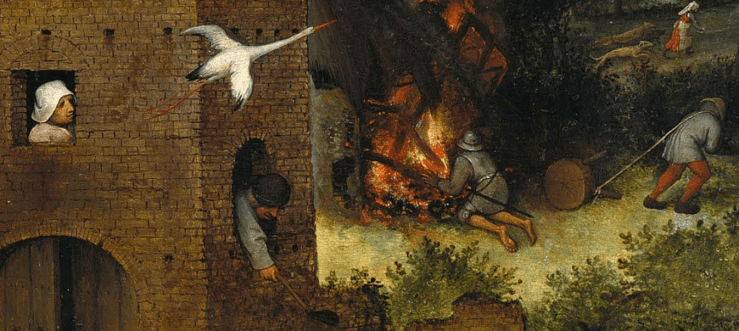
From Giuseppe di Lampedusa’s 1958 novel The Leopard. English translation by Archibald Colquhoun.
The Left Hand of Darkness by Ursula K. Le Guin. First edition mass market paperback from Ace Books, 1969. The marvelous Klimtish cover is by Leo & Diane Dillon. I wrote about the novel here.
The Order of the Day by Marcio Souza. English translation by Thomas Colchie. First edition mass market trade paperback by Bard/Avon, 1986. No illustrator credited.
Neuromancer by William Gibson. 1988 mass market trade paperback by Ace Books. Cover art by Richard Berry. A friend foisted this on me; I never gave it back, which was wrong. I don’t think I can overstate how important this book (and the following two in the so-called “Sprawl Trilogy”) were to me in the late nineties. In fact, Gibson was one of the first things I wrote about on this blog. (Don’t click on that link; the early days of this blog were Bad).
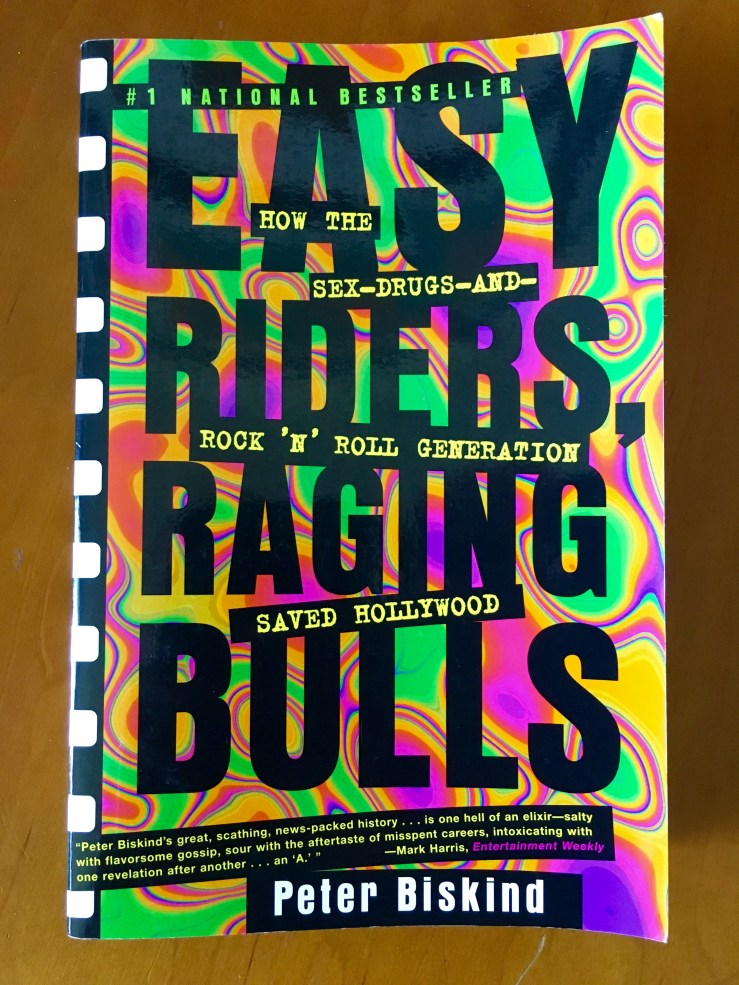
Peter Biskind’s Easy Riders, Raging Bulls has been on my radar forever (or at least since its publication in the late nineties), but I’d resisted picking it up until earlier this week—maybe because of its awful, awful cover (good lord), or maybe because of that off-putting subtitle, which just seems to scream, Boomer mythologies!
But after watching William Friedkin’s Sorcerer a third time, I wanted to read about the film, and Biskind’s book was easy to find used and so well hey. Of course I skipped to the index, and found enough pages on Sorcerer to take the book home. I read those pages at home, right away, with mounting disappointment, or frustration, rather. Biskind’s dishy, bitchy style is annoying, (although I assuaged the bad prose by reading the whole thing, as best as I could, in a Robert Evans accent) and beyond the bad prose is a paucity of information about, like, the actual filmmaking behind Sorcerer. It might be interesting to some people that Friedkin was a total asshole to his girlfriend, but I guess I wanted to know about the work, y’know? At least there’s a whole bunch of stuff on Heaven’s Gate too.
So well anyway, I read the introduction to the book and I can see how it does seem promising, but there’s also something deeply frustrating about Biskind’s approach (from the outset, anyway)—he seems to want to valorize the Baby Boomers at every turn. He introduces the first wave of the heroes of his book at “white men born in the mid- to late ’30s” without a hint of irony, noting that the “second wave was made up of the early boomers.” Of course it’s the names of the heroes that attract the reader: Bogdanovich, Coppola, Nichols, Scorsese, Malick, De Palma, etc. (It’s also sort of fascinating that even in the late ’90s, Biskind, a few paragraphs later, parses the “new group of actors” he lauds (Nicholson, De Niro, Keitel, et al) from “the women,” the “new faces.” Yeesh). My guess is that I’ll pick at this book as I watch and/or re-watch the films of the decade it valorizes—the films of the ’70s—the films that it so boomerishly insists were The Last Great Golden Age of Film Never to Be Replicated Again, Nope, That’s All Folks.
Here’s the trailer for Friedkin’s Sorcerer (the soundtrack is by Tangerine Dream, who also scored Michael Mann’s 1981 film Thief. Mann is not indexed in Easy Riders, Raging Bulls):
Concord, August 5th.–A rainy day,–a rainy day. I am commanded to take pen in hand, and I am therefore banished to the little ten-foot-square apartment misnamed my study; but perhaps the dismalness of the day and the dulness of my solitude will be the prominent characteristics of what I write. And what is there to write about? Happiness has no succession of events, because it is a part of eternity; and we have been living in eternity ever since we came to this old manse. Like Enoch, we seem to have been translated to the other state of being without having passed through death. Our spirits must have flitted away unconsciously, and we can only perceive that we have cast off our mortal part by the more real and earnest life of our souls. Externally, our Paradise has very much the aspect of a pleasant old domicile on earth. This antique house–for it looks antique, though it was created by Providenceexpressly for our use, and at the precise time when we wanted it–stands behind a noble avenue of balm-of-Gilead trees; and when we chance to observe a passing traveller through the sunshine and the shadow of this long avenue, his figure appears too dim and remote to disturb the sense of blissful seclusion. Few, indeed, are the mortals who venture within our sacred precincts. George Prescott, who has not yet grown earthly enough, I suppose, to be debarred from occasional visits to Paradise, comes daily to bring three pints of milk from some ambrosial cow; occasionally, also, he makes an offering of mortal flowers. Mr. Emerson comes sometimes, and has been feasted on our nectar and ambrosia. Mr. Thoreau has twice listened to the music of the spheres, which, for our private convenience, we have packed into a musical-box. E—- H—- , who is much more at home among spirits than among fleshly bodies, came hither a few times merely to welcome us to the ethereal world; but latterly she has vanished into some other region of infinite space. One rash mortal, on the second Sunday after our arrival, obtruded himself upon us in a gig. There have since been three or four callers, who preposterously think that the courtesies of the lower world are to be responded to by people whose home is in Paradise. I must not forget to mention that the butcher conies twice or thrice a week; and we have so far improved upon the custom of Adam and Eve, that we generally furnish forth our feasts with portions of some delicate calf or lamb, whose unspotted innocence entitles them to the happiness of becoming our sustenance. Would that I were permitted to record the celestial dainties that kind Heaven provided for us on the first day of ourarrival! Never, surely, was such food heard of on earth,–at least, not by me. Well, the above-mentioned persons are nearly all that have entered into the hallowed shade of our avenue; except, indeed, a certain sinner who came to bargain for the grass in our orchard, and another who came with a new cistern. For it is one of the drawbacks upon our Eden that it contains no water fit either to drink or to bathe in; so that the showers have become, in good truth, a godsend. I wonder why Providence does not cause a clear, cold fountain to bubble up at our doorstep; methinks it would not be unreasonable to pray for such a favor. At present we are under the ridiculous necessity of sending to the outer world for water. Only imagine Adam trudging out of Paradise with a bucket in each hand, to get water to drink, or for Eve to bathe in! Intolerable! (though our stout handmaiden really fetches our water.) In other respects Providence has treated us pretty tolerably well; but here I shall expect something further to be done. Also, in the way of future favors, a kitten would be very acceptable. Animals (except, perhaps, a pig) seem never out of place, even in the most paradisiacal spheres. And, by the way, a young colt comes up our avenue, now and then, to crop the seldom-trodden herbage; and so does a company of cows, whose sweet breath well repays us for the food which they obtain. There are likewise a few hens, whose quiet cluck is heard pleasantly about the house. A black dog sometimes stands at the farther extremity of the avenue, and looks wistfully hitherward; but when I whistle to him, he puts his tail between his legs, and trots away. Foolish dog! if he had more faith, he should have bones enough.
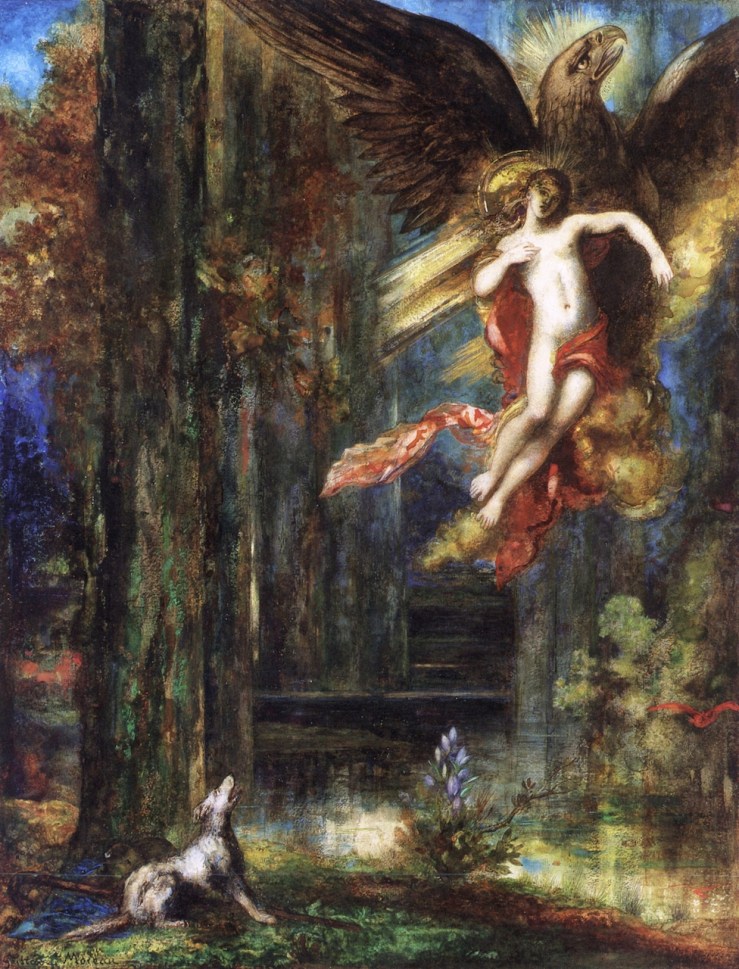
In the beginning Dardanus was the son of Jove, and founded Dardania, for Ilius was not yet stablished on the plain for men to dwell in, and her people still abode on the spurs of many-fountained Ida. Dardanus had a son, king Erichthonius, who was wealthiest of all men living; he had three thousand mares that fed by the water-meadows, they and their foals with them. Boreas was enamoured of them as they were feeding, and covered them in the semblance of a dark-maned stallion. Twelve filly foals did they conceive and bear him, and these, as they sped over the rich plain, would go bounding on over the ripe ears of corn and not break them; or again when they would disport themselves on the broad back of Ocean they could gallop on the crest of a breaker. Erichthonius begat Tros, king of the Trojans, and Tros had three noble sons, Ilus, Assaracus, and Ganymede who was comeliest of mortal men; wherefore the gods carried him off to be Jove’s cupbearer, for his beauty’s sake, that he might dwell among the immortals.
From Book XX of The Iliad (translation by Samuel Butler).









 Biblioklept