Darwin anecdote (David Markson)

A review of The Paris Review’s overproduced podcast

64100a01b64641e5115c2c856d12fd7e_89081506

In his introduction to the first episode of The Paris Review Podcast, former editor Lorin Stein tells us that we’re going to hear some great writing. He then claims, “what you won’t hear is much in the way of hosting from me or anyone else. We’re just going to let the writing speak for itself, the way it always has in the magazine.” The first two parts are true—there’s plenty of great writing here from The Paris Review archive, and there’s no one hosting the pieces. The last part of Stein’s claim is the problem though: The Paris Review Podcast repeatedly refuses to simply let the writing speak for itself. Prose and poems alike are slathered in distracting and silly sound effects and busy musical cues. This is a shame, because the estimable voice talents the producers have enlisted do a marvelous job conveying the tones, mood, and rhythms of the pieces the producers have selected (most of which are excellent). Perhaps the podcast’s producers simply don’t trust their readers enough to stay engaged without all the buzzing clutter—but for me the overproduction is too much.

There are ten episodes of The Paris Review Podcast to date. I have listened to half of them: episodes 10, 1, 5, 2, and 3 (in that order). Episode 10, “The Occasional Dream,” was perhaps an unfortunate starting point, as it contains some of the most overproduced segments I heard in the series.

The problem wasn’t the first selection, a fantastic Frank O’Hara poem called “A True Account of Talking to the Sun at Fire Island” which I’d never read before. David Sedaris’s reading conveys the poem’s wit and depth, and the musical cues are only mildly intrusive, bleeding in at beginning and end. Then we get to Roberto Bolaño’s poem “When Lisa Told Me,” read by Dakota Johnson. The poem is set in a phone booth, so the producers, not trusting Bolaño’s powers of mimesis, or the auditor’s imagination (or both), include phone booth sound effects, like change dropping into a slot, buttons being punched, a dial tone. There’s also some distracting music. All of this takes away from Bolaño’s music (and Johnson’s capable reading).

By the time I got to Mary-Louis Parker reading Joy Williams’s story “Making Friends” I was dismayed. Cheesy calypso music crawls all over the story. When Williams notes a dog panting, the producers employ the sound effect of a dog panting. This is not how fiction works. In my distracted consternation, I forgot to pay attention to the story itself.

The worst offender by far though is an archival recording of John Ashberry reading his poem “Soonest Mended” which has been, for some reason I do not understand, accompanied by a new guitar composition by Steve Gunn. Gunn’s music is wonderful, his guitar evocative of fingerpickers like John Fahey and Leo Kottke, and I would be happy to listen to it on its own. Mashing it up with Ashberry’s poem adds nothing—or rather, we have subtraction by addition.

Archival recordings fare better elsewhere. In Episode 2, Jack Kerouac tells the story of the Buddha without any fussy interruptions. Kerouac’s unadorned riff showcases the podcast’s potential to present wonderful little moments, stitching them to other wonderful moments, without any overproduced impositions. Similarly, the inaugural episode, “Times of Cloud,” gives us Maya Angelou and Paris Review founder George Plimpton in conversation. The producers choose an apt moment; Angelou essentially offers a raison dêtre for The Paris Review Podcast:

I want to hear how English sounds; how Edna St. Vincent Millay heard English. I want to hear it, so I read it aloud. It is not so that I can then imitate it. It is to remind me what a glorious language it is.

The most “glorious language” in Episode 1 of The Paris Review Podcast comes from Wallace Shawn reading Denis Johnson’s classic story “Car-Crash While Hitchhiking.” A really good reader—and Wallace Shawn is a really good reader—can help us hear a story we’ve read a dozen times in a new way. It’s a testament to both Shawn’s reading and Johnson’s prose that they withstand the goofy sound effects and needless music the producers daub all over the story. Johnson’s narrator has already told us that it is raining; we do not need a canned rain shower murking up the audio.

The mimetic cloudiness of sound effects can be cheesy, but the unneeded musical cues are often the more damaging imposition. In Episode 5, Alison Fraser reads Lucia Berlin’s  “B.F. and Me,” conveying the story’s odd flirty energy with aplomb. The bluesy vamping soundtrack adds nothing though—again, it takes away from the auditor’s experience of the prose. In the same episode, Caleb Crain reads his wonderful short story “Envoy.” The tale’s strange poignant climax manages to survive the unnecessary intrusion of a heavy-handed musical cue that could easily have disrupted the ambiguities in the last few sentences. A Dorothea Lasky poem in Episode 3 begins well enough. Its imagistic contours of concrete reality unfurl without any noisy claptrap. But when the poem’s second half steers toward abstraction, the producers add a piano étude to compete with Lasky’s own music. And in the climactic moment in Raymond Carver’s “Why Don’t You Dance?” (also in Episode 3)—you know, the part where the characters, um, dance—the producers actually add a fucking country waltz.

The Paris Review Podcast perhaps suffers from an anxiety of influence. I imagine the show wishes to separate itself from The New Yorker’s no-frills Fiction Podcast, where one author reads another author’s story, and then discusses the story with New Yorker fiction editor Deborah Treisman. The Paris Review Podcast veers far more closely to the busy buzziness of Radiolab, with a dash of This American Life. I can understand the appeal there, the attempt to capture some of that ole timey radio Foley stage energy. But Radiolab is its own medium with its own formal innovations. The Paris Review is a mixtape, yes, but it’s a mixtape of poetry, prose, and interviews. A poem that John Ashberry wrote and read aloud in his own voice does not need the innovation of a contemporary guitar score. We do not need the sound of shallots simmering in a pan to convey that someone is cooking, as happens in Shelly Oria’s story “My Wife, In Converse.” We do not need a bluesy-guitar bend or the sustain of melancholy piano chords to convey the emotion that the writer has already conveyed through the language.  The effect of such impositions is like someone doing shadow puppets over an oil painting, or talking during a film, or pouring soup over a really good salad.

And yet you’ll note above that I listened to half of the podcasts. I listened while walking or driving or doing small household chores or yard chores. The stories, the poems, the interviews are quite good. There’s so much potential here. But it often seems like The Paris Review Podcast is content to present the material as an ambient backdrop, an aural texture that might compete with a commute. This is wholly unnecessary. The form is already there, embedded in the content—the language itself. And the language is best—most glorious, Angelou might say—when it is naked.


“The Scarlet Woman” — Fenton Johnson

Screenshot 2018-02-10 at 11.42.16 AM

Little Sweet — William H. Johnson

little-sweet-19441

Little Sweet, 1944 by William H. Johnson (1901-1970)

Tintagel — John William Inchbold

Tintagel 1862 by John William Inchbold 1830-1888

Tintagel, 1861 by John William Inchbold (1830–1888)

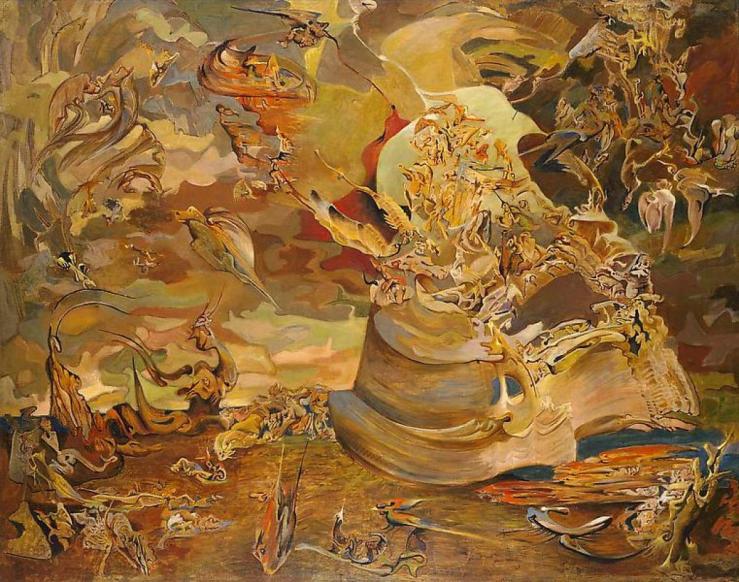
Portrait of My Mother — Boris Margo

teganboris

Portrait of My Mother, 1935 by Boris Margo (1902-1995)

Paul Kirchner’s comix collection Awaiting the Collapse reviewed

img_8914-1

My review of Paul Kirchner’s collection Awaiting the Collapse is up now at The Comics Journal.

From the review:

Tanibis has now published Awaiting the Collapse: Selected Works 1974-2014, a gorgeous compendium of some of Kirchner’s finest work over the past four decades. Many of Kirchner’s Dope Rider strips are here, along with a handful of his covers for Screw, as well as miscellaneous comics in different genres. Despite the range of years and variety in genres here, Kirchner’s surrealist spirit dominates. His comics poke at the weird worlds that vibrate beneath the surface of our own routine reality, offering new ways of seeing old things, to see the real as surreal.

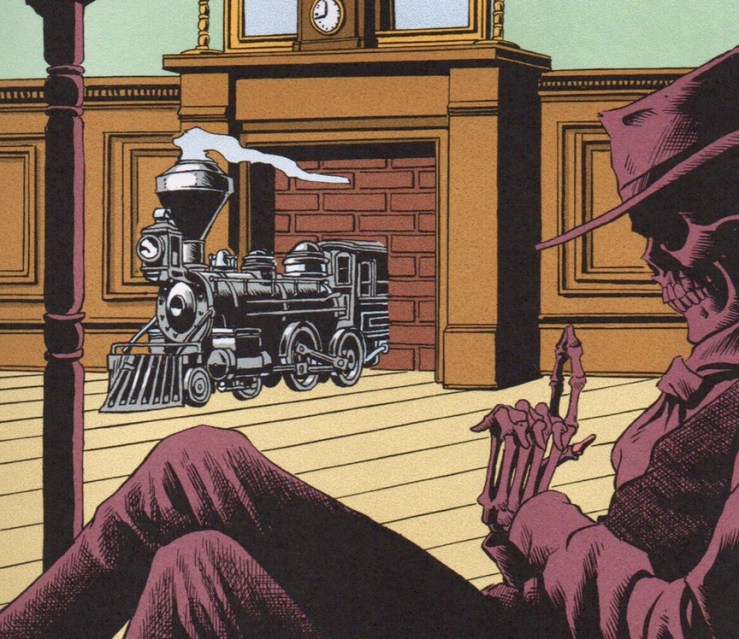
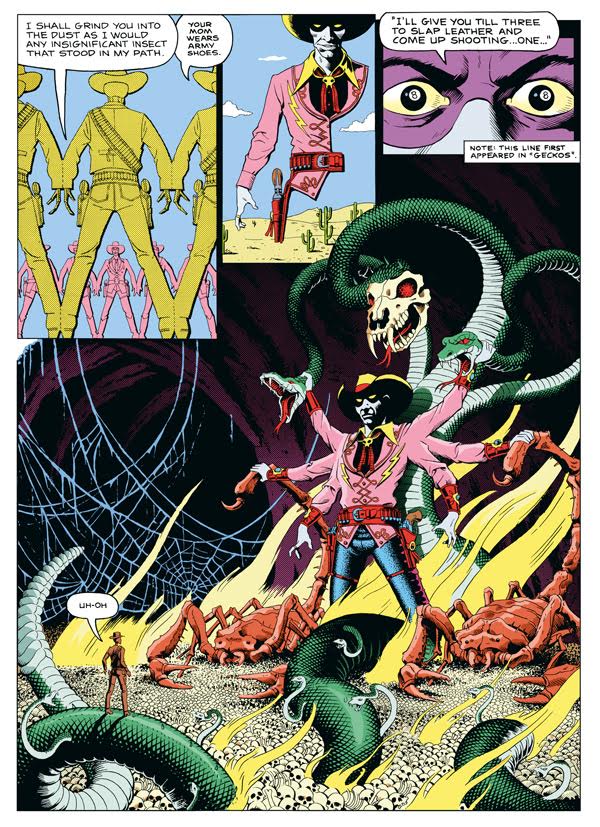
Kirchner’s Dope Rider strips are particularly surreal. Dope Rider, a psychedelic skeleton cowboy, embarks on adventures that transcend time, space, and psyche. In “Beans for All”, Dope Rider rescues Pancho Villa, busts his revolutionary army out of the hoosegow, and opens the U.S. border, leading the revolution to Las Vegas, a psychedelic city floating over an astral desert. In “Loco Motive”, Dope Rider crosses the border again to smuggle good dope back into the mother country. “Crescent Queen” finds Dope Rider on a quest to find mythical Tucumcari. In this episode, Kirchner transmutes the Battle of Little Bighorn into a Pop Art mandala where Plains Indians morph into centaurs. And in “Meanwhile, Back at the Ranch…” our hero… well, our hero smokes some really, really good dope, resulting in a vision that allows Kirchner to show off his estimable visual talents.

Check out the full review.

unnamed

“All art constantly aspires towards the condition of music”


A Hilly Scene — Samuel Palmer

A Hilly Scene c.1826-8 by Samuel Palmer 1805-1881

A Hilly Scene, c. 1868 by Samuel Palmer (1805–1881)

“Cadbury, the Beaver Who Lacked” — Philip K. Dick

“Cadbury, the Beaver Who Lacked”

by

Philip K. Dick


Once, long ago, before money had been invented, a certain male beaver named Cadbury lived within a meager dam which he had constructed with his own teeth and feet, earning his living by gnawing down shrubs, trees and other growth in exchange for poker chips of several colors. The blue chips he liked best, but they came rarely, generally only due in payment for some uniquely huge gnawing-assignment. In all the passing years of work he had owned only three such chips, but he knew by inference that more must exist, and every now and then during the day’s gnawing he paused a moment, fixed a cup of instant coffee, and meditated on chips of all hues, the blues included.

His wife Hilda offered unasked-for advice whenever the opportunity presented itself. “Look at you,” she customarily would declare. “You really ought to see a psychiatrist. Your stack of white chips is only approximately half that of Ralf, Peter, Tom, Bob, Jack and Earl, all who live and gnaw around here, because you’re so busy woolgathering about your goddam blue chips which you’ll never get anyhow because frankly if the blunt truth were known you lack the talent, energy and drive.”

“Energy and drive,” Cadbury would moodily retort, “mean the same thing.” But nevertheless he perceived how right she was. This constituted his wife’s main fault: she invariably had truth on her side, whereas he had nothing but hot air. And truth, when pitted against hot air in the arena of life, generally carries the day.

Since Hilda was right, Cadbury dug up eight white chips from his secret chip-concealing place — a shallow depression under a minor rock — and walked two and three-quarters miles to the nearest psychiatrist, a mellow, do-nothing rabbit shaped like a bowling pin who, according to his wife, made fifteen thousand a year and so what about it.

“Clever sort of day,” Dr. Drat said amiably, unrolling two Tums for his tummy and leaning back in his extra-heavily padded swivel chair.

“Not so very darn clever,” Cadbury answered, “when you know you don’t have it in you ever to catch sight of a blue chip again, even though you work your ass off day in and day out, and what for? She spends it faster than I make it. Even if I did get my teeth in a blue chip it’d be gone overnight for something expensive and useless on the installment plan, such as for instance a twelve million candle-power self-recharging flashlight. With a lifetime guarantee.”

“Those are darn clever,” Dr. Drat said, “those what you said there, those self-recharging flashlights.”

“The only reason I came to you,” Cadbury said, “is because my wife made me. She can get me to do anything. If she said, ‘Swim out into the middle of the creek and drown,’ do you know what I’d do?”

“You’d rebel,” Dr. Drat said in his amiable voice, his hoppers up on the surface of his burled walnut desk.

“I’d kick in her fucking face,” Cadbury said. “I’d gnaw her to bits; I’d gnaw her right in half, right through the middle. You’re damn right. I mean, I’m not kidding; it’s a fact. I hate her.”

“How much,” Dr. Drat asked, “is your wife like your mother?”

“I never had a mother,” Cadbury said in a grumpy way — a way which he adopted from time to time: a regular characteristic with him, as Hilda had pointed out. “I was found floating in the Napa Slough in a shoebox with a handwritten note reading ‘FINDERS KEEPERS.’ ”

“What was your last dream?” Dr. Drat inquired.

“My last dream,” Cadbury said, “is — was — the same as all the others. I always dream I buy a two-cent mint at the drugstore, one of the flat chocolate-covered mints wrapped in green foil, and when I remove the foil it isn’t a mint. You know what it is?”

“Suppose you tell me what it is,” Dr. Drat said, in a voice suggesting that he really knew but no one was paying him to say it.

Cadbury said fiercely, “It’s a blue chip. Or rather it looks like a blue chip. It’s blue and it’s flat and round and the same size. But in the dream I always say ‘Maybe it’s just a blue mint.’ I mean, there must be such a thing as blue mints. I’d hate like to hell to store it in my secret chip-concealing place — a shallow depression under an ordinary-looking rock — and then there’d be this hot day, see, and afterwards when I went to get my blue chip — or rather supposed blue chip — I found it all melted because it really was a mint after all and not a blue chip. And who’d I sue? The manufacturer? Christ; he never claimed it was a blue chip; it clearly said, in my dream, on the green foil wrapper –”

“I think,” Dr. Drat broke in mildly, “that our time is up for today. We might well do some exploring of this aspect of your inner psyche next week because it appears to be leading us somewhere.”

Rising to his feet, Cadbury said, “What’s the matter with me, Dr. Drat? I want an answer; be frank — I can take it. Am I psychotic?”

“Well, you have illusions,” Dr. Drat said, after a meditative pause. “No, you’re not psychotic; you don’t hear the voice of Christ or anything like that telling you to go out and rape people. No, it’s illusions. About yourself, your work, your wife. There may be more. Goodbye.” He rose, too, hippity-hopped to the door of his office and politely but firmly opened it, exposing the tunnel out.


Read the rest of “Cadbury, the Beaver Who Lacked” by Philip K. Dick

Miles Davis recording the score for Louis Malle’s film Elevator to the Gallows

Sweet Thang (Lynn Jenkins) — Barkley L. Hendricks

bh10-051-sweet-thang-lynn-jenkins-hrba

Sweet Thang (Lynn Jenkins), (1976) by Barkley L. Hendricks (1945-2017)

Our hearts and minds may keep themselves above moral mud-puddles | Nathaniel Hawthorne’s journal entry for February 7th, 1840

February 7th, 1840.–What beautiful weather this is!–beautiful, at least, so far as sun, sky, and atmosphere are concerned, though a poor, wingless biped is sometimes constrained to wish that he could raise himself a little above the earth. How much mud and mire, how many pools of unclean water, how many slippery footsteps, and perchance heavy tumbles, might be avoided, if we could tread but six inches above the crust of this world. Physically we cannot do this; our bodies cannot; but it seems to me that our hearts and minds may keep themselves above moral mud-puddles and other discomforts of the soul’s pathway.

Nathaniel Hawthorne’s journal entry for February 7th, 1840. From Passages from the American Note-Books.

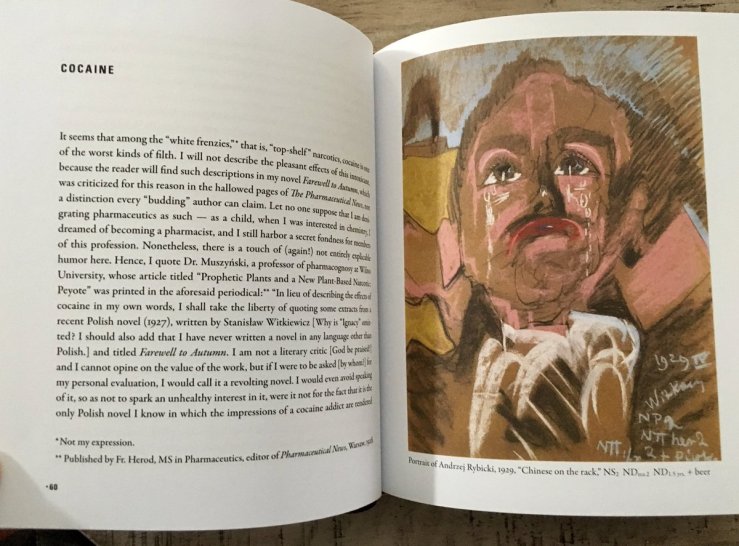
Stanisław I. Witkiewicz’s Narcotics (Book acquired, 5 Feb. 2018)

dvsfm7rvwaaoolo

Stanisław I. Witkiewicz’s Narcotics is forthcoming in full-color hardback from Twisted Spoon PressSubtitled “Nicotine, Alcohol, Cocaine, Peyote, Morphine, Ether + Appendices,” the volume consists of Witkiewicz’s musings on his intake of these substances, both in his creative and personal life, as well as the various portraits he composed while taking those substances. Narcotics is translated by Soren Gauger, who also authors a helpful afterword that contextualizes Witkiewicz’s volume. Narcotics was written and published in Poland in the 1930s, and was apparently quite a big hit. I read Witkiewicz’s foreword last night (as well as the section on, um, peyote). In its strange moralizing, the foreword—an apologia really–reminded me a bit of Henri Michaux’s similar exercise, Miserable Miracle, which also strikes a defensive tone at the outset.

dvsfm7qvqaa8cwv

The book, like Witkiewicz’s portraits, is gorgeous. Here is Twisted Spoon’s blurb; full review forthcoming—

For his “portrait painting firm,” established rules and types for his portrait work, marking the paintings and pastels with corresponding symbols and abbreviations of the substances he had either taken or, in the case of alcohol and nicotine, not taken at the time. Type C were created under the influence of alcohol and “narcotics of a superior grade” to produce abstract compositions he called “Pure Form.” A variety of drugs and their combinations were taken to produce a variety of distortions and effects, and often this would be the portrait subject’s choice. And in some instances a given portrait might be marked with symbols denoting how many days he had gone without smoking or without drinking (and type D were executed to achieve the same results without any artificial means). Different substances resulted in different color combinations or brought out different aspects of the subject’s features or psyche. One stunning series of self-portraits, for example, was executed while on a combination of moderate amounts of beer and cocaine.

In the vein of the well-known drug writings of De Quincey and Baudelaire from a century earlier and those of his contemporaries Walter Benjamin and Jean Cocteau – and foreshadowing the later writings of Aldous Huxley and Carlos Castaneda on psychoactive drugs – Witkacy composed Narcotics in 1930 to discuss and document not only his own experimentation with different substances but the nature of addiction itself and the prevailing social attitude toward drugs, particularly those that were considered “acceptable.” As life became increasingly mechanized, Witkacy felt that a sense of the metaphysical could only be achieved by artificial means, and like Henri Michaux, he produced an extensive oeuvre of singular visual art while under the influence of a variety of substances.

Meandering, acerbic, and burlesque, rife with neologisms and expressions from German, French, English, and Russian, Witkacy dissects Polish society and the art world as well as himself via the hypocrisy surrounding drug use. Since it was first published in the 1930s, Narcotics has achieved a cult status in Poland where it is considered both a modernist classic and a paragon of Witkiewiczian madness. This edition, the first complete translation in English, includes a second appendix written later, passages from the novel Farewell to Autumn, and 34 color reproductions of a cross section of portraits to show how various substances impacted Witkacy’s art.

dvsfm7svoau9vvg

“Karintha” — Jean Toomer

“Karintha”

by

Jean Toomer

from Cane


Her skin is like dusk on the eastern horizon,

O can’t you see it,

O can’t you see it,

Her skin is like dusk on the eastern horizon

. . . When the sun goes down.

Men had always wanted her, this Karintha, even as a child, Karintha carrying beauty, perfect as dusk when the sun goes down. Old men rode her hobby-horse upon their knees. Young men danced with her at frolics when they should have been dancing with their grown-up girls. God grant us youth, secretly prayed the old men. The younger fellows counted the time to pass before she would be old enough to mate with them. This interest of the male, that wishes to ripen a growing thing too soon, could mean no good to her.

Karintha, at twelve, was a wild flash that told the other folks just what it was to live. At sunset, when there was no wind, and the pinesmoke from over by the saw-mill hugged the earth, and you couldn’t see more than a few feet in front, her sudden darting past you was a bit of vivid color, like a black bird that flashes in the light. With the other children one could hear, some distance away, their feet flopping in the two inch dust. Karintha’s running was a whir. It had the sound of the red dust that sometimes makes a spiral in the road. At dusk, during the hush just after the mill had closed down, and before any of the women had started their supper-getting-ready songs, her voice, Wgh-pitched, shrill, would put one’s ears to itching. But no one ever thought to make her stop because of it. She stoned the cows, and beat her dog, and fought the other children . . . Even the preacher, who caught her at mischief, told himself that she was as innocently lovely as a November cotton-flower. Already, rumors were out about her. Homes in Georgia are most often built on the two-room plan. In one, you cook and eat, in the other is where you sit and sleep, and where love goes on. Karintha had seen or heard, perhaps she had felt her parents loving. One could but imitate one’s parents, for to follow them was the way of God. She played home’ with a small boy who was not afraid to do her bidding. That started the whole thing. Old men could 110 longer ride her hobby-horse upon their knees. But young men counted faster.

Her skin is like dusk,

O can’t you see it,

Her skin is like dusk

When the sun goes down.

Karintha is a woman. She who carries beauty, perfect as dusk when the sun goes down. She has been married many times. Old men remind her that a few years back they rode her hobby-horse upon their knees. Karintha smiles, and indulges them when she is in the mood for it. She has contempt for them. Karintha is a woman. Young men run stills to make her money. Young men gamble to make her money. Young men go to the large cities and run on the road. Young men go away to college. They all want to bring her money. These are the young men who thought that all they had to do was to count time. But Karintha is a woman, and she has had a child. A child fell out of her womb onto a bed of pine-needles in the forest. Pine-needles are smooth and sweet. They are elastic to the feet of rabbits . . . A saw-mill was nearby. Its pyramidal saw-dust pile smouldered. It is a year before one completely burns. Meanwhile, the smoke curls up and hangs in odd wraiths about the forest, curls up, and spreads itself out over the valley. . .  Weeks after Karintha returned home, the smoke was so heavy you tasted it in water. Someone made a song:

Smoke is on the hills. Rise up.

Smoke is on the hills, O rise

And take my soul away to Jesus

Karintha is a woman. Men do not know that the soul of her was a growing thing ripened too soon. They will bring their money; they will die not having found it out . . . Karintha at twenty, carrying beauty, perfect as dusk when the sun goes down. Karintha . . .

Her skin is like dusk on the eastern horizon,

O can’t you see it, O can’t you see it,

Her skin is like dusk on the eastern horizon

. . . When the sun goes down.

Goes down . . .

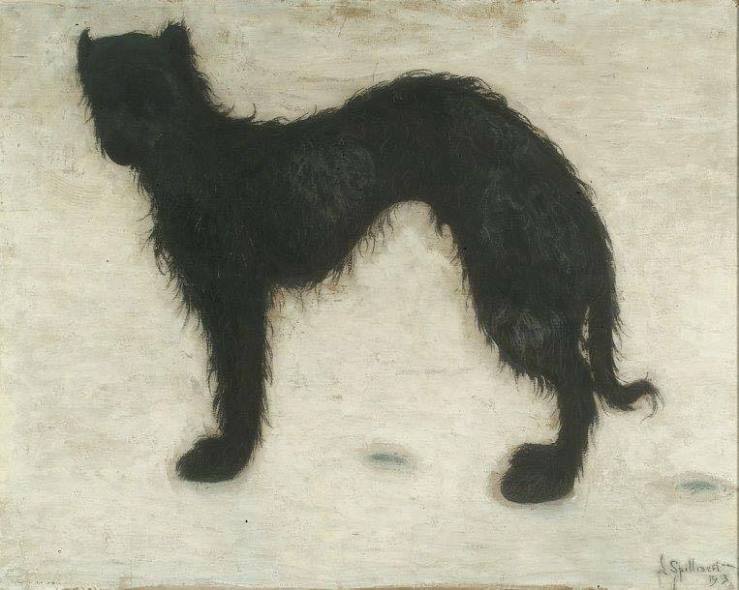
Dog in the Snow — Leon Spilliaert

tumblr_p2eukw6ad81sji0i4o1_1280

Dog in the Snow, by Leon Spilliaert (1881-1946)