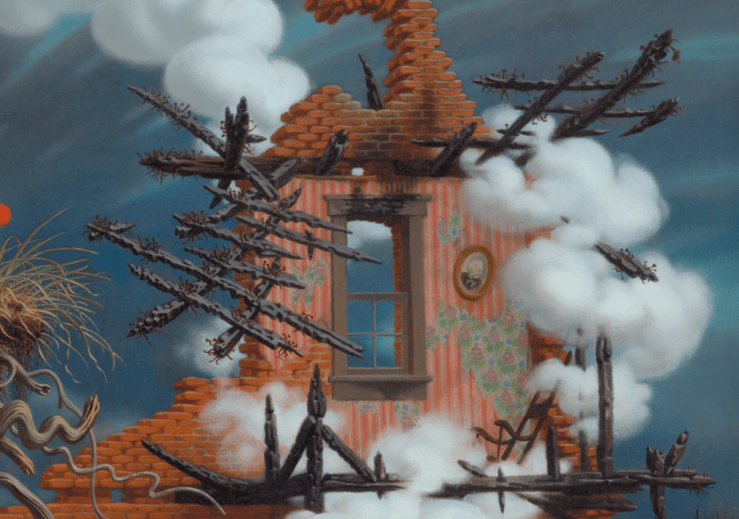
Negrophobia by Darius James. Cover design by Katy Homans, employing All Cats Are Black in the Dark by Natasha Xavier. Trade paperback, NYRB, 2019.
Darius James’s Negrophobia, first published in 1992, is ugly, hilarious, abject, and gritty, a deep comic dive into American racism and the ways that massculture and urban living propagate and feed off of racism. NYRB’s blurb rightfully compares the novel to the work of William S. Burroughs and Ishmael Reed, but, in its hallucinatory film script form (an apocalyptic angles), it also recalls Aldous Huxley’s overlooked novel Ape in Essence. I loved it and am too much of a coward to attempt a real review.
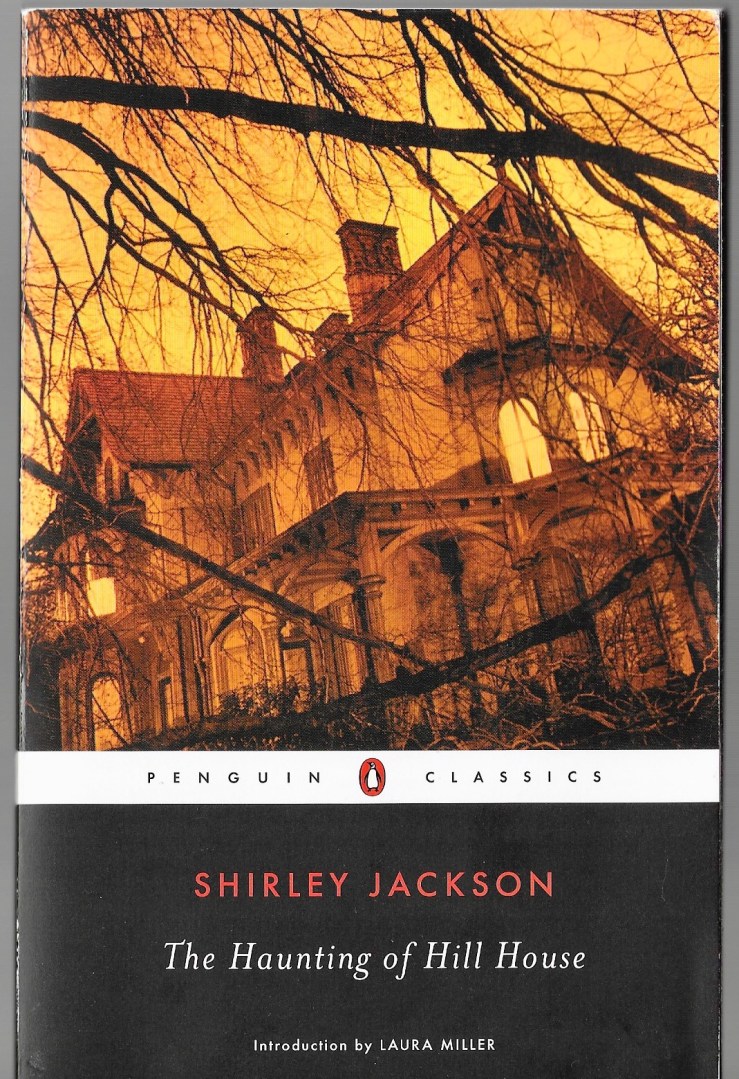
The Haunting of Hill House by Shirley Jackson. Cover photograph by W. Eugene Smith; designer uncredited. Penguin Classics US trade paperback, 2006.
Jackson’s spooky 1959 novel has some of the best opening lines of a novel I’ve read in recent years. Hills’ final section answers to its weird opening, dramatizing fraught consciousness in turmoil, disintegrating in a ping-pong free indirect style that leaves the reader stunned, puzzled, and wishing for an extra chapter against his better judgment.
Berlin Alexanderplatz by Alfred Döblin. English translation by Michael Hoffmann. Book design by Katy Homans, featuring Georg Grosz’s painting Down with Liebknecht (1919). NRYB trade paperback, 2018.
I picked up Döblin’s 1929 Berlin Alexanderplatz on a whim a while ago at a bookstore and picked it up off the shelf today on a different whim and laughed in sympathy through the first two chapters. It’s a long book but I think I’ll keep going.
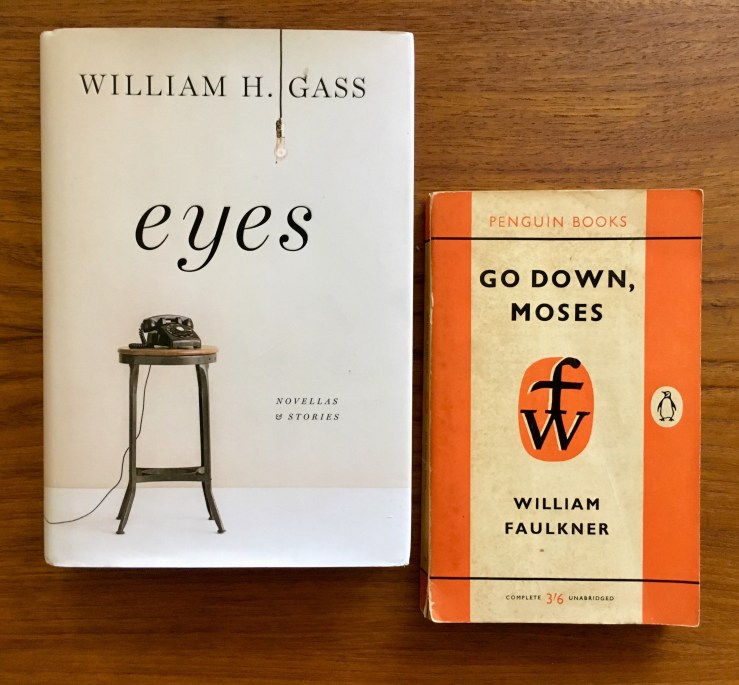
Friday is a day in which I have a few rare spare hours to myself after lunch, and I often like to browse my beloved labyrinthine used bookstore in one of those hours. Last week, I managed to leave without picking anything up, but today I couldn’t resist these two Williams.
Wiliam H. Gass’s last collection of fiction Eyes jumped out at me. I struggled with his bigass opus The Tunnel last year, hardly making a dent, but I loved Middle C as well as the novellas in Cartesian Sonata and Other Novellas—so maybe Eyes will be more manageable.
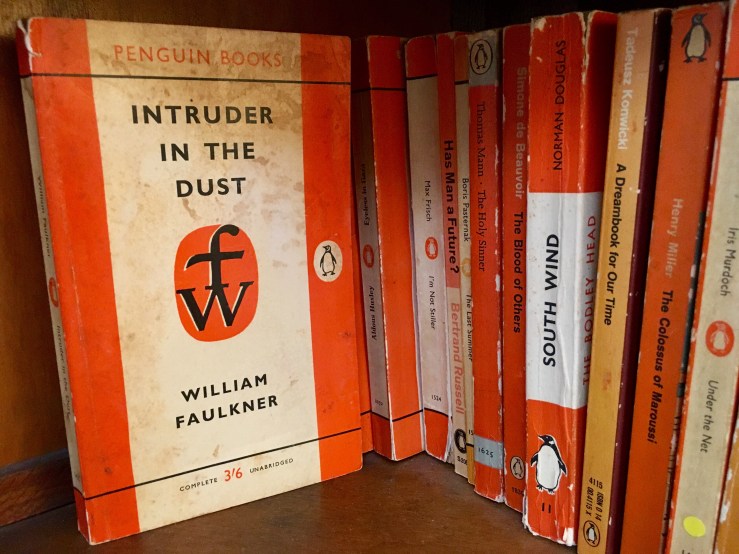
I wasn’t actually browsing the Faulkner section, simply walking past it, but the orange spine of a 1960 Penguin edition of Go Down, Moses jumped out at me. I’m a sucker for these Penguin editions, and Go Down, Moses is my favorite Faulkner (I haven’t read everything Faulkner wrote but I doubt he wrote anything as great as “The Bear”). This edition makes a nice partner with the copy of Intruder in the Dust I picked up a few years ago, too.
Intruder is a really underrated Faulkner novel in my estimation, and Clarence Brown’s 1949 film adaptation is pretty strong as well.
I was attracted to another orange book, an English-language Japanese publication of Kenzaburo Oe’s The Silent Cry, but I had to pass on it—the print was tiny and my forty-year-old eyes aren’t as strong as they used to be. The cover is gorgeous though:
I watched Martin Scorsese’s 1982 film The King of Comedy last weekend and then added it to a list of examples for a much bigger Thing I’ve been working on for a few years (and hence will never likely finish, unlike these Blog about posts). The much bigger Thing is about the relationship between Comedy and Horror—not purely the formal characteristics that belong to specific genres of literature, film, and art, but rather the relationship between the emotions themselves (with special attention to how literature, film, and art evoke that relationship).
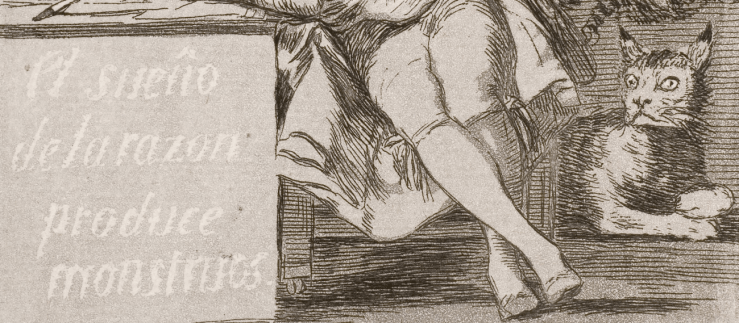
The short thesis for this bigger Thing is that I think that comedy relies strongly on horror, and that the best provocations of horror are tempered in humor. There is a long list of examples in support of this thesis, including Goya and Bolaño and Larry David and Don Quixote and Candide and Thomas Bernhard and Surrealism and Get Out and etc. —-but that’s all for said bigger Thing, and the title of this post seems to promise Something (not a big Thing) on Martin Scorsese’s 1983 film The King of Comedy, which I recently rewatched.
I first saw The King of Comedy in the spring of 1998. I was a freshman at the University of Florida and had quickly discovered their library of films on VHS, which I would imbibe over my four years there. I started with stuff I was already a bit familiar with though. Like every other stupid eighteen-year old, I thought Taxi Driver was A Work of Genius (without fully understanding it), and I’d seen Goodfellas and Casino approximately one thousand times by this point. I started UF’s collection of Scorsese tapes with the neo-neorealism of Raging Bull, a brutal and hence thoroughly comprehensible character study, an ugly film shot in gorgeous black and white. The King of Comedy was next.
The internet in 1998 was not the internet of 2018. What I mean is that we generally learned about films through books and journals and magazines, or really other films, or really, really by word of mouth. I don’t think I had any word of mouth on The King of Comedy—what I mean is that I think I thought the film was a comedy. Which it is. Sort of. I mean, it’s funny—-very funny sometimes. But it’s also very cruel, and often scary and off putting, and generally queasy.
The King of Comedy stars Robert De Niro as Rupert Pupkin. That ridiculous name is on one hand a running joke, but on the other hand a vein of horror that pulsates throughout the film—an aberrant twitching oddity, a sort of literal curse, both on poor Rupert (who bears that name) and on every person who encounters him. Rupert is a would-be comedian who dreams (literally and often from his mother’s basement) of stardom. He dreams that he’ll achieve this stardom through a spotlight gig on The Jerry Langford Show, a Carson-style late night show hosted by Jerry Langford, played by a wonderfully fed-up Jerry Lewis.
Rupert is an autograph hound, an obsessive type of fan who makes Jerry’s life a literal terror. Rupert’s foil is Masha, a trust-fund baby played by Sandra Bernhard. Masha stalks Jerry with extreme competitive anxiety; her stalking is a lifestyle elevated to art. When Masha goes too far early in the film and hijacks Jerry’s limo, Rupert sees an opening—he saves the day, ousting Masha, but then he invades the limo (proving himself stalker supreme over Masha). In the limo ride, Rupert asks Jerry for help in advancing his career, and Jerry gives generous if general advice, which amounts to Put the work in and pay your dues. Rupert complains that he simply doesn’t have time to invest in doing the real hard grinding work, and basically demands that Jerry give him a shortcut.
In showing a deranged would-be artist who feels he’s entitled to bypass the years of work involved in honing a skill, Scorsese anticipates our current zeitgeist. Rupert Pupkin desires fame, adoration, and applause, but he is far less interested in producing an art that would earn these accolades. The King of Comedy slowly shows us that Pupkin is mentally ill, and that his disease is radically exacerbated by a culture of mass media.
The King of Comedy’s most sarcastic biteis that Rupert is eventually rewarded for his deranged behavior. He and Masha kidnap Jerry as part of a plan to get Rupert an opening set of The Jerry Langford Show. The plan succeeds, and Rupert executes it so that he not only gets to land his dream gig, he also gets to watch himself do it in front of The Girl He Liked in High School:
Rupert’s audacious gambit is part and parcel of a postmodern mass media era that makes only the slightest distinction between fame and infamy. Rupert is famous for doing something famous—and something horrific, kidnapping a beloved TV host. It’s his one bit of work, but it’s enough to land him a book deal, celebrity, and money (and a fairly short prison sentence).
Parts of Rupert’s monologue are funny, but other parts read like the memoir of a damaged soul trying to recover from an abusive childhood. And maybe these parts mix. Again, horror underwrites comedy.
This horror repeats in Scorsese’s framing of Rupert’s routine. There’s a dream-like quality to the monologue, with its television tube frame. This is not the first time we’ve seen this framing in King of Comedy—we get similar TV fantasies via Rupert’s deranged mind—but this time the plot asks us to think of it as “real,” even as Scorsese’s aesthetics suggest that the ending of the film may all be in Pupkin’s warped mind, the unseen clapping audience just another delusion of grandeur.
The same gesture is present at the end of Taxi Driver, which is essentially the twin of The King of Comedy. Travis Bickle—another ridiculous name, another loser—improbably ends up the hero of the narrative. But the conclusion of Taxi Driver has always struck me as the internal fantasy of its reactionary (anti-)hero. Likewise, The King of Comedy concludes in yet another fantasy in Rupert Pupkin’s addled consciousness.
With its metatextual contours and its insinuations of reality-as-mediated-by-mass-media, The King of Comedy is perhaps Scorsese’s most formally postmodern film (although his smaller follow-up After Hours might be his most thematically postmodern). It’s no wonder that the film didn’t land with audiences in 1983. Beyond its postmodern rhythms, The King of Comedy is essentially repulsive—nothing good happens; there is no clear hero; the world it depicts is devoid of any meaning not centered in relation to fame. Its satire is so black no light escapes. In comparison, Scorsese’s later films like Goodfellas and The Wolf of Wall Street are laugh riots.
The genius of The King of Comedy is something best felt. The film disrupts genre conventions (and audience expectations), pushing a comedy into a horror. Or maybe The King of Comedy is a horror film with comedic overtones. Or, really—I mean, what I really want to say here is:
The King of Comedy isn’t a horror film or a comedy film—like many of Scorsese’s best films, it’s a character study—realistic and engrossing and grotesque in its utter realism. Time has caught up with it. If Rupert Pupkin seemed an extreme example of the kind of derangement and alienation that could be aggravated by a mass media culture in the early 1980s, by today’s standards he’s perhaps charming. And that’s horrifying.
[Ed. note: Biblioklept originally ran this post in April, 2018].
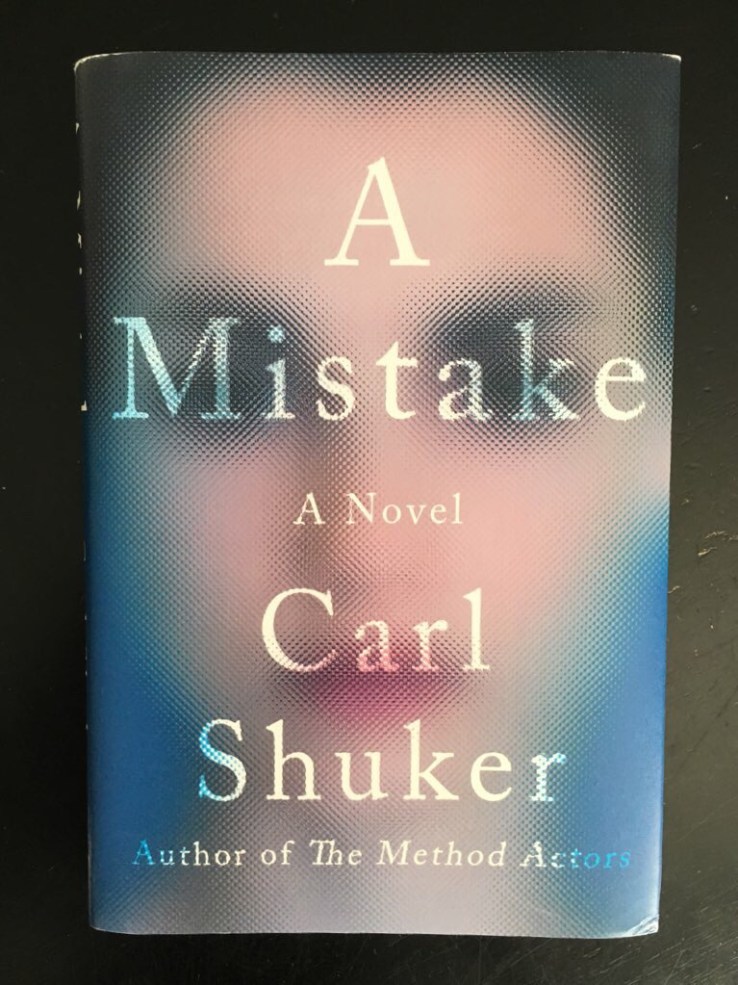
Carl Shuker’s fourth novel A Mistake is new from Counterpress. Their blurb–
Elizabeth is a gifted surgeon—the only female consultant at her hospital. But while she operates on a young woman with life-threatening blood poisoning, something goes horribly wrong. In the midst of a new scheme to publicly report surgeons’ performance, her colleagues begin to close ranks, and Elizabeth’s life is thrown into disarray. Tough and abrasive, Elizabeth has survived and succeeded in this most demanding, palpably sexist field. But can she survive a single mistake?
A Mistake is a page-turning procedural thriller about powerful women working in challenging spheres. The novel examines how a survivor who has successfully navigated years of a culture of casual sexism and machismo finds herself suddenly in the fight of her life. When a mistake is life-threatening, who should ultimately be held responsible?
Carl Shuker has produced some of the finest writing on the physicality of medical intervention, where life-changing surgery is detailed moment by moment in a building emergency. A Mistake daringly illustrates the startling mix of the coolly intellectual and deeply personal inherent in the life and work of a surgeon.
Nearing the end of Shirley Jackson’s 1959 American Gothic novel The Haunting of Hill House, and not having blogged that much in September of 2019, I thought that I’d write something about its perfect opening sentences, which I’ve returned to a few times (and used in my classroom).
Here are those opening lines:
No live organism can continue for long to exist sanely under conditions of absolute reality; even larks and katydids are supposed, by some, to dream. Hill House, not sane, stood by itself against the hills, holding darkness within; it had stood so for eighty years and might stand for eighty more. Within, walls continued upright, bricks met neatly, floors were firm, and doors were sensibly shut; silence lay steadily against the wood and stone of Hill House, and whatever walked there, walked alone.
I shared the opening on twitter when I first read it the other week and one of the replies to the tweet linked to Random House copy editor (and author of Dreyer’s English) Benjamin Dreyer’s annotations of the first paragraph of The Haunting of Hill House. I didn’t read Dreyer’s annotations at the time, but as I sat down to write this blog, the memory that someone had already written about the opening of Hill House wormed its way into my soft brain. I read Dreyer’s appreciation twenty minutes ago, and then decided Not to Write this blog.
And then I decided to write anyway.
My fascination with the opening paragraph of Hill House has only increased as I’ve read the novel (the first I’ve read by Jackson, admittedly). When I first read the opening I was struck by Jackson’s forceful use of semicolons. There are three semicolons (and three periods) in the series of sentences, creating a strange stilted tilting rhythm.
Let’s consider the first sentence, comprised of two independent clauses:
No live organism can continue for long to exist sanely under conditions of absolute reality; even larks and katydids are supposed, by some, to dream.
Our novel begins with that magic word No. Phrases like “exist sanely” and “absolute reality” begin to sketch the novel’s themes. Jackson then pivots from the abstract to the concrete with her “larks and katydids”; in his annotations, Dreyer wonders “how many combinations of fauna Jackson experimented with before she landed on ‘larks and katydid.” I suspect those five wonderful syllables had lolled around her brain before the novel’s gestation.
And now our middle sentence, again two independent clauses tentatively joined by a semicolon:
Hill House, not sane, stood by itself against the hills, holding darkness within; it had stood so for eighty years and might stand for eighty more.
“Hill House, not sane” is a genius of four syllables, expressing again the theme of Jackson’s novel in terse curt prose. Dreyer finds fault with “the Hill/hills repetition right here,” writing that “it just doesn’t sing to me,” and suggesting that if he were the novel’s editor, he’d have “asked her whether she’d consider deleting ‘against the hills.'” That deletion would be a rhetorical mistake, I think, because the doubling of “hills” formalizes another of the novel’s tropes—twins and doubles, cousins and doppelgänger. Jackson’s punctuation instantiates this doubling in the first two sentences, both in the repetition of the semicolons and in the twinning of the phrases “by some” and “not sane.” (The repetition of “eighty years” serves as kind of syntactic echo, reverberating the ghostly theme from lifetime past to a generation beyond one’s own death.)
Here is the third and final line of the opening paragraph of Hill House, in which we get a rush of independent clauses—and another semicolon:
Within, walls continued upright, bricks met neatly, floors were firm, and doors were sensibly shut; silence lay steadily against the wood and stone of Hill House, and whatever walked there, walked alone.
The descriptions and events in the novel ultimately ironize this description: Hill House is hardly “upright,” nothing meets “neatly,” and the doors don’t seem to be “sensibly shut,” at least to the quartet of visitors who come to stay at Hill House. This quartet is led by and includes Dr. Montague a committed yet somewhat embarrassed paranormalist, who recruits three others: Luke Sanderson, heir to Hill House, wild Theodora (no last name), and Eleanor Vance, the viewpoint character who, cracked before the events of the novel begin, cracks even more.
(There is a part of me that would love to argue that the three opening sentences, sundered in strange twos by semicolons, represent Eleanor, Theodora, and Luke—but no, that’s ridiculous. Right?)
The final phrase of the last sentence, “walked alone,” set off by a comma (which Dreyer points out is unnecessary and perhaps ungrammatical) balances the other two-word nonessential elements (“by some” and “not sane”), highlighting its rhetorical importance. Hills is a novel of loneliness and companionship, of alienation and belonging. Our viewpoint character Eleanor navigates a walk alone in a world that may or may not be sane. And yet Eleanor doesn’t walk fully alone in this twisted house, with its infirm floors and unneat bricks and crooked walls. Hills vacillates between gloomy lethargy and kinetic ebullience, manically ping-ponging, thriving strangely, radiating a larky katydidiad dream of absolute unreality.













 Biblioklept