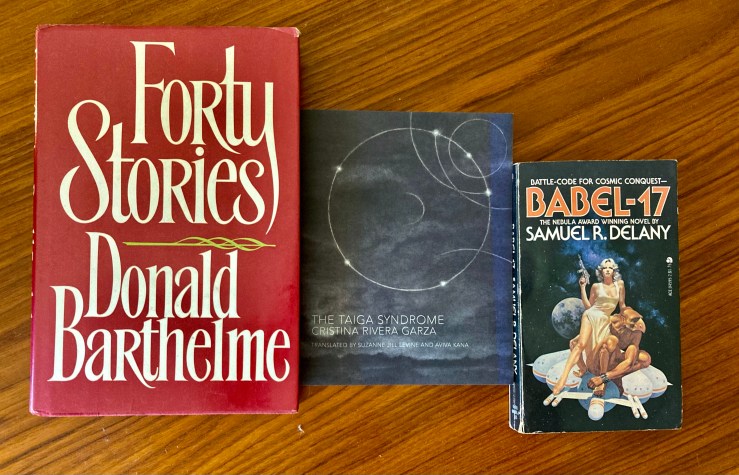
Last Friday I found a hardback first edition of Barthelme’s Forty Stories, which is cool (it’s much more handsome and plain than the paperback Penguin Contemporary Fiction edition I have). I’ve been re-reading Barthelme’s Sixty Stories and writing blog posts about them that no one reads for a few weeks now.
I also picked up Cristina Rivera Garza’s novel The Taiga Syndrome, in translation by Suzanne Jill Levine and Aviva Kana. Here’s publisher Dorothy’s blurb:
A fairy tale run amok, The Taiga Syndrome follows an unnamed Ex-Detective as she searches for a couple who has fled to the far reaches of the earth. A betrayed husband is convinced by a brief telegram that his second ex-wife wants him to track her down—that she wants to be found. He hires the Ex-Detective, who sets out with a translator into a snowy, hostile forest where strange things happen and translation betrays both sense and one’s senses. Tales of Hansel and Gretel and Little Red Riding Hood haunt the Ex-Detective’s quest into a territory overrun with the primitive excesses of Capitalism—accumulation and expulsion, corruption and cruelty—though the lessons of her journey are more experiential than moral: that just as love can fly away, sometimes unloving flies away as well. That sometimes leaving everything behind is the only thing left to do.
I picked up Samuel R. Delany’s novel Babel-17 too, maybe in part of a continued attempt to get into his stuff, despite stall outs, shrugs, and, Hey, that was okays, and maybe just because of this cover:
The book’s Wikipedia entry notes that, “Rush drummer and lyricist Neil Peart noted that Babel-17 was one of his early literary influences, and was an important part of the crafting of the band’s hugely successful 2112 album.”
A cruel cruel story bristling with venomous punchlines, “Critique de la Vie Quotidienne” takes its title from Marxist philosopher Henri Lefebvre’s 1947 book of the same name. The story is a caustic satire of quotidian domesticity, showing the dissolution of a marriage through the perspective of an alcoholic narrator who very much resembles Barthelme. It begins ugly:
While I read the Journal of Sensory Deprivation, Wanda, my former wife, read Elle. Elle was an incitement to revolt to one who had majored in French in college and now had nothing much to do with herself except take care of a child and look out of the window.
And continues ugly:
Our evenings lacked promise. The world in the evening seems fraught with the absence of promise, if you are a married man. There is nothing to do but go home and drink your nine drinks and forget about it.
There’s a deep anger and contempt toward domesticity that Barthelme’s narrator sustains throughout the story while also pulling the rhetorical trick of quickly retreating into the second-person you, a conceit that never fully absolves the narrator from his intrinsic horribleness:
Slumped there in your favorite chair, with your nine drinks lined up on the side table in soldierly array, and your hand never far from them, and your other hand holding on to the plump belly of the overfed child, and perhaps rocking a bit, if the chair is a rocking chair as mine was in those days, then it is true that a tine tendril of contempt – strike that, content – might curl up from the storehouse where the world’s content is kept, and reach into your softened brain and take hold there, persuading you that this, at last, is the fruit of all your labors, which you’d been wondering about in some such terms as, “Where is the fruit?”
The narrator quickly divides himself from the you, the horrible man who cannot live the quotidian life:
…you look, as I say, to your wife, as the cocktail hour fades, there being only two drinks left of the nine (and you have sworn a mighty oath never to take more than nine before supper, because of what it does to you), and inquire in the calmest tones available what is for supper and would she like to take a flying fuck at the moon for visiting this outrageous child upon you.
Ultimately, “Quotidienne” is too mean and ugly (borderline misogynistic, perhaps); it lacks the kernel of heart that beats in Barthelme’s best satires.
The story is a list numbered to one hundred. Most of the numbered points are a solitary sentence, with exceptions coming from a handful of citations Barthelme includes.
“The Glass Mountain” fits neatly into City Life. It’s a city story transported into the realm of the mock-heroic. With the aid of two plumber’s friends (plunger, you might call them), the narrator (a mock hero) climbs the titular mountain, which “stands at the corner of Thirteenth Street and Eighth Avenue.” It’s a skyscraper, of course:
7. I had strapped climbing irons to my feet and each hand grasped sturdy plumber’s friend.
8. I was 200 feet up.
9. The wind was bitter.
10. My acquaintances had gathered at the bottom of the mountain to offer encouragement.
11. “Shithead.”
12. “Asshole.”
13. Everyone in the city knows about the glass mountain.
His “acquaintances” continue to berate him as he climbs (“24. “Dumb motherfucker.” / 25. I was new in the neighborhood.”)
As he climbs, the heroic arc swells, enriched by a riff on symbolism and signs, which is the story’s main theme. And yet at the end, Barthelme’s “hero” rejects symbolism the minute it transubstantiates into sign:
97. I approached the symbol, with its layers of meaning, but when I touched it, it changed into only a beautiful princess.
98. I threw the beautiful princess headfirst down the mountain to my acquaintances.
In his Barthelme biography Hiding Man, Tracy Daugherty links “The Policeman’s Ball” to the eruptions and disruptions of May ’68:
In Don’s story, Horace, a policeman with the “crack of authority” in his voice, takes his girlfriend Margot to a policemen’s ball, hoping she will surrender to his force–the “force of the force.” At the balll, she is drawn to a fireman named Vercingetorix. Finally, though, she returns home with Horace and gives him what he wants…All the while, the “horrors lurk outside Horace’s apartment…The story’s smirk at authority is clear. The names Horace and Vercingetorix come to us from Roman history. Vercingetorix was a Gallic rebel noted for building barricades to thwart Roman soldiers. Shortly after vanquishing Vercingetorix, Caesar was assassinated. Horace, an irreverent poet and satirist, fell under Brutus’s sway, and joined him in a hopeless attempt to establish a republic.
The historical referents–to a decadent empire and rebellions against it–make Don’s story, in the context of the May Days, an extended utopian slogan, as playful, sly, and funny as much of the graffiti in the Latin Quarter.
(A version of) Vercingetorix shows up in “City Life” (in City Life).
I think “The Policemen’s Ball” is more relevant than ever, as we (who is we?) contest against the force of the force.
Another story about writing a story—and again, Barthelme displaces the creative act to fine art—and again (in reverse), he chooses a sculptor as his artist. The sculptor achieved a thin bare fame with his YAWNING MAN statues, but when a dog falls on him, he finds new inspiration. (And puns. Lots of lots of puns.)
(I keep thinking about another Don here, although it’s in no way related—Don DeLillo’s Running Dog (1978) and Don DeLillo’s Falling Man (2007).)
(doG is God backwards—can you even fucking believe?)
20. “Kierkegaard Unfair to Schlegel” (City Life, 1970)
There’s a tension that runs throughout much of Barthelme’s short fiction: professed leftist idealism set against the writer’s urbane bourgeoisie (or bourgeoisie-proximal) reality as an arbiter and curator of Modernist culture. Barthelme’s aesthetic describes technological postwar American culture–often through a mythological lens, often through the spectacle of both pop art and Pop Art (which becomes American mythology in his writing). His satires, pastiches, and parodies set a funhouse mirror up to America’s hypermediated massculture reality. At the same time, Barthelme’s stories tend to eschew direct action, direct engagement with the realities of the age his stories (not so much document but) describe: the Civil Rights movement, the Vietnam War, and other social inequalities. A passage in the Q&A story “Kierkegaard Unfair to Schlegel” shows Barthelme perhaps a bit defensive about these elisions:
Q: You’re not political?
A: I’m extremely political in a way that does no good to anybody.
Q: You don’t participate?
A: I participate. I make demands, sign newspaper advertisements, vote. I make small campaign contributions to the candidate of my choice and turn my irony against the others.
Here, we get Barthelme declaring the political scope of his literature: it is an irony against the others. Much of the story is given over to the answerer’s summary and analysis of Kierkegaard’s The Concept of Irony, followed by a defense of Friedrich Schlegel’s novel Lucinde, which Kierkegaard regards as a moral failure because it does not instruct its readers how to live. The answerer says Kierkegaard fails to attend to the novel’s “objecthood” — its aesthetics. At the end he remains ambivalent: Kierkegaard is both fair and not fair to Schlegel:
…What is interesting is my making the statement that I think Kierkegaard is unfair to Schlegel. And that the whole thing is a damned shame! Because that is not what I think at all. We have to do here with my own irony. Because of course Kierkegaard . was “fair” to Schlegel. In making a statement to the contrary I am attempting to… I might have several purposes-simply being provocative, for example. But mostly I am trying to annihilate Kierkegaard in order to deal with his disapproval.
Q: Of Schlegel?
A: Of me.
(There’s also a deep strain of horniness to the story that I will not comment on at this time.)
19. “City Life” (City Life, 1970)
The title story of Barthelme’s 1970 collection is a weird, oblique love letter to a version of NYC. The Houston-native seems to finally earn his New Yorker stripes. It’s an unusually long story, rich with meanings that I won’t bother to plumb here, because I’ve had a long day, and I doubt anyone is actually reading this (I can live in doubt). The basic plot of “City Life” is the whole Virgin Birth thing, with the city-as-father—which is par for Barthelme’s oedipal course. It has some wonderful passages, including this one.
Summary thoughts: “City Life” and “Kierkegaard Unfair to Schlegel” strike me as seminal Barthelme texts, but neither make a good starting point to his fiction. “Critique de la Vie Quotidienne,” the story in this batch from Sadness is sad, mean stuff, and also likely relatable for any dad who’s ever wanted to hop in his car and go out for a pack of cigarettes or a carton of milk or whatever your deadbeat idiom is. “The Falling Dog” is okay. Both “The Policemen’s Ball” and “The Glass Mountain” would make nice starting places for anyone interested in Barthelme’s stuff.
Going forward (in reverse): A few more from City Life and then we crack into what might be Barthelme’s best collection, 1968’s Unspeakable Practices, Unnatural Acts.
A messy bright drunken satire on academia and parties involving academics and pseudointellectuals in general. It opens with assholery, with unnecessary incorrect corrections:
I went to a party and corrected a pronunciation. The man whose voice I had adjusted fell back into the kitchen. I praised a Bonnard. It was not a Bonnard. My new glasses, I explained, and I’m terribly sorry, but significant variations elude me, vodka exhausts me, I was young once, essential services are being maintained.
Essential services are being maintained cracked me up this go around. (I too have been sometimes exhausted by vodka.)
King Kong shows up at the party! Barthelme pulls a few Robert Coover moves, but is less comfortable parodying film than he is parodying modern art (or Modern Art, I mean).
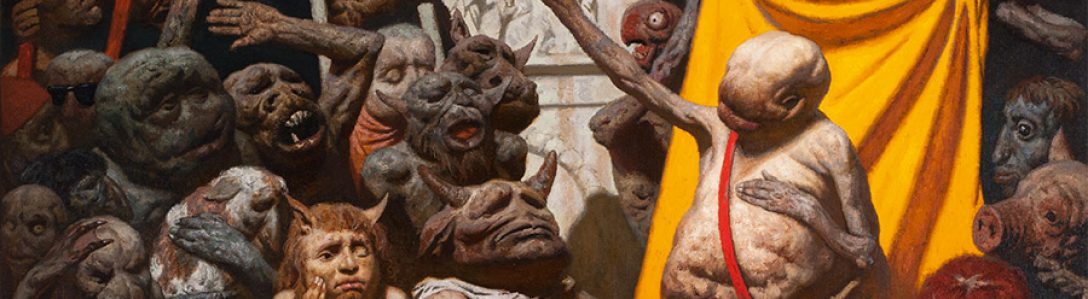
I Don’t Like to Look at Him, Jack by Walton Ford
“The Party” is a sad story, a bad scene with some good cruel jokes. Near the end, our narrator—some ironic extrapolation of Barthelme his own damn self—internally remarks:
What made us think that we could escape things like bankruptcy, alcoholism, being disappointed, having children?
Yuck.
29. “Daumier” (Sadness, 1972)
Probably my favorite story so far in this reverse re-read. “Daumier” is the best sort of metafictional postmodernism: wry, occasionally mean, and fun with a tight little heart, the story never displays its plumage or winks at the reader.
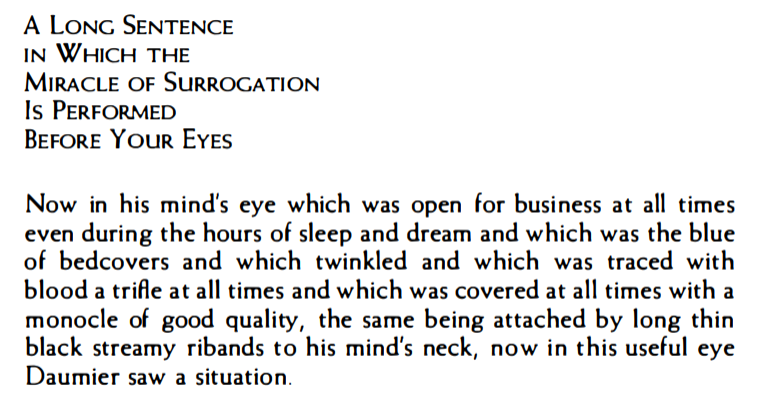
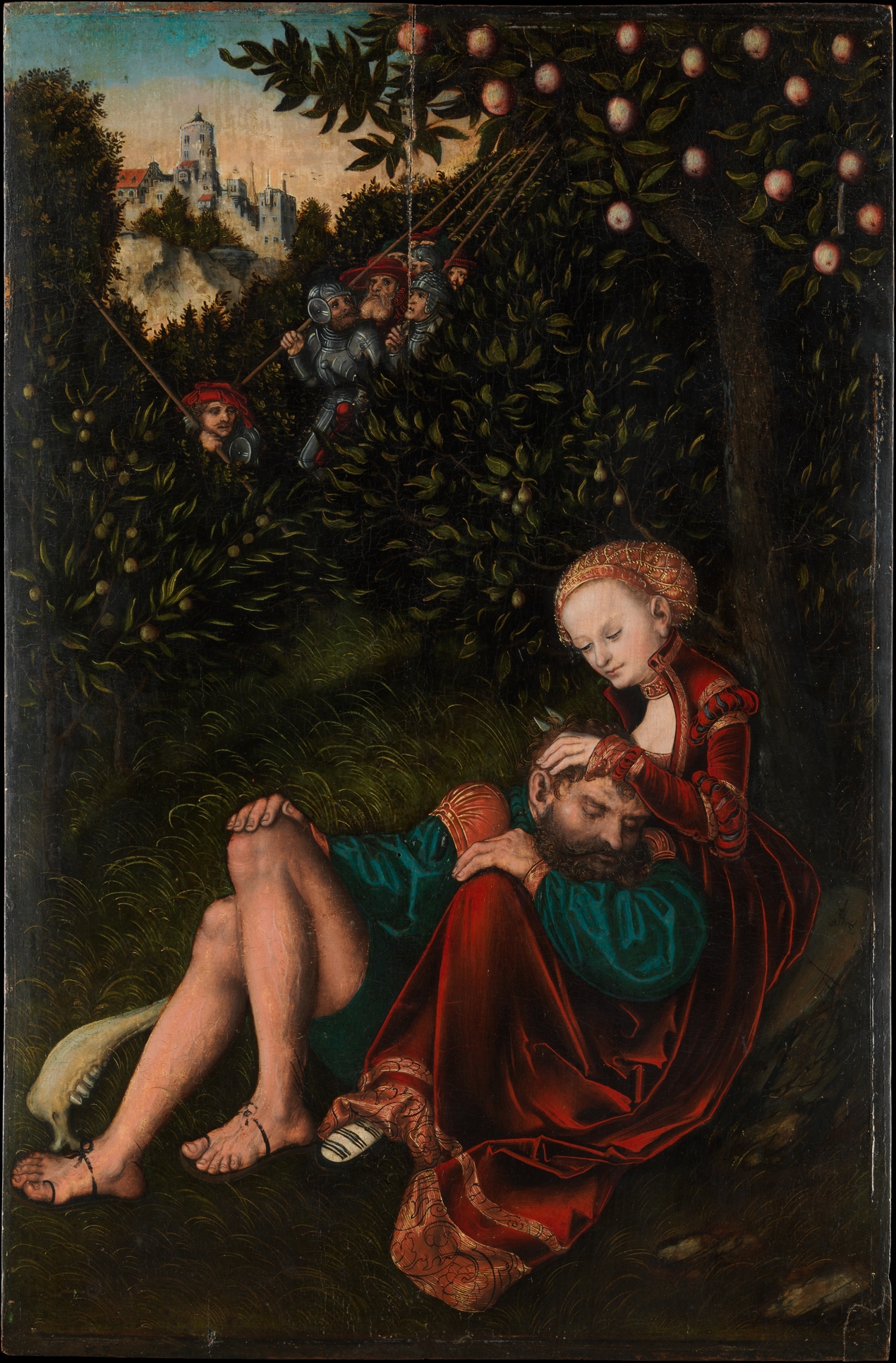
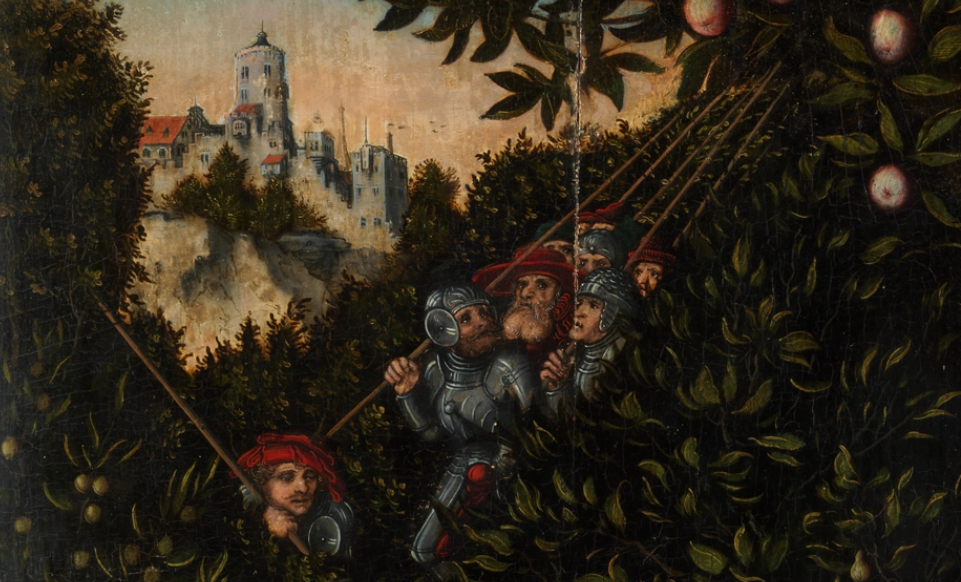
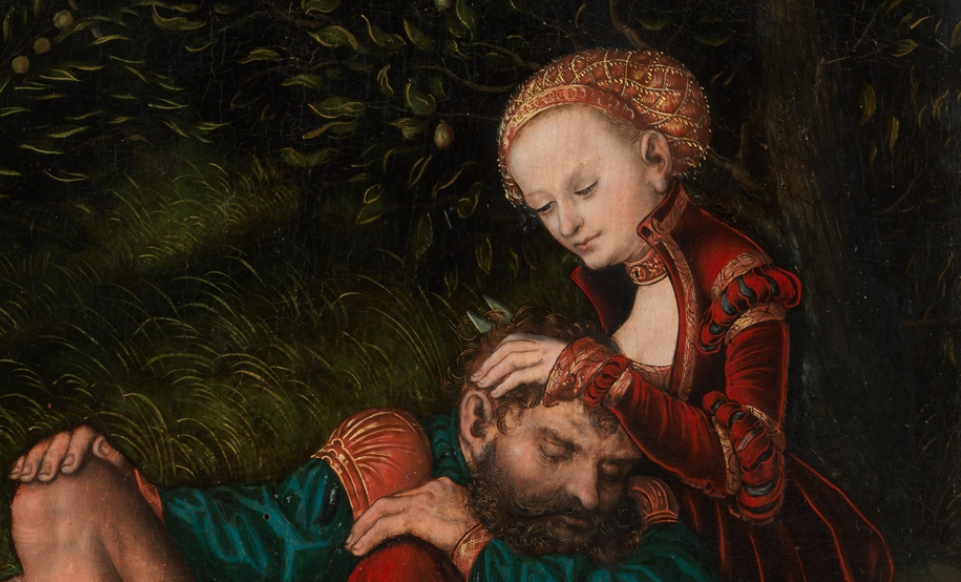
On the outside of “Daumier” is the ostensible narrator who is playing around with a psychological gadget he calls surrogation, a concept the rest of us would identify as identifying with characters we create, avatars we write into being. He causes to be, via surrogation, in his mind’s narrative eye, a Western scene. A band of misunderstood rustlers are herding a herd of French au pairs across the Western plains. There are chili dogs and villainous priests and at least one muskateer. In case we get confused, Barthelme’s narrator offers a resume of the plot:
Ignatius Loyola XVIII, with a band of hard-riding fanatical Jesuits under his command, has sworn to capture the herd and release the girls from the toils so-called of the Traffic, in which Daumier, Mr. Hawkins, and Mr. Bellows are prominent executives of long standing. Daumier meanwhile has been distracted from his proper business by a threat to the queen, the matter of the necklace (see Dumas, The Queen’s Necklace, pp. 76-1 05).
“Daumier” sees Barthelme quick switching between genres, moods, and registers. The story showcases some of the best bits of his midseventies ironic-epic mode. When his metatextual narrative moves back to the “ordinary,” contemporary world, Barthelme paints the scene with heroic bravado:
Immature citizens in several sizes were massed before a large factorylike structure where advanced techniques transformed them into true-thinking right-acting members of the three social classes, lower, middle, and upper middle. Some number of these were engaged in ludic agon with basketballs, the same being hurled against passing vehicles producing an unpredictable rebound. Dispersed amidst the hurly and burly of the children were their tenders, shouting. lnmixed with this broil were ordinary denizens of the quarter-shopmen, rentiers, churls, sellers of vicious drugs, stum-drinkers, aunties, girls whose jeans had been improved with applique rose blossoms in the cleft of the buttocks, practicers of the priest hustle, and the like.
The image of the children “engaged in ludic agon with basketballs” made me laugh aloud.
A penultimate section parodying modern food production surpasses this section, but also ends in a sweet if weird resolution—Barthelme’s surrogate commits to sweet marriage with a character. The last section, simply labeled “Conclusion” blows the phantasy apart. The narrator assures us that he has folded and wrapped up his characters and stuffed them tidily into desk drawers. He will take them out again in the future when he needs them again, “someday when my soul is again sickly and full of sores.” It is the exact same ending of Barthelme’s most-anthologized story, “The Balloon,” wherein the titular balloon is sent off to, what is it, West Virginia, to be stored for a future time, etc. etc. But this later story — “Daumier,” I mean — concludes in a strangely sadly depressive affirmation of life as doing, despite the pain of being:
The self cannot be escaped, but it can be, with ingenuity and hard work, distracted. There are always openings, if you can find them, there is always something to do.
“A City of Churches” is one of Barthelme’s more straightforward satires. A woman named Cecelia plans to move to a new city where she hopes to open a car rental place. The name of the city, Prester, is likely an allusion to Prester John, the mythical Christian king of a lost Christian city. A certain Mr. Phillips shows Cecelia around, informing her that not only do all the citizens of Prester live in churches, but also all businesses are housed in churches. Irreligious Cecelia realizes that she cannot fit into such conformist confines.
An essentially sad story in a book called Sadness, “The Rise of Capitalism” begins cryptically:
The first thing I did was make a mistake. I thought I had understood capitalism, but what I had done was assume an attitude — melancholy sadness — toward it. This attitude is not correct.
What follows is a pastiche of critical essay and parodic riffs; there’s no real plot but there are plenty of gags. In one memorable passage, capitalism becomes personified and literally rises, presumably to work. But the narration gives way to lamenting the alienation we feel under late capitalism, before shifting into absurdity:
Capitalism arose and took off its pajamas. Another day, another dollar. Each man is valued at what he will bring in the marketplace. Meaning has been drained from work and assigned instead to remuneration. Unemployment obliterates the world of the unemployed individual. Cultural underdevelopment of the worker, as a technique of domination, is found everywhere under late capitalism. Authentic self-domination by individuals is thwarted. The false consciousness created and catered to by mass culture perpetuates ignorance and powerlessness. Strands of raven hair floating on the surface of the Ganges…Why can’t they clean up the Ganges? If the wealthy capitalists who operate the Ganges wig factories could be forced to install sieves, at the mouths of their plants….And now the sacred Ganges is choked with hair, and the river no longer knows where to put its flow, and the moonlight on the Ganges is swallowed by the hair, and the water darkens. By Vishnu! This is an intolerable situation! Shouldn’t something be done about it?
I think something should be done about it.
26. “Träumerei” (Sadness, 1972)
Calling them “the most formally complex pieces” in Sadness, Barthelme’s biographer Tracy Daugherty notes that both “Träumerei” and “Sandman” were rejected by The New Yorker. I read “Träumerei” twice (reread, I suppose) and have no idea what it’s “about.” Formally, it’s a sort of monologue, a tirade even, addressed to “Daniel”:
So there you are, Daniel, reclining, reclining on the chaise, a lovely picture, white trousers, white shirt, red cummerbund, scarlet rather, white suede jacket, sunflower in buttonhole, beard neatly combed, let’s have a look at the fingernails. Daniel, your fingernails are a disgrace. Have a herring. We are hungry, Daniel, we could eat the hind leg off a donkey.
The narrator continues on and on, riffing on music and film and art, dropping composer names (Hadyn, Spontini, Glazunov), and decrying “the damned birds singing.” The title “Träumerei” is perhaps a reference to Schumann’s piece from Scenes from Childhood, as well as an invocation of the word’s translation as dream or reverie. It’s enjoyable as an accretion of images, but a bit frustrating if approached as a puzzle to figure out, which is not how one should necessarily approach it, but which, nevertheless, I did.
25. “The Sandman” (Sadness, 1972)
Another monologue, this time in epistolary form. The unnamed narrator writes a contempt-laden letter to his girlfriend’s psychoanalyst; she wants to terminate the analysis and buy a piano, but the shrink can only see this desire as a displacement. The narrator assures him that sometimes a piano is just a piano. In Hiding Man, Daugherty calls “The Sandman” an “unusually autobiographical story,” noting that the tale reflects Barthelme’s own disenchantment with analysis. The story also includes a scene cribbed from Barthelme’s early days writing for The Houston Post back in the mid-fifties. In it, the narrator describes police brutality:
There was a story that four black teenagers had come across a little white boy, about ten, in a vacant lot, sodomized him repeatedly and then put him inside a refrigerator and closed the door…and he suffocated. I don’t know to this day what actually happened, but the cops had picked up some black kids and were reportedly beating the shit out of them in an effort to make them confess.
The narrator makes a number of calls and finally gets enough pressure on the police force to hold them accountable:
So the long and short of it was that the cops decided to show the four black kids at a press conference to demonstrate that they weren’t really beat all to rags, and that took place at four in the afternoon. I went and the kids looked OK, except for one whose teeth were out and who the cops said had fallen down the stairs.
He concedes that “we all know the falling-down-the-stairs story,” but ultimately decides that,
Now while I admit it sounds callous to be talking about the degree of brutality being minimal, let me tell you that it was no small matter, in that time and place, to force the cops to show the kids to the press at all. It was an achievement, of sorts.
Barthelme’s work rarely—rarely is too big a word—almost never directly addressed the Civil Rights Movement in the same way that it engaged the Youth Movement, the Vietnam War, and second wave feminism. The notations here read almost like a mea culpa, a “this is the best we could do.” There’s no rage there (although there’s little rage in Barthelme—mostly melancholy). The only other story I recall directly addressing racial issues in America is the first story in the collection, “Margins” (which I should be getting to soon).
Another autobiographical detail that Daugherty unpacks in his biography Hiding Man comes from Karen Kennerly, a writer whom Barthelme had an affair with, “Don’s story ‘The Sandman’ is all true. I’m the woman in that story.” In the story, the woman receives a late-night call from another man she was seeing. Kennerly claims that that man was Miles Davis, whom she claimed to be involved with between 1966-1979. She describes an awkward meeting between the two at Elaine’s in NYC. Davis’s nickname for Barthelme was “Texas.” I don’t think it was affectionate.
Ultimately, the narrator of “The Sandman” realizes that the “world is unsatisfactory,” and that depressions are a fine response to this problem. There are solutions, including this one: “Put on a record.”
Summary thoughts: The weakest story here is “Träumerei.” “A City of Churches” would be a nice starting point for anyone interested in Barthelme, but it’s a bit on-the-nose for me. Both “The Rise of Capitalism” and “The Sandman” seem like attempts at oblique mission statements. “Daumier” is the best of the bunch.
Going forward (in reverse): One more from “Sadness” (maybe the saddest one in the collection—and also an autobiographical jam, for sure), and then we get into 1970’s City Life.
I know a painter who feels the same way about being a painter. Every morning he gets up, brushes his teeth, and stands before the empty canvas. A terrible feeling of being de trop comes over him. So he goes to the corner and buys the Times, at the corner newsstand He comes back home and reads the Times. During the period in which he’s coupled with the Times he is all right. But soon the Times is exhausted. The empty canvas remains. So (usually) he makes a mark on it, some kind of mark that is not what he means. That is, any old mark, just to have something on the canvas. Then he is profoundly depressed because what is there is not what he meant. And it’s time for lunch. He goes out and buys a pastrami sandwich at the deli. He comes back and eats the sandwich meanwhile regarding the canvas with the wrong mark on it out of the corner of his eye. During the afternoon, he paints out the mark of the morning. This affords him a measure of satisfaction. The balance of the afternoon is spent in deciding whether or not to venture another mark. The new mark, if one is ventured, will also, inevitably, be misconceived. He ventures it. It is misconceived. It is, in fact, the worst kind of vulgarity. He paints out the second mark. Anxiety accumulates. However, the canvas is now, in and of itself, because of the wrong moves and the painting out, becoming rather interesting-looking. He goes to the A&P and buys a TV Mexican dinner and many bottles of Carta Blanca. He comes back to his loft and eats the Mexican dinner and drinks a couple of Carta Blancas, sitting in front of his canvas. The canvas is, for one thing, no longer empty. Friends drop in and congratulate him on having a not-empty canvas. He begins feeling better. A something has been wrested from the nothing. The quality of the something is still at issue-he is by no means home free. And of course all of painting-the whole art-has moved on somewhere else, it’s not where his head is, and he knows that, but nevertheless he-
-How does this apply to trombone playing? Hector asked.
-1 had the connection in my mind when I began, Charles said.
-As Goethe said, theory is gray, but the golden tree of life is green.
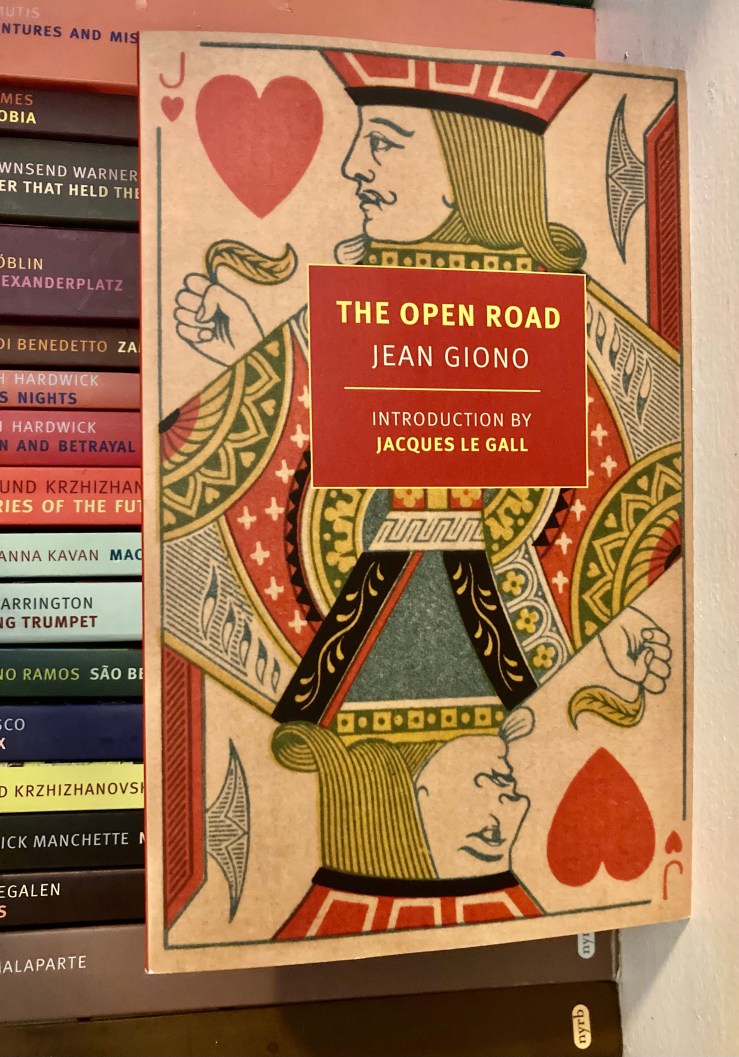
I’m a big fan of picaresque novels about con artists. Jean Giono’s The Open Road is forthcoming in translation by Paul Eprile from NYRB. Their blurb:
The south of France, 1950: A solitary vagabond walks through the villages, towns, valleys, and foothills of the region between northern Provence and the Alps. He picks up work along the way and spends the winter as the custodian of a walnut-oil mill. He also picks up a problematic companion: a cardsharp and con man, whom he calls “the Artist.” The action moves from place to place, and episode to episode, in truly picaresque fashion. Everything is told in the first person, present tense, by the vagabond narrator, who goes unnamed. He himself is a curious combination of qualities—poetic, resentful, cynical, compassionate, flirtatious, and self-absorbed.
While The Open Road can be read as loosely strung entertainment, interspersed with caustic reflections, it can also be interpreted as a projection of the relationship of author, art, and audience. But it is ultimately an exploration of the tensions and boundaries between affection and commitment, and of the competing needs for solitude, independence, and human bonds. As always in Jean Giono, the language is rich in natural imagery and as ruggedly idiomatic as it is lyrical.
We are left, I submit, with the problem of her depressions. They are, I agree, terrible. Your idea that I am not “supportive” enough is, I think, wrong. I have found, as a practical matter, that the best thing to do is to just do ordinary things, read the newspaper for example, or watch basketball, or wash the dishes. That seems to allow her to come out of it better than any amount of so-called “support. ” (About the chasmus hystericus or hysterical yawning I don’t worry any more. It is masking behavior, of course, but after all, you must allow us our tics. The world is waiting for the sunrise.) What do you do with a patient who finds the world unsatisfactory? The world is unsatisfactory; only a fool would deny it. I know that your own ongoing psychic structuralization is still going on-you are thirty-seven and I am forty-one-but you must be old enough by now to realize that shit is shit. Susan’s perception that America has somehow got hold of the greed ethic and that the greed ethic has turned America into a tidy little hell is not, I think, wrong. What do you do with such a perception? Apply Band-Aids, I suppose. About her depressions, I wouldn’t do anything. I’d leave them alone. Put on a record.
From Donald Barthelme’s short story “The Sandman.”





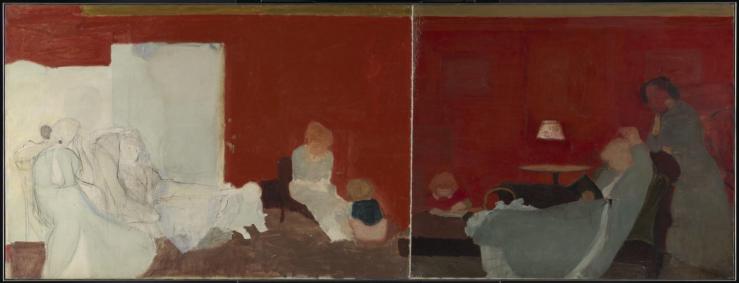 Interior with Reclining Women, 1946 by Victor Pasmore (1908-1998)



 Biblioklept