Biblioklept Interviews Filmmaker Paul Festa

Paul Festa

Musician, writer, and filmmaker Paul Festa contacted me a few months ago to point out that I’d used a still of Harold Bloom from his film Apparition of the Eternal Church without crediting him. It was the nicest possible email in the world, and after a few pleasant exchanges, he sent me a copy of Apparition along with his new film, The Glitter Emergency. Both films are marked by humor, pathos, and a deep love for music. Paul was kind enough to talk with me about his work over a series of emails. For more info, check out his website.

Biblioklept: Your new film The Glitter Emergency is about a girl with a peg leg who dreams about being a ballerina. There’s a humor in the film that highlights some of the dramatic absurdity to the premise, but there’s also a lot of pathos there. How did the idea for the film come about?

Paul Festa: The germ of the plot itself came from an act Matthew Simmons had me accompany on violin many years ago, when his drag persona Peggy L’Eggs came out onstage as a one-legged ballerina on a rollerskate. But what precipitated the making of the film last year was a profound career crisis that came between the death of an extremely important and beloved mentor and my 40th birthday. I’d worked seriously – feverishly – to become a violinist, but a repetitive strain injury curtailed my musical career. Then I put all that energy and commitment into becoming a writer, but I didn’t achieve any success until almost by accident I became a filmmaker with my experimental documentary Apparition of the Eternal Church, a no-budget personal project that went on to screen throughout the US and Europe and win prizes and get very well reviewed. So at the age of 39 I found my energies and time divided between music, fiction and film, and none of the above had coalesced into a sustainable career and I still didn’t know, squarely into my middle age, what I was going to be when I grew up.

I spent December of 2009 and much of January lying awake through the night listening to my heart beat and it was in that period of grief for my mentor, and panic about my life, that I came up with the idea for this film that would be a comedic metaphor for my experience as an injured artist who finds his way back to his art through supernatural intervention. In the peg-leg ballerina’s case, it’s the vial of Enchanted Glitter; in my own case, it’s film, which enabled me to resume my life as a professional musician. And in both cases, it’s an enchantment much like Dumbo’s feather, a suspension of our self-doubt more than any external magical agent that permits us to do extraordinary things with our lives.

Biblioklept: The Glitter Emergency — at least most of it — is stylized as an early silent film: black and white, placards for dialog and titles, even the jumpiness of an old reel-to-reel machine is replicated. Was this form always part of the project? What prompted your decision to shoot the film this way?

PF: The silent-film aesthetic was there from the get-go, and for several reasons. First of all, the whole project is a star vehicle for Peggy L’Eggs, and as a film presence she was born sixty years too late — she’s Clara Bow and Lillian Gish and Stan Laurel all rolled into one. Second, the convention of silent film, with dialogue represented in intertitles, works perfectly with what I do at the intersection of music and film. In the usual relationship, music is there to serve film, to color it emotionally as soundtrack. What I do is the other way around – I’m using film to illuminate or dramatize music. And so the music has to play uninterrupted, and intertitles work perfectly. When you think of it, it happens in both my films – the last third of Apparition of the Eternal Church consists of silent images of the interview subjects, and text titles, and organ music accompanying.

I don’t have any formal education in film, but when I was a kid my father used to take me to the Avenue Theater out on San Bruno Avenue in San Francisco, where every Friday night they would show a silent film and an early talkie, the silent accompanied on the theater’s Wurlitzer by an old guy named Bob Vaughn who had accompanied these films when they first came out in the 20s. So the look and feel are second nature for me, as they are for my co-director Kevin Clarke, who came up with a lot of the signature silent-film flourishes in Glitter.

Biblioklept: You bring up your first film, Apparition of the Eternal Church, which again is obviously very much about music. The film begins by having a number of people listening to the music of Messiaen on headphones and reacting to it, discussing it, emoting to it, puzzling over it — but the music is withheld from the audience for quite some time. I found it very, very frustrating! Was this by design? What’s the story behind Apparition?

PF: I would never intentionally frustrate an audience, though I might withhold satisfaction for a half hour as Apparition does. The reason for the structure of that film is again to serve the music, to preserve our ability to hear it whole and to some extent on its own terms. I had filmmakers advise me that the film could only work if I dosed out the music in parcels, letting the audience hear it piece by piece, fading it in and out throughout the interviews. I never seriously considered this option – as the playwright Karen Hartman observes early in the film, you don’t talk over Messiaen! It’s not background music. So that is an experience – a trial – I reserved for the interview subjects and spared the audience. And I spared the music from being chopped up and presented piecemeal, which would have rendered it meaningless for the following reason: the piece is composed of two sonic pyramids, one short and preliminary, the next reaching up to what Messiaen understands to be God. If you present a pyramid in pieces, you have a pile of stones and they don’t do anything, much less ascend to heaven.

So my options were to play the music first, before the interviews, to play it after, or not to play it at all. I tend to think the option I chose results in the least frustration – but everyone experiences the film, and the music, differently.

Biblioklept: For the record, I don’t think the frustration is negative at all — the withholding primes anticipation to a level that passes, I don’t know, an itch, I suppose. I wanted to hear what your subjects were hearing. Speaking of the subjects, how did you get people involved in the film? There’s such a wide range of interviewees there, from Harold Bloom to Squeaky Blonde. How long did it all come together?

PF: The subject of frustration in Messiaen is interesting, because some people – including much more sophisticated musicians than I – find a disturbing lack of direction or resolution in his music. It’s static to them – it floats, an object in space that gets bigger or smaller as its relation to you changes, but beyond the change in that spatial relationship it’s not doing anything and it drives you bonkers. And I think that frustration is a species of the torture that eternity threatens, the emptiness of life without end. For theological reasons Messiaen can’t intend that dark gloss on eternal life, and it’s pretty far from my experience of the music, but plenty of people experience it. Hence John Rogers’s observation that despite what the composer intends to portray, “this is what hell is like.”

I interviewed 115 people for Apparition, and 31 are in the film — some of them for just one or two clips. The first interview was with the harpsichord virtuoso and early music guru Albert Fuller, who had taught me chamber music when I was a student at Juilliard in the early 90s, and who taught me in large part by putting on music and talking through it, describing what he heard in “the theater of his imagination,” as he called it. Albert’s interview was so great — so wide ranging ad surprising, starting in laughter and ending in tears — that I felt I needed to keep going. I interviewed pretty much everyone I could get to put on the headphones and sign a release – anyone who walked into my apartment. Several of my English mentors are in the film – I took Bloom’s Shakespeare seminar at Yale, and Rogers’s Milton and Spencer courses, and several classes with Wayne Koestenbaum. Michael Warner, who now heads the Yale English department, I met along with several other cast members in the woods of Tennessee at a gathering of the Radical Faeries. I spent most of three years collecting the interviews, a pace I recommend to anyone doing a project like this.

Biblioklept: You’ll be presenting both movies later this month (in Santa Cruz) with live musical accompaniment. Have you done that before? What can audiences hope to see and hear?

PF: Both Apparition of the Eternal Church and The Glitter Emergency are blessed with having had numerous screenings with live musical accompaniment. Apparition has screened accompanied by some great church organs in the US and Europe, including St. Bartholomew’s Church in New York and Grace Cathedral here in San Francisco. I’ve accompanied Glitter on violin at every public screening since we premiered the rough cut in May of last year. And while the two films have screened before as a double bill, this is the first time both will screen together with live music. In addition to the films and music, the audience should expect a robust discussion afterward. The screening is sponsored by UCSC, where both films screened last year to a terrific film history class where I got some of the most intelligent questions and commentary of any post-screening Q&A.

Biblioklept: Have you ever stolen a book?

PF: I’ve stolen a lot of books, most significantly Virginia Woolf’s Orlando and Thomas di Cantimpre’s Life of Christina Mirabilis. I’ve been boiling them down with some Bible and Franzen and a pinch of Milton and dimly remembered Steinbeck and any year now am expecting it to yield my first novel, Heaven Descending, a sort of bildungsroman amid a world of Hollywood lowlives and Radical Faerie medical marijuana farmers that sparkles with magical realism and catastrophic drug busts. In the fall I had seven weeks at Yaddo in which I laid the foundation for the fourth draft but work on two new films has prevented me from making any progress since New Year’s. Next year is a big year for the project; it turns 10.

The Glitter Emergency will have its Midwest premiere at the Chicago International Movies & Music Festival on Thursday, April 14, at 7:30 p.m., at the Wicker Park Art Center, launching a program that features Kenneth Anger’s two masterpieces, Lucifer Rising and Scorpio Rising – all with live musical accompaniment.

The Collected Fictions of Gordon Lish (as Read by Gordon Lish)

Listening to Gordon Lish read selections from Iambik Audio’s compendium of his Collected Fictions for the fourth time today, it occurred to me that I should just go ahead and review the damn thing. Quit stalling. Get to it. I hope that pointing out that I’ve listened to Lish narrate ten of his odd, funny, gut-wrenching tales four times now (and will surely listen again) is enough to motivate thee, gentle reader, to follow my example—but that’s lazy, wishful thinking, right? There needs to be a proper review. Here goes—
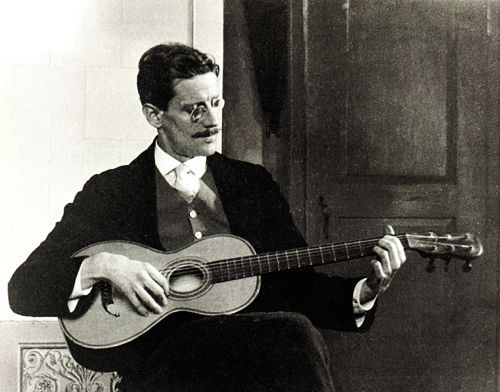
Lish is perhaps more famous as an editor than a writer of short fiction. He worked for years at Vanity Fair and later for Knopf, and the list of writers that he championed reads like a who’s-who of contemporary greats: Don DeLillo, Cynthia Ozick, Amy Hempel, Barry Hannah, David Leavitt, and Harold Brodkey, just to name a few. The writer he is perhaps most associated with though is Raymond Carver. By paring down sentence after sentence, Lish helped Carver develop his spare, minimalist style.

It’s that attention to sentences, to the truth of each sentence, to their individual force, that shines through in the collection. Consider this beauty, from “The Death of Me,” a story about a boy (surely Gordon Lish, hero of all Gordon Lish stories) who peaks too early, winning first place in all five field events at his summer camp one fine day in 1944, and then succumbing to the realization that this apex is, frankly, the end of it all–

I felt like going to sleep and staying asleep until someone came and told me that my parents were dead and that I was all grown up and that there was a new God in heaven and that he liked me better even than the old God had.

This sentence seems to me to be the expression of an emotion that I’ve felt for which I have no name. Lish’s sentences can move through tragedy and pathos to devastating comedy, a kind of comedy that collapses the auditor. Check out a line from “Mr. Goldbaum”–

What if your father was the kind of father who was dying and he called you to him and you were his son and he said for you to come lie down on the bed with him so that he could hold you and so that you could hold him so that you both could be like that hugging with each other like that to say goodbye before you had to actually go leave each other and did it, you did it, you god down on the bed with your father and you got up close to your father and you got your arms around your father and your father was hugging you and you were hugging your father and there was one of you who could not stop it, who could not help it, but who just got a hard-on?

Lish advised, “Don’t have stories — have sentences,” but “The Death of Me” and “Mr. Goldbaum” are more than the sum of their parts, more than just a collection of sculpted, scalpeled syntax. From the 1988 collection Mourner at the Door (the only Lish book I’d read before Collected Fictions), both stories announce Lish’s major theme of death, the absurdity of death, or the absurdity of life against the inevitability of death—but also the heavy truth of death, the ugly truth of death, the powerlessness of language against the finality of death. “Spell Bereavement,” also from Mourner, is essentially a prequel to “Mr. Goldbaum”: Gordon gets the news of his father’s death from his sister and mother. The story takes place over the phone as a sort of switch-hit interrogation, as mom and sis caustically berate the speechless man, who tells us, at the end, “There are not people in my heart of hears. There are just sentences in my heart of hearts.” Why does Gordon the narrator of “Spell Bereavement” fail to respond to the news of his father’s death? He is “too disabled to talk . . . going crazy with pencil and paper so as not to miss one word.”

Lish means to capture the ecstatic truth in death, and truth is at the core of all these stories, even when they are fables of a sort, like “After the Beanstalk,” which features a bewitched princess who has been transmogrified into a dog. The tale is hilarious and cutting and sad. There’s also “Squeak in the Sycamore,” which begins as a child’s list of fears and enumerations of death and longing and nature and ends in a joke and then an insult to the reader for laughing at the joke. (Best line: “Six is: the gardener died from digging up a basilisk”). “How to Write a Poem” is a caustic rant that argues that literary theft is really a matter of stern guts, of facing truth, and “Everything I Know” problematizes the very act of storytelling — it’s a story about how we tell stories, or our versions of stories. By far the most affecting piece that Lish reads though is “Eats with Ozick and Lentricchia,” about which he tells us, before reading it, “there is not a word of it that is not true.” It is a story that hovers around the death, or the dying of, more accurately, Lish’s wife Barbara; its details are almost too cruel, too true to bear.

Lish reads his tales in a bold voice that seems to challenge the auditor at all angles, as if his sentences were prodding you, poking you, pinching you even. He claims, in one of the many asides that precede these tales, to have never really read his work aloud before, and not to have really read the work in years, but his confidence seems to belie this notion; maybe, more accurately, it conveys the intense concentration of his intellect. His tone fascinates, and then he cracks out something like: “It always astonishes me I could have written such a thing” in such a dry honest voice that, while his quip hangs ambiguous, it remains utterly sincere. There’s a wonderful moment in the recording when he moves from reading “Mr. Goldbaum” to “Spell Bereavement” and seems to notice, as if for the first time, their close connection. He then remarks–

It shames me in one kind of way to see that my writing gathers itself into such a rut, but on the other hand it does please me to have spoken again and again and again about that which occurred to me at the time to be of consequence. I haven’t written fiction or anything else really for a great number of years and this occasion, reading these pieces, is an education for me and alien, foreign, in one kind of way, because the sentences are complex, but in another kind of way, I’m reminded of who I am.

Lish’s influence cannot be underestimated, from writers like David Foster Wallace to Denis Johnson to Sam Lipsyte, and all of those who will follow in turn. Readers have a fantastic (and incredibly inexpensive, I must add) starting place in Iambik’s wonderful collection. Do yourself a favor and check this out. Very highly recommended.

We Review RTÉ’s Full Cast Audio Recording of James Joyce’s Ulysses

My third (complete) trip through James Joyce’s Ulysses finds me just as (or even more than) stunned as the previous two journeys, a bit (very much) unequal to properly reviewing the book, but this time with an easy out — I listened to an unabridged, full cast audio recording. The aforementioned “easy out” is resting on the received greatness and goodness (and evilness) of the book, which I will hardly contend with and heartily endorse (and do very little real critical work to support my endorsement). Ulysses is fantastic. But what about this audio recording?
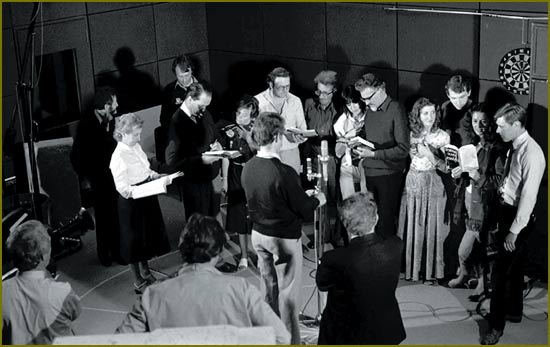
First thing’s first — I listened to, absorbed, choked up at, guffawed about, cackled around, and generally loved RTÉ’s 1982 dramatized, soundtracked, sound-effected, lovingly detailed recording of Ulysses, a work crammed with voices to match (if perhaps not equal) Joyce’s big fat work. This recording is not as widely available as LibriVox’s (free) full cast production or Jim Norton’s Naxos reading, but, after sampling both, I’d argue that it’s better. The Irish players bring sensitivity and humor to their roles, but beyond that pathos, the energy of RTÉ’s troupe is what really makes the book sing. Leopold Bloom gets his own voice, as does Stephen Dedalus and Molly (and all the characters). This innovation propels the narrative forward with dramatic power, and clarifies the oh-so indirectness of Joyce’s free indirect style, making the plot’s pitfalls and pratfalls more distinct and defined. There are songs (and dances) and music (and musing) and humming (and hemming and hawing and reverb). There is chanting and chawing and brouhaha. There is chaos and calamity and confusion. There is brilliance and peace and transcendence. It’s all very good, great, wonderful.

So: Who is a full cast unabridged audio recording of Ulysses for? Say, for instance, can someone who’s never read Ulysses listen to this instead?

I don’t know.

Here’s what I think though: Ulysses begs to be read aloud, is musical, soundical. Beyond obvious chapters like episode 11, “Sirens,” an overtly musical interlude that actually hurt my throat the first (second?) time I read it (even though I read it that time silently) — beyond the obvious musicality of “Sirens,” Ulysses hums and thrums and bristles and thumps with lively, vocal, melodious, rhythmic energy, pulses in sound and vision. The full cast reading, to cling to a hoary cliché, brings this sound and vision to life, animating Joyce’s words with a just vitality. But I’ve tripped into details, put carts before horses — the prime advantage for an audio recording of Ulysses to newbies is probably how clearly (and audibly, ahem) it delineates the book’s plot. But —

At the same time, I think anyone reading the book for the first time will want to read it along with the audio recording. Read along as in literally read along with, or, more likely read first or after — chapter by chapter that is. Yes, I think, yes, that’s what I’d recommend (lagersoaked now as my brain might be) — read a chapter first, then listen, then read another (or reread). Rinse. Lather. Repeat.

The Cast at Work

Now I retreat to that ugly bastard of literary criticism, reader response shtick, the stuff of fellows who can’t make real claims on the work itself but rather hide behind how the book made me feel and think and blah blah blah. Sorry. I break myself against Ulysses. And it’s not even the book, truth be told (to trot out another hoary cliché) — I’ve reviewed books here that sought to rival Ulysses, books that undoubtedly contend with it — it’s more the critical tradition that accompanies Ulysses that daunts me. But enough. Anyone who wishes to read pages of graduate school work on the subject, written by moi, may apply below. Suffice to say for now that I loved loved loved listening to this audio recording.

Perhaps because I was so familiar (or familiar enough) with Joyce’s themes at this reading/auditing, I was able to relax during this odyssey through Joyce’s epic. To put it another way, I felt no need to be “on” — to pick up allusions, to grasp at threads — and trip over them. Instead, I found a human dimension to Joyce’s work, one I’d felt there before, but perhaps not fully experienced (I am not claiming that I have fully experienced Ulysses). I laughed. I angered. I spit. I snarled. I cried (yes, I cried; at the mention of Rudy at the end of “Circes,” and then, again, at the end of the novel, just a bit, when I felt (felt) Molly’s love for her husband). There might have been a stirring at the loins.

I found a confirmation of my favorite episodes: “Circe,” foremost, an apocalyptic carnival brought to a bristling boil in the Irish cast’s capable choir. The aforementioned “Sirens” sings of course; far more pleasant, really, to hear than read. “Telemachus,” sure, who can nay-say an opener like that, although it’s really just the opener to the prelude to the real opener “Calypso” — great stuff. What earthy joy to meet Bloom. “Hades” — a sad treat. “Aeolus” — a funny treat, windily rebounding in vim and vigor and vigorous vim. The library episode — “Scylla and Charybdis” — I’ve always thought of it as Hamlet and Stephen, or grandfathers and ghosts — becomes clearer in the voices of RTÉ’s cast. Clearer not in the sense of: “Now I understand what Stephen’s getting at,” but clearer in the sense: “Now I see where Stephen sees what he is not quite sure he is getting at.” That chapter on pig-headed closemindedness, “The Cyclops” — a triumph, a magnitude, a bold chuckle. And “Penelope.” Well, yes, great stuff.

It’s more remarkable, I suppose, the ways in which RTÉ’s recording illuminated those chapters I’d struggled with, those that had made me yawn. The first, tedious, purposefully clichéd half of “Nausica” tried my patience (get back to Bloom!) — but the actress who reads it highlights the chapter’s tedium, its commonplaces — even as it/she rushes to that juicy climax. “Proteus”: far more manageable than I’d remembered. And “The Oxen of the Sun” (aka that chapter that I never really read properly) — well, with a full band of nasty drunken med students, a bold narrator (and a sympathetic nurse), this stumbling rock becomes a springboard to the madness I so love (and have loved) in “Circe.” In the once-trying catechism of “Ithaca,” the actors find a rhythmic bounce, a dry crunching that explodes in the wet gush of “Penelope.” And didn’t I say, yes, great stuff.

What this audio recording does best is humanize Joyce’s characters. While there is never a doubt that they are set against their mythotypical forebears, I found in Joyce’s characters this time a deep specificity, a concreteness of place, a realness. I found no need to situate a Bloom-as-Odysseus correspondence. Molly did not have to be an earth goddess. Stephen was freed from the burden of Hamlet. Sure, metempsychosis was in play, but it was a backdrop, not a foregrounding, determining analytical program. I think the audio recording helped transmit this humanity, a humanity that was always there, obscured by the clutter of critical tradition.

If I haven’t been clear: Very highly recommended.

The Matchmaker of Kenmare — Frank Delaney

Frank Delaney’s new novel The Matchmaker of Kenmare is set against the dramatic backdrop of Europe in 1943. Its narrator is Ben McCarthy (returning from Delaney’s previous novel Venetia Kelly’s Traveling Show), who lets the story unfold in the style of a memoir. Ben’s wife Venetia Kelly has mysteriously disappeared. To assuage his anxiety, Ben begins collecting folklore Irish folklore as part of a government project. In the process, he comes into contact with the titular matchmaker, Kate Begley. The two soon form a close bond, and Kate does everything in her power to aid the grieving narrator. The plot turns when a U.S. intelligence officer named Charles Miller enters the picture. He strikes up a romance with Kate, but their relationship is tested when he asks her — and Ben — to use their country’s neutral status to travel through enemy territory in order to find a man the American’s need before D-Day. Their mission soon turns to finding the man Kate believes she loves, a plot doubled in Ben’s search for his wife Venetia. The Matchmaker of Kenmare, new in hardback from Random House, will appeal to those who enjoy sweeping, richly detailed historical romances with a literary bent.
The Clown — Heinrich Böll

The titular figure in Heinrich Böll’s 1963 novel The Clown is Hans Schnier, a man whose personal and professional life is burning down around him as he howls in (often hilarious) despair. During a performance at a third-rate venue, Hans purposefully injures his knee and retreats to Bonn, where he holes up in his small apartment and makes angry desperate phone calls (and tries not to drink too much brandy) as he reflects on his past.
His common-law wife Marie has returned to the conservative Catholicism she was raised on, and subsequently left Hans; even worse, shes’ taken up with a bourgeois hack named Zupfner. Marie and Hans initially came together as teens, sexing it up in their provincial German town. After scandalizing all the decent ex-Nazis in town, they retreat to the comparatively cosmopolitan city of Bonn and begin a life (in sin) together, traveling from venue to venue and performance to performance as Hans’s career grows.

It becomes clear through the course of The Clown — which is essentially Hans’s long, angry rant against complacent conformity — that Marie is merely an object for Hans, a romantic idealization. He repeatedly tells us that she doesn’t get his art–

I don’t believe there is anyone in the world who understands a clown, even one clown doesn’t understand another, envy and jealousy always enter into it. Marie came close to understanding me, but she never quite understood me. She always felt that as a “creative person” I must be “deeply interested in absorbing as much culture as possible.” She was wrong.

Hans is always the outsider, even to the woman he loves. Still, Marie represents both comfort and some sense of continuity for this traveling artist whose life is basically a series of hotels, train rides, and performances. Without her, Hans is lost, adrift without an anchor, pure vitriol aimed at a society he rebukes at every turn. Consider his parents, for instance, rich Protestants with a penchant for providing patronage to middling writers — Hans’s hate for them is almost metaphorical, a hate that extends to their religion and their complicity in the evils of WWII. While The Clown is a highly personal story, the tale of an artistic soul tortured in the absence of his love, it’s also an indictment of postwar Germany, a milieu all-too ready to whitewash its sins in the easy absolution of cheap religion.

At times the nuances of The Clown’s argument against the conformist postwar German culture were lost on me. Hans’s many references to the particular rhythms and contrasts of Teutonic Protestants and Catholics were beyond my ken. Still, this rarely detracted from my enjoyment or involvement in the novel. Its caustic bite and extreme depression is tempered by ironic humor and expansive knowledge. Here’s an early passage in the book that I think shows off these attributes and obsessions while highlighting a bizarre metaphysical conceit that I don’t know how to properly work into this review–

I felt sick. I forgot to say that not only do I suffer from depression and headaches but a I also have another, almost mystical peculiarity: I can detect smells over the telephone.  . . . I had to get up and clean my teeth. Then I gargled with some of the cognac that was left, laboriously removed my makeup, got into bed again, and thought of Marie, of Christians, of Catholics, and contemplated the future. I thought of the gutters I would lie in one day. For a clown approaching fifty there are only two alternatives: gutter or palace. I had no faith in the palace, and before reaching fifty I had somehow to get through another twenty-two years.

So we learn that our hero is only in his late twenties, yet already romanticizes a dramatic life of failure; he sees himself as the failed artist down in the gutter, perhaps dreaming of the stars. And he can smell through the phone!

At its core, The Clown is a searing attack on hypocrisy, one grounded in a sense of time and place. And it’s this grounding that gives the book the weight — the concreteness of truth — to transcend its postwar setting and remain relevant today in a world where language, religion, and custom all provide societies and their institutions a kind of metaphysical escape hatch to avoid squarely assessing the gaps between mantra and action. Hans shows us that it takes a jester to truthfully comment on the absurdity of modernity; it’s the trickster whose pantomimes tap into the most mundane gestures to expose the intricate ways these gestures might disguise ugly, banal, or even evil intentions. Great stuff.

The Clown is new in print again from Melville House.

Will Self Is Wrong About the Coen Brothers

Will Self‘s recent hatchet job on the Coen brothers for The Guardian is the kind of calculated contrarianism that poses for meaningful criticism far too often on the internet. Let me offer his smarmy lede–

Sometimes it occurs to me that the job of a serious cultural critic mostly consists in telling the generality of people that their opinions – on films, on books, on all manner of widgets, gadgets and even the latest electronic fidgets – simply aren’t up to scratch. It’s a dirty, thankless task, but someone has to do it; someone has to point out that, no, Inception wasn’t the last word in sci-fi meta-sophistication, but rather a stupid person’s idea of what an intelligent film is like. And by the same token, as the Coen brothers’ True Grit comes galloping into our multiplexes surrounded by dust clouds of Stateside approbation, someone has to take a bead on the whole sweep of their careers, squint, and then if not exactly shoot them down, at any rate cold-cock the notion that the Coens are the great American auteurs of their generation, when, sadly, they are only a moderately clever person’s idea of what great American auteurs might be like.

I’ll set aside for a moment puzzling out whether Self sees himself as a serious cultural critic or a critic of serious culture (whatever that means) — there are too many inaccuracies, unsupported judgments, and logical fallacies in his essay to waste time with this detail for the moment. Let’s start with his premise that the Coens “are only a moderately clever person’s idea of what great American auteurs might be like.” Self links this premise to Inception for some reason, perhaps, I imagine, to trot out his zinger that Nolan’s blockbuster is “a stupid person’s idea of what an intelligent film is like.” This is a clever bit of sophistry that ultimately means nothing, an argument rooted in arrogance alone. Imagine a stupid person. Now, ask this imaginary stupid person what his or her idea of “great literature” is. He or she may reply “Stephen King” or he or she may just as easily reply “Shakespeare.” The perceived intelligence of the person has absolutely nothing to do with the aesthetic merit of the literary work he or she ultimately names. I might just as easily suggest that Will Self is a self-satisfied snob’s idea of a clever critic. But what would that actually say about Self’s brand of criticism? Nothing. Self’s claim about the Coens here (and Inception) is simply an ad hominem attack that relies on a perceived (yet never justified) superiority of aesthetic sensibility over the middlebrow masses.

Self tries to take on the Coens’ oeuvre, yet couldn’t even stay awake during Fargo

Fargo, I’ve always fallen asleep in – all that snow, and Frances McDormand’s mien of winsome determination, why, it’s enough to make anyone nod-off. But now I realise that my failure to stay awake during a film many consider to be among the Coens’ finest, was probably telling me something.

So the film fails the critic, who cannot bother to account for it (Self never even mentions Miller’s Crossing, for the record). Must be all that snow. Even worse, the film doesn’t do what Self wishes for it to do–

Fargo is a film that seems to be a genre noir picture, while never quite committing itself. This capacity the Coens have had to flirt with genre rather than ever wholly embracing it is something that – until someone like me comes along to tell you otherwise – people find particularly engaging.

The arrogance of this line is stunning. Who does Self think “someone like me” might be? Does he seriously see himself as some kind of aesthetic revelator? Self ends by writing that,

the Coens’ central problem [is] their reflexivity as directors, making films of films rather than films tout court. Still, in our benighted age, when films about amusement park rides and electronic fidgets scoop the honours, perhaps Hollywood redux is the best we can hope for.

I still don’t really understand Self’s argument. He seems to think that the Coens make decent Hollywood films, but they don’t make art. He’s upset because he thinks people are falling for two guys who are merely ironizing classic Hollywood structures. And yet he utterly fails to engage those structures, to actually analyze the Coens’ films in any meaningful way. Here’s a sample of Self’s facile criticism–

With O Brother, Where Art Thou? (2000) you even get another overlay: this isn’t just a retro-style depression-era chain-gang jailbreak movie, but a retelling of the Odyssey to boot. It’s James Joyce with a catchy country soundtrack instead of all that brain-ache wordplay.

How fucking glib is that? O Brother is a musical where every single song intrinsically connects to the particular scene in which it appears. It’s not merely a retelling of the Odyssey, but also an allusive reworking of much of Faulkner and Flannery O’Connor. At its core, it’s a film about the rise of modernism and the changing cultural scope of the South. And, for what it’s worth, it’s full of brainy wordplay.

O Brother also reworks a 1941 Preston Sturges film called Sullivan’s Travels. This film is a film about a film-maker — this is exactly the kind of ironic self-reflexivity that bothers Self for reasons he fails to account for beyond the notion that such self-reflexivity leads to the dangers of people who think that they are smart but who are really not smart believing that they are seeing a smart film — hang on, that was a long clause, sorry; okay, Sullivan’s Travels is a film about a film-maker who wants to make a film of social commentary, a film of meaningful art, a film he will call O Brother, Where Art Thou? As the director makes his way through the mean mean world, he comes to realize that the average person — the middlebrow viewers that Self holds so much contempt for — would really rather have their pains relieved in some way than experience them again through an art film.

But I get the feeling that Self has little capacity for an emotional response to film — he’s likely far too concerned that the film is trying to like, trick him or something. (It is. That’s the job of all storytelling). And yes, I haven’t bothered to say why the Coens’ films are great, are marvelous, are fantastic films, but this rant has already grown too long, and besides, I think that all one has to do is watch them. (And if you don’t like them, that’s fine. Doesn’t make you “stupid” or “middlebrow”). Finally — and this is just pure meanness — Will Self’s novel Great Apes was so singularly gross, gnarly, and devoid of meaningful insight that it ensured I would never read another word of his literature. His essay on the Coens ensures that I’ll ignore his criticism as well.

The Sunset Limited — Cormac McCarthy

thesunsetlimited

Cormac McCarthy’s The Sunset Limited is a lean, spare dialectic between two characters named simply “Black” and “White.” Black, a recovering addict who found Jesus in prison, saves White, an aging professor, who attempts to kill himself by jumping in front of a commuter train, the Sunset Limited. Black keeps White in his apartment, probing the older man’s justification for suicide. White makes it very clear that he intends to finish the job the moment he can leave Black’s apartment, leading Black to stall the professor through argument and storytelling. As such, Black sustains most of the book’s driving questions about morality, redemption, and love for one’s fellows, until near the end, when White unleashes a tirade of nihilism. As the story charges to its climactic conclusion, it becomes clear that it is not just White’s soul at stake, but also Black’s own spirituality.

The cover of The Sunset Limited attests that the book is “A Novel in Dramatic Form,” a conceit that may divide many of McCarthy’s admirers. The language here is precise and visceral, loaded with meaningful ideas yet also utterly concrete. McCarthy’s grasp of colloquial diction shines through these two voices, carrying the story forward in a hurtling momentum with minimal stage directions. Still, some readers may feel cheated out of McCarthy’s rich prose in this bare story (they need only to pick up Blood Meridian or The Road or All the Pretty Horses, of course). I found the story engaging, poignant, dark, and often surprisingly funny, and I read it in one taut sitting. The Sunset Limited is not the starting place for those interested in McCarthy, but fans who’ve yet to read it will probably enjoy it quite a bit. I’m already anticipating a second reading. Highly recommended.

(Editorial note: Biblioklept originally posted this review on February 14th, 2009. We run it again today to coincide with HBO’s debut of a feature film adaptation of McCarthy’s play).

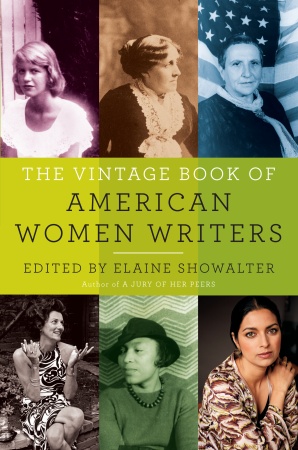
The Vintage Book of American Women Writers

In her introduction to The Vintage Book of American Women Writers, editor Elaine Showalter suggests that “the main reason women do not figure in American literary history is because they have not been the ones to write it.” Showalter sought to amend the fact that women writers, even those who were praised in their own era, “tended to disappear from literary history and national memory” in her earlier volume A Jury of Her Peers, a comprehensive history of American women writers from 1650 to 2000. History though is not enough — Showalter continues in her introduction: “Finally, we need a canon of outstanding women writers over the past four centuries both to organize their history and to begin the arguments that keep literary discussion alive.” The Vintage Book of American Women Writers aims to be that canon, or at least to be a volume of that canon, collecting writing by American women from the past 360 years. And while Showalter admits that “it cannot claim to be comprehensive,” the trade paperback is impressively hefty at over 800 pages, showcasing the work of 79 authors.
Many of these authors will be familiar (hopefully) to anyone who didn’t sleep through his or her American lit class in high school. The volume begins with several selections from the Puritan poet Anne Bradstreet; there’s also Mary Rowlandson, Phillis Wheatley, and Margaret Fuller. A tidy chunk of the early part of the book comes from writers we might associate with the transcendentalist movement — Harriet Beecher Stowe, Julia Ward Howe, Louisa May Alcott, and Emily Dickinson, just to name a few of the more famous writers. There’s an abundance of riches near the turn of the twentieth century, with tales from Willa Cather, Kate Chopin, Charlotte Perkins Gilman, and Edith Wharton, writers who set the stage for the modernism of Gertrude Stein, Katherine Anne Porter, and H.D. And then: Marianne Moore, Sylvia Plath, Elizabeth Bishop, Dorothy Parker, Edna St. Vincent Millay, Zora Neale Hurston (the collection won my heart simply by including her incomparable short story “Sweat”), Gwendolyn Brooks, Cynthia Ozick, Joyce Carol Oates, Annie Proulx, Ursula K. LeGuin, Flannery O’Connor (but not, for some reason, Carson McCullers), Amy Tan, and Jhumpa Lahiri.

I realize I’m just listing names now, but hopefully you know these names, are familiar with them, have read their works (if not, The Vintage Book of American Women Writers is clearly a great starting place). As an experiment — and perhaps an implicit challenge to Showalter’s contention that these writers continue to be neglected — I counted the authors I’d read at least once before this collection: 33, or 42%. Granted, I teach English for a living, and many of these authors are represented in every literature anthology I’ve ever used. But that might be my point, I suppose, that the canon has opened up, been re-examined and reformed. I can’t think of a literature course I’ve ever taught that hasn’t included Hurston or O’Connor or Katherine Anne Porter.

For me then, the greater joy in The Vintage Book of American Women Writers is in reading the writers that I haven’t seen anthologized before. I’m almost ashamed to admit I hadn’t yet read (okay, never even heard of) the abolitionist poet Frances E. W. Harper; Lydia Huntley Sigourney’s poem “Indian Names,” written in 1849, seems more poignant (and troubling) than ever; Rose Terry Cooke’s “Blue-beard’s Closet” (1861) resonates strongly, in that it connects to the latest piece in the collection, Annie Proulx’s “55 Miles to the Nearest Gas Pump.” The story of Bluebeard of course metaphorizes the history that Showalter wishes to reverse, what with its discarded bodies, locked in a secret room, awaiting discorvery. Okay, maybe that’s a stretch (or at least a hyperbole). In any case, these stories, poems, essays, fables, and tales are hardly lifeless. Great stuff.

The Vintage Book of American Women Writers is new in trade paperback from Vintage.

Biblioklept Recommends Five Novels, Some of Them New, Not All of Them German

I shouldn’t be reading five novels at once. It’s a terrible idea, a symptom of a bad habit that I thought I’d broken, but after abandoning Levin’s tedious tome The Instructions and wasting my time on Shteyngart’s insipid dystopian novel Super Sad True Love Story, I found myself absorbed by a lovely little cache that had been neatly, patiently stacked for a few weeks now.
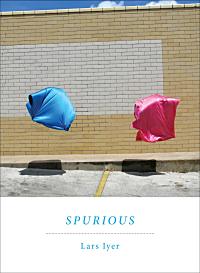
I’m only 60 or so pages into Lars Iyer’s Spurious — about a third of the way through — and at the rate I’m reading, I won’t finish it until the end of this month. It’s not that it’s slow or tedious or hard work: quite the opposite, in fact — it’s funny and lively, even when it’s erudite and depressive. I’ve enjoyed taking it in as a series of vignettes or skits or riffs. Spurious is about, or seems to be about (the term must be placed under suspicion) two would-be intellectuals, W. and his friend the narrator. They bitch and moan and despair: it’s the end of the world, it’s the apocalypse; they find themselves incapable of original thought, of producing any good writing. The shadow of Kafka paralyzes them. They travel about Europe, seeking out knowledge and inspiration — or at least a glimpse of some beautiful first editions. W. is cruel to the narrator, calling him fat and deriding his intellect for sport. But it’s all in good fun. Or maybe not. I’m really enjoying Spurious and have no hesitation recommending it; however, like a strong shot of bourbon, it’s best enjoyed frequently but in small doses. Spurious is brand spanking new from Melville House.

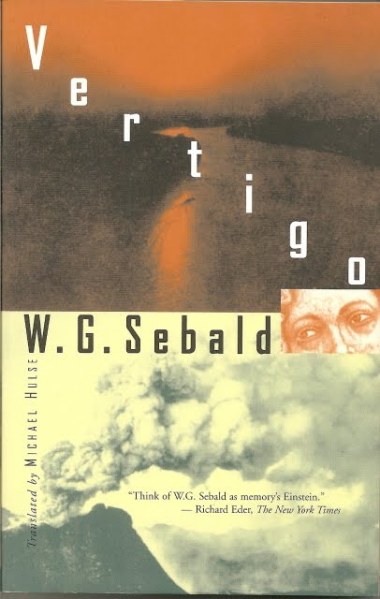
Iyer’s book dovetails nicely with W.G. Sebald’s first novel, Vertigo, which I picked up expressly to get the bad taste of Shteyngart out of my brain. Both books are haunted by Kafka, both  blur the lines between fiction and biography, both are works of and about flânerie, and both are melancholy. The book comprises four sections; the first section tells the story of the romantic novelist Stendhal (or, more to the point, a version of Stendhal); the second section details two trips Sebald made to Italy, one in 1980, and one in 1987; the third section, which I just read last night, describes a trip Kakfa took to Italy near the end of his life. I’m almost certain that I’ve read this section, “Dr. K Takes the Waters at Riva,” before — but I can’t remember where or when. It was strange reading it, almost as if I were experiencing some of the vertigo that permeates the volume. Full review forthcoming.
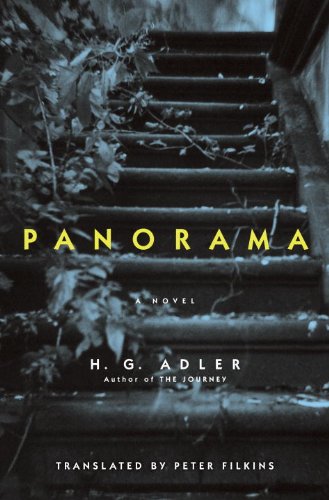
Kafka was a German-speaking Jewish writer from Prague. So was H.G. Adler, author of Panorama, new in English for the first time (hardback; Random House). Another way to transition from the Sebald paragraph above to this write-up of Panorama might be to point out that Sebald references Adler in Austerlitz, a book that tries to measure continental memory of the Holocaust. Adler survived the Holocaust, forced first into Theresienstadt and then Auschwitz, where his wife and mother were murdered in the gas chambers. Panorama is an autobiographical bildungsroman, with its hero young Josef Kramer standing in for Adler, and while it will clearly work its way into grim territory, the beginning — which is to say, the part that I’ve read so far — is bucolic and sweet and strange, as we see young Josef at home with his family. There’s a cinematic scope to Adler’s prose — Panorama is a Modernist work, one where the narrative freely dips into its protagonist’s mind. More to come.

Continuing in this Teutonic vein is Heinrich Böll’s novel The Clown (also Melville House). It’s postwar Germany, and Hans Schnier is a clown who’s crashing and burning. He hurts himself–purposefully–during a performance (at one of the increasingly more provincial venues he finds himself playing for these days) and retreats to Bonn, where he holes up in his small apartment and makes angry desperate phone calls (and tries not to drink too much brandy) and reflects on his past. What’s eating him up? His gal Marie, basically his common-law wife, has reverted back to her Catholic ways and up and left him for some chump named Zupfner. Schnier rants against a complacent and complicit German bourgeoisie, spitting vitriol against Protestants and Catholics alike; some of the best parts of the novel though are his ravings about art and the role of the “artiste” in society. Also: he can smell over the phone. Full review soon.
Wesley Stace’s new novel Charles Jessold, Considered as a Murderer (new from Picador) is a musical murder mystery set in the early part of 20th century Britain. Our (seemingly less than reliable) narrator Leslie Shepherd is a music critic with an aristocratic background who likes to spend his weekends collecting folk songs with other rich boys in the towns surrounding their country manors. He’s smitten (platonically, of course) with Charles Jessold, a middle class composer with a spark of avant-garde genius, and wins the younger man’s friendship quickly when he tells the story of Carlo Gesualdo, a fifteenth century composer/lord who kills his wife and her lover. (Notice the etymological connection between their names?) This tale of murder and cuckoldry is doubled in the ballad “Little Musgrave“; when Jessold and Shepherd find a new variation of the ballad, they set out to write the next (only?) great English opera, an adaptation of “Musgrave.” Oh, and that plot? The book opens with a news clipping reporting that Jessold killed his wife and her lover, and then himself, after the première of his opera Little Musgrave. Life imitates art imitates life. Stace has a keen ear for the period he writes about as well as a seemingly encyclopedic knowledge about music, but he also has the good sense to restrain himself and remember that he’s delivering a murder mystery. I’ve been enjoying Jessold quite a bit, and will return to it when I finish writing these lines. (And, for what it’s worth, part of Jessold is set in Germany).

Biblioklept Interviews Steve Hendricks About Torture, Extraordinary Rendition, Liberal Complacency, and His New Book A Kidnapping in Milan

Steve Hendricks is the author of two works of investigative journalism. 2006’s The Unquiet Grave is an examination of how the FBI aided and abetted the erosion of American Indian culture in the United States. Hendricks’s newest book is A Kidnapping in Milan, a nonfiction thriller that exposes the extraordinary rendition of radical imam Abu Omar by the CIA. In our review we noted that “Hendricks combines journalistic clarity with the structure of a detective novel in Kidnapping,” pointing out that what guides “the narrative is a refined sense of moral outrage against the idea that dark deeds done in the dark make our world somehow safer.” Hendricks was kind enough to talk with us via email about his book, torture, the Obama administration, and the rise of the apathetic liberal in America. You can read more at Hendricks’s site.

Biblioklept: Obviously a lot of work went into A Kidnapping in Milan — lots of research and interviews, not to mention the fact that you learned Italian. What made you want to tell this story?

Steve Hendricks: I came to the story somewhat sideways–less because of Abu Omar’s rendition itself than because I was frustrated that no one had written a compelling account of the horror of America’s torture-by-proxy; that is, the horror of the torture that our client states were inflicting on our captives in what amounted to our offshore dungeons. Reporters of course said that the torture was horrific, and sometimes they went into a bit of good detail, but there weren’t any narratives that went deep enough to make us feel that horror–to make us understand in our gut why political torture is not just a crime but a crime against humanity. So I was looking for a story that would allow me to try to write that narrative.

As I researched the renditions that we knew something about (so many renditions, of course, we know nothing or next to nothing about), I came across Abu Omar’s story and was immediately struck by the almost incredible amount of detail that the Italian prosecutor, Armando Spataro, had dug up on the CIA, by the ludicrousness of how the CIA went about the rendition, and by the possibility that Spataro might be a heroic figure. I wasn’t naive about heroes. They’re flawed like all the rest of us. But in America’s “war on terror” the villains–both terrorists and our own war criminals–have so often outnumbered the heroes that if there was a chance of writing a tale that could be somewhat uplifting while at the same time being wrenching (because of Abu Omar’s torment) and comic (because of the CIA’s Keystone Kommandos), that was great. So much the better, for the narrative anyway, that Abu Omar was a terrorist. It made the book more gray than black-and-white. In the end, the story of his torture, which had gotten me into the book, ended up being just one chapter, though to my mind it’s one of the most powerful chapters in the book.

Biblioklept: I think for most readers that chapter, “Torment,” will certainly stand out. I found it fascinating, particularly the historical overview of how various governments have used torture (and “ordeals”) to coerce information from captives. There’s a brutal episode in the chapter that describes how the torturers used a cattle-prod type device on Abu Omar. In narrative terms, we find ourselves sympathizing with this “bad guy,” this enemy-other who’s been locked up in a no-place. How important was it for you to elicit this kind of emotional identification on the reader’s part with Abu Omar? Were you concerned with alienating some potential readers?

Hendricks: It was very important to me that readers empathize with the atrocities visited on Abu Omar. It’s easy for anyone to say that lesser criminals shouldn’t be tortured. But for some people it’s much harder to say that torture shouldn’t be used against our greatest enemies. Yet that’s the test–one test anyway–of whether a deed like torture is evil: does it repulse and degrade us even when we use it against those who are themselves in some measure evil? Yes, I was sure, as you suggest, that my portrayal would alienate some pro-torture readers, but I was more interested in appealing to readers whose minds weren’t made up.
I did hear, shortly after the book’s publication, from one reader who said he was put off that I was advocating a moral view rather than giving a neutral “here’s this side of the story, here’s that side of story.” My response was that most of the supposedly “neutral” descriptions of torture-by-proxy haven’t in fact been neutral. For example, most American media refuse to refer to our use of waterboarding as torture, even though if you asked a hundred torture experts, ninety-nine would say it’s torture. I believed a corrective was needed–not an unfair and ludicrously biased corrective but one that reported the brutal facts unsparingly, which in turn would make plain that the mainstream media, by sins of omission and commission, had gotten things badly wrong.

I would add that there are some crimes so heinous that if you don’t call them heinous, you’re either dishonest, naïve, or a coward. Look at it this way: if an author told the story of the Holocaust as “well, Hitler had his take on it, and the Jews had theirs,” would you trust the author, or would you think him a lout? The torture of a few hundred men is not the same as the murder of millions, but international law deems systematic torture as so awful that it puts it in a class of crime similar to genocide–and it’s not just international law, but American law that does so. The United States has adopted both the Rome Convention and the UN Convention Against Torture as the law of the land, and both laws define political torture as a crime against humanity. The Convention Against Torture, as enacted here, provides jail time for people who send someone to another country to be tortured, and if the tortured person dies, the punishment can even be the death penalty. That’s not something you hear much in the media–that Clinton (who began extraordinary renditions), Bush junior, and now Obama (who continues the rendition program) could be subject to jail time or even death.

All that said, I strongly believe that a writer like me who advocates a moral position is obliged to present the facts in such a way (even if he’s presenting his opinions alongside them) that will allow readers to judge for themselves whether his advocacy is valid. I think I did that in the book, but, in the spirit of what I’m saying here, I’ll leave it to the reader to decide.

Biblioklept: Your book ends in early 2009, where you point out that, from the outset, the Obama administration essentially followed the Bush administration’s policies; Obama has even authorized the assassination of American terror suspects. Over the past few years, the average American’s focus has shifted from US foreign relations to our sagging economy. It seems that there’s a sense among many progressives that our international reputation and morality have been restored simply by electing Obama. Do you worry that there’s too much complacency on the left? What’s at stake in continuing to ignore our government’s abuses?

Hendricks: Absolutely, there’s far too much complacency on the left. Most leftists simply packed up their bags and went home after the 2008 elections, then were utterly dismayed when Obama tacked way to the right on just about everything: on health care, on banking reform, on the stimulus package, on the wars in Afghanistan and Iraq, on torture, and on and on. Some leftists have woken up, but most of them still think that with some pretty tepid nudging, they can bring out the good Obama that they “know” is inside him. Guess what, folks: As he has shown again and again, he’s a corporatist/defense-hawk Democrat, and he’s not going to change unless he has no choice–and at this late date, that’s not going to happen unless he’s threatened with a serious challenge to his renomination in 2012. But of course most progressives, demoralized and limp, are too scared to give him a run for his money and will stand by their man, even if he’s not their man.

I’m endlessly amazed (and depressed) at how little the left learns from the right. Right wingers build power by playing strongly to their base. They push and push their far-right policies, and the national discourse moves rightward with them. Contrast that with progressives, who plead rather than demand and who, when they get into the office, make a mad dash for the center-right. Don’t these people know that in poll after poll a majority of Americans support their (supposed) goals: an end to the illegal wars, a real ban on torture, health care with a public option, accountability for banks, etc.?

As for what’s at stake in continuing to ignore abuses like torture, to my mind the biggest danger is that torture becomes normalized. Ten years ago it would have been thought barbaric to advocate torture. But after the pro-torture drumbeat of the last decade, “leaders” like Bush and Cheney not only can advocate torture but can boast about having ordered it–and face only the smallest blip of public disapproval. If we don’t reckon with our past, ever more Americans will come to see torture as acceptable, and we will have become the barbarians we set out to fight.

Biblioklept: What’s your next project?

Hendricks: A Kidnapping in Milan and my first book, The Unquiet Grave (which was about how the FBI undermined the Indian rights movement of the 1970s), each took about four years–four long years–to complete. So I’m giving myself a break from book-length nonfiction and taking my time mulling the next book. It’s not the easiest part of the job to find a topic will excite both me and a publisher, but the search itself is fun. I get to read a lot of fascinating things, and the time just to think is a luxury. Meanwhile, I’m working on a few magazine articles. One is about some rather astounding health benefits that fasting can yield. Another is about a man who was wrongly convicted of murder but was executed nonetheless. Actually, though, what takes up most of my time these days is a novel for middle grade kids. The book is something like a mystery, it’s mildly futuristic, and it has some political overtones–evidently I can’t keep politics out of my writing. I’m writing it as a way of saying thanks to my eight-year-old for tolerating my many absences, physical and psychological, while I researched and wrote my two books.

Biblioklept: Have you ever stolen a book?

Hendricks: Yes–or rather, to qualify my crime, sort of yes. I once borrowed a book from friends whose house I was sitting, and, meaning to return it, didn’t tell them about their loan. But then I moved away, and the book stayed with me, still unannounced. The book was Peter Matthiessen’s In the Spirit of Crazy Horse, which so moved me and which left me with so many questions, that I wrote The Unquiet Grave as a way of following up on it. I like to think this redeemed my delinquency, and from to time I’ve thought about finding the book’s owners (with whom I’ve lost touch) and letting them know about their honor. But I’m too big a coward. Confronting a terrorist in his own home? Sure. Confessing I purloined a paperback? Too scary.

I Super Hated Gary Shteyngart’s Super Sad True Love Story

At a certain point, I was inclined to write a thoughtful review of Gary Shteyngart’s much-lauded, truly awful novel Super Sad True Love Story, the kind of review that might try to weigh Shteyngart’s choked May-December romance against its dystopian background. That was a few chapters in, a point at which I’d gotten past the realization that Shteyngart was going to do nothing new with the dystopian genre I so love, yet still early enough for me to think that he might have something to say about American culture and politics in the early 21st century. There’s nothing there, though — Super Sad True Love Story subscribes to the normal dystopian program of synthesizing 1984 and Brave New World through a contemporary lens, yet what we’re left with is Shteyngart’s observation that people might not like to read as much as they used to.
Obligatory plot summary: it’s America a few decades down the line–not enough to account for the change that Shteyngart proposes–an America under Bipartisan rule, a country without an elected President, at war with Venezuela, heavily indebted to China, and essentially ruled by a corporatocracy. People no longer read, they only scan data from their ever-present “äppäräti,” screen media devices they are addicted to through which they shamelessly broadcast every last piece of personal data. Sound familiar? Sure. (Those damn kids with their Facebooks!)

Shteyngart’s hero is Lenny Abramov, son of immigrant Russian Jews. Lenny works for Post-Human Services, a company that aims to extend human life indefinitely– as long as you’re very, very rich. This is Lenny’s obsession. For some reason, never fully explained (although painfully and boringly explored) Lenny wants to live forever. I suppose Shteyngart is trying to parody America’s obsession with youthfulness, only the parody is not funny and never insightful. Lenny meets a Korean-American girl named Eunice Park while spending some Bohemian time in Italy. Eunice is twenty years his junior, yet Lenny falls madly for her right away, for no good reason, at least not for any reason that we, the readers, are given to understand. It’s real old-white-boy-meets-young-Asian-girl-territory, which Shteyngart seems to understand yet seems too embarrassed (rightfully) to properly remark upon.

The backdrop of this romance is an American dystopia that Shteyngart wishes was as affecting as Alfonso Cuaron’s Children of Men. Hey, you know what? Watch Children of Men again instead of reading Shteyngart’s super boring book. And I think I won’t waste anymore time detailing Shteyngart’s super boring plot, a plot that seems to have no idea where its going, yet is, at all turns, overwhelmingly self-satisfied (and derivative). Shteyngart wants to write an end-of-America epic, yet nothing he says is worth re-remarking upon — yes, it seems like people are increasingly facile; yes, young people seem increasingly willing to forsake traditional ideas of privacy; yes, we owe the Chinese government some money. Sam Lipsyte does it all way better in The Ask, a book that doesn’t have to borrow its plot from every dystopian that came before it.

That Shteyngart has written a poor dystopian novel offends me at a literary-type level, but I’m also offended by his myopic regionalism, which, as I just mentioned, he tries to pass off as Americanism. For Shteyngart, New York City is America, and the (relatively) newly immigrated populations he places in his fictionalized NYC are far-more American than anyone else, particularly the dumb-ass-hick-redneck-Southerners he throws into the city as transplanted bad guys. Shteyngart’s Southern grotesques are mere props, barely thought out stereotypes that offend me as both a reader and a Southerner — and yet, they are just as facile as his leads.

Speaking of offensive and facile, there’s a moment at the end of the book when a critic takes the time to reflect on the publication of Lenny’s diaries and Eunice’s emails (not called “emails,” but Jesus Christ I’m not going to waste more time explaining the book’s silly recoding of contemporary culture) — it’s surreal in its tackiness, an overt act of literary criticism upon the rest of the book, one which attempts to focus a specific viewpoint upon the narrative proper. Like the rest of the book it fails miserably, and yet is indicative of Shteyngart’s needy, whiny program.

But why end negatively? There are plenty of great dystopian novels out there — Margaret Atwood’s Oryx and Crake and The Year of the Flood, almost anything by William Burroughs, Disch’s Camp Concentration, Aldous Huxley’s sorely under-read Ape and Essence, Cormac McCarthy’s Blood Meridian, which understands that it’s always the end of the world, more or less all of Philip K. Dick, Riddley Walker, Cloud Atlas, shit, even Roberto Bolaño. Just don’t waste your time with Shteyngart’s super sorry book.

The Instructions — Adam Levin

Adam Levin’s début novel The Instructions is long. It’s very long. It’s too long.

Or, more to the point, it’s too long to be so mediocre.

This is not a fair criticism, especially considering that I have only read about 35.5% of the book. 8 chapters. 366 pages. I have no conclusive evidence that the next 664 pages won’t be the kind of mind-blowing read that can justify taking up over a thousand pages. Significantly though, there’s nothing in the first 366 pages that especially compels me to continue reading. I give up. I abandon it. Although reading is hardly a quantitative experience — reading and digesting a page of Melville requires more sustained concentration and energy than a page of, say, Bukowski — it stands to reason that I can read two or three novels in the time it would take finish The Instructions. And if I spend my (limited, I am a human and am going to die at some point) reading time reading three novels instead of finishing Levin’s book, it’s likely that at least one of them might be good, even great, while I’m pretty sure that The Instructions is going to continue its middling trajectory.

So what’s it about? It must have had an interesting premise for me to read 366 pages, right?

Gurion ben-Judah Maccabee is a 10 year-old seventh grader (he’s been promoted, sort of) who is forced to attend a special program called “The Cage” after being expelled from his first three schools for various violent acts. Gurion is a hyper-intelligent, budding rabbinical scholar with serious Torah-interpreting skills. He’s also pretty much the toughest kid at Aptakisic Junior High, where, despite being only ten, he kicks ass left and right (his mom is a former Israeli commando). The novel takes place over four days in 2006, as Gurion declares his love for June Watermark, meets a new friend, and begins to rally the behavioral disorder kids against The Cage’s totalitarianism.

The opening scene of the novel is an engaging piece — Gurion and two friends take turns simulating water boarding on each other during a gym class held in a pool. Then, in the locker room, a fight. Gurion loves to fight, despite his inkling — or, at least the inkling of others — that he may be the potential messiah. This obsession with Jewish (“Israelite,” Gurion would correct me) identity seems to be the main thrust of the novel. Gurion, who is the “author” of the novel (which he refers to as “scripture”) speaks authoritatively and eruditely about Torah and religious philosophy. In fact, he speaks like a fully matured scholar who has taught and studied religious philosophy for decades. One can allow this conceit of the novel: sure, Gurion is special, he can fight, he’s a genius, sure, that’s what drives the plot–but Levin wants to extend this genius, or at least rhetorical flair, to almost every other character.

The effect is by turns grating and numbing, as we are subjected to page after page of dialog that is meant to sound witty or empathetic or just plain flavorful but is more often silly or inauthentic or, at worst, too fucking precious for words. The cartoonish dialog, rife with fake slang that no middle school kids ever used, wouldn’t be so bad on its own; in fact, it seems to go hand in hand with Levin’s goal, which appears to be slapstick of some kind. Only he (or Gurion) repeatedly calls attention to the slapstick, commenting on it, even pointing out how the reader should appreciate it.

This meta-textual attention is at work at all times. In particular, it’s there in the long (oh my god are they long) descriptions of each and every action that takes place in the prose. Gurion feels the need to analyze every last little detail, to load it with preternatural significance; these lengthy passages scream for an editor. The arrangement of the text is of course meta-textual as well: it purports to be a work of Gurion’s authorship, and includes a variety of texts from his “personal file” including emails, detention records, essay assignments, and, in one glaring case of squandered potential, a psychological report. And yet in all these documents, there does not seem to be any perspective outside of Gurion’s; when Gurion’s therapist comments on his behavior we learn nothing new, nothing different — we only see a confirmation of Gurion’s highly perceptive intelligence. It is grand solipsism on the largest of scales.

Which brings me to the David Foster Wallace comparisons, which are probably what got me interested in The Instructions in the first place. Granted, The Instructions may have facile similarities to Infinite Jest, but the books differ tremendously in how the reader must engage them. IJ is pluralistic and heteroglossic; The Instructions is essentially a monologue. IJ invites the reader to play, to pursue mystery; The Instructions, despite its volume, seems to contain just one mind. And maybe that’s the problem. Reviewers have compared Gurion to Hal Incandenza — and it’s true, both are bright, troubled young men — but The Instructions seems to be lacking a Don Gately.

Looking over my comments, they seem harsher than I perhaps intended. I believe that Levin has great talent and is surely a keen intellect with stories worth sharing. More to the point, I think that there might be a good novel somewhere inside of The Instructions — only I’m pretty sure it’s much, much shorter.

The Instructions is new in hardback from McSweeney’s.

Books I Am Always (Re-)Reading

Trudging through a very long book the other night–never mind the title, at least now anyway–it occurred to me that I’d rather be reading from 2666; that, at that particular moment, I’d rather re-read from “The Part About the Crimes.” I don’t know if it was the effete dullness of the first volume that made me want to pick up Bolaño’s epic, perhaps trying to zap some life into my waning eyeballs; perhaps it was just the sense that I was wasting my time with the merely good, which, after all, is mediocrity when set against genius (yes, these are subjective terms).

Anyway, I didn’t have to go looking for 2666 — I have a copy (yes, I have two) right there jammed into my nightstand, along with a few other books that I realize that I’m always reading. Furthermore, I’m always reading these books in the most discontinuous, stochastic fashion, often picking them up at random and thumbing through them. I think I use these books to clear my literary palate, to get a bad (or worse, boring) taste out of my brain, to inspire me, to suggest another book. Some of these books, like 2666 are big, fat volumes, volumes that I set close at hand in the hopes of rereading in full. Sometimes I’ve met this goal; in the case of Moby-Dick, I’ve read the book through at least three times now, and yet never tire of it. I’m always picking it up again and again, sometimes to find Elijah’s rant or to dip into Ahab’s mad monologue or perhaps just to hear Stubb comment on the proper preparation of shark steaks. Of a piece with those big novels is David Foster Wallace’s Infinite Jest, which I turn to repeatedly, reading over a riff or two at a time, perhaps still trying to figure out the ending, or some clue of the ending, perhaps trying to figure out why Hal can’t speak (you know, beyond like, a a metaphorical level).

There’s also Blood Meridian.

A book I always keep proximal is D.H. Lawrence’s Studies in Classic American Literature, which, if this were a dictatorship under Biblioklept might replace the Constitution (jaykay, Tea Partiers!). Tellingly, I’ve never managed to finish one of Lawrence’s novels (I even struggle through his much-anthologized piece, “The Rocking Horse Winner”), but I consider his dissertations on Hawthorne, Poe, and Melville indispensable (and creative in their own right). I guess I just like lit crit; Harold Bloom’s too-huge volume The Western Canon is a book I return to again and again. Sometimes I find myself throwing it to the ground, quite literally (if I’ve enjoyed a drink or two, that is), in disgust. Bloom’s battle with “The School of Resentment” can be maddening, especially when he’s so up front about essentially making Shakespeare God. Still, Shakespeare doesn’t seem like a bad God to have.

I should point out that I’ve made no attempt to read The Western Canon the whole way through; in fact, I’ve never made a single attempt to read it systematically. I just sort of pick it up, thumb through it, occasionally plumb the index. There are several books that I am always rereading in this category: Books That I Am Always Reading and Yet Have Never Finished. Foremost among these is Nietzsche’s Human, All Too Human, a book that I probably, at this point, have read in full, but never fully through. Its aphorisms beg to be read discontinuously; I think Nietzsche wet-dreamed about his fragmentary works being literally fragmented and then later found, read piecemeal against some newer, more garish culture. Or perhaps that’s just my metaphorical wet dream.

Other Books That I Am Always Reading and Yet Have Never Finished — The Life and Opinions of Tristram Shandy, Gentleman stands out, as does Finnegans Wake. Sterne’s book is such an oddity: I remember picking it up in a stack of books to be shelved at my college library, thumbing through it, bewildered, thinking that it must be contemporary with John Barth. A bit of research left me even more perplexed. Like Tristram, who can’t seem to finish his story, I can’t seem to actually finish it, but I’m okay with picking it up again and again. Similarly, Finnegans Wake strikes me as an unfinished-unfinishable volume (I do not mean this literally; I know that Joyce “finished” the book as an infinite strange loop, just as I know that the book can be read). I have an audio recording of Finnegans Wake that I like to listen to occasionally (especially while driving), as well as William York Tindall’s  guide (which is fun), but I’d rather just sort of grab the thing at random and read a page or two. I know, in an intellectual sense, that is, that I could easily read the book in a calendar year by committing to three pages a day (plus a few pages of Tindall), but I don’t think that I can read books in an intellectual sense. I think, at the risk of sounding unbearably corny, that books have to call to their readers in an emotional and perhaps even spiritual sense. Otherwise, what’s the point?

The Novelist’s Lexicon

The Novelist’s Lexicon, new in hardback from Columbia University Press, is an auspicious and at times bewildering project originating from an international literary conference hosted by Le Monde a few years ago. Over seventy authors from more than a dozen countries were asked to write about a “key word that opens the door to his work.” A list of just a few of the authors here is probably more than enough to pique interest: Rick Moody, Helene Cixous, Colum McCann, Jonathan Lethem, Adam Thirlwell, A.S. Byatt, David Peace, Dennis Cooper, and Annie Proulx all contribute pieces, mostly short, somewhere between 100 and 500 words. By nature, The Novelist’s Lexicon is a fragmentary affair, discontinuous, open to multiplicity, and unified only by its authors’ sense of craft, as well as an abiding intelligence.

Some authors take the project in earnest, like Lethem, whose piece “Furniture,” (which we excerpted late last year) pinpoints a fundamental yet largely unremarked upon element of novel-writing. French author Nicholas Fargues taps into etymology, offering a bit of advice in his piece “Novice”–

Don’t ‘make’ literature. Don’t write because that’s what people expect of you now that you’re a ‘writer.’ Don’t write for the beauty of the gesture or the love of art. Beware of fine phrases and well-turned maxims; that’s not your thing. Watch out for words that strike a pose. But do let your memory and your instincts flow; let the aptest words, the words that resemble you most closely, come of their own accord.

Anne Weber’s piece “Waiting/Attention” suggests that a key word — or any key, really — is an impossible dream–

It would be a word that encapsulated my aspirations and expectations, my sadness and my joy, my amazement at the quince’s hairy skin, the wash of the sky, and the delicate pattern of the cyclamen’s leaves. And since everything would be contained in this single, essential word, since it would express everything, I wouldn’t need to write anymore. And good riddance, too!

Swedish author Jonas Hassen Khemiri, who goes with “Un-” also points to language’s simultaneous limitations and possibilities–

Un- as in never being satisfied with the language we have. Un- as in the realization of how difficult it is to communicate with people in a language you have invented yourself. Un- as in doubting whether you will ever succeed. Un- as in continuing to try even so. Un- as in suddenly launching yourself over a coffee table and transforming a dictionary into confetti.

Khemiri’s frustration with language (and paradoxical love) is thematic throughout Lexicon; we see it, for instance in David Peace’s “Plague.” Peace comes off like the crotchety old man in the group–

To be honest or stupid or both, but not churlish or contrary (I hope), I am uncertain I understand the premise of this lexicon. However, I am against the presumption of all premises and, equally, I am against all definitions and dictionaries, lexicons and lists, which, in their commodification and exclusivity, are the preserve and the territory of fascists and shoppers.

After this radical caveat, including the claim that he is under “duress” (did the folks at Le Monde put guns to these authors’ heads?), Peace goes on to discuss the word “plague,” tracing it through Western lit and showing how it evinces in his novel Occupied City (which we reviewed here, by the way).

Perhaps Peace should’ve just ignored the assignment, like Dennis Cooper, whose piece is “Signed D.C.” is simply a work of microfiction, imagining what would happen if Olive Oyl and Popeye who “peel like decals from the TV and live in the world.” The story is a clever, short five paragraphs, and ends with at least a trace of insight into Cooper’s writing process: “I am heavier than my constructions understand.” Maybe he didn’t ignore the assignment.

Cooper is not the only writer to let fiction reign — there are poems and meditations and strange riffs here, largely divorced of discussion from technique or craft. In any case, those interested in getting into the heads of some of the 21st century’s most prominent (and skillful) writers will wish to take notice of The Novelist’s Lexicon, a fun and repeatedly rewarding book. Recommended.

Oh Pure and Radiant Heart — Lydia Millet

The nice people at Iambik Audiobooks were kind enough to give me a few books from their catalog recently, one of which is Lydia Millet’s Oh Pure and Radiant Heart, which I will review momentarily, but first I’m compelled to comment on Iambik itself. The company is a true indie, run by people who care very much about literature; they release audiobooks on mp3 from independent publishers in the U.S. and Canada. Their prices are more than reasonable — around five bucks a book, cheaper than iTunes or Audible. And, unlike many audiobook vendors, there’s no weird third-party software you have to download, no DRM, no password protected files. Just nice, high quality mp3s, tagged and ready to go. I was able to download the books in a few minutes, put them on my iPod, and begin listening. Good stuff.

The premise of Oh Pure and Radiant Heart is this: three of the lead scientists of the Manhattan Project, Robert Oppenheimer, Leo Szilard, and Enrico Fermi — those nice men who brought us the atom bomb — are somehow transported from 1945 (during the Trinity test) to the early 2000s, during the first term of George W. Bush. Their arrival coincides with a strange dream (or mystical vision) on the part of the book’s protagonist, a quiet, thoughtful librarian named Ann, who lives with her husband Ben, a gardener, in Santa Fe, New Mexico. After a violent tragedy at Ann’s library, circumstance brings her together with the three scientists, whom she recognizes. Ann quickly comes to believe in the scientists in an almost spiritual sense. They give her life the meaning it has thus far lacked. Ben is far more skeptical, and one of the novel’s strengths, particularly in its first half, is watching the strain on the young couple’s marriage as Ann increasingly finds her identity wrapped up in the scientists’ mission. Even more problematic is her platonic relationship with Oppenheimer, who becomes both a father-figure to her as well as the object of her motherly protection. Ann, Ben, and Oppenheimer form the novel’s intellectual and philosophical core; Millet grants us repeated access into their first-person thoughts and feelings, which comprise many of the book’s most interesting obsessions — Ann mulls over the tension between the concrete world and the hopes of a metaphysical reality; Ben ponders how one might come to possess (or perhaps earn) a soul; Oppenheimer, through a somewhat guilty lens, observes a materialistic and intellectually degraded 21st century.
It’s this degradation that the scientists seek to redress, perhaps in part to atone for their own complicity in creating the future (or rather, this future). First, however, there’s a trip to Japan to see what their bombs did firsthand. In Tokyo the scientists are doubly alienated, not only by Japanese culture, but also by the intensity and futurity of hyperkinetic Tokyo. It’s here that they meet Larry, a 40-something surfer-bum/stoner/rich kid/lazy plot device, whose father has “more money than God.” It’s this money that funds the scientists throughout the rest of the novel. Larry comes to believe in them almost immediately, and becomes their chief financier (and manager of sorts) as they move on to the next episode, an overlong final-third back in America.

Despite Ben’s protests, the scientists, led by pushy, media-savvy Szilard, set out on a rambling tour of America, leading a campaign for world peace via nuclear disarmament. The conflict heightens between Szilard and Ben, natural foils, as Oppenheimer becomes increasingly abstracted from the physical world, and Fermi enters a mystical depression. As the scientists tour about on luxury RVs, meeting with media organizations and staging rallies, they begin to attract a strange cavalcade of hippies and dropouts, runaways and weirdos –and, significantly, a burgeoning group of End Times obsessed evangelical Christians. Szilard initially thinks he can control the swelling circus, but leadership soon falls into disarray. Complicating the matter are the private security forces the different contingents utilize. The irony that the peace movement is littered with men bearing guns is not lost on Oppenheimer. In the meantime, Ann feels increasingly marginalized and Ben continues to see their marriage dissolve (Ann seems abstractedly unaware). Ben does, however, make a meaningful and somewhat paternal relationship with sensitive Fermi, taking the man on hiking trips and otherwise shielding him from the craziness that Szilard openly embraces.

This final section of the novel is easily its weakest–Millet’s strength in the early parts of the book comes in her handling of the interior spaces of Oppenheimer, Ben, and Ann, as well as the mystical absurdity of the scientists’ transportation to the future. These concerns get muddied by too many characters and too many plots as the book reaches its climax; what should be a build to a thrilling end is instead something of a slog. Nevertheless, Millet (thankfully) pulls off that end in a dazzling, disturbing rally in Washington D.C. complete with riots and spiritual revelations of a sort.

While Millet’s conclusion is not my metaphysical cup of tea, it is an appropriate and organic resolution for the novel. Far more interesting, to me anyway, is Millet’s keen research about the development of the atom bomb and the (continued) proliferation of nuclear weapons. The novel is larded with frank, concise facts about America’s military-industrial complex that, when set against the narrative proper, create a highly ironic and coldly searing satire. The closest point of comparison I can think of here is J.G. Ballard, whose 1994 novel Rushing to Paradise Oh Pure and Radiant Heart often echoes. And while Millet’s satire is often funny, it’s the kind of funny that is cold and black when honestly reflected on — which her thoughtful characters often do. Ultimately, Oh Pure and Radiant Heart is a deeply sad comedy, especially if we identify strongly with Ben and Ann, who in a wistful coda, continue to search for meaningful lives against the existential backdrop of a word that is, to use the novel’s language, “post-history.”

The Lost Art of Reading — David L. Ulin

“One evening not long ago, my fifteen-year-old son, Noah, told me that literature was dead,” begins David L. Ulin’s new book-length essay, The Lost Art of Reading. Noah is not enjoying The Great Gatsby; or, perhaps more accurately, he’s not enjoying how his English teacher is having him analyze the book. Noah’s experience with Gatsby is probably not too different from many young readers who are told that they must appreciate a book, break it down, reckon and account for all of its subtleties — all in the context of a classroom, for a grade. Reading literature is just a means to an end then, a way to pass a class; unlike Ulin, who “frame[s] the world through books,” Noah’s “inner-life is entwined within the circuits of his laptop.” Noah’s pronouncement that literature is dead is fraught with cultural and technological significance. And while such declarations are hardly new, the idea that books — literary works in particular — not only do not hold the place they once did in our society, but now cannot hold a place of significance seems to hold more water than it did even ten years ago. Books are no longer the dominant media. Discourse is frenetic, fractured, shallow. Accordingly, Ulin subtitles his book Why Books Matter in a Distracted Time.

Gatsby — and Ulin’s conversations with his son about it — become organizing touchstones throughout the essay, along with Frank Conroy’s memoir Stop-Time, Faulkner’s obsession with time, and Thomas Paine’s Common Sense — a tract that Ulin points out might be “the most important book ever published in America.” It’s this consideration of Common Sense, along with his son’s declaration that lit is dead, that prompts Ulin to ask, “Could a book, any book, have this kind of impact in contemporary society? What about a movie or a website?” The questions continue–

How do things stick to us in a culture where information and ideas flare up so quickly that we have no time to assess one before another takes place? How does reading maintain its hold on our imagination, or is that question even worth asking anymore?

Ulin sets out to address these questions, drawing examples and analyses from a dizzying pool of books, websites, movies, and other media to do so. One of the highlights of The Lost Art of Reading is its confidence in defining reading as a meaningful art. Ulin tells us that–

Reading is an act of contemplation, perhaps the only act in which we allow ourselves to merge with the consciousness of another human being. We possess the books we read, animating the waiting stillness of their language, but they possess us also, filling us with thoughts and observations, asking us to make them part of ourselves.

And a few pages later–

This is what literature, at its best and most unrelenting, offers: a slicing through of all the noise and the ephemera, a cutting to the chase. There is something thrilling about it, this unburdening, the idea of getting at a truth so profound that, for a moment anyway, we become transcendent in the fullest sense. I’m not talking here about posterity, which is its own kind of fantasy, in which we regard books as tombstones instead of souls. No, I’m thinking more of literature as a voice of pure expression, a cry in the dark.

And yet Ulin admits to becoming, increasingly, a distracted reader, a reader who too quickly puts down his book to pick up his laptop or smart phone. This distraction seems endemic, environmental, even professionally necessary — and admittedly very, very familiar. The costs are also familiar–

. . . to read, we need a certain kind of silence, an ability to filter out the noise. That seems increasingly elusive in our overnetworked society, where every buzz and rumor is instantly blogged and tweeted, and it is not contemplation we desire but an odd sort of distraction, distraction masquerading as being in the know. In such a landscape, knowledge can’t help but fall prey to illusion, albeit an illusion that is deeply seductive, with its promise that speed can lead us to more illumination, that it is more important to react than to think deeply, that something must be attached to every bit of time. Here, we have my reading problem in a nutshell, for books insist we take the opposite position, that we immerse, slow down.

It’s key to note that Ulin is hardly a Luddite or a reactionary; when he writes “my reading problem” this is not a generalization — he is referring to his first-person experience as a reader. He is also open to the ways in which new media enhances literature. He writes, for example, of the ways in which Facebook and other websites create virtual platforms in which to honestly engage literature. He also discusses times when one habit of distraction — stopping to reference what he’s reading on YouTube or elsewhere on the net (a habit I fully identify with) — genuinely enriches his reading. However, Ulin’s greater fear is not so much his own personal distraction, but the costs of a permanently distracted populace–

This is how we interact now, by mouthing off, steering every conversation back to our agendas, skimming the surface of each subject looking for an opportunity to spew. We see it on blogs and in e-mails, on television talk shows, in public meetings and community forums; we are a culture that seems unable to concentrate, to pursue a line of thought or tolerate a conflicting point of view.

Wallowing through the comments section of any politicized news story is pretty much a recipe for depression, or at least a loss of faith in Americans’ ability, as Fitzgerald says ” to hold two opposed ideas in the mind at the same time, and still retain the ability to function.”

I should admit my bias — Ulin had little work to do to convince me that a decline in “deep” reading — and meaningful, reflective discussion about that reading — can only further contribute to an increasingly shallow, trivial, and openly anti-intellectual society. So what is at stake here?–

Stories, after all — whether aesthetic or political — require sustained concentration; we need to approach them as one side of a conversation in which we play a part. If we don’t, we end up susceptible to manipulation, emotional or otherwise. In February 1946, Hermann Goering told the judges of the Nuremberg tribunal, ‘Naturally the common people don’t war . . . But, after all, it is the leaders of a country who determine policy, and it is always a simple matter to drag people along, whether it is a democracy, or a fascist dictatorship, or parliament, or a communist dictatorship. All you have to do is tell them they are being attacked, and denounce the pacifists for lack of patriotism and exposing the country to danger. It works the same in every country.’ Such a statement is chilling on all sorts of levels, but nowhere more than in its recognition of the fact that we are complicit in our fate.

One solution for Ulin (and I’m apt to agree) is reading, “an act of resistance in a landscape of distraction, a matter of engagement in a society that seems to want nothing more than for us to disengage.” Best of all, Ulin’s book is the act of criticism — both cultural and literary — that makes one want to read. He reminds us that the currency of ideas is always open to us if we put in the effort, and that the moments of enlightenment, of transcendence that we might gain from literature are part of what makes a life worth living. Recommended.

The Lost Art of Reading is available now from Sasquatch Books.

Walton Ford’s Strange Naturalism