The Novelist’s Lexicon

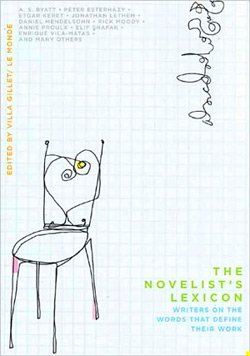
The Novelist’s Lexicon, new in hardback from Columbia University Press, is an auspicious and at times bewildering project originating from an international literary conference hosted by Le Monde a few years ago. Over seventy authors from more than a dozen countries were asked to write about a “key word that opens the door to his work.” A list of just a few of the authors here is probably more than enough to pique interest: Rick Moody, Helene Cixous, Colum McCann, Jonathan Lethem, Adam Thirlwell, A.S. Byatt, David Peace, Dennis Cooper, and Annie Proulx all contribute pieces, mostly short, somewhere between 100 and 500 words. By nature, The Novelist’s Lexicon is a fragmentary affair, discontinuous, open to multiplicity, and unified only by its authors’ sense of craft, as well as an abiding intelligence.

Some authors take the project in earnest, like Lethem, whose piece “Furniture,” (which we excerpted late last year) pinpoints a fundamental yet largely unremarked upon element of novel-writing. French author Nicholas Fargues taps into etymology, offering a bit of advice in his piece “Novice”–

Don’t ‘make’ literature. Don’t write because that’s what people expect of you now that you’re a ‘writer.’ Don’t write for the beauty of the gesture or the love of art. Beware of fine phrases and well-turned maxims; that’s not your thing. Watch out for words that strike a pose. But do let your memory and your instincts flow; let the aptest words, the words that resemble you most closely, come of their own accord.

Anne Weber’s piece “Waiting/Attention” suggests that a key word — or any key, really — is an impossible dream–

It would be a word that encapsulated my aspirations and expectations, my sadness and my joy, my amazement at the quince’s hairy skin, the wash of the sky, and the delicate pattern of the cyclamen’s leaves. And since everything would be contained in this single, essential word, since it would express everything, I wouldn’t need to write anymore. And good riddance, too!

Swedish author Jonas Hassen Khemiri, who goes with “Un-” also points to language’s simultaneous limitations and possibilities–

Un- as in never being satisfied with the language we have. Un- as in the realization of how difficult it is to communicate with people in a language you have invented yourself. Un- as in doubting whether you will ever succeed. Un- as in continuing to try even so. Un- as in suddenly launching yourself over a coffee table and transforming a dictionary into confetti.

Khemiri’s frustration with language (and paradoxical love) is thematic throughout Lexicon; we see it, for instance in David Peace’s “Plague.” Peace comes off like the crotchety old man in the group–

To be honest or stupid or both, but not churlish or contrary (I hope), I am uncertain I understand the premise of this lexicon. However, I am against the presumption of all premises and, equally, I am against all definitions and dictionaries, lexicons and lists, which, in their commodification and exclusivity, are the preserve and the territory of fascists and shoppers.

After this radical caveat, including the claim that he is under “duress” (did the folks at Le Monde put guns to these authors’ heads?), Peace goes on to discuss the word “plague,” tracing it through Western lit and showing how it evinces in his novel Occupied City (which we reviewed here, by the way).

Perhaps Peace should’ve just ignored the assignment, like Dennis Cooper, whose piece is “Signed D.C.” is simply a work of microfiction, imagining what would happen if Olive Oyl and Popeye who “peel like decals from the TV and live in the world.” The story is a clever, short five paragraphs, and ends with at least a trace of insight into Cooper’s writing process: “I am heavier than my constructions understand.” Maybe he didn’t ignore the assignment.

Cooper is not the only writer to let fiction reign — there are poems and meditations and strange riffs here, largely divorced of discussion from technique or craft. In any case, those interested in getting into the heads of some of the 21st century’s most prominent (and skillful) writers will wish to take notice of The Novelist’s Lexicon, a fun and repeatedly rewarding book. Recommended.

Oh Pure and Radiant Heart — Lydia Millet

The nice people at Iambik Audiobooks were kind enough to give me a few books from their catalog recently, one of which is Lydia Millet’s Oh Pure and Radiant Heart, which I will review momentarily, but first I’m compelled to comment on Iambik itself. The company is a true indie, run by people who care very much about literature; they release audiobooks on mp3 from independent publishers in the U.S. and Canada. Their prices are more than reasonable — around five bucks a book, cheaper than iTunes or Audible. And, unlike many audiobook vendors, there’s no weird third-party software you have to download, no DRM, no password protected files. Just nice, high quality mp3s, tagged and ready to go. I was able to download the books in a few minutes, put them on my iPod, and begin listening. Good stuff.

The premise of Oh Pure and Radiant Heart is this: three of the lead scientists of the Manhattan Project, Robert Oppenheimer, Leo Szilard, and Enrico Fermi — those nice men who brought us the atom bomb — are somehow transported from 1945 (during the Trinity test) to the early 2000s, during the first term of George W. Bush. Their arrival coincides with a strange dream (or mystical vision) on the part of the book’s protagonist, a quiet, thoughtful librarian named Ann, who lives with her husband Ben, a gardener, in Santa Fe, New Mexico. After a violent tragedy at Ann’s library, circumstance brings her together with the three scientists, whom she recognizes. Ann quickly comes to believe in the scientists in an almost spiritual sense. They give her life the meaning it has thus far lacked. Ben is far more skeptical, and one of the novel’s strengths, particularly in its first half, is watching the strain on the young couple’s marriage as Ann increasingly finds her identity wrapped up in the scientists’ mission. Even more problematic is her platonic relationship with Oppenheimer, who becomes both a father-figure to her as well as the object of her motherly protection. Ann, Ben, and Oppenheimer form the novel’s intellectual and philosophical core; Millet grants us repeated access into their first-person thoughts and feelings, which comprise many of the book’s most interesting obsessions — Ann mulls over the tension between the concrete world and the hopes of a metaphysical reality; Ben ponders how one might come to possess (or perhaps earn) a soul; Oppenheimer, through a somewhat guilty lens, observes a materialistic and intellectually degraded 21st century.

It’s this degradation that the scientists seek to redress, perhaps in part to atone for their own complicity in creating the future (or rather, this future). First, however, there’s a trip to Japan to see what their bombs did firsthand. In Tokyo the scientists are doubly alienated, not only by Japanese culture, but also by the intensity and futurity of hyperkinetic Tokyo. It’s here that they meet Larry, a 40-something surfer-bum/stoner/rich kid/lazy plot device, whose father has “more money than God.” It’s this money that funds the scientists throughout the rest of the novel. Larry comes to believe in them almost immediately, and becomes their chief financier (and manager of sorts) as they move on to the next episode, an overlong final-third back in America.

Despite Ben’s protests, the scientists, led by pushy, media-savvy Szilard, set out on a rambling tour of America, leading a campaign for world peace via nuclear disarmament. The conflict heightens between Szilard and Ben, natural foils, as Oppenheimer becomes increasingly abstracted from the physical world, and Fermi enters a mystical depression. As the scientists tour about on luxury RVs, meeting with media organizations and staging rallies, they begin to attract a strange cavalcade of hippies and dropouts, runaways and weirdos –and, significantly, a burgeoning group of End Times obsessed evangelical Christians. Szilard initially thinks he can control the swelling circus, but leadership soon falls into disarray. Complicating the matter are the private security forces the different contingents utilize. The irony that the peace movement is littered with men bearing guns is not lost on Oppenheimer. In the meantime, Ann feels increasingly marginalized and Ben continues to see their marriage dissolve (Ann seems abstractedly unaware). Ben does, however, make a meaningful and somewhat paternal relationship with sensitive Fermi, taking the man on hiking trips and otherwise shielding him from the craziness that Szilard openly embraces.

This final section of the novel is easily its weakest–Millet’s strength in the early parts of the book comes in her handling of the interior spaces of Oppenheimer, Ben, and Ann, as well as the mystical absurdity of the scientists’ transportation to the future. These concerns get muddied by too many characters and too many plots as the book reaches its climax; what should be a build to a thrilling end is instead something of a slog. Nevertheless, Millet (thankfully) pulls off that end in a dazzling, disturbing rally in Washington D.C. complete with riots and spiritual revelations of a sort.

While Millet’s conclusion is not my metaphysical cup of tea, it is an appropriate and organic resolution for the novel. Far more interesting, to me anyway, is Millet’s keen research about the development of the atom bomb and the (continued) proliferation of nuclear weapons. The novel is larded with frank, concise facts about America’s military-industrial complex that, when set against the narrative proper, create a highly ironic and coldly searing satire. The closest point of comparison I can think of here is J.G. Ballard, whose 1994 novel Rushing to Paradise Oh Pure and Radiant Heart often echoes. And while Millet’s satire is often funny, it’s the kind of funny that is cold and black when honestly reflected on — which her thoughtful characters often do. Ultimately, Oh Pure and Radiant Heart is a deeply sad comedy, especially if we identify strongly with Ben and Ann, who in a wistful coda, continue to search for meaningful lives against the existential backdrop of a word that is, to use the novel’s language, “post-history.”

The Lost Art of Reading — David L. Ulin

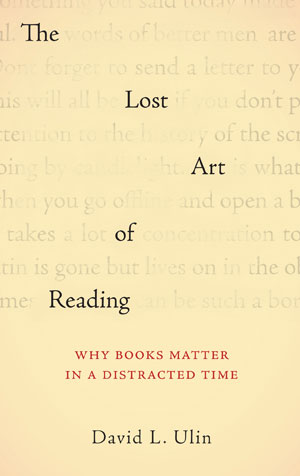
“One evening not long ago, my fifteen-year-old son, Noah, told me that literature was dead,” begins David L. Ulin’s new book-length essay, The Lost Art of Reading. Noah is not enjoying The Great Gatsby; or, perhaps more accurately, he’s not enjoying how his English teacher is having him analyze the book. Noah’s experience with Gatsby is probably not too different from many young readers who are told that they must appreciate a book, break it down, reckon and account for all of its subtleties — all in the context of a classroom, for a grade. Reading literature is just a means to an end then, a way to pass a class; unlike Ulin, who “frame[s] the world through books,” Noah’s “inner-life is entwined within the circuits of his laptop.” Noah’s pronouncement that literature is dead is fraught with cultural and technological significance. And while such declarations are hardly new, the idea that books — literary works in particular — not only do not hold the place they once did in our society, but now cannot hold a place of significance seems to hold more water than it did even ten years ago. Books are no longer the dominant media. Discourse is frenetic, fractured, shallow. Accordingly, Ulin subtitles his book Why Books Matter in a Distracted Time.

Gatsby — and Ulin’s conversations with his son about it — become organizing touchstones throughout the essay, along with Frank Conroy’s memoir Stop-Time, Faulkner’s obsession with time, and Thomas Paine’s Common Sense — a tract that Ulin points out might be “the most important book ever published in America.” It’s this consideration of Common Sense, along with his son’s declaration that lit is dead, that prompts Ulin to ask, “Could a book, any book, have this kind of impact in contemporary society? What about a movie or a website?” The questions continue–

How do things stick to us in a culture where information and ideas flare up so quickly that we have no time to assess one before another takes place? How does reading maintain its hold on our imagination, or is that question even worth asking anymore?

Ulin sets out to address these questions, drawing examples and analyses from a dizzying pool of books, websites, movies, and other media to do so. One of the highlights of The Lost Art of Reading is its confidence in defining reading as a meaningful art. Ulin tells us that–

Reading is an act of contemplation, perhaps the only act in which we allow ourselves to merge with the consciousness of another human being. We possess the books we read, animating the waiting stillness of their language, but they possess us also, filling us with thoughts and observations, asking us to make them part of ourselves.

And a few pages later–

This is what literature, at its best and most unrelenting, offers: a slicing through of all the noise and the ephemera, a cutting to the chase. There is something thrilling about it, this unburdening, the idea of getting at a truth so profound that, for a moment anyway, we become transcendent in the fullest sense. I’m not talking here about posterity, which is its own kind of fantasy, in which we regard books as tombstones instead of souls. No, I’m thinking more of literature as a voice of pure expression, a cry in the dark.

And yet Ulin admits to becoming, increasingly, a distracted reader, a reader who too quickly puts down his book to pick up his laptop or smart phone. This distraction seems endemic, environmental, even professionally necessary — and admittedly very, very familiar. The costs are also familiar–

. . . to read, we need a certain kind of silence, an ability to filter out the noise. That seems increasingly elusive in our overnetworked society, where every buzz and rumor is instantly blogged and tweeted, and it is not contemplation we desire but an odd sort of distraction, distraction masquerading as being in the know. In such a landscape, knowledge can’t help but fall prey to illusion, albeit an illusion that is deeply seductive, with its promise that speed can lead us to more illumination, that it is more important to react than to think deeply, that something must be attached to every bit of time. Here, we have my reading problem in a nutshell, for books insist we take the opposite position, that we immerse, slow down.

It’s key to note that Ulin is hardly a Luddite or a reactionary; when he writes “my reading problem” this is not a generalization — he is referring to his first-person experience as a reader. He is also open to the ways in which new media enhances literature. He writes, for example, of the ways in which Facebook and other websites create virtual platforms in which to honestly engage literature. He also discusses times when one habit of distraction — stopping to reference what he’s reading on YouTube or elsewhere on the net (a habit I fully identify with) — genuinely enriches his reading. However, Ulin’s greater fear is not so much his own personal distraction, but the costs of a permanently distracted populace–

This is how we interact now, by mouthing off, steering every conversation back to our agendas, skimming the surface of each subject looking for an opportunity to spew. We see it on blogs and in e-mails, on television talk shows, in public meetings and community forums; we are a culture that seems unable to concentrate, to pursue a line of thought or tolerate a conflicting point of view.

Wallowing through the comments section of any politicized news story is pretty much a recipe for depression, or at least a loss of faith in Americans’ ability, as Fitzgerald says ” to hold two opposed ideas in the mind at the same time, and still retain the ability to function.”

I should admit my bias — Ulin had little work to do to convince me that a decline in “deep” reading — and meaningful, reflective discussion about that reading — can only further contribute to an increasingly shallow, trivial, and openly anti-intellectual society. So what is at stake here?–

Stories, after all — whether aesthetic or political — require sustained concentration; we need to approach them as one side of a conversation in which we play a part. If we don’t, we end up susceptible to manipulation, emotional or otherwise. In February 1946, Hermann Goering told the judges of the Nuremberg tribunal, ‘Naturally the common people don’t war . . . But, after all, it is the leaders of a country who determine policy, and it is always a simple matter to drag people along, whether it is a democracy, or a fascist dictatorship, or parliament, or a communist dictatorship. All you have to do is tell them they are being attacked, and denounce the pacifists for lack of patriotism and exposing the country to danger. It works the same in every country.’ Such a statement is chilling on all sorts of levels, but nowhere more than in its recognition of the fact that we are complicit in our fate.

One solution for Ulin (and I’m apt to agree) is reading, “an act of resistance in a landscape of distraction, a matter of engagement in a society that seems to want nothing more than for us to disengage.” Best of all, Ulin’s book is the act of criticism — both cultural and literary — that makes one want to read. He reminds us that the currency of ideas is always open to us if we put in the effort, and that the moments of enlightenment, of transcendence that we might gain from literature are part of what makes a life worth living. Recommended.

The Lost Art of Reading is available now from Sasquatch Books.

Walton Ford’s Strange Naturalism

The Adventures of Huckleberry Finn: One of Our Favorite Challenged Books

E.W. Kemble's frontispiece to the original 1884 edition
E.W. Kemble’s frontispiece to the original illustrated edition

The Adventures of Huckleberry Finn by Mark Twain, undoubtedly one of the Great American Novels, ranks a healthy #5 on the ALA’s list the 100 Most Frequently Challenged Books. Young Huck’s casual colloquial use of the word “nigger” and the cruel hijinks Huck and Tom play on Jim at the novel’s end are two reasons that many have sought to suppress Twain’s masterpiece, including educator and critic John Wallace, who famously called it “the most grotesque example of racist trash ever given our children to read.” Wallace went so far as to suggest that “Any teacher caught trying to use that piece of trash with our children should be fired on the spot, for he or she is either racist, insensitive, naive, incompetent or all of the above.”

I guess I should’ve been fired on the spot, as I’ve used Huck Finn in my classroom a number of times, almost always in conjunction with excerpts from Olaudah Equiano’s Interesting Narrative, some Philis Wheatley poems, and a UN report on modern human trafficking. Context is everything.

While I can concede readily that Huck, the voice of the novel, says some pretty degrading things about Jim, often meant (on Twain’s part) to create humor for the reader, to expect Twain’s treatment of race to be what we in the 21st century want it to be is to not treat the material with any justice. And while Huck Finn may be insensitive at times, it handles the issues of race, slavery, class, and escape from the dominant social order with the complexity and thought that such weighty issues deserve. Ultimately, the novel performs a critique on the hypocrisy of a “Christian,” “democratic” society that thought it was okay to buy and sell people. This critique shows up right in the second page. Consider these lines (boldface mine):

The widow rung a bell for supper, and you had to come to time. When you got to the table you couldn’t go right to eating, but you had to wait for the widow to tuck down her head and grumble a little over the victuals, though there warn’t really anything the matter with them,—that is, nothing only everything was cooked by itself. In a barrel of odds and ends it is different; things get mixed up, and the juice kind of swaps around, and the things go better.

After supper she got out her book and learned me about Moses and the Bulrushers, and I was in a sweat to find out all about him; but by and by she let it out that Moses had been dead a considerable long time; so then I didn’t care no more about him, because I don’t take no stock in dead people.

Huck’s dream is of a delicious mix, a swapping of juices — integration. Additionally, his disregard for the dead Bible heroes reveals that the white Christian society’s obsession with the ancient past comes at the expense of contemporary value. Huck, an orphan, and Jim, separated from his family, will symbolically echo Moses in the bulrushes as they use the great Mississippi as a conduit for escape, for freedom. Huck (or Twain, really) here points out that it’s not enough to look at dead words on a page, on old dead lawgivers–we have to pay attention to the evils and wrongs and hypocrisies that live today.

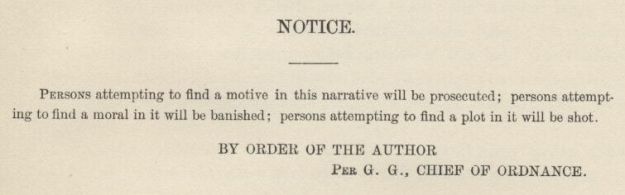
Twain even tells us how to read his book from the outset:

Now, it’s impossible to read a book–a good book–without finding its plot, searching for its moral, or caring about its characters, and Twain knows this. His “Notice” is tantamount to saying “don’t think about an elephant”–he uses irony to tell us we must find motive, moral, and plot here, and that we must do so through this lens of irony.

But of course, you have to read closely for all these things. I suppose it’s technically easier to call something trash, throw it in the garbage, and not have to devote time and energy to thinking about it. Who knows? You might learn something–and we wouldn’t want that, would we?

[Editorial note: Biblioklept originally published this piece in September of 2008].

Books I Will (Make Every Reasonable Attempt to) Read in 2011

If you’re looking for a comprehensive “Books to Look Forward to in 2011” kind of list, The Millions has you covered. This post is not about books that are coming out in 2011, although some books mentioned here will come out in 2011. This post is really just about books I’d like to/plan to read in 2011 (it’s also kind of a dare to myself).

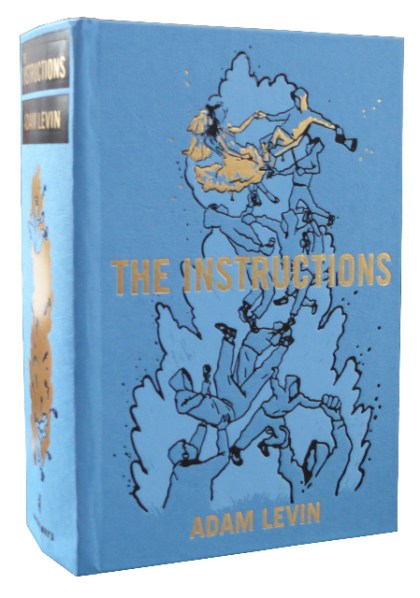
First up, I will finish the books I’m reading/listening to now. This means Adam Levin’s The Instructions (reading; McSweeney’s) and Lydia Millet’s Oh Pure and Radiant Heart (listening; Iambik Audio). I’m on page 342 of The Instructions; there are 1030 pages; a calculator tells me that that is 33.2%. It’s easy reading, often entertaining, but it’s hard to see, even a third of the way in, how Levin can justify taking up this much space. Oh, what is it about? Okay, this kid Gurion Maccabee may or may not be the Messiah. In the meantime, he rules the special ed program at his suburban Chicago school, writes scripture, and gets in lots of fights. The best parts of the book (so far, anyway) are Gurion’s comments on Torah (I would’ve written “the Torah,” but this book seems to suggest that the definite article is pretty Gentile).

Oh Pure and Radiant Heart has been enjoyable, sardonic — funny but sad — and I’m coming up to the end soon. Basically, a trinity of scientists who helped invent the atom bomb (Robert Oppenheimer is the famous one) come back from the dead (sort of) to . . . I don’t know yet. It’s unclear. To hang out with a quiet librarian and her gardener husband as their marriage slowly dissolves? To lead our nation to world wide peace? To take part in a movable circus of weirdos and End Times prophets? Not sure. Full review forthcoming.

I already wrote about one of the Tintin collections I picked up late last year; I will read the other three collections (and likely hunt down more). I’ll also read (hopefully; that is, hopefully it will come out) the next installment in Charles Burns’s X’ed Out trilogy.

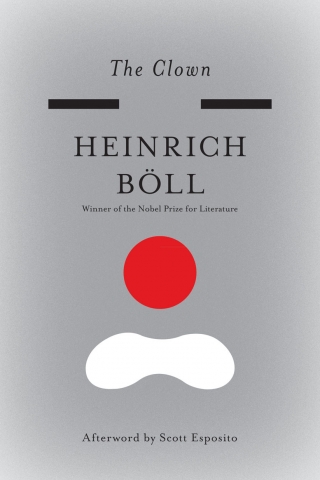
Also on the proverbial plate, non-illustratedwise, is Heinrich Böll’s The Clown, the story of a clown in post-Reich Germany who can smell through the phone (I think there’s more to it than that). Melville House is actually releasing several new editions of Böll’s novels this year, and they have a pretty excellent track record with the Germans, what with Hans Fallada and all, so hey, why not.

On the I-will-read-everything-Sam-Lipsyte-writes front, Picador is putting out a new edition of his first novel The Subject Steve (perhaps in concordance with The Ask coming out in paperback?). I will read The Subject Steve.

Books I bought this year and didn’t read but will make every reasonable attempt to read this year—

William Gaddis’s JR was, I think anyway, the last book I picked up in 2010. It’s really long, seems to be written entirely as a dialog, and hey, I read 2/3rds of The Recognitions and then didn’t even finish it (yet?) which is kinda remarkable/totally lazy. Maybe I should just finish The Recognitions. I just feel like “I get it already.” Lazy, lazy, lazy.

Loved the first chapter of Katherine Dunn’s Geek Love, even though it was really silly. Stay tuned, folks.

I read the first two stories in Barry Hannah’s Airships and then a few galleys bombed my doorstep and then I got distracted, but these things have Spring Break written all over them, so, yes, look for the Airships report in the future (or be a hipster douchebag and write in to tell me how awesome you already know Hannah is now that he’s dead blah blah blah).

I remember that I bought Renata Adler’s Speed Boat the same day I bought Airships (because, y’know, the titles). I read the first 30 or so pages and then read them again and then read them again a week or so ago. Kind of dumbfounding stuff. It’s been hovering around the coffee table, the nightstand; it’s been jammed in briefcases, wedged in coat pockets. What is it? What is she doing?

After slowing down my consumption in 2010, I’m ready to feed the addiction again in 2011: Bolaño, Bolaño, Bolaño. I need to read Amulet; I’ll also read The Insufferable Gaucho and probably something else.

And:

The Pale King

But everyone’s buzzing about that already, right?

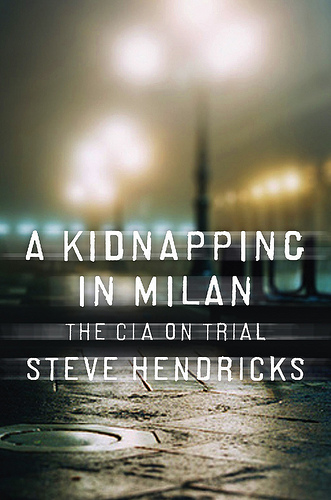
A Kidnapping in Milan: The CIA on Trial — Steve Hendricks

Steven Hendricks’s A Kidnapping in Milan: The CIA on Trial details the story of radical imam Abu Omar. Omar, an Egyptian radical who sought political asylum in Italy, was the focus of an investigation by the Milan police force, who, via wiretaps and other forms of surveillance, were building a case against Omar for recruiting a network of Islamist terrorists. In early 2003, the Milanese case fell apart when Omar was disappeared in what turned out to be one of the most conclusively documented cases of the CIA’s “extraordinary renditions.” Omar was kidnapped, relocated to Germany, and then returned to Egypt, where he was tortured and held by Egypt’s SSI–under the watchful eyes of the CIA. Italian prosecutor Armando Spataro, erstwhile protagonist of Kidnapping, reconstructed the evidence of the CIA’s extraordinary (and extra-legal) rendition, leading to the prosecution of twenty-six CIA operatives for kidnapping; twenty-three were convicted.

Hendricks combines journalistic clarity with the structure of a detective novel in Kidnapping, giving his book the urgency of a modern thriller, all the more striking for its cold reality. The book is well-researched; Hendricks interviewed, among others, Spataro, Omar, and even some of the indicted CIA agents–but Kidnapping never reads as a dry recitation of facts or a ponderous series of analyses. Additionally, Hendricks fleshes out his story with a consideration of the CIA’s history in Italian politics, with an emphasis on why Milan is such a hotbed for clandestine activities. Guiding the narrative is a refined sense of moral outrage against the idea that dark deeds done in the dark make our world somehow safer. While there are some that will remain unmoved by his descriptions of Omar’s torture — the cleric is a “bad guy,” in the Bush admin’s parlance, after all — Hendricks builds a clear case that the “outsourcing of torture” is a vile practice, and one antithetical to the spirit of our Constitution. And, even if the Obama administration is unwilling to shed further light on such crimes, it is good to know that there are writers who will.

A Kidnapping in Milan is new in hardback from W.W. Norton.

The Adventures of Tintin, Vol. 3 — Hergé

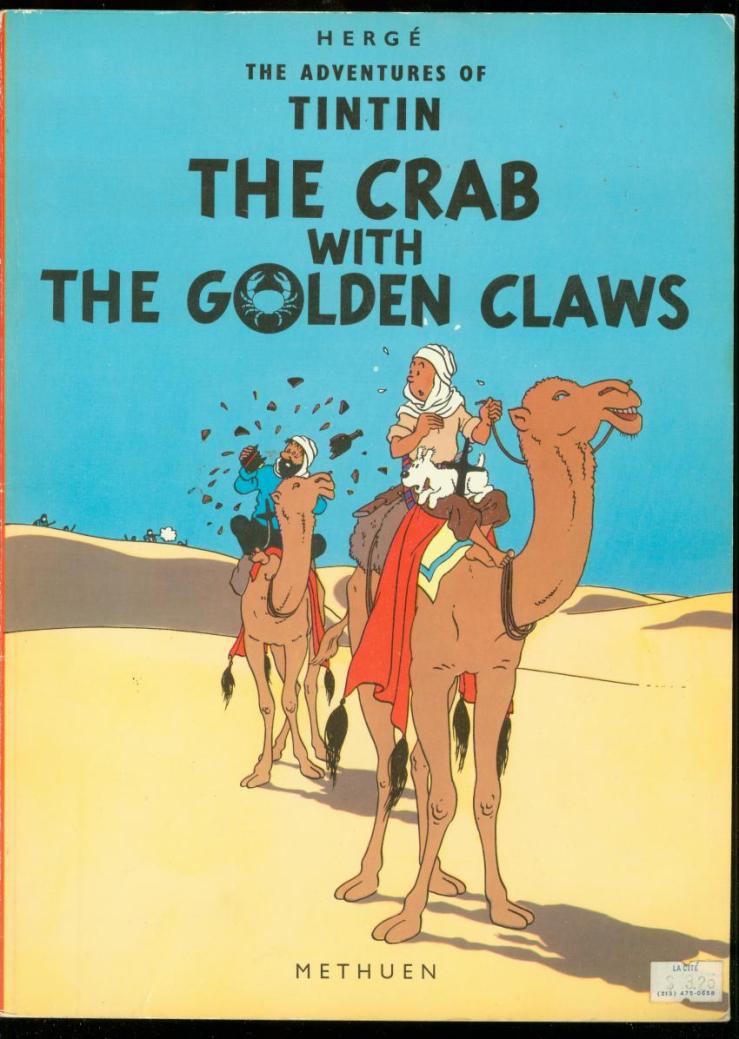
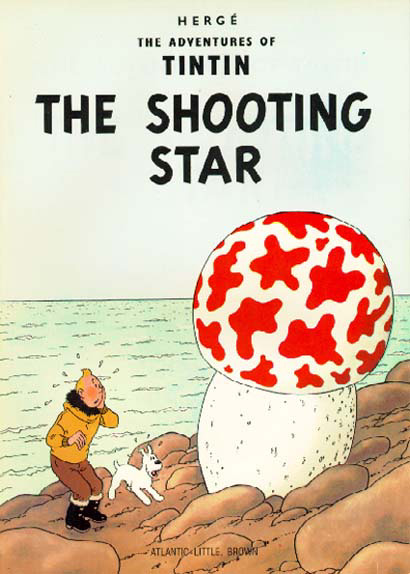
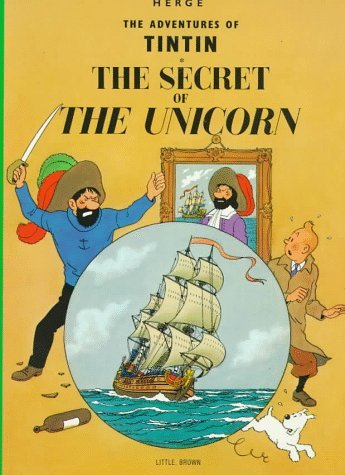
I’ve long been interested in Hergé’s Belgian comic series Tintin, which chronicles the adventures of Tintin, boy reporter, and his faithful dog Snowy. When a batch of hardback three-in-one editions showed up at my favorite used book store I picked up Vol. 3, which collects The Crab with the Golden Claws, The Shooting Star, and The Secret of the Unicorn. I read The Crab with the Golden Claws in one pleasant sitting that night and finished the other two adventures in similar fashion. Then I went back to the bookshop and picked up the other four three-in-one editions they had in stock.

It’s hard to divide the tales, which are all fun adventures in the high style of boy-adventuring, but I think Crab was my favorite of the three. It involves a drug smuggling ring and a trip to the Sahara desert. It also introduces Captain Haddock, an alcoholic lummox who tips into a verbose stream of insults whenever he’s in a rage (he merely stutters when in his cups). Haddock is Tintin’s unlikely (but totally likely) sidekick in the other tales in the volume, and he shows up in the other books I bought as well. The Shooting Star is a bit more sporadic in its plot–it begins with the end of the world (by asteroid!) and when that doesn’t pan out, moves into an ocean race to recover a meteorite. Unicorn also boasts a nautical theme; Tintin finds part of a treasure map in a model ship and fights against antique-collecting brothers to recover the booty (Keno Bros. beware). These adventure stories share more in common with Indiana Jones and Edgar Rice Burroughs than Marvel or DC comics; there’s a prevalent sense of danger, fun, and mystery that underscores the series.

Hergé’s clean, efficient style evokes beautiful and strange worlds. His economy of storytelling is simply brilliant; he knows how to connote his characters’ movements–including some sweaty action sequences–and he also knows how to move the plot forward without resorting to talking heads (although you will find the occasional expository-friendly radio broadcast pop up in a Tintin comic). It’s when Hergé drops a luscious market scene or a crowded basement-dungeon larded with antiquities that the art in Tintin shines. Hergé’s great talent is to evoke a startling sense of place for each setting in his comics, a fully-realized set that creates a sort of visual (and emotional) baseline for the reader. This allows for the cleaner, crisper panels to relay action without clutter. Hergé’s knack for storytelling cannot be underestimated either. He blends high adventure with slapstick and verbal comedy, much of it courtesy Tintin’s foils: the Thompsons, bungling detectives, precisely, who provide Tintin with many of his cases; Haddock; and Snowy, of course.

If you know a bit about Hergé’s Tintin series, you may know that its depiction of non-white and non-European characters has come under attack in recent years; Tintin in the Congo has been singled out in particular. I haven’t read Congo, but Crab’s representation of  Arabs (and Asians) is riddled with all kinds of wrong–at least when viewed from a PC postmodern post-colonialist post-whatever perspective. Hergé’s comics reveal at times a particularly suspect Western European ideology, one that privileges white male authority in the form of white male adventure. We can see the same colonialism and Orientalism at work decades later in the Indiana Jones movies (particularly Temple of Doom). This comparison is not meant to indict Indy (or Spielberg, rather) or excuse Tintin (and Hergé); instead, I’m merely pointing out that adventure tales that feature white heroes exploring–and dominating–the Other are hardly new; nor have they disappeared. The big mistake would be not to read Hergé’s work for fear of tripping over politically-correct mores. Banning a book is never a smart practice.

Far better is Charles Burns’s recent Tintin revisionism in X’ed Out: he moves his inverted hero Nitnit to a bizarro world version of the Saharan market, a place teeming with strangeness that is also largely indebted to William Burroughs’s Interzone. The inversion reverses Tintin’s a priori white male domination into an equally fantastic (but far more horrific) vision of confrontation with radical Otherness. Shit gets weird (as alien encounters should). Nitnit is not in control, not the master of this domain, which is plainly not his. Burns’s Tintin revision saliently calls attention to the ways that the best in art might be transformed and reinterpreted. It points toward the subconscious inheritance intrinsic to art.

But back to the book I am ostensibly reviewing. The Adventures of Tintin, Vol 3 seems to me as good a place as any to start with Tintin, and those interested should dig in. These three-in-one editions are smaller than the traditional oversized format, but you can compensate by holding the book closer to your face (ah, intimacy). Lovely stuff.

A Blood Meridian Christmas

Cormac McCarthy’s seminal anti-Western Blood Meridian isn’t exactly known for visions of peace on earth and good will to man. Still, there’s a strange scene in the book’s final third that subtly recalls (and somehow inverts) the Christmas story. The scene takes place at the end of Chapter 15. The Kid, erstwhile protagonist of Blood Meridian, has just reunited with the rampaging Glanton gang after getting lost in the desert and, in a vision-quest of sorts, has witnessed “a lone tree burning on the desert” (a scene I argued earlier this year was the novel’s moral core).

Glanton’s marauders, tired and hungry, find temporary refuge from the winter cold in the town of Santa Cruz where they are fed by Mexicans and then permitted to stay the night in a barn. McCarthy offers a date at the beginning of the chapter — December 5th — and it’s reasonable to assume, based on the narrative action, that the night the gang spends in the manger is probably Christmas Eve. Here is the scene, which picks up as the gang — “they” — are led into the manger by a boy–

The shed held a mare with a suckling colt and the boy would would have put her out but they called to him to leave her. They carried straw from a stall and pitched it down and he held the lamp for them while they spread their bedding. The barn smelled of clay and straw and manure and in the soiled yellow light of the lamp their breath rolled smoking through the cold. When they had arranged their blankets the boy lowered the lamp and stepped into the yard and pulled the door shut behind, leaving them in profound and absolute darkness.

No one moved. In that cold stable the shutting of the door may have evoked in some hearts other hostels and not of their choosing. The mare sniffed uneasily and the young colt stepped about. Then one by one they began to divest themselves of their outer clothes, the hide slickers and raw wool serapes and vests, and one by one they propagated about themselves a great crackling of sparks and each man was seen to wear a shroud of palest fire. Their arms aloft pulling at their clothes were luminous and each obscure soul was enveloped in audible shapes of light as if it had always been so. The mare at the far end of the stable snorted and shied at this luminosity in beings so endarkened and the little horse turned and hid his face in the web of his dam’s flank.

The “shroud of palest fire” made of sparks is a strange image that seems almost supernatural upon first reading. The phenomena that McCarthy is describing is simply visible static electricity, which is not uncommon in a cold, dry atmosphere–particularly if one is removing wool clothing. Still, the imagery invests the men with a kind of profound, bizarre significance that is not easily explainable. It is almost as if these savage men, naked in the dark, are forced to wear something of their soul on the outside. Tellingly, this spectacle upsets both the mare and her colt, substitutions for Mary and Christ child, which makes sense. After all, these brutes are not wise men.

Fate, Time, and Language: An Essay on Free Will — David Foster Wallace

Sometime last year, during a rare visit to a big chain bookstore, I was disgusted to see what had happened to David Foster Wallace’s amazing Kenyon College commencement speech, “This Is Water.” Wallace’s speech, about 3,815 words, give or take (maybe twelve standard typed pages), was being sold as a 144 page hardback volume with only a sentence or two printed per page. The book was (and is) a nakedly commercial attempt to turn a text that is widely available on the web into the sort of thing that well-meaning uncles give to their nephews or nieces as graduation gifts. Of course, hardcore Wallace fans might want such a book — and I’d never begrudge them that — but it’s hard to imagine that Wallace would have been comfortable with how his book was marketed.

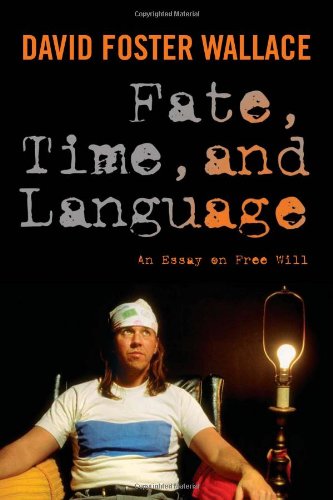
Which brings us to Fate, Time, and Language: An Essay on Free Will, new from Columbia University Press this week. The book publishes the 1985 honors thesis that Wallace submitted to the Amherst College’s Department of Philosophy, “Richard Taylor’s ‘Fatalism’ and the Semantics of Physical Modality.” The essay’s title alone signals a prohibitive level of academic specialization. In his introductory essay to the volume, “A Head That Throbbed Heartlike,” New York Times Magazine editor James Ryerson points out, “Its obscurity is easy to appreciate. A highly specialized, seventy-six page work of logic, semantics, and metaphysics, it is not for the philosophically faint of heart.” Ryerson then warns his reader to “Brace yourself for a sample sentence,” before offering a sample from Wallace’s essay that I do not have the patience or fortitude to type out (it would take me too long to locate all the diacritical marks and special logic symbols). Ryerson concludes the paragraph with this wry remark: “There are reasons that he’s better known for an essay about a cruise ship.”

Fortunately, the editors of Fate, Time, and Language make every effort to contextualize Wallace’s essay in a way that explains its aims, strengths, and even shortcomings. There’s Ryerson’s lengthy introduction, which provides an overview to Wallace’s life in philosophy. Then there’s Taylor’s “Fatalism” of course, a short, provocative argument combining six presuppositions that led Taylor to declare that humans have no control — none, whatsoever — over any future event. The volume collects four other essays by Taylor on fatalism, as well as eight other essays responding to his arguments, before delivering Wallace’s essay (the longest in the collection). Here’s Wallace—

So Taylor’s central claim, the Taylor problem, is that just a few basic logical and semantic presuppositions, regarded as uncontroversially true by most philosophers, lead directly to the metaphysical conclusion that human beings, agents, have no control over what is going to happen.

I ain’t even gonna front–pretty much everything that Wallace says after this was lost on me; if you want to read and comprehend the details of his argument you will need to have a grasp on the basics of Montague grammar and tensed modal logic. If you lack these skills, there will be skimming. Lots and lots of skimming. So, in short, I have no ideawhether Wallace’s logic is sound, although I find his conclusion (minus all the modal evidence) quite compelling—

This essay’s semantic analysis has shown that Taylor’s proof doesn’t “force” fatalism on us at all. We should now recall that Taylor was offering a very curious sort of argument: a semantic argument for ametaphysical conclusion. In light of what we’ve seen about the semantics of physical modality, I hold that Taylor’s semantic argument does not in fact yield his metaphysical conclusion.

After Wallace’s honors thesis, there’s a wonderful little memoir essay by his adviser on the project, Jay L. Garfield, who offers up this nugget—

I knew at the time, as I mention above, that David was also writing a novel as a thesis in English. But I never took that seriously. I though of David as a very talented young philosopher with a writing hobby, and did not realize that he was instead one of the most talented fiction writers of his generation who had a philosophy hobby.

These little pockets of insight appeal to me most in Fate, Time, and Language, and as such, Ryerson’s essay “A Head That Throbbed Heartlike” is the highpoint of the book. It weaves together Wallace’s personal life, writing career, and academic pursuits into a moving elegy of sorts, although one more rooted in ideas than feelings. He also spells out the book’s mission quite clearly—

For all its seeming inscrutability, though, the thesis is lucidly argued and–with some patience and industry on the part of the lay reader–ultimately accessible, which is welcome news for those looking to deepen their understanding of Wallace. The paper offers a point of entry into an overlooked aspect of his intellectual life: a serious early engagement with philosophy that would play a lasting role in his work and thought, including his ideas about the purpose and possibilities of fiction.

Many of us might shudder at the idea of our college essays being published posthumously. Of course, most of us aren’t Wallace, but there are undoubtedly critics out there who will cry foul at this publication. Fortunately, the team behind Fate, Time, and Language has produced a book of remarkable integrity, one that understands why it exists, readily acknowledges its obscurity without trying to gloss over that obscurity, and makes every effort to communicate with and engage its readers without sacrificing erudition. To return to my opening anecdote, this is not the naked commercialism that motivated a gimmicky edition This Is Water; rather, this is a book delivered by people who genuinely care about Wallace and his ideas. Make no mistake–it’s very dry and very specialized, but fanatics will no doubt want it.

The Best Books We Read in 2010 That Were Published Before 2010

The best books that we read in 2010 that were published before 2010:

Nazi Literature in the Americas by Roberto Bolaño (2008, English translation) — Bolaño’s fake encyclopedia of right-wing writers is a tragicomic crash course in misanthropy, failure, and fated violence. Francisco Goldman’s blurb on the back of the book is spot on–the book is a “key cosmology to Bolaño’s literary universe.” Nazi Literature is like an index for the Bolañoverse–creepy, steeped in dread, deeply, caustically funny, and bitterly poignant.

Butterfly Stories by William T. Vollmann (1993) Adventures in the Southeast Asian sex trade. Bleakly funny, often depressing, and filled with erudite asides on Nobel prizewinners, transvestites, and the benefits of whiskey and benadryl. Plenty of grotesque sex. Not for everyone. In fact, not for most people.

The Friends of Eddie Coyle by George V. Higgins (1970) — Higgins throws his audience into the deep end of gritty urban Boston on the wrong side of the sixties in this crime noir classic. There’s little exposition to spell out Coyle’s intricate and fast-paced plot, but there is plenty of machine-gun dialogue, rendered very true and very raw. Higgins trusts the reader to sort out the complex relationships between hustlers and dupes, cops and finks from their conversations alone. The imagery is straight out of a Scorcese film, and like that director, Higgins has a wonderful gift for showing his audience action without getting in the way.

Home Land (2004) and Venus Drive (2000) by Sam Lipsyte — Is there a better stylist working today than Lipsyte? Does anyone write better sentences? Of course, sentences alone don’t matter much if you don’t have a story worth telling, and both Homeland and Venus Drive deliver. They are seething, funny, poignant books, with characters tipped toward some redemption, awful or otherwise, despite their myriad sins.

Steps by Jerzy Kosinski (1968) — One of the many small vignettes that comprise Steps begins with the narrator going to a zoo to see an octopus that is slowly killing itself by consuming its own tentacles. The piece ends with the same narrator discovering that a woman he’s picked up off the street is actually a man. In between, he experiences sexual frustration with a rich married woman. The piece is less than three pages long. You will either hate or love this book.

Cloud Atlas (2004) and Black Swan Green (2006) by David MitchellCloud Atlas is a postmodern puzzle piece of six nested narratives (each a smart take on some kind of genre fiction), informed by Nietzsche’s idea of eternal recurrence; Black Swan Green (which for some reason we forgot to review here) is a funny and heartwarming coming-of-age story of a boy who copes with his terrible stutter and his parents’ crumbling marriage in early 1980’s England. The books have little in common save their brilliance–which seems kinda sorta unfair. It also seems unfair that Mitchell put them out so quickly. Damn him.

Angels by Denis Johnson (1983) — Angels begins as a small book about not very much and ends as a small book about pretty much everything. Johnson has a keen eye and keener ear for the kinds of marginal characters many of us would rather overlook all together, people who live and sweat and suffer in the most wretched, unglamorous, and anti-heroic vistas of a decayed America. The great achievement of the novel (beyond Johnson’s artful sentences) is in staging redemption for a few–not all, but a few–of its hopeless anti-heroes.

Suttree by Cormac McCarthy (1979) — A beautiful, rambling riff on American literature — Suttree picks up on Emerson and Twain, Faulkner and Whitman, and flows into a new, wild territory that is pure McCarthy. Is it his best novel? Could be. Read it.

The Best Books of 2010

Here are our favorite books published in 2010 (the ones that we read–we can’t read every book, you know).

Sandokan — Nanni Balestrini

A dark, elliptical treatise on the mundane and inescapable violence wrought by the Camorra crime syndicate in southern Italy.

Everything Ravaged, Everything Burned — Wells Tower (trade paperback)

Tower’s world is a neatly drawn parallel reality populated by down-on-their-luck protagonists who we always root for, despite our better judgment, even as they inadvertently destroy whatever vestiges of grace are bestowed upon them.

The Union Jack — Imre Kertész

Kertész’s slim novella explores a storyteller’s inability to accurately and properly communicate spirit and truth against the backdrop of an oppressive Stalinist regime.

BodyWorld — Dash Shaw

Shaw’s graphic novel is sardonically humorous in its psychoanalytic/post-apocalyptic visions. It’s a sweet and sour subversion of 1950’s comics and contemporary conformist groupthink politics. Witty and poignant, it advances its medium.

The Thousand Autumns of Jacob de Zoet — David Mitchell

An unexpected historical romance from postmodern poster boy David Mitchell. Thousand Autumns is a big fat riff on storytelling and history and adventure–but mostly, Mitchell’s Shogunate-era Japan is a place worth getting lost in.

C — Tom McCarthy

“I see what I’m doing as simply plugging literature into other literature,” McCarthy said in an interview this year. “For me, that’s what literature’s always done.” C, our favorite novel of 2010, seems plugged into the past and the present, pointing to the future.

Wolf Hall — Hilary Mantel (trade paperback)

Who knew that we needed to hear the Tudor saga again? Who knew that Thomas Cromwell could be a good guy?

The Ask — Sam Lipsyte

A mean, sad, hilarious novel that simultaneously eulogizes, valorizes, and mocks the American Dream.

X’ed Out — Charles Burns

Charles Burns does Tintin in William Burroughs’s Interzone. ‘Nuff said.

The Collected Stories of Lydia Davis — Lydia Davis

An epic compendium of, jeez, I don’t know, how do you define or explain what Davis does? Inspection, perception, mood, observation. Tales, fables, riffs, annotations, skits, jokes, japes, anecdotes, journals, thought experiments, epigrams, half-poems, and would-be aphorisms. Great stuff.

Biblioklept Interviews Mahendra Singh About Fitting Lewis Carroll into a Protosurrealist Straitjacket with Matching Dada Cufflinks

Mahendra Singh’s new book is a graphic-novelization of Lewis Carroll’s epic poem The Hunting of the Snark (read our review). Singh was kind enough to talk to us about his project over a series of emails. The Hunting of the Snark is available now in hardback from Melville House. You can read more about Singh’s work at his website.

Biblioklept: Where did your interest in Carroll originate?

Singh: I read the Alice books as a child and only read the Snark when I was a teenager. The Alice’s were fun, as was the Snark, but it also puzzled me at first. It was hard-core Nonsense and it took me a while to digest it, and half-way understand it. It was a great mental stretching exercise, still is. Kids need that sort of thing if they want their brains to grow up to be something besides consumer units.

Alice’s game of Nonsense is really a warm-up to the Snark’s. When Carroll got to the Snark, he’d had a bit of practice and was in top form. The Snark is really Alice 2.0, the more expensive professional upgrade to Nonsense Making.

When I was young, I had odd reading tastes. From 70s SF to Aristophanes to the Ramayana; I was a little piggy. What I usually liked was a complex, completely furnished fictional world, along with a nice musicality with words. What really turned me on was when that fictional world would be logically intertwined with the real world, past or present. In short, one world would be a sort of code for the other.

I think a lot of kids still like that, it’s really the basic premise of most storytelling, although nowadays it is often so deeply monetized and predigested that it’s hard to really enjoy or even benefit from.

In any case, everything Carroll wrote fit my tastes, but the Snark was extra-special, the difference being that this epic poem (the only genuine Victorian epic poem and I’ll defend that claim against all comers), this epic took the Alice premise of mismatching appearances and meaning and took it to its logical conclusion, which itself is another Nonsense paradox doubled upon itself — beware these Carrollian infinite regressions!

In the Snark, the story-telling code of Nonsense is perfected. Most of the elements are still drawn from the familiar, real world but they are so recombined that their appearances and meaning are impossible to decipher anymore. And yet the persistent, nagging feeling of a genuine logic behind it all still remains.

I think for most young people who are thinking things over, the above Snarkian description is a pretty accurate of their budding world view. And anyway, breaking world-codes was pure catnip for me, it’s the essence of reading, good reading anyway.

And I have to mention the poetry. I’ve always loved poetry and Carroll’s verse skills in the Snark are the perfect vehicle for what he’s doing. Their anapestic bounce, their goofy mouth feel (the mouthfeel of Old English poetry charms and chants) make a perfect vehicle for the code. It’s a bit of a music hall, Gilbert & Sullivan feel to what is technically a tragic verse epic.

I wouldn’t say I’m a full-bore Carrollian Obsessive, I’ve met plenty of them and they’re dangerous … quiet, nattily dressed librarians with bow ties and a deadpan penchant for puns and parody. Book editors concealing rural silos crammed full of  highly addictive Carrollian Nonsense. Carrollian Illuminatis cleverly disguised as entomologists hanging out at obscure Snarkian forestry associations.

I’m just a Carrollian Nutter, I’m harmless as long as I have access to drawing materials. And pictures of Snarks.

Biblioklept: You’ve described your work on Snark as “fitting Lewis Carroll into a protosurrealist straitjacket with matching Dada cufflinks.” Why do the techniques of surrealism and Dada lend themselves to Carroll?

Singh: Surrealism is one of those things that everyone can point at but few can define. It’s the idea of awakening the sleeper within us and letting them speak to us in their own dream language of pictures and words. Since dreams are a universal form of memory that draw upon every possible human experience, Surrealism is sort of the simultaneous dream-memory of everything.

Protosurrealism is what I call the comfy, cozy Carrollian straitjacket I’ve trapped my Snark in. Carroll was himself hailed as a protosurrealist by the founding fathers of this odd cult, Breton, Aragon, etc. His work, with its dreamlike logic and free associations entranced them and they regarded him as a unique trail-blazer in their explorations. And his verse, to me, is the epitome of the dream world; all poetry (Nonsense or otherwise) must surely be the natural, Adamic language of dreams!

The Surrealist Max Ernst was an enormous inspiration to me — his technique of using 19th-century engravings to illustrate dream stories is brilliant; the old-fashioned, realistic visual style gives them a jarring sense of authority. Realism is the optimal style of the determined dreamer! The urban dreamscapes and dream-eroded objects of Giorgio de Chirico and his brother, the unjustly neglected Alberto Savinio, were also part of my bag of tricks. And of course, references to Rene Magritte are scattered everywhere in this Snark. Magritte’s various techniques for undermining systems of linguistic and visual meaning are ideally suited to navigating the Carrollian Multiverse.
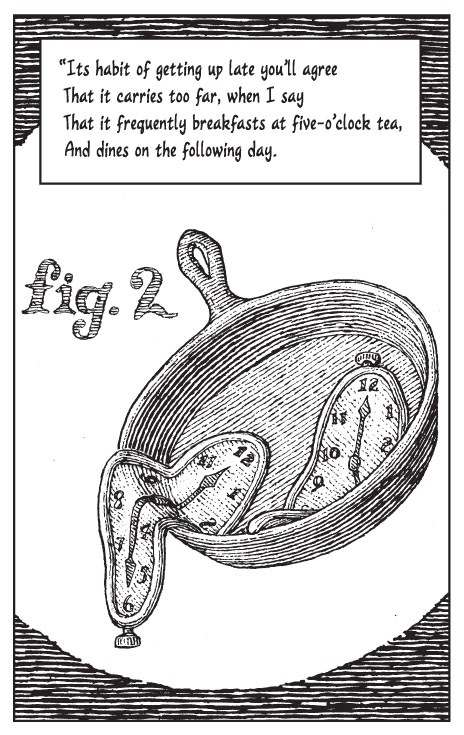
It’s hard to illustrate an idea and oddly enough, the Snark is really a poem of ideas, couched in the form of a tragic epic and then declaimed by a master comedian. One thing I wanted to avoid was doing literal drawings of the scenes in it; I wanted the Snark to constantly bring up a stream of associations, references, insinuations, all of them triggering more and faster allusions, what I call a gateway Surrealism that leaves readers hopelessly addicted and desperate for more! Don’t say no, kids!

I’ll add that protosurrealism is the 21st-century application of 19th-century answers to 20th-century problems. The application is this 21st century Snark, the answers are the Victorian rendering style I used and also Carroll’s entire invention of Victorian Nonsense, and the questions are the existential questions that 20th-century artists couched in the language of Surrealism.

Plus, let’s face it, Surrealism just looks cooler! Who wants a postmodernist or abstract expressionist Snark? And the smart kids love it, they’re still young enough to dare to question the sordid, official version of reality. Which is where Dada comes in — there’s a bit of it in my Snark and it’s there because Dada was the ultimate poke in Western Civ’s eye. If the idea of using a blank map isn’t pure Dada, what is it then?

It’s odd having to discuss this in words, proof positive that the Surrealist project remains unfinished. In a perfect Surrealist world, the meaning of my Snark would bleed out of the book and contaminate the reader’s world until they could not distinguish where the Snark began or reality left off. And that’s the essence of Carrollian Nonsense, fiddling with the logical doors of perception.

Biblioklept: Much of surrealist and Dadaist art seems to be an immediate response to mechanical reproduction. In Snark, you seem to at times be reconfiguring, recombining, recontextualizing otherwise familiar images. How do you work? How do you go about creating your art? Can you describe your process?

Singh: Mechanical reproduction can be a loaded phrase. Walter Benjamin gave it quite the kick in the pants, pointing out that it is a degradation of the cult object, a commodification, etc. But the problem is us, the public. A work of art has absolutely no meaning or value except what the viewer puts into it. This is a very important point. If art is degraded or degrades others, it is our choice.
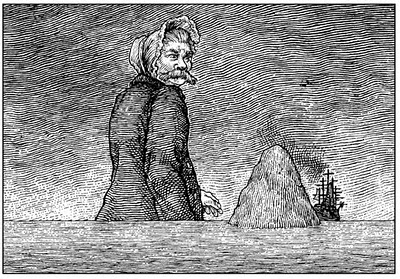
Poor Benjamin, a smart guy but always wriggling back into a Marxist strait-jacket just as useless as medieval Scholasticism or modern neoconservatism. At least Carrollian Nonsense makes the kiddies giggle! He never grasped that all philosophy is individual psychology (and wish-fulfilment) in essence. That’s why the Banker in my Snark is Karl Marx — revenge was sweet! I also included Nietzsche as the Bonnet-maker and Heidegger as the Barrister to round things off. I can assure you, several philosophers were injured in the course of this production. A broken ontology can be quite painful.

Nothing has meaning or value unless we decide it does. For years, readers have puzzled over the meaning behind the Snark. It’s another Carrolian Zen koan : the meaning is the meaning. It’s always been staring us in the face, the meaning of the Snark is a verb, it is to search for meaning and when doing so, one automatically generates a meaniningful purpose just as naturally as a spider ejects its web. Inside this silky web is the comfort of whatever logic you feel up to (and that is the secret pleasure of Carrollian Nonsense) and outside the web is just chaos, a Boojum!

In my Snark I’ve mashed up artists including Hieronymous Bosch, Grünewald, Titian, Théodore Géricault, David, Ingres, even George Herriman and also many Surrealists such as Man Ray, Dali, Magritte, etc. There are musicians and authors, the Beatles and Gilbert and Sullivan, Edgar Allan Poe, the Comte de Lautremont, even Victorian parlor games and optical illusions. The idea was to create a web, a labyrinth of allusions in which to hunt the Snark. Some of the references will be familiar but some will not and the reader, if so inclined, can hunt them down on their own. It’s a hunt within a hunt, another Carrollian regression.

The educational aspect is important to me. I really do hope some of the kids who read this will get curious and start off on their own, pillaging a library, ransacking a museum, sneaking into the opera, whatever turns them on. The smart kids are hungry for culture. We must get them thinking, to get them to manufacture and own their own meanings before a mass-marketing goon does it for them.
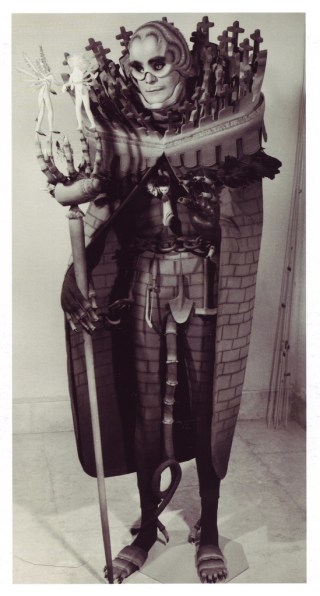
The actual process of creating the imagery was simple, it’s basically me lying on a sofa, maybe a quick snooze and then free-associating while pondering the text. The cover image is a good example, it’s also the illustration for the whiskered Snarks who scratch and the feathered Snarks who bite. This made me think of Old Scratch, the devil, AKA Lucifer, who was once an angel with feathered wings who also showed a nasty tendency to bite the hand that feeds. I had a vague visual memory of seeing a photo of a surrealist devil; I rummaged through some books until I found it — Denise Bellon’s photo of the Québécois Surrealist, Jean Benoit, at a costume party.

The slippers are what caught my eye, it made me think of Old Scratch lounging at home in Pandemonium, his day off, not bothering to shave, hence the whiskers that scratch. I made the toes unequal on a lark, it just seemed right to have Satan misshapen but afterwards I came up with a cabalistic explanation which I won’t bore you with for now.

I then did a pencil drawing on tissue paper, constantly refining and adding or deleting, this was the slowest part of the entire Snark, the pencils. Afterwards I did the pen and ink drawing atop the tissue, on Denril, a synthetic vellum. This is an old technical illustrator’s work habit, which is how I started out actually, in the 80s.

This business of free associating while simultaneously referring to one’s internal visual memory is only possible if one has spent many years romping though books and museums. You cannot be a serious illustrator if you don’t read and look voraciously, all the time. And above all, don’t look at too much rubbish or you will start drawing rubbish. Art students reading this, take heed! You are what you see.

Recombining Surrealism and other –isms, along with the free associations triggered by Carroll’s Nonsense verse, creates a matrix which allows the reader to move seamlessly back and forth between the worlds of dreams, culture, memory and emotion. Those readers who catch the references will enjoy the historical and even non-verbal logic binding them, the rest is up to you.

You are really bringing the meaning with you, and when confronted by my Snark I hope it triggers a cascade of free associations, a mental phenomenon which is the precursor to dreaming, the royal road of Surrealism and Carrollian Nonsense.

Biblioklept: How does your work respond to the nine illustrations by Henry Holiday that originally accompanied Carroll’s text?

Singh: Holiday’s illustrations are odd things, I’ve never been very keen on them. He was a graceful artist usually, very talented and yet these drawings are a bit grotesque, ugly perhaps. They just don’t look so appealing to me. The technique is flawless though, a very classic British style of line work that lasted well into the 1940s.

Some Snarkologists believe that Holiday worked with Carroll to hide a secret meaning in the art. Angles and distances have been measured, objects analysed,  hidden shapes discovered and reconfigured. Who knows? It’s unlikely but in any case, you can’t avoid Holiday if you’re doing the Snark.

I used some of his symbols, the bare-breasted woman and her anchor representing Hope, a very british motif which suits the nautical nature of much of the quest. His picture of the Beaver doing its math problem inspired me to treat that entire Fit the Fifth as a long variation upon the Temptation of St. Anthony, especially the version by Bosch. Holiday really nailed that one. I have to confess that Flaubert’s version is a favorite book of mine and I tried to give this part of the Snark the same baroque, over the top feeling of deranged pagan vs. Christian imagery.

Holiday also crammed a considerable number of small details in the Beaver illustration. It’s quite a contrast to the style of the other big Carroll illustrator, Sir John Tenniel, who favored a cleaner look. Nowadays this technique is called “chicken fat” and I used a lot of chicken fat in my Snark, more than Holiday. Of course, with only 9 drawings, he had to keep to a slower visual tempo. That was another reason I did it as a graphic novel — I could vary the tempo quite a bit and really overwhelm the reader with chicken fat when the verses demanded it.

On the other hand, doing it as a graphic novel required creating a narrative visual thread through the whole thing, something which Holiday really didn’t need. In this case, my idea was to make it a theatrical presentation, each Fit a new set change until the end, when Carroll is revealed as the spectator in the empty hall. Carroll was fond of theatricals and the Snark does have a stagey feel to it anyway.

Biblioklept: Have you ever stolen a book?

Singh: Yes, Aces High, a lavishly illustrated book about British fighter pilot aces of WWI. It once graced the shelves of the high school I once attended in a desultory manner (myself, not the book). I was, and still am, fascinated by all things aviation and I could not bear the sight of that wonderful book languishing there, unremarked, unappreciated. I still know the difference between a Sopwith Pup and a Sopwith Camel and I love a well-executed Immelman at the crack of dawn. It was wrong to do and I can only plead callow youth in my defence. Don’t do it, kids! It isn’t worth it! Gosh, I hope Mrs. Merrill isn’t reading this . .  .

Suttree — Cormac McCarthy

In his 1992 interview with The New York TimesCormac McCarthy said, “The ugly fact is books are made out of books. The novel depends for its life on the novels that have been written.” McCarthy’s fourth novel, 1979’s Suttree is such a book, a masterful synthesis of the great literature — particularly American literature — that came before it. And like any masterful synthesis, Suttree points to something new, even as it borrows, lifts, and outright steals from the past. But before we plumb its allusions and tropes and patterns, perhaps we should overview the plot, no?

The novel rambles over several years in the life of Cornelius Suttree. It is the early 1950s in Knoxville, Tennessee, and Suttree ekes out a mean existence on the Tennessee River as a fisherman, living in a ramshackle houseboat on the edge of a shantytown. This indigent life is in fact a choice: Suttree is the college-educated son of an established, wealthy family. His choice is a choice for freedom and self-reliance, those virtues we like to think of, in our prejudicial manner, as wholly and intrinsically American. Suttree then is both Emersonian and Huck Finnian, a reflective and insightful man who finds his soul via a claim to agency over his own individuality, an individuality poised in quiet, defiant rebellion against the conforming forces of civilization. These forces manifest most pointedly in the Knoxville police, a brutal, racist organization, but we also see social constraint in the form of familial duty. One thinks of the final lines of Huckleberry Finn: “I reckon I got to light out for the Territory ahead of the rest, because Aunt Sally she’s going to adopt me and sivilize me and I can’t stand it. I been there before.”

Like Huck, Suttree aims to resist all forces that would “sivilize” him. His time on the river and in the low haunts of Tennessee (particularly the vice-ridden borough of McAnally) brings him into close contact with plenty of other outcasts, but also his conscience, which routinely mulls over its place in the world. Suttree is punctuated by–perhaps even organized by–several scenes of hallucination. Some of these psychotrips result from drunkeness, one comes from accidentally ingesting the wrong kind of mushrooms (or, the right kind, if that’s your thing), and the final one, late in the novel, sets in as Suttree suffers from a terrible illness. In his fever dream, a small nun–surely a manifestation of the guilt that would civilize us–accuses him–

Mr. Suttree it is our understanding that at curfew rightly decreed by law in that hour wherein night draws to its proper close and the new day commences and contrary to conduct befitting a person of your station you betook yourself to various low places within the shire of McAnally and there did squander several ensuing years in the company of thieves, derelicts, miscreants, pariahs, poltroons, spalpeens, curmudgeons, clotpolls, murderers, gamblers, bawds, whores, trulls, brigands, topers, tosspots, sots and archsots, lobcocks, smellsmocks, runagates, rakes, and other assorted and felonious debauchees.

The passage is a marvelous example of McCarthy’s stream-of-consciousness technique in Suttree, moving through the various voices that would ventriloquize Suttree, into the edges of madness, strangeness, and the sublimity of language. The tone moves from somber and portentous into bizarre imagery that blends humor and pathos. This is the tone of Suttree, a language that gives voice to transients and miscreants, affirming the dignity of their humanity even as it details the squalor of their circumstance.

It is among these criminals and whores, transvestites and gamblers that Suttree affirms his own freedom and humanity, a process aided by his comic foil, Gene Harrogate. Suttree meets Harrogate on a work farm; the young hillbilly is sent there for screwing watermelons. After his release, Harrogate moves to a shantytown in Knoxville. He’s the country mouse determined to become the city rat, the would-be Tom Sawyer to Suttree’s older and wiser Huck Finn. Through Harrogate’s endless get-rich-quick schemes, McCarthy parodies that most-American of tales, the Horatio Alger story. Simply put, the boy is doomed, on his  “way up to the penitentiary” as Suttree constantly admonishes. In one episode, Harrogate tries to buy arsenic from “a grayhaired and avuncular apothecary” to poison bats he hopes to sell to a hospital (don’t ask)–

May I help you? said the scientist, his hands holding each other.

I need me some strychnine, said Harrogate.

You need some what?

Strychnine. You know what it is dont ye?

Yes, said the chemist.

I need me about a good cupful I reckon.

Are you going to drink it here or take it with you?

Shit fire I aint goin to drink it. It’s poisoner’n hell.

It’s for your grandmother.

No, said Harrogate, craning his neck suspectly. She’s done dead

Suttree, unwilling father-figure, eventually buys the arsenic for the boy against his better judgment. The scene plays out as a wonderful comic inversion of William Faulkner’s “A Rose for Emily,” from which it is so transparently lifted. McCarthy borrows liberally from Faulkner here, of course, most notably in the language and style of the novel, but also in scenes like this one, or a later episode that plays off Faulkner’s comic-romantic story of a man and a woman navigating the aftermath of a flood, “Old Man.” Unpacking the allusions in Suttree surpasses my literary knowledge or skill, but McCarthy is generous, if oblique, with his breadcrumb trail. Take, for example, the following sentence: “Suttree with his miles to go kept his eyes to the ground, maudlin and muttersome in the bitter chill, under the lonely lamplight.” The forced phrase “miles to go” does not immediately present itself as a reference to Robert Frost’s famous poem, yet the direction of the sentence retreats into the history of American poetry; with its dense alliteration and haunted vowels, it leads us into Edgar Allan Poe territory. Only a few dozen pages later, McCarthy boldly begins a chapter with theft: “In just spring the goatman came over the bridge . . .” The reference to e.e. cummings explicitly signifies McCarthy’s intentions to play with literature. Later in the book, while tripping on mushrooms in the mountains, Suttree is haunted by “elves,” the would-be culprits in Frost’s poem “Mending Wall.” The callback is purposeful, but tellingly, McCarthy’s allusions are not nearly as fanciful as their surface rhetoric might suggest: the goatman does not belong in Knoxville–he’s an archaic relic, forced out of town by the police; the elves are not playful spirits but dark manifestations of a tortured psyche.

Once one spots the line-lifting in Suttree it’s hard to not see it. What’s marvelous is McCarthy’s power to convert these lines, these riffs, these stories, into his own tragicomic beast. An early brawl at a roadhouse recalls the “Golden Day” episode of Ralph Ellison’s Invisible Man; a rape victim’s plight echoes Hubert Selby’s “Tralala”; we find the comic hobos of John Steinbeck’s Cannery Row–we even get the road-crossing turtle from The Grapes of Wrath. A later roadhouse chapter replays the “Circe/Nighttown” nightmare in James Joyce’s Ulysses. Ulysses is an easy point of comparison for Suttree, which does for Knoxville what Joyce did for Dublin. Suttree echoes Ulysses’s language, both in its musicality and appropriation of varied voices, as well as its ambulatory structure, its stream-of-consciousness technique, its rude earthiness, and its size (nearly 600 pages). But, as I argued earlier, there’s something uniquely American about Suttree, and its literary appropriations tend to reflect that. Hence, we find Mark Twain, Herman Melville, Ernest Hemingway, Walt Whitman, Emerson and Thoreau, Emily Dickinson, and William Carlos Williams, to name just a few writers whose blood courses through this novel (even elegant F. Scott Fitzgerald is here, in an unexpected Gatsbyish episode late in the novel).

Making a laundry list of writers is weak criticism though, and these sources–all guilty of their own proud plagiarisms–are mentioned only as a means to an end, to an argument that what McCarthy does in Suttree is to synthesize the American literary tradition with grace and humor, while never glossing over its inherent dangers and violence. So, while it appropriates and plays with the tropes of the past, Suttree is still pure McCarthy. Consider the following passage, which arrives at the end of a drunken, awful spree, Suttree locked up for the night–

He closed his eyes. The gray water that dripped from him was rank with caustic. By the side of a dark dream road he’d seen a hawk nailed to a barn door. But what loomed was a flayed man with his brisket tacked open like a cooling beef and his skull peeled, blue and bulbous and palely luminescent, black grots his eyeholes and bloody mouth gaped tonguless. The traveler had seized his fingers in his jaws, but it was not alone this horror that he cried. Beyond the flayed man dimly adumbrate another figure paled, for his surgeons move about the world even as you and I.

Suttree’s dark vision points directly toward the language of McCarthy’s next novel, 1985’s Blood Meridian, roundly considered his masterpiece. Critics who disagree tend to point to Suttree as the pinnacle of McCarthy’s writing. I have no interest at this time in weighing the books against each other, nor do I think that doing so would be especially enlightening. For all of their sameness, they are very different animals: Suttree provides us intense access to its hero’s consciousness, where Blood Meridian always keeps the reader on the outside of its principals’ souls (if those grotesques could be said to have souls). And while Blood Meridian does display some humor, it is the blackest and driest humor I’ve ever read. Suttree is broader and more compassionate; it even has a fart joke. Blood Meridian, at least in my estimation (and many critics will contend this notion) has no flawed episodes; much of this results from the book’s own internal program–it resists love, compassion, and even human dignity. In contrast, Suttree is punctuated by two deaths the audience is meant to read as tragic, yet I found it impossible to do so. The first is the death of Suttree’s child, whom he has abandoned, along with its mother. As such, he is not permitted to take part in the funeral, observing the process rather from its edges. The second tragedy is the death of Suttree’s young lover in a landslide. The book begs us to empathize with Suttree, just as he often empathizes with the marginal figures in the novel, but ultimately these tragedies are a failed ploy. They underwrite a sublime encounter with death for Suttree, an encounter that deepens and enriches his character while paradoxically freeing him from the burdens of social duty and familial order. McCarthy is hardly alone in such a move; indeed, it seems like the signature trope of American masculine literature to me. It’s the move that Huck Finn wishes to make when he promises to light out for the Territory to escape the civilizing body of Aunt Sally; it’s the ending that Hemingway was compelled to give to Frederic Henry at the end of A Farewell to Arms; it’s all of Faulkner, with his mortification of fatherhood and the dramatic responsibility fatherhood entails. It is a cost analysis that neglects any potential benefits.

But these are small criticisms of a large, beautiful, benevolent novel, a book that begs to be reread, a rambling picaresque of comic and tragic proportions. “I learned that there is one Suttree and one Suttree only,” our hero realizes, but this epiphany is set against a larger claim. Near the end of the novel, Suttree goes to check on an old ragman who he keeps a watchful eye on. He finds the man dead, his shack robbed, his body looted. Despairing over the spectacle’s abject lack of humanity, Suttree cries, “You have no right to represent people this way,” for “A man is all men. You have no right to your wretchedness.” Here, Suttree’s painful epiphany is real and true, an Emersonian insight coded in the darkest of Whitman’s language. If there is one Suttree and one Suttree only, he is still beholden to all men; to be anti-social or an outcast is not to be anti-human. Self-hood is ultimately conditional on others and otherness. To experience the other’s wretchedness is harrowing; to understand the other’s wretchedness and thus convert it to dignity is life-affirming and glorious. Suttree is a brilliant, bold, marvelous book. Very highly recommended.

Sex, Drugs, and Harry Potter

[Editorial note–We originally ran this post in the summer of 2009 when Harry Potter and the Half-Blood Prince was in theaters. We run it again now to celebrate the premiere of Harry Potter and the Deathly Hallows, Part I (we also are running it again ’cause we’re lazy)].

First thing’s first: if you’re looking for Harry Potter slash fiction, you’ll have to check out our original Harry Potter Sex Romp post for links, you dirty dawg (you’re weird but you’re welcome). Just like that post a few years ago, this post’s title is really kinda sorta mostly irrelevant to what this post is about. What is it about? I want to take a look at some of the homoerotic tension in the new Harry Potter movieHarry Potter and the Half-Blood Prince. If you want to find a proper review of the film, with plot summary and insight, shop around. That’s not gonna happen here.

Also, there will be SPOILERS, okay? Fair warning.

INTL_HarryDumbledore (Large)

Okay. So, I saw the new film last night (henceforth HP6). And it was pretty good or whatever. But I noticed a subtext that cracked me up quite a bit, an underlying motif that might be lost on most summer blockbuster audiences. I’m talking about the implicit love between men and boys in this film.

At the beginning of the film, in an apparently insignificant scene, young Harry makes a date with an attractive young girl. However, old man Dumbledore shows up and dashes any hopes for a late sumer romance. Instead of meeting up with this lithe young thing, Harry has to grip hard to Dumbledore’s stiff arm to be apparated away to meet Horace Slughorn, an old potions master. Dumbledore uses Harry as fresh young bait for Slughorn, who has something the old wizard needs–a key memory about the development of Tom Riddle–Voldemort–a former protégé of Horace’s (lots of mentors and mentees here). Much of the narrative’s conflict revolves around the task Dumbledore has given Harry; it’s almost as if Dumbledore is pimping out the young wizard. These multiple man-boy relationships are doubled darkly in the failing bond between Snape and emo Draco.

In contrast, heterosexual relationships between the teens are treated with a lightness and even frivolity that codes such romances as ephemeral, or perhaps even inessential. Although the film solidifies the groundwork for the long-term relationships between the series’ principals (Harry-Ginny/Ron-Hermione), the real love story here is between older men and their young apprentices. HP6 depicts teen romance as silly without coloring any of its fragility with pathos. What the film really argues for is a sort of Greek or Platonic ideal of love; that love exists as a conduit for wisdom, passed from an older, experienced man to a younger boy in exchange for some of that youth’s beauty and vitality. Although moments of teenage adventure punctuate the film, the real scope of heroic encounters are shared between older men and their attendant lads (particularly Dumbledore and Harry, although even Snape, through the annotations of his old textbook, manages to plant part of himself into Harry).

The film reaches its climax with a lot of phallic wand waving and a bit of indecision over who gets to shoot off at whom. The climactic scene encodes the strange aggressions and series of shifting allegiances between the male wizards present. Dumbledore becomes the tragic figure; his death allows for Harry’s maturation, enacting a definitive arc in Harry’s Oedipal complex, where Dumbledore is both father figure and secret sex object. The weight of this tragedy initiates Harry into the adult world and adult responsibilities.

So why bother to write about this? No reason really, and I’m sure plenty of readers will find my analysis insupportable, silly, offensive, or just plain wrong. That’s fine. I guess I mostly find it remarkable that this motif should prevail so heavily in a summer blockbuster. There was also a whole drug motif going on–so many of the film’s plot development hinge on the ingestion of mind-altering substances–so maybe I just like the idea that the film is kinda sorta subversive.

My Year of Flops — Nathan Rabin

Let me admit biases up front: for the past few years, I’ve looked forward every Wednesday to Nathan Rabin’s regular column at the AV Club,“My Year of Flops,” where he reviews–and reappraises–some of the worst-received films of all time. I’m also a fan of Rabin’s other columns, “THEN! That’s What They Called Music!” and “Nashville or Bust,” as well as the general tone of the AV Club, which he no doubt helps set as its head writer. I also thought Rabin’s memoir The Big Rewind was pretty good. So, I’m probably not the most objective person to review Rabin’s new book My Year of Flops, which comprises 35 of Rabin’s past columns, 15 new entries, and interview snippets with some of the actors who had the (mis)fortune to turn up in these flops. I’ll do my best to assess how well these columns–most of which were written for the internet–hold up as a book.

So, what, exactly, constitutes a flop?  There are the biggies here, of course, infamous studio-busting career-killers like Heaven’s Gate, Battlefield Earth, and Ishtar;  the batshit crazy weirdfests that were destined to become cult classics, like Southland Tales, Howard the Duck, and The Apple; the disposable movies made to be forgotten, like Bratz: The Movie; there are forgotten and overlooked oddballs, like Robert Altman’s teen sex comedy, O.C. and Stiggs, and Gospel Road, where Johnny Cash tells the life story of Jesus. All of these films share disappointing (or non-existent) box office results as well as general critical disapproval (or at least bewilderment). As part of his revisionist project, Rabin ends each entry by declaring the re-appraised film a “Secret Success,” a “Fiasco,” or a “Failure.” Tellingly, most of the time Rabin finds his subject to be a “Fiasco.” He’s willing to take each film on its own terms; he’s also incredibly open to viewing each film in a way that transcends the trappings of its marketing to an intended audience.

Take, for example Tough Guys Don’t Dance, a film macho novelist Norman Mailer thought it would be a totally sound idea to not only write but direct. Rabin’s initial analysis derides the film for its cardboard characters, debased gimmickry, and embarrassing dialog. By the end of his reassessment, however, Rabin has given the would-be thriller a new life as “a darkly comic, horror-tinged melodrama about the emptiness of excess and the soul-crushing costs of pursuing endless pleasure.” His review rests not on a personal ironic vision, but rather on a willingness to see Mailer’s own ironic vision at work behind (and in front of) the camera.

In the same way, Rabin is able to put aside–even while acknowledging–the dreadful reputations surrounding films like Ishtar and Heaven’s Gate. Even though the latter film essentially destroyed both its studio and the maverick filmmaking style of the 1970s, Rabin finds in it more than a slight redemption–he finds a flawed masterpiece, a gorgeous treatise on Manifest Destiny that doesn’t deserve its reputation. Similarly, Rabin would have us believe that Istar actually is funny. Both of these entries are remarkable not just in their clear revisionist goal, but also for how instructive they are. In both write-ups, Rabin reveals much of how movies are made, and how movies are made flops–the ways that infighting, firings, and studio expectations can damn a film before it even premieres.

While My Year of Flops is instructive in its criticism, it’s also very entertaining. Rabin has a keen sense of satire, and if he occasionally tips into snark, it’s always earned (and if you have a problem with a writer being snarky at the expense of Battlefield Earth, well, you’re probably a prig anyway). A great illustration of how Rabin combines his sense of humor with his instructive criticism in his coinage of the term “Manic Pixie Dream Girl”–

The Manic Pixie Dream Girl exists solely in the fevered imaginations of sensitive writer-directors, who use them to teach broodingly soulful young men to embrace life. The Manic Pixie Dream Girl serves as a means to an end, not a flesh-and-blood human being. Once life lessons have been imparted, the Manic Pixie Dream Girl might as well disappear in a poof! for her life’s work is done.

Cameron Crowe is particularly guilty of employing the MPDG trope, but you can find her pretty much everywhere you look–at least in the domain of rom-coms. Rabin proposes the term in his first entry in the series (also the first entry in the book) a review of Crowe’s much maligned Elizabethtown. Rabin finds it to be a Fiasco. In a move that sums up both Rabin’s program and his generous spirit, Rabin concludes My Year of Flops by re-reassessing Elizabethtown–he now dubs it a Secret Success. While I don’t subscribe to the idea that a critic should-be a starry-eyed optimist who finds the best of all possible worlds in each work, I do think that it has become far too easy to outright dismiss someone’s hard work. We live in a hyper-mediated age that moves too fast: all propositions are disposable, including the arts. Rabin, in taking each work on its own terms, does a service to both criticism and creativity.

Rabin’s own columns might, of course, fall prey to this disposable age. Today’s columns and blog posts are meant to be consumed quickly; although the best might find a life of new clicks in cyberspace, most are tomorrow’s virtual bird-cage liners. The blog-book is thus a tenuous grasp at some permeability–or at least respectability. My Year of Flops is fun, energetic, and insightful, but it does not bear sustained reading. The entries are best consumed one at time, probably between other tasks (or other books). It’s a great book for the john. Still, in an ideal library, My Year of Flops would stand squarely along side any other work of film criticism (it’s certainly sharper than anything by Leonard Maltin or Gene Shalit). Ultimately, Rabin does here what all great critics do–he makes a case for the works he’s appraising. He makes you want to see his Secret Successes and even the Fiascos (and, at times, even the Failures). I’ll even forgive him for making me watch The Apple. Recommended.

The Collected Stories of Lydia Davis

The Collected Stories of Lydia Davis compiles all 198 of Davis’s short stories in one handsome volume. That’s all four of Davis’s exceptional short story collections: Break It Down, Varieties of Disturbance, Samuel Johnson Is Indignant, and Almost No Memory. FS&G debuted the hardback edition a year ago, and this month Picador offers up a lovely (and more affordable) trade paperback version; it sports deckle edge pages and French flaps, and runs over 700 pages.

I front-load my review with this data to make it obvious that, if you have any interest in Lydia Davis, this is a book to pick up. It’s a wonderful collection, a tidy brick of words that begs for immersion, the kind of book you float around in, flipping pages at random to find and enjoy yet another strange little gem. Go get it.

If you’re not sure why you should be interested in Davis, read on.

Most of Davis’s stories are very short; many are just a paragraph or two, and some a mere sentence in length. They are not stories in the traditional sense: don’t look for sweeping character development or grand plot arcs. These stories thrive rather on tone, a keen sense of inspection, perception, and mood, and an intensity of observation on matters large and small. They are tales, fables, riffs, annotations, skits, jokes, japes, anecdotes, journals, thought experiments, epigrams, half-poems, and would-be aphorisms.

“In a House Besieged,” from her first collection Break It Down (1986) reveals much about the Davis program. Here it is in full–

In a house besieged lived a man and a woman. From where they cowered in the kitchen the man and woman heard small explosions. “The wind,” said the woman. “Hunters,” said the man. “The rain,” said the woman. “The army,” said the man. The woman wanted to go home, but she was already home, there in the middle of the country in a house besieged.

“In a House Besieged” illustrates a number of the themes and motifs that run throughout Davis’s oeuvre: unnamed protagonists identified only as “the man” and “the woman” (later stories might call them “the husband” and “the wife”) who are at once allegorical placeholders and at the same time singular individuals; a domestic setting (with family members as protagonists); an unknowable and perhaps unidentifiable threat; a pervasive sense of alienation balanced by an ironic sense of humor. The story’s brevity also shows that, from the outset of her publishing career, Davis was already working toward something wholly different from the Carveresque stories that dominated MFA fiction in the 80s.

The domestic settings of Break It Down–spaces often haunted by mothers and fathers–rear up again and again throughout the collection. 1997’s Almost No Memory kicks off with “Meat, My Husband,” a story about a wife who is trying to get her husband to eat healthier–a difficult prospect considering his affection for beef. The tale should be utterly banal, but instead it is humorous and even oddly moving; the wife, who narrates the piece, concludes by realizing that her husband would really just prefer to cook for himself. The insight transcends the particular domestic scenario: it seems applicable to the reader’s own life (or to this reader’s, anyway). “How He Is Often Right,” also from the same collection, is a short paragraph where the narrator concludes that the titular “he” is often wrong, “but wrong for circumstances different from the circumstances as they actually were, while [his decision] was right for circumstances I clearly did not understand.” The story captures the way that we impart great meaning to the smallest arguments, dwelling on them, connecting them to our sense of identity. We see the same analysis at work in “The Outing” (also from Almost No Memory). In full–

An outburst of anger near the road, a refusal to speak on the path, a silence in the pine woods, a silence across the old railroad bridge, an attempt to be friendly in the water, a refusal to end the argument on the flat stones, a cry of anger on the steep bank of dirt, a weeping among the bushes.

Davis’s sentence might be telescopic, but it also, paradoxically, puts the relationship in the story under a microscope. The reader can fill in the gaps with his or her own background: we’ve all experienced this anger, this silence, this refusal. We’ve been there. The story is real. It’s true.

The truth of Davis’s stories is what unites them; it’s the reader’s recognition of their truth that makes them so pleasurable. Take “Boring Friends” from 2001’s Samuel Johnson Is Indignant (again, in full)–

We know only four boring people. The rest of our friends we find interesting. However, most of the friends we find interesting find us boring: the most interesting find us the most boring. The few who are somewhere in the middle, with whom there is reciprocal interest, we distrust: at any moment, we feel, they may become too interesting for us, or we too interesting for them.

Davis’s treatment on friendship consistently penetrates facades, exposes our competitive cores, and, at the same time, celebrates the joys we might take in others. This precarious line also evinces in Davis’s stories about taking care of young children. The short scene “Child Care” focuses on a grumpy father who’d rather watch TV than take his turn with the baby. Solution: “Together they watch The Odd Couple.” And perhaps it is because I have two young children, but I can’t recall a more accurate depiction of the simultaneous wonder and boredom of taking care of a new baby than “What You Learn About the Baby” (a lengthy treatise at six pages).

Not all of Davis’s stories focus on family and friends. There’s much here about academia: troubles with translation, grappling with tenure, the perils of teaching, and so on. There are at least three entries on grammar here. If not all readers can connect with these stories (although I certainly did), they need not worry–part of the joy of the book is its diversity. If a story doesn’t catch right away, flick to the next one, or one a hundred pages down the line. Perhaps you will alight on one of the collection’s imaginative historical biographies, like “Kafka Cooks Dinner” or “Marie Curie, So Honorable Woman,” positively epic at 18 pages. Davis’s histories fascinate; they seem utterly real and true and absurd and improbable, all at the same time.

Indeed, discursive movement is the core of Davis’s, but her digressions all point to a thematic analysis of truth, of an individual’s attempt to understand the world in terms other than the individual herself. They dwell on problems of self-consciousness, often employing literary distortion as an analytical tool. Davis’s literary distortions always point to a concrete reality, a livable, experiential reality; the fact that we should experience the real as surreal or absurd only makes her work more truthful.

It would be easy to park Davis with the postmodernist counter-tradition, but I think her work looks to something else, something post-postmodernist (I write this, I know, at the risk of falling into an abyssal loop).  Davis’s work presages contemporary “flash fiction”; her stories’ brevity reflect the simultaneous contraction of our attention spans and the expansion of our diverse interests. Her story “Samuel Johnson Is Indignant:” reads like a Facebook update. Here it is in full — “that Scotland has so few trees.” Davis transmutes an amusing annotation into a story that somehow brings the great critic back to life. The title of the story is also the title of the book; what follows then is a kind of meta-joke on reader expectations, subverting our expectations of Dr. Johnson’s (supposed) meta-commentary on the book-proper. But I fear I’m headed into a lit-crit navel-gazing snoozefest (in what has already been a long review). Far better to wrap things up, I think, by simply noting again how joyful it is to move through the book, to open at random and read. Very highly recommended.