On Bookstore Compulsions

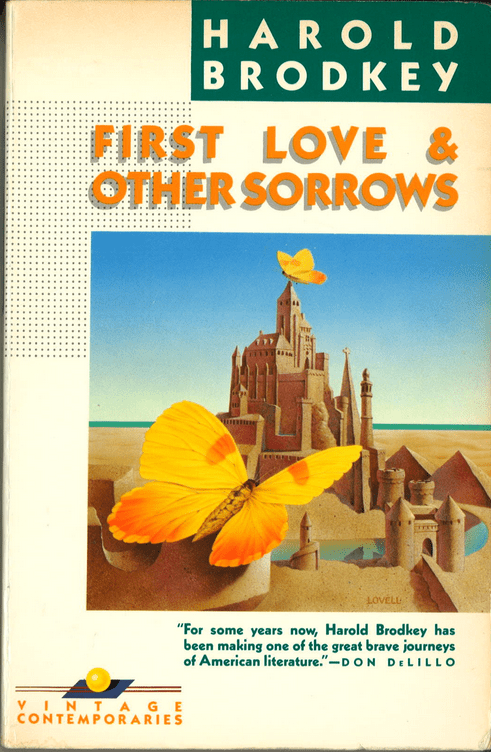
I went to my favorite bookstore the other afternoon, a visit that I make at least once a week, usually when I’m bored, perhaps when I’ve had a bad day, or, often, when I can invent some reason to go, usually under the delusion that I “need” another book. I made this particular trip to replace Harold Brodkey’s First Love and Other Sorrows, which I’d given to a friend who was visiting from out of town. Not only did I feel compelled to replace this book, I also felt a strong desire to replace the exact edition, part of the Vintage Contemporaries mid-80s line, all featuring horrendous (and far-too literal) covers. And this is of course the first compulsion—the compulsion simply to go to the bookstore. Once in the bookstore I regularly experience a variety of other compulsions, which I’ll describe below.

But first, a little about this particular bookstore, which I will not name here because I am slightly ashamed of these compulsions, which are admittedly a little creepy. The store has two locations, one of which is a downtown café with a hip menu and the occasional art show. I rarely go to that one. The location I go to is a massive labyrinth, a twisty maze constructed out of books, sprawling out over a few connected buildings. To enter is to be immersed in that old book smell, that smell that makes me dizzy, that loads me with a strange anxiety. The staff seems to be in a constant state of reorganizing the flood of books that pours in each day. There are, quite literally, hundreds of thousands of books, from floor to ceiling. They take review copies off my hands for credit, so I haven’t had to pay cash for a book in years, which is, you know, nice. I also live 1.1 miles away. So, again, you can understand the repeated visits.

Anyway. Once compelled to the bookstore, I experience additional compulsions, such as

  • Offering unsolicited help to confused-looking customers: Most of the time these are high school or college students, searching for assigned reading, usually in the wrong section (Contemporary Authors when they should be in Classics). Not only do I feel compelled to point them to the opposite side of the store, I’ve even gone so far as to walk them over there, and then suggest particular editions of the book. I try to avoid a route that would put me in the direct scope of the legitimate employees as I perform this unwanted service.
  • Suggesting books to strangers: This compulsion is linked to another urge, the compulsion to look at what people are buying. If I see someone picking up a Philip K. Dick novel, I nosily ask about China Miéville, because I know that there’s a copy of Perdido Street Station that still hasn’t found a home. If some poor kid is in the Faulkner section to find As I Lay Dying for school, I become the creepy weirdo who suggests that she also read Go Down, Moses. On the “B” aisle once, my awareness of a used copy of 2666 became so distressing (why hadn’t someone already picked it up!) that I waited until someone else strolled down the aisle and tried to casually mention how awesome the book was, and that that person could not do wrong to buy it. Weird look ensues.
  • Desiring books I already own: The copy of 2666 (which disappeared by the next week, thankfully) highlights another strange compulsion. If I find a copy of, say, Tree of Smoke, I feel compelled to pick it up and give it to someone. I have to remind myself that giving someone a 700 page book that got incredibly mixed reviews is not really a gift; it’s a dare or burden.
  • Tracking books: So, yeah, I keep track of books. Why hasn’t anyone picked up Vollmann’s The Ice-Shirt in six months? Why is there still a used copy of Suttree? This is shamefully obsessive, but not as shamefully obsessive as—
  • Hiding books: I don’t even know how to begin to start to try to explain this. Let’s move on.
  • Buying books I’m pretty sure I’ll never read: I’m pretty sure that I’ll never get through all or even most of Roland McHugh’s Annotations to Finnegans Wake, but I had to buy the first edition. When will I have time to get through Malcolm Lowry’s Hear Us O Lord from Heaven Thy Dwelling Place? Why do I feel the need to pick up British Penguin editions of Aldous Huxley books that I already own (and have not read all of yet)?
  • Scouring for book marks: I don’t know why, but I like to find what people have used to mark their places in their books. I have, to my great shame, transferred, on occasion, a bookmark from a book that I’m not going to buy to one I am taking. This isn’t exactly theft, but it feels like a strange violation of sorts.

There are more compulsions of course, but this isn’t meant to be a case study of my illness, so I’ll spare you further details. So, did I get the Brodkey? No. They had about a dozen copies, but not that first Vintage Contemporaries edition with the ugly cover with sandcastles and butterflies that I wanted. So I picked up his later collection Stories in an Almost Classical Mode. I also picked up another book that I used to own but had given to a friend, James Weldon Johnson’s memoir Along This Way, and The Stories of Breece D’J Pancake by, uh, Breece D’J Pancake. Of course I won’t have time to read these before next week’s trip.

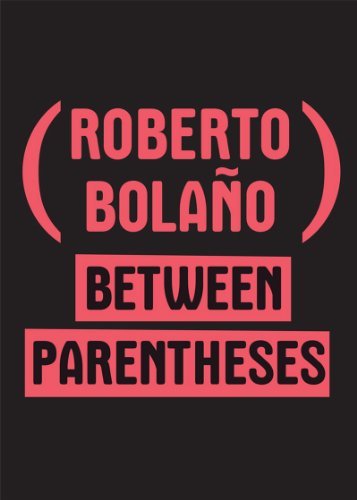
Between Parentheses — Roberto Bolaño

Between Parentheses (new from New Directions and deftly translated by Natasha Wimmer) collects over 400 pages of Roberto Bolaño’s essays, speeches, introductions, and newspaper columns, composed between 1998 and 2003, the year Bolaño died. The bulk of the book, as well as its title, comes from a column that Bolaño wrote for the Chilean newspaper Las Últimas Noticias. As one would expect, these pieces are relatively short, sometimes under 500 words, punctuated with a depth that belies their brevity. Bolaño writes about everything (or, everything worth writing about, I suppose), but, as those familiar will guess, literature is his main subject, whether he’s reviewing a Spanish-language translation of McCarthy’s Blood Meridian, comparing Kafka and Philip K. Dick, explaining his affection for William Burroughs, or discussing the merits of translating literature. If these samples tantalize you, let me go further: Bolaño writes about detective novels, Walter Mosley, Jonathan Swift, Jorge Luis Borges, magic, devils, memoirs, Gunter Grass, murder, troubadours, the Hell’s Angels, poetry, and more, more, more.

Despite its discursive topics, a unified tone inheres throughout Between Parentheses, a distinctly Bolañonian tone, at once grand and romantic (and Romantic) and profound and cynical and biting and flippant. In her blurb on the back of the book, Marcela Valdes (The Nation) declares that in Between Parentheses “we hear Bolaño’s real voice, the one he often disguised through the ventriloquism of his fiction.” This is perhaps a too-bold statement—I’m not sure if Bolaño can be said to have a “real voice”—instead, we find an author who’s constantly inventing and then reinventing, inflating and deflating, expanding and contracting.

And yet I think we’ll have to take Between Parentheses as Bolaño’s “real voice”—it’s perhaps the closest thing we’ll get to memoir or autobiography from the man (at least for now: his literary estate seems to be  in a constant state of excavation, so who knows). But Bolaño, ever the winking imp, is there to warn us against taking memoir at face value—

Of all books, memoirs are the most deceitful because the pretense in which they engage often goes undetected and their authors are usually only looking to justify themselves. Ostentation and memoirs tend to go together. Lies and memoirs get along swimmingly.

If Bolaño may occasionally employ invention in some of the passages here, it’s all to his credit, and all perhaps in the service of Higher Artistic Truth (whatever that means). He shares much of himself in Between Parentheses, especially in the book’s first section, “Three Insufferable Speeches,” (you may have already read “Literature and Exile”) and its second section, “Fragments of a Return to the Native Land,” detailing the writer’s return to Chile in 1998. These are indeed fragments, sketchy, pained moments where we glimpse Bolaño trying to process a difficult and emotional journey. The tone is at once comic, analytical, and depressive—familiar territory to Bolaño’s readers, I suppose. Besides its obvious appeal as a Bolaño memoir, “Fragments” is also fine travel literature, as is the later section “Scenes,” which comprises evocations of various locales, chief among them Bolaño’s adopted home Blanes. Several of the pieces in “Scenes” seem to extend into the realm of pure fiction; a few are narrated by speakers who are only partly-Bolaño (if such a construction can be said to exist). In any case, they are the book’s closest approximations of short fiction.

The book’s fifth section, “The Brave Librarian,” features one of the highlights (and longer pieces) of the volume, a preface for The Adventures of Huckleberry Finn called “Our Guide to the Abyss,” where Bolaño parses Twain and Melville, delving into American literature. I’m sure that for many this piece alone will be worth the price of admission. If you still need convincing, the book’s final section offers a treatise on book theft, advice on the art of writing short stories, a transcript of Bolaño’s last interview before his death, and more, more, more. “More, more, more” might be a simple way to summarize this book.

Between the Parentheses does little, ultimately, to explicate Roberto Bolaño. If anything, it helps to further confound those of us who’ve been puzzling out his fiction for the past few years. And thank God for that. I’ve written before about “the Bolañoverse,” about Bolaño’s labyrinthine genre-crossing intertextuality. Between Parentheses, despite its claims to reality or truth, is nevertheless a part of Bolaño’s maze, a maze by turns dark or illuminating, tragic or comic, and stark and enriching. Most of all, this maze is a strange joy to get lost in. Highly recommended.

Wilson — Daniel Clowes

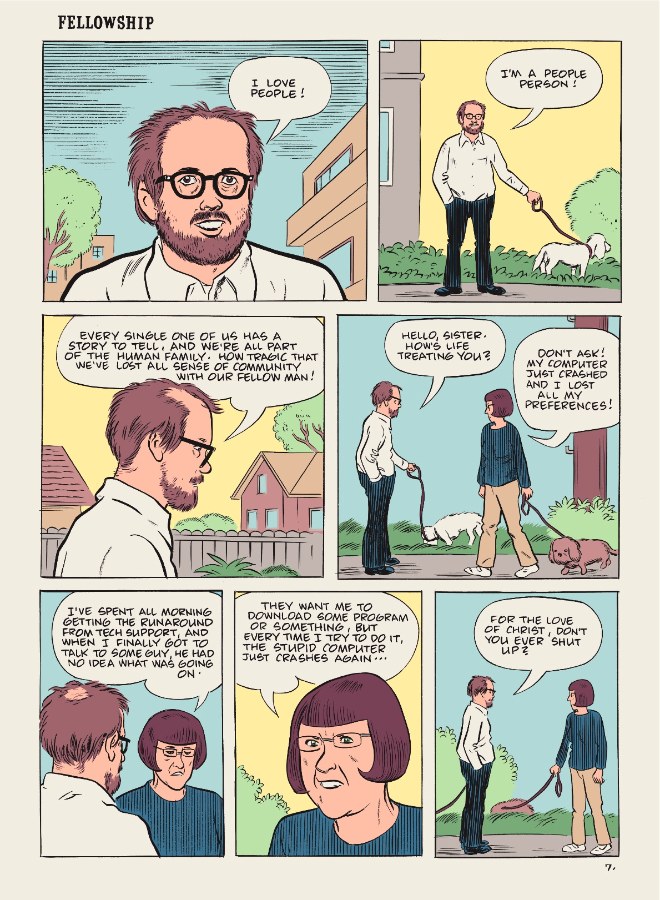
In the first line of the first panel of the first strip in Daniel Clowes’s graphic novel Wilson, the eponymous character, looking directly at the reader, claims, “I love people!” The statement is both ironic and strangely true. Our hero Wilson loves the idea of loving people, and goes about his daily business (walking his dog, drinking coffee, mailing boxes of shit to his former in-laws) in a way that maximizes human contact. With no real family of his own, Wilson reaches out to every person he passes by, addressing them as “brother” or “sister” in an embracing, Emersonian spirit. The problem is that, as much as he loves the idea of loving humanity, Wilson pretty much hates every person he meets. Here’s the opening episode—

Wilson comprises about 70 one-page episodes, each with six or seven panels, each essentially self-contained yet part of a loose plot. The episode above is indicative of the structure of each chapter: a build-up, a monologue, often delivered to disinterested stranger, and then an anti-punchline in which Wilson reveals the ironic cognitive dissonance at the core of his being. The effect can be hard to process, and Clowes’s acerbic humor is clearly not for everyone. Although Clowes uses a traditional Sunday comic page structure, his technique is unsettling: the humor is drawn not so much from the deflationary punchlines that end each chapter, but the overall disconnect between perception, desire, and reality that those punchlines reveal.

Clowes uses this method consistently throughout Wilson, but alternates styles and color palettes, moving from a classic-Clowes style familiar to anyone who’s read Eightball or Ghost World, to a bouncy, cartoony style (see: “Marriage”). The choice to change up the styles calls back, again, to the Sunday comic pages of yore; it also underscores Wilson’s unstable identity, as the narrative slips through gradations of more realistic to more cartoony representations. It is a consistent inconsistency.

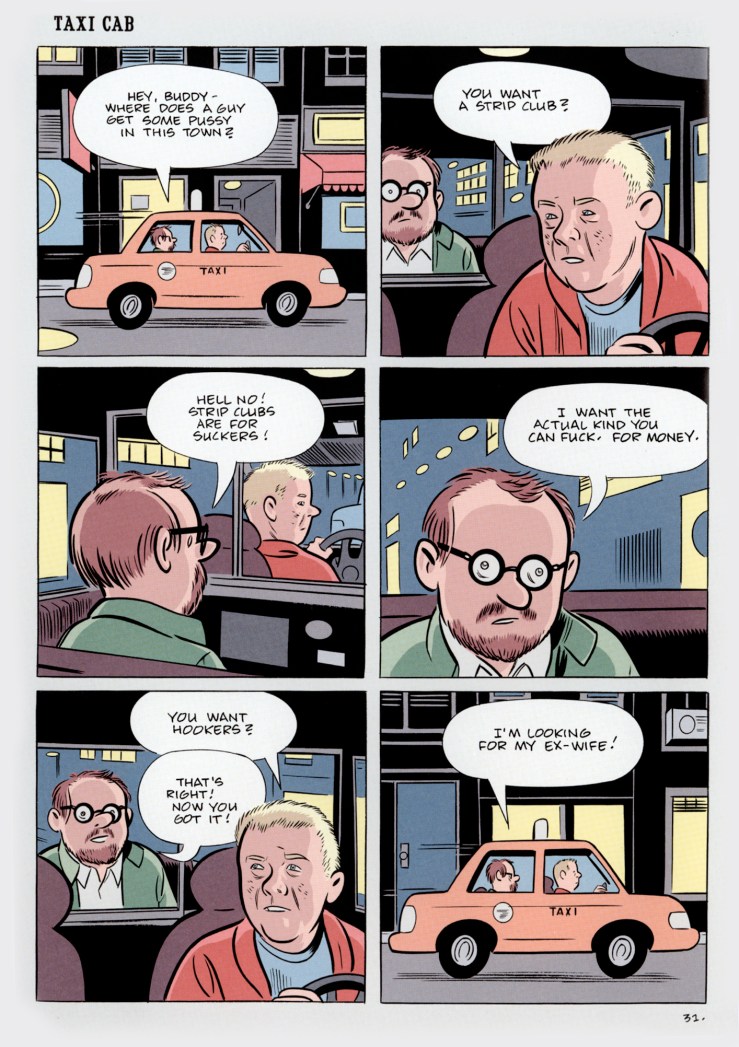
Surprisingly, Wilson has a cohesive plot. After the death of his father, Wilson seeks to reunite with his ex-wife, whom he believes to be a drug-addicted hooker. He also hopes to meet the child she was pregnant with when she left him—

Wilson does find his wife. And then he finds his teenage daughter. And then he kinda sorta kidnaps her, or at least doesn’t bother to return her to her adoptive parents. And then he goes to prison. But maybe I’m spoiling the plot now. In any case, Wilson’s adventures are hardly zany. They are poignant and sad and pathetic and cringe-worthy. Clowes is willing to punish his already-tortured protagonist, and yet there’s a payoff for pour Wilson. Throughout the graphic novel, Wilson yearns for human connection, yet is always disappointed by the humans around him who can never measure up to his ideals. Like any sociopath, Wilson lacks a meaningful emotional core; throughout the narrative he longs to experience an epiphany, staring at the ocean, for example, in the hopes illumination. He finally earns this epiphany near the close of his life. The moment is unexpectedly touching, and provides the kind of balance that proves Wilson a work of art and not merely a collection of funny strips. Recommended.

Wilson is available now from Drawn & Quarterly.

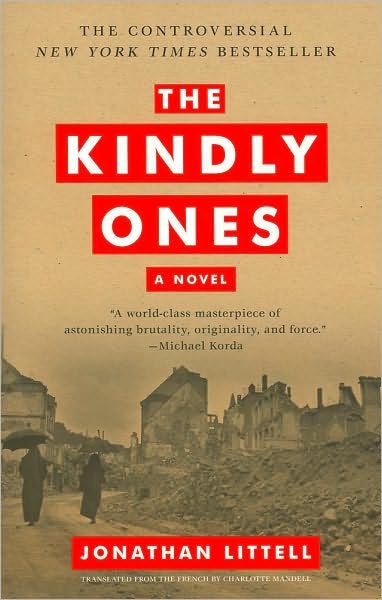
Jonathan Littell’s The Kindly Ones Is Lurid Abject Art

Yesterday, I finished listening to the unabridged audiobook version of Jonathan Littell’s 900+ page novel The Kindly Ones, the plot of which is too long and complex and detailed (and frankly, often boring) to unpack here. To make a very long story short (after which I’ll talk about the book’s scandalous and (deservedly) tawdry reputation), Maximilien Aue is an SS officer of mixed Franco-Germanic parentage, who, amazingly, seems to be present at an unlikely number of key events during WWII. These events include time at the eastern front, orchestrating mass killings in Ukraine and holing up during the battle of Stalingrad, where he gets shot through the head yet miraculously survives. After this, Aue convalesces in Berlin, and later visits his mother and stepfather in Antibes. He soon takes up the project of improving conditions for concentration camp prisoners, visiting camps like Auschwitz, all the while meeting and working with Nazi bigwigs like Albert Speer, Adolf Eichmann, and Heinrich Himmler. After an intense illness (the book is full of illness–more on that in a moment), Aue seeks his twin sister (uh, yeah, more on her shortly) at her husband’s house in Pomerania, where, finding her absent, he indulges in a psychotic wine-fueled masturbation binge (yes, more presently). The end of the novel ups the psycho-ante, detailing the last days of the Third Reich in Berlin, a period Littell depicts as dripping in decadent nastiness. Aue survives via murder murder murder.

This is a very brief outline of a very long book, the kind of book that dares to be important, and Littell surely knows his history. In fact, the book is often incredibly dry, dusty even, constipated by historical facts that Aue and other characters frequently reveal in long, clunky passages of exposition. Indeed, one of the great weaknesses of The Kindly Ones is Littell’s tendency to use his characters as mouthpieces, little pawns who will discourse on politics or linguistics or music or whatever for a few pages. At the same time, it’s clear that Littell wants certain passages to bore the reader. A lengthy episode in the Ukraine concerns the fate of a group of Caucus mountain people of whom the SS wish to determine a “racial origin.” Littell presents the process of deciding whether or not these people should be exterminated or not in excruciatingly bureaucratic (bureaucratically excruciating?) detail. One of the novel’s core points is an observation of the Nazi Reich as a lurching machine, a sick machine whose various limbs were often at bureaucratic war with each other.

If The Kindly Ones is often dry, its wetness is all the more foul. This is a novel that might as well take place in the asshole, or at least the colon. Our hero (?!) Aue spends much of his time describing his alternate diarrhea and vomiting; indeed, emetic purging seems to be his only form of absolution from the constant sin he’s wallowing in. It’s as if the entire Nazi project—its racial purging, its mass murder, its bureaucratic domination, its lies that were obvious to any person with eyes—is a constant stream of shit and vomit that Aue is forced to (yet unable to) process. The Nazis worked to elevate their unnatural sins to a kind of weltanschauung, yet Aue is unable to reconcile this world view with the visceral reality of the organized mass murder he daily helps orchestrate. This hardly absolves him; indeed, Aue seems to engage in every perversion and sin imaginable as a means to release the metaphysical pressure valve that’s pushing down on him all the time.

And this is the core of The Kindly Ones, and certainly why the novel is so infamous. The Nazis were an abject regime, a force that sought to “cleanse” Europe and the world of a perceived filth, and set about doing so in the most paradoxical way imaginable—by engaging in genocide, the worst kind of moral filth. Littell’s novel explores the bureaucratic nature of these abject sins in detail, but Aue is the very (tortured) soul of abjection. He is a paradoxical figure, a “true” SS party member who nevertheless idealizes Greek culture—an ironic twist, given the book’s title, a not-so-subtle nod to Aeschylus’ Oresteia. Quick warning: spoilers ahead—although, given Littell’s potboileresque structure, you’d have to be a blind Oedipus to miss these twists.

Yes, young Max Aue is a thoroughly Greek figure. He’s a homosexual who longs to be a woman so he can feel the “pleasure” that only women can feel, yet he’s obsessively in love with his twin sister, whom he buggered regularly in their pre-teen days (and perhaps a few times afterwards). He fights Nazi bureaucracy to improve the living conditions of doomed concentration camp victims, yet he periodically murders the people around him, for no discernible reason. He delights in his own illnesses, his own filth and shit. He facilitates child murder. He fantasizes about coprophagiac feasts, sticks bottles up his ass while wet-daydreaming about Edgar Rice Burroughs novels, and pays starving boys a few marks for a dirty fuck. And, like Orestes, pursued by the Furies, he kills his mother and step-father. The novel’s greatest concession to Greekness is its reveling in horror, horror, horror.

The Kindly Ones is a bizarre book, one that asks its readers to sympathize with the lowest of low-lifes, and yet somehow nevertheless succeeds, at least in a marginal sense. Littell requires tremendous patience from his readers—and strong stomachs as well, perhaps. In short, I don’t know who The Kindly Ones is for. It’s a bit of a potboiler, yet hardly a genre novel, and certainly not the kind of thing most people would want to read on the beach. I’m not sure if most folks who read historical WWII fiction want theirs served up with so much psycho sickness. To call The Kindly Ones an oddity is an understatement. There are stunning (and I don’t use that word loosely here) passages in the book, moments of overwhelming psychosis, dream sequences that might match the verity of war, including its utter spiritual despair. There’s also a fine tawdriness to The Kindly Ones, an overwhelming sense of the lurid and grotesque, overcompensated, as I mentioned earlier, with the dry crust of historical detail. The result is messy and brutal and uneven, but nonetheless compelling, like a foul, open wound that attracts even as it repels.

The Third Reich: Part I — Roberto Bolaño

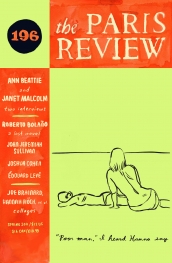
Two years ago, a typed manuscript for Roberto Bolaño’s unpublished novel The Third Reich The Third Reich was discovered. The Paris Review is serializing the novel, publishing it in full over four issues in a translation by Natasha Wimmer. I finished the first part of The Third Reich last night, reading the 63 pages in one engrossing session.

Udo Berger, a German from Stuttgart with a passion for war games, narrates the story in the form of a journal he keeps, detailing the daily events of a vacation he is taking in a Spanish resort town with his girlfriend Ingeborg. The couple checks in to the Del Mar, a seaside hotel where Udo spent a few teenage summers with his family. He seems driven to return to this particular hotel, at least in part, by memories of the enigmatic Frau Else, an alluring German woman who married the hotel’s Spanish owner. Frau Else barely remembers Udo, a fact that disappoints him, yet he nevertheless pursues strange awkward conversations with her; it’s unclear to both Udo and the reader what, exactly, he hopes to gain from talking to her.

Indeed, Udo’s intentions and motivations are strange and murky in general. He’s the classic unreliable narrator. In particular, Udo’s perceptions (and descriptions of those perceptions) seem to be clouded by a radical fear of otherness, and an underlying contempt for almost everyone. He’s also a little paranoid, perhaps, in part anyway, because we get the sense that Ingeborg might be just a bit out of his league. Consider the following scene—

Ingeborg was at her most radiant, and when we walked into the club we were greeted with covert admiring glances. Admiring of Ingeborg and envious of me. Envy is something I always pick up on right away. Anyways, we didn’t plan to spend much time there. And yet as fate would have it, before long a German couple sat down at our table.

That German couple is Hanna and Charly, and Udo quickly comes to detest them, although he repeatedly points out that he covers his disgust at all times (and, by the end of Part I, it’s clear that he has an unvoiced sexual attraction to Hanna). Charly is boorish, foolhardy, and quick to make friends with the locals. Through him, the Germans become acquainted with two locals Udo dubs the Wolf and the Lamb. The Wolf and the Lamb take the four tourists to the kind of working class haunts that only locals go to; Charly and the girls find adventure in this, but Udo is contemptuous and disgusted of these clubs, bars, and restaurants. His depictions of the local spots veer into classic Bolaño territory, that mix of unnerving dread and surreal energy, a kind of Lynchian anxiety that suggests abyssal darkness looms under the veneer of every “normal” surface.

Udo would rather stay in the hotel and work on his war game; he’s devoted the summer to playing out a new strategy and writing an essay about it for one of the various magazines devoted to the hobby. Ingeborg is embarrassed and ashamed of Udo’s passion for games, and when Hanna shows interest in the large hexagonal board set up in their room, Ingeborg quickly rushes her out to the beach. Udo, for the first time realizes this division in his relationship with Ingeborg, who spends her time on various daytrips (perhaps, although Udo doesn’t seem to recognize this, with the Wolf and the Lamb)—yet he fecklessly makes amends by buying cheap gift store jewelery, and avers that losing Ingeborg would destroy him. A dark set up.

The only person apart from Frau Else who Udo takes any interest in is El Quemado (“the Burned One”), a horribly burn-scarred, well-muscled man who makes a living renting paddle boats to tourists. Udo becomes obsessed with El Quemado when he realizes that the man seems to build a shelter out of the paddle boats each night; over time, he strikes up a strange friendship, leading to the revelation that they share a trait: both consider themselves writers.

The Third Reich, composed at the beginning of Bolaño’s career as a novelist, doesn’t feature the labyrinthine syntax or heteroglossia of later works, but it does showcase the particularly Bolañonian sense of dread that seethes under so many of his works. The novel feels like a slow burn, with plenty of sinister elements in play—but there’s also the possibility that this nervous dread stems from Udo’s internal paranoia. In any case, Bolaño is beginning to play with the tropes of the detective novels and crime fiction he loved so much. As I argued in my review of Amulet last month, the more one reads Bolaño, the more difficult it is to parse his fictions from each other. Instead, they seem part of the Bolañoverse, a dark visceral inversion of our own world. Thus The Third Reich strongly recalls the title story in the collection Last Evenings on Earth, where the narrator B and his father take a bizarre, sinister vacation in Acapulco. The Third Reich also obviously recalls Nazi Literature in the Americas, which featured an entire chapter on neo-Nazi boardgames.

Of course, my observations are only drawn from the first fourth of the novel, but as a Bolaño fan I was not disappointed. I just wanted more—but I guess I’ll have to wait for the summer issue.

First Love and Other Sorrows — Harold Brodkey

One way to measure how great a work of literature is might be to ask how true (or “True,” if one is feeling particularly romantic) the writing is. We can find facts anywhere, but details and data are not the same as art. Great literature happens in the arrangement of that data, by presenting details with the right ear and eye for truth—and also, the good sense to know what to withhold from the audience, who, after all, are a part of the equation. The stories collected in Harold Brodkey’s First Love and Other Sorrows, both inspiriting and crushing, are some of the most psychologically true pieces of fiction I’ve ever read.

First Love collects nine stories, all composed and published in the 1950s; all but one was originally published in The New Yorker. Although discrete entities, the stories function together. First Love is very much a novel-in-stories, with recurring characters, themes, and motifs. Brodkey’s stories document the strange little bubble of time between WWII and the turmoil of the sixties, and his writing, a kind of late modernism, reflects this period, when the ideal of the American Dream began to be redefined in terms of new modes of class and education.

The first few stories in the collection are told from the first-person perspective of an adolescent, likely an iteration of Brodkey himself. Opener “State of Grace” serves as an overture to the collection, introducing a family that will be transposed throughout the tales. There’s the narrator, a sensitive, awkward boy, beginning to feel strains of alienation from his older sister and his mother. Dad is out of the picture, and with him, the family’s fortunes have fallen: big sis is expected to marry the right man for money—and for class.

These themes are explored in greater length in the very-long short story “First Love and Other Sorrows,” a compact little novella, really, that everyone should read at some point. The narrator, likely the same boy from the first story, describes his life at the end of his high school career in St. Louis, as he prepares to move on to college soon. Again, the major explicit conflict of the story revolves around his sister’s romances, as their mother pressures her to marry the right man. The real conflict though is the boy’s emerging realization of his own dramatic detachment from his family; or, more accurately, the young man is coming to realize the underlying instability that adults tend to hide from children. The boy observes his older sister, whom he reveres—

It occurred to me that she didn’t really know what she was doing; she was not really as sure of everything as she seemed. It was a painfully difficult thought to arrive at, and it clung to me. Why hadn’t I realized it before? Also, she sort of hated me, it seemed to me. I had never noticed that before, either. How could I have been so wrong, I wondered. Knowing how wrong I had been about this, I felt that no idea I had ever had was safe. For instance, we were not necessarily a happy family, with the most wonderful destinies for my sister and me. We might make mistakes and choose wrong. Unhappiness was real. It was even likely…

The narrator’s epiphany is articulate and crushing and wholly real: it documents the ugly realization that the fantasies of a middle class childhood — “happily ever after” — are, indeed, mere fantasies. Brodkey twins this moment in another epiphany at the end of the story that I would love to discuss but fear spoiling; suffice to say that the final line of the story, forever etched in my brain, is simply one of the finest and most fitting moments I’ve ever read.

The next story, “The Quarrel,” finds our young hero, a bit more jaded, off to Harvard, where he falls in with a bitter rich kid named Duncan; they quickly make it their business to despise everything, adopting (unearned) world-weary poses and contrarian natures. Against the advice of their families, the two take a semester off college to tour Europe, spending much of their time bicycling across France. The story documents the kind of friendships that many young people emerging from adolescence engage in: fierce, passionate, identity-defining relationships that always buckle under their own weight. Hence—

Duncan enjoyed Pernod. It made me sick. Duncan hated talking to people. I talked to everyone. My French vocabulary was better than Duncan’s. His pronunciation was better than mine. I became terribly adept at not irritating Duncan before breakfast. I couldn’t see that he appreciated any of this, or that he responded with any similar awareness. For the fiftieth time, I thought him unfair. The moment came when I could no longer stand the sound of his voice, or his ideas. After traveling with him day and night, without a break, for fifty-three days, I felt my senses suffocating in an awareness of Duncan.

“The Quarrel” perfectly captures the strange paradoxes of youthful, immature friendships that can’t survive; reading it forced me to remember myself at eighteen, and to recall a friendship similar to that between the narrator and Duncan, an intense friendship that burned out bitterly and quickly, yet nevertheless helped me to define myself.

“The Quarrel” is the last story in the collection written in first-person perspective; indeed, Brodkey’s narrative shift signals a shift in development; as his characters age (as they do through the collection), he allows himself to step outside of them a bit, as if the psychological pain he explores is almost too much to bear. “Sentimental Education” tells the story of an intense first love (the male lead seems like another iteration of the narrator from the first three stories). In a free indirect style, Brodkey glamorizes, valorizes, and satirizes the young lovers, all at once, exploring the passion and shame and confusion of early adulthood. Here, he describes what happens when the pair begin a sexual relationship—

Their first dip in sensual waters left them nonplussed. They didn’t know what to make of it. They tried to persuade themselves that something had really happened, but the minute it was over, they couldn’t believe they had ever done such a thing. They rushed into further experiences; they broke off in the middle of embraces and looked at each other, stunned and delighted. “Is this really happening?” they both asked at different times, and each time the other said, “No,” and they would laugh. They knew that nothing they did was real, was actual. They had received a blow on the head and were prey to erotic imaginings, that was all. But at the same time they half realized it was true, they were doing these things, and then the fact that they, Caroline and Elgin, shared such intimacy dazed and fascinated them; and when they were together, they tried to conceal it, but this indescribable attraction they felt for each other kept making itself known and draining all the strength from their bodies.

“Sentimental Education” retraces the fallout explored in “The Quarrel,” as the young lovers inevitably fall apart.

After this love story, Brodkey shifts his attention to a character named Laura (or, in one version, “Laurie”), who seems to be a version of the narrator’s sister from the first few stories. The five Laura stories are much shorter than the other narratives. These tightly detailed miniature portraits trace the development of Laura as she chooses the man her mother didn’t approve of; this plot is very much in the background of the stories, though, an implicit detail that nevertheless hangs over Laura’s psychological development. The Laura stories seem to trace what it means to grow old but not mature. They recall the narrator in “First Love and Other Stories” epiphany that adulthood might be a murky or unhappy place. “Laura” documents postpartum depression and “Trio for Three Gentle Voices” subtly explores the ways in which parents seek to avoid repeating their own parents’ mistakes. “Piping Down the Valley’s Wild” is a simple, elegant story about Laura’s husband’s college roommate coming over for dinner. Reading it, I experienced an uncanny transposition, as if I were observing a reinterpretation of something I experienced a few weekends ago. The story ends with another sad epiphany—

She just wanted this day to go on forever and ever, unending, with all its joys intact, and no one changing, nothing new happening, just these same things occurring over and over. Because how did you know happiness would come back? Or if it came back, that it would be as good as this? Laura sighed and wiped her eyes surreptitiously. The trouble with being happy was that it made you frightened.

This realization again encodes the paradox of adulthood, pointing toward its radical instability. To grow up, in Brodkey’s terms (terms I again point out strike me as utterly true) is to face irretrievable loss at every single moment, even as you gain new friends, new lovers, or new children. The joys of life are predicated on the necessary loss of these joys: existence costs.

First Love and Other Sorrows is a book that deserves more attention. In its spirit and art, it matches (and perhaps surpasses) other mid-century American narratives like The Catcher in the Rye or The Glass Menagerie, and in its spare, precise, minimal style, it points toward the later fiction of writers like Raymond Carver. This is a beautiful, sad book, the kind that leaves a deep impression. Very highly recommended.

Orlando — Virginia Woolf

The plot of Virginia Woolf’s novel Orlando hangs on two key conceits: the title character transforms from male to female; the title character is immortal. Orlando has been a staple of gender studies courses since before such courses existed, and is in many ways the pioneer text (or one of the pioneer texts) of an entire genre. And that’s great and all—there are plenty of stunning passages where Woolf has her character explore what it means to be a man and what it means to be a woman and how power and identity and all that good stuff fits in—but what I enjoyed most about Orlando was its rambling, satirical structure.
Orlando functions like an inverted picaresque, detailing the adventures of an aristocrat who finds him- (and then her-) self flung into every sort of damn predicament: Elizabethan intrigues; ice-skating during the Great Frost; a dalliance with a Russian princess; an attempt at artistic patronage; an attempt at art; an ambassadorship in Constantinople; an encounter with the Fates (I suspect); time with a band of gypsies; time with Alexander Pope; a marriage to the great sea captain Marmaduke Bonthrop Shelmerdine; and, finally (if that adverb might apply to an apparent immortal), the publication of her great small work The Oak Tree. Sorry to laundry-list plot points, but, gosh, don’t you want to read this now—or at least listen to the audiobook, like I did?

Woolf seems to be channeling Voltaire’s Candide at all times, subtly ridiculing era after era, until Orlando finally emerges into Woolf’s (Modernist) present—it’s the fuzziest moment of the novel for our protagonist, as if she, or the author operating behind her, cannot parse out the post-industrial landscape. It’s also the moment at which Woolf’s prose becomes its most fluid and free—its most Woolfian, I suppose.

I thoroughly enjoyed Clare Higgins’s smart, confident reading of this unabridged production (BBC/Chivers). At not quite nine hours long, it’s a great way to spend a few afternoons of chores or gardening, or perhaps a week’s commute. It made me fish out Mrs. Dalloway, which I haven’t read since my undergrad days, and shove it into a “to read” stack. It also prompted me to revisit Sally Potter’s admirable 1992 film adaptation starring Tilda Swinton, whose very being seems like call and cause enough for an Orlando movie. I recommend both the audiobook and the film. Great stuff.

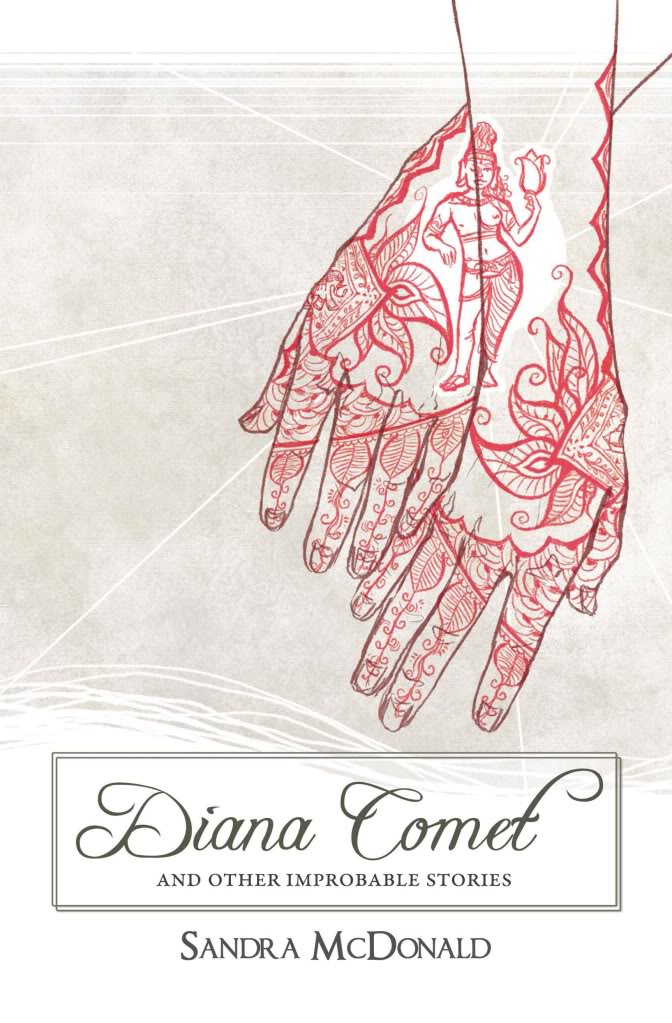
Diana Comet and Other Improbable Stories — Sandra McDonald

Fantasy gets a bad rap. While science-fiction has enjoyed something of a restoration of sanctified hipness in recent years, thanks in part to the genre-bending efforts of authors like David Foster Wallace and Jonathan Lethem, as well as a reappraisal of the works of authors like Philip K. Dick and Margaret Atwood, novels that find themselves classified in the fantasy genre can often be outright dismissed as having no artistic or literary merit. Amazingly, even the work of king daddy J.R.R. Tolkien still finds itself in need of critical defense from time to time. And while fantasy certainly has more than its fair share of rote genre exercises, including countless copycat cash-ins, it’s also an imaginative space buzzing with invention and the capacity for social commentary. Sandra McDonald’s Diana Comet and Other Improbable Stories exemplifies the best kind of invention and social commentary that we might expect from post-modern fantasy.

Diana Comet collects fifteen stories connected via shared motifs, characters, and settings. McDonald crafts a world that inverts or displaces our own. This world, with its lands like New Dalli and Massasoit, is slightly decentered from our own: we find familiar iterations of our history here—there’s war and imperialism, colonialism and poverty, homophobia and racism—but the idioms are all slightly off, displaced enough be paradoxically familiar and alienating at the same time. “Diana Comet and the Lovesick Cowboy,” for instance, seems set in a 19th-century American milieu amidst a civil war (there’s even a poet named Whit Waltman), yet the transposition, articulate as it is, is also nebulous, disturbing even. McDonald’s spare distortion forces the reader to reconsider his own notions of cultural history, and she does this to great effect, whether taking on gender ideologies (“Diana Comet and the Disappearing Lover”), homophobia (“The Fireman’s Fairy”), or racism (“Fay and the Goddesses”). None of these issues are presented glibly, didactically, or clumsily; indeed, it’s through the slightest distortions of fantastic imagination that the reader must re-examine his own society through McDonald’s reflective lens. Most of the stories end with enumerated discussion questions, often silly or whimsical, that serve to puncture the seriousness of the tales; they sometimes force details from our “real” world into the texts of Diana Comet in a way that’s doubly disconcerting. It’s a meta-textual gambit that pays off, however, both in belying any self-seriousness to the narrative proper as well as establishing a thin membrane between fantasy and reality—a membrane of questions that allows the reader to “play,” to disrupt that boundary through his or her own imagination.

McDonald’s world-building in Diana Comet never comes at the expense of good storytelling. With a few exceptions, most of the stories here piece together the frame of a world, leaving the reader’s imagination to fill in most of the gaps. Most of the stories seem to take place in an iteration of the nineteenth century, but some to be set earlier, later, and even in a displaced future, like “Kingdom Coming,” a playful apocalypse tale. McDonald’s expositive restraint does wonders; too many writers of inventive fiction feel the need to tell the reader every single detail and nuance of their worlds. I think here of Ursula K. LeGuin’s marvelous novel The Left Hand of Darkness, a book toward which I believe Diana Comet bears considerable comparison, particularly with respect to the exploration of how gender and sexuality functions in a society. While LeGuin’s book is terrific and fully-realized, she spends a bit too much narrative energy transmitting every detail of that realization to her audience. Diana Comet is rewarding in its gaps and mysteries, as well as its ability to evoke a sense of the uncanny in its reader. Oh, I should probably add that McDonald can write; her prose is elegant, lively, wry, and spare.

Diana Comet is a smart, thoughtful post-modern fantasy that may appeal to the kids out there who have outgrown the narrative simplicity of Harry Potter and are looking for a challenge; it will undoubtedly appeal to fans of writers like LeGuin and Atwood, writers who know how to channel narrative traditional tropes of imaginative fiction through distortion and ambiguity and force their readers to think, even as they entertain. Recommended.

Charlie Chaplin’s Overlooked Masterpiece, Monsieur Verdoux

Charlie Chaplin’s 1947 film Monsieur Verdoux is rarely mentioned alongside his early classics like The Great Dictator, Modern Times, or City Lights, which is a shame, because it’s easily one of his funniest. Perhaps that’s because it’s one of his rare speaking roles, although that’s hard to believe—Chaplin is just as funny when he opens his mouth as when he’s cutting physical capers. I suspect that the movie is just too dark for some folks. It is, after all, a black comic take on the Bluebeard story, and I guess the story of a man who marries and then murders his wives as a form of careerism might not hold a general appeal. In any case, it’s hilarious. Here’s a compilation of clips that show off Verdoux’s seduction technique; these are some of the funnier moments in the film—

Monsieur Verdoux is hardly a romantic comedy though. Observed closely, it works as an allegorical commentary on the moral response to the horrors of WWII. These observations are made plain at the end of the film, as Verdoux, put on trial, must first account for his crimes—and then pay for them. Here is the extraordinary final scene of the movie, which contains spoilers, although I believe that one can still watch the ending out of context and later enjoy the film—

We see here the major hallmarks of Chaplin’s greatest films: not just comedy, but also genuine pathos and social commentary, all delivered with acerbic bite that nevertheless reveals a real love for humanity. Highly recommended.

Melville House Publishes Imre Kertész’s “Missing” Novel, Fiasco

Melville House has just published Imre Kertész’s Fiasco, available for the first time in English translation (Tim Wilkinson). Fiasco is the final part of a trilogy, along with Fatelessness and Kaddish for an Unborn Child, that tells the story of the author’s time in the Auschwitz and Bunchenwald concentration camps, and his eventual return to an alien home. When I interviewed Melville House publisher Dennis Loy Johnson last year, he was enthusiastic about the book—

We’re doing another one with Kertész next year, which is a big novel called Fiasco. He wrote a trilogy years ago about his experience in the camps. What was he, fifteen or something, when he was sent to Auschwitz-Birkenau, working in a Nazi factory trying to turn coal into gasoline? And he wrote a novel called Fatelessness about that and another one called Kaddish for an Unborn Child. And Knopf published Kaddish and Fatelessness but they never published Fiasco. So we’re really excited about that.

I haven’t read Fatelessness or Kaddish, but I very much enjoyed Kertész’s novella The Union Jack, and I’ve been enjoying Fiasco as well so far. It’s a strange novel, beginning with a 100 page prologue of sorts detailing “the old boy” (surely Kertész) riffling through a cabinet full of old sketches, half-formed ideas, and old papers in the hopes of generating a new novel, a novel that will save his name from sinking into oblivion—a fate he wishes to avoid for (apparently) purely monetary reasons. This prologue is recursive, full of parenthetical asides, diversions, and a general Kafkaesque anxiety about the narrative proper, the Auschwitz story, I suppose, that I guess will begin with chapter one (on page 119!). Anyway, more to come.

David Foster Wallace, Slavoj Žižek, and Scatological Ideology

I came across this clip of Slavoj Žižek discussing the different types of toilets that one finds across Europe the other day, and his riff immediately reminded me of David Foster Wallace’s novella The Suffering Channel (or “The Suffering Channel,” if you prefer to think of it as a long short story). Here’s a version of the riff in English, which seems to approach a stand-up comedy routine at times—

“You go to the toilet and you sit on ideology,” says Žižek, arguing that “Disgust . . . is not necessarily, immediately characterized by its object” — disgust is when you confront something from your inside on your outside (Žižek is likely working in part from Julia Kristeva’s theory of the abject here). His inventory and analysis of the differences between French, English, and German toilets immediately recalled this passage from The Suffering Channel

She had also at some point spent a trimester at Cambridge, and still spoke with a slight British accent, and asked generally now whether anyone else who traveled abroad much had noticed that in German toilets  the hole into which the poop is supposed to disappear when you flush is positioned way in front, so that the poop just sort of lies there in full view and there’s almost no way you can avoid looking at it when you get up and turn around to flush. Which she observed was so almost stereotypically German, almost as if you were supposed to study and analyze your poop and make sure it passed muster before you flushed it down

Of course, pretty much every page of The Suffering Channel concerns the scatological: it is literally about a man who shits out art. Wallace seems to be exploring the ways in which we are unable to reconcile what is inside us — that is, what makes us us — with its final form. For Kristeva, the ultimate abject is the corpse. Žižek, less mordant perhaps, seems to be signalling (in the short clip anyway) the relatively straightforward idea that ideology is always operating, always a force conditioning our identity.

Near the end of the clip (around 5:25 or so), Žižek brings up the example of saliva, pointing out that we are constantly swallowing it, producing it and absorbing it back into ourselves, yet to fill a glass with it and then try to drink it would be revolting, horrific. Compare this with another passage from The Suffering Channel

‘Your own saliva,’ said Laurel Manderley. ‘You’re swallowing it all the time. Is it disgusting to you? No. But now imagine gradually filling up a juice glass or something with your own saliva, and then drinking it all down.’

‘That really is disgusting,’ the editorial intern admitted.

‘But why? When it’s in your mouth it’s not gross, but the minute it’s outside of your mouth and you consider putting it back in, it becomes gross.’

‘Are you suggesting it’s somehow the same thing with poo?’

‘I don’t know. I don’t think so. I think with poo, it’s more like as long as it’s inside us we don’t think about it. In a way, poo only becomes poo when it’s excreted. Until then, it’s more like a part of you, like your inner organs.’

‘It’s maybe the same way we don’t think about our organs, our livers and intestines. They’re inside all of us —‘

‘They are us. Who can live without intestines?’

‘But we still don’t want to see them. If we see them, they’re automatically disgusting.’

Wallce lards his novella with example after example of this kind, of the ways in which abject encounters with the borders of self — shit, saliva, menstrual blood, farts — confer identity through a kind of ritual shame. I doubt that Wallace is following, overtly anyway, any post-Lacanian figures in The Suffering Channel, and the concordance of examples used by Wallace and Žižek is probably ultimately not that remarkable. What I do find worth remarking upon, I suppose, are the ways in which Wallace and Žižek were/are so adept at discussing those areas of humanity we’re often happy to overlook.

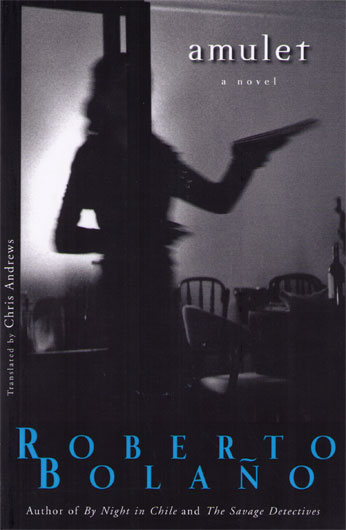
Amulet — Roberto Bolaño

When one takes on the project of reading the novels of Roberto Bolaño — and 2666 is the sort of beast that is likely to hook a reader into such an endeavor — it becomes increasingly impossible to separate and compartmentalize his fictions. Instead, the reader becomes ever more entangled in a labyrinthine Bolañoverse, a chilling, dreadful mirror-maze world that discharges its echoes across continents and epochs. In a fascinating essay at The Quarterly Conversation, Javier Moreno attempts to map out this world. I’d read the essay (and commented on it) a few years ago, but I revisited it after finishing Amulet, mostly because I was pretty sure Moreno had already succinctly stated a key idea that I wanted to bring up in my review. He writes—

Amuleto, which tells the story of an Uruguayan poet that claims herself to be the mother of all Mexican writers, may be seen both as an extra chapter to Los Detectives or as a short introduction to 2666—or both at the same time.

Readers of 2666 and The Savage Detectives will find in Amulet a channel between Bolaño’s “big books,” just as Nazi Literature in the Americas serves as a strange, ironic connective tissue for the violence and chaos of the rest of Bolañoverse. Amulet is narrated by Auxilio Lacouture, and her story appears in a much shorter form in The Savage Detectives. I’ll let her summarize Amulet’s plot (such that it is)—

I am the mother of Mexico’s poets. I am the only one who held out in the university in 1968, when the riot police and the army came in. I stayed there on my own in the Faculty, shut up in the a bathroom, with no food, for more than ten days, for more than fifteen days, from the eighteenth to the thirtieth of September, I think, I’m not sure anymore.

I stayed there with a book by Pedro Garfias and my satchel, wearing a little white blouse and a pleated sky-blue skirt, and I had more than enough times to think things over. But couldn’t think about Arturo Belano , because I hadn’t met him yet.

In these two short paragraphs, late in the book, we get so many of the motifs that populate Bolaño’s world: the self-naming poet, the influence of violence in Latin America, the horrors inherent in resisting this violence, exile, hints of madness. We even get Bolaño’s elusive alter-ego, Arturo Belano, who floats through Amulet and the rest of the Bolañoverse like an unknowable specter.

The fact that Auxilio couldn’t think about Belano when she was stuck in the bathroom in 1968 does not actually stop her from doing so. She is, to borrow a phrase from Vonnegut, a woman unstuck in time. It is as if the entire novel, that is to say her narrative, her telling of her story, is tenuously anchored in the those traumatic days of September, 1968. She tells us, echoing Stephen Dedalus perhaps, that “History is a horror story”; unlike Dedalus, she can’t awake from the nightmare. Here’s a relatively early passage that describes what Auxilio can never really explain—

I don’t know why I remember that afternoon. That afternoon of 1971 or 1972. And the strangest thing is that I remember it prospectively, from 1968. From my watchtower, my bloody subway carriage, from my gigantic rainy day. From the women’s bathroom on the fourth floor of the Faculty of Philosophy and Literature, the timeship from which I can observe the entire life and times of Auxilio Lacouture, such as they are.

The life and times of Auxilio Lacouture, such as they are, will be somewhat familiar to anyone who’s read some of Bolaño’s other novels: plenty of dread, lots of sinister shadows, and many, many drunk poets. The anecdotes and small set pieces that fill Amulet seem culled from Bolaño’s own life (real or imagined), and can be alternately thrilling, dull, or even maddening. For my taste, the novel works itself into its finest moments when Auxilio’s grip on reality — both temporal and spacial — is at its weakest. At one point she tells us—

I don’t know if I’m in 1968 or 1974 or 1980, gliding, finally, like the shadow of a sunken ship, toward the blessed year 2000, which I shall not live to see.

Auxilio’s sanity both unravels and compresses, and Bolaño codes these movements in images of descent and ascension. Auxilio moves through fever dreams and nightmares, memories and prognostications, alternate realities and astral projections. Near the end of the novel, still in the bathroom, starving, probably in shock, she experiences her ordeal as a difficult climb up a frozen mountain. Along the way, she begins casting bizarre literary prophecies. A quick taste—

Virginia Woolf shall be reincarnated as an Argentinian fiction writer in the year 2076. Louis-Ferdinand Celine shall enter Purgatory in the year 2094. Paul Eluard shall appeal to the masses in the year 2101.

These pronouncements continue for a few pages. Underneath the madness, one can sense Bolaño’s goofy joy, but there’s more here than just list-making: Auxilio is pointing toward metempsychosis, suggesting her own soul’s migration, perhaps—here we find a way in which literature might transcend the violence and horror of history. And yet there’s also a sense of doom, of repeated violence and exile. Late in the novel Auxilio finds herself cast in the role of Erigone, daughter Aegisthus and Clytemnestra, forced from home by her half-brother, Orestes. There’s a sense that tragedy capitulates throughout time; that even if Auxilio can survive the army’s occupation, it will nevertheless scar her forever. Cycles of violence are bound to recur indefinitely.

This recurrence evinces in what might be the book’s most famous passage. Auxilio is walking home with some friends—

Then we walked down the Avenida Guerrero; they weren’t stepping so lightly any more, and I wasn’t feeling too enthusiastic either. Guerrero, at that time of night, is more like a cemetery than an avenue, not a cemetery in 1974 or in 1968, or 1975, but a cemetery in the year 2666, a forgotten cemetery under the eyelid of a corpse or an unborn child, bathed in the dispassionate fluids of an eye that tried so hard to forget one particular thing that it ended up forgetting everything else.

The passage names Bolaño’s opus: there is no mention of “2666” in 2666. The reference rests outside the book; or, perhaps Bolaño demands that we read his books intertextually. In any case, 2666 has its graveyards and its corpses, its own demanding geometry of memory. One gets the sense that this oblique reference to “2666” is really part of Bolaño crafting his own canon, an internal canon of the Bolañoverse, almost as if he were J.R.R. Tolkien or even Philip K. Dick. I think again of Auxilio’s prophecies, of her list of writers who will be reborn or forgotten, where we find Bolaño securing a historical place for the writers he loves and values.

Looking over this review, I realize that it might not be helpful for readers new to Bolaño: mea culpa. Amulet is a very fine novel, but not the right starting point. That would be 2666 or, if that prospect is too daunting, Last Evenings on Earth. To me, Amulet reads like the “Mexico” chapter in a trilogy about violence and exile in Latin America; the other two parts would be Distant Star (which I enjoyed more) and By Night in Chile. But perhaps I’m simply reaching for evidence to support this idea that Bolaño’s books are best read together. I’m sure that one can enjoy them on their own—only, at this point, I’m not sure how to do that.

Amulet, translated by Chris Andrews, is available now from New Directions.

How to Stop Living and Start Worrying — Simon Critchley

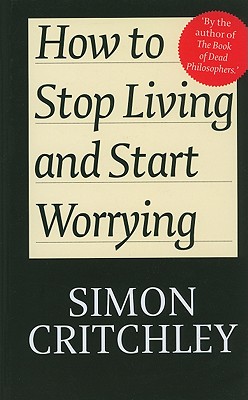
Simon Critchley’s latest book How to Stop Living and Start Worrying picks up where his last work, The Book of Dead Philosophers, left off. Both works explore what Critchley contends to be the signal problem of all philosophy; namely, how one might live a meaningful life against the backdrop of inevitable death. In Dead Philosophers, Critchley plumbed this question by surveying the deaths of dozens of famous philosophers, ultimately affirming a positive reality in death (both our own deaths and the deaths of others), and arguing that philosophies (and religions) that advocate the idea of a spiritual afterlife ultimately negatively disrupt human existence and lead to inauthentic lives. How to Stop Living reiterates these themes in a new form, essentially arguing that in asking “how to live,” we must also ask “how to die” — and also how to love and how to laugh. How to Stop Living takes form as a series of conversations between Critchley and Carl Cederström, an Associate Professor at the Institute of Economic Research at Lund University in Sweden. There’s a warm rapport between the pair, and although Critchley does most of the talking, there’s a genuine dialog in play, not merely a flat interview. The book unfolds over six chapters. The first, “Life,” is a discussion of, well, Critchley’s life, both personal and academic. I originally thought I’d be doing a lot of skimming here, but it’s actually kind of fascinating; more importantly, though, it establishes Critchley’s contention that a philosopher’s work cannot be divorced from his biography. To philosophize is to live. This idea is reiterated succinctly at the beginning of the second chapter, “Philosophy,” when Critchley states—

The first thing to say is that philosophy is not a solely professional or academic activity for me. Philosophy is not a thing, it’s not an entity; it’s an activity. To put it tautologically: philosophy is the activity of philosophizing, an activity which is conducted by finite, thinking creatures like us. Now, my general view of philosophy is that this activity must for part of the life of a culture. Philosophy is the living activity of critical reflection in a specific context; it always has a radically local character.

What follows in “Philosophy” is a somewhat discursive overview of the philosophers who will pop up again and again in the book: Heidegger, Husserl, Kant, Nietzsche, and, of course, Derrida. While I’m laundry listing, I might as well add Freud, Lacan, Beckett, and Hegel as key figures in How to Stop Living. In the third chapter, “Death,” Critchley discusses how many of these philosophers frame a subject’s individual relationship to his or her personal death. In a particularly enlightening passage, Critchley explains Heidegger’s “possibility of impossibility,” the idea that to be authentic, to lead an authentic life, one must internalize and master the finitude of a personal death. The chapter continues, working through other conceptions of death, including those of Freud, Beckett, and Derrida. Perhaps because of its dialogic structure, How to Stop Living often feels like a rap session, a big brainstorm, a work in process, and nowhere is this more evident in a chapter called “Love,” where Critchley moves from Hannah Arendt to The Song of Solomon to Lacan and Freud to a story about his marriage proposal. It’s all a bit messy, a bit watery, a bit undefined, and therefore difficult to summarize, so I’ll let Critchley dish on love in his own words—

Love is the attempt to break the logic of masochism that defines the subject, and to behave in a different way. That’s something that has to be wound up everyday . . . and it’s something with no end; and it requires a constant experience of faith. That’s the only sense I can make of love.

The next section, “Humour,” is better defined—and one of the highlights of the book. Critchley discusses jokes against a backdrop of psychoanalysis and anthropology, ultimately arguing that humor has the power to disrupt an individual’s relation to time or place, and thus reconstitute that relation in some meaningful way. Critchley’s book itself is indeed a meta-joke, a play against the sophistry of New Age self-help books. Indeed, the very name of the book is an inversion of Dale Carnegie’s 1948 “classic” of the genre, How to Stop Worrying and Start Living. If you find the cover of Critchley’s book as off-putting and cheesy as I do, just remind yourself that it’s a parody of Carnegie’s cover. And yet Critchley’s sense of humor is not ultimately black irony, but rather a humor of affirmation of — and confrontation of — the absurdity of contemporary life. It’s not irony but authenticity he wants. “Authenticity” is thus the final chapter of this relatively short book, and here Critchley invites his friend (and partner in the International Necronautical Society) novelist Tom McCarthy to participate in the conversation. The chapter is lively, almost frenetic, and frankly all over the place, as Critchley and McCarthy rocket from subject to subject — Finnegans Wake, the Challenger explosion, Terrence Malick, J.G. Ballard, Levinas, A Midsummer Night’s Dream, McCarthy’s first novel Remainder — each reference seems to slip into the next, reined in occasionally by Cederström, who steers the conversation back to its center (leave it to deconstructionists to get off center). Good stuff.

How to Stop Living and Start Worrying, despite its tongue in cheek title and cover, and its discursive flow, is serious (if playful) about philosophy. Those interested in the thinkers and topics I’ve mentioned in this review may be interested, but it’s not necessary for one to have a working knowledge of Continental philosophy to enjoy Critchley’s latest. Recommended.

How to Stop Living and Start Worrying is available now from Polity Books.

Biblioklept Interviews Camelia Elias, Editor-in-Chief of EyeCorner Press

Camelia Elias is the founder and editor-in-chief of EyeCorner Press, an independent publisher devoted to printing a host of difficult-to-classify writings, including creative academic writing, and poetic fragments and aphorisms. EyeCorner publishes works in English, Danish, and Romanian, as well as bilingual editions. This multilingual approach gels with the publishing house’s fragmentary philosophy, as well as its origins as a collaborative venture between universities in three nations. In addition to her editorial duties, Elias is also one of EyeCorner’s authors; her latest work Pulverizing Portraits is a monograph on the poetry of Lynn Emanuel. Elias is Associate Professor of American Studies at Roskilde University in Denmark and she blogs at FRAG/MENTS. Elias was kind enough to talk with me over a series of emails; in our discussion she defines creative criticism, discusses the value in being open to error, accounts for hostility against deconstruction and post-structuralism in academia, and explains why it doesn’t hurt to throw the word “fuck” into a textbook now and then.

Camelia Elias

Biblioklept: EyeCorner Press is somewhat unusual, even for an indie publisher — a joint venture between universities in Denmark, Finland, and the US that focuses on creative criticism. How did the press come into being?

Camelia Elias: The press came into being as an act of anarchism, if you like, a form of resistance against the idea that academic work must be measured not only against its own standard, but also against the standard that idiotic governments sets for measuring, and hence controlling, intelligence, creativity, and freedom. In 2007 I was editing new research papers written by colleagues and associates of the Institute of Language and Culture at Aalborg University with view to publication by the Faculty of Humanities at AU. A new change in leadership also brought about a new set of ideas. These were rigidly formulated along the newly established injunction passed down by the Danish government, which dictated that all Danish academics must now prioritize publishing with Oxford and Harvard. Without getting into the silly and imbecilic arguments produced for the sustainability of such a demand in reality, the fact remains that many heads of department throughout our Danish universities tried to implement the new regulations literally. The good publishing folks at Aalborg were told that Research News (the publishing venue) was going to close, and no, as the justification for it ran, this was not because the papers were not good enough, but 1) because publishing new research under the aegis of the department was likely to have the undesirable effect of preventing the researchers from expanding their range of publishing possibilities – and hence not consider Oxford and Harvard – and 2) there will be no money for it anymore. Few of us tried to make obvious the stupidity pertaining to the first argument – bad idea, as bosses generally don’t want to be told that they have limited visions – and as to the second argument, pertaining to the precarious, or rather by then non-existent financial support, a few of us also tried to suggest that we could go ‘on demand’ and even work ‘con amore’ for it, which would involve no expenses. The answer was still no. So, there we were, with a few manuscripts in the pipeline and no possibility of getting them out. As the editor of these papers, I felt a responsibility not only towards the writers but also towards the readers who had bothered to peer-review the works. I decided to start EyeCorner Press in my own name, but retain the ties we had in terms of publishing jointly with a few other partner universities. With Brenau University in Gainesville, Georgia, we had just finalized a volume on transatlantic relations (aesthetics and politics) within Cultural Text Studies Series published by Aalborg University Press. We are happy to call them our close allies. University of Georgia, Gwinnett, and Oulu University in Finland followed suit and so did Roskilde University, which became my new working place not long after the Aalborg ‘situation’.

Continue reading “Biblioklept Interviews Camelia Elias, Editor-in-Chief of EyeCorner Press”

The Subject Steve — Sam Lipsyte

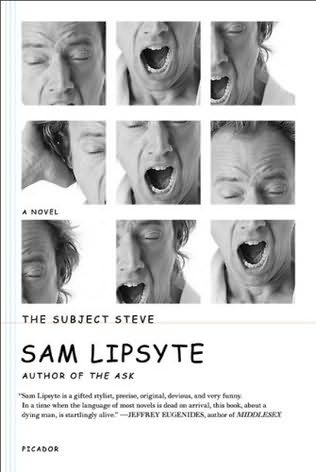
A few years ago, I wrote about cult novels, and, in trying to define them, I suggested that “a cult book is not (necessarily) a book about cults.”  Sam Lipsyte’s first novel The Subject Steve is a cult novel about a cult, or at least heavily features a cult. Like many cult novels, there’s an apocalyptic scope to Steve, one in this particular case (or subject, if you will), that extends from the personal to the universal.

I’ll let Lipsyte’s compressed acerbic prose spell out the book’s central conflict—

The bad news was bad. I was dying of something nobody had ever died of before. I was dying of something nobody had ever died of before. I was dying of something absolutely, fantastically new. Strangely enough, I was in fine fettle. My heart was strong and my lungs were clean. My vitals were vital. Nothing was enveloping me or eating away at me or brandishing itself towards some violence in my brain. There weren’t any blocks or clots or seeps or leaks. My levels were good. My counts were good. All my numbers said my number wasn’t up.

The problem of death, or the problem of how to live a meaningful life against the specter of death, is of course an ancient conceit, and Lipsyte makes it the core of his book, upon which he hangs an often shaggy picaresque plot. The Subject Steve is post-modernist caustic satire in the good old vein of Candide; put another way, it’s just one damn thing happening after the next.

So, what are some of those things that happen? Steve (not his real name) is condemned to die of a disease with no name; he tries to make contact with his estranged wife and not-quite-a-genius daughter; he blows his life savings on hookers and blow; he heads upstate to a cult’s compound in the hopes of finding a cure to his unnamed (unnameable) disease; he suffers the cult’s sadistic practices; he escapes the cult’s sadistic practices; he reunites with his wife and daughter; he abandons his wife and daughter; he reunites with a new version of the cult somewhere in the Nevada desert; he becomes enslaved by the cult in the Nevada desert; he escapes the cult; &c. And he reflects on his life (and his death) repeatedly. I’ll let Steve reflect on his life at length, if for no other reason than to share more of Lipsyte’s marvelous prose—

And I was still dying, wasn’t I? Who would note? What had I ever noted? I’d taken my pleasures, of course, I’d eaten the foods of the world, drunk my wine, put this or that forbidden particulate in my nose until the room lit up like a festival town and all my friends, but just my friends, were seers. I’d seen the great cities, the great lakes, the oceans and the so-called seas, slept in soft beds and awakened to fresh juice and fluffy towels and terrific water pressure. I’d fucked in moonlight, sped through desolate interstate kingdoms of high broken beauty, met wise men, wise women, even a wise movie star. I’d lain on lawns that, cut, bore the scent of rare spice. I’d ridden dune buggies, foreign rails. I’d tasted forty-five kinds of coffee, not counting decaf.

I love this passage. In almost any other book I can think of, the final detail about coffee would puncture the passage’s inflation, serve as a comic anti-climax. In Lipsyte’s phrasing it’s both tragic and triumphant.

I don’t mean to gloss over the plot of The Subject Steve, but the book’s narrative, its sense of time, is so radically compressed (again, I think of the compression of Candide) that reading it is more like experiencing a rapid series of scenarios. I’m particularly fond of books like this, that seem to ramble and erupt in strange and unexpected moments. I think of Ellison’s Invisible Man or Woolf’s Orlando, but there’s also something of Aldous Huxley in Steve, that apocalyptic-comic axis, the satire of despair. The book is one of those pre-9/11 novels (forgive the phrase) that seems utterly prescient. Take the following observation for example—

Someday sectors of this city would make the most astonishing ruins. No pyramid or sacrificial ziggurat would compare to these insurance towers, convention domes. Unnerved, of course, or stoned enough, you always could see it, tomorrow’s ruins today, carcasses of steel teetered in a halt of death, half globes of granite buried like worlds under shards of street. Sometimes I pictured myself a futuristic sifter, some odd being bred for sexlessness, helmed in pulsing Lucite, stooping to examine an elevator panel, a perfectly preserved boutonniere.

The language here anticipates the Dead America that Lipsyte explores in his latest novel, The Ask, and reinforces a general argument I’d like to make, which is that Lipsyte is at heart a writer of dystopian fictions, fictions so contemporary that their dystopian nature becomes effaced.

These dystopian tropes coalesce in the frantic, hyperbolic ending of Steve, where our subject becomes the object of a bizarre cult’s ritual sadistic practices, all available via the panopticon of the internet. Lipsyte’s vision is of a post-human existence, a radical otherness of degradation through technological alienation. At this late moment in the book, the satire is so black that even Lipsyte’s tightest, pithiest sentences fail to elicit a laugh or a smile — indeed, I am almost certain that they are not intended to do so. Instead we are immersed in the apocalyptic horror of dehumanization (the book here reminded me of Hunter S. Thompson’s Fear and Loathing, of all things, both in its desert location and in its gradual movement from sardonic humor to vivid terror).

Like any cult novel, or destined cult novel, The Subject Steve is Not For Everyone. Those looking for plot development and tidy endings will not find them here, and, if the tone of this review has not already made it clear, the book is extremely dark. But it’s also very, very funny, and there are few stylists working today who can match Lipsyte’s mastery of the sentence. Highly recommended.

The Subject Steve is now available in trade paperback from Picador.

Home Land — Sam Lipsyte

[Editorial note: Biblioklept ran a version of this review last year; we run it again in the spirit of Sam Lipsyte Week].

In Sam Lipsyte’s 2004 novel Home Land, minor loser Lewis Miner sends missives to his high school alumni newsletter, Catamount Notes, about his awful, sad misadventures in small-time drug use, petty copy-writing, itinerant busboyism, and chronic masturbation (he has a strong erotic disposition toward leg warmer porn. If this idea repels you (with no reciprocal attraction) this book is not for you). Miner wants to be sweet but he can be mean. He’s obsessed with the past–and who can blame him? His nickname in high school was Teabag, an appellation literally thrust upon him by the dumbest of jock-bullies. He carries this kernel of spite for years like a pebble in the sock, one that rubs up a giant blister–Miner is all blister. Writing ostensibly to his former classmates, but really just for himself, another form of masturbation:

It’s always been this way, as many of you might recall. Somebody chucks a snowball, I’m scouring the school yard for rocks. The bully just wants to shove sadness around, shake me down for spare change, I’m looking to scrape out his eye. I lack a sense of proportion. I have no sensitivity to sport. I’m the aggrieved rider on the grievous plain. I’m still pissed about the parade.

For all his anger though, Miner is an engaging, preternaturally sensitive voice. Along with his best friend/foil Gary, he muddles through a wretched life, finding solace (and an outlet for an outsized comic voice) in his letters to Catamount Notes–even if disgraced Principal Fontana won’t publish them. Despite his censorious discretion, Fontana reignites a downright silly mentorship with Miner. Fontana, a man after Holden Caulfield’s heart who calls everyone a “phony,” plays a weird father-figure to our favorite loser (even though Lewis’s own “Daddy Miner” is an ever-present terror in this tragicomedy).

Fontana, Daddy Miner, and the other characters in Home Land often feel like props rather than fully-drawn beings. Take the aforementioned Gary, for example, flush with cash after suing the hypnotherapist who convinced him that his parents sexually abused him repeatedly as part of elaborate Satanic rituals. His ridiculous past is par for course in the book. Such characters are the stock-in-trade of Home Land; they are, paradoxically, both its strength and weakness, beings who seem to speak entirely in misplaced metaphors and fucked-up aphorisms. There are too many of them for the book’s 200 pages. The fast writing never sags under the huge cast, but, nonetheless, its spine, its plot, its quick rhythm can’t bear their weight. There’s a much bigger novel here, but I don’t think I’d want to read it. Even Lipsyte’s normals are grotesques–or maybe it’s just Miner’s bilious perspective. In any case, sympathy is in short supply in Catamount country.

None of this is meant to disparage the reading experience of Home Land, which is marvelous, quick, funny, and a little bit gross (in a good way). Lipsyte crafts his sentences with a concrete, witty excellence that is near unrivaled in contemporary lit. It’s true that he sacrifices the depth of his characters here from time to time, and then includes passages that add nothing to the plot as a whole, like this one:

An older shapely woman swerved past on rollerblades. Bronzed, undulant in black Lycra, she clutched a pack of menthol cigarettes, danced on her wheels to something pumped through headphones. It was an admirable kind of ecstasy, hard-won. I wanted her for a lewd aunt.

That last line, of course, tells us so much about Lewis Miner and is also indicative of his overall method of storytelling. Not that he sees his letters to his alumni newsletter as part of a larger narrative–indeed, he’s to be forgiven all his esoterica, his mean, incisive commentary on contemporary life that doesn’t add up. Halfway through the book he tells us:

It occurs to me, Catamounts, sitting here composing this latest update, that someday, if and when the collected works of Lewis Miner ever see the light of day, some futuristic editor-type might attempt to assemble these dispatches in a certain manner, to, for example, tell a story, or else effect some kind of thematic arrangement of interwoven leitmotifs: Work, Love, Masturbation, Gary.

This would be a mistake. There are no leitmotifs. There is no story.

Miner then goes on to makes a pretty convincing case against stories (or at least against narrative arcs) and, tellingly, Home Land is better as a series of ugly, gross, hilarious anecdotes than it is as a novel with a traditional character arc. Which it is–a novel with a traditional character arc, climax, all that good stuff. Strangely, this is the book’s biggest failure. But that failure doesn’t get in the way of what is a pretty great and often very funny reading experience. Miner’s voice is a pleasure to inhabit for a while, a postmodern Falstaff heavy on the self-loathing. Home Land is a quick, easy read, a novel destined for cult-status, and Lewis Miner’s pathetic ironic braggadocio will hit home for many folks. Recommended.

Home Land is available in trade paperback from Picador.


Venus Drive — Sam Lipsyte

[Editorial note: Biblioklept ran a version of this review last year; we run it again in the spirit of Sam Lipsyte Week].

The thirteen stories in Venus Drive compose a sort of novel-in-stories. The title of the collection takes its name from a banal suburban street mentioned in a few of the stories, and many of the characters seem like iterations of the same type or voice. There are washed up would-be indie rock stars, small-time coke peddlers, and underemployed and overeducated addicts. There are deviants and perverts and outsiders. There are bullies. There are dead or dying mothers, dead or dying sisters. In short, Venus Drive is its own tightly-drawn, tightly-coiled, and highly-compressed world.

As the plot points double and re-double in these stories, so do the themes. “Our culture is afraid of death, and considers it something we must wage battle against,” says Tessa, a pain specialist, a peripheral character in “Cremains.” She continues: “I say, surrender, submit. Go gentle. Terminal means terminal.” Death informs almost all of these stories in some way, and Tessa’s commentary presents the problem with death, or at least the problem these characters have with dealing with death: it’s not easy to go gentle. It goes against our culture and our nature to surrender. If she’s presented as a voice of wisdom, she’s also an ironic character, one of the many would-be authorities Lipsyte’s weirdos and outsiders can’t help but mock. “The Drury Girl,” part-suburban satire and pure pathos, posits a pre-pubescent narrator obsessed with his teenage babysitter; his dad’s cancer plays second fiddle to his lust. Thus the story neatly ties together the overarching themes of Venus Drive, sex and death. Admittedly, these are probably the only real themes of proper literature, but Lipsyte does it so damn well and lays it all out so bare and does so in such humor and grace that it really sticks. It’s good stuff.

That humor is desert-dry, of course, and succeeds so well because his characters are so endearing in their pathetic pathologies. The antiheroes of “Beautiful Game” and “My Life, for Promotional Use Only,” are also-rans in the sordid history of underground rock, addicts approaching washed-up (Are they the same person? Maybe. They have different names, of course. Doesn’t matter). A scene from “Beautiful Game” shows the ambivalence at the core of many of these characters: “At the bank machine, Gary doesn’t check the balance. Better to leave it to the gods. Someday the bank machine will shun him. Why know when?” Gene, the ex-rocker in “My Life, for Promotional Use Only” now suffers the indignities of working for his ex-girlfriend. Everyone in the story is an ex-something, everyone is growing up and leaving art (or is it “Art”?) behind. In a poignant and funny and cruel scene, familiar to many of us, Gene sees some of himself in a waitress:

Rosalie calls over the waitress and they talk for a while about somebody’s new art gallery. The waitress is famous for a piece where she served the Bloody Marys mixed with her menstrual blood. Word had it she overdid the tabasco.

I wait for the moment when our waitress stops being a notorious transgressor of social mores and becomes a waitress again, look for it in her eyes, that sad blink, and order a beer.

Gene, a former “notorious transgressor of social mores” himself feels both sorrow and hate for the waitress. He sees her job as menial and pathetic — just like his own. He doesn’t seem to think much of her art, either. Lipsyte telegraphs so much there with so few words, his sentences clean, spare, precise, and rarely of the compound variety. There’s a truncated, clipped rhythm that Lipsyte builds over the thirteen-story run that helps propel the immediacy of his tales. The stories are short, too; the longest is sixteen pages and most run to eight or ten. Lipsyte’s rhetorical gift is to shine the grubby and, at times, his sentences can feel almost too perfect, too-fussed over–but this (minor) complaint, it must be noted, comes from someone who admires occasional ambiguity or incoherence. Lipsyte removes his own authorial voice and thus achieves lucidity in his characters’ voices; somehow, though — and paradoxically — these voices bear the ghostly trace of his absence. But that seems like a silly conversation, and certainly not one for this post.

Venus Drive reminds me very much of one of my favorite books, Denis Johnson’s Jesus’ Son, which I would also call a novel-in-stories, also a spare and precise collection, also a study of weirdos and addicts and outsiders. Jesus’ Son is something of a standard in creative writing workshops (or at least it used to be) and a sensible teacher would add Venus Drive to her syllabus as well. Finally, like Jesus’ Son, Lipsyte’s book is seething, funny, and poignant, with characters tipped toward some redemption, awful or otherwise, for all their myriad sins. The book might take its name from a geographic location, but the “Venus drive” is also a spiritual inclination toward love and hope. Highly recommended.

Venus Drive is available in trade paperback from Picador.