
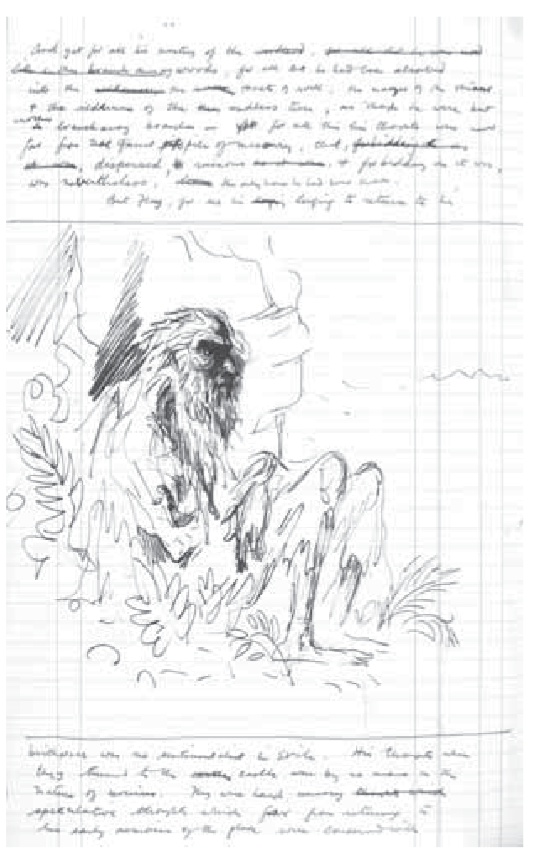
A page of Donald Barthelme’s story “The Expedition.” From 1974’s Guilty Pleasures. Read “The Expedition” here.

A page of Donald Barthelme’s story “The Expedition.” From 1974’s Guilty Pleasures. Read “The Expedition” here.
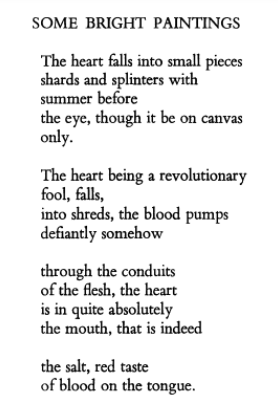
“Olives”
by
Donald Hall
“Dead people don’t like olives,”
I told my partners in eighth grade
dancing class, who never listened
as we fox-trotted, one-two, one-two.
The dead people I often consulted
nodded their skulls in unison
while I flung my black velvet cape
over my shoulders and glowered
from deep-set, burning eyes,
walking the city streets, alone at fifteen,
crazy for cheerleaders and poems.
At Hamden High football games, girls
in short pleated skirts
pranced and kicked, and I longed
for their memorable thighs.
They were friendly—poets were mascots—
but never listened when I told them
that dead people didn’t like olives.
Instead the poet, wearing his cape,
continued to prowl in solitude
intoning inscrutable stanzas
as halfbacks and tackles
made out, Friday nights after football,
on sofas in dark-walled rec rooms
with magnanimous cheerleaders.
But, decades later, when the dead
have stopped blathering
about olives, obese halfbacks wheeze
upstairs to sleep beside cheerleaders
waiting for hip replacements,
while a lascivious, doddering poet,
his burning eyes deep-set
in wrinkles, cavorts with their daughters.

Aurora, 1962 by Remedios Varo (1908-1963)
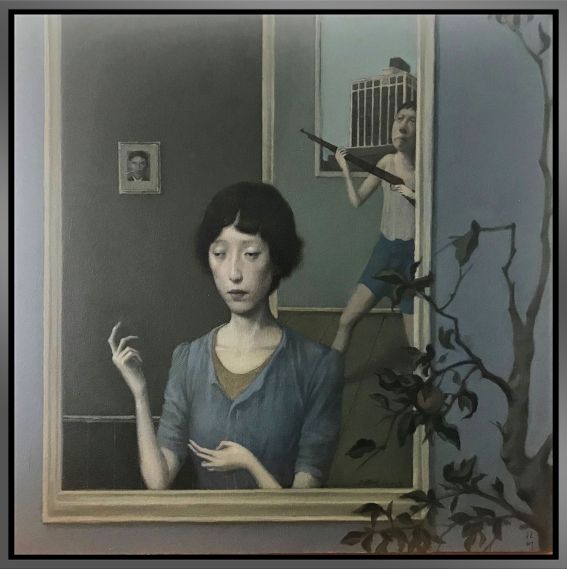
The Sophists, Jeffrey Chong Wang
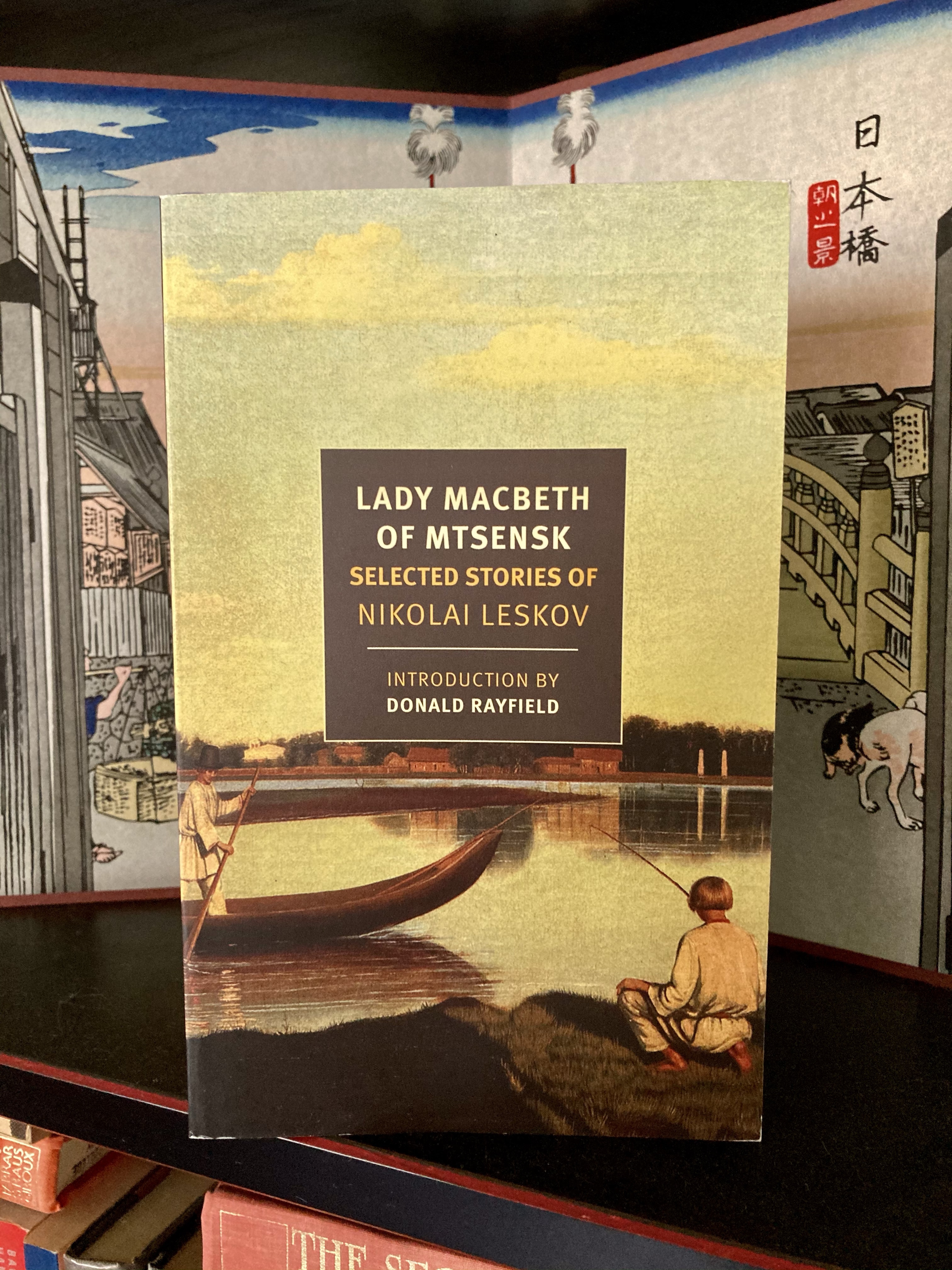
NRYB has a forthcoming collection of Nikolai Leskov stories (novellas, really) called Lady Macbeth of Mtsensk. The collection features new translations from Donald Rayfield, Robert Chandler, and William Edgerton. NYRB’s blurb:
Nikolai Leskov is the strangest of the great Russian writers of the nineteenth century. His work is closer to the oral traditions of narrative than that of his contemporaries, and served as the inspiration for Walter Benjamin’s great essay “The Storyteller,” in which Benjamin contrasts the plotty machinations of the modern novel with the strange, melancholy, but also worldly-wise yarns of an older, slower era that Leskov remained in touch with. The title story is a tale of illicit love and multiple murder that could easily find its way into a Scottish ballad and did go on to become the most popular of Dmitri Shostakovich’s operas. The other stories, all but one newly translated, present the most focused and finely rendered collection of this indispensable writer currently available in English.
The collection includes six novellas: Lady Macbeth of Mtsensk, The Sealed Angel, The Enchanted Wanderer, The Steel Flea, The Unmercenary Engineers, and The Innocent Prudentius.
I read a few of these stories some years back in a Borzoi collection of Leskov stories called The Enchanted Wanderer and Other Stories; those translations were by Richard Pevear and Larissa Volokhonsky (and included some much shorter tales).
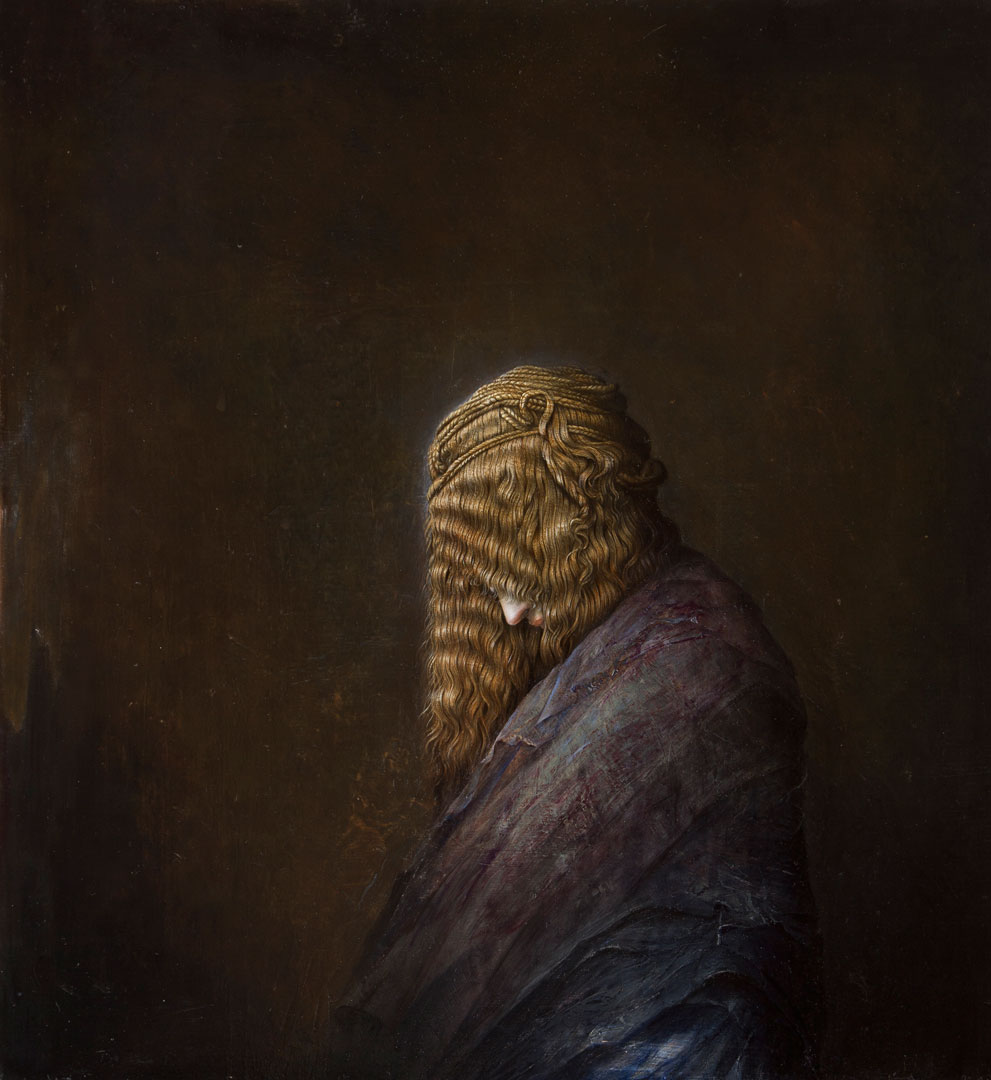
L’Annunciata, 2016 by Agostino Arrivabene (b. 1967)
Brigitte Felix: If I may ask the same question, phrasing it differently: Jack Gibbs says at one point “Most god damned readers rather be at the movies because when you walk in to the movies you walk in empty-handed and leave much the same way.” What do you think your readers walk out with, after reading J R, for example?
William Gaddis: [after a long pause] I suppose . . . here’s the heart of the matter, he’s drawn a picture of . . . In J R someone is repeatedly saying “This is what America is all about.” It’s buried usually under paragraphs, but this is what America is all about. I suppose that one wants the reader to put the book down finally, having finished it — not after starting it, which is the case, frequently — and say, Yes, that’s what America is all about: it is a paper empire, it’s Gresham’s Law, the bad drives out the good, and so forth . . .
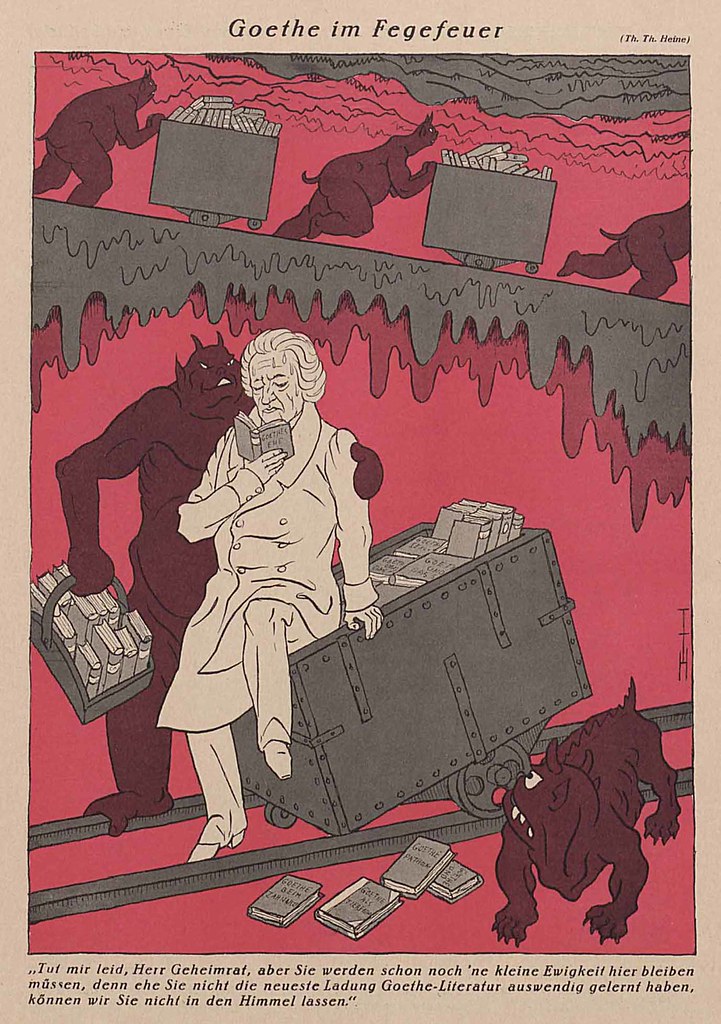
Goethe In Purgatory, 1932 by Thomas Theodor Heine (1867–1948). Via/more.
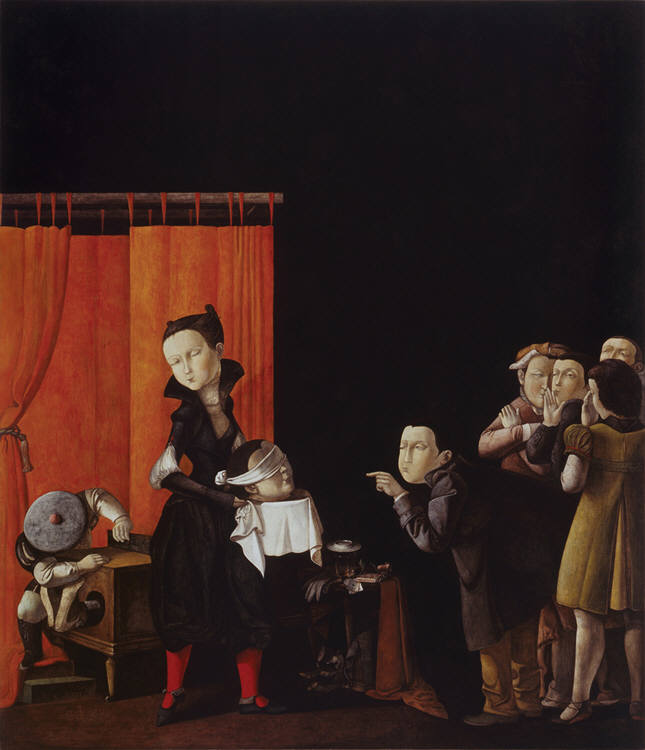
The Magician, 2010 by Xiao Guo Hui (b. 1969)
It is hard not to be appalled by existence.The pointlessness of matter turns us into cornered animalsthat otherwise are placid or indifferent,we hiss and bare our fangs and attack.But how many people have felt the terror of existence?Was Genghis Khan horrified that he and everything else existed?Was Hitler or Pol Pot?Or any of the other charming figures of history?Je m’en doute.It was something else made them mean.Something else made Napoleon think it gloriousto cover the frozen earth with a hundred thousand bloody corpses.Something else made . . . oh, name your monsterand his penchant for destruction,name your own period in history when a darkness swept over usand made not existing seem like the better choice,as if the solution to hunger were to hurl oneselfinto a vat of boiling radioactive carrots!Life is so awful!I hope that lion tears me to pieces!
Bobbie Ann Mason: “Book dedications are…a private message in a public place… They’re like reading the personals.”
Joseph Heller: “I have not the slightest understanding of what they mean…none of my books except the first one have any.”
Richard Ford: “All of my books are dedicated to my wife.”
Ward Just: “My last seven books were all dedicated to my wife.”
Kaye Gibbons: “In the new printings of A Virtuous Woman, I’m deleting my ex-husband’s name and replacing it with my second and final husband’s Frank Ward.”
Christopher Buckley: “I was finishing The White House Mess just as I was about to be married. I asked Lucy to put a sheet of paper in the typewriter, and I said, ‘Now type, “For my wife, with love.”‘ And she cried. I dedicated my first book, Steaming to Bamboola, to John Lennon. It was about the merchant marine, and he was the son of a merchant seaman, and he died while I was writing it, and I was very sad, so I just dedicated it to him.”
Nicholson Baker: “I hope to dedicate several more books to my wife although not every one. You don’t want to be like Nabokov. Every book was to Vera, to Vera, to Vera.”
Susanna Moore: “My favorite dedication is by Gregor von Rezzori. In one of his books, he just says, For whom else but you!'”
William Gaddis: “You never dedicate a book to another writer. You’d worry that he wouldn’t like it.”
John Updike: “You worry with another writer, that he won’t like the book, that you’re like the cat who’s bringing a dead mouse to the back door.”
From “Dedicated Lines,” an article by Jamie Malanowski in the 25 Dec. 1995 issue of The New Yorker.
I ended up reading Walker Percy’s postmodern Gothic novel Lancelot earlier this month. I’m a big fan of Southern literature—Faulkner and O’Connor, Barry Hannah and Charles Portis, etc.—but Percy has been a blind spot up until now. I got copies of Lancelot and The Second Coming when my college’s library removed a ton of books last year. They’d been in my office for months, and when I went back at the beginning of the fall semester to grab some textbooks—I’m teaching online only now—I grabbed the Percys (Percies?). I picked up Lancelot and then never really put it down. Something about its comedic grotesquerie, its insane monologuing just…clicked for me right now.
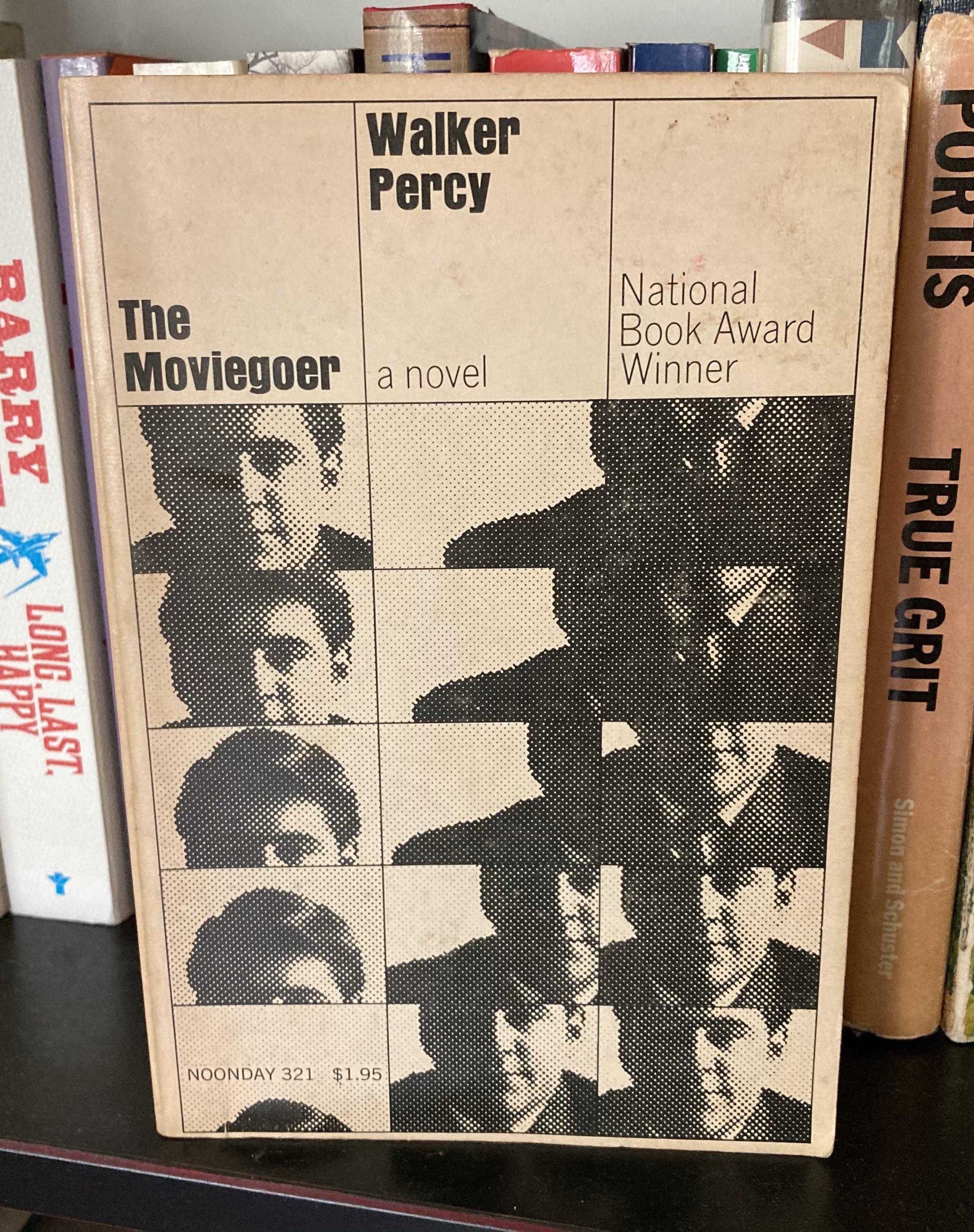
I figured I should read Percy’s first and most famous novel The Moviegoer next, so I picked up a used copy last week. I was stoked to find a 1971 Noonday edition with a cover design by Milton Glaser. I read the first fifty pages this weekend, and have enjoyed it so far, but maybe Lancelot spoiled me a bit. Percy’s first novel seems far more restrained and measured—subtler, really, although Lancelot is, to be clear, out there. While Lancelot reminded me of Barry Hannah’s zany, mean-spirited stuff, so far The Moviegoer strikes me as soaked in existentialist ennui. The main character and narrator, Binx Bolling, echoes Camus’ hero of The Stranger, Mersault so far. I do enjoy Percy’s evocation of New Orleans in the late fifties very much, but I was hoping for a little more humor. Still, I’ll stick with it.
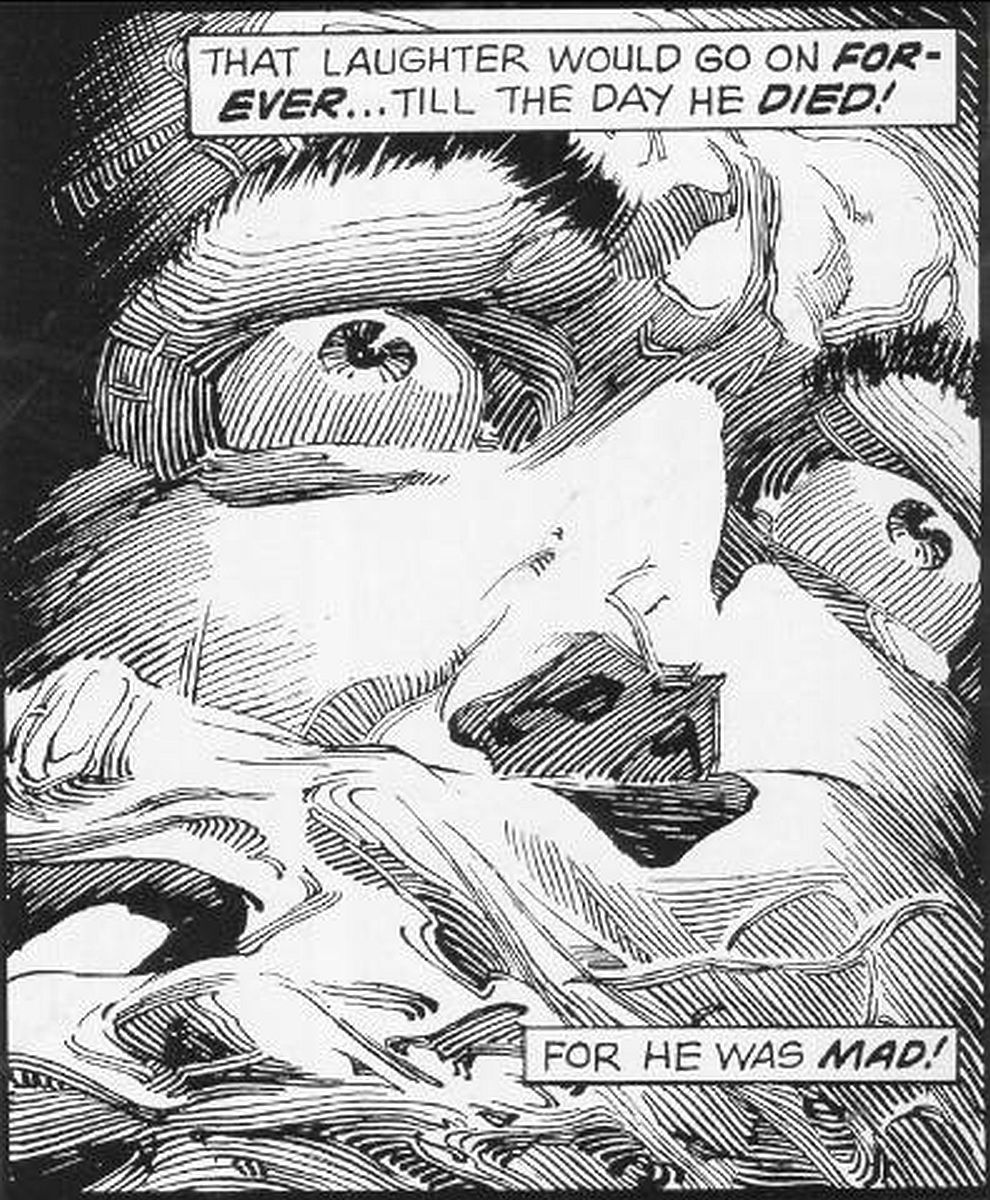
By Bernie Wrightson, 1948-2017
Who should be the next American Nobel Prize winner?
CORMAC McCARTHY: Would you wish the Nobel Prize off on a friend or an enemy?
What would you have done, do you think, if it hadn’t been for writing?
CORMAC McCARTHY: I think I can say that if I hadn’t been a writer I’d have been what I have been all my life anyway: one more unemployed person of dubious character.
The “article” consists of a ten-question questionnaire Esquire fiction editor Rust Hills sent to around fifty American writers. These are the only two answers from Cormac McCarthy.
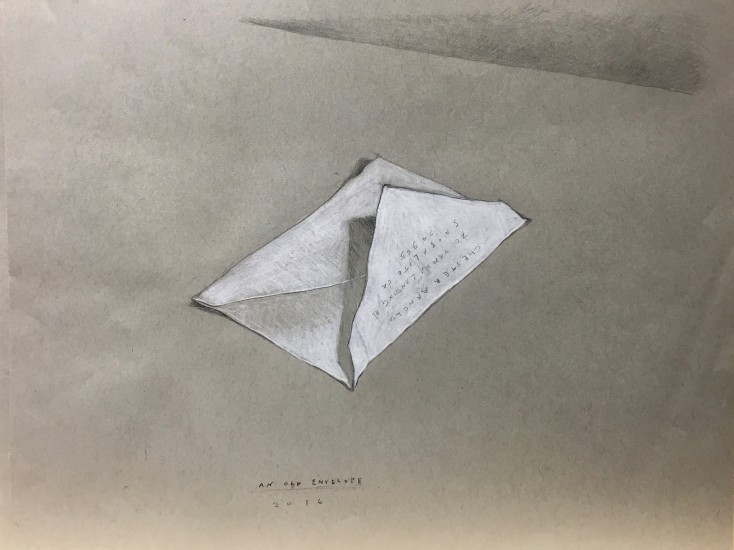
An Old Envelope, 2016 by Chester Arnold (b. 1952)

