
Cover art for Philip K. Dick’s Ubik, 1982 by Bob Pepper (1938-2019). Via/more.

Cover art for Philip K. Dick’s Ubik, 1982 by Bob Pepper (1938-2019). Via/more.
“Red Rubber Gloves”
by
Christine Brooke-Rose
From this position on my high balcony, the semi-detached beyond the garden looks more squat than it ought to in such a prosperous suburb, forming with its Siamese twin a square inverted U that faces me and boxes a wide inverted T of a back-yard, neatly divided by a hedge of roses and hydrangeas. On the left of the hedge there is a bit of lawn. On the right, only a small paved yard. The house on the left seems devoid of life, devoid, that is, of the kind of life liable to catch the eye and stop it in its casual round, mutating its idle curiosity through momentary fascination and hence, inexorably, by the mere process of reiteration, to a mild but fixed obsessiveness. As does the right-hand house.
In the angle of the square U, outside the french windows of the right-hand house, the girl sits on the edge of the red canvas bed in a pale pink bikini, carefully oiling inch after inch of her thin white body. She looks, from up here, totally naked, the pink bikini being so pale, and she sits on the edge of the red canvas bed which is set obliquely in the paved yard to face the morning sun. She has oiled the arms, the shoulders, the chest and the long midriff. Now she is doing the right leg, starting with the foot, the ankle, then the shin, as if to meet her upper oily self half way. She is oiling the right thigh. Inside the thigh. The left foot. If the heat-wave holds out she will perhaps become brown enough to contrast with the pink and so look less totally naked on the red canvas bed. The inside of the left thigh. She lies now framed in the red canvas bed, chin up, eyes closed to face the hot June sun. Round the corner from her naked body, at the square end of the inverted U, the red rubber gloves lie quiet on the kitchen window-sill.
In the morning the large rectangular windows of the house tend to reflect the sun in some at least of their thirty-two small black squares framed in cream-painted wood. And in the afternoon they are quite cast into the shade as the sun moves round to face me on my high balcony, immobilised in convalescence. I cannot therefore see much further than the beginning of the pink wash-basin in the bathroom or, in the kitchen below it, the long and gleaming double-sink unit. And the red rubber gloves, moving swiftly apart and together, vanishing and reappearing, moving apart and down. All the windows of both houses, those of the kitchen and of the bathroom above it, at each end of the square inverted U, and those of each bedroom inside the U above the french windows, are rectangular and divided into four panels, each of eight black squares, two over two over two over two, all in cream-painted frames.
The thin girl has melted away into the sun, the red canvas bed is empty. Continue reading “Read “Red Rubber Gloves,” a short story by Christine Brooke-Rose”

Previously,
27. “Some of Us Had Been Threatening Our Friend Colby” (Amateurs, 1976)
This is probably the first essential story in Forty Stories—maybe at the end of this silly project I’ll put together something like Fifty Stories, whittling down Sixty Stories and Forty Stories. Here are the first few sentences:
Some of us had been threatening our friend Colby for a long time, because of the way he had been behaving. And now he’d gone too far, so we decided to hang him. Colby argued that just because he had gone too far (he did not deny that he had gone too far) did not mean that he should be subjected to hanging. Going too far, he said, was something everybody did sometimes. We didn’t pay much attention to this argument. We asked him what sort of music he would like played at the hanging. He said he’d think about it but it would take him a while to decide.
Colby finally settles on Ive’s Fourth Symphony.
“Some of Us” showcases in a non-showy way the best of Barthelme—absurdity balanced by syntactic restraint; surreal humor weighted in the visceral specter of impending violence. It’s a very, very funny story, and while I think it resists simple allegorical interpretation, it’s nevertheless a little parcel of domestic fascism in practice. Great stuff. Read “Some of Us Had Been Threatening Our Friend Colby” here.
26. “Pepperoni” (first published in The New Yorker, 23 Nov. 1980)
Published over four decades ago, “Pepperoni” is a depressingly prescient riff on what happens when capital decides to take over journalism. Newspapers become just another widget, a slice of pepperoni, a trifle, a nothing to sell and sell and resell:
Financially, the paper is quite healthy. The paper’s timber-lands, mining interests, pulp and paper operations, book, magazine, corrugated-box, and greeting-card divisions, film, radio, television, and cable companies, and data-processing and satellite-communications groups are all flourishing, with overall return on invested capital increasing at about eleven percent a year.
Despite the vertical integration, all is not well: “But top management is discouraged and saddened, and middle management is drinking too much.” Barthelme’s hyperbole is jaunty in 1980, where the paper’s “editorials have been subcontracted to Texas Instruments, and the obituaries to Nabisco, so that the staff will have ‘more time to think.'” But in 2024 it reads as a grim warning about the gross intersection of capital and journalism. Read “Pepperoni” here.
25. “Sentence” (City Life, 1970)
I mean what if I just…
Or a long sentence moving at a certain pace down the page aiming for the bottom-if not the bottom of this page then some other page-where it can rest, or stop for a moment to think out the questions raised by its own (temporary) existence, which ends when the page is turned, or the sentence falls out of the mind that holds it (temporarily) in some kind of embrace, not necessarily an ardent one, but more perhaps the kind of embrace enjoyed (or endured), by a wife who has just waked up and is on her way to the bathroom in the morning to wash her hair, and is bumped into by her husband, who has been lounging at the breakfast table reading the newspaper, and doesn’t see her coming out of the bedroom, but, when he bumps into her, or is bumped into by her, raises his hands to embrace her lightly, transiently, because he knows that if he gives her a real embrace so early in the morning, before she has properly shaken the dreams out of her head, and got her duds on, she won’t respond, and may even become slightly angry, and say something wounding, and so the husband invests in this embrace not so much physical or emotional pressure as he might, because he doesn’t want to waste anything-with this sort of feeling, then, the sentence passes through the mind more or less, and there is another way of describing the situation too, which is to say that the sentence crawls through the mind like something someone says to you while you are listening very hard to the FM radio, some rock group there, with its thrilling sound, and so, with your attention or the major part of it at least already rewarded, there is not much mind room you can give to the remark, especially considering that you have probably just quarreled with that person, the maker of the remark, over the radio being too loud, or something like that, and the view you take, of the remark, is that you’d really rather not hear it, but if you have to hear it, you want to listen to it for the smallest possible length of time, and during a commercial, because immediately after the commercial they’re going to play a new rock song by your favorite group, a cut that has never been aired before, and you want to hear it and respond to it in a new way, a way that accords with whatever you’re feeling at the moment, or might feel, if the threat of new experience could be (temporarily) overbalanced by the promise of possible positive benefits, or what the mind construes as such, remembering that these are often, really, disguised defeats (not that such defeats are not, at times, good for your character, teaching you that it is not by success alone that one surmounts life, but that setbacks, too, contribute to that roughening of the personality that, by providing a textured surface to place against that of life, enables you to leave slight traces, or smudges, on the face of human history-your mark) and after all, benefit-seeking always has something of the smell of raw vanity about it, as if you wished to decorate your own brow with laurel, or wear your medals to a cookout, when the invitation had said nothing about them, and although the ego is always hungry (we are told) it is well to remember that ongoing success is nearly as meaningless as ongoing lack of success, which can make you sick, and that it is good to leave a few crumbs on the table for the rest of your brethren, not to sweep it all into the little beaded purse of your soul but to allow others, too, part of the gratification, and if you share in this way you will find the clouds smiling on you, and the postman bringing you letters, and bicycles available when you want to rent them, and many other signs, however guarded and limited, of the community’s (temporary) approval of you, or at least of it’s willingness to let you believe (temporarily) that it finds you not so lacking in commendable virtues as it had previously allowed you to think, from its scorn of your merits, as it might be put, or anyway its consistent refusal to recognize your basic humanness and its secret blackball of the project of your remaining alive, made in executive session by its ruling bodies, which, as everyone knows, carry out concealed programs of reward and punishment, under the rose, causing faint alterations of the status quo, behind your back, at various points along the periphery of community life, together with other enterprises not dissimilar in tone, such as producing films that have special qualities, or attributes, such as a film where the second half of it is a holy mystery, and girls and women are not permitted to see it, or writing novels in which the final chapter is a plastic bag filled with water, which you can touch, but not drink: in this way, or ways, the underground mental life of the collectivity is botched, or denied, or turned into something else never imagined by the planners, who, returning from the latest seminar in crisis management and being asked what they have learned, say they have learned how to throw up their hands; the sentence meanwhile, although not insensible of these considerations, has a festering conscience of its own, which persuades it to follow its star, and to move with all deliberate speed from one place to another, without losing any of the “riders” it may have picked up just being there, on the page, and turning this way and that, to see what is over there, under that oddly-shaped tree, or over there, reflected in the rain barrel of the imagination, even though it is true that in our young manhood we were taught that short, punchy sentences were best (but what did he mean? doesn’t “punchy” mean punch-drunk? I think he probably intended to say “short, punching sentences,” meaning sentences that lashed out at you, bloodying your brain if possible, and looking up the word just now I came across the nearby “punkah,” which is a large fan suspended from the ceiling in India, operated by an attendant pulling a rope-that is what I want for my sentence, to keep it cool!) we are mature enough now to stand the shock of learning that much of what we were taught in our youth was wrong, or improperly understood by those who were teaching it, or perhaps shaded a bit, the shading resulting from the personal needs of the teachers, who as human beings had a tendency to introduce some of their heart’s blood into their work, and sometimes this may not have been of the first water, this heart’s blood, and even if they thought they were moving the “knowledge” out, as the Board of Education had mandated, they could have noticed that their sentences weren’t having the knockdown power of the new weapons whose bullets tumble end-over-end (but it is true that we didn’t have these weapons at that time) and they might have taken into account the fundamental dubiousness of their project (but all the intelligently conceived projects have been eaten up already, like the moon and the stars) leaving us, in our best clothes, with only things to do like conducting vigorous wars of attrition against our wives, who have now thoroughly come awake, and slipped into their striped bells, and pulled sweaters over their torsi, and adamantly refused to wear any bras under the sweaters, carefully explaining the political significance of this refusal to anyone who will listen, or look, but not touch, because that has nothing to do with it, so they say; leaving us, as it were, with only things to do like floating sheets of Reynolds Wrap around the room, trying to find out how many we can keep in the air at the same time, which at least gives us a sense of participation, as though we were Buddha, looking down at the mystery of your smile, which needs to be investigated, and I think I’ll do that right now, while there’s still enough light, if you’ll sit down over there, in the best chair, and take off all your clothes, and put your feet in that electric toe caddy (which prevents pneumonia) and slip into this permanent press hospital gown, to cover your nakedness-why, if you do all that, we’ll be ready to begin! after I wash my hands, because you pick up an amazing amount of exuviae in this city, just by walking around in the open air, and nodding to acquaintances, and speaking to friends, and copulating with lovers, in the ordinary course (and death to our enemies! by and by)-but I’m getting a little uptight, just about washing my hands, because I can’t find the soap, which somebody has used and not put back in the soap dish, all of which is extremely irritating, if you have a beautiful patient sitting in the examining room, naked inside her gown, and peering at her moles in the mirror, with her immense brown eyes following your every movement (when they are not watching the moles, expecting them, as in a Disney nature film, to exfoliate) and her immense brown head wondering what you’re going to do to her, the pierced places in the head letting that question leak out, while the therapist decides just to wash his hands in plain water, and hang the soap! and does so, and then looks around for a towel, but all the towels have been collected by the towel service, and are not there, so he wipes his hands on his pants, in the back (so as to avoid suspicious stains on the front) thinking: what must she think of me? and, all this is very unprofessional and at-sea looking! trying to visualize the contretemps from her point of view, if she has one (but how can she? she is not in the washroom) and then stopping, because it is finally his own point of view that he cares about and not hers, and with this firmly in mind, and a light, confident step, such as you might find in the works of Bulwer-Lytton, he enters the space she occupies so prettily and, taking her by the hand, proceeds to tear off the stiff white hospital gown (but no, we cannot have that kind of pornographic merde in this majestic and high-minded sentence, which will probably end up in the Library of Congress) (that was just something that took place inside his consciousness, as he looked at her, and since we know that consciousness is always consciousness of something, she is not entirely without responsibility in the matter) so, then, taking her by the hand, he falls into the stupendous white puree of her abyss, no, I mean rather that he asks her how long it has been since her last visit, and she says a fortnight, and he shudders, and tells her that with a condition like hers (she is an immensely popular soldier, and her troops win all their battles by pretending to be forests, the enemy discovering, at the last moment, that those trees they have eaten their lunch under have eyes and swords) (which reminds me of the performance, in 1845, of Robert-Houdin, called The Fantastic Orange Tree, wherein Robert-Houdin borrowed a lady’s handkerchief, rubbed it between his hands and passed it into the center of an egg, after which he passed the egg into the center of a lemon, after which he passed the lemon into the center of an orange, then pressed the orange between his hands, making it smaller and smaller, until only a powder remained, whereupon he asked for a small potted orange tree and sprinkled the powder thereupon, upon which the tree burst into blossom, the blossoms turning into oranges, the oranges turning into butterflies, and the butterflies turning into beautiful young ladies, who then married members of the audience), a condition so damaging to real-time social intercourse of any kind, the best thing she can do is give up, and lay down her arms, and he will lie down in them, and together they will permit themselves a bit of the old slap and tickle, she wearing only her Mr. Christopher medal, on its silver chain, and he (for such is the latitude granted the professional classes) worrying about the sentence, about its thin wires of dramatic tension, which have been omitted, about whether we should write down some natural events occurring in the sky (birds, lightning bolts), and about a possible coup d’etat within the sentence, whereby its chief verb would be-but at this moment a messenger rushes into the sentence, bleeding from a hat of thorns he’s wearing, and cries out: “You don’t know what you’re doing! Stop making this sentence, and begin instead to make Moholy-Nagy cocktails, for those are what we really need, on the frontiers of bad behavior!” and then he falls to the floor, and a trap door opens under him, and he falls through that, into a damp pit where a blue narwhal waits, its horn poised (but maybe the weight of the messenger, falling from such a height, will break off the horn)-thus, considering everything very carefully, in the sweet light of the ceremonial axes, in the run-mad skimble-skamble of information sickness, we must make a decision as to whether we should proceed, or go back, in the latter case enjoying the pathos of eradication, in which the former case reading an erotic advertisement which begins, How to Make Your Mouth a Blowtorch of Excitement (but wouldn’t that overtax our mouthwashes?) attempting, during the pause, while our burned mouths are being smeared with fat, to imagine a better sentence, worthier, more meaningful, like those in the Declaration of Independence, or a bank statement showing that you have seven thousand kroner more than you thought you had-a statement summing up the unreasonable demands that you make on life, and one that also asks the question, if you can imagine these demands, why are they not routinely met, tall fool? but of course it is not that query that this infected sentence has set out to answer (and hello! to our girl friend, Rosetta Stone, who has stuck by us through thick and thin) but some other query that we shall some day discover the nature of, and here comes Ludwig, the expert on sentence construction we have borrowed from the Bauhaus, who will-“Guten Tag, Ludwig!”-probably find a way to cure the sentence’s sprawl, by using the improved way of thinking developed in Weimer-“I am sorry to inform you that the Bauhaus no longer exists, that all of the great masters who formerly thought there are either dead or retired, and that I myself have been reduced to constructing books on how to pass the examination for police sergeant”-and Ludwig falls through the Tugendhat House into the history of man-made objects; a disappointment, to be sure, but it reminds us that the sentence itself is a man-made object, not the one we wanted of course, but still a construction of man, a structure to be treasured for its weakness, as opposed to the strength of stones
Is good if not great.
24. “The Temptation of St. Anthony” (Sadness, 1972)
After rereading this one, the thought that dominated my stupid brain was, How the fuck did an editor allow DB to use the word “ineffable” four times in this short story? He uses a version of the word here, in this nice little excerpt in which one of the things that St. Anthony did was the passive doing of being mugged:
There was the ineffableness I’ve already mentioned, and there were certain things that he did. He was mugged, for example. That doesn’t happen too often here, but it happened to him. It was at night, somebody jumped on him from behind, grabbed him around the neck and began going through his pockets. The man only got a few dollars, and then he threw St. Anthony down on the sidewalk (he put one leg in front of the saint’s legs and shoved him) and then began to run away. St. Anthony called after him, held up his hand, and said, “Don’t you want the watch?” It was a good watch, a Bulova. The man was thunderstruck. He actually came back and took the watch off St. Anthony’s wrist. He didn’t know what to think. He hesitated for a minute and then asked St. Anthony if he had bus fare home. The saint said it didn’t matter, it wasn’t far, he could walk. Then the mugger ran away again.
If not essential, “St. Anthony” is a robust and colorful example of DB riffing in his prime. Read “The Temptation of St. Anthony” here.

So I finally made some time to dig into Augusto Monterroso’s lone novel, 1978’s The Rest Is Silence (trans. Aaron Kerner). It’s hardly a conventional novel (and seems very much of a piece with the other novel I’m reading right now, Cuban author Guillermo Cabrera Infante’s 1967 novel Tres tristes tigres (in its 1971 translation as Three Trapped Tigers by Donald Gardner and Suzanne Jill Levine). Both novels eschew traditional novelistic forms—no central narrator, no conventional plot, per se, polyglossia given rein over a controlling and unifying voice. I read the first fifty or so pages of The Rest Is Silence and look forward to digging in deeper.
From Dustin Illingworth’s introduction
Augusto Monterroso’s The Rest Is Silence, a fictional Festschrife for a provincial Mexican Intellectual, teems with invented texts, imaginary writers, dubious footnotes, possible pseudonyms, and unreliable memories. The novel’s constituent parts reveal the social, culeural, and literary life of one Eduardo Torres, a writer and elder statesman of the fictional town of San Blas, Mexico, Its four sec-tions— grouped loosely into tributes, selected writings, aphorisms, and “impromptu collaborations” —make a case for compilation as a natural handmaiden to farce. The opening remarks from friends and family are largely hatchet jobs born of petty jealousy or long acquain-tance. The selections from Torres’s oeuvre—incredible misreadings, all-are bathetic, anodyne, lacking in sense, and almost invariably wrong. Yet the vivisection is marked by compassion as much as it is by savagery. Ferried by the risible figure of Torres, avatar of vanity and misjudgment, Monterroso smuggles a pocket autobiography within his deflation of Mexico’s literati. In the process, he forges one of the sublime fools of literature, a man whose commitment to delusion is itself a kind of glorious art.
“The Pedestrian”
by
Ray Bradbury
To enter out into that silence that was the city at eight o’clock of a misty evening in November, to put your feet upon that buckling concrete walk, to step over grassy seams and make your way, hands in pockets, through the silences, that was what Mr Leonard Mead most dearly loved to do. He would stand upon the corner of an intersection and peer down long moonlit avenues of sidewalk in four directions, deciding which way to go, but it really made no difference; he was alone in this world of 2053 A.D., or as good as alone, and with a final decision made, a path selected, he would stride off, sending patterns of frosty air before him like the smoke of a cigar. Continue reading “Read “The Pedestrian,” a short story by Ray Bradbury”
Zelda Fitzgerald’s Special Breakfast
Vladimir Nabokov’s Eggs à la Nabocoque
Thomas Pynchon’s European Pizza
Hunter S. Thompson’s Open-Face Cigarette-Special Hot-and-Cold Sandwich with Artichoke Appetizer
Denise Levertov’s Black Bean Soup
Donald Barthelme’s Fine Homemade Soups
Ursula K. Le Guin’s Crab Nebula
John Brunner’s Squid with Pine Nuts
Marjorie Kinnan Rawlings’ Recipes for Coot Surprise, Jugged Rabbit, and Jellied Tongue
Ernest Hemingway’s Campfire Trout
Thomas Pynchon’s Crocodile (A Traditional Anarchist Favorite)
Poul Anderson’s All My Own Invention
Elizabeth Bishop’s brownie recipe:
4 squares bitter chocolate (or about a cup of cocoa)
4 eggs
1/2 cup butter
2 1/2 cups white sugar
1 cup flour
2 teaspoons vanilla
2 cups chopped nutsMelt the chocolate and butter together – or, if you use cocoa, melt along with half the sugar and a little water. Cool slightly and beat in eggs and rest of sugar.
Sift in flour, add vanilla and nuts and beat. The batter is fairly stiff – doesn’t run much. Spread about <——————> this thick in square pan.
Bake in a slow oven – about 45 minutes to an hr., depending on pan, thickness, etc. They should be dry on top, just pulling away from edges, but still rather damp in the middle. Cut in squares in pan and remove with spatula.
This makes chewy brownies – for a harder kind, use brown sugar and an extra egg – or half brown sugar – Can be made thicker and used hot with whipped cream on top for a desert [sic] –
Via the excellent blog Paper and Salt, whose author Nicole acquired it via Bishop’s at Vassar College.
“I’ll be in the bar,” said Reef. Yzles-Bains was in fact one of the few places on the continent of Europe where a sober Anarchist could find a decent Crocodile—equal amounts of rum, absinthe, and the grape spirits known as trois-six—a traditional Anarchist favorite, which Loïc the bartender, a veteran of the Paris Commune, claimed to have been present at the invention of.
A cocktail recipe from Thomas Pynchon’s novel Against the Day. (More on trois-six here; good luck finding real absinthe).
Bonus recipe: Kit Traverse’s drink invention:
“‘Love in the Shadows of Pera,’ ” Kit said. “It’s just Creme de Menthe and beer.”

Anita Loos’ recipe for kitten’s tongue:
Take 2 eggs and not quite a cup of sugar. Whip them just a little, then add not quite a cupful of melted butter and a cup of flour. Stir the mixture, spread it on a tin in small quantities, bake them. Roll in nuts and sugar.
From Famous Recipes of Famous Women (ed. Florence Stratton, 1925).

Poul Anderson’s cocktail “All My Own Invention” is collected in collected in Cooking Out of This World (ed. Anne McCaffrey, 1973).
All My Own Invention
2 oz. dark rum, 2 oz. dry vermouth, 1 oz. fresh lemon juice, stirred over ice. Sneaky.
As a postscript to his 1957 essay “Bourbon,” Walker Percy offers his favorite recipe for the drink:
Reader, just in case you don’t want to knock it back straight and would rather monkey around with perfectly good Bourbon, here’s my favorite recipe, “Cud’n Walker’s Uncle Will’s Favorite Mint Julep Receipt.”
You need excellent Bourbon whiskey; rye or Scotch will not do. Put half an inch of sugar in the bottom of the glass and merely dampen it with water. Next, very quickly—and here is the trick in the procedure—crush your ice, actually powder it, preferably in a towel with a wooden mallet, so quickly that it remains dry, and, slipping two sprigs of fresh mint against the inside of the glass, cram the ice in right to the brim, packing it with your hand. Finally, fill the glass, which apparently has no room left for anything else, with Bourbon, the older the better, and grate a bit of nutmeg on the top. The glass will frost immediately. Then settle back in your chair for half an hour of cumulative bliss.
Uncle Will shows up a few times in Signposts in a Strange Land, a collection of essays that includes “Bourbon” along with 1965’s “Uncle Will,” which offers this nugget:
Early each afternoon he made himself a pitcher of vodka martinis—no one had ever heard of such a drink in Mississippi in the 1930s—and set up shop in the pantry, listened and talked to any and all comers.
Also from “Bourbon”:
Bourbon does for me what the piece of cake did for Proust.
1926: As a child watching my father in Birmingham, in the exurbs, living next to number-6 fairway of the New Country Club, him disdaining both the bathtub gin and white lightning of the time, aging his own Bourbon in a charcoal keg, on his hands and knees in the basement sucking on a siphon, a matter of gravity requiring cheek pressed against cement floor, the siphon getting going, the decanter ready, the first hot spurt into his mouth not spat out.
1933: My uncle’s sun parlor in the Mississippi Delta and toddies on a Sunday afternoon, the prolonged and meditative tinkle of silver spoon against crystal to dissolve the sugar; talk, tinkle, talk; the talk mostly political: “Roosevelt is doing a good job; no, the son of a bitch is betraying his class.”
1934: Drinking at a Delta dance, the boys in bi-swing jackets and tab collars, tough-talking and profane and also scared of the girls and therefore safe in the men’s room. Somebody passes around bootleg Bourbon in a Coke bottle. It’s awful. Tears start from eyes, faces turn red. “Hot damn, that’s good!”
1935: Drinking at a football game in college. UNC versus Duke. One has a blind date. One is lucky. She is beautiful. Her clothes are the color of the fall leaves and her face turns up like a flower. But what to say to her, let alone what to do, and whether she is “nice” or “hot”—a distinction made in those days. But what to say? Take a drink, by now from a proper concave hip flask (a long way from the Delta Coke bottle) with a hinged top. Will she have a drink? No. But it’s all right. The taste of the Bourbon(Cream of Kentucky) and the smell of her fuse with the brilliant Carolina fall and the sounds of the crowd and the hit of the linemen in a single synesthesia.
1941: Drinking mint juleps, famed Southern Bourbon drink, though in the Deep South not really drunk much. In fact, they are drunk so seldom that when, say, on Derby Day somebody gives a julep party, people drink them like cocktails, forgetting that a good julep holds at least five ounces of Bourbon. Men fall facedown unconscious, women wander in the woods disconsolate and amnesiac, full of thoughts of Kahlil Gibran and the limber lost.
Would you believe the first mint julep I had I was sitting not on a columned porch but in the Boo Snooker bar of the New Yorker Hotel with a Bellevue nurse in 1941? The nurse, a nice upstate girl, head floor nurse, brisk, swift, good-looking; Bellevue nurses, the best in the world and this one the best of Bellevue, at least the best-looking. The julep, an atrocity, a heavy syrupy Bourbon and water in a small glass clotted with ice. But good!
I’ve been sharing literary recipes on Biblioklept, mostly around Thanksgiving and Christmas, since I first started the blog back in 2009. The first entry was Zora Neale Hurston’s mulatto rice.
I’ve enjoyed taking note of recipes (or approximations of recipes) in the books I’ve read and sharing them here, as well as recipes authored by authors (printed originally in cookbooks or elsewhere). I’ve rehashed the recipes each Thanksgiving (here’s last year’s entry), but this Thanksgiving I thought I’d search for new stuff—hence the flurry of recipes on the blog the past few days. In the same spirit, I figured I’d share a simple staple in our household: a recipe for oven rice.
Really, this isn’t so much a recipe as it is a technique. My aunt taught me how to cook rice in the oven over twenty years ago and I haven’t looked back. I’ve employed this technique to cook all kinds of rice: long grain and short grain; jasmine, brown, wild, basmati, sushi and so on. It even works for middlins (but not grits). I’ve cooked this rice in smaller and larger batches, used different stocks, added vegetables, used a variety of oils and fats; I’ve cooked the rice in at least five different ovens. It always turns out perfect.
Here is what you need:
An enameled cast iron Dutch oven.
An oven and a cook top.
A cup of rice.
Two cups of stock or water. I almost always use stock that I make on Sundays.
Oil or fat; I usually use olive oil or schmalz if I have it.
Salt.
Here is how you make the rice:
Preheat the oven to 350°F.
Preheat your stock or water if it is cold. The liquid need not be aboil or anything, but it can’t hit the pan cold.
Coat the bottom of the Dutch oven with oil, turn the cook top eye to high, throw in your rice and add salt (more salt than you think you need).
Stir the rice until it’s coated with oil and salt and cook it until it’s nearly translucent—but you’re not making a pilaf here, please.
Add your liquid (really, the liquid should be a stock, which is easy to make from any bones or scraps you have about).
Bring the rice to not quite boiling and make sure it doesn’t stick to the bottom of your pan. But don’t overagitate it. If need be, remove the pan from the eye in the event you’ve misjudged how long it takes your oven to heat to 350°F. You’re not cooking the rice on the stove top; you simply want the liquid to be close to the same temperature as the oven.
Cover the rice and put it in the oven, setting a thirty minute timer or simply attending to the time yourself.
Now is the perfect time to read a short story and drink a glass of white wine, as you’ve already prepped a suitable match for this lovely oven rice, yes? Butter beans and chorizo with the onions you caramelized on Monday? Roasted garlic and peppers? Field peas cooked with a leftover smoked chicken thigh? Even a quick spinach wilt with a few tomato slices or an egg on top will do.
But you’ve taken care of that; read your story, drink your wine.
Remove the rice from the oven after thirty minutes. It will stay nice and hot in the enameled cast iron dish for an hour or more. If you’ve neglected to prepare butter beans or field peas or spinach—or even a can of sardines and hot sauce from your pantry—you can eat this rice with butter and salt and lots of pepper. And maybe you’ll have enough peace to read another story while you eat.
I’m pretty sure there should be some hyphens in the title of Hunter S. Thompson’s recipe for “open face cigarette special hot and cold sandwich with artichoke appetizer.” From The Great American Writers’ Cookbook (ed. Dean Faulkner Wells, 1981).
OPEN FACE CIGARETTE SPECIAL HOT AND COLD SANDWICH WITH ARTICHOKE APPETIZER
Ingredients
1 Artichoke
1 stalk of celery
1 onion
1 tomato
one quarter lb. butter
1 container cottage cheese
1 can Ortega whole green chilis
1 lemon
mayonnaise
vinegar
4 strips of bacon
1 slice dill rye bread
La Victoria green taco sauce
Directions
Fill a large pot three quarters full with water and add celery and half of the onion. Bring to a boil.
Add artichoke, cover and boil for 45 minutes. While you are waiting for the artichoke to cook you can prepare the sauce for it and the sandwich.
Sauce:
Mix 3 heaping tablespoons of mayonnaise with one table spoon of Dijon mustard. Add a splash of vinegar and a squeeze of lemon.
Cigarette Special
Cook bacon and put aside.
Butter the slice of rye bread generously and toast until the bread is light brown and the butter is sizzling.
Spread cottage cheese exactly one quarter inch thick on the toast.
Cut Ortega whole green chilis into 4 one quarter inch strips and place lengthwise on top of cottage cheese.
Add bacon to sandwich.
Cut 3 or 4 thin slices of tomato and place on top of bacon.
Cut 2 or 3 very thin slices of onion and put those on top of the tomatoes.
Then spread another one quarter inch thick layer of cottage cheese.
Salt and pepper and garnish with La Victoria green taco sauce.
Then cover the open face sandwich with Reynolds Wrap, leaving the bottom of the toast uncovered. Timing is crucial at this point. The artichoke should be well-boiled and ready to eat and all sandwich ingredients prepared for the final mix before the bread is toasted for the first time.
The sandwich must be lashed together and toasted (twice) in less than 5 minutes, or the toast will get limp and soggy.
When you have finished eating your artichoke appetizer and are ready to eat the Cigarette Special, place the sandwich back into the toaster oven and toast for about one minute. Remove Reynolds Wrap and you will now have a hot buttered toast cold cottage cheese cigarette special.
The procedure by steps:
Drink good whiskey while boiling artichoke and frying bacon.
Prepare sandwich ingredients.
Eat artichoke leaves
Mix sandwich and toast.
Eat artichoke heart, with good beer.
Eat sandwich.
Drink coffee and good whiskey, with sharp chocolate.
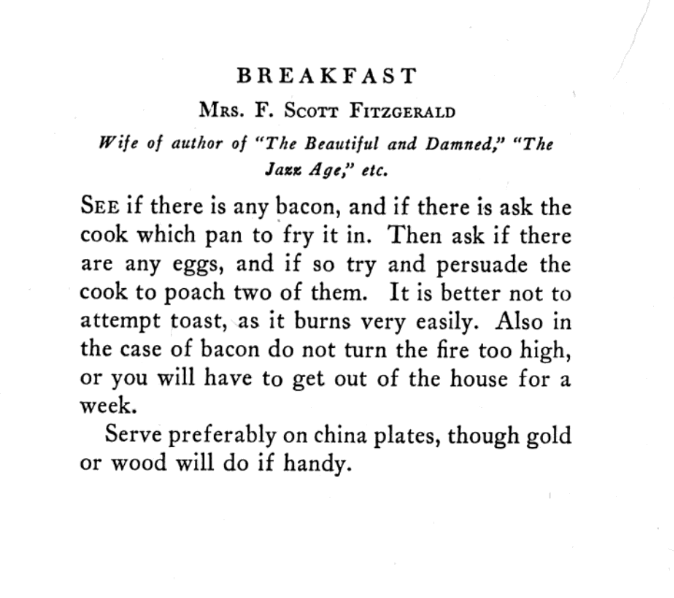
Zelda Fitzgerald’s “recipe” for breakfast:
See if there is any bacon, and if there is ask the cook which pan to fry it in. Then ask if there are any eggs, and if so try and persuade the cook to poach two of them. It is better not to attempt toast, as it burns very easily. Also in the case of bacon do not turn the fire too high, or you will have to get out of the house for a week. Serve preferably on china plates, though gold or wood will do if handy.
From Famous Recipes of Famous Women (ed. Florence Stratton, 1925)
John Brunner’s recipe for squid with pine nuts:
1 1b. baby squid
1 large onion
1 oz. pine nuts (pinon nuts)
2 oz. butter
1 clove garlic
salt and pepper
2 sherry-glasses dry sherry
water
Chop the onion and garlic fine, brown in the butter. Clean squid, cut into rings, add to pan and add nuts. Season lightly. Stir over low heat until everything is coated with the butter. Add the sherry. Simmer for 2-3 minutes. Add water to barely cover. Simmer until squid is tender-approximately 20 minutes, but this depends on the age of the squid: the older, the longer. Serve hot. Keep the breadsticks coming.
Try and finish off the white wine at the same time the last bit of squid disappears. (It will. I’ve seen people who were convinced they didn’t like the stuff come back for seconds of this dish, then ask optimistically for thirds-too late.)
Then we get down to the really serious item on the agenda, a member of that family of classic peasant dishes which runs from Normandy to Yugoslavia and can probably be found in recognizable form in the New World, too. What they amount to, basically, is a means of making stored beans taste wonderful when that’s all you’ve got for a large family. Any number of changes can be rung on the fundamental principle.
Brunner’s recipe is collected in Cooking Out of This World (ed. Anne McCaffrey, 1973)
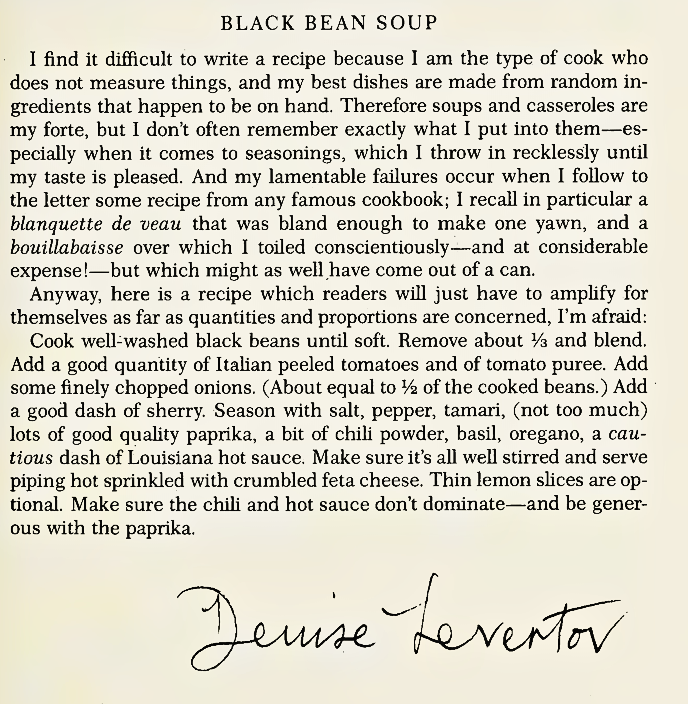
Denis Levertov’s recipe for black bean soup:
I find it difficult to write a recipe because I am the type of cook who does not measure things, and my best dishes are made from random ingredients that happen to be on hand. Therefore soups and casseroles are my forte, but I don’t often remember exactly what I put into them—especially when it comes to seasonings, which I throw in recklessly until my taste is pleased. And my lamentable failures occur when I follow to the letter some recipe from any famous cookbook; I recall in particular a blanquette de veau that was bland enough to make one yawn, and a bouillabaisse over which I toiled conscientiously–and at considerable expense!–but which might as well have come out of a can.
Anyway, here is a recipe which readers will just have to amplify for themselves as far as quantities and proportions are concerned, I’m afraid:
Cook well-washed black beans until soft. Remove about ⅛ and blend. Add a good quantity of Italian peeled tomatoes and of tomato puree.”Add some finely chopped onions. (About equal to ½ of the cooked beans.) Add a good dash of sherry. Season with salt, pepper, tamari, (not too much) lots of good quality paprika, a bit of chili powder, basil, oregano, a cautious dash of Louisiana hot sauce. Make sure it’s all well stirred and serve piping hot sprinkled with crumbled feta cheese. Thin lemon slices are optional. Make sure the chili and hot sauce don’t dominate—and be generous with the paprika.
From The Great American Writers’ Cookbook (ed. Dean Faulkner Wells, 1981).
The following recipes are from Marjorie Kinnan Rawlings’ 1942 cookbook Cross Creek Cookery, which was published the same year as her seminal Florida memoir Cross Creek. If you ever find yourself in north central Florida, you might dine at The Yearling, where some of the dishes from Rawlings’ cookbook are still served.
Coot Surprise
Skin coots and rub with salt and lemon juice or vinegar. Let stand overnight. Wash, split in halves, and rub with salt and pepper. Dust with flour. Fry in medium deep hot fat in a covered pan until golden brown. Serve with wild rice and green vegetables or a green salad.

Jugged Rabbit
Cut rabbit in pieces. Place in deep pan and cover with red wine, to which is added one teaspoon whole cloves, one teaspoon all-spice, two bay leaves, one teaspoon whole peppercorns. Let stand in cool place for three days. Drain. Roll in salted and peppered four. Brown in one-quarter inch butter. Cover with hot water and simmer until tender. More hot water may be necessary. Remove rabbit. Stir in one tablespoon flour dissolved in four tablespoons cold water for every cup of gravy. Add one-half teaspoon salt, dash of pepper. Pour over rabbit. One rabbit serves four to six.

Jellied Tongue
1 small or medium-sized fresh beef tongue 1 stalk celery
1 slice of onion
2 bay leaves
6 whole cloves
6 whole allspice
2 tablespoons vinegar
1 teaspoon salt
1 cup to 1 can beef consommé
1 tablespoon gelatine
3 to 5 hard-boiled eggs
1 tablespoon Worcestershire sauce
Serves 6 generously
Boil tongue slowly in cold water to cover well, adding all the seasonings except Worcestershire. When tender, in two to two and one-half hours, turn out fire and let tongue cool in the broth. Peel tongue and cut out any small bones or coarse particles at the thick end. Cut in slices lengthwise and put through the meat grinder. Put the hard-boiled eggs through the meat grinder. Mix with the ground tongue. The number of eggs and the amount of consommé depend on the size of the tongue. Soak gelatine in two tablespoons of the cold consommé. Heat the rest of the consommé to boiling and pour over the gelatine, stirring until dissolved. Mix with the ground tongue and eggs. Add Worcestershire and more salt to taste. Turn into a mould. Set in ice box to harden. Serve on a platter of lettuce leaves or grape leaves, and pass a generous bowl of tart mayonnaise.
 Biblioklept