Bacchus and Ariadne (Detail) — Titian

1

Bacchus and Ariadne (detail),1522–23 by Titian (c. 1488-1576)

Sketch from Titian’s Bacchus and Ariadne — Frank Auerbach

Sketch from Titian's 'Bacchus and Ariadne' 1970-71 by Frank Auerbach born 1931

Sketch from Titian’s Bacchus and Ariadne, 1970–1 by Frank Auerbach (b. 1931)

Golden Head — Nathan Oliveira

tumblr_n3wly8viIA1rpvjjio1_1280.jpg

Golden Head, 1986 — Nathan Oliveira (1928-2010)

Woman Undressing — Egon Schiele

Egon_Schiele_-_Sich_entkleidende_Frau_-_1914

Sich entkleidende Frau (Woman Undressing), 1914 — Egon Schiele (1890-1918)

My variegated face looks somewhat more human to-day | Nathaniel Hawthorne’ journal entry for Monday, April 10th, 1843

Monday, April 10th.–I sat till eight o’clock, meditating upon this world and the next, . . . and sometimes dimly shaping out scenes of a tale. Then betook myself to the German phrase-book. Ah! these are but dreary evenings. The lamp would not brighten my spirits, though it was duly filled, . . . This forenoon was spent in scribbling, by no means to my satisfaction, until past eleven, when I went to the village. Nothing in our box at the post-office. I read during the customary hour, or more, at the Athenæum, and returned without saying a word to mortal. I gathered from some conversation that I heard, that a son of Adam is to be buried this afternoon from the meeting-house; but the name of the deceased escaped me. It is no great matter, so it be but written in the Book of Life.

My variegated face looks somewhat more human to-day; though I was unaffectedly ashamed to meet anybody’s gaze, and therefore turned my back or my shoulder as much as possible upon the world. At dinner, behold an immense joint of roast veal! I would willingly have had some assistance in the discussion of this great piece of calf. I am ashamed to eat alone; it becomes the mere gratification of animal appetite,–the tribute which we are compelled to pay to our grosser nature; whereas, in the company of another it is refined and moralized and spiritualized; and over our earthly victuals (or rather vittles, for the former is a very foolish mode of spelling),–over our earthly vittles is diffused a sauce of lofty and gentle thoughts, and tough meat is mollified with tender feelings. But oh! these solitary meals are the dismallest part of my present experience. When the company rose from table, they all, in my single person, ascended to the study, and employed themselves in reading the article on Oregon in the “Democratic Review.” Then they plodded onward in the rugged and bewildering depths of Tieck’s tale until five o’clock, when, with one accord, they went out to split wood. This has been a gray day, with now and then a sprinkling of snow-flakes through the air. . . . To-day no more than yesterday have I spoken a word to mortal. . . . It is now sunset, and I must meditate till dark.

Nathaniel Hawthorne’ journal entry for Monday, April 10th, 1843. From Passages from the American Note-Books.

Sunday Comics

img_0513img_0515img_0514

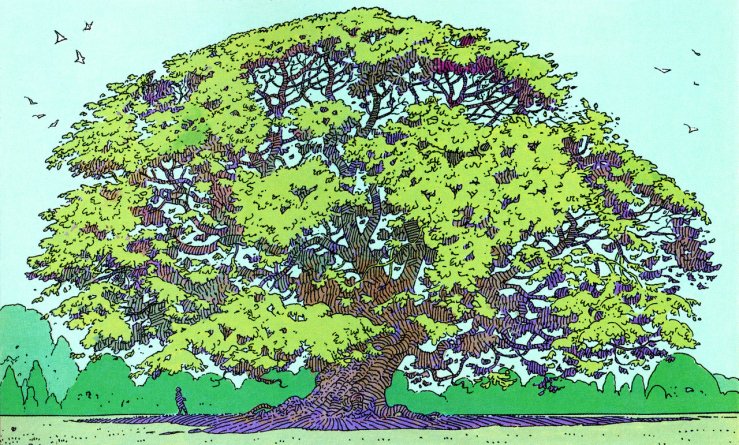
Three (noncontiguous, nonconsecutive, unrelated) panels by Moebius from various comics in Moebius 3: The Airtight Garage (Epic Comics/Marvel).

The Cardsharps — Caravaggio

Caravaggio_(Michelangelo_Merisi)_-_The_Cardsharps_-_Google_Art_ProjectScreenshot 2017-04-09 at 4.43.34 PMScreenshot 2017-04-09 at 4.44.00 PMScreenshot 2017-04-09 at 4.43.15 PMScreenshot 2017-04-09 at 4.44.42 PMScreenshot 2017-04-09 at 4.44.14 PM

Bari (The Cardsharps), c. 1594 by Michelangelo Merisi da Caravaggio (1571-1610)

Self Portrait with Scorpion — Leonor Fini

Fini Autoportrait au Scorpion 1938

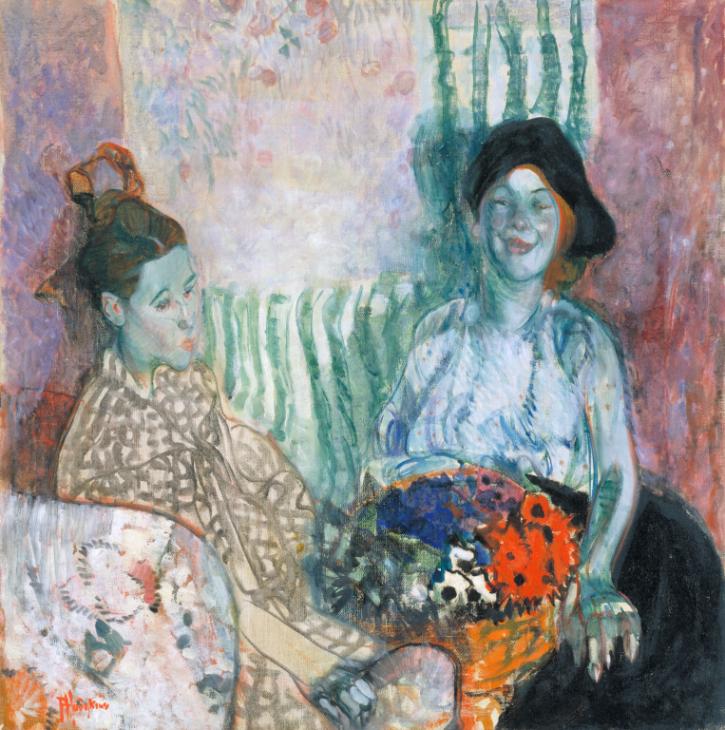
Self Portrait with Scorpion, 1938 by Leonor Fini (1908-1996)

Female Runner II — Willi Baumeister

tumblr_okwg9qbnqE1v1k5edo1_1280

Female Runner II, 1925 by Willi Baumeister (1889-1955)

Drowsed over Voltaire’s “Candide,” occasionally refreshing myself with a tune from Mr. Thoreau’s musical-box | Nathaniel Hawthorne’s journal entry for Saturday, April 8th, 1843

Saturday, April 8th.–After journalizing yesterday afternoon, I went out and sawed and split wood till teatime, then studied German (translating “Lenore”), with an occasional glance at a beautiful sunset, which I could not enjoy sufficiently by myself to induce me to lay aside the book. After lamplight, finished “Lenore,” and drowsed over Voltaire’s “Candide,” occasionally refreshing myself with a tune from Mr. Thoreau’s musical-box, which he had left in my keeping. The evening was but a dull one.

I retired soon after nine, and felt some apprehension that the old Doctor’s ghost would take this opportunity to visit me; but I rather think his former visitations have not been intended for me, and that I am not sufficiently spiritual for ghostly communication. At all events, I met with no disturbance of the kind, and slept soundly enough till six o’clock or thereabouts. The forenoon was spent with the pen in my hand, and sometimes I had the glimmering of an idea, and endeavored to materialize it in words; but on the whole my mind was idly vagrant, and refused to work to any systematic purpose. Between eleven amid twelve I went to the post-office, but found no letter; then spent above an hour reading at the Athenæum. On my way home, I encountered Mr. Flint, for the first time these many weeks, although he is our next neighbor in one direction. I inquired if he could sell us some potatoes, and he promised to send half a bushel for trial. Also, he encouraged me to hope that he might buy a barrel of our apples. After my encounter with Mr. Flint, I returned to our lonely old abbey, opened the door without the usual heart-spring, ascended to my study, and began to read a tale of Tieck. Slow work, and dull work too! Anon, Molly, the cook, rang the bell for dinner,–a sumptuous banquet of stewed veal and macaroni, to which I sat down in solitary state. My appetite served me sufficiently to eat with, but not for enjoyment. Nothing has a zest in my present widowed state. [Thus far I had written, when Mr. Emerson called.] After dinner, I lay down on the couch, with the “Dial” in my hand as a soporific, and had a short nap; then began to journalize.

Mr. Emerson came, with a sunbeam in his face; and we had as good a talk as I ever remember to have had with him. He spoke of Margaret Fuller, who, he says, has risen perceptibly into a higher state since their last meeting. [There rings the tea-bell.] Then we discoursed of Ellery Channing, a volume of whose poems is to be immediately published, with revisions by Mr. Emerson himself and Mr. Sam G. Ward. . . . He calls them “poetry for poets.” Next Mr. Thoreau was discussed, and his approaching departure; in respect to which we agreed pretty well, . . . We talked of Brook Farm, and the singular moral aspects which it presents, and the great desirability that its progress and developments should be observed and its history written; also of C. N—-, who, it appears, is passing through a new moral phasis. He is silent, inexpressive, talks little or none, and listens without response, except a sardonic laugh and some of his friends think that he is passing into permanent eclipse. Various other matters were considered or glanced at, and finally, between five and six o’clock, Mr. Emerson took his leave. I then went out to chop wood, my allotted space for which had been very much abridged by his visit; but I was not sorry. I went on with the journal for a few minutes before tea, and have finished the present record in the setting sunshine and gathering dusk. . . .

Nathaniel Hawthorne’ journal entry for Saturday, April 8th, 1843. From Passages from the American Note-Books.


Fortress — Jeremy Geddes

Fortress2000Screenshot 2017-04-06 at 8.18.17 AMScreenshot 2017-04-06 at 8.18.47 AM

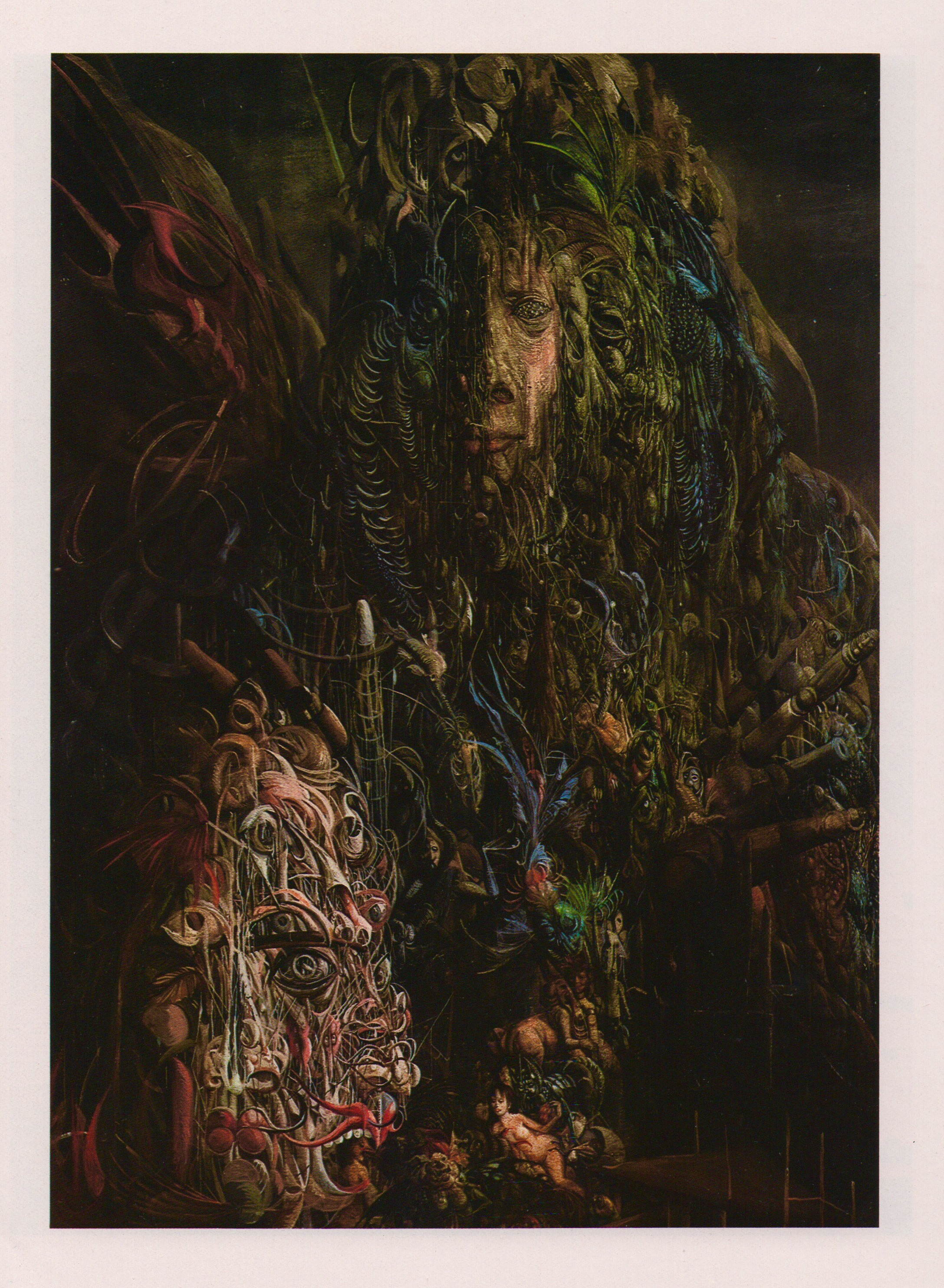
Fortress, 2014 by Jeremy Geddes (b. 1974)

Little Magazine, World Form (Book acquired, 5 April 2017)

img_5662

Eric Bulson’s Little Magazine, World Form is new from Columbia University Press. It looks pretty cool. Their blurb:

Little magazines made modernism. These unconventional, noncommercial publications may have brought writers such as James Joyce, T. S. Eliot, Ezra Pound, Marianne Moore, Mina Loy, and Wallace Stevens to the world but, as Eric Bulson shows in Little Magazine, World Form, their reach and importance extended far beyond Europe and the United States. By investigating the global and transnational itineraries of the little-magazine form, Bulson uncovers a worldwide network that influenced the development of literature and criticism in Africa, the West Indies, the Pacific Rim, and South America.

In addition to identifying how these circulations and exchanges worked, Bulson also addresses equally formative moments of disconnection and immobility. British and American writers who fled to Europe to escape Anglo-American provincialism, refugees from fascism, wandering surrealists, and displaced communists all contributed to the proliferation of print. Yet the little magazine was equally crucial to literary production and consumption in the postcolonial world, where it helped connect newly independent African nations. Bulson concludes with reflections on the digitization of these defunct little magazines and what it means for our ongoing desire to understand modernism’s global dimensions in the past and its digital afterlife.

Window — Kansuke Yamamoto

window-1941.jpg!Large.jpg

Window, 1941 by Kansuke Yamamoto (1930-86)

The Photographer — Jacob Lawrence

hb_2001.205a

The Photographer, 1942 by Jacob Lawrence (1917–2000)

Crossing the Border — Odd Nerdrum

Crossing-the-border.jpg

ab

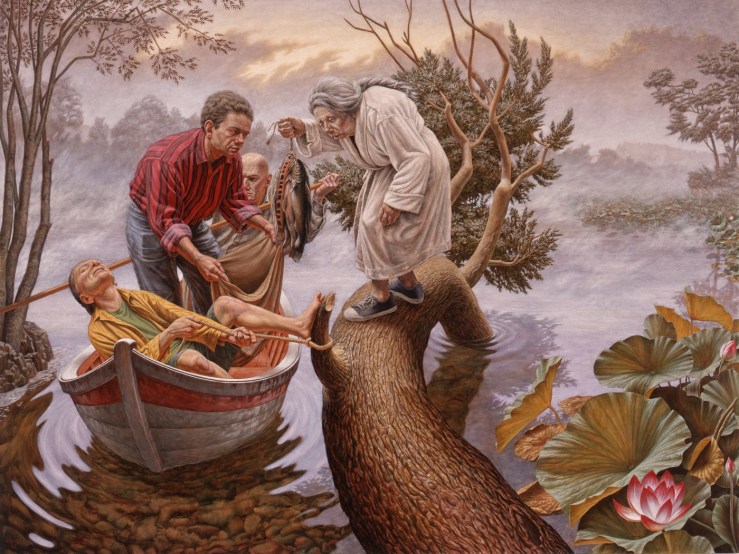
Crossing the Border by Odd Nerdrum (b. 1944)

“O Florida, Venereal Soil” — Wallace Stevens

“O Florida, Venereal Soil”

by

Wallace Stevens


A few things for themselves,
Convolvulus and coral,
Buzzards and live-moss,
Tiestas from the keys,
A few things for themselves,
Florida, venereal soil,
Disclose to the lover.

The dreadful sundry of this world,
The Cuban, Polodowsky,
The Mexican women,
The negro undertaker
Killing the time between corpses
Fishing for crayfish…
Virgin of boorish births,

Swiftly in the nights,
In the porches of Key West,
Behind the bougainvilleas,
After the guitar is asleep,
Lasciviously as the wind,
You come tormenting,
Insatiable,

When you might sit,
A scholar of darkness,
Sequestered over the sea,
Wearing a clear tiara
Of red and blue and red,
Sparkling, solitary, still,
In the high sea-shadow.

Donna, donna, dark,
Stooping in indigo gown
And cloudy constellations,
Conceal yourself or disclose
Fewest things to the lover —
A hand that bears a thick-leaved fruit,
A pungent bloom against your shade.

“Old Jerusalem” — Palace Music