Bulgakov, Bowles, Gass (Books acquired 31 March 2017)

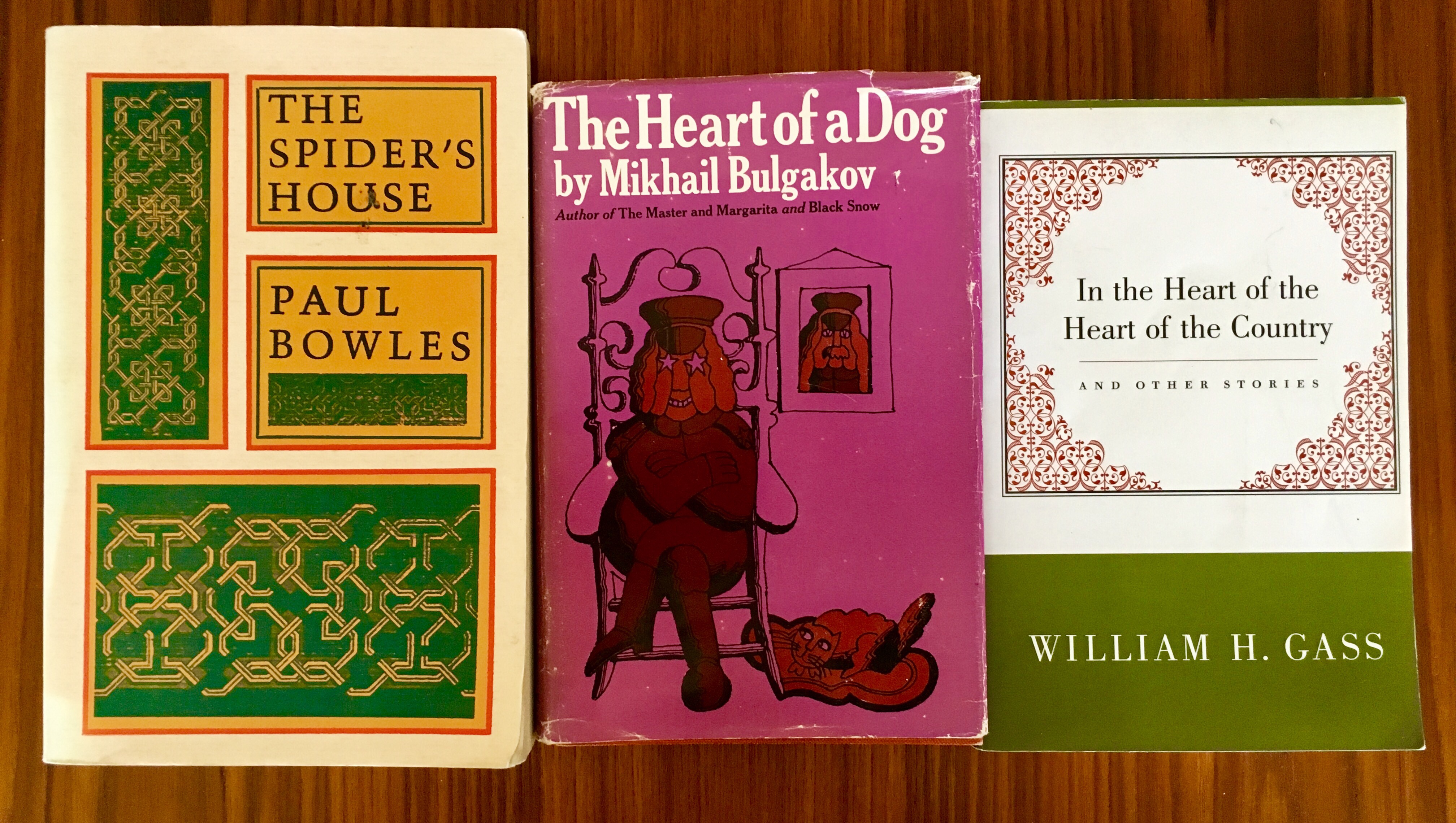
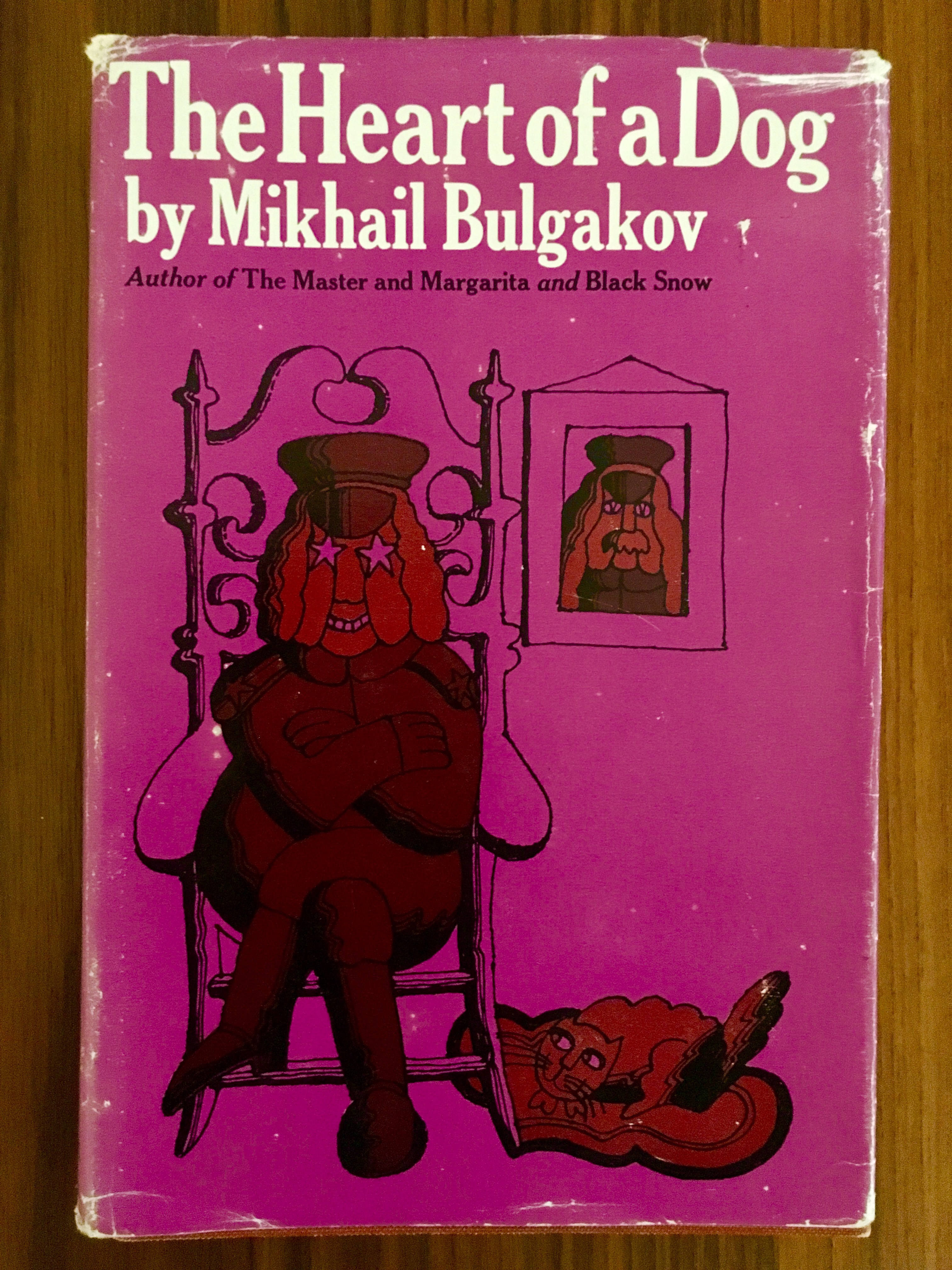
I like to shuffle around my favorite used bookstore on Fridays if I have a loose hour. This afternoon, I picked up three: A first-ed. U.S. hardback Bulgakov, an Ecco-Press-imitating-Black-Sparrow-Press Paul Bowles, and a stately-but-too-stately-too-prestigish-(as-opposed-to-“prestigious”) copy of William H. Gass’s In the Heart of the Heart of the Country. 

I read the devastating  “The Pedersen Kid,” the first novella in the In the Heart of the Heart of the Country collection of collected novellas a few years ago when I checked this book out of the library. Some helpful joker inscribed a map in this copy:

img_5637

Said joker also appended three ball pen inked cursive notes to the end of the tale:

“Coming-of age

Christ / resurrection

Oedipal”

I think I read the next story (it’s much shorter), “Mrs. Mean,” but I confess I can’t recall it right now. I do remember returning the book to the library though.

The design of the Paul Bowles Ecco Press edition of The Spider’s House kinda sorta matches the design of In the Heart of the Heart of the Heart of the Heart (Nonpareil Books, btw). I recently finished Up Above the World (after reading and being slightly-disappointed in the more-lauded debut The Sheltering Sky). I liked Up Above the World’s sinister slow-burn. My understanding is that The Spider’s House is considered superior, so we’ll see. (2017 is turning into The Year I Finally Read Paul Bowles).

Mikhail Bulgakov’s samizdat Soviet-era novel Master and Margarita has improved in my memory; reviewing my review of it a few years ago, I find that I remember it fondly, and stronger. (I wrote that it “sags at times”; I don’t remember the saggy bits, but I recall its fun effervescent evil bits).

Anyway, I couldn’t pass up on this first-edition U.S. copy (1968 Harcourt, Brace & World) of Bulgakov’s novel The Heart of a Dog (English translation by Michael Glenny, with jacket design by Applebaum & Curtis, Inc.).

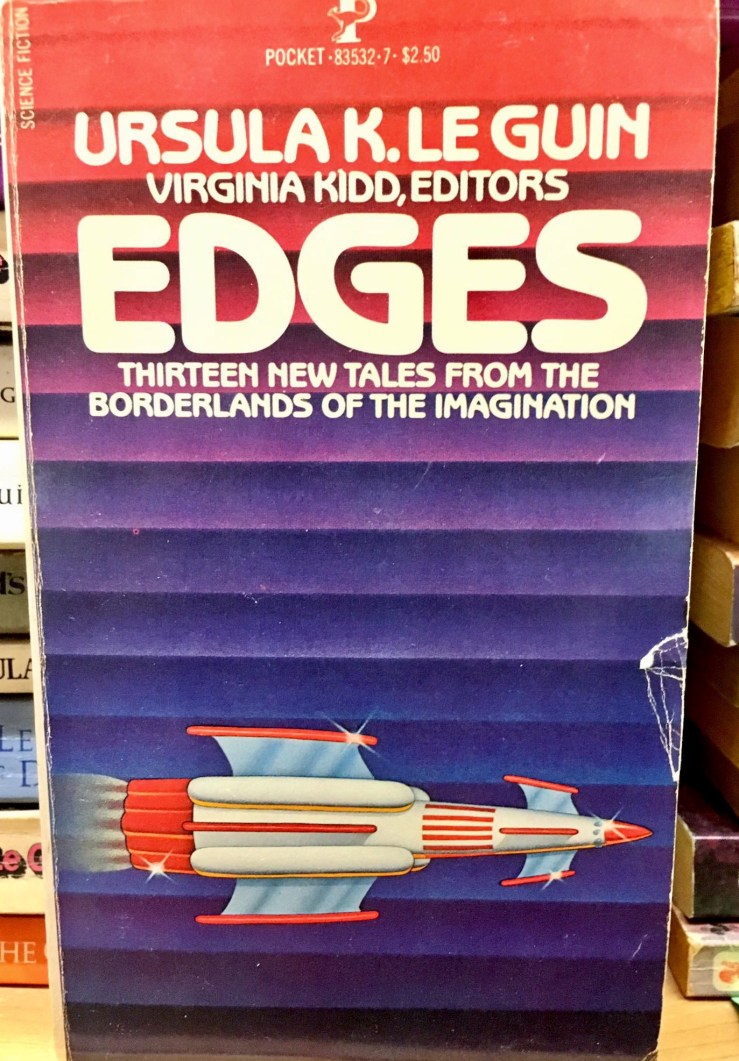
I also took note of this cover for Edges, a 1980 sci-fi anthology edited by Ursula K. Le Guin and Virginia Kidd (and featuring authors like Thomas Disch and Gene Wolfe)—but I didn’t pick it up, mostly because I didn’t particularly have any desire to read it, even though a much younger version of me out there would’ve loved to read it. I mean, I was thinking about that younger version of me out there; maybe that version—a different version of course—will find it.

img_5630

Self-Portrait under Plastic — Maria Lassnig

1972_Selbstportraet unter Plastik

Selbstporträt unter Plastik (Self-Portrait under Plastic), 1972 by Maria Lassnig (1919-2014)

Nathaniel Hawthorne’s journal entry for Friday, March 31st, 1843

Friday, March 31st, 1843.–The first month of spring is already gone; and still the snow lies deep on hill and valley, and the river is still frozen from bank to bank, although a late rain has caused pools of water to stand on the surface of the ice, and the meadows are overflowed into broad lakes. Such a protracted winter has not been known for twenty years, at least. I have almost forgotten the wood-paths and shady places which I used to know so well last summer; and my views are so much confined to the interior of our mansion, that sometimes, looking out of the window, I am surprised to catch a glimpse of houses, at no great distance, which had quite passed out of my recollection. From present appearances, another month may scarcely suffice to wash away all the snow from the open country; and in the woods and hollows it may linger yet longer. The winter will not have been a day less than five months long; and it would not be unfair to call it seven. A great space, indeed, to miss the smile of Nature, in a single year of human life. Even out of the midst of happiness I have sometimes sighed and groaned; for I love the sunshine and the green woods, and the sparkling blue water; and it seems as if the picture of our inward bliss should be set in a beautiful frame of outward nature. . . . As to the daily course of our life, I have written with pretty commendable diligence, averaging from two to four hours a day; and the result is seen in various magazines. I might have written more, if it had seemed worth while, but I was content to earn only so much gold as might suffice for our immediate wants, having prospect of official station and emolument which would do away with the necessity of writing for bread. Those prospects have not yet had their fulfilment; and we are well content to wait, because an office would inevitably remove us from our present happy home,–at least from an outward home; for there is an inner one that will accompany us wherever we go. Meantime, the magazine people do not pay their debts; so that we taste some of the inconveniences of poverty. It is an annoyance, not a trouble.

Every day, I trudge through snow and slosh to the village, look into the post-office, and spend an hour at the reading-room; and then return home, generally without having spoken a word to a human being. . . . In the way of exercise I saw and split wood, and, physically, I never was in a better condition than now. This is chiefly owing, doubtless, to a satisfied heart, in aid of which comes the exercise above mentioned, and about a fair proportion of intellectual labor.

On the 9th of this month, we left home again on a visit to Boston and Salem. I alone went to Salem, where I resumed all my bachelor habits for nearly a fortnight, leading the same life in which ten years of my youth flitted away like a dream. But how much changed was I! At last I had caught hold of a reality which never could be taken from me. It was good thus to get apart from my happiness, for the sake of contemplating it.

On the 2lst, I returned to Boston, and went out to Cambridge to dine with Longfellow, whom I had not seen since his return from Europe. The next day we came back to our old house, which had been deserted all this time; for our servant had gone with us to Boston.

From Nathaniel Hawthorne’s Passages from the American Note-Books.

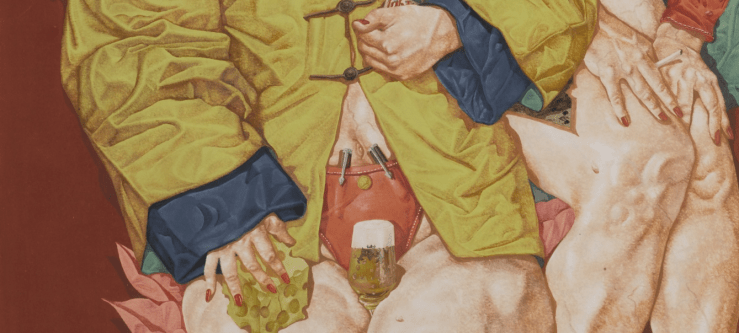
Interior Series No. 1 — Wei Dong

R0017HK0614_86P8XScreenshot 2017-03-30 at 8.47.55 PMScreenshot 2017-03-30 at 8.48.13 PM

Interior Series No. 1, 1999 by Wei Dong (b. 1968)

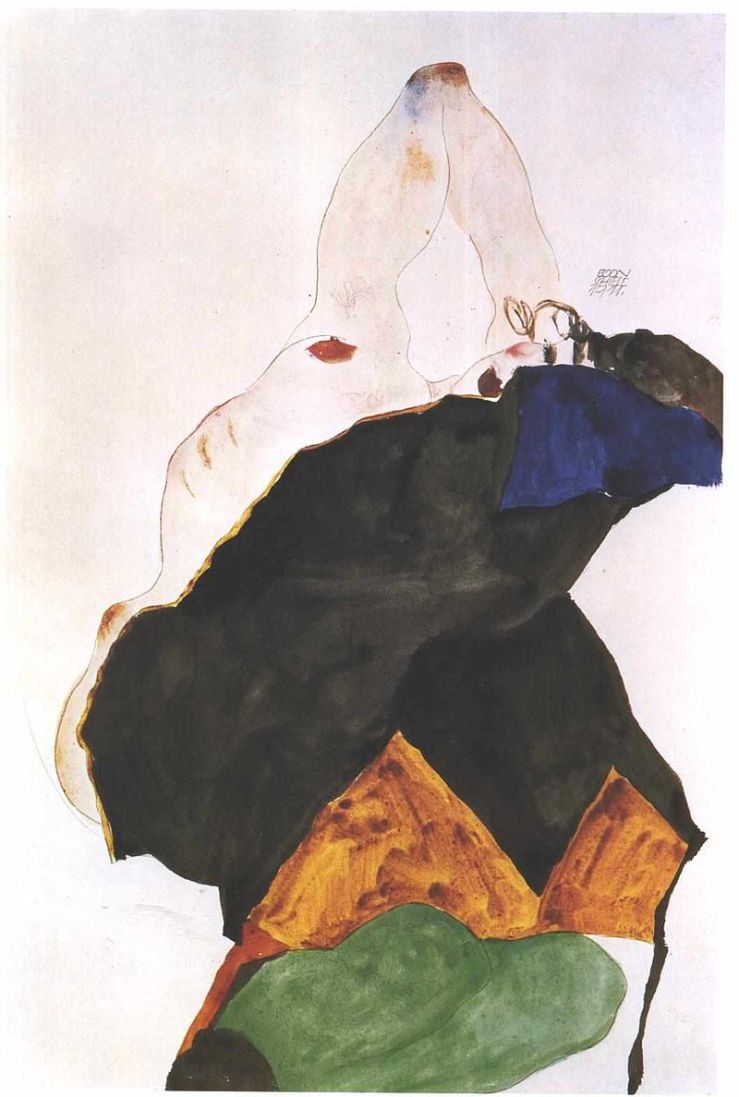
Girl with Raised Elbow — Egon Schiele

800px-Schiele_-_Mädchen_mit_erhobenen_Ellenbogen_-_1911

Mädchen mit erhobenen Ellenbogen (Girl with Raised Elbow), 1911 by Egon Schiele

Or shroud of gnome / Himself, himself inform (Emily Dickinson)

eds

The Participants — Jean-Pierre Roy

JeanPierre_Roy_The_Participants_2016_oil_on_linen_140_x_190_cm_55_x_75_in_3000

abcd

The Participants, 2016 by Jean-Pierre Roy (b. 1974)

The Temptation of St. Anthony — Ivan Albright

6624261251_ab455590f9_oScreenshot 2017-03-29 at 2.30.31 PMScreenshot 2017-03-29 at 2.30.52 PMScreenshot 2017-03-29 at 2.31.11 PMScreenshot 2017-03-29 at 2.31.53 PM

The Temptation of St. Anthony, 1944-45 by Ivan Albright (1897-1983)

The Years Which The Bumblebees Have Eaten — Dejan V. Ulardžić

449784694Screenshot 2017-03-28 at 3.20.12 PMScreenshot 2017-03-28 at 3.20.30 PMScreenshot 2017-03-28 at 3.21.17 PMScreenshot 2017-03-28 at 3.21.35 PMScreenshot 2017-03-28 at 3.21.52 PM

The Years Which the Bumblebees Have Eaten, 1989-95 by Dejan V. Ulardžić  (b. 1956)

Tell Me How This Ends Well (Book acquired some time in March, 2017)

img_5470

David Samuel Levinson’s novel Tell Me How This Ends Well is forthcoming in hardback from Penguin Random House. Their blurb:

Untitled (Grey Angel) — Heinrich Nüsslein

tateetc-thehiddenhand7 (1).jpeg

Untitled (Grey Angel), 1930–40s by Heinrich Nüsslein (1879-1947)

The Guest Room — Dorothea Tanning

dtguestroomScreenshot 2017-03-27 at 8.02.03 PMScreenshot 2017-03-27 at 8.01.38 PMScreenshot 2017-03-27 at 8.02.21 PMScreenshot 2017-03-27 at 8.01.16 PM

The Guest Room, 1950-52 by Dorothea Tanning (1910-2012).

“Tapiama,” a surreal and abject short story by Paul Bowles

“Tapiama”

by

Paul Bowles


JUST BEHIND the hotel was the river. If it had come from very far inland it would have been wide and silent, but because it was really only a creek swollen by the rains, and its bed was full of boulders, it made a roaring noise which the photographer briefly mistook for more rain. The heat and the trip had tired him out; he had eaten the cold fried fish and the leathery omelet that oozed grease, the brown bean paste with rice and burned bananas, and had been overtaken suddenly by a sleepiness powerful as the effect of a drug. Staggering to his bed, he had ripped off his shirt and trousers, lifted the stiff mosquito-net that reeked of dust, and dropped like a stone onto the mattress, only distantly noticing its hardness before he lost himself in sleep.

But in the night when he awoke he realized he had been in the false sleep of indigestion; staring into the blackness over his head he told himself that it was going to be hard to find the way back into oblivion. It was then that he had become aware of the night’s changeless backdrop of sound, and had taken it for rain. Now and then, far above his head (how could the ceiling be that high?) a firefly’s nervous little light flashed its indecipherable code for an instant or two. He was lying on his back; something small was crawling down his chest. He put his hand there; it was a slowly moving drop of sweat. The rough sheet under him was wet. He wanted to move, but if he did there would be no end to the shifting, and each new position would be more uncomfortable than the last. In the anonymous darkness of a nearby room someone coughed from time to time; he could not tell whether it was a man or a woman. The meal he had eaten lay like ten meals in his stomach. Slowly the memory of it was suffused with a nebulous horror—particularly the heavy cold omelet shining with grease.

Lying there smelling the dust from the netting was like being tied up inside a burlap bag. To get out into the street and walk—that was what he wanted, but there were difficulties. The electricity went off at midnight; the old man who ran the hotel had told him that. Instead of putting the matches under his pillow he had left them in his trouser-pocket, and the idea of stepping out on to the floor barefoot without a light did not appeal to him. Besides, he reminded himself, listening again to the wide, strangely distant clamor out there, it was raining. But to move along the dead streets even under the invisible rain would be a pleasure.…If he lay quite still, sleep might return. Finally, in desperation he yanked the net aside and sprang out of bed, across the room in the direction of the chair over which he had thrown his clothes. Continue reading ““Tapiama,” a surreal and abject short story by Paul Bowles”

We were always one step removed with irony | John Waters on art-house exploitation films

Sunday Comics

img_5607img_5608img_5609img_5610img_5611img_5613img_5606

The denouement of Barry Windsor-Smith’s Weapon X origin story. From Marvel Comics Presents #84, September, 1991. BWS was the author, penciller, inker, and colorist of the series. He also did a lot of the lettering. One of my favorite comics when I was a kid.

Some pics I took of Flannery O’Connor’s childhood home

img_5525

I enjoyed my visit to Flannery O’Connor’s childhood home in Savannah, Georgia. We visited the day before her birthday.

The house is located at 207 East Charlton Street, facing Lafayette Square, with a prominent view of the Cathedral of St. John the Baptist, where young Mary Flannery attended mass.

Here’s the house:

img_5551 Continue reading “Some pics I took of Flannery O’Connor’s childhood home”

Sunday — Edward Hopper

AR-310019948Screenshot 2017-03-26 at 12.15.32 PMScreenshot 2017-03-26 at 12.15.52 PMScreenshot 2017-03-26 at 12.15.17 PM

Sunday, 1926 by Edward Hopper (1882-1967).