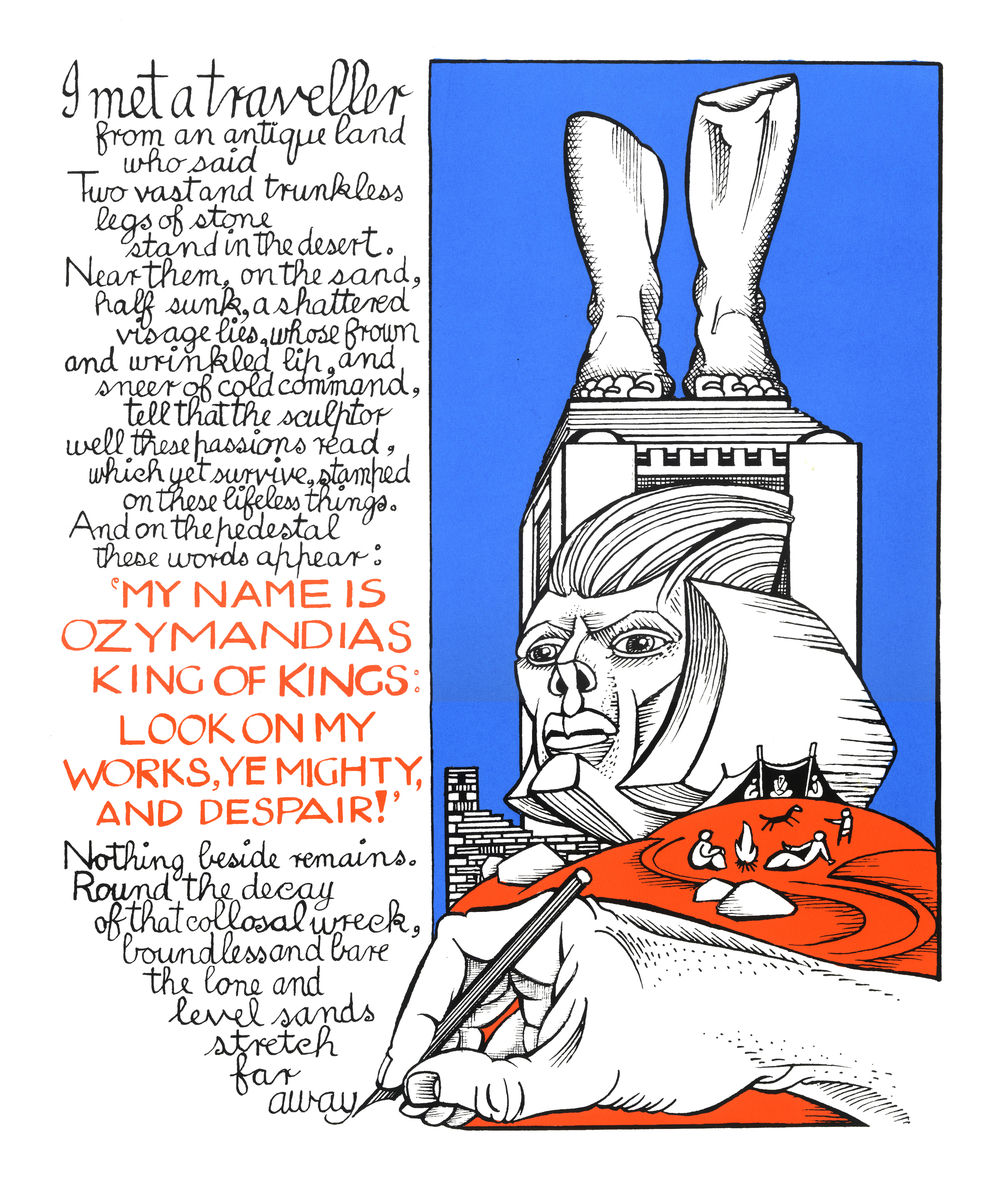
“The Rest of the Novel” — Stanley Elkin

“The Rest of the Novel”

an essay by

Stanley Elkin

collected in Pieces of Soap


For conveying ideas, novels are among the least functional and most decorative of the blunt instruments. (Could this be a universal truth, some starry, operative mathematical principle? Most stars are decorative too, of course, their function merely to peg the universe in place like studs in upholstery, servicing the elegancies, strumming its physics like a man with a blue guitar, fleshing all the centripetals and centrifugals, stringing the planets like beads, some beautiful pump of placement, arranging night, moving the planetary furniture, and fixing the astronomical data, but less useful, finally, in the sense that a handful more here or a dollop less there could make as much of a never mind as corks or rhythm, less useful, finally, than mail or ice cream.) And if, a few times in a way, novels like Richard Henry Dana’s Two Years Before the Mast or Beecher Stowe’s Uncle Tom’s Cabin or Steinbeck’s Grapes of Wrath come along to legislate, or raise a consciousness or two, or rouse a rabble, to make, I mean, what history or the papers call a difference, why that’s decorative, too, I think, a lip service the system, touching the bases like a superstitious braille, pays art—like, oh, the claims made a few years back for the “We Are the World” folks when it was really the Catholic Relief Services already on site during the Ethiopian famine that did the heavy lifting.

Well it’s not the novelist’s fault. Not that they don’t deserve some of the blame, leaking encouragement like someone paying out line to fish, some of your have-cake-and-eat-its like a little miracle of the loaves. And there are still a few big mouths who stake claims for the ameliorative shamanism of—hark! this is interesting: not the book so much as the writer—the practice of fiction—the loyal, Nutso Art Jerk Groupie, like some devoted cultist, the last Deadhead, say, worrying like holy beads the shoelace on his wrist he thinks is a bracelet making confrontation with an Elvis Presley impersonator.

Isn’t it pretty to think so, though? To take oneself as seriously as one’s readers sometimes do? To believe, if only briefly, and if only by the light off the gloss of the brittlest mood swing, in the justice or even the palpability of one’s cause, to Don Quixote principle, any principle, and raise to the level of purpose what in the final analysis is only what given egos, fashionably or not, fashion or no, frozen in mere season’s hipped au courantness, perceive as beauty. Continue reading ““The Rest of the Novel” — Stanley Elkin”

Old Man Reading — Vincent van Gogh

Old Man Reading, 1882 by Vincent van Gogh (1853–1890)

Mass-market Monday | Paulo Emílio Sales Gomes’s P’s Three Women

P’s Three Women, Paulo Emílio Sales Gomes. Translation by Margaret A. Neves. Avon Bard (1984). No cover artist credited. 136 pages.

Gomes’s only novel got a reprint from Dalkey Archive back in 2012 with a new introduction by translator Margaret Neves, who notes that in “Portuguese, the title of this book is Trés Mulheres de trés PPPés. The expression “p-p-p” means chitchat, bla-bla-bla. Hence, three women and their chitchats. In addition to echoing the narrator’s first initial, the term is lightly condescending to the women, just like P himself.”

Annie Reading — Lucian Freud

Annie Reading, 1961 by Lucian Freud (1922-2011)

Read “Among the Beanwoods,” a short story by Donald Barthelme

“Among the Beanwoods”

by

Donald Barthelme


The already-beautiful do not, as a rule, run.

I am, at the moment, seated.

Ireland and Scotland are remote; Wales fares little better. Here in this forest of tall, white beanwoods, the already-beautiful saunter. Some of them carry plump red hams, already cooked.

I am, at the moment, seated. On a chair in the forest, listening. I will rise, shortly, to hold the ladder for you. Every beanwood will have its chandelier scattering light on my exercise machine, which is made of cane. The beans you have glued together are as nothing to the difficulty of working with cane, at night, in the dark, in the wind, watched by insects. I will not allow my exercise machine to be photographed. It sings, as I exercise, like an unaccompanied cello. I will not allow my exercise machine to be recorded.

Tombs are scattered through the beanwoods, made of perfectly ordinary gray stone. All are empty. The chandeliers, at night, scatter light over the tombs, little houses in which I sleep, from time to time, with the already-beautiful, and they with me. We call to each other, at night, saying “Hello, hello” and “Who, who, who?” That one has her hips exposed, for rubbing.

Holding the ladder, I watch you glue additional chandeliers to appropriate limbs. You are tiring, you have worked very hard. Iced beanwater will refresh you, and these wallets made of ham. I have been meaning to speak to you. I have set bronze statues of alert, crouching Indian boys around the periphery of the forest, for ornamentation. Each alert, crouching Indian boy is accompanied by a large, bronze, wolf-like dog, finely polished.

I have been meaning to speak to you. I have many pages of notes. I have a note about cameras, a note about recorders, a note about steel wool, a note about the invitations. On weightier matters I will speak without notes, freely and passionately, as if inspired, at night, in a rage, slapping myself, great tremendous slaps to the brow which will fell me to the earth. The already-beautiful will stand and watch, in a circle, cradling, each, an animal in mothering arms — green monkey, meadow mouse, tucotuco. That one has her hips exposed, for study. I make careful notes. You snatch the notebook from my hands.

The pockets of your smock swinging heavily with the lights of chandeliers. Your light-by-light, bean-by-bean career.

I am, at this time, prepared to dance. The already-beautiful have, historically, danced. The music made by my exercise machine is, we agree, danceable. The women partner themselves with large bronze hares, which have been cast in the attitudes of dancers. The beans you have glued together are as nothing to the difficulty of casting hares in the attitudes of dancers, at night, in the foundry, the sweat, the glare. Thieves have been invited to dinner, along with the deans of the great cathedrals. The thieves will rest upon the bosoms of the deans, at dinner, among the beanwoods. Soft benedictions will ensue.

I am privileged, privileged, to be able to hold your ladder.

Pillows are placed in the tombs, together with pot holders and dust cloths. The already-beautiful strut. England is far away, and France is scarcely nearer. I am, for the time being, reclining. In a warm tomb, with Concordia, who is beautiful. Mad with bean wine she has caught me by the belt buckle and demanded that I hear her times tables. Her voice enchants me. Tirelessly you glue. The forest will soon exist on some maps, a tribute to the quickness of the world’s cartographers. This life is better than any life I have lived, previously. I order more smoke, which is delivered in heavy glass demi-johns, twelve to a crate. Beautiful hips abound, bloom. Your sudden movement toward red kidney beans has proved, in the event, masterly. Everywhere we see formal gowns of red kidney beans, which have been polished to the fierceness of carnelians. No ham hash does not contain two beans, polished to the fierceness of carnelians.

Spain is distant, Portugal wrapped in an impenetrable haze. These noble beans, glued by you, are mine. Thousand-pound sacks are off-loaded at the quai, against our future needs. The thieves are willing workers, the deans, straw bosses of extraordinary tact. I polish hares, dogs, Indian boys in the chill of early morning. Your weather reports have been splendid. The fall of figs you predicted did in fact occur. There is nothing like ham in fig sauce, or almost nothing. I am, at the moment, feeling very jolly. Hey hey, I say. It is remarkable how well human affairs can be managed, with care.

The Magdalene Reading — Rogier van der Weyden

The Magdalene Reading, 1445 by Rogier van der Weyden (c. 1399-1464)

Selections from One-Star Amazon Reviews of Iain Bank’s novel The Wasp Factory

[Editorial note: The following citations come from one-star Amazon reviews of Iain Bank’s novel The Wasp Factory (which I thought was great). More one-star Amazon reviews.]


Crap

drivel

childish

twaddle

well written

I am baffled

absolute tosh

talented author

load of rubbish

Science function.

an unusual story

Distastful content

mild teenage drivel

making me feel sick

positively disgusting

This book is diseased.

potential to be terrific

supposed great author

had to delete this book

I am missing something

is self indulgent and nasty

I had not hear of Iain Banks

I read this almost to the end

sticking their heads on poles

making me feel physically sick

sitting in a a bar with half drunks

I am a high school English teacher

Deeply distasteful dystopian drivel

an ugly Freudian post-modern sack

I hated this book and wish I never read it

soul destroying book makes me feel icky

Woof ! Creepy ! I read 2 pages … no more.

a skilled writer delivering pointless awfulness

At the top of the list of worst books I’ve ever read.

The characters had absolutely no redeeming features

I thought it would be a horror tale that would be great for Halloween

I couldn’t relate to any of the characters in the story. As a matter of fact, I didn’t like any of them.

well written, well constructed and kept me gripped page by page – but it was a loathsome experience

a sordid study of a grubby psychopathic personality of no merit or interest at all

I ordered this product and ended up with a Cuban poetry book. :(

I would burn my copy if I could. Unfortunately, it is electronic,

I bought it because it’s a story about psychopath. Well its not!

Miserable characters, childish writing, and pointless violence

Perhaps reading should expose us to such things but

I like mysteries, including murder mysteries, but

I’ve rarely had this negative reaction to a book

there are enough crazies in the real world

easily the worst book I have ever read

gratuitous tripe sweeps nation

I’m stupider for having read it

why am I reading this horror

I absolutely hated this book.

Found it a thoroughly book

violent, mad and depraved

Misogynistic, pretentious

This book is simply BAD

im glas i only bought one

I ploughed diligently

difficult to empathise

lacklustre last chapter

don’t waist your time

contains sick cruelty

blowing up animals

vulgar and uncouth

our book group

our Book Group

excellent prose

Drunks beware!

Poorly written

straight fiction

twisted mind

Well written

book club

unpleasant

I feel used.

I hate it!

Enjoy.

Dinah Brooke’s Death Games (Book acquired, 8 Aug. 2024)

I broke down and bought an inexpensive copy of Dinah Brooke’s 1976 novel Death Games from an internet vendor. I absolutely loved her 1973 novel Lord Jim at Home, which never got a U.S. release (until a year or two ago). Death Games did get a U.S. release—I guess because it involves the Vietnam War?—and was reviewed by Jane Larkin Crain in The New York Times. She wrote:

Pornographic brutality dominates this distasteful tale of carnage, corruption and colonialism in Indochina, starring young, beautiful, demented Elspeth Waterhouse, who pursues her impeccably detached tycoon of a father from Bangkok to Vientiane to Saigon, hungering after his recognition and love. Also featured are maimed and traumatized American war veteran who conducts an unlikely affair with Elspeth and Veronique, Waterhouse’s business associate and mistress, whose son is relegated to boarding school so that she may go globe‐trotting with her lover. . .

Death Games . . . largely dispenses with the mechanics of plot, pacing and characterization. In the course of a very short novel, scenes of debauchery, rape, murder, cannibalistic fantasy, suicide, bloodshed follow so quickly one upon the other, with so little sense or modulation…

I think Crain hated it!

Who are the postmodernists? | John Barth

Who are the postmodernists? By my count, the American fictionists most commonly included in the canon, besides the three of us at Tubingen, are Donald Barthelme, Robert Coover, Stanley Elkin, Thomas Pynchon, and Kurt Vonnegut, Jr. Several of the critics I read widen the net to include Saul Bellow and Norman Mailer, different as those two writers would appear to be. Others look beyond the United States to Samuel Beckett, Jorge Luis Borges, and the late Vladimir Nabokov as engendering spirits of the “movement”; others yet insist upon including the late Raymond Queneau, the French “new novelists” Nathalie Sarraute, Michel Butor, Alain Robbe-Grillet, Robert Pinget, Claude Simon, and Claude Mauriac, the even newer French writers of the Tel Quel group, the Englishman John Fowles, and the expatriate Argentine Julio Cortázar. Some assert that such filmmakers as Michelangelo Antonioni, Federico Fellini, Jean-Luc Godard, and Alain Resnais are postmodernists. I myself will not join any literary club that doesn’t include the expatriate Colombian Gabriel García Márquez and the semi-expatriate Italian Italo Calvino, of both of whom more presently. Anticipations of the “postmodernist literary aesthetic” have duly been traced through the great modernists of the first half of the twentieth century—T. S. Eliot, William Faulkner, André Gide, James Joyce, Franz Kafka, Thomas Mann, Robert Musil, Ezra Pound, Marcel Proust, Gertrude Stein, Miguel de Unamuno, Virginia Woolf—through their nineteenth-century predecessors—Alfred Jarry, Gustave Flaubert, Charles Baudelaire, Stephane Mallamd, and E. T. A. Hoffmann—back to Laurence Sterne’s Tristram Shandy (1767) and Miguel de Cervantes’s Don Quixote (1615).

On the other hand, among certain commentators the sifting gets exceedingly fine. Professor Jerome Klinkowitz of Northern Iowa, for example, hails Barthelme and Vonnegut as the exemplary “postcontemporaries” of the American 1970s and consigns Pynchon and myself to some 1960ish outer darkness. I regard the novels of John Hawkes as examples of fine late modernism rather than of postmodernism (and I admire them no less for that). Others might regard most of Bellow, and Mailer’s The Naked and the Dead, as comparatively premodernist, along with the works of such more consistently traditionalist American writers as John Cheever, Wallace Stegner, William Styron, or John Updike, for example (the last of whom, however, Ihab Hassan calls a modernist), or those of most of the leading British writers of this century (as contrasted with the Irish), or those of many of our contemporary American women writers of fiction, whose main literary concern, for better or worse, remains the eloquent issuance of what the critic Richard Locke has called “secular news reports.” Even among the productions of a given writer, distinctions can be and often are invoked. Joyce Carol Oates writes all over the aesthetical map. John Gardner’s first two published novels I would call distinctly modernist works; his short stories dabble in postmodernism; his polemical nonfiction is aggressively reactionary. Italo Calvino, on the other hand, began as an Italian new-realist (in The Path to the Nest of Spiders, 1947) and matured into an exemplary postmodernist (with e.g., Cosmicomics, 1965, and The Castle of Crossed Destinies, 1969) who on occasion rises, sinks, or merely shifts to modernism (e.g., Invisible Cities, 1972). My own novels and stories seem to me to have both modernist and postmodernist attributes, even occasional premodernist attributes.

One certainly does have a sense of having been through this before. Indeed, some of us who have been publishing fiction since the 1950s have had the interesting experience of being praised or damned in that decade as existentialists and in the early 1960s as black humorists. Had our professional careers antedated the Second World War, we would no doubt have been praised or damned as modernists, in the distinguished company listed above. Now we are praised or damned as postmodernists.


From John Barth’s 1980 essay “The Literature of Replenishment.”

“Dangeresque,” a very short story by Diane Williams

“Dangeresque”

by

Diane Williams


Mrs. White at the Red Shop showed me the beady-eyed garment, but I can’t pay for it. I’m broke! I already own a gold ring and a gold-filled wristwatch and I am very uncomfortable with these. My eyes sweep the garment and its charms.

I am tempted to say this is how love works, bury­ing everyone in the same style.

Through a fault of my own I set off as if I’m on a horse and just point and go to the next village.

This village is where flowers are painted on the sides of my house—big red dots, big yellow balls.

At home, stuck over a clock’s pretty face, is a note from my husband to whom I do not show affection. With a swallow of tap water, I take a geltab.

By this time I had not yet apologized for my actions. Last night my husband told me to get up out of the bed and to go into another room.

My husband’s a kind man, a clever man, a patient man, an honest man, a hard-working man.

Many people have the notion we live in an age where more people who behave just like he does lurk.

See, I may have a childlike attitude, but a woman I once read about attempted a brand new direction with a straight face.

Mass-market Monday | Stanley Elkin’s The Living End

The Living End, Stanley Elkin. First Warner Books printing (1980). Cover art by Don Ivan Punchatz; cover design by Gene Light; cover type by Richard Nebiola. 141 pages.

An excerpt from The Living End:

God gave a gala, a levee at the Lord’s.

All Heaven turned out.

“Gimme,” He said, that old time religion.” His audience beamed. They cheered, they ate it up. They nudged each other in Paradise.

“What did I tell you?” He demanded over their enthusiasm.

“It’s terrific, isn’t it? I told you it would be terrific. All you ever had to do was play nice. Are you disappointed? Is this Heaven? Is this God’s country? In your wildest dreams-let Me hear it. Good-in your wildest dreams, did you dream such a Treasury, this museum Paradise? Did you dream My thrones and dominions, My angels in fly-over? My seraphim disporting like dolphins, tumbling God’s sky in high Heaven’s high acrobacy? Did you imagine the miracles casual as card tricks, or ever suspect free lunch could taste so good? They should see you now, eh? They should see you now, trembling in rapture like neurological rut. Delicious, correct? Piety a la mode! That’s it, that’s right. Sing hallelujah! Sing Hizzoner’s hosannas, Jehovah’s gee whiz! Well,” God said, .1 that’s enough, that will do.” He looked toward the Holy Family, studying them for a moment.

“Not like the creche, eh?” He said.

“Well is it? Is it?” He demanded of Jesus.

“No,” Christ said softly.

“No,” God said, “not like the creche. just look
at this place- the dancing waters and indirect lighting. I could put gambling in here, off-track betting. Oh, oh, My costume jewelry ways, My game show vision.

Well, it’s the public. You’ve got to give it what it wants. Yes, Jesus?”

“Yes,” Jesus said.

“It just doesn’t look lived in, is that what you think

“Call on someone else,” Christ said.

“Sure,” God said.

“I’m Hero of Heaven. I call on Myself.”

That was when He began His explanations. He revealed the secrets of books, of pictures and music, telling them all manner of things-why marches were more selfish than anthems, lieder less stirring than scat, why landscapes were to be preferred over portraits, how statues of women were superior to statues of men but less impressive than engravings on postage. He explained why dentistry was a purer science than astronomy, biography a higher form than dance. He told them how to choose wines and why solos were more acceptable to Him than duets. He told them the secret causes of inflation-“It’s the markup,” He said-and which was the best color and how many angels could dance on the head of a pin. He explained why English was the first language at Miss Universe pageants and recited highlights from the eighteen-minute gap.

Mary, wondering if she showed yet, was glad Joseph was seated next to her. Determined to look proud, she deliberately took her husband’s hand. So rough, she thought, such stubby fingers. He explained why children suffered and showed them how to do the latest disco steps. He showed them how to square the circle, cautioning afterwards that it would be wrong.

He revealed the name of Kennedy’s assassin and told how to shop for used cars.

Gravity’s Rainbow annotations (so far)

img_4025

I’ll be adding to these and then doing more the next time (?!) I read Gravity’s Rainbow.*

Pages 82-83: The White Visitation, etc.

Page 103: Black Markets, King Kong, etc.

Pages 148-49: Preterite/Elect, Lurianic Kabbalah, Uncanny X-Men, etc.

Page 203: Rainbows, Fuck-yous, Plastic Man, etc.

Pages 204-05: Paper, mise en abyme, a silkenness of girls, etc.

Page 256: “Real America,” Hughes contra Whitman, BANZAI!, etc.

Pages 257-58: The War, nimbus clouds, Zoot Suit Riot!, etc.

Page 299: Tannhäuser, horny expectations, etc.

Page 364: Knights and fools, dendrites and axons, etc.

Pages 412-13:  Ouroboros, organic chemistry, tarot, etc.

Page 419: Innocence, experience, Wm Blake, Wagner’s Ring cycle, etc.

Page 539: Critical Mass, Weismann’s tarot reading, Rilke, hymns, etc.

Pages 627-28: Optimum time, barrage balloons, Wall of Death, etc.

Pages 712-13: The Man has a branch office in each of our brains. We might be freaks, but We are not doomed and We are not Their pets.

A(nother) completely subjective and thoroughly unnecessary ranking of Thomas Pynchon’s novels


In 2018—six years ago—on Thomas Pynchon’s 81st birthday, I put together a thoroughly unnecessary ranking of his eight novels. I’m somewhat ashamed of the post, as I included two novels I had abandoned a few times—Vineland and Bleeding Edge. Three years ago, on Pynchon’s 84th birthday, I wrote a few sentences on each of Pynchon’s novels, having, at that point, made my way through all of them. The first post, perhaps because it contains the word “ranking” in its title gets far more traffic to this day than the more thoughtful and finished post from 2021. Indeed, the “ranking” post regularly shows up in the top ten percentile of my weekly and monthly stats on Biblioklept, which, I guess, has bothered me enough to write this (thoroughly unnecessary still) “ranking.”

I know that if I were to approach Pynchon’s eight novels on eight different days, I’d likely end up with a consistent #1, #2, #3, and #8—but the other spots would shift depending on my memory or fancy or whatever spell I’d fallen under, chemical, metaphysical or otherwise. But here’s the list I came up with today.

8. Vineland (1990)

In my 2018 post (where I ranked Vineland at number 7) I noted that “Vineland seems to have a strange status for Pynchon cultists—its a cult novel in an oeuvre of cult novels,” and I’ve found that intuition confirmed over the years. I stick by my assertion in my 2021 post in which I asserted that “Vineland is ultimately depressing and easily my least-favorite Pynchon novel, but it does have some exquisite prose moments.” I’m sure I’ll revisit it before seeing Paul Thomas Anderson’s film adaptation though.

7. Inherent Vice (2009)

Speaking of Paul Thomas Anderson—I think I like his film adaptation of Inherent Vice more than I like the novel. And I love Inherent Vice. But I think PTA provides an emotional ballast that gives the narrative a center that’s missing from Pynchon’s novel (which is, likely, the point, or at least the byproduct of Pynchon’s shaggy dogging it). (I originally ranked Inherent Vice at number 6).

6. Bleeding Edge (2013)

So I finally found my way into Bleeding Edge in the earliest weeks of the COVID-19 lockdown. I’d stuck the book at the bottom of my 2018 list. I’m not really sure why I stalled out on—maybe it feels the closest to my own timeline of any Pynchon novel. Anyway, it’s one I want to revisit again soon. I riffed on it some in 2020, writing “Pynchon captures a time in America during which I was, at least theoretically, becoming an adult (a becoming which may or may not have happened yet). Reading Bleeding Edge helped evoke all the weirdness the 2000s were about to lay out for us. It made me angry again, or reminded me of the anger that I’d sustain for most of the decade. It reminded me of our huge ideological failure after 9/11, an ideological failure we are watching somehow fail even more today.  But I also loved the novel’s unexpectedly sweet domestic plot, and found a kind of solace even in its affirmation of family, even as its final image pointed to the kind of radical inconclusiveness at the heart of being a parent.”

5. V. (1963)

So from here on out my rankings are identical to my stupid 2018 list, with that big caveat that I would easily swap, say, V. and 49 here. I’ll repeat my endorsement that “V. makes a good starting place for anyone new to Pynchon” and recommend that anyone interested in Pynchon but daunted by the scope check out the book from their library and read the ninth chapter, the story of of Kurt Mondaugen.

4. The Crying of Lot 49 (1966)

The Crying of Lot 49 is probably a better novel than V. but I think I like V. better. 49 is very funny and showcases Pynchon’s tonality of paranoia/hope wrapped up in zaniness/horror. It’s an excellent sophomore novel, but also dense, claustrophobic even. I guess I like the Pynchon sprawl a bit better.

3. Against the Day  (2006)

Speaking of sprawl: Against the Day is Pynchon’s biggest novel, just fat and giddy and overstuffed with goodies. I think this novel would make an excellent American history textbook. Its thesis: resist the military-industrial-entertainment-complex. Start here!

2. Mason & Dixon (1997)

A measurement of the world and a story about friendship. It would be Pynchon’s best novel if he hadn’t written—

1. Gravity’s Rainbow (1973)

The best book. I reread it earlier this summer and it’s roomier and stranger and more rewarding each time.

Charles Burns’s Final Cut (Book acquired, 23 July 2024)

I’m excited about this one. Charles Burns’s novel Final Cut is out in late September. I’ll have a review around that time. For now, here’s publisher Pantheon’s blurb:

Riff on July 2024 reading, etc.

I experienced the middle weeks of July 2024 as simultaneously rapid and static. Doldrums should never be so frenetic. If this decade were a novel I would’ve put it down several chapters back. I try not to obsess over things I cannot control. I try to get away from screens. I try to go outside, but the feels like heat index here in north Florida goes over a hundred and five every day. (At least it’s raining again and nothing is on fire.) So I try to read more (and actually write more).

This July I read some great stuff.

I finished Katherine Dunn’s first novel Attic a couple of days ago. The book is seriously fucked up—like William Burroughs-Kathy Acker fucked up—an abject rant from a woman in prison in the mode of Ginsberg’s Howl. The narrator seems to be an autofictional version of Dunn herself, which is perhaps why Eric Rosenblum, in his 2022 New Yorker review described it as “largely a realist work in which Dunn emphasizes the trauma of her protagonist’s childhood.” Rosenblum uses the term realism two other times to describe Attic and refers to it at one point as a work of magical realism. If Attic is realism then so is Blood and Guts in High School. I need to read her second and third novels (Truck, 1971 and the posthumous Toad) and then go back and reread Geek Love, which I remember as being Gothic and gross but also whimsical. (I don’t sniff any whimsy in Attic.)

There are eight stories in Oğuz Atay’s story collection Waiting for the Fear (in translation by Ralph Hubbell); I’ve read the first five this summer, including the long title story, which is especially good, as is the opener “Man in a White Overcoat.” Atay’s heroes (I use the term loosely) find their antecedents in Kafka’s weirdos. Or Paul Bowles. Or Jane Bowles. I should have a proper review up near the end of October when NYRB publishes Waiting for the Fear.

I had picked up Mauro Javier Cárdenas’s third novel American Abductions earlier this summer and finally started it a few nights ago after finishing Attic. Each chapter is a run-on sentence that has made me want to keep reading and reading, running on with it. The novel is, at least so far, both challenging and entertaining; it is not difficult, exactly, but rather engrossing. Sometimes I’ll find myself a bit lost in the layered consciousnesses, layers (layerings) of speech in Cárdenas’s sentences—especially when I find myself startled by an image or a joke or idea—and then I’ll wade backwards again and pick up the rhythm and keep going. The plot? I’ll steal from the Dalkey Archive’s blurb: “American Abductions opens in a near-future United States whose omnipresence of data-harvesting and algorithms has enabled the mass incarceration and deportation of Latin Americans—regardless of citizenship.” But that’s not really the plot; I mean, this isn’t a third-person dystopian world-building YA thing. The novel, at least its first half, is about a family, daughters Ada and Eva and their father Antonio, a novelist who was abducted by the titular abductors (the Pale Americans!). It’s also about writing, how we construct memory in a surveillance state, and, I suppose, love.

I reviewed Jean-Baptiste Del Amo’s latest novel The Son of Man (in translation by Frank Wynne) in the middle of July, although I think I probably read it in late June. In my review I suggested that The Son of Man “is ultimately a novel about the atavistic transmission of violence from generation to generation.” I also highly recommended it.

I went on a big Antoine Volodine binge a couple of years ago which stalled out before I got to (what I believe is) his longest novel in English translation, Radiant Terminus. I finally started into it a few weeks ago (in translation by Jeffrey Zuckerman), and I think it might be Volodine’s best work. In my longish review, I declared Radiant Terminus “an astounding novel, a work that will haunt any reader willing to tune into its strange vibrations and haunted frequencies. Very highly recommended.” I think it’s a perfect starting place for anyone interested in Volodine’s so-called post-exotic project.

Denis Johnson’s The Stars at Noon was one of two novels I revisited via audiobook this month (the other is Portis’s Gringos, which we’ll get to in a moment). I honestly didn’t remember much about The Stars at Noon other than its premise and the fact that its narrator was an alcoholic journalist-cum-prostitute in Nicaragua. It hadn’t made the same impression on me as other Johnson novels had when I went through a big Johnson jag in the late nineties and early 2000s, and I think that assessment was correct—it’s simply not as strong as AngelsFiskadoro, or Jesus’ Son. As an audiobook though I enjoyed it, especially in Will Patton’s reading. (His narration of Johnson’s perfect novella Train Dreams is the perfect audiobook.) I guess the audiobook came out in conjunction with Claire Denis’ 2022 adaptation of the film, which I still haven’t seen.

The collection of Remedios Varo’s writings On Homo rodans and Other Writings is another book I read earlier in the summer but didn’t write about until July. I was fortunate enough to get a long interview with the translator, Margaret Carson, and I think the result is one of the better things Biblioklept has published this year.

I picked up Dinah Brooke’s “lost” novel Lord Jim at Home in late June, and then read it in something of a sweat over a few days. In my review, I wrote that

Lord Jim at Home is squalid and startling and nastily horrific. It is abject, lurid, violent, and dark. It is also sad, absurd, mythic, often very funny, and somehow very, very real for all its strangeness. The novels I would most liken Lord Jim at Home to, at least in terms of the aesthetic and emotional experience of reading it, are Ann Quin’s BergAnna Kavan’s Ice, Mervyn Peake’s Gormenghast novels, Virginia Woolf’s Mrs. Dalloway, and James Joyce’s Portrait (as well as bits of Ulysses).

Gringos is the other book I “reread” via audiobook this July. Charles Portis wrote five novels and all of them are perfect—but I think Gringos might be my favorite. David Aaron Baker’s reading of the novel is excellent. He conveys the dry humor of narrator Jimmy Burns as well as the cynical sweet pathos at the core of Portis’s last novel. Highly recommended.

So well I guess July is over; the kids will be back in school again soon, and so will I. The air here will remain swamp thick, humidity that starts cooking you the minute you venture out of the desiccating AC that licensed growth on this weird peninsula. It might let up by November. Maybe because I’ve spent my entire adult career as a teacher I have always thought of August as the end of the year, not December. And some years I feel melancholy at this end, this pivot away from freer hours. But writing this on the last day of July, I think I want a return to routine, to something I can think of as a return to normalcy, the kind of normalcy that makes me appreciate the weird fucked up oddball novels that I do so love to hang out inside of.

Mass-market Monday | Philip K. Dick’s A Maze of Death

A Maze of Death, Philip K. Dick. Dawn Books, first Daw printing (1983). Cover art by Bob Pepper. 191 pages.

In my review of Philip K. Dick’s 1970 novel, I wrote that A Maze of Death is

…a mishmash of metaphysical mumbo jumbo, filtered through touches of space opera and good old fashioned haunted housery. A Maze of Death is a messy space horror that threatens to leave its readers unsatisfied right up until the final moments wherein it rings its sad coda, a reverberation that nullifies all its previous twists and turns in a soothing wash of emptiness. Not the best starting place for PKD, but I’m very glad I read it.

On top of stolen books behind the Life Magazine picture of Bertrand Russell like a baby eagle | From Katherine Dunn’s first novel Attic

In the five-and-dime can’t see over the counters with her—see
the red thimble—plastic knobby—just fits—put it on and tap things with it—lips and teeth and wish I had two to click against each other—wander out with her—why where did you get that you little thief march right back in there and give it to the man and apologize—penny thimble—I didn’t even notice I’d taken it—big noise and hits—the shame…

Drugstore book racks—need a book a day at least—three thin ones—too far to the library—heavy—always overdue—little ladies in pale green uniforms inventory hair spray—perfume—Kotex while I’m putting books in my purse—in my armpits—Agatha Christie—Nero Wolfe—James Bond—candy bars in pockets—have to lay off M & Ms—they rattle too much—an extra eyebrow pencil up my sweater sleeve and buy a deodorant—go out to the car and drop the stuff—back into the supermarket for cookies and cigarettes and chocolate-covered cherries—buy milk and then tool back home to turn the heat up and sit with the rain outside—with my feet up reading trash—eating trash—drinking milk straight from the carton only pouring it into a glass when I want to dunk cookies in it…

Girls League Cake Sale—high school cakes by girls in coordinated sweaters and skirts—ribbons holding their hair—dozens of pairs of shoes—their proud bras and girdles mocking my brother’s cast-off tee shirts in the locker room—they study typing with old Birdsing and wear ribbons in their hair—bake cakes for the cake sale from scratch with boiled frosting that slump in the middle and cave on the side—patch it up with frosting and candy drops—hide them on mother’s best cake plates behind screens in the cafeteria—I ducking class as usual—hiding stink bombs behind the encyclopedias in the library—sneaking through the halls with my five-button Levi’s swishing between my legs a cake under each arm—stacking them carefully in my locker on top of stolen books behind the Life Magazine picture of Bertrand Russell like a baby eagle his fierce fuzzy face on the scrawny neck—hide for the rest of the afternoon in the conference rooms in the library listening to Jake in his chemistry room gas mask searching for the stink bombs and cursing—thinking of him fumbling with the pear-assed librarian from the grade school—all the time rehearsing my lines for if I’m caught—when the final bell rings parading down to the boys’ locker room with a dozen cakes on a book cart to wait for the wrestling team to finish weighing in and come out famished after a month of making weight…

From Katherine Dunn’s first novel Attic.