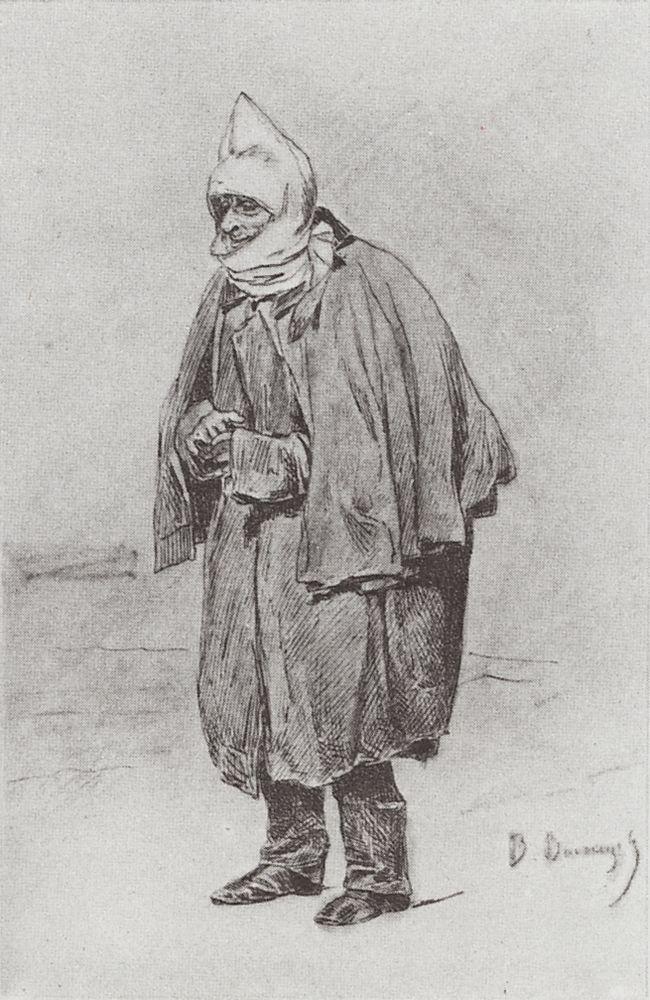
Read Nathaniel Hawthorne’s story “Ethan Brand”

“Ethan Brand: An Abortive Romance”

by

Nathaniel Hawthorne


Bartram the lime-burner, a rough, heavy-looking man, begrimed with charcoal, sat watching his kiln, at nightfall, while his little son played at building houses with the scattered fragments of marble, when, on the hillside below them, they heard a roar of laughter, not mirthful, but slow, and even solemn, like a wind shaking the boughs of the forest.

“Father, what is that?” asked the little boy, leaving his play, and pressing betwixt his father’s knees.

“O, some drunken man, I suppose,” answered the lime-burner; “some merry fellow from the bar-room in the village, who dared not laugh loud enough within doors lest he should blow the roof of the house off. So here he is, shaking his jolly sides at the foot of Graylock.”

“But, father,” said the child, more sensitive than the obtuse, middle-aged clown, “he does not laugh like a man that is glad. So the noise frightens me!”

“Don’t be a fool, child!” cried his father, gruffly. “You will never make a man, I do believe; there is too much of your mother in you. I have known the rustling of a leaf startle you. Hark! Here comes the merry fellow now. You shall see that there is no harm in him.”

Bartram and his little son, while they were talking thus, sat watching the same lime-kiln that had been the scene of Ethan Brand’s solitary and meditative life, before he began his search for the Unpardonable Sin. Many years, as we have seen, had now elapsed, since that portentous night when the IDEA was first developed. The kiln, however, on the mountain-side stood unimpaired, and was in nothing changed since he had thrown his dark thoughts into the intense glow of its furnace, and melted them, as it were, into the one thought that took possession of his life. It was a rude, round, towerlike structure, about twenty feet high, heavily built of rough stones, and with a hillock of earth heaped about the larger part of its circumference; so that the blocks and fragments of marble might be drawn by cart-loads, and thrown in at the top. There was an opening at the bottom of the tower, like an oven-mouth, but large enough to admit a man in a stooping posture, and provided with a massive iron door. With the smoke and jets of flame issuing from the chinks and crevices of this door, which seemed to give admittance into the hillside, it resembled nothing so much as the private entrance to the infernal regions, which the shepherds of the Delectable Mountains[2] were accustomed to show to pilgrims.

There are many such lime-kilns in that tract of country, for the purpose of burning the white marble which composes a large part of the substance of the hills. Some of them, built years ago, and long deserted, with weeds growing in the vacant round of the interior, which is open to the sky, and grass and wild flowers rooting themselves into the chinks of the stones, look already like relics of antiquity, and may yet be overspread with the lichens of centuries to come. Others, where the lime-burner still feeds his daily and night-long fire, afford points of interest to the wanderer among the hills, who seats himself on a log of wood or a fragment of marble, to hold a chat with the solitary man. It is a lonesome, and, when the character is inclined to thought, may be an intensely thoughtful, occupation; as it proved in the case of Ethan Brand, who had mused to such strange purpose, in days gone by, while the fire in this very kiln was burning.

The man who now watched the fire was of a different order, and troubled himself with no thoughts save the very few that were requisite to his business. At frequent intervals he flung back the clashing weight of the iron door, and, turning his face from the insufferable glare, thrust in huge logs of oak, or stirred the immense brands with a long pole. Within the furnace were seen the curling and riotous flames, and the burning marble, almost molten with the intensity of heat; while without, the reflection of the fire quivered on the dark intricacy of the surrounding forest, and showed in the foreground a bright and ruddy little picture of the hut, the spring beside its door, the athletic and coal-begrimed figure of the lime-burner, and the half-frightened child, shrinking into the protection of his father’s shadow. And when again the iron door was closed, then reappeared the tender light of the half-full moon, which vainly strove to trace out the indistinct shapes of the neighboring mountains; and, in the upper sky, there was a flitting congregation of clouds, still faintly tinged with the rosy sunset, though thus far down into the valley the sunshine had vanished long and long ago. Continue reading “Read Nathaniel Hawthorne’s story “Ethan Brand””

Nude — Egon Schiele

1920px-egon_schiele_-_liegender_weiblicher_akt_-_1917

A fine, pedantic sunshine (Emily Dickinson)

2

Still Life with Mussels and Shrimp –Vincent van Gogh

still-life-with-mussels-and-shrimp-1886halfhd

Birdsong — Karoly Ferenczy

birdsong-1893

Vaudeville — Jacob Lawrence

vaudeville-1951large

“All art constantly aspires towards the condition of music”

Elephant with Whale — Samuel Branton

sam-branton-13

November — Koloman Moser

november-1902hd

Jack O’ Lantern, 2016

img_4119

Make Your Own Animal Mask

mask_www-scarfolk-blogspot-com

Powers of Darkness: The Lost Version of Dracula (Book required, appropriately, on Halloween, 2016)

img_4120

Ha! Look what showed up in today’s mail?

Powers of Darkness was Valdimar Ásmundsson’s 1901 Icelandic “translation” (Makt Myrkranna) of Stoker’s Dracula; however, translator Hand de Roos discovered that Ásmundsson had actually repurposed and added to the story.

Publisher Duckworth’s blurb:

Powers of Darkness is an incredible literary discovery: In 1900, Icelandic publisher and writer Valdimar Ásmundsson set out to translate Bram Stoker’s world famous 1897 novel Dracula. Called Makt Myrkranna (literally, “Powers of Darkness”), this Icelandic edition included an original preface written by Stoker himself. Makt Myrkranna was published in Iceland in 1901 but remained undiscovered outside of the country until 1986, when Dracula scholarship was astonished by the discovery of Stoker’s preface to the book. However, no one looked beyond the preface and deeper into Ásmundsson’s story.

In 2014, researcher Hans de Roos dove into the full text of Makt Myrkranna, only to discover that Ásmundsson hadn’t merely translated Dracula but had penned an entirely new version of the story, with all new characters and a totally reworked plot. The resulting narrative is one that is shorter, punchier, more erotic, and perhaps even more suspenseful than Stoker’s Dracula. Incredibly, Makt Myrkranna has never been translated or even read outside of Iceland until now.

Powers of Darkness presents the first ever translation into English of Stoker and Ásmundsson’s Makt Myrkranna. Powers of Darkness will amaze and entertain legions of fans of Gothic literature, horror, and vampire fiction.

The intro to the book is fascinating—lots of historical detail, newspaper clippings, and a thorough mapping of Castle Dracula. The text proper is riddled with comparative annotations. A sample:
img_4121

Halloween — Bo Bartlett

bb-halloween-28094

The Witch of Endor — William Blake

the_witch_of_endor_28william_blake29_2

Continue reading “The Witch of Endor — William Blake”

“How Jack O’Lanterns Came To Be” — Zora Neale Hurston

From Zora Neale Hurston’s novelization of folklore, Mules and Men:

It was slavery time, Zora, when Big Sixteen was a man. They called ‘im Sixteen  cause dat was de number of de shoe he wore. He was big and strong and Ole Massa looked to him to do everything.

One day Ole Massa said, “Big Sixteen, Ah b’lieve Ah want you to move dem sills Ah had hewed out down in de swamp.

“I yassuh, Massa.”

Big Sixteen went down in de swamp and picked up dem 12 X 12’s and brought ’em on up to de house and stack ,em. No one man ain’t never toted a 12 X 12 befo’ nor since.

So Ole Massa said one day, “Go fetch in de mules. Ah want to look ’em over.”

Big Sixteen went on down to, de pasture and caught dem mules by de bridle but they was contrary and balky and he tore de bridles to pieces pullin’ on ’em, so he picked one of ’em up under each arm and brought ’em up to Old Massa.

He says, “Big Sixteen, if you kin tote a pair of balky mules, you kin do anything. You kin ketch de Devil.”

“Yassuh, Ah kin, if you git me a nine-pound hammer and a pick and shovel!”

Ole Massa got Sixteen de things he ast for and tole ‘im to go ahead and bring him de Devil.

Big Sixteen went out in front of de house and went to diggin’. He was diggin’ nearly a month befo’ he got where he wanted. Then he took his hammer and went and knocked on de Devil’s door. Devil answered de door hisself.

“Who dat out dere?”

“It’s Big Sixteen.”

“What you want?”

“Wanta have a word wid you for a minute.”

Soon as de Devil poked his head out de door, Sixteen him over de head wid dat hammer and picked ‘im  up and carried ‘im back to Old Massa.

Ole Massa looked at de dead Devil and hollered, “Take dat ugly thing ‘way from here, quick! Ah didn’t think you’d, ketch de Devil sho ’nuff.”

So Sixteen picked up de Devil and throwed ‘im back down de hole.

Way after while, Big Sixteen died and went up to Heben. But Peter looked at him and tole ‘im to g’wan ‘way from dere. He was too powerful. He might git outa order and there wouldn’t be nobody to handle ‘im. But he had to, go somewhere so he went on to hell.

Soon as he got to de gate de Devil’s children was playin’ in de yard and they seen ‘im and run to de house, says, “Mama, mama! Dat man’s out dere dat kilt papa!”

So she called ‘im in de house and shet de door. When Sixteen got dere she handed ‘im a li’l piece of fire and said, “You ain’t comin’ in here. Here, take dis hot coal and g’wan off and start you a hell uh yo’ own.”

So when you see a Jack O’Lantern in de woods at night you know it’s Big Sixteen wid his piece of fire lookin’ for a  place to go.

The Monster — Odilon Redon

the-monster