“The Chemist’s Wife” — Anton Chekhov

“The Chemist’s Wife”

by

Anton Chekhov

The little town of B——, consisting of two or three crooked streets, was sound asleep. There was a complete stillness in the motionless air. Nothing could be heard but far away, outside the town no doubt, the barking of a dog in a thin, hoarse tenor. It was close upon daybreak.

Everything had long been asleep. The only person not asleep was the young wife of Tchernomordik, a qualified dispenser who kept a chemist’s shop at B——. She had gone to bed and got up again three times, but could not sleep, she did not know why. She sat at the open window in her nightdress and looked into the street. She felt bored, depressed, vexed . . . so vexed that she felt quite inclined to cry—again she did not know why. There seemed to be a lump in her chest that kept rising into her throat. . . . A few paces behind her Tchernomordik lay curled up close to the wall, snoring sweetly. A greedy flea was stabbing the bridge of his nose, but he did not feel it, and was positively smiling, for he was dreaming that every one in the town had a cough, and was buying from him the King of Denmark’s cough-drops. He could not have been wakened now by pinpricks or by cannon or by caresses.

The chemist’s shop was almost at the extreme end of the town, so that the chemist’s wife could see far into the fields. She could see the eastern horizon growing pale by degrees, then turning crimson as though from a great fire. A big broad-faced moon peeped out unexpectedly from behind bushes in the distance. It was red (as a rule when the moon emerges from behind bushes it appears to be blushing).

Suddenly in the stillness of the night there came the sounds of footsteps and a jingle of spurs. She could hear voices. Continue reading ““The Chemist’s Wife” — Anton Chekhov”
Silent Murders (Book Acquired, 9.02.2014)

IMG_3229

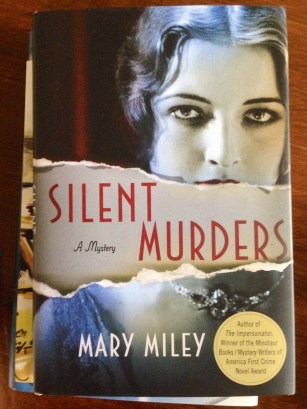
Mary Miley’s Silent Murders. Macmillan/Minotaur’s blurb:

Vaudeville actress Leah Randall took on her most daring role ever when she impersonated missing heiress Jessie Carr in order to claim Jessie’s inheritance inThe Impersonator. Now that the dust has settled around that tumultuous time in her life, Leah has adopted Jessie’s name as her own and moved to Hollywood, where she’s taken a modest but steady job in the silent film industry.

Jessie’s thrilled when Bruno Heilmann, a movie studio bigwig, invites her to a party. She’s even more delighted to run into a face from her past at that party. But the following day, Jessie learns that sometime in the wee hours of the morning both her old friend and Bruno Heilmann were brutally murdered. She’s devastated, but with her skill as an actress, access to the wardrobes and resources of a film studio, and a face not yet famous enough to be recognized, Jessie is uniquely positioned to dig into the circumstances surrounding these deaths. But will doing so put her own life directly in the path of a murderer?

The Bus — Paul Kirchner

The Day — Ferdinand Hodler

At the Porter’s Room — Vladimir Makovsky

Slavoj Žižek picks DVDs from the Criterion Collection closet (and so on and so on)

Harold Bloom on Wallace Stevens

Detail from Ward Shelley’s Matrilineage, A Painting that Charts Women Painters through History

ws

(See the whole thing).

“Titian Paints a Sick Man” — Roberto Bolaño

“Titian Paints a Sick Man”

by

Roberto Bolaño

At the Uffizi, in Florence, is this odd painting by Titian. For a while, no one knew who the artist was. First the work was attributed to Leonardo and then to Sebastiano del Piombo. Though there’s still no absolute proof, today the critics are inclined to credit it to Titian. In the painting we see a man, still young, with long dark curly hair and a beard and mustache perhaps slightly tinged with red, who, as he poses, gazes off toward the right, probably toward a window that we can’t see, but still a window that somehow one imagines is closed, yet with curtains open or parted enough to allow a yellow light to filter into the room, a light that in time will become indistinguishable from the varnish on the painting.

1

The young man’s face is beautiful and deeply thoughtful. He’s looking toward the window, if he’s looking anywhere, though probably all he sees is what’s happening inside his head. But he’s not contemplating escape. Perhaps Titian told him to turn like that, to turn his face into the light, and the young man is simply obeying him. At the same time, one might say that all the time in the world stretches out before him. By this I don’t mean that the young man thinks he’s immortal. On the contrary. The young man knows that life renews itself and that the art of renewal is often death. Intelligence is visible in his face and his eyes, and his lips are turned down in an expression of sadness, or maybe it’s something else, maybe apathy, none of which excludes the possibility that at some point he might feel himself to be master of all the time in the world, because true as it is that man is a creature of time, theoretically (or artistically, if I can put it that way) time is also a creature of man.

2

In fact, in this painting, time — sketched in invisible strokes — is a kitten perched on the young man’s hands, his gloved hands, or rather his gloved right hand which rests on a book: and this right hand is the perfect measure of the sick man, more than his coat with a fur collar, more than his loose shirt, perhaps of silk, more than his pose for the painter and for posterity (or fragile memory), which the book promises or sells. I don’t know where his left hand is.

How would a medieval painter have painted this sick man? How would a non-figurative artist of the twentieth century have painted this sick man? Probably howling or wailing in fear. Judged under the eye of an incomprehensible God or trapped in the labyrinth of an incomprehensible society. But Titian gives him to us, the spectators of the future, clothed in the garb of compassion and understanding. That young man might be God or he might be me. The laughter of a few drunks might be my laughter or my poem. That sweet Virgin is my friend. That sad-faced Virgin is the long march of my people. The boy who runs with his eyes closed through a lonely garden is us.

From Between Parentheses.

Reader — Francine Van Hove

879c93ba3bac48e60a0133c45eff7fbc

The Lie — Felix Vallotton

A particularly moving experience (Glen Baxter)

20140627-095604-35764552.jpg

The Wreck — Agostino Arrivabene

resize

Lou Reed Live in ’84 (Full Set)

The dark patches fall (Walt Whitman)

Capture

Rosa and Bertha Gugger — Albert Anker

xgagbxws3vwl

Seated Woman — Richard Diebenkorn