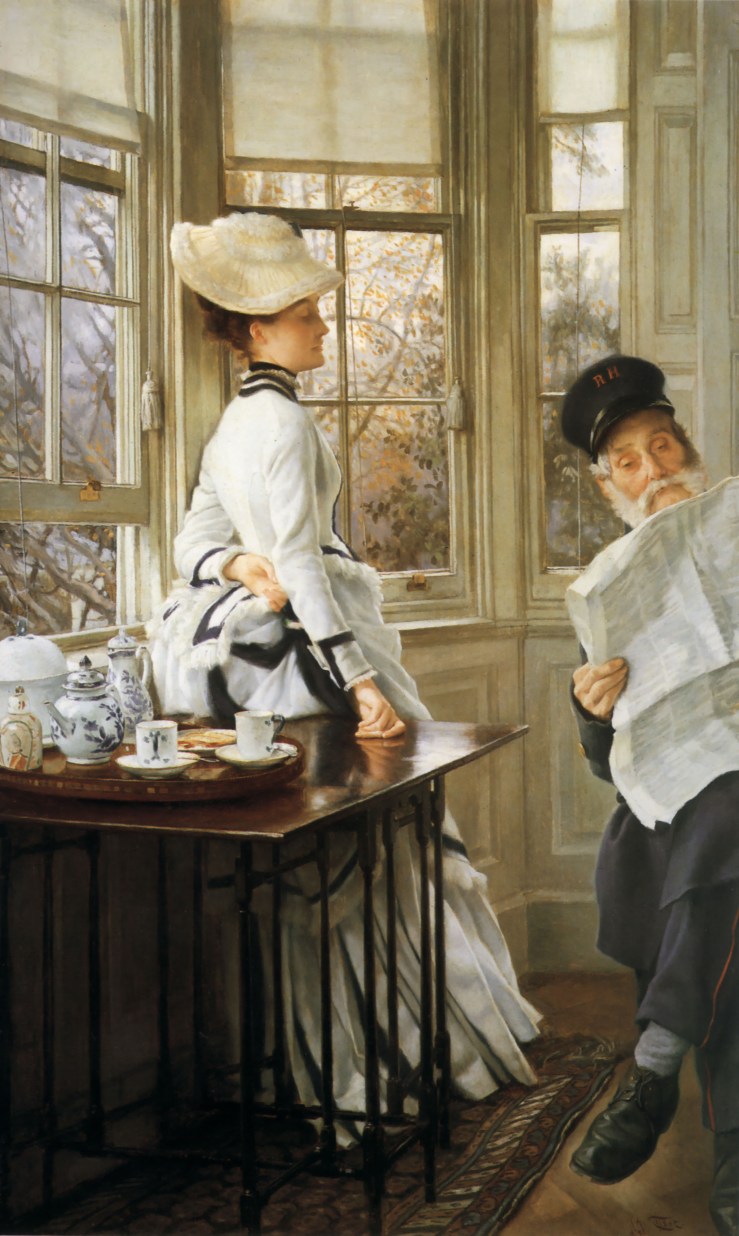
Reading the News — James Tissot

reading-the-news-1874

The Shipwreck — Francisco Goya

the-shipwreck-1794

Slavoj Žižek: “Really, let me tell you something—It’s nice to sleep with a woman”

List with No Name #18

  1. Ishmael
  2. Ishmael & Queequeg
  3. Father Mapple & Jonah
  4. Elijah
  5. Bildad & Peleg
  6. Bulkington
  7. Starbuck, Stubb & Flask
  8. Queequeg, Tashtego & Daggoo
  9. Starbuck & Queequeg
  10. Stubb & Tashtego
  11. Flask & Daggoo
  12. Stubb & Cook
  13. Steelkilt & Radney
  14. Ahab
  15. Moby Dick
  16. Ahab & Starbuck
  17. Ahab & Pip
  18. Ahab & Fedallah
  19. Ahab & Carpenter
  20. Ahab & Perth
  21. Ahab & Gardiner
  22. Ahab & Moby Dick

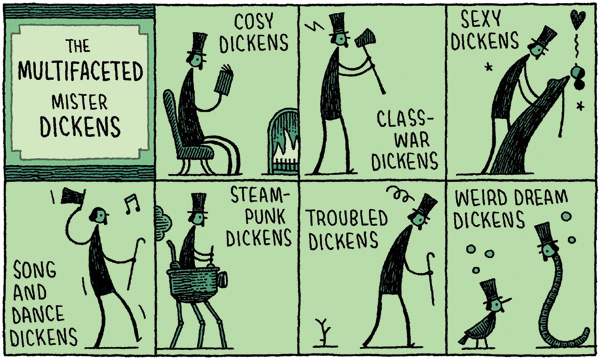
“The Multifaceted Mr. Dickens” — Tom Gauld

dickens(Via/more).

“Ye Legend of Sir Stupid and the Purple Knight” — Thomas Pynchon (Juvenilia)

“Ye Legend of Sir Stupid and the Purple Knight” was published in Thomas Pynchon’s high school newspaper; he was 16 at the time. (Via).

“Ye  Legend of Sir Stupid and the Purple Knight”


“Ridiculous!” roared King Arthur, slamming his beer mug on the Round Table. “Purple, you say?”

“All purple, my liege,” said Sir Launcelot, nervously wiping the foam from his face, “head to toes. Completely.”

“I say! Most irregular. Well, what does he want?”

“He wants audience with you, my liege. It seems he’s done ole Cholmondesley in.”

“Cholmondesley?”

“With an axe, your grace. A purple axe. He says he’ll do the same to us all if we don’t send a challenger to fight him in fair battle.”“Well?”

“Well, he— he’s— twenty feet tall.”

“Twenty! Oh, I say! Ghastly business! Who’ve we got crazy enough to fight him? How about you, Launcelot?”

“Oh, no, my liege. Cut my finger last night peeling potatoes. The pain is beastly.”

“Rotten luck, old chap. Well,” he addressed the knights of the round table, “there’s a big purple idiot outside who’s looking for a fight. Who’s game?”

Then up spake Sir Bushwack, a sturdy youth with a broad beam and a low center of gravity: “Where is the bloke? I’m not afraid, even if he is twenty feet taII!” Sir Bushwack had been drinking.

Then spake King Arthur to Sir Launcelot, telling him to bid the knight enter. And Launcelot did this, and the horns sounded, and in staggered a tremendous giant, perhaps four feet in height, dragging behind him a ten-foot purple axe. He had a vast quantity of purple hair which fell down over his eyes, and was clad in purple armor, and his feet in purple sneakers. He led a noble steed, also purple, which resembled a cross between a Shetland pony and an armadillo.

King Arthur whispered to Launcelot, “I thought you said he was twenty feet tall.”“That’s what he told me, your majesty.”

“That’s what he what? Why you …”

The rest of King Arthur’s tirade was drowned out by the purple giant, who was bellowing in a mighty voice:

“Okay, I can beat any man in the house! I ain’t scared of nobody ‘cause you’re all … “ he hiccoughed “ … chicken to fight me! Come on, who’s first?”

Up spake Sir Bushwack, shouting, “I challenge thee, Sir Knight!” The purple knight laughed. “Look what’sh challenging me! You slob, I can,—hic—can lick you with, — hic— one hand tied behind my back! Come ahead!” Then did the purple knight pick up the purple axe and begin to whirl it about his head, faster and faster. Sir Bushwack waddled up dubiously with sword in hand, feebly attempted to parry, then quickly retreated. The purple knight stood and laughed.

“Chicken, all of you! Scared to fight me! Har! Har!”

Suddenly, the horns sounded and into the hall rushed a very brave and manly knight, Sir Stupid.

“I say!” he shouted to all and sundry, “Old Fotheringay’s run amok! He and his horse fell into that newly-pressed grape juice up at the distillery, and …”.

Then he caught sight of the purple knight and stopped short. King Arthur started to laugh hysterically, spilling beer hither and yon.

“I say, old Fotheringay’s gone and fallen into the wine vat! Old Fotheringayl Haw, Haw, Haw! Old Fotheringay’s got high on grape juice! Haw! In the still of the knight!”

Old Fotheringay stood digesting this in silence. Then slowly he began to chuckle and whirl that axe.

“Oh, oh,” Sir Stupid whispered to Arthur, “here he goes!” With a savage yell, Old Fotheringay charged the Round Table, swinging his axe. In an instant, the hall became the scene of a free-for-all. The purple knight was in the thick of the whole mess, smashing furniture, beer kegs, and anything else that happened to be in his way. The hall resounded with the clanging of swords, the splintering of wood, and the demonaical chuckling of the purple knight. In the midst of the noise and confusion, Sir Stupid buttonholed Bushwack.

“Noble knight,” he said, “art thou truly dedicated to thy leige?”

“Yes.”

“And wouldst thou suffer discomfort to rid thy liege of this menace?”

“Surely,” Sir Bushwack said absently, as he ducked a flying beer mug.

“That’s all I wanted to know! Fotheringay! You feeble-minded halfwit cretin! Over here!”

Infuriated, the purple knight whirled toward Sir Stupid and raised his axe. Sir Stupid lifted the protesting Bushwack and hurled him bodily at Fotheringay. There was a loud, splintering smash as the purple knight went down, and then all was silent, except for the gurgling of beer from a shattered keg. Sir Stupid stood over the horizontal Fotheringay.

“Now, thou proud knight,” roared Sir Stupid triumphantly, “now what hast thou to say?”

Slowly, the purple knight looked up and sneered. “CHICKEN,” he said.

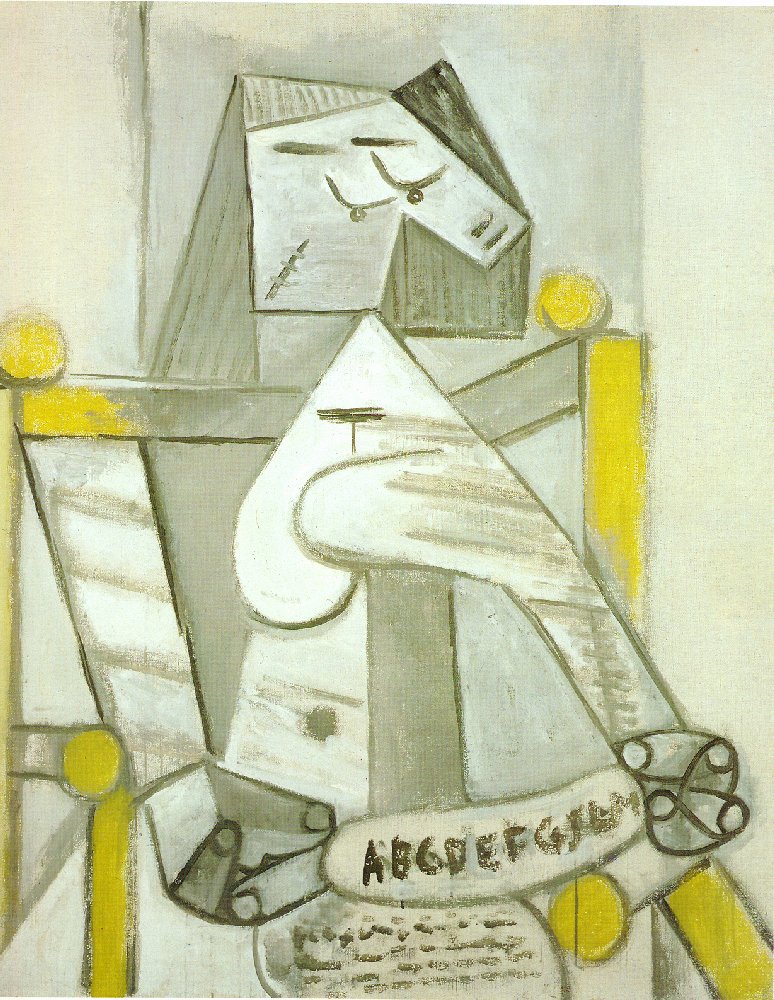
Seated Woman with Spelling Book — Pablo Picasso

seated-woman-with-spelling-book-1941

Whoever Says the Truth Shall Die: A Film About Pier Paolo Pasolini

Stacks — David Harper (Bookshelf/Tree Art)

DavidHarper4

(More via Juxtapoz)

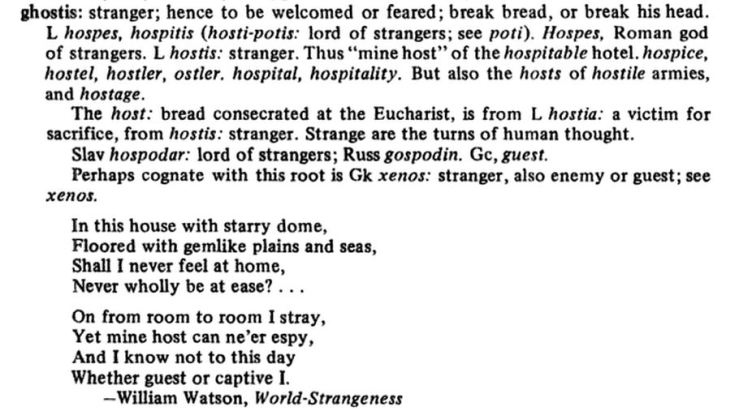
ghostis: stranger, hence to be welcomed or feared; break bread, or break his head. (Etymology)

Capture

(From The Origins of English Words: A Discursive Dictionary of Indo-European Roots by Joseph T. Shipley)

Gordon Lish’s My Romance (Book Acquired, 2.22.2013)

20130225-173906

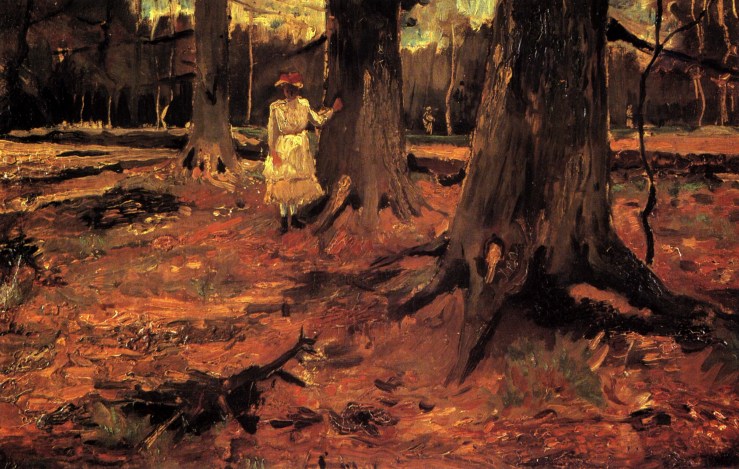
Girl in White in the Woods — Vincent van Gogh

girl-in-white-in-the-woods-1882(1)

“Game” — Donald Barthelme

“Game” by Donald Barthelme

Shotwell keeps the jacks and the rubber ball in his attaché case and will not allow me to play with them. He plays with them, alone, sitting on the floor near the console hour after hour, chanting “onesies, twosies, threesies, foursies” in a precise, well-modulated voice, not so loud as to be annoying, not so soft as to allow me to forget. I point out to Shotwell that two can derive more enjoyment from playing jacks than one, but he is not interested. I have asked repeatedly to be allowed to play by myself, but he simply shakes his head. “Why?” I ask. “They’re mine,” he says. And when he has finished, when he has sated himself, back they go into the attaché case.

It is unfair but there is nothing I can do about it. I am aching to get my hands on them.

Shotwell and I watch the console. Shotwell and I live under the ground and watch the console. If certain events take place upon the console, we are to insert our keys in the appropriate locks and turn our keys. Shotwell has a key and I have a key. If we turn our keys simultaneously the bird flies, certain switches are activated and the bird flies. But the bird never flies. In one hundred thirty-three days the bird has not flown. Meanwhile Shotwell and I watch each other. We each wear a .45 and if Shotwell behaves strangely I am supposed to shoot him. If I behave strangely Shotwell is supposed to shoot me. We watch the console and think about shooting each other and think about the bird. Shotwell’s behavior with the jacks is strange. Is it strange? I do not know. Perhaps he is merely a selfish bastard, perhaps his character is flawed, perhaps his childhood was twisted. I do not know.

Each of us wears a .45 and each of us is supposed to shoot the other if the other is behaving strangely. How strangely is strangely? I do not know. In addition to the .45 I have a .38 which Shotwell does not know about concealed in my attaché case, and Shotwell has a .25 caliber Beretta which I do not know about strapped to his right calf. Sometimes instead of watching the console I pointedly watch Shotwell’s .45, but this is simply a ruse, simply a maneuver, in reality I am watching his hand when it dangles in the vicinity of his right calf. If he decides I am behaving strangely he will shoot me not with the .45 but with the Beretta. Similarly Shotwell pretends to watch my .45 but he is really watching my hand resting idly atop my attaché case, my hand resting atop my attaché case, my hand. My hand resting idly atop my attaché case. Continue reading ““Game” — Donald Barthelme”

The Fall — Dmitry Samarov

File0096

(Read my interview with Dmitry Samarov)

Onibaba — Kaneto Shindô (Full Film)

“The drama’s done” (Moby-Dick)

The drama’s done. Why then here does any one step forth?—Because one did survive the wreck.

It so chanced, that after the Parsee’s disappearance, I was he whom the Fates ordained to take the place of Ahab’s bowsman, when that bowsman assumed the vacant post; the same, who, when on the last day the three men were tossed from out of the rocking boat, was dropped astern. So, floating on the margin of the ensuing scene, and in full sight of it, when the halfspent suction of the sunk ship reached me, I was then, but slowly, drawn towards the closing vortex. When I reached it, it had subsided to a creamy pool. Round and round, then, and ever contracting towards the button-like black bubble at the axis of that slowly wheeling circle, like another Ixion I did revolve. Till, gaining that vital centre, the black bubble upward burst; and now, liberated by reason of its cunning spring, and, owing to its great buoyancy, rising with great force, the coffin life-buoy shot lengthwise from the sea, fell over, and floated by my side. Buoyed up by that coffin, for almost one whole day and night, I floated on a soft and dirgelike main. The unharming sharks, they glided by as if with padlocks on their mouths; the savage sea-hawks sailed with sheathed beaks. On the second day, a sail drew near, nearer, and picked me up at last. It was the devious-cruising Rachel, that in her retracing search after her missing children, only found another orphan.

The untitled epilogue to Melville’s Moby-Dick, which I’ve always thought of by its epigraph from Job, “And I Only Am Escaped Alone to Tell Thee.”

I’ve enjoyed citing these extracts through this reading of Moby-Dick.