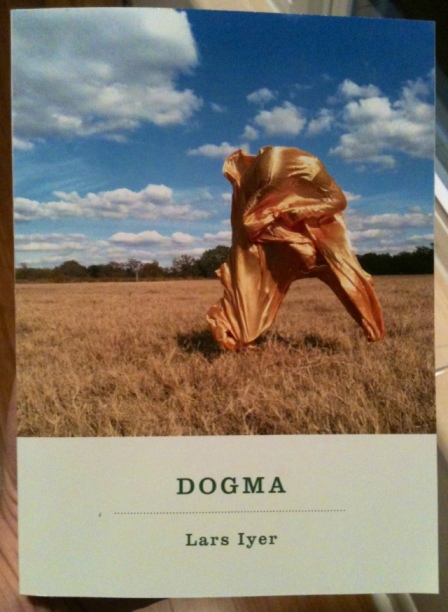
Book Acquired, 1.30.2012 — Dogma, Lars Iyer’s Sequel to Spurious

20120202-195422.jpg

Lars Iyer’s novel (or anti-novel, if you swing that way) Spurious was one of the better books I read last year. From my review:

Lars Iyer’s début novel Spurious is about two would-be intellectuals, W., the book’s comic hero, and his closest friend, our narrator Lars. They bitch and moan and despair: it’s the end of the world, it’s the apocalypse; they find themselves incapable of original thought, of producing any good writing. The shadow of Kafka paralyzes them. They travel about Europe, seeking out knowledge and inspiration — or at least a glimpse of some beautiful first editions of Rosenzweig. They attend dreadful academic conferences; they write letters. They flounder and fail.

Iyer was also kind enough to talk with me in a long, detailed interview.

So like basically I’m a fan, and I’ve been eager for Dogma, so I was psyched when an ARC showed up in Monday’s mail. Dogma is new from Melville House at the end of this month; more coverage to come.

Diorama with Gasoline, Dopamine and Adrenaline — Laurie Hogin

Arena #10 (Dogs) — Mike Kelley

(Via/more).

“Don’t Worry About the Government” (Live) — Talking Heads

Topless Faulkner, Part III

(See also).

RIP Mike Kelley

RIP artist/musician Mike Kelley. (Obit/more).

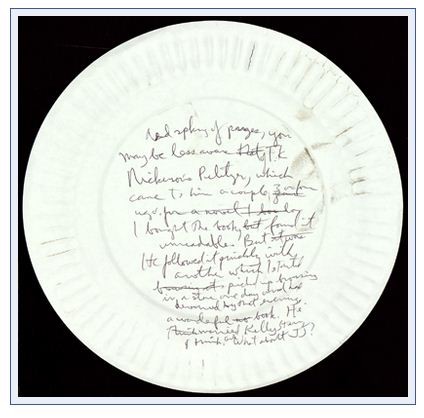
Denis Johnson’s Notes for The Name of the World, as Recorded on a Paper Plate

Tom Waits and John Lurie Go Fishing in Jamaica

(From the cult 1991 TV series Fishing with John)

William Gaddis on Hipsters: “An Ill-dressed, Underfed, Overdrunken Group of Squatters with Minds So Highly Developed That They Were Excused from Good Manners”

gaddis_large

Love this passage from William Gaddis’s The Recognitions. Mocking “hipsterism” has been around forever (or at least 50 years):

And by now they were at the door of the Viareggio, a small Italian bar of nepotistic honesty before it was discovered by exotics. Neighborhood folk still came, in small vanquished numbers and mostly in the afternoon, before the two small dining rooms and the bar were taken over by the educated classes, an ill-dressed, underfed, overdrunken group of squatters with minds so highly developed that they were excused from good manners, tastes so refined in one direction that they were excused for having none in any other, emotions so cultivated that the only aberration was normality, all afloat here on sodden pools of depravity calculated only to manifest the pricelessness of what they were throwing away, the three sexes in two colors, a group of people all mentally and physically the wrong size.

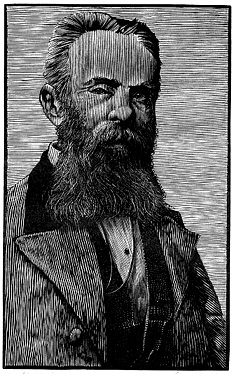
Herman Melville (Portrait) — Barry Moser

Cormac McCarthy, Unchallenged King of Literary Mule Carnage

In his essay “The Dead Mule Rides Again,” Jerry Leath Mills argues

. . . there is indeed a single, simple, litmus-like test for the quality of southernness in literature, one easily formulated into a question to be asked of any literary text and whose answer may be taken as definitive, delimiting, and final. The test is: Is there a dead mule in it?

Mills’s convincing textual evidence draws on over thirty authors, but declares Cormac McCarthy “unchallenged king of literary mule carnage.” Some proof:

4. Decapitation by irate opera singer. Cormac McCarthy, who far surpasses even Faulkner in the mayhem he visits upon literary mules (see #s 5, 6, 7, 9, 14, 15), includes in his recent novel The Crossing (1994) the following dialogue about a mule whose recalcitrance proves insufferable to the artistic temperament of a singer assigned to tend him in a road company:

What was it he done to the mule?

He tried to cut off the head with a machete. . . .

I wouldn’t have thought you could cut off a mule’s head with a machete.

Of course not. Only a drunken fool would attempt such a feat. When the hacking availed not he began to saw. . . .

What happened to the mule?

The mule? The mule died. Of course

5. Drowning. This is Faulkner’s most commonly employed means of dispatch for the mules in his works. In the flood scenes he renders so effectively, we inevitably find drowned mules floating down river. As opposed to the train-struck animals in “Mule in the Yard” (see # 3), which are instrumental in developing motive and plot, Faulkner’s drowned mules tend to fall into the decorative or ornamental category, employed chiefly for drama, mood, and atmosphere. In As I Lay Dying (1930), for example, Darl recreates a wagon disaster in the surging stream: “Between two hills I see the mules once more. They roll up out of the water in succession, turning completely over, their legs stiffly extended as when they had lost contact with the earth”. In the “Old Man” sections of The Wild Palms (1939), the flood throws forth its “charging welter of dead cows and mules and outhouses and cabins and hencoops,” and Faulkner’s prose strikes an elegiac note as the convict’s skiff rides “even upon the backs of the mules as though even in death they were not to escape that burden-bearing doom with which their eunuch race was cursed”. Before the ordeal ends, the accumulation of mule carcasses reaches almost cosmic proportions as the stranded convict remembers “that other wave, the second wall of water full of houses and dead mules building up behind him in the swamp”.

Robert Morgan’s story “Poinsett’s Bridge” (1989) picks up the drowned mule topos in distinctly Faulknerian terms: “The body of a mule shot by in the current, and then a chicken coop”; but Cormac McCarthy (see #s 4, 6, 7, 9, 14, 15) varies it in Blood Meridian (1985) by having a mule drowned intentionally: “The Yumas were swimming the few sorry mules . . . across the river. . . . Downriver they’d drowned one of the animals and towed it ashore to be butchered”. (On recurrent uses of mules as culinary items see # 14.)

That the image of the drowned mule also occupies a subliterary folk status in the South is perhaps attested by a common simile in which a wealthy person is said to have “enough money to burn up a wet mule.”

6. Falls from cliffs. The novel Blood Meridian (1985) establishes Cormac McCarthy as unchallenged king of literary mule carnage. No fewer than fifty-nine specific mules die in the book, plus dozens more that are alluded to in groups and bunches. Mules are shot, roasted, drowned, knifed, and slain by thirst; but the largest number, 50 out of a conducta of 122 mules carrying quicksilver for mining, plummet from a single cliff during an ambush, performing an almost choreographic display of motion and color, “the animals dropping silently as martyrs, turning sedately in the empty air and exploding on the rocks below in startling bursts of blood and silver as the flasks broke open and the mercury loomed wobbling in the air in great sheets and lobes and small trembling satellites. . . . Half a hundred mules had been ridden off the escarpment”. (See also #s 4, 5, 7, 9, 14, 15.)

. . .

7. Fall into subterranean cavity. Near the conclusion of Cormac McCarthy’s Child of God (1973), “Arthur Ogle was plowing an upland field one evening when the plow was snatched from his hands. He looked in time to see his span of mules disappear into the earth taking the plow with them” (195). These doomed mules qualify as highly functional in the story, since a search for their bodies leads to the discovery of a number of human corpses stored in the caves underground for sexual use by the necrophiliac Lester Ballard. (See also #s 4, 5, 6, 9, 14, 15.)

. . .

9. Gunshot wounds. The high quotient of gunplay in southern fiction quite naturally extends to some of the mules that grace its pages. . . .

Mules absorb lead throughout much of Cormac McCarthy’Blood Meridian (1985), one providing a shield against incoming fire: “He . . . crouched under the ribs of a dead mule and recharged the pistol”.

. . .

14. Stab wounds. . . .

But mules are consumed readily by man, beast, and fowl in Cormac McCarthy‘s Blood Meridian (1985), and a character in Bernice Kelly Harris’s Purslane (1939) finds the practice a perfectly acceptable topic for mealtime conversation: “Uncle Millard near the foot of the table was telling about the Christmas dinner he ate in the pesthouse years ago, declaring it was fried dog and mouse stew with a slice of boiled mule”.

15. Thirst. Alkali flats in Cormac McCarthy‘s Blood Meridian (1985) yield no shortage of “the black and desiccated shapes of horses and mules. . . . These parched beasts had died with their necks stretched in agony in the sand”

. . .

18. Submersion in domestic metaphor. Once again, Cormac McCarthy creates an exclusive category (see # 4) with a scene in Cities of the Plain (1998):

When he turned around Billy [Parham] was standing in the doorway watching him [John Grady Cole].

This the honeymoon suite? he said.

You’re lookin at it.

He leaned in the doorframe and took his cigarettes from his shirtpocket and shucked one out and lit it.

The only thing you ain’t got here is a dead mule in the floor.

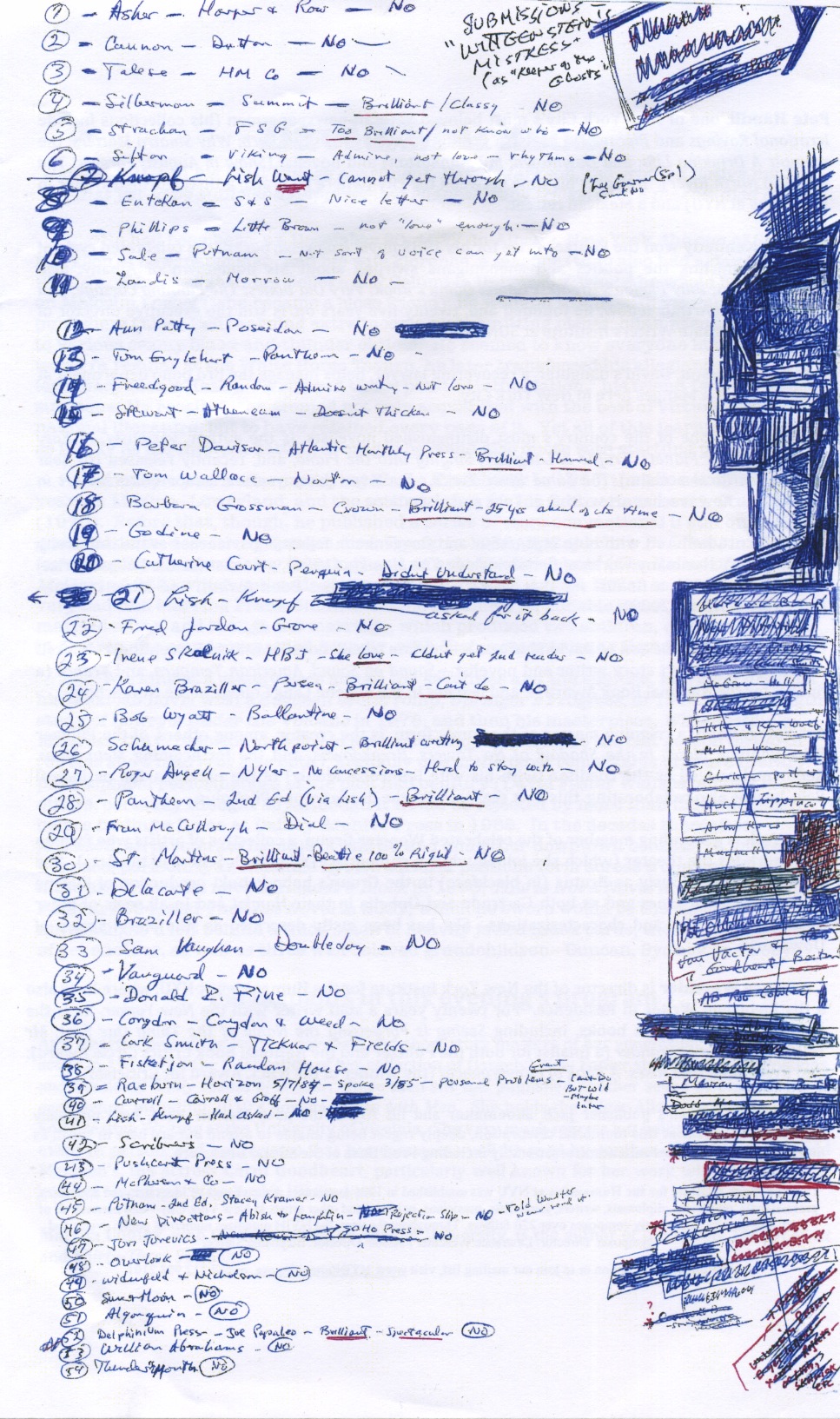
List of Rejections of Wittgenstein’s Mistress — David Markson

(Via/cheers).

Game of Thrones Season 2 Trailer

Kermit the Frog and Miss Piggy Strike Back at FOX News

(Some context, if you wish).

Detail from The Triptych of the Mystical Marriage of Saint Catherine — Hans Memling

“A Well-Meaning, Sincere Hypocrite” — William Gaddis on His Title Character, JR (And Capitalism)

More from William Gaddis’s 1986 Paris Review interview:

INTERVIEWER

Is JR’s story something you extrapolated from life only, or did you rely on sociologies devoted to how the corporate world works upon social values, human qualities, and relationships in American culture?

GADDIS

The boy himself is a total invention, completely sui generis. The reason he is eleven is because he is in this prepubescent age where he is amoral, with a clear conscience, dealing with people who are immoral, unscrupulous; they realize what scruples are, but push them aside, whereas his good cheer and greed he considers perfectly normal. He thinks this is what you’re supposed to do; he is not going to wait around; he is in a hurry, as you should be in America—get on with it, get going. He is very scrupulous about obeying the letter of the law and then (never making the distinction) evading the spirit of the law at every possible turn. He is in these ways an innocent and is well-meaning, a sincere hypocrite. With Bast, he does think he’s helping him out. As for the corporate world, I do read the newspapers, clip things, ideas, articles, and just use them as fodder. But all that hardly requires a text in sociology. And this may be the place to make a further point. I’m frequently seen in the conservative press as being out there on the barricades shouting: Down with capitalism! I do see it in the end as really the most workable system we’ve produced. So what we’re talking about is not the system itself, but its abuses, I don’t mean criminal but the abundant abuses just within the letter of the law. The essential question is whether it can survive these abuses given free rein and whether these abuses are inherent in the system itself. I should think it is perfectly clear in my work—calling attention, satirizing these abuses—that our best hope lies in bringing things under better and more equitable control, cutting back the temptations to unmitigated greed and bemused dishonesty . . . in other words that these abuses the system has fostered are not essential, but running out of moral or ethical control can certainly threaten its survival.

“Have One On Me” (Live on Austin City Limits) — Joanna Newsom