“And there were shepherds living out in the fields nearby, keeping watch of their flocks at night. An angel of the Lord appeared to them, and the glory of the Lord shone around them, and they were terrified. But the angel said to them, ‘Do not be afraid. I bring you good news of great joy that will for all the people. Today in the town of David a Savior has been born to you; he is Christ the Lord'” — Luke 2:8-11
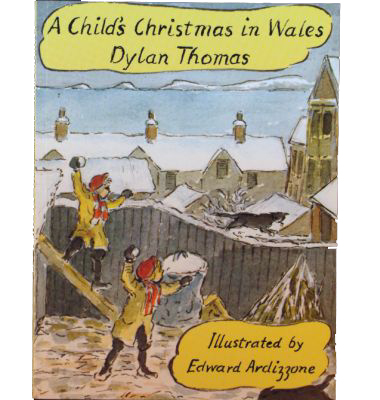
When he wasn’t busy drinking himself to death, Dylan Thomas wrote some pretty awesome poems and stories, and the Welshman had quite the knack for reading them aloud. Check out his sonorous reading of “A Child’s Christmas in Wales,” a lovely impressionistic series of vignettes about Useful vs. Useless Presents, ever-present Uncles, eating with the fam, letter-carriers, etc. Good stuff. Fellow Welshman John Cale wrote his own version of “A Child’s Christmas in Wales.” It’s on his pretty-good record Paris 1919. Merry Xmas!
We love Christmas music. We especially love the track, “It’s Christmas Time,” by Sun Ra’s early doo-wop group The Qualities. We first were made aware of the track via Yo La Tengo’s lovely rendition on their 2002 EP, Merry Christmas from Yo La Tengo.
The image of Sun Ra is from the Sun Ra Picture Archive, a totally radical site. And you should go there. And you should download these songs. And you should listen to them. And bring good cheer to all your friends and neighbors.
Simon Mason’s The Rough Guide to Classic Novels covers “a selection of 229 novels . . . from 36 countries, published between 1604 and 2002.” Roughly pocket-sized (if you have big pockets), Classic Novels provides short, simple summaries of each of the books, outlining the plot as well as contextualizing the relative importance of the novel. Mason also recommends the best English translations and discusses film adaptations (quite even-handedly), where applicable. He also includes a “Where to Go Next” bullet for each novel. Sometimes these suggestions work: liked Brave New World? Then check out Russell Hoban’s Riddley Walker. Other times, they’re a bit nonsensical–does anyone really go to A Portrait of the Artist as a Young Manafter they’ve made it through Ulysses?
…but we prefer the British cover
But this criticism is mere quibbling; Mason does a great job with an almost impossible task–after all what books would you cover in such a limited space (and you’d have to include Ulysses, and you’d have to give it pride of place over the Portrait, right?). Simon admits in his preface that inevitably “the selection is a personal one, and not likely to be the same as anyone else’s.” Of course he includes the “classics” that will jump to anyone’s mind–Jane Eyre, War and Peace, Moby-Dick, etc., but he also includes works by Toni Morrison, Don DeLillo, and Haruki Murakami, along with dozens and dozens of books I’ve never heard of, but now feel that I simply must read. And in exposing a potential reader to a book they’ve never heard of, Classic Novels is a success.
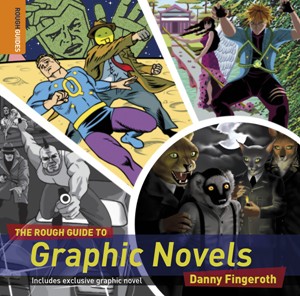
If Danny Fingeroth’s The Rough Guide to Graphic Novels is less successful than Mason’s Classic Novels, that shortcoming is in his attempt to sanctify a canon in a medium that is still often misunderstood as a genre. While most of us will readily agree that Don Quixote and The Catcher in the Rye are classics, the canonical works of the comic book medium still need some sorting out, and many fans of graphic novels will find Fingeroth’s language a bit too-definitive. After a great first chapter that asks “What Is a Graphic Novel?,” a brief history of the comic book story-telling medium, and his own comic, “For Art’s Sake,” (a fun but forgettable overview of the graphic story-telling arts from an artist’s perspective), Fingeroth initiates the bulk of the book, “The Canon: The Sixty Best Graphic Novels.” As if his language weren’t definitive enough, he kicks the section off with “Ten Graphic Novels Everyone Should Read.” And while Fingeroth’s “Canon” and top-ten list are full of obvious choices that should certainly be there–Spiegelman‘s Maus, Satrapi’s Persepolis, Charles Burns’s Black Hole, Clowes‘s Ghost World–there are also gaping holes on one hand and complete over-representation on the other, as well as some real head-scratchers thrown in to boot. Why, for instance, does Fingeroth include Frank Miller’s The Dark Knight Strikes Again over its vastly superior and more influential predecessor, The Dark Knight Returns? Why is Sin City canonized at all? Although Alan Moore’s From Hellis canonized, why is his controversial recent novel Lost Girls included over work like Watchmen, V for Vendetta, or Saga of Swamp Thing–all books that had a tremendous impact on comic book storytelling? Why does Dave Sim’s massive contribution Cerebus get glossed over in a single sentence, while Kyle Baker’s trifling missive Why I Hate Saturn is given pride of place on the top ten list? Fingeroth could’ve saved himself a lot of nitpicking by simply changing his language a bit to at least admit that his choices are subjective. Far more satisfying is the next chapter, “The Icons,” covering some of the most influential persons in comic history, including Robert Crumb, Chris Ware, Joe Sacco, and the Hernandez Brothers. I would’ve liked to have seen this chapter expanded quite a bit (perhaps at the expense of the superfluous chapter on manga); if The Rough Guide to Graphic Novels is to be a starting place for new readers interested in this medium, “The Icons” best represents that starting place. Those interested in discovering graphic novels they haven’t heard of will also be pleased with the many full-page art reproductions throughout the book, probably its best feature. Despite its flaws, however, there is something admirable about Fingeroth’s attempt to create a canon out of a medium that has for far too long been marginalized.
The Rough Guide to Classic Novels and The Rough Guide to Graphic Novels are now available from Rough Guides,
After the jump: Fingeroth’s top ten list vs. Biblioklept’s top ten list–
In Section IV of his Prelude, William Wordsworth evokes the most moving encounter with a veteran of war that I have ever read. At first reticent to be anything but a voyeur, the narrator (Wordsworth, in all likelihood), slips “into the shade/ Of a thick hawthorn” to spy on the “meagre man” with a “ghastly” mouth “in military garb” resting on a “mile-stone.” As the poor ex-soldier, “Companionless,” begins to issue “low muttered sounds, as if of pain / Or some uneasy though,” the narrator shakes his “heart’s specious cowardice” and hails the veteran as a human being, asking for his story. It turns out that the guy is slowly–and with great difficulty–returning to his “native home.” Wordsworth takes the veteran to a nearby friend’s house for companionship and rest, before returning to his own home in a contemplative mood. Full text of the “Discharged Soldier” episode after the jump–
John Leonard, a widely influential and enduringly visible cultural critic known for the breadth of his knowledge, the depth of his inquiries and the lavish passion of his prose, died on Wednesday in Manhattan. He was 69 and lived in Manhattan. . . .
As a critic, Mr. Leonard was far less interested in saying yea or nay about a work of art than he was in scrutinizing the who, the what and the why of it. His writing opened a window onto the contemporary American scene, examining a book or film or television show as it was shaped by the cultural winds of the day.
Amid the thicket of book galleys he received each week, Mr. Leonard often spied glimmers that other critics had not yet noticed. He was known as an early champion of a string of writers who are now household names, among them Mary Gordon, Maxine Hong Kingston and the Nobel Prize winners Toni Morrison and Gabriel García Márquez.
Mr. Leonard’s prose was known not only for its erudition, but also for its sheer revelry in the sounds and sentences of English. Stylistic hallmarks included wit, wordplay, a carefully constructed acerbity and a syntax so unabashedly baroque that some readers found it overwhelming. The comma seemed to have been invented expressly for him.
I’ve subscribed to Harper’s for about a decade now, and in that time John Leonard’s “New Books” column has been not only one of my favorite features of the magazine, but also an inspirational guide on how to review a book. Leonard knew how to show why a book mattered; he also knew how to capture the essence of not just the plot but the author’s style in just a few short lines–something that’s really, really tough to do. I read one of Leonard’s last reviews, a write up of Toni Morrison’s latest A Mercy in this month’s Harper’s, just last Monday to a group of my high school students who were interested in Morrison’s work. The review made one of them say: “I want to read that book.” I think there is no higher compliment for any critic. John Leonard will be missed.
If I should need to name, O Western World, your powerfulest scene and
show,
‘Twould not be you, Niagara–nor you, ye limitless prairies–nor
your huge rifts of canyons, Colorado,
Nor you, Yosemite–nor Yellowstone, with all its spasmic
geyser-loops ascending to the skies, appearing and disappearing,
Nor Oregon’s white cones–nor Huron’s belt of mighty lakes–nor
Mississippi’s stream:
–This seething hemisphere’s humanity, as now, I’d name–the still
small voice vibrating–America’s choosing day,
(The heart of it not in the chosen–the act itself the main, the
quadriennial choosing,)
The stretch of North and South arous’d–sea-board and inland–
Texas to Maine–the Prairie States–Vermont, Virginia, California,
The final ballot-shower from East to West–the paradox and conflict,
The countless snow-flakes falling–(a swordless conflict,
Yet more than all Rome’s wars of old, or modern Napoleon’s:) the
peaceful choice of all,
Or good or ill humanity–welcoming the darker odds, the dross:
–Foams and ferments the wine? it serves to purify–while the heart
pants, life glows:
These stormy gusts and winds waft precious ships,
Swell’d Washington’s, Jefferson’s, Lincoln’s sails.
So let’s just say we’re too anxious around here to run a proper book review, okay? I promise to have reviews of new books up after Election Day. In the meantime–
It leaked a few weeks ago, but it was nice to see Homer Simpson endorse Obama on this year’s Treehouse of Horror episode–
(The best part of the episode was the Mad Men parody, though).
Speaking of election humor, Sarah Palin continues to be a comedy goldmine. How could she be so readily duped by a French Canadian pretending to be President Sarkozy? She’s fucking stupid, that’s how. I’m reminded of her appearance on SNL a few weeks ago–unjustifiably lauded–where she smirked along as if she were actually in on the joke, and not being simply mocked.
Speaking of ignorance and ugliness, the aughties in America have been culturally and politically awful. Beginning with the one-two punch of the 2000 election debacle and the nightmare of the 9/11 attacks, this past decade has been an embarrassing series of disastrous blunders for the United States government, coupled with a spike in civic apathy at home. The results: our stock has fallen in the rest of the world’s eyes and a large portion of Americans have found solace and even pride in ignorance and xenophobia (what else could explain the ascendancy of an ignoramus like Palin?)
And for all the great things that I’ve experienced in my personal life this past decade (marriage, fatherhood), the idea of another decade like the aughties–selfish and cruel and ignorant–seems miserable. The Bush administration–and the American people who supported them–has been working hard to usher in a New Dark Age. Yet in the past few days I’ve seen some of my cynicism fall away, as I see friends and acquaintances and complete strangers excited about the prospect of change for this country. Watching Obama in Cleveland tonight, I found myself moved and excited and hopeful, not just for Tuesday, or for a new President in January, but for a whole new spirit in this country, one that embraces progressive ideals and puts them into action.
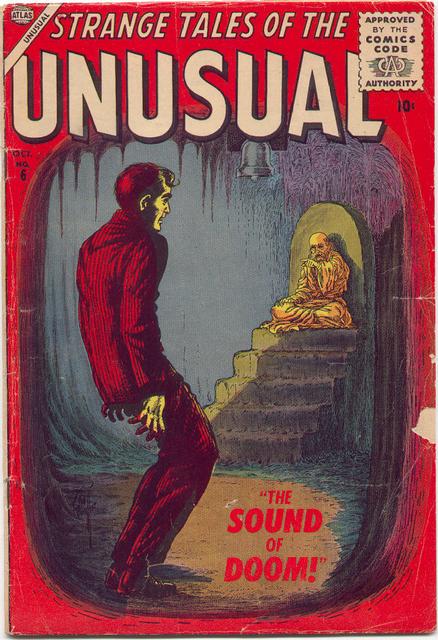
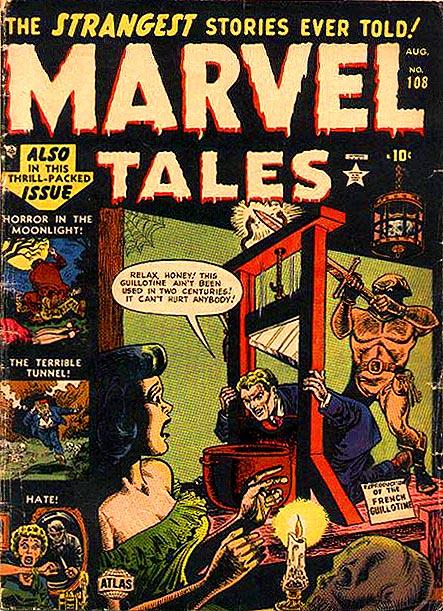
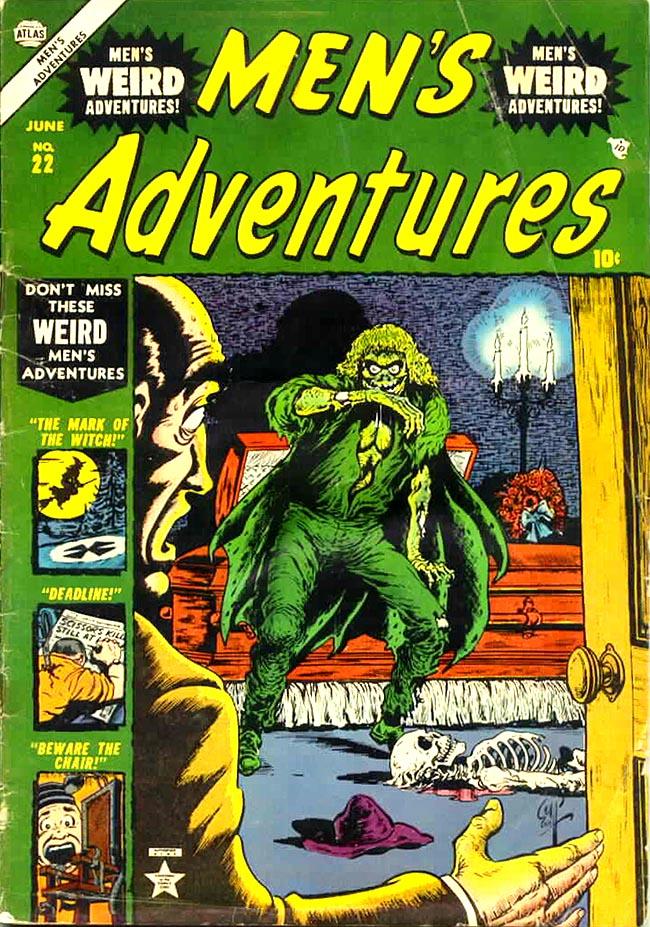
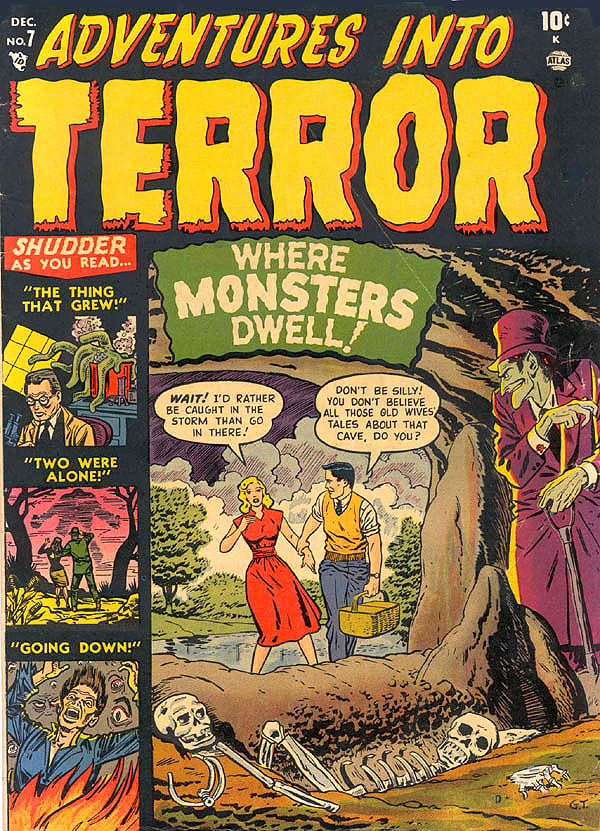
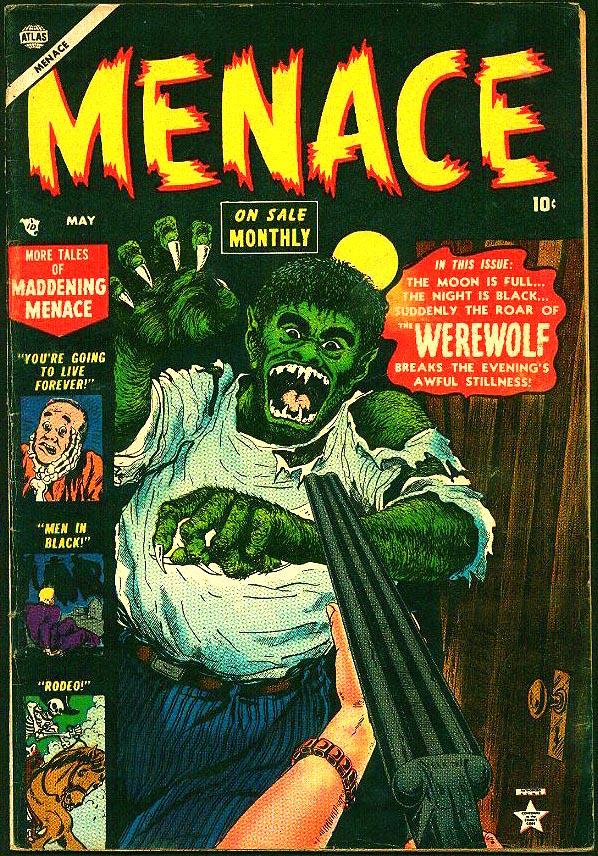
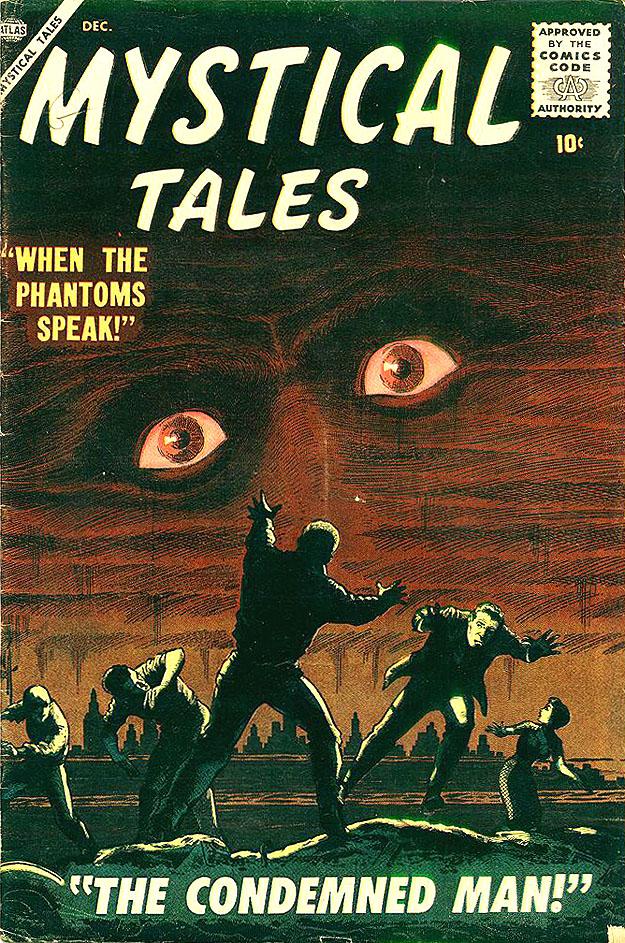
Let’s kick off Halloween week right by analyzing some old horror comic book covers from the 1950s.
I love this one: the jagged posture, the bloody reds, the weird mystic guy. And what can beat a title as redundant as Strange Tales of the Unusual?
Of course, all of these titles are strange, except when they’re weird or uncanny or unusual. Or mystical. But honestly, what’s so strange about putting your head in an old guillotine? I mean, seriously, relax. Who hasn’t put their neck on the chopping block like this. Literally, that is. (I love the bottom corner panel that just says “HATE!” incidentally).
Let me be clear on this: I am a man. Further, I am a manly man. Therefore, I require–no, demand–only men’s adventures. Further, I require my adventures to be weird. And not just slightly weird. I need creepy-green-gay-zombie weird. I need mark-of-the-witch weird. Newspaper-oriented-murder weird. Chair weird!
This comic is a clear forerunner of all those eighties slasher films that warned against teenage sex. Look at all the sexual anxiety here: “THE THING THAT GREW!”? “TWO WERE ALONE!”? “GOING DOWN!”? Jeez! Or, alternately, I am a pervert who sees sex everywhere. But seriously, don’t go into caves, kids.
My grandpa always taught me that the only thing more maddeningly menacing than a werewolf is a green werewolf.
Nothing snarky to say about this one: it’s beautiful. But really, I love them all.
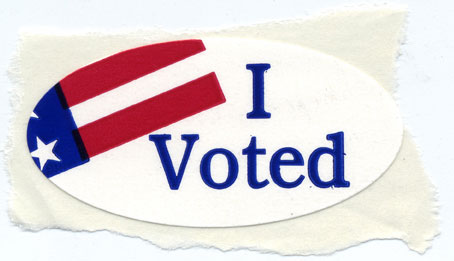
I voted last Thursday. It was easy. I had to go pick up my daughter from daycare, and an early voting location happened to be right on the way. I left half an hour early just in case, and then drove the 1.1 miles to the Murray Hill Library. I returned three audio books (I know you’re dying to know: Don DeLillo’s The Body Artist, Margaret Atwood’s Moral Disorder, and Michael Chabon’s The Amazing Adventures of Kavalier and Clay) and then stood in a line five-people deep where I waited all of 120 seconds before entering the voting area. There, I handed over my driver license and voter registration card, confirmed my address, and waited about 45 seconds for my ballot. The woman in front of me was living at an address different from the one on her ID, but she was able to vote anyway. Easy. I overheard the process involved (she had to fill out some form) while I waited about a minute to go to a booth. Then I went to the booth and voted for Obama (I didn’t even look wistfully at Nader’s name, I swear!). I voted on some other stuff too, but the only other thing I cared about quite a bit was Florida’s proposed Amendment 2, another American Taliban scheme to define marriage. I voted “no,” of course. The whole process, including driving, took less than 20 minutes (I should mention that I had my sample ballot with me, which is a time saver of course).
Some folks I know personally have worried about early voting–will their vote be counted?–and after debacles in 2000 and 2004, who can blame them for these anxieties? However, Florida voters can go to the Florida Division of Elections website to check the early voting and absentee ballot reports. I went there, clicked on my county’s updated report, downloaded a .txt file and found my name, as well as my wife’s, and the respective times we voted. Done. I know–and have a record–that my vote will be counted. Simple. Now, go vote–you never know what surprise might pop up on November 4th.
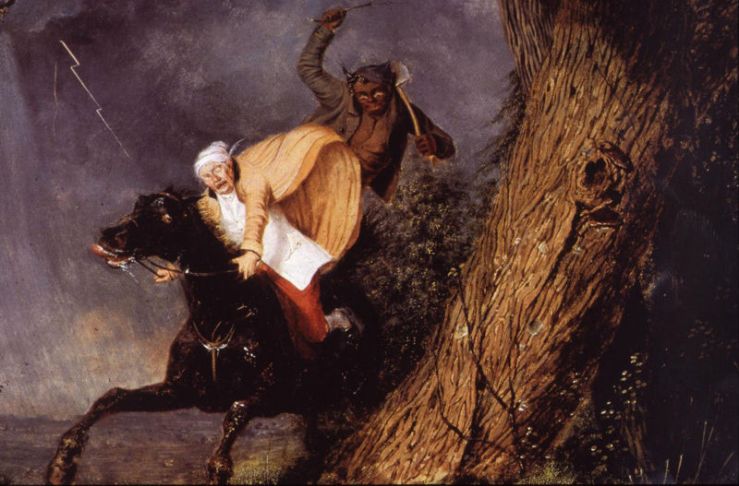
Washington Irving’s famous short story, “The Devil and Tom Walker,” seems as prescient and uncanny as ever in the lurid light of our recent financial woes:
Finding Tom so squeamish on this point, he did not insist upon it, but proposed instead that he should turn usurer; the devil being extremely anxious for the increase of usurers, looking upon them as his peculiar people.To this no objections were made, for it was just to Tom’s taste.“You shall open a broker’s shop in Boston next month,” said the black man.“I’ll do it to-morrow, if you wish,” said Tom Walker.“You shall lend money at two per cent. a month.”“Egad, I’ll charge four!” replied Tom Walker.“You shall extort bonds, foreclose mortgages, drive the merchant to bankruptcy—”“I’ll drive him to the d——l,” cried Tom Walker, eagerly.“You are the usurer for my money!” said the black legs, with delight. “When will you want the rhino?”“This very night.”“Done!” said the devil.“Done!” said Tom Walker. —So they shook hands, and struck a bargain.A few days’ time saw Tom Walker seated behind his desk in a counting house in Boston. His reputation for a ready moneyed man, who would lend money out for a good consideration, soon spread abroad. Every body remembers the days of Governor Belcher, when money was particularly scarce. It was a time of paper credit. The country had been deluged with government bills; the famous Land Bank had been established; there had been a rage for speculating; the people had run mad with schemes for new settlements; for building cities in the wilderness; land jobbers went about with maps of grants, and townships, and Eldorados, lying nobody knew where, but which every body was ready to purchase. In a word, the great speculating fever which breaks out every now and then in the country, had raged to an alarming degree, and every body was dreaming of making sudden fortunes from nothing. As usual the fever had subsided; the dream had gone off, and the imaginary fortunes with it; the patients were left in doleful plight, and the whole country resounded with the consequent cry of “hard times.”
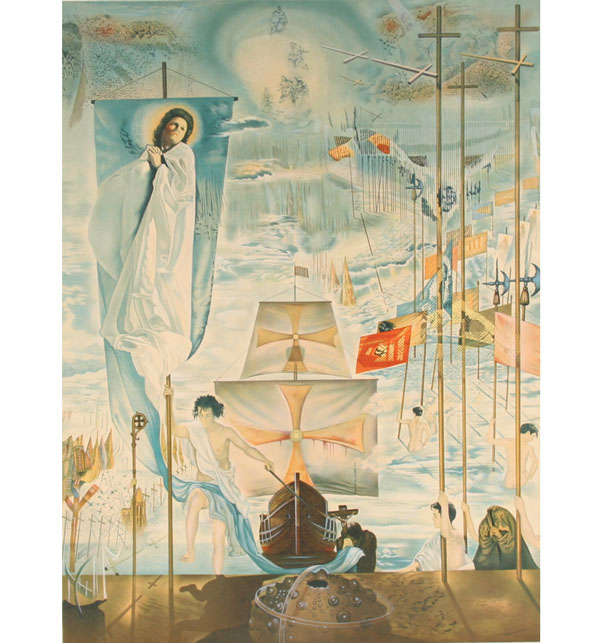
Salvador Dalí, The Discovery of America by Christopher Columbus, 1959, oil on canvas, 410 x 284 cm, St. Petersburg, Florida: Salvador Dalí Museum.
“Prayer of Columbus” by Walt Whitman
A batter’d, wreck’d old man,
Thrown on this savage shore, far, far from home,
Pent by the sea and dark rebellious brows, twelve dreary months,
Sore, stiff with many toils, sicken’d and nigh to death,
I take my way along the island’s edge,
Venting a heavy heart.
I am too full of woe!
Haply I may not live another day;
I cannot rest O God, I cannot eat or drink or sleep,
Till I put forth myself, my prayer, once more to Thee,
Breathe, bathe myself once more in Thee, commune with Thee,
Report myself once more to Thee.
Thou knowest my years entire, my life,
My long and crowded life of active work, not adoration merely;
Thou knowest the prayers and vigils of my youth,
Thou knowest my manhood’s solemn and visionary meditations,
Thou knowest how before I commenced I devoted all to come to Thee,
Thou knowest I have in age ratified all those vows and strictly kept them,
Thou knowest I have not once lost nor faith nor ecstasy in Thee,
In shackles, prison’d, in disgrace, repining not,
Accepting all from Thee, as duly come from Thee.
All my emprises have been fill’d with Thee,
My speculations, plans, begun and carried on in thoughts of Thee,
Sailing the deep or journeying the land for Thee;
Intentions, purports, aspirations mine, leaving results to Thee.
O I am sure they really came from Thee,
The urge, the ardor, the unconquerable will,
The potent, felt, interior command, stronger than words,
A message from the Heavens whispering to me even in sleep,
These sped me on.
By me and these the work so far accomplish’d,
By me earth’s elder cloy’d and stifled lands uncloy’d, unloos’d,
By me the hemispheres rounded and tied, the unknown to the known.
The end I know not, it is all in Thee,
Or small or great I know not–haply what broad fields, what lands,
Haply the brutish measureless human undergrowth I know,
Transplanted there may rise to stature, knowledge worthy Thee,
Haply the swords I know may there indeed be turn’d to reaping-tools,
Haply the lifeless cross I know, Europe’s dead cross, may bud and
blossom there.
One effort more, my altar this bleak sand;
That Thou O God my life hast lighted,
With ray of light, steady, ineffable, vouchsafed of Thee,
Light rare untellable, lighting the very light,
Beyond all signs, descriptions, languages;
For that O God, be it my latest word, here on my knees,
Old, poor, and paralyzed, I thank Thee.
My terminus near,
The clouds already closing in upon me,
The voyage balk’d, the course disputed, lost,
I yield my ships to Thee.
My hands, my limbs grow nerveless,
My brain feels rack’d, bewilder’d,
Let the old timbers part, I will not part,
I will cling fast to Thee, O God, though the waves buffet me,
Thee, Thee at least I know.
Is it the prophet’s thought I speak, or am I raving?
What do I know of life? what of myself?
I know not even my own work past or present,
Dim ever-shifting guesses of it spread before me,
Of newer better worlds, their mighty parturition,
Mocking, perplexing me.
And these things I see suddenly, what mean they?
As if some miracle, some hand divine unseal’d my eyes,
Shadowy vast shapes smile through the air and sky,
And on the distant waves sail countless ships,
And anthems in new tongues I hear saluting me.
Motoko Rich’s article “The Future of Reading,” published in today’s New York Times, discusses the emerging trend in publishing and education of reaching out to young readers via video games. According to the article–
Increasingly, authors, teachers, librarians and publishers are embracing this fast-paced, image-laden world in the hope that the games will draw children to reading. Spurred by arguments that video games also may teach a kind of digital literacy that is becoming as important as proficiency in print, libraries are hosting gaming tournaments, while schools are exploring how to incorporate video games in the classroom. In New York, the John D. and Catherine T. MacArthur Foundation is supporting efforts to create a proposed public school that will use principles of game design like instant feedback and graphic imagery to promote learning.
Loyal readers will recall that last year I wrote quite positively about the MacArthur grant to promote gaming literacy. However, the trend detailed in today’s article seems like a big step in the wrong direction. While graphic design and computer programming are vital skill sets we should be teaching our kids, trying to hook them on reading through video games is altogether different. It smacks of cheap gimmickry that dismisses outright that reading might be a pleasure unto itself. In an age when the majority of college students can’t handle complex but necessary reading tasks and high school illiteracy rates are woefully underreported, trying to hook kids on books with Dance Dance Revolution just doesn’t seem like a great plan. If anything, it’s yet another step in the dumbing-down of America, a land increasingly hostile to anything with a hint of intellectualism–reading included. No wonder the Nobel Committee are such dicks to the U.S. Buried at the end of the article, luckily, is a voice of reason–
“I actually think reading is pretty great and can compete with video games easily,” said Mark S. Seidenberg, a professor at the University of Wisconsin in Madison who specializes in reading research. “So rather than say, ‘Oh, books are irrelevant in the modern era because there are all these other media available,’ I would ask shouldn’t we be doing a better job of teaching kids how to read?”
Professor Seidenberg seems like a wise and reasonable man. Let’s hope that we can get this country back on track and realize that the skill sets needed to survive and compete in a technological world do not replace but rather augment traditional literacy. Video games are great entertainment but it’s hard to imagine that they could ever trump the depth and breadth of philosophy and cultural currency contained in literature. Let’s not cheat our children out of that heritage by mistakenly believing that they cannot be taught to access it.

 When he wasn’t busy drinking himself to death, Dylan Thomas wrote some pretty awesome poems and stories, and the Welshman had quite the knack for reading them aloud. Check out his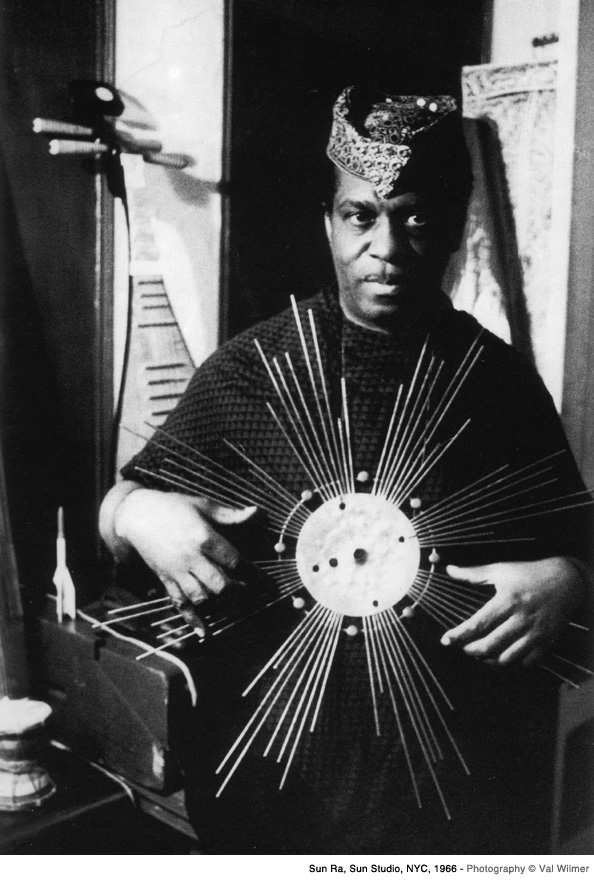






 Biblioklept